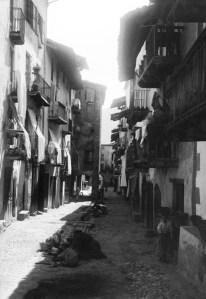
- Madrid
On 14 November 1936, the Casa de Campo was a apocalyptic landscape. The battlefield was choked with dense fog, smoke from constant artillery, and piles of unburied corpses from the previous week’s intense fighting. While the day is historically framed as a tactical lull or preparation phase just before the Battle of University City began, fierce attrition occurred.
The Republicans held a crescent-shaped defensive line anchoring the eastern, lower-elevation half of the park, pinned against the Manzanares River. Hold the crossing points over the river at the Puente del Rey and the Puente de los Franceses to block the invaders from accessing the city proper. But the Republicans were completely exposed to direct-sight observation and plunging fire from the Cerro de Garabitas which the enemy held.
Because both sides were heavily disorganised, but the Nationalists had about 5,000–6,000 men active in the sector, Asensio’s Column supported tightly on their flanks by Castejón’s Column. The sector was heavily saturated with Republican forces but fragmented, with approximately 8,000–10,000 men in the sector, with the Líster Column holding vital defensive chokepoints, and took the brunt of the heavy artillery shelling on 14 November. They spent the daylight hours pinned down under severe bombardment but successfully held their trenches, preventing any enemy breakthroughs. The Barceló Column operating on the flanks of the park, remnants and militia detachments of the Mangada Colum holding specific tactical sectors, aiding the Galán Column, who anchored defensive sectors near the river boundaries near University City and reinforced in trenches and brick outbuildings, successfully blocking enemy scouts from securing easy approaches to the Puente de los Franceses.
Because the centre and right units (Líster and Mangada) were severely depleted and physically exhausted from days of nonstop fighting, the command used the cover of darkness on 14 November to cycle them out. The 3,000 fighters of the Durruti Column moved into the central trenches of the Casa de Campo. The anarchists found the positions heavily damaged by the day’s shelling. Durruti’s men spent the final hours of 14 November rebuilding sandbag barricades, establishing ammo caches, and setting up machine-gun nests to prepare for the planned counter-offensive.
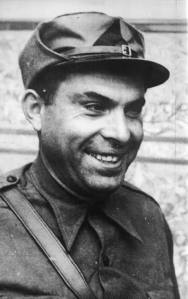
On 14 November 1936, the entry of Buenaventura Durruti and his column into Madrid was a major turning point for the city’s psychological defence, marked by immediate strategic disagreements. Durruti arrived in Madrid by train with a force of roughly 3,000 anarchist militia fighters from the Aragon front, and the arrival was met with massive public fanfare, acting as a powerful morale boost for a civilian population that feared the city was on the verge of falling to Nationalist forces.
Upon arrival, Durruti met immediately with General José Miaja and General Sebastián Pozas of the Madrid Defence Council. Miaja wanted to use the fresh Durruti Column as a strategic reserve to plug gaps in the battered lines or deploy them defensively. Durruti fiercely resisted this, demanding an independent sector of the front where his men could launch an immediate offensive strike against the Nationalists. Durruti ultimately won the argument and his column was assigned to the Casa de Campo sector on the western edge of the city. They were ordered to relieve exhausted Republican units and prepare a direct counter-attack to push General Francisco Franco’s forces back across the Manzanares River.

The defence of Sector 4 (the South) was fiercely managed by the Martínez de Aragón Column of roughly 3,500 to 4,000 men held the core defensive grid of the southern suburbs. What made the southern flank extraordinarily resilient on November 14 was the massive influx of local civilians. Off-duty factory workers, trade unionists (UGT and CNT), and neighbourhood residents fought right outside their own front doors. Because they knew every alleyway, back door, and sewer line, they successfully outmanoeuvred the invaders trying to slip through the streets. Enrique Líster’s 1st Mixed Brigade anchored the boundary line where the south of the Casa de Campo met the northern edge of Carabanchel, ensuring the fascists could not sweep downward to cut off the southern defences.
Unlike the open terrain of the Casa de Campo, the southern front was a dense labyrinth of narrow streets, industrial factories, and working-class tenements. On 14 November, fighting was literally conducted from room to room, floor to floor, and basement to basement. The fascist forces under Colonel Heli Rolando de Tella and Colonel Eduardo Barrón had pushed into parts of Carabanchel Bajo but were entirely bottlenecked. Republican forces used the architecture to their advantage, transforming the historic gateways and blockaded street intersections into a wall the invaders could not breach.
The Puente de Toledo served as a major artery. The Republican forces had dug a complex network of deep trenches on both banks of the Manzanares River flanking the bridge.
Despite the ongoing combat just blocks away, the Republicans successfully held the bridge head securely enough that civilian shepherds were actually photographed herding livestock across the Puente de Toledo to secure the food supply for central Madrid. By the end of 14 November, the southern flank had achieved its primary objective. The Republican neighborhood defenders completely neutralised the fascist attempt to break through from the south, forcing the enemy to accept that any future decisive breakthrough attempt would have to be redirected entirely toward University City to the north.
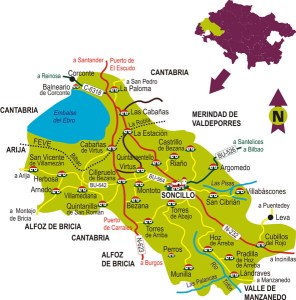
- Argomedo, Las Merindades, Burgos
Of the many atrocities committed and hidden away, most have the benefit of even just one witness, even if they had to wait decades to speak out, a sign of a burial site, steps of a process that left hints of what happened. The village of Argomedo, which was so small it did not even get census details, is part of the Valle de Valdebezana region, which itself only had 4,000 residents from a group of 20 towns that was brought together as one population in 1930. (Today, Argomedo has around 25 locals and is marked as a ghost town). Thirteen of the local towns would vote Republican, the rest Nationalist, a tiny pocket of agrarian region that had attempted Republican reform against wall-to-wall Nationalist pressure in every direction. Argomedo even had a candidate who promised to build a whole secular school.
Valle de Valdebezana in the Las Merindades region had already been suffering horrific repression, Under Nationalist control since day one of the uprising, those who could not escape over the La Maza range into Santander were in danger. This small area has been covered many times already, with violence of fighting and capture, towns being swamped and targeted by soldiers, or innocents being taken away and murdered, and towns suffering heavy repression among small populations, plus detention centres being set up and violent, cruel punishments to solve personal grudges in the region. Now it was tiny Argomedo’s turn.
The hamlet lies by the Nela River in the upper valley, 3km outside Soncillo, the local municipal centre of the region, along the old Bilbao–Reinosa road, near San Martín de Las Ollas, Castrillo de Bezana, and San Cibrián. The La Maza mountain range looms large and the area would be home to violence and repression for another year to come. The La Maza de Bezana, which sits 1,165 metres above sea level is claimed to have a ‘void of ignorance’ surrounding the multitude of events that happening during the war. In May 1936, Soncillo hosted a small May Day celebration for the workers. Their new council was impressive for a small population looking to reform – Saturnino Ruiz García, Eusebio Ibáñez Fernández, José Peña Ruiz, and Bernabé González Gallo all for the Sindicato de Obreros Agrícolas (Agricultural Workers’ Union), plus Martín Díez García and Jesús Díez Díez for Izquierda Republicana, Aquilino Cimarras Mangas and Herminio Ruiz Sainz for Partido Comunista, and José Varela Gil for Partido Socialista.
But the new vision for the future was not going to last. Herminio Ruiz Sainz and José Varela Gil were soon assassinated. The repression, of violent overthrows by Falangists and Requetés in the region began, makeshift prisons went up through the valley, with October being a peak time for killings. The details is incredibly obscure in Argomeda; a group of locals, plus a man from nearby, up to a dozen of them, were all taken to the council building, which was now a prison. Between this group and the men who took them, a member of the Guardia Civil and local Falangists, this would have made up a sizeable portion of the area. It is not even known when these people were taken, but it was all at the same time. It is not known how many there were, or what happened at the hall. It is believed that were ‘disappeared’ to Valdenoceda, 30km south, where there was a prison, but no one from Argomedo was registered as a prisoner there. A rumour abounded they were beaten to death and thrown on the Ebro River. Another suggested they were thrown in the river and shot at, and those who managed to float away may have escaped or been killed once they got ashore.
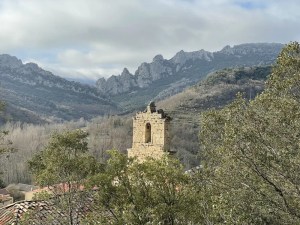
These rumours came from somewhere, but where? The mystery remains even now. No relative has stepped forward to even say someone in their family disappeared. Only a week earlier on 3 November, had been the massacre of the Simas of Ojo Guareña, when residents of Villamartín de Sotoscueva were thrown, or shot backwards into, the enormous caverns outside the town. This was happening only 15km away from Argomedo, at almost the same time, in the exact same terrain. Rather than creating formal public burial sites, the executioners strategically weaponised the unique, rugged geography of northern Burgos to make people vanish. Whether it was using the heavy currents of the Ebro River or dropping bodies into the 110-kilometre subterranean labyrinth of Ojo Guareña, the goal was exactly the same, to enforce absolute terror while leaving behind no physical graves for families to mourn. There are simply no mass grave sites to identify. It is entirely possible that the men who murdered people at Villamartin were the same men hunting in Argomedo.
Witnesses are near impossible to come by. neighbours of the council building heard sounds of men being beaten, which was on an extreme level of torture. How many nights this continued remains unknown, but then one night the sounds of people were suddenly gone. Reports of the men being dumped in the Ebro, which was only a few kilometres away came later, whether from someone who saw, or boasting or deathbed confessions by those who did it, remains unclear. They may have been dumped already dead; there were no reports of gunshot sounds on any of the nights between 6-14 November when they men ‘disappeared.’ They may have never made it as far as the Ebro.
What is known is that seven men are believed dead, but 12 went into the council building under arrest. All were from Argomedo, though one was living in Castrillo de Bezana 5km away (by today’s standard, these towns are like wide green suburbs more or less bordering on each other). The victims are all related, and all voted for the same man, Eliseo Cuadrao, who had promised a local school.
Before the bulk ‘disappearances,’ Ángel Fernández Fernández, 29 years old, a resident of Argomedo, was taken away on a paseo on 14 October 1936. He had 5 children, and his wife was pregnant with their sixth. Then came the ‘disappearances’ of his brothers –
Rufino Fernández Fernández, unmarried, a resident Argomedo, who has an unknown arrest and ‘disappeared’ date, but is known to have been in the council building.
Vicente Fernández Fernández, 42 years old, was arrested at his home in Castrillo on an unknown date by the Guardia Civil from Soncillo and held in the Argomedo council building; he ‘disappeared’ on 14 November 1936.
Víctor Fernández Fernández, a married father of Argomedo was taken on a paseo on 9 November 1936. Rumour has it he died in the council building and was dumped outside the village. Nothing has been found.
Then there is what appears to be their uncle and two cousins –
Felipe Fernández González, 57 years old, married, of Argomedo, who was taken on a paseo in Soncillo on 6 November 1936.
Modesto Fernández Ruiz, 36 years old, a married father of three of Argomedo, was taken on a paseo on 12 November 1936.
Bonifacio Fernández Ruiz, 28 years old, single aof Argomedo, on an unknown date, was arrested at the council building, possibly looking for his father and brother.
Genaro López López, 52 years old, appears unrelated to the group, was a married farmer of Argomedo, and is only known to have been arrested and ‘disappeared’ in autumn 1936.
None of these men have ever been found. Because these were paseados, legally and bureaucratically, these men simply vanished off the face of the earth. If a widow spoke out or asked questions, she risked losing her property, her rationing card, or exposing her surviving children to state retaliation. The family line was effectively wiped out. Surviving women often fled or went into exile to survive, so there was no one left in the village to pass down the names to the next generation of local researchers. It is also possible the unknown men in the council building were day labourers and could have been from out of town/area, meaning no one knew their official names. The population of Argomedo, like much of the rural Valle de Valdebezana, suffered a catastrophic decline from which it never truly recovered. The removal of a dozen able-bodied men broke the agricultural backbone of the village overnight.
The investigation into the Argomedo case and the wider Francoist repression in the Valle de Valdebezana is handled primarily by local, volunteer-led memory collectives and grassroots historical associations. Because the victims were thrown into a river or chasms, meaning there is no traditional mass grave to excavate, the work today focuses on historical tracking and archival recovery. Las Merindades en la Memoria is collective of local historians and relatives of the victims who have spent years interviewing elderly survivors in the valley to map out the exact timeline of the November 1936 massacre. They actively run a digital archive to cross-reference fragmented family trees from the Valle de Valdebezana. Whenever a relative steps forward, they add missing names to the collective registry to try to complete the list of the 12 victims here, or elsewhere in the valley.
The national Association for the Recovery of Historical Memory also supports local Burgos groups with structural resources. The ARMH assists local researchers by providing access to broader military, civil guard, and ecclesiastical archives that regional volunteers cannot easily access. For cases like Argomedo where bodies were thrown into the Ebro River or local chasms, physical exhumation is rarely an option. Instead, the ARMH logs genetic data from living descendants. This helps identify victims if any scattered remains are found nearby, or if records surface indicating that bodies washed up downstream and were buried anonymously in village cemeteries.
Coordinadora Provincial por la Recuperación de la Memoria Histórica de Burgos is an umbrella organsation coordinates all active memory groups across the province of Burgos. They focus heavily on educational outreach and ensuring the casa concejo (the town hall where the victims were tortured) and surrounding sites are officially recognised as locations of historical trauma. The issue is that the council building was torn down and replaced with a standard one-level building, destroying all evidence. Through these associations’ persistent tracking, other victims from the immediate area have recently been successfully identified via DNA analysis and returned to local cemeteries, keeping the pressure on to solve the remaining mysteries of the Valdebezana valley, which now has a population of around 450 for all the towns.
- Oliete, Teruel, Aragon
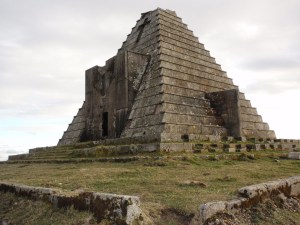
On 14 November 1936, a targeted mass execution took place in the small municipality of Oliete, Teruel, resulting in the deaths of eight local men. The event was part of a larger wave of violence that swept through the locality as the province remained a heavily contested front line. Oliete fell under the control of Republican militias and local revolutionary committees and repression against the landowners, clergy and local conservatives continued. Between August 1936 and May 1937, a total of 18 people from Oliete were killed in extrajudicial executions. The single deadliest day of this local purge occurred on 14 November 1936, when eight men were rounded up and executed by Republican factions.
Local revolutionary committees or mobile militia columns operating in the area conducted quick, neighbourhood-level roundups. Individuals suspected of holding right-wing or religious sympathies were taken directly from their homes or farms and shot in nearby fields, ravines, or roadsides. Because the front lines in Teruel were fluid and heavily militarised, individuals were frequently intercepted at rural checkpoints. If they lacked the proper revolutionary transit papers or were recognised by local informants, they were executed on the spot along that specific stretch of road.
Some of the victims could have been taken from their homes, but never imprisoned before being sent to the roadsides and murdered. Despite this incredibly randomised execution style, all 18 men who were executed in the town between August 1936 and May 1937 had to be meticulously found after the war, and reinterred in a small mausoleum made in the town for all those who died of Republican repression. But the eight men of 14 November 1936 were deliberately left off the plaque made by Francoist authorities, but the other ten were all included.
These men were were categorised them as Mártires de la Cruzada (Martyrs of the Crusade). The regime institutionalised the grave, erecting a large commemorative cross and plaque dedicated to those who had Fell for God and Spain. While the regime weaponised the grave as a political symbol, the individual names of the eight men executed on 14 November 1936 were notably absent from the primary commemorative inscriptions. Their individual identities were secondary to their utility as anonymous symbols of Nationalist martyrdom.
For decades, the site remained a highly partisan monument. In recent years, regional memory collectives like the Asociación de Pozos de Caudé and the Asociación para la Recuperación e Investigación Contra el Olvido (ARICO) have worked to de-politicise the cemetery space. A new, inclusive plaque was established to restore the actual names of the dead in Oliete who lost their lives to the war, regardless of faction. The eight men who died on 14 November 1936 were – Antonio Burillo, 31, Celestino Candial Cotaina, José Lázaro Giménez, 58,Angel Oliete, 33,Pedro José Royo Calzada, 66, Antolín Santiago, 48,Emilio Santiago, 42, and José Santiago, 61.
- Tolosa, Gipuzkoa, Basque Country
On 13 November 1936, a group of prisoners held at the Tolosa prison was ordered to be transferred to the Ondarreta Prison in San Sebastián-Donostia on 14 November 1936. Between 14 and 18 November 1936, 19 of those 25 prisoners were systematically taken from Ondarreta Prison and executed. The death squads executed the 19 prisoners at various regional execution points, primarily in Bera (Vera de Bidasoa), Oiartzun (Oyarzun) and Tolosa, forming part of the Caravana de la muerte (Caravan of Death) in Gipuzkoa, and marked as released or transferred while being dumped in multiple locations, so no one would ever find a dedicated Tolosa ‘transfer’ grave.
From Amasa-Villabona, Cipriano Cardenal Galdós, 19, Daniel Arrillaga Urcola, Juan Echenique Landa, Maximino Erostarbe Berasategui, and Adrián Quintana Arenas were taken and shot at a makeshift execution site near a quarry in Bera. They were working-class men and trade unionists killed on 15 November 1936. Approximately 130 people were dumped at the Bera quarry.
Witness have been able to named Carlists and Falangists as the killers of the men, and four people came forward as witnesses to the events, and a quarry works sae the trucks and firsiging squads in November 1936. Locals in the towns were forced to bury the bodies, and that was how Nicolás Guerendiain, mayor of Irún was killed at the site (a witness identified a Melitón Manzanas as the killer). A local tenor, Isidoro Fagoaga, could hear executions from his home, and had a nervous breakdown.
Bera was home a famous Spanish family; artist Ricardo Baroja y Nessi, his brother the writer Pío Baroja y Nessi, and their sister, writer/ethnologist Carmen Baroja y Nessi (and her children anthropologist Julio Caro Baroja and director/screenwriter Pío Caro Baroja). Pío and Carmen both stood as witnesses to the killings, and Ricardo Baroja completed 70 artworks on the war, including the executions of Bera.
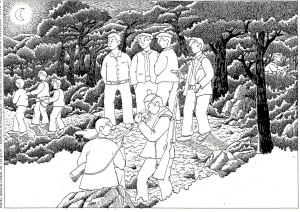
Félix Goya Urbieta was another signed off for release on 14 November 1936. From Eulate in Navarra, the town was taken over immediately after the uprising, and Goya was arrested on 23 July, and taken to Pamplona, but was part of a group of men taken out to the moutnains outside the city to be executed. A group managed to escape, Goya among them, despite being shot. He hid out in Larragoa with a friend, eventually turning himself in, and returned home under house arrest, only for the whole family to be exiled from Eulate in August. Goya and his wife, and six children had to travel on foot to Hernani in the Basque Country for safety. But as they walked to ‘safety’ they were stopped in Tolosa, and seen by the same men who had first arrested Goya. He was placed in Tolosa prison, and and sent his wife a postcard saying he was being transferred on 14 November. In the early hours of 15 November 1936, he was executed in Oiartzun along the isolated, mountainous road leading to Artikutza. His wife spent decades fighting to prove her husband was dead and reclaiming their confiscated home. She had to send several children away because she could not longer feed them and one died of illness. The grandchildren of Goya remains committed to finding his burial site.
Killed along this same stretch of road were Manuel Insausti Lardizabal, Angel Otaegi Insausti, and Rufino Garmendia Iartza. None have been found.
Some of the men ‘transferred’ on 14 November were were executed at Hernani cemetery – Constantino Iglesias Ortiz, Blas Rubio Peña, José María Pérez Irazusta, Antonio Echeverria Ayestarán, Vicente Argote Gaviriam and Faustino Luloaga Echeverria.
Lorenzo Zabala Ríos (also known as Pedro Ríos Puentevilla), Joaquín Lascurain Otaegui, Martín José Alberdi Michelena, José Manuel Goikoetxea Asurabarrena, and Angel Otaegi Insausti were all killed around Tolosa cemetery. None have not been identified.
- Ponts, Lleida, Catalonia
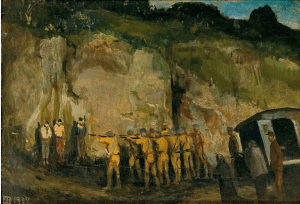
On the morning of 14 November 1936, a commercial bus travelled south, carrying seven men from the prison at La Seu d’Urgell. Just under 2km short of the town of Ponts, at a roadside clearing known as Costa Blanca, the vehicle pulled over. The passengers were marched into the brush and executed by firing squad.
Among the seven victims, only one identity has been preserved by history. Alfons Callén i Cagigós was the 75-year-old priest and rector of the nearby village of Organyà. Seeking safety during the uprising, Callén went into hiding in the remote hamlet of Escales (Fígols). His sanctuary was short-lived; discovered by militiamen, he was arrested and transferred to the makeshift prison facility at La Seu d’Urgell. On the morning of 14 November 1936, he was selected for transfer alongside six fellow inmates. The identities of those six men, believed to be local residents or political dissidents held in the same jail, remain lost to history, omitted from surviving public registries.
Following the executions, the bodies were hastily buried in a communal pit directly adjacent to the the modern-day C-14 highway. Unlike many Nationalist victims of wartime violence whose remains were systematically exhumed by the Francoist regime in the 1940s and 1950s for reburial or transfer , the Costa Blanca grave was bypassed. No official recovery efforts were ever made, leaving the seven men at the unmarked site. Today, the Costa Blanca site is officially designated by the Generalitat de Catalunya’s Democratic Memory project as a lost or unexcavated mass grave.
Over nine decades, the C-14 highway has undergone extensive widening, paving, and infrastructure upgrades. Experts believe the layer of earth holding the remains has either been paved over by modern asphalt or significantly disrupted by heavy machinery. The names of Alfons Callén and his anonymous companions remain inscribed in the digital annals of the Banc de la Memòria Democràtica, serving as the only monument to the event.