- Madrid
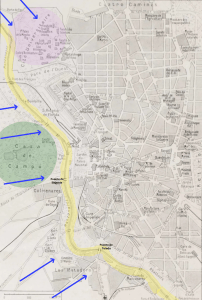
On November 7, 1936, the battle for Madrid reached its first major crisis as the Nationalist approach march was ready to make a direct assault on the capital’s immediate perimeter. General José Enrique Varela directed columns of the Army of Africa toward the western and north-western edges of Madrid and moved moved heavily into the Casa de Campo, the vast former royal hunting ground directly west of the Manzanares River. Republican militias, Carabineros, and assault guards scrambled to retreat from the outlying towns and occupy newly dug trenches, barricades, and buildings along the eastern bank of the Manzanares River.
Savage, often disorganised fighting erupted inside the woods and open spaces of the Casa de Campo as Nationalist scouts and forward columns collided with entrenched Republican militia lines while Nationalist forces subjected the city centre and defensive lines to intense artillery shelling and aerial bombing by the German Condor Legion to demoralise the defenders. But Republican forces successfully held the key bridges, the Puente de Toledo and Puente de Segovia, preventing Nationalist cavalry and armor from crossing the river into the city proper.
General Francisco Franco’s objective was a swift, decisive breakthrough now take the city now devoid of the country’s leadership. Varela intended to seize the Casa de Campo, cross the Manzanares River, push through Ciudad Universitaria, and capture the city before the Republicans could organise a coherent defence. meanwhile, Republican General José Miaja and his chief of staff, Vicente Rojo, aimed to hold the river line at all costs. Their objective was to delay the Nationalist advance long enough to turn Madrid into a fortress and wait for reinforcements.
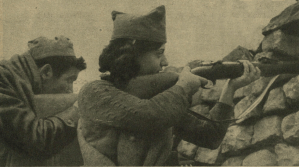
Because the regular military command had largely fractured, the militias and the newly formed Junta de Defensa lacked standardised military map sets. Commanders and militia leaders were literally using commercial pocket street maps, standard city directories, and tourist guides purchased from local kiosks to coordinate troop movements. They heavily relied on the standard Callejero (the commercial street-by-street atlas of the city) to identify buildings, intersections, and factories to fortify. What they lacked in cartographic precision, they made up for in native knowledge. The defenders were locals; they knew the shortcuts, the alleyways, the structural layout of the university buildings, and the terrain of the Casa de Campo intuitively without needing a map.
The Nationalists had better military organisation, but their maps for the assault on Madrid were notoriously flawed. The Nationalists were relying on older topographic maps from the Instituto Geográfico y Catastral. These maps were highly accurate for rural terrain but completely failed to account for Madrid’s massive urban expansion during the late 1920s and early 1930s. Because their maps did not show newly built worker suburbs, apartment blocks, or the exact layout of the recently constructed University City, Nationalist columns frequently advanced into funnel-like bottlenecks and urban dead-ends where they were ambushed by hidden Republican positions.
This widespread lack of quality mapping is exactly why the map found on the dead Nationalist officer, was such a massive prize for the Republicans. A pivotal outcome occurred when a Republican patrol found a copy of Varela’s exact attack plans on the body of a dead Nationalist officer in a disabled tank. The incident involved a Nationalist tank commander, Captain Francisco Castejón (some sources note him as an officer in a tank crew under Colonel Carlos Asensio Cabanillas). His Italian-supplied Ansaldo tank was knocked out or disabled during the heavy fighting in the Casa de Campo. When Republican militia forces searched the disabled vehicle and the bodies of the crew, they found Varela’s exact operational order for the assault on Madrid. It was not a standard map of Madrid; it was a topographical staff map overlaid with hand-drawn, precise operational vectors created by General Varela’s staff. It explicitly marked out the Nationalists’ own calculated paths of least resistance, their planned artillery coordinates, and their exact staging zones within the Casa de Campo.
The map and attached documents revealed three critical secrets – that the primary Nationalist attack was not coming from the south (where the Republicans had heavily reinforced), but from the west and northwest through the Casa de Campo and University City, that the movements in the south near the Carabanchel sector were just a feint to draw defenders away, and that the full-scale, coordinated assault was scheduled to launch the very next morning, 8 November. Republican Chief of Staff Vicente Rojo used this literal cheat sheet to immediately shift his sparse reserves, anti-tank guns, and artillery to the University City sector overnight. When the Nationalists launched their main assault the next day, they marched directly into a heavily reinforced brick wall instead of an exposed flank. For Vicente Rojo, a highly trained regular army strategist, getting his hands on an enemy staff map when his own men were using tourist guides was the ultimate tactical lifeline.
By the end of the day, the Nationalists successfully captured most of the Casa de Campo and reached the banks of the Manzanares River, positioning themselves for a direct assault on the city. But the Republican lines did not collapse as Franco expected. The defence held the river crossings, proving that Madrid would not fall without a brutal, street-by-street fight. The people of Madrid had gone to the fringes of their city and personally cut in trenches to mount a defence against an entire army.
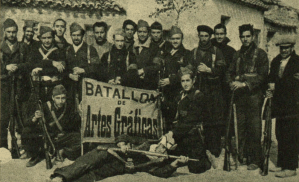
The Batallón de Artes Gráficas (Graphic Arts Battalion) was a specialised socialist trade union militia made up primarily of printers, typesetters, and bookbinders from Madrid. On 7 November, 1936, they were stationed in the western suburbs and the immediate perimeter of Madrid, scrambling to dig trenches and erect barricades to halt General Varela’s vanguard. Organised through the Inspección General de Milicias and socialist trade union networks, the battalion was part of a sudden wave of professional and trade-based trade union units, joining barbers, street sweepers, and metalworkers, who were rushed straight from their workshops to the front lines. They were deployed to reinforce the vital choke points protecting the city from the western advance coming through the Casa de Campo. They manned makeshift lines and trenches in the brick-and-mortar outskirts of the city to prevent the Army of Africa from breaking into the urban centre.
Later in the war (April 1937), as the chaotic trade union militias were formally integrated into the regular Republican army, the Batallón de Artes Gráficas was designated as the 445th Battalion. It merged with various El Socialista battalions to form the 112th Mixed Brigade (112.ª Brigada Mixta), which went on to defend the sector running from La Zarzuela to the San Fernando Bridge.
The XI International Brigade, commanded by Soviet General Kléber (Manfred Stern), spent 7 November traveling toward the capital. The brigade’s approximately 2,000 volunteers, comprising the German-Austrian Edgar André, the French-Belgian Commune de Paris, and the Polish-Balkan Dąbrowski battalions, spent the day packed into trains and trucks traveling from their training bases northward. They did not pull into Madrid’s Vallecas railway station until late that night and the early morning hours of 8 November.
Concurrently, the XII International Brigade (known as the Garibaldi Brigade) was formally mustered and organised at the central International Brigades headquarters in Albacete on 7 November. While the XI Brigade was rushing to the front lines, the XII Brigade, consisting of Italian, French, Belgian, and German anti-fascists, was still assembling, short on rifles, and undergoing basic training hundreds of kilometres away from the fighting. They would not arrive to reinforce Madrid until November 12–13.
- Paracuellos de Jarama, Madrid
Fearing that thousands of political and military prisoners held in the capital would form a fifth column to sabotage defences from within, the Republican authorities ordered prison massive evacuations. Instead of being relocated to safe zones, prisoners were removed in organised sacas. They were loaded onto buses and trucks under the false pretense of being transferred or freed. Convoys from Madrid’s Cárcel Modelo, Porlier, and San Antón prisons were diverted 25km away to fields in Paracuellos de Jarama, where they were shot before dawn and buried in mass graves. The following day, the operations expanded to Soto de Aldovea in Torrejón de Ardoz, where further mass executions took place.
Mariano Valenciano Herranz, a prison officer at Cárcel Modelo, secretly compiled a list of 967 victims from that single prison during the initial days, smuggling the document to foreign embassies. Only about 500 of the victims were active military personnel. The vast majority were civilians, including conservative politicians, Catholic priests, falangists, and intellectuals. The thousands of prisoners held in these institutions like Cárcel Modelo and San Antón would undoubtedly have joined the Nationalist administration. However, because they were securely locked behind bars, they had no immediate tactical way to break out or assist the invading forces on their own, and there was never any evidence otherwise. Underground Nationalist networks did exist in Madrid. They operated clandestine radio transmitters, passed intelligence to Franco’s forces, smuggled targets into foreign embassies, and occasionally engaged in sniping or sabotage, none of which was happening in prisons.
While right-wing or Francoist publications historically claimed up to 12,000 casualties, consensus among modern historians (such as Antony Beevor, Julián Casanova, and Julius Ruiz) places the true death toll between 2,000 and 3,000 victims.
The systematic killings were temporarily halted on 9–10 November when the anarchist Melchor Rodríguez García was appointed Prison Inspector. Appalled by the violence, he refused to permit further sacas until he was briefly pressured out of office mid-month. Some analyses suggest that with Nationalist troops actively entering the western suburbs (like the Casa de Campo), the Republican defense lines were incredibly thin. Moving or neutralising potential enemies was seen by hardliners as a brutal but necessary step to prevent a prison breakout that could overwhelm the rear guard. Historian Julius Ruiz argues that the Paracuellos massacres were not a spontaneous panic, but a systematic policy orchestrated by the newly formed Public Order Committee (Junta de Defensa de Madrid). Ruiz argues that the threat was deliberately exaggerated by authorities to justify the elimination of ideological opponents under the guise of wartime necessity. Rather than securing the city, historians note that the massacres severely damaged the Republic’s international reputation. When foreign diplomats (such as the British Ambassador and the Norwegian Chargé d’Affaires) discovered the killings, it alienated democratic nations whose support the Republic desperately needed to counter German and Italian intervention.
Removing the prisoners did nothing to quiet the fear of hidden enemies. Because the fifth column was defined as an invisible, civilian threat, the Republican security apparatus simply shifted its focus from organised prisoners to the general population. Neighbours routinely denounced one another to local checas (unofficial leftist tribunals) to settle personal scores under the guise of uncovering Francoist spies. Invaluable military personnel and equipment that should have been on the front lines defending against the Nationalist advance were instead diverted to police the city’s residents, hunting for phantom saboteurs.
The massacres gave General Franco a massive propaganda victory. The Nationalist media weaponised the killings to convince his troops and conservative Spaniards that they were fighting a holy war against barbarism. It solidified the Nationalist resolve, making any hope of a negotiated peace impossible. Killing defenceless people under state custody crossed a line that deeply damaged the Republic. It directly led to the intervention of Melchor Rodríguez García (the anarchist appointed to run the prisons), who famously argued:
‘You can die for an idea, but you should never kill for one.’ Rodríguez recognised that by copying the brutal tactics of their fascist enemies, the Republic was losing the very moral authority it needed to win international support. His intervention proved that even in the absolute height of wartime panic, maintaining legal order was both morally correct and strategically smarter.
Rodríguez was a staunch anarchist, former bullfighter, and member of the CNT, halted the Paracuellos massacres is one of the most remarkable logistical and moral interventions of the Spanish Civil War. Dubbed the El Ángel Rojo by the Nationalist prisoners he protected, Rodríguez used strict bureaucratic control, personal physical courage, and political leverage to dismantle the system of executions. Rodríguez issued a strict decree that no prisoner could be released or transferred between 6:00pm and 8:00am, regardless of any paperwork presented. He stripped power from the radical, partisan political militias who had embedded themselves as guards inside institutions like Cárcel Modelo and San Antón. He returned total administrative authority back to professional, pre-war prison officials who answered directly to him. He decreed that no prisoner could be removed from any Madrid facility without his explicit, personal signature. This immediately jammed the parallel, illegal command pipeline operated by the communist-led Public Order Committee (Junta de Defensa de Madrid).
Rodríguez repeatedly risked his life by physically placing himself between armed militias and the prisoners. The most famous display of this happened outside Alcalá de Henares prison. Following a brutal Nationalist aerial bombardment of the town, an enraged, armed mob of civilians and milicianos stormed the prison, demanding the immediate hand-over of all 1,532 right-wing inmates to be lynched. Rodríguez drove to the prison, jumped onto a table to address the hostile crowd, and fought verbally for hours. When the crowd threatened to shoot him, he famously shouted that he would arm the prisoners themselves and die fighting alongside them before he would let a mob break the law. His sheer force of will successfully dispersed the crowd without a single casualty.
The sacas were kept alive by an intricate web of unofficial checas run by radical factions, most notably the Communist PCE. Rodríguez conducted surprise inspections, gathered evidence, and publicly exposed that José Cazorla (the communist state security director who succeeded Santiago Carrillo) was operating a network of illegal prisons. Rodríguez leaked this information to the anarchist press (Solidaridad Obrera), causing a massive political scandal within the Popular Front government. The exposure was so severe that Prime Minister Largo Caballero ultimately dissolved the communist-controlled Madrid Defence Council. Rodríguez’s ultimate weapon was his unwavering adherence to anarchist morality. Hardline communists and socialists accused him of protecting fascists and helping the fifth column. He countered them by asserting that the Republic would lose the war ideologically if it abandoned human rights.
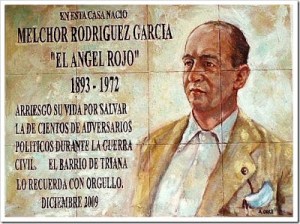
The 9 November decree stopping sacas only temporarily stopped the killings. But on 14 November, under intense pressure from communist officials, Rodríguez resigns. The executions immediately resume. on 4–5 December, he is re-appointed with expanded powers and the Paracuellos executions stop permanently. By asserting total administrative sovereignty over the prison gates, Rodríguez saved thousands of political prisoners, including future high-ranking post-war figures like Ramón Serrano Súñer and Rafael Sánchez Mazas (which unfortunately unleashed their own brand of evil on the country). When Madrid fell, many of the fascists he saved actually stepped forward to defend him at Rodríguez own court-martial.
In December 1939, 414 bodies were officially exhumed from the mass graves at Soto de Aldovea and moved to their primary memorial site, the Cemetery of the Martyrs of Paracuellos. The primary execution fields were converted into the Cementerio de los Mártires de Paracuellos, which contains distinct, massive trenches turned into mass graves. Families of the missing prisoners filed thousands of official testimonies stating exactly when their loved ones disappeared from custody, but Francoist investigators deliberately inflated their numbers for propaganda purposes. The Causa General database frequently listed the same victim multiple times under slightly different name spellings. Investigators counted individuals who had actually survived the war or were legitimately released later in 1937.
The regime included bodies of Nationalist soldiers who died in combat during the Siege of Madrid, burying them alongside the massacre victims to make the atrocity look larger.
The Franco regime heavily memorialised Paracuellos after 1939 to legitimise its own dictatorship, turning the site into a massive political symbol while actively suppressing any public mention or excavation of the much larger number of mass graves containing Republican victims. The memorial site was now dominated by a massive white cross painted onto the side of the hill directly overlooking Madrid–Barajas Airport, serving as a highly visible monument to those killed, while more than 100,000 others remain hidden.
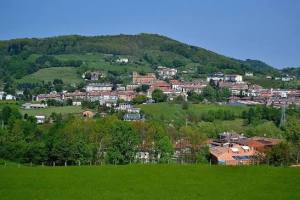
- Iragorri-Katin Txiki, Oiartzun, Gipuzkoa, Basque Country
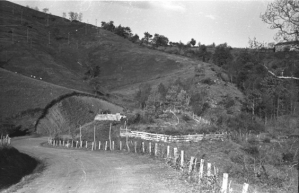
Elsewhere, the Nationalists were not arguing over whether killings people was ethical. Much like the sacas in Madrid, the Nationalist forces in Gipuzkoa were arranging extractions. Prisoners were taken from Ondarreta under the cover of night, driven into the mountains, shot, and buried in unmarked graves. In the area known as Iragorri-Katin Txiki, located along the road leading up to Artikutza Park (at the 4km mark), within the municipality of Oiartzun, it was known that several individuals had been buried following their murder in October and November 1936. This site is situated on the inner bend of a sharp curve in the road, in an area characterised by dense vegetation, including oaks and acacias. The archives of Jesús Elosegui, founder of the Aranzadi Science Society, contain several photographs of the location taken in 1942, labelled Oyarzun ilerria (Oiartzun burial site).
An exhumation was carried out at this site in 1960, as it was believed that one of those executed and buried there might have been Jorge Iturricastillo, the priest from the Marin neighbourhood of Eskoriatza, who had been taken from the Ondarreta prison in San Sebastián (Donostia) along with other prisoners and murdered on November 7, 1936. The exhumation is documented on the first page of issue 3264 of Eusko Deya; the account notes that the process was halted upon the discovery of the priest’s cassock, eyeglasses, and fountain pen, while also mentioning the discovery of a woman’s footwear. Born in 1902 in Elgeta, Jorge Iturricastillo was ordained in Vitoria-Gasteiz and served as the parish priest (cura ecónomo) for the rural Marín neighbourhood of Eskoriatza. His execution highlighted a unique political contradiction of the Spanish Civil War. While the Nationalists framed their coup as a holy crusade to defend Catholicism against atheist Reds, they relentlessly targeted Basque Catholic priests. Because the Basque nationalist movement (PNV) sided with the democratic Republic, any priest suspected of Basque nationalist, social-justice, or pro-Euskera sympathies was branded a traitor to the Crusade. Following the Nationalist capture of Gipuzkoa in the autumn of 1936, Father Jorge was rounded up and sent to the notorious Ondarreta Prison in San Sebastián.
Iragorri area of the Oiartzun municipality is still a remote, heavily forested mountain terrain made it an ideal, hidden location for the Requetés and Falangists to carry out killings away from public view. Oiartzun was one of the most heavily affected municipalities in Gipuzkoa regarding civil war mass graves. Local memory and forensic registries managed by Basque memory institutions like the Sociedad de Ciencias Aranzadi show dozens of individuals ‘disappeared’ from Ondarreta Prison were brought to various mountain tracks in this valley between October and November 1936.
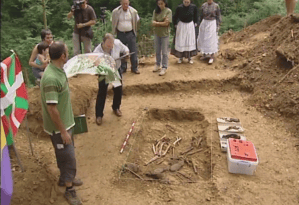
Because the Nationalist forces used the mountains of Oiartzun as a continuous, clandestine disposal ground in the autumn of 1936, researchers have had to piece the numbers together fosa by fosa. Historians and forensic anthropologists from the Sociedad de Ciencias Aranzadi) estimate that around 100 people were sent to the mountain passes of Oiartzun to be disappeared into a cluster of burial spots. In 1960, the Francoist authorities reluctantly permitted a highly restricted excavation specifically because the family of Father Jorge Iturricastillo was searching for his remains. When workers dug into the trench, they unearthed eight bodies. Once they identified the priest’s personal items, the authorities immediately ordered the excavation to stop, forcing the workers to cover the remaining skeletons back up with dirt.
Then 47 years later in 2007, Aranzadi and the local memory group Katin Ttiki returned to the woods of Iragorri with ground-penetrating radar. They uncovered a parallel, rectangular mass grave containing five additional male victims. Forensic examination showed intense bone corrosion, but gold dental work and personal artefacts (like txapelas, rectangular cufflinks, and Mauser ammunition casings) confirmed they were executed in the same October–November 1936 window. These remains were placed in a crypt at the Oiartzun cemetery, which had been built in 1977 by architect Luis Peña Ganchegui as a tribute to the victims of the Civil War. The remains from Iragorri, which had been exhumed in 1960, were also relocated there. To date, at least 12 to 15 victims have been physically accounted for in the immediate Iragorri roadside gravesite.
The reason Aranzadi estimates the total toll across the broader Oiartzun/Artikutza mountain track to be roughly 100 victims is due to the nature of the sacas from Ondarreta Prison.
During the chaotic regional conquest of Gipuzkoa, the fascist forces used Oiartzun as a military headquarters. Trucks left Ondarreta at night carrying groups of 4 – 10 prisoners at a time, and the executioners stopped dynamically along different isolated bends of the mountain roads, pulling small groups off the trucks, shooting them by the tree line, and burying them shallowly. Because many of these graves were completely undocumented and buried in deep forest terrain, finding the remaining pockets of the ‘disappeared 100’ relies almost entirely on fading oral histories passed down by local Basque shepherds and villagers who heard the midnight gunfire in 1936.
Jesús Elosegi Irazusta was a Basque archaeologist, ethnographer, and a brilliant photographer. Because of his sympathies toward Basque nationalism, he was arrested by Franco’s forces, sent to the notorious Miranda de Ebro concentration camp, and eventually assigned to a forced-labour battalion deployed directly in the Oiartzun area. While performing forced labour, Elosegi listened to the whispered testimonies of local Basque shepherds and villagers. They told him about the trucks that used to arrive from Ondarreta Prison under the cover of night, and they pointed him toward the quiet, isolated mountain passes, including the Iragorri site along the Artikutza road, where the executions had taken place.
After his release from the labour battalion, the knowledge of those hidden graves haunted him. In 1942, at the absolute height of Franco’s power and WWII, Elosegi decided to document the locations. Photographing or mapping a Francoist mass grave was treated as a treasonous act of anti-government subversion. If caught, Elosegi would have been sent straight back to the execution walls or a prison camp. Elosegi used his professional background as a naturalist and archaeologist as a shield. He walked the mountain passes carrying his heavy camera gear under the pretense of documenting local flora, landscapes, and ancient megalithic dólmenes or stone circles.
Knowing his home or files could be raided by the Guardia Civil at any moment, Elosegi couldn’t label the photographs honestly. He devised a secret archival code to protect himself and the local guides. When he developed the negatives of the Iragorri mass gravesite, he catalogued them under the Basque phrase Oyarzun ilerria (The Oiartzun Graveyard). To an outsider or a fascist inspector flipping through his files, it looked like a harmless, poetic description of the mountain landscape. To those in the underground network, it was a precise coordinate map of a crime scene.
Elosegi hid those photos and used them as the emotional and moral blueprint for something greater. Five years later, in 1947, he co-founded the Aranzadi Science Society. Though it was initially founded to study natural sciences, caves, and archaeology under the strict limitations of the dictatorship, Aranzadi was built from the ground up by men who understood that the soil of the Basque Country held darker secrets. Elosegi even famously smuggled the legendary Basque anthropologist José Miguel de Barandiarán back into Spain from exile, hiding him in his own home.
After Jesus Elosegi’s death in 1979, his photography collection was kept by the librarian Juan Jose Agirre of the Beneditarreta in Lazkao, until the Aranzadi Science Association digitized the collection, which consisted of 18,000 photographs, between 2002 and 2006. In 2007, on the1 00th anniversary of Jesus Elosegi’s birth, the book Jesus Elósegui 1907-1979 was published, and an exhibition of the most representative photographs was organised at the Aranburu Palace in Tolosa. Most of his works are still missing.
and Human Rights
- Villatobas, Toledo, New Castile (Castilla La-Mancha)
With the sound of Nationalist artillery echoing at the frontline 30km away at Aranjuez, and only 80km from Madrid, local militias were terrified that if Nationalist forces broke through the lines, the local right-wingers and prisoners would break out of jail and attack the retreating Republicans from behind. As reports of heavy casualties and brutal Nationalist behaviour on the front lines flooded into the towns in the Toledo area, local leftist militias reacted with immense anger. Unable to stop the professional troops on the battlefield, they took out their vengeance on their local class enemies (priests, landowners, and conservative lawyers) now under their control. On November 6, the Republican government fled Madrid for Valencia, leaving a massive power vacuum. In the chaos of the evacuation, central legal authorities completely lost control over local committees. With no one to enforce regular legal procedures, radical local factions were free to carry out the sacas (prison extractions) at Villatobas without anyone stopping them.
On the morning of 7 November, a group of approximately 10 to 12 prisoners was extracted from the cells of Corral de Almaguer, forced into transport trucks, driven roughly 22km to the municipal cemetery of Villatobas, and shot at 3:00am. Feliciano Montero Navarro, 64, was the local parish priest of Corral de Almaguer since 1930. and made a big speech of giving his fellow prisoners absolution. Eduardo Andrade Trujillo was local priest and chaplain to the Franciscan consecrationist nuns, had been used as forced labour, working on the threshing floors (harvesting wheat and seeds) since July when he was arrested. This was claimed to be public humiliation, psychological torture, and physical degradation, when it was actually just a standard work day for the locals. By forcing the priest onto the threshing floors under those exact same conditions, the local committee was making a calculated statement: This is the life you normalised. This is the reality you told us was God’s will. Now live it.
Vicente Díaz Pimienta Guisasola, 63, was rich, prominent local patriarch and latifundista targeted due to his conservative standing and labour exploitation. Landowners completely controlled who got to work each day. If a labourer joined a trade union (like the socialist UGT or anarchist CNT) or voted for a leftist party, the landowners would blacklist them, leaving their families to starve. When the left-wing Popular Front won the February 1936 election, they began a massive program of land reform, seizing large estates to give to the peasants. The landowners fiercely resisted, often hiding crops or letting fields go unplanted to sabotage the economy. When the war started, the peasants viewed the coup as the landowners’ ultimate attempt to steal their newly acquired land back by force.
Arturo Armenta Tierno was high-profile lawyer belonging to the Colegio de Abogados de Madrid and former Civil Governor. He was executed along with the group after a period of imprisonment in the local jail. The legal system had never been neutral. It was a tool used exclusively to protect private property, evict poor tenant farmers, and jail union organisers.
Lawyers associated with the Traditionalist Communion (Carlists) or right-wing parties were openly hostile to the democratic Republic.
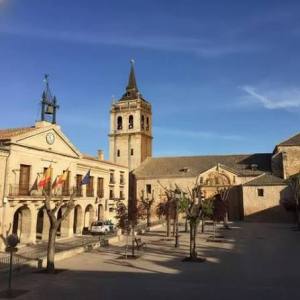
Other taken from the prison were Angel García Mochales Esmit, a member of another prominent local landowning family, Manuel F. Vítora, Miguel López Morales, and Emilio Amores López, along three brothers – Pascual Gálvez de las Heras, Cecilio Gálvez Fernández, and Pascual Gálvez Fernández.
Five days after the first convoy, the local revolutionary committee extracted the remaining high-value prisoners who had been held back during the initial sweep. They were taken to the same location at the Villatobas cemetery walls. They took Eduardo Díaz Pimienta, 32, son of landowner, son of Vicente Díaz Pimienta killed on 7 November 7, and a highly active lawyer affiliated with the Asociación de Estudiantes Católicos de Madrid and the Traditionalist Communion. Also killed Clemente Tradacete Paniego was prominent, wealthy latifundista in the region. In December 1921, he had purchased the 15th century palace Casa de los Collado and had also previously served as a deputy municipal representative. They also took his son, Benjamin Tradacete López, 17, Angel Tradacete López, 30, and Ubaldo Tradacete López. Theyt also took Braulio Correa Pacheco, Isabelo Moratalla Morán, Gabriel Moratalla Sánchez Ríos, and Juan Moreno Calero from nearby Ontígola, members of old landowning families.
One man, Anastasio del Nuevo García, founder the Villatobas Casa del Pueblo, was denounced and executed as a ‘consummate Marxist who had an active role in arrests, robberies, looting, arson, and the murders of Isabelo Moratalla Morán and Braulio Correa Pacheco (by arresting them).’ He was also accused of being the one to denouncing and arresting the Traducete brothers in Corral de Almaguer. He claims that he was at home when the arrests took place and that he was in Madrid on the day of the murders. Del Nuevo was givne a chance to refute the charges after being arrested in October 1939 in nearby Ocaña, and stated he had not been part of the realry arrests, and had been in Madrid for the siege on 7 November 1936. His wife, Adoración Vizcaíno Otero plead the court for clemency, providing an alibi, but he still was found guilty after a witness claimed he watched the executions.
- Almería
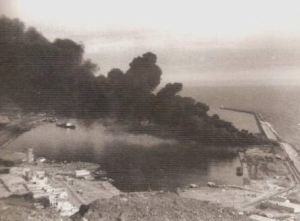
The combined air and naval assault on Almería on 7 and 8 November was deliberate targeting of the economic lifeblood and essential energy infrastructure of Republican cities rather than frontline troops. The 7 November midday attack by a Nationalist seaplane targeted the utility foundations of Almería as a testing ground for economic warfare. The goal was to totally sever the energy supply to the Republican southeast coast and disrupt maritime communications. The Nationalist command intended to trigger local paralysis, knock out communications, and demoralise the civilian population.
At approximately midday, a lone Nationalist military seaplane flew low over the Almería coast and dropped a cluster of lower-intensity bombs at the local electricity works and the gasworks. This immediately triggered power failures across municipal government operations. The seaplane then lowered its altitude to strafe the primary fuel deposits owned by CAMPSA (Spain’s state petroleum monopoly). The heavy machine-gun fire punctured the massive fuel tanks, causing an immediate, uncontrollable inferno.
The presence of a German vessel associated with the Non-Intervention Committee in Almería’s harbour during the shelling highlights the profound hypocrisy of international diplomacy during the war. Under the international Non-Intervention Agreement, democratic and fascist European powers deployed naval patrols to theoretically prevent weapons and volunteers from reaching Spain. While Germany operated under the banner of a neutral observer patrol, Nazi Germany was simultaneously supplying the Nationalist forces with the Condor Legion aircraft and intelligence. The German crew in the harbour watched from a front-row seat as a Nationalist cruiser devastated a Republican port city with absolute impunity.
The following morning, at 9:30am on 8 November, the Nationalist heavy cruiser Canarias arrived off the coast. The Canarias was the flagship of the Nationalist navy and possessed an immense artillery range. In a display of tactical dominance, the cruiser breached deep into the bay, positioning itself 400 metres from the western breakwater. The Canarias carried out the entire operation without flying a military flag, hiding its identity from any international ships observing the area and fired 10 heavy artillery shells directly into the port infrastructure. The primary target was again the CAMPSA fuel tanks. The heavy shelling tore open the remaining fuel deposits, reigniting the previous day’s fire and creating what local survivors described in testimonies as a ‘dantesque, hellish spectacle’ that blanketed the city in thick black smoke.
Recognising that Almería’s port was a strategic gateway for Soviet supply ships, the Nationalist navy and allied Italian/German aircraft began launching routine, devastating bombardments. To combat this, the municipal architect Guillermo Langle Rubio designed a massive network of underground air-raid shelters. Hand-dug by local miners and labourers starting in October, this project eventually spanned 4.5km of underground galleries carved 9 meters deep. Equipped with an operating room, ventilation shafts, and room for 34,000 people, it successfully protected the majority of the city’s population from ongoing aerial atrocities.
Almería served as the primary supply conduit keeping the defence of Málaga alive. Because Nationalist columns held the inland territories of Granada, the only way the Republic could send food, weapons, and medical aid from the central government down to Málaga was along the N-340 coastal highway. Almería’s port and truck depots worked around the clock in late October to route supplies down this narrow coastal throat.
While Almería in November was highly stressed by resource shortages, food rationing, and naval blockades, it was structurally peaceful compared to what lay ahead. The province was essentially a waiting zone. The massive, tragic influx of hundreds of thousands of desperate refugees fleeing the La Desbandá massacre along the coast would not arrive at Almería’s gates until February 1937, making this the final window of relative municipal stability for the province.

