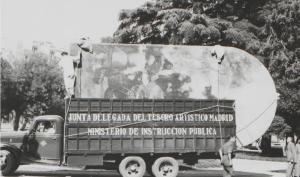
While the newly established Republican government scrambled to organize its ministries in Valencia, a parallel battle for the soul of the Spanish Republic reached its first major operational milestone. On 10 November 1936, the first systematic, large-scale transport of Spain’s national artistic patrimony departed the besieged capital of Madrid for Valencia.
Following the frantic emergency run of a single truck on 5–6 November, this date marked the transition into a highly organised, institutional rescue operation managed by the Junta de Incautación y Protección del Patrimonio Artístico (Board for the Seizure and Protection of Artistic Heritage).
The relentless air and artillery bombardments of 5 November had shattered the windows of the Museo del Prado. With Nationalist forces firmly entrenched at Carabanchel and Campamento, the risk of a direct hit on the world’s finest collection of Velázquez, Goya, El Greco, and Titian was unacceptable. Under the leadership of intellectuals like María Teresa de León, Rafael Alberti, and Prado director Pablo Picasso (who supported the operation from Paris), cultural workers spent the intervening days meticulously packing masterpieces into custom-built wooden crates padded with wood shavings and textiles.
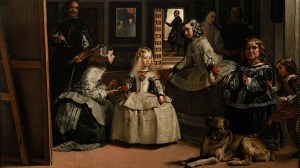
On 10 November, a heavily guarded convoy of trucks carrying the first massive instalment of these irreplaceable treasures rolled out of Madrid, taking the treacherous, winding highway toward the new capital on the coast. The journey from Madrid to Valencia was a logistical nightmare. Masterpieces like Velázquez’s Las Meninas, the crown jewel of the Prado collection, were too large to fit flat inside standard military transport trucks. They had to be carefully angled, often protruding from the back of the vehicles, exposed to the elements. At several points along the route, notably at the bridge in Arganda del Rey, the massive crates cleared the overhead structures by mere centimetres. Transport teams frequently had to stop, dismount the crates, and manually slide them across bridges under the constant threat of Nationalist strafing runs. The Equestrian Portrait of the Count-Duke of Olivares, another huge Velázquez canvas suffered minor paint flaking/dripping due to humidity and transport conditions during the journey, and his The Buffoon Calabacillas, was discussed by its handlers having caught a cold on the journey, caused by sudden temperature shifts during the exodus making the man look ill.
Goya’s The Second of May 1808 had the same issues, and was severely damaged during a truck accident on the road to Benicarló when a balcony collapsed near the convoy, fracturing the canvas. Goya’s massive Portrait of the Marchioness of Santa Cruz, a neoclassical portrait of Joaquina Téllez-Girón, travelled through Valencia before later being caught up in post-war political trading by Franco. Works of El Greco, Titian, and Peter Paul Rubens, core Renaissance and Baroque masterworks that defined the wealth of Spain’s national collection were stripped from the Prado’s walls and sent alongside the Spanish masters.
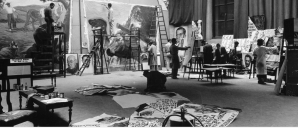
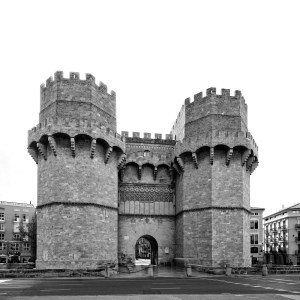
When the convoy arrived in Valencia, the city was not yet fully prepared to house them. The architect José Lino Vaamonde was working around the clock to transform two iconic Valencian landmarks into the most advanced bomb-proof art repositories in Europe. Vaamonde chose this 14th-century medieval gateway because its massive stone walls already offered substantial protection. To reinforce it, his teams built a massive concrete slab over the top floor, covered it with a thick cushion of sandbags, and installed a sophisticated internal climate-control system to prevent moisture from damaging the canvases.
The Colegio del Patriarcam, a historic Renaissance seminary, was similarly modified, with its vaults reinforced to serve as a secondary cache for the influx of cultural treasures.
Because Vaamonde’s structures were still being hastily finalized when the 10 November shipments arrived, the priceless crates were initially placed under armed guard in the central depositories of the Dirección General de Bellas Artes before being transferred to their fortified medieval vaults later in the month. The relocations were a massive coordinated effort involving museum staff, security guards, military drivers, and the central arts committee, and continued until February 1938, moving 391 paintings (along with 181 drawings) in 22 convoys, a total of 71 trucks transported 1,868 protective crates packed with masterpieces.
- Madrid
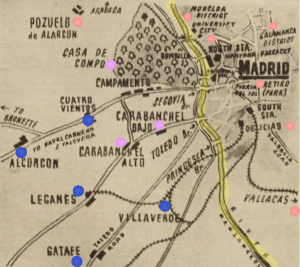
On 10 November, Nationalist forces under General Varela focused their main infantry push on the working-class southern suburb of Carabanchel. Colonels Tella and Barrón commanded roughly 5,000–6,000 elite, professional Moroccan Regulares and Spanish Foreign Legionnaires backed by light Italian-supplied tanks allocated to the area south of the city, but they struggled heavily in the tight, narrow street layout. Local Republican militiamen used their intimate knowledge of the neighbourhood to turn tenements into mini-fortresses, inflicting massive casualties on the Nationalist advance. The sector was held by the 2nd Brigade’s Martínez de Aragón Column, which fielded between 3,500 and 4,000 formal militiamen. Because Carabanchel was a dense, highly unionised proletarian heartland, this force was actively augmented by thousands of local civilians, including off-duty labourers, teenagers, and grandfathers, who literally fought from their own doorways, tenements, and balconies.
Nationalist forces had already managed to seize parts of Upper Carabanchel and the outskirts. On 10–11 November, the line hardened directly into the narrow, labyrinthine grid of Carabanchel Bajo. Combat occurred at point-blank range along streets like Calle de General Ricardos. Militiamen and civilians knocked down internal walls between apartment buildings, allowing them to move unseen through entire blocks of housing to ambush the advancing Nationalist columns from upper storeys.
On Tuesday, 10 November, Barrón’s colonial troops attempted to break the stalemate by driving armour and infantry deep into the narrow streets. They completely miscalculated the psychological shift of the defenders. The fighting degenerated into room-to-room, floor-to-floor combat. The Regulares used hand grenades to clear rooms, while civilians threw makeshift petrol bombs (early Molotov cocktails) and heavy furniture from upper windows to crush the infantry below.
Women operated communal kitchens inside shattered courtyards just fifty metres behind the barricades, cooking and passing hot coffee to the fighters. When the ammo ran low on the afternoon of 11 November, human chains of local women and children moved through the underground sewer lines to bring rifle crates up from the central supply depots, bypassing the Nationalist snipers watching the surface streets. Varela’s professional army had expected a quick breakthrough; instead, the working-class citizens of Carabanchel turned their own homes into an impassable graveyard.
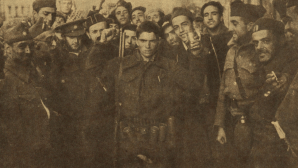
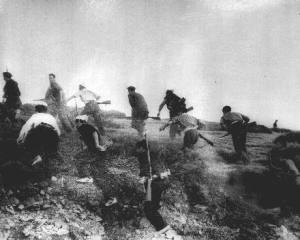
It was during this immediate window of street fighting in Carabanchel and adjacent Usera that Republican propaganda and myth-making crystallised around the figure of Antonio Coll. Coll, a Republican sailor, famously threw himself flat into the dirt as three Nationalist tanks approached, waited until they were at point-blank range, and destroyed two of them with hand-tied dynamite bundles before being killed. Whether partially embellished by the communist press to boost morale, the tank-hunter phenomenon became a tactical reality in Carabanchel on the 10th when it stripped away the civilian fear of Italian armour.
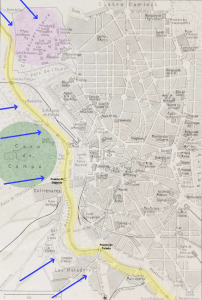
Meanwhile, before 10 November dawned, a pivotal tactical choice had just been made. Under the cover of total darkness on the night of 9 November, the newly arrived XI International Brigade (2,000 men under General Emilio Kléber), alongside local Spanish militias, was launched directly into the thick, oak-forested expanse of the Casa de Campo. Kléber initiated a fierce, all-night counter-offensive against General Varela’s advancing professional African columns. The fighting raged through the scrubland, meaning that by the morning of 10 November, the battlefield was a fragmented, smoking maze.
Because the Casa de Campo was a vast, open hunting park rather than an urban street grid, the combat split into isolated, terrifying skirmishes. Hand-to-hand combat with bayonets and knives occurred around the park’s small stone lodges, streams, and walking paths. The XI Brigade’s battalions, the German-speaking Edgar André, the French-speaking Commune de Paris, and the Polish-speaking Dąbrowski, could not understand each other’s commands, nor those of the Spanish militias on their flanks. When Varela’s Moroccan Regulares infiltrated the tree lines, whole platoons were cut off and slaughtered simply because retreat or support orders couldn’t be translated in the fog of war.
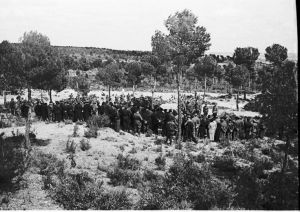
By the afternoon, the International Brigade had successfully pushed the Nationalists back from the eastern edge of the park, securing the banks of the Manzanares River and protecting the city centre. However, the cost was horrific: the XI Brigade lost a third of its entire strength (roughly 600–700 men killed or wounded) in less than 24 hours.
Griffith Campbell ‘Mac’ Maclaurin, a brilliant Cambridge mathematics graduate from a prominent Auckland academic family turned London-based left-wing bookseller, and Steve Yates, a New Zealand-born London electrician, communist, and disgruntled World War I veteran, were embedded within the predominantly French-speaking Commune de Paris Battalion machine-gun unit in the Casa del Campo on 10 November 1936. Because they had no unified language with their French-speaking battalion, they operated almost like an isolated island on the battlefield. The French battalion was mostly equipped with obsolete, jamming weapons. The machine gunners were desperately trying to hold back the highly professional Spanish Foreign Legion and Moroccan Regulares who were using aggressive, close-quarters infiltration tactics.
Many general histories state Maclaurin and Yates died in the iconic University City buildings (like the Philosophy School). However, the battle hadn’t even reached the university buildings yet. Their column had been deployed to the southern University area, which bordered on the northern edges of the Casa del Campo. They were then deployed on the high ridges of the Casa de Campo, overlooking the Manzanares River, or near the Palacete de la Moncloa (the entry slopes to the university grounds). The weather on 10 November was miserable, thick autumn fog mixed with the heavy smoke of burning scrubland in the park. Visibility was near zero.
Varela’s Moroccan troops did not attack in predictable waves; they used the terrain and fog to slip through gaps in the Republican lines. Eyewitness accounts from survivors of the XI Brigade (including British volunteer John Sommerfield) painted a harrowing picture of that Tuesday afternoon. The Nationalist troops managed to flank the Republican militia positions under the cover of the fog and heavy artillery bombardment. The French battalion was forced to pull back, but in the chaos, communication broke down. Maclaurin, Yates, and a few others were left isolated on a ridge inside a forward outpost, completely unaware that their flanks were gone from the small patch of woods near the Pozuelo-Húmera sector (just northwest of Casa de Campo). Moroccan Regulares rushed the position from the sides and rear to stage a close-range overrun.
Without an ammunition bearer, Maclaurin carried all the extra machine-gun drums and his own rifle alone. He was shot immediately upon entering the trees. According to the archival letter from the Scottish volunteer Mackenzie, their comrades counterattacked the Nationalist position in the woods a few days later. It was during this temporary pushback that they discovered the bodies. Maclaurin was found dead under a tree. Right next to his body lay a Moroccan Regulares sniper whom Maclaurin had managed to shoot down before he died of his wounds.
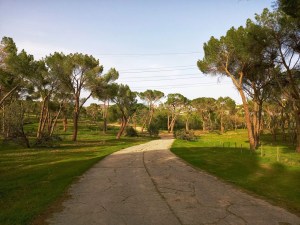
Yates had taken the Lewis machine gun and the remaining ammunition and pressed on alone through the woods after MacLaurin went down, to cover the rest of the unit’s retreat. After being heavily wounded, he propped his back against a tree, hoisted the heavy weapon, and continued firing blindly from the hip at the Nationalist forces surrounding a nearby house. A few days later, Yates was found still upright against the tree, but so riddled with machine-gun bullets that his body came apart in the hands of those who tried to move him. Because the front lines in the Pozuelo-Húmera and Casa de Campo sectors remained extremely fluid, highly volatile, and subjected to endless heavy artillery fire, the Republican soldiers could not recover the bodies to bring them back to the city centre. The ground was heavily contested and quickly fell back into Nationalist hands.
Like thousands of other International Brigade volunteers and Republican militiamen who fell in the mud of the Madrid outskirts, Maclaurin and Yates became part of Spain’s massive, anonymous wartime missing. Following his victory in 1939, General Francisco Franco’s regime established a funerary apartheid. The bodies of Republican casualties were routinely cleared from the battlefields by prison labour or local burial detachments and thrown anonymously into unmarked mass graves, often right where they fell at the edge of the woods, along roadsides, or in collective trenches outside local civilian cemeteries. There is also a distinct, grim possibility that their bones were moved decades later without anyone’s knowledge when Franco constructed the Valle de los Caídos mausoleum. To fill it, the regime dug up tens of thousands of bodies from anonymous Civil War mass graves across Spain, including the Madrid front, and shipped them to the crypts in unmarked boxes to line the walls.
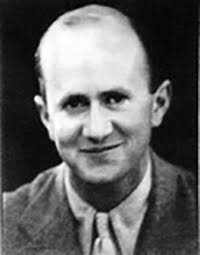
Because they fought for the leftist Republic rather than King and Country, they were largely ignored by the NZ government of the era, despite being the first kiwis to die fighting fascism. When news of Maclaurin and Yates’s deaths trickled back in late 1936, it was met with official silence and calculated political avoidance. The government, led by Michael Joseph Savage, officially adhered to the British policy of Non-Intervention. To the state, the men were not brave soldiers defending democracy; they were rogue ideologues who had gone abroad to fight a foreign war. To deter others, the New Zealand government began stamping passports with strict prohibitions, specifically stating they were not valid for travel to Spain (this does not stop kiwis, not really sure they thought it would). Because they died nearly three years before the official outbreak of World War II, Maclaurin and Yates were completely omitted from official national rolls of honour, military archives, and traditional Anzac Day commemorations. For decades, the state treated their sacrifice as if it had never happened.
While the conservative press and the government ignored them, the working-class left, trade unions, and the Communist Party of New Zealand treated them as fallen martyrs. On 14 May 1939, shortly after the fall of Madrid and the end of the civil war, a massive memorial meeting was held at the Auckland Town Hall. Over 900 people packed the venue to mourn the New Zealanders who died in Spain. A dramatic memorial poster was circulated across the country, honouring them as the vanguard of the fight against global fascism.
Kenneth and Gwladys Maclaurin did not know their son was in Spain until a telegram arrived a month after he died. They believed he was running a leftist bookstore in Cambridge, England. The sudden revelation that their brilliant, university-educated son had died as a machine gunner in the mud of Madrid was a massive shock. Rather than hiding his death out of social shame or political embarrassment, which was common for conservative families of the era during the Red Scare, his parents chose radical transparency. They were immensely proud of his courage. They openly embraced his ultimate sacrifice against fascism and refused to let his memory be swept under the rug. The family immediately put their name, resources, and social standing behind the Republican cause, channelling their grief into humanitarian action and became highly active, prominent fundraisers for the Auckland branch of The Spanish Medical Aid Committee (SMAC). They used their institutional connections to raise money for ambulances, medical supplies, and field hospitals to save other young men on the Spanish front lines. Their work helped fund the deployment of three New Zealand nurses directly to the Spanish front (yes, I will definitely cover them).
Back in England, MacLaurin’s academic peers and fellow activists set up a memorial fund named jointly after him and John Cornford (a famous British poet killed a month later). This fund sent a continuous stream of material and financial aid to the Republican forces. His close circle in England organised shipments of food and clothing for Spanish civilians and actively helped resettle a group of displaced Basque refugee children who had fled Franco’s terror bombings.
Soviet-supplied Polikarpov I-16 monoplane also fighters made their absolute combat debut over the Madrid front on 10 November. Flying alongside I-15 biplanes, they conducted three separate low-level strafing runs on Nationalist infantry and cavalry in the Casa de Campo. Caught completely by surprise, Nationalist troops noted that the ultra-fast fighters seemed to emerge from within the city’s skyline, hugging the ground. The Nationalists immediately dubbed them Ratas (Rats).
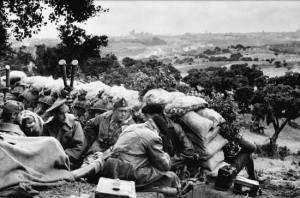
They same day, a Nationalist pilot defected directly to the Republican side, flying a German Junkers Ju 52/3m bomber into Republican territory. Backed by German Condor Legion aircraft and Italian Fiat CR.32 fighters, the Nationalists heavily bombarded residential and commercial areas. Artillery positions on the newly captured Garabitas Hills systematically targeted the city centre. The central artery of Gran Vía was hit so frequently it earned the civilian nickname Avenida de los Obuses (Howitzer Avenue). On 10 November alone, international press reported that combined aerial and artillery strikes killed at least 80 civilians.
By 11 November, the frantic manoeuvring stopped. The battle in the Casa de Campo transformed from a fluid melee into a stagnant, industrial war of attrition. Realising that a swift, direct infantry sweep through the park to the city centre was blocked by the battered but unyielding Republicans, Varela ordered his Nationalist columns to dig in and secure the highest ground. The Nationalists fortified Garabitas Hill (Cerro de Garabitas), the highest elevation point in the park. From this vantage point, Nationalist gunners could look straight down over the Manzanares River into the heart of Madrid, marking the birth of the systematic shelling that would terrorise civilian life for the next two and a half years.
The remnants of the Commune de Paris and Edgar André battalions retreated slightly to set up a more sustainable defensive perimeter along the eastern fringes of the park. Lacking proper tools, volunteers used their helmets, bayonets, and bare hands to scratch shallow trenches into the muddy autumn earth. Madrid’s civilians actively kept the front line alive. On 11 November, trade union columns of civilian women and older men walked out into the open, bullet-swept paths of the Casa de Campo carrying heavy cauldrons of hot stew, coffee, and boxes of ammunition directly to the muddy foxholes where the surviving militiamen and foreign volunteers lay shivering. November 10 had been defined by the raw shock of survival, the euphoria of seeing the Ratas planes reclaim the skies mixed with the sudden, agonising realisation that hundreds of the brave international volunteers who had paraded down Gran Vía just two days prior were already dead in the mud. November 11 as the grim morning after, when civilians and soldiers alike looked out at the newly fortified Garabitas Hill and realised that the enemy was not going away. The war was no longer a quick street battle; it was going to be a long, grinding siege.
- Gijón, Asturias
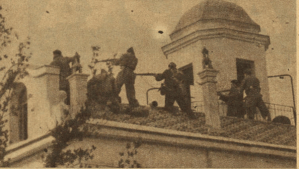
The dissolution of the Gijón War Committee (originally established in July 1936 under anarchist leadership) was a crucial step in the Republic’s effort to centralise power. In the opening months of the conflict, the Republican zone was fragmented, with local revolutionary committees and labour unions (primarily the CNT and UGT) taking autonomous control of governance, logistics, and militias. The central Republican government, alongside regional leaders, actively pushed to dismantle these independent revolutionary bodies to create a more unified, conventional military structure.
The dissolution of local bodies like the Gijón War Committee eventually paved the way for the creation of the Council of Asturias and León in December 1936. Led by socialist Belarmino Tomás, this council absorbed the various localised factions into a single administrative structure that managed the isolated Northern Front until its eventual fall in late 1937.
- Santander (Cantabria)
The trial of Luciano Revuelta Gutiérrez, Eusebio Vergara de la Vega, and Tomás Martínez Mantilla on 10 November 1936 was a direct product of the chaotic, high-stakes military landscape of the Northern Front during the Spanish Civil War. In November 1936, the northern Republican zone (consisting of parts of the Basque Country, Santander, and Asturias) was cut off from the main Republican territory in central and southern Spain. The Nationalist (Francoist) forces were actively pressing hard on the borders of these province.
The defendants came from Bercedo and Espinosa de los Monteros. These towns are located in Las Merindades, a mountainous region in the far north of the Burgos province. This area was a volatile, active frontline where Republican and Nationalist troops frequently clashed. Because the frontline cut right through these communities, local residents were intensely scrutinised by military tribunals, and the line between a civilian neighbour and a military informant was incredibly thin.
The three men were arrested by Republican authorities early in the war, around August 1936, just weeks after the initial military uprising. The core of the prosecution’s case was that the men were operating an espionage cell. Specifically, Tomás Martínez Mantilla was accused of conspiring with Revuelta and Vergara to gather and transmit sensitive intelligence. Their target was a Republican armoured train scheduled to move up from the industrial hub of Bilbao. They intended to relay the train’s movements to the advancing Nationalist forces to prevent it from reaching the front lines, effectively trying to blindside the Republican military defence.
Because their home towns in Burgos were unstable or entirely occupied, they were transferred to the nearby Republican stronghold of Santander to face a military tribunal on 10 November 1936. Tomás Martínez Mantilla was found guilty as the primary actor or coordinator and was sentenced to eight years of imprisonment. Luciano Revuelta Gutiérrez and Eusebio Vergara de la Vega faced varying degrees of complicity; in many such multi-defendant wartime trials, those deemed accessories or lower-level informants received lesser prison terms or were held in custody awaiting labour assignments, though Martínez bore the brunt of the sentence reported by the press.
In the context of the Spanish Civil War, where Popular Tribunals and military courts frequently handed down summary executions for suspected treason, an eight-year prison sentence indicates that the tribunal either lacked absolute proof of completed treason or that the men’s defence successfully argued mitigating circumstances (such as coercion or partial involvement). However, serving a long-term prison sentence in a blockaded, increasingly starved Republican northern pocket was incredibly perilous. Less than a year later, in August 1937, Santander fell completely to Franco’s forces. When Nationalist troops captured the region’s prisons, the fates of inmates inverted. Republican political prisoners faced execution, while individuals previously jailed by the Republic for ‘espionage’ or pro-Nationalist sympathies, like Martínez Mantilla, were typically released, re-vetted, and often integrated into the Nationalist machinery.
- Huelva, Andalucía
By late autumn, Huelva’s intense, targeted cleansings continued to eliminate union leaders, left-wing politicians, and Republican sympathisers, particularly around the fiercely resistant mining basins. Concurrently, local men who managed to flee were dying on the front lines defending the Republic in the sieges of major cities.
On 10 November, the repression struck deeply into both the provincial capital and the isolated communities of the Sierra de Aracena. In the capital, Francisco López Jiménez was executed at Huelva. Meanwhile, the strategic and highly politicised mining basin faced its own losses, with Juan Lozano Sánchez killed at Nerva and Juan Salgado Gálvez executed at the copper mining hub of Riotinto. Further north, the sweep continued into agricultural villages, claiming the lives of Juan Peña Mesa at Higuera de la Sierra, Manuel T. Pereira Castilla at Jabugo, and Manuel Sánchez Gómez at Cumbres de San Bartolomé.
Two days later, the violence in the mining centre of Riotinto peaked with a wave of executions that took the lives of Antonio Mantero Viera, Valerio Prieto Palma, and José Antonio Teniza Brazo. The surrounding area remained perilous, marked by the death of Carlos León Ramos at Nerva and Domingio Rubio Caro at Calañas. The reach of the conflict also pulled victims far from their homes. Eulalia Martín García, a woman from the mountain village of Alájar, was taken and killed at Seville, the regional centre of the Nationalist military command. In contrast to these rearguard executions, Antonio Morejón Yerpes of Huelva died on the same day, officially recorded as a casualty on the military war front, which gives little insight, since war never came to Huelva.
The pattern of localised executions continued on 13 November. In Riotinto, the extraction of suspected dissidents claimed Francisco Gago Pérez and Marcelino Garrido Manzano. Near the northern border with Extremadura, Andrés Delgado González was killed at Cumbres de San Bartolomé, while Francisco José Nadal González was executed at Cumbres Mayores. Simultaneously, the broader war claimed Huelva’s exiled sons. Enrique García Román, originally from Nerva, fell as a war-front victim. Farther away, Gabriel Fernández Martínez, a native of El Campillo who had likely fled the Nationalist takeover of the mines to join the regular Republican forces, was killed during the brutal, pivotal Battle of Madrid.
The week closed with a final succession of killings on 14 November. In the northern highlands, Francisco Fernández Santos, a resident of Puerto Moral, was taken to the judicial and military head of the district and killed at Aracena. In the mining zones, Manuel Sánchez Tovar was executed at Calañas, while Nicolás Garzón Ramírez and Felipe Garzón Viegas were put to death at Riotinto. The ultimate anonymity of this wartime terror was underscored back at El Campillo, where two unidentified men were executed and buried, their identities erased by the chaos of the conflict. (see also Terror of Western Andalucía)
The combined physical evidence from ongoing cemetery exhumations, execution records, and air raid casualties shows that well over 1,000 people lost their lives specifically within the communities making up the Huelva mining basin, part of the 6,000 murdered in Huelva province. (also see How Fascist Britons Helped Franco in Huelva)
- Zaragoza, Aragon
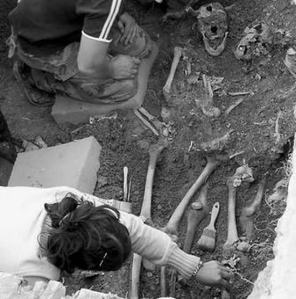
The mid-November days of 1936 in Zaragoza marked a devastating peak in the Nationalist rearguard repression, centred heavily around the execution grounds of Valdespartera.
Following the July 1936 military uprising, Zaragoza quickly fell under Nationalist control. Valdespartera, located on the southern outskirts of the city, was transformed into a primary site for systematic summary executions. The killings during this period were frequently retaliatory, designed by the military authorities to eliminate suspected Republican sympathisers, trade unionists, and entire families viewed as politically hostile.
On 10 November, the executions at Valdespartera were defined by the heart-breaking targeting of an entire family network. A single sweep claimed the lives of Manuela Iglesias Cuella, Andrés Iglesias Cuella, and Felipe Iglesias Cuella, alongside Ángela Cuella Roche. The destruction of multiple generations of the same family was a deliberate tactic used to entirely root out perceived leftist influence in the region. On the same day, Ángela Sánchez García and Justo Bosch Sanz were also taken to the Valdespartera grounds and executed.
The following day, 11 November, witnessed an even larger, coordinated mass execution at Valdespartera. Among those put to death was a group of local men and a woman, including Antonio Abadía Hernández, Joaquín Blasco Pascual, Ramón Ferrer Pérez, Pedro José Daroca Bernal, Matías Hornos Pérez, Primitivo Pérez García, Gonzalo Cabrero Domenech, and Justa Gómez Arcos. The clinical, bureaucratic nature of the wartime record-keeping is starkly reflected in the remaining data for that morning: two additional victims were entered into historical ledgers using only their initials, J. and T., while several other individuals executed alongside them were buried completely unidentified, their names lost to the chaos of the repression. (Also see the Subjugation of Zaragoza)
- Fuente Del Maestre, Badajoz, Extremadura
By November 1936, the Spanish Civil War had evolved from a fractured military coup into a total, industrialised conflict. While the active front lines had pushed further east toward the defence of Madrid, deep rearguard territories like the region of Extremadura were left to endure a regime of absolute civilian terror. Overrun in August 1936 by Lieutenant Colonel Juan Yagüe’s advancing African army columns, frequently dubbed the Column of Death, Extremadura became one of the most violently purged territories in all of wartime Spain. Historians estimate that between 12,000 and 15,000 civilians were executed by Francoist forces across the region. The province of Badajoz recorded the second-highest tally of rearguard executions in the country, eclipsed only by Seville.
Living in Extremadura in late 1936 meant surviving an atmosphere of total physical and psychological intimidation. The military authorities, allied with local wealthy landowners and Falangist paramilitary squads, enacted a deliberate clean-up plan designed to permanently alter the region’s social and agrarian structure. Personal grudges and ideological differences quickly turned lethal. Neighbour turned on neighbour through anonymous accusations made to military tribunals. The sweeps primarily hunted down agrarian day labourers, labour unionists, and members of the democratically elected Popular Front municipal councils who had previously advocated for land reform.
Women related to left-wing figures faced unique horrors, including public head-shavings, forced ingestions of castor oil, and widespread sexual assault. Paramilitary squads also continued their out nightly paseos. The town of Fuente del Maestre stands as a textbook example of this rearguard devastation. The town was occupied by a column of Falangists and Moroccan regulars on 20 August 1936 without facing any organised military resistance. Despite the lack of combat, a ruthless, months-long purge was initiated against its population of 8,000 residents, eventually claiming between 300 and 350 local lives.
On 9 November, Vicente Sánchez Rico and Benito Utrero Romero were taken from their homes or makeshift holding cells by local squads and executed. On 10 November, the purge continued as Diego Saavedra Toresano and Manuel Sánchez López were lined up against the municipal cemetery wall and shot. Most of these victims were dumped into unmarked communal graves within the local cemetery, where their identities and the true scale of the tragedy remained officially silenced for decades under the Franco dictatorship. While Fuente del Maestre does have its own mass grave site, private digs in the 180s uncovered an unknown number of bodies, but whether they were removed or reburied is unknown, and 2016 investigations could not find the original site, which is likely hidden under new burial niches (see also the Fall Fuente del Maestre and links to the photography of José Gordillo Sánchez)

