- Albacete, Murcia (Castilla La-Mancha)
Between 2–6 November 1936, the first group of International Brigades departed from Albacete towards the Madrid front in three principal battalions, with approximately 2,100 men, overseen by General Emilio Kléber, a seasoned Soviet military intelligence agent appointed to command the collective brigade.
The volunteers had crossed into Spain, mostly through the Pyrenees on foot to bypass international non-intervention blockades, and had assembled at the central International Brigades headquarters in Albacete. Because the small city was completely overwhelmed by thousands of arriving foreigners, the battalions were distributed into nearby rural villages to train and billet. The Polish Battalion was stationed was Mahora, where the unit was officially birthed on 17–24 October, and named the Jąrosław Dąbrowski Battalion, named after the 19th-century Polish general. The group had 600 men Poles and Balkan volunteers, including Polish miners who had been living and working in exile in France and Belgium. This allowed them to travel to Spain very quickly. The initial commander was Bolesław Ulanowski, and organised by Józef Strzelczyk, and included a nucleus of Soviet Red Army tactical advisers.
From La Gineta, the French/Belgian Commune de Paris Battalion, named after the 1871 French revolutionary government, had between 600–700 men French and Belgians. A high proportion were trade unionists, industrial workers, and WWI veterans from Paris and Brussels. Included a small contingent of British, American, and New Zealand volunteers, and commanded by Jules Dumont, a veteran French military officer, and Henri Rol-Tanguy, a political commissar (and later a famous French Resistance leader.)
From La Roda came the German/Austrian Edgar André Battalion, named after a German communist executed by the Nazis, had 600–700 men Germans and Austrians. Many were anti-Nazi exiles, political refugees, and veteran communists who had fled Central Europe. Hans Kahle was the First Commander, and a former imperial German officer, Wilhelm Föckel, who also took command in November, and Heinrich Rau led the group.
These volunteers had travelled to Spain to stop what they saw as the global spread of fascism. In July 1936, a right-wing military coup attempted to overthrow Spain’s democratically elected Popular Front government. While Great Britain and France signed non-intervention pacts that starved the Spanish Republic of aid, Nazi Germany and Fascist Italy actively supplied Franco with state-of-the-art aircraft, troops, and weapons. For the volunteers, Spain was the line in the sand. To the German exiles, it was a chance to fight Hitler on open ground; to the Polish miners and French unionists, it was a defence of the international working class.
By late October 1936, the International Brigades’ central headquarters in the province of Albacete was overflowing with thousands of raw volunteers. However, most had absolutely no military training. The decision to send the XI Brigade to Madrid first was purely pragmatic, since they were the only units with a substantial nucleus of combat veterans. A high percentage of the German exiles and French unionists had fought in WWI, and the Polish miners were accustomed to physical hardship and tight-knit collective discipline. When General Franco’s forces reached the gates of Madrid in early November, the Republic faced total collapse. General Kléber’s partially trained but heavily veteran brigade was the only shock force available to plug the gap.
The units functioned as semi-autonomous national battalions beneath a unified high command. This structure was dictated by a glaring practical reality: they could not easily communicate with one another. Language barriers were immense. Orders from General Kléber had to be translated from Russian or German into French and Polish. Within the ranks, the universal anthem of the Internationale was often the only shared language. Because Albacete was overcrowded, the battalions had been billeted in separate rural villages: the Germans in La Roda, the French in La Gineta, and the Poles in Mahora, meaning they had no preparation shared among the units.
Their departure between 2 and 6 November 1936 was a frantic logistical scramble. The Polish battalion in Mahora was loaded into open-topped commercial lorries and driven through the night to the central Albacete railway station. Meanwhile, steam trains rattled up the line, pausing at the small rural platforms of La Gineta and La Roda to collect the French and German troops directly from their billets. While the Soviet Union had begun sending some shipments of arms, the XI Brigade went to the front heavily under-equipped. They possessed a chaotic assortment of outdated rifles, Mexican, old Spanish, and obsolete French models, often with mismatched ammunition. Uniforms were a patchwork of civilian clothes, boiler suits, and leftover French corduroy. They lacked adequate medical supplies, communications gear, and heavy support weapons, save for a small British machine-gun company that accompanied them.
The volunteers had a clear ideological understanding that Madrid was the focal point of the anti-fascist struggle, popularised by the slogan ‘Make Madrid the tomb of fascism.’ However, they had virtually no accurate tactical intelligence regarding how dire the situation inside the city actually was. They did not know that fascist troops had already breached the Casa de Campo park or that the Spanish Republican government had panicked and fled to Valencia, leaving Madrid to be defended by a desperate junta.
Several New Zealanders had got themselves into the French contingent. Griff ‘Mac’ Maclaurin was an unlikely candidate for a battlefield. Born in Auckland to a highly scholarly family, grew up wealthy, earned his Master’s degree in New Zealand and travelled to England to pursue a postgraduate degree in maths at the University of Cambridge. However, it was a trip to Germany in 1933 gave him a start introduction into the violent rise of the Nazi regime, and politics swung to the far left. He abandoned his academic pursuits to open the city’s very first progressive, left-wing bookshop (Maclaurin’s Bookshop) in 1934. When the Spanish Civil War erupted, he volunteered immediately. He was assigned to the Machine Gun Company of the French Commune de Paris Battalion because of earlier cadet training.
Steve Yates represented the hardened working-class core of the volunteer movement, a WWI veteran, he understood the realities of combat far better than the eager young students surrounding him. Born in New Zealand, Yates had moved to England and was working as an electrician in London when the Spanish conflict broke out. He was an active member of the Communist Party and a fixture in the aggressive anti-fascist street protests that shook London in the mid-1930s. His peers remembered him simply as reliable, quiet, and deeply committed. The two Kiwis were paired together in a small English-speaking machine-gun section within the French-speaking battalion. During that long, dark train journey from Albacete, Maclaurin and Yates sat together among the crates of mismatched weapons, knowing their English section was meant to provide vital fire support. Both would be dead within 48 hours of the dramatic arrival in Madrid.
A third Kiwi was also Madrid-bound. Born in Palmerston North and raised in Invercargill, Geoffrey Cox graduated with a Master’s degree in history from the University of Otago before winning a prestigious Rhodes Scholarship to Oriel College, Oxford, in 1932. Cox undertook a dangerously bold stunt in 1934 and disguised himself to infiltrate a Hitler Youth Labour Service camp in Hanover to investigate the realities of Nazism from the inside. His gripping investigative articles were picked up by major papers in London and New York, instantly cementing his reputation on Fleet Street.
In October 1936, the London News Chronicle sent Cox to Spain after their main Madrid correspondent was captured by fascist forces. Still a young freelancer, Cox arrived at the absolute climax of the siege. He was standing on the streets of Madrid to witness the fateful arrival of the XI International Brigade on 8 November. For six terrifying, intense weeks, he dodged falling masonry and artillery shells to report on what was essentially the twentieth century’s first major experience of total urban warfare, and would go on to write one of the most important first-hand accounts ever written on the Spanish Civil War and , lived an absolutely extraordinary life. He wasn’t just a passive observer passing through; he was a brilliant Kiwi trailblazer who quite literally helped invent modern television news broadcasting in the United Kingdom.
- Madrid
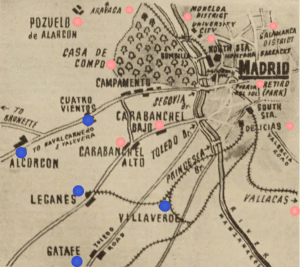
Meanwhile, on 4 November was the moment the scale of the emergency around Madrid flipped from critical to catastrophic, with the loss of Getafe and Cuatro Vientos, which stripped Madrid of its immediate southern air defence shield and force Prime Minister Largo Caballero to desperately bring Anarchist leaders into the Republican government that evening, and triggered the government’s flight to Valencia two days later.
The direct tactical assault on these towns was executed by roughly 10,000 to 12,000 elite frontline troops spearheading the advance. The remaining half of Colonel Varela’s force was held just behind them as a strategic reserve, artillery support, and supply line guards. These four columns were devastatingly effective because they were composed entirely of the most feared professional soldiers in Spain, the Moroccan Regulares and the Spanish Foreign Legion, the fanatical shock troops known for their high tactical discipline and mercilessness toward defenders and innocent civilians.
Varela coordinated these columns to attack along two parallel paths, which explains why the towns fell almost simultaneously on 4 November. The right flank, the Toledo Road Axis had two columns under the direct tactical direction of the fierce Colonel Juan Yagüe advanced northward along the main Toledo highway. Their job was to smash directly through Getafe and its crucial airfield. The left flank, the Extremadura/Mérida Axis had two columns under Varela’s immediate eye pushed up the western highway. They converged on Alcorcón and Leganés, before aggressively cutting inward to overrun the technical staff and garrison holding the Cuatro Vientos air base. By using roughly 2,500 professional killers per column, fully supported by Italian Fiat light tanks and German Condor Legion aviation, Varela did not need a massive army to take the towns. The concentrated 10,000-man professional spearhead simply out-paced, out-gunned, and out-flanked the 40,000 civilian militiamen blocking the path.
The fall of Alcorcón, Leganés, Getafe, and the Cuatro Vientos airfield on 4–5 November 1936 represented the shattering of Madrid’s final outer defensive perimeter. They were the heavily fortified southwest industrial hubs and aviation bastions protecting the capital. Their lightning-fast collapse threw the Spanish Republic into a state of absolute existential panic and directly dictated the immediate, frantic deployment of the incoming International Brigades. The assault on 4 November was characterised by overwhelming firepower and devastating aerial bombardment. German Ju 52 bombers and Italian fighters systematically pounded the brick factories, railway junctions, and trenches of Getafe and Leganés to break the militias’ morale before the infantry moved in.
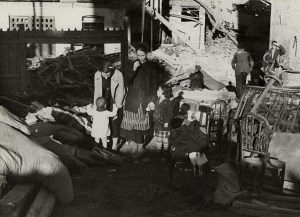
The fighting was incredibly bloody, desperate, and asymmetric. In Getafe, Republican militias armed with nothing but rifles and homemade dynamite bundles tried to hold the streets against oncoming Italian-supplied tanks. In the open fields around the Cuatro Vientos airfield, Moroccan cavalry charges routinely flanked and cut down retreating militia groups who did not know how to form defensive squares. The defenders were entirely overwhelmed by the coordinated blitzkrieg tactics of the Nationalist war machine, and t hundreds of militia fighters were killed in action orexecuted upon surrender by the advancing Legionnaires.
As the southwestern front completely dissolved on the afternoon of 4 November, the surviving Republican militias broke into a chaotic, panicked retreat. They fled northeast, abandoning their heavy weaponry, and crowded along the main roads leading directly into the capital. Their destination was the Manzanares River and the working-class southern suburbs of Carabanchel and Usera. Here, under the frantic direction of the newly formed Madrid Defence Junta led by General José Miaja and Colonel Vicente Rojo, the retreating men were forced at gunpoint to dig a network of trenches, machine-gun nests, and barricades. The Manzanares River was now the absolute last line of defence; if it fell, the city fell.
The impact on the local civilian population across these suburban towns was catastrophic. The towns of Alcorcón, population 800, Leganés, population 4,500, and Getafe, population 8,500, and Cuatro Vientos, which had hundreds on site at the active air base, barracks, and aviation school, and a local garrison of Republican troops, had to run the 5-10km to Madrid
Thousands of terrified civilians packed what few belongings they could carry onto carts, bicycles, and their own backs, joining the sea of refugees clogging the highways into Madrid. The Carabanchel Districts (Carabanchel Alto and Carabanchel Bajo), directly northeast of Alcorcón and Leganés, was a dense, highly politicised working-class suburban hub of Madrid. Because it was heavily populated by trade unionists, the local neighbourhood committees rapidly organised makeshift refugee centres inside public schools, converted convents, and abandoned churches. While it offered immediate shelter out of the open fields, it was only a temporary stop. Within 48 hours of the towns falling, Carabanchel itself became the violent frontline of the war, forcing the refugees to flee even deeper into the city centre.
Once refugees successfully crossed the Manzanares River into Madrid proper, they flooded into the city’s deepest underground train stations. his was the only place offering genuine safety from the German and Italian bombers. Stations like Sol, Gran Vía, and Opera effectively became massive underground tent cities. Thousands of displaced families from Getafe and Leganés slept on the concrete platforms and tracks, living in pitch darkness whenever the power cut out during air raids. For those looking to escape the siege entirely, Atocha was the ultimate destination. The Republican government, alongside international evacuation committees, ran heavily crowded evacuation trains out of Atocha, sending thousands of women, children, and elderly refugees eastward toward the relative safety of Valencia and Catalonia on the Mediterranean coast.
Seeing thousands of exhausted, mud-spattered mothers, crying children, and elderly people dragging carts down the Toledo Bridge brought the reality of the war right to their doorsteps.
It proved that the elite Army of Africa was right behind them. Local families watched the retreat with a sense of impending doom, realising that their own homes would be the next target for the artillery and bombers. Despite the fear, the immediate reaction of Madrid’s working-class population was to help. Because Madrid was a bastion of left-wing, trade union, and anarchist organising, the local population was uniquely structured to handle a crisis.
Food was already tightly rationed in Madrid, but locals routinely shared their meagre portions of bread and chickpeas with the newcomers. The arrival of the refugees actually hardened the resolve of many locals. It transformed from a feeling of being helpless to a fierce, defensive fury. Seeing the civilian toll of the Getafe air raids made everyday Madrileños grab rifles and head to the Manzanares River to dig trenches alongside the retreating militias.
While solidarity was incredibly high, the sheer volume of people completely overwhelmed the city’s infrastructure, creating pockets of friction and desperation. As refugees flooded into the underground Metro stations for safety from air raids, the platforms became severely overcrowded, unsanitary, and riddled with disease. Some locals who used the Metro to commute to work or find food grew overwhelmed by the sights, smells, and sheer congestion of thousands of people living on the tracks. In the more affluent, conservative, and right-wing neighbourhoods of Madrid, the reaction was vastly different. These residents (whom the Republicans suspected of being a hidden fifth column) viewed the incoming wave of poor, working-class refugees with quiet hostility, resentment, and fear of social chaos.
The civilian toll from the preliminary air raids was severe. In Getafe alone, historical records from the Getafe City Council’s Department of Democratic Memory document dozens of civilian casualties from this assault. For the locals who chose to stay behind or were unable to flee, the arrival of the Nationalist forces brought immediate political cleansing. Anyone suspected of trade union membership, left-wing political affiliations, or aiding the militias was systematically rounded up by the Falangist paramilitary units following behind Varela’s army and executed.
By the night of 5 November, the Nationalist forces stood at the literal gates of the capital, looking across the river at a terrified city. It was this precise disaster that prompted the Republican government to flee to Valencia the very next day, setting the stage for the arrival of the XI International Brigade to defend the trenches the militias had just dug.
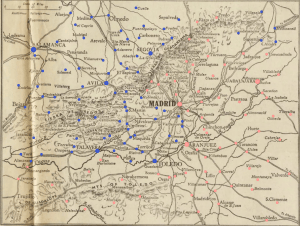
On 4 November 1936, Prime Minister Francisco Largo Caballero reshuffled his cabinet to form his second government, marking a historic and highly controversial moment in the Spanish Civil War. For the first time, the anarcho-syndicalist Confederación Nacional del Trabajo (CNT) abandoned its strict anti-state principles to enter a central government. Federica Montseny was appointed Minister of Health (becoming Spain’s first female cabinet minister), Joan García Oliver was Minister of Justice, Juan Peiró was Minister of Industry, and Juan López Sánchez was Minister of Commerce. Prior to this reshuffle, regional bodies, such as the Inter-Provincial Council of Santander, Palencia and Burgos, operated with a high degree of autonomy, often dominated by local anti-fascist coalitions where the CNT held significant sway. By bringing the national CNT leadership into the central government in Madrid, Largo Caballero successfully altered the political equilibrium. It diluted the radical, independent leverage of regional anarchist committees, aligning them closer to central state authority and institutionalised wartime coordination.
The centralisation efforts of the Republican government stood in stark contrast to the violence occurring on the ground in Madrid, where 56 prisoners were executed inside the Carabanchel Reformatory for Men (Reformatorio de Adultos de Carabanchel). This facility, operating on the site where the massive Francoist-era Carabanchel Prison (Cárcel de Carabanchel) would later be built in the 1940s, was caught in the atmosphere of the Nationalist advance. The executions were tied to the unchecked overreach of the Comité Provincial de Investigación Pública (CPIP), a revolutionary policing body. Within days, the approaching front line would turn Carabanchel into a bloody combat zone, prompting the newly reshuffled government and the Junta de Defensa de Madrid to initiate mass evacuations of the city’s detention facilities to prevent prisoners from being liberated by Franco’s troops.
The Comité Provincial de Investigación Pública (CPIP) kept internal files, logbooks, and freedom chits (execution orders disguised as transfer papers), so the victims were recorded. The bodies of victims left in Carabanchel were routinely collected by municipal services or court authorities who compiled daily lists of the deceased for the city’s morgues and forensic registers. Following the war, Francoist investigators gathered every available Republican prison ledger, municipal graveyard register, and CPIP document and the names of these 56 individuals are preserved today within those Causa General files held in Spain’s historical archives, which modern researchers like Fernando Jiménez Herrera used to reconstruct the timelines of the violence.
The bodies of the 56 prisoners followed a two-stage journey from the moment of execution to their final resting places. In early November 1936, Madrid’s cemeteries were entirely overwhelmed. When the CPIP or local militias executed prisoners inside or just outside the Carabanchel Reformatory, the bodies were initially deposited in mass graves dug within the grounds of the nearby Carabanchel Cemetery (Cementerio de Carabanchel Baja) or left in roadside ditches to be swept up by municipal trucks. Just days after these executions, the battle lines shifted directly into Carabanchel. The area became an active front line, sealing these initial, shallow burial sites beneath trenches and artillery fire for the remainder of the war. After Franco took Madrid in 1939, the Nationalist regime exhumed hundreds of mass graves across the city to recover the bodies of those they deemed Martyrs of the Crusade. Many families who could identify their relatives claimed the remains and reburied them in private family plots within Madrid’s municipal cemeteries. For the remaining, unidentified, or unclaimed bodies from the Carabanchel mass graves, the regime systematically transferred them in the late 1950s to the Valle de los Caídos (Cuelgamuros).
- León Province
On 4 November 1936, the province of León, firmly under the control of Nationalist forces, began a new phase in systemic campaign known as la depuración franquista (the Nationalist political screening) of the civil service. The Nationalists viewed the existing state apparatus, teachers, municipal workers, judicial staff, and provincial administrators, with deep suspicion. They believed these public servants were structurally loyal to the Second Spanish Republic. They had, of course, been killing anyone they considered against their new fascist regime, but wanted to take things to a new level in order to find extra victims. Public employees were forced to submit formal declarations, swear unequivocal loyalty to the ‘National Movement,’ and provide testimonies from local authorities (such as the Guardia Civil, the clergy, or Falangist officials) to prove they had no anti-patriotic or leftist leanings. Failing to demonstrate this absolute ideological alignment resulted in immediate dismissal, loss of pensions, blacklisting, imprisonment and/or execution. This screening process allowed the Nationalist authorities to rapidly replace the pre-war bureaucracy with politically vetted loyalists.
The depuración plan had devastating, generational consequences for the people of León, effectively fracturing local society through a planned campaign of terror, economic ruin, and cultural erasure. Because León was seized by Nationalist forces early in the war, the province did not experience front-line combat, but was a primary testing ground for the White Terror, and its cold, methodical institutional cleansing designed to eliminate any traces of the Second Spanish Republic. For many public servants, the loyalty screening was a death sentence. Anyone suspected of leftist sympathies, trade union ties, or freemasonry was arrested. In León city alone, records show that at least 1,018 people were executed or murdered by Nationalist death squads and Falangist militias during the repression. Victims were dumped into unmarked mass graves in local cemeteries and roadside ditches across the province. Decades later, León remains one of the focal points for the modern Association for the Recovery of Historical Memory (ARMH), as families continue to exhume mass graves in areas like Ponferrada to identify their lost relatives.
Primary and secondary school teachers bore the heaviest brunt of the ideological purge. The Francoist regime viewed public educators as the ‘intellectual poison’ that had spread Republican ideas of secularism and democracy. Hundreds of teachers across León were permanently stripped of their titles, banned from teaching, and replaced by ideologically vetted loyalists, Falangists, or members of the Catholic clergy. This hollowed out the province’s educational system overnight. A generation of children in León lost their most qualified, progressive teachers and were instead subjected to a rigid curriculum of national-Catholicism and strict military-style discipline.
For those who survived the executions, the administrative orders broke them financially. If an employee was flagged as disaffected, they were dismissed without a pension. The Law of Political Responsibilities mechanism allowed the state to seize the property, savings, and lands of Republican-aligned families. Families of the purged were blacklisted from finding other work, plunging entire households into extreme poverty.
The order turned neighbours against one another, as designed. To keep their jobs, public servants had to submit testimonies from the local priest, landowners, or the Guardia Civil. This weaponised personal grievances. People began denouncing co-workers, neighbours, or business rivals as reds to save themselves or to steal the accused person’s job or property. The plan successfully achieved the Nationalist goal: it completely dismantled the democratic civil service and crushed any potential resistance behind the lines. For the people of León, it left behind a traumatised community defined by enforced silence, institutional mistrust, and grief that families were forced to hide publicly for nearly four decades until the death of Franco. Historical consensus estimates that between 3,000 and 3,500 people were killed by Nationalist and Francoist repression in the province of León.
- Badajoz, Extremadura
The initial, explosive violence of the Badajoz massacre in August 1936, where Nationalist forces under Lieutenant Colonel Juan Yagüe turned the city’s bullring into a site of mass execution, frequently dominates the historical memory of the Spanish Civil War. However, the fall of the city did not signal the end of the bloodshed. By autumn, the sensationalist, public slaughter transitioned into a cold, bureaucratic, and unrelenting administrative purge. Through October and November 1936, Badajoz city experienced a daily cadence of executions designed to systematically eradicate the remnants of the democratic Second Spanish Republic. Archival records reveal that the Francoist machinery maintained a steady rhythm of violence, transforming execution squads into a routine instrument of local governance.
By late October, the rhythm of executions fluctuated but never ceased. Instead of the chaotic battleground casualties of August, these deaths were the result of arrests, quick military tribunals, or arbitrary lists drawn up by local informants, and seemed to often killed in groups of seven. On 21 October 1936: 7 victims were executed, on 27 October 1936, 13 victims were executed. These figures illustrate how the occupying forces maintained tight control over the local populace through periodic, calculated spikes in violence designed to crush any underground resistance or union activity before it could take root.
As the calendar turned to November, the repression shifted into an ongoing, relentless routine. Records indicate that on most days throughout November, the death toll in Badajoz city hovered between 7 to 14 victims daily. The specific records from early November offer a stark, individualised window into the diverse social backgrounds targeted by the White Terror. On 3 November 1936, the Nationalists took only one victim to be executed. On 4 November, they escalated again and had eight victims killed inside the city on a single day. Their names and professions reflect the regime’s systematic targeting of working-class labourers, state employees, and ordinary citizens – Desiderio Almena Prada, 46, a railway worker, Antonio Campanón García, 22, a day labourer, Manuel Campini Fernández, 46, a border guard, José Carretero Sánchez, 41, also a border guard, Eduardo Chaves Álvarez, Ramona Cierva Gemio, 47, a housewife, showing that women who were family members of of those deemed ideologically suspect but had managed to flee were still be murdered, and Antonio García Torres, and José Vidal Rincón. the next morning, two more were marched out of prison – Faustino Colazo Barreda, 35, a day labourer, and Ramón Vaca Marín.
The customs and border guards were heavily targeted across Spain because their institutional loyalty lay with the established Republican state. Similarly, day labourers and railway workers formed the backbone of the local land reform movements and socialist trade unions that had sought economic equality before the coup. By executing a steady stream of people nearly every single day through November, the Nationalist authorities achieved an environment of total compliance through psychological exhaustion. The bodies were routinely taken to unmarked mass graves in the local municipal cemetery, leaving families in a permanent state of terror and enforced silence. This grinding, daily attrition in Badajoz city serves as a poignant reminder that the White Terror was not merely a consequence of the initial military invasion, but a deliberate, long-term policy of societal pacification.
For decades, families and historical memory associations have consistently called for the opening and exhumation of the mass graves at the San Juan cemetery in Badajoz. Since 2006, various historical memory associations, including PREMHEX, have received countless requests from families seeking to locate and exhume the remains of relatives who were murdered in the city of Badajoz. Because of the vast number of innocent people killed in Badajoz city, the Cemetery of San Juan was filled so heavily with unidentified people, the point there is many mass graves, which each have individual levels and departments, which were occasionally recorded on military execution paperwork. The issue is there is no way to know where any mass site is, let alone a level or department, as people were then buried above the victims, with tombs, niches and walkways neatly laid on top to prevent the truth from ever being discovered.
Historians do not know the exact, final number of people who died of repression in Badajoz city, and we likely never will. However, rigorous archival research provides a chilling baseline: historians have fully identified and named between 1,349 and 1,545 individual victims killed within the capital city itself. The total estimated death toll for the city, including the thousands of unrecorded killings from the initial August 1936 onslaught, is much higher, with consensus placing it between 2,000 and 4,000 deaths. This means that up to 10% of Badajoz city’s entire pre-war population was eradicated by the Nationalist repression, when other locations showed killing 2% was generally enough to subjugate a population (though percentages are not a good measurement in dealing with repression numbers, they artificially suggest the damage was low).
Following their victory, the Francoist authorities systematically purged municipal civil registries, hospital entries, and prison ledgers. For decades, the regime aggressively denied that the massacre had occurred at all, famously dismissing the reports of foreign journalists as red propaganda. Witnesses recounted hundreds of bodies at a time from the bullring and the cathedral being stacked like logs into municipal trucks, driven to the San Juan cemetery, dumped into mass ditches, and immediately cremated using petrol to hide the evidence and prevent disease. Historian Francisco Espinosa Maestre (La columna de la muerte) changed everything. Espinosa painstakingly went through surviving local civil registries, court-martial fragments, and hidden oral testimonies. He managed to rescue the names of 1,349 specific victims executed inside the capital city. More recent exhaustive investigations, such as Javier Martín Bastos’ doctoral work, Badajoz, Tierra Quemada, have expanded the verified database across the entire province to over 10,088 victims of the White Terror, confirming that the grinding daily attrition inside the capital city was part of a meticulously organised, long-term blueprint of political extermination.
Tt was a highly coordinated collaboration between the Nationalist military and local fascists, rather than the army simply leaving locals to kill as they pleased. The military maintained absolute top-down control over Badajoz, and the ongoing daily repression was heavily institutionalised. The army did not create a lawless power vacuum and leave; instead, they stayed and deputised local right-wing civilians to help them systematically cleanse the city.
The division of labour between the military and the locals worked through a specific structure. While Lieutenant Colonel Yagüe’s main column advanced toward Madrid, a permanent military garrison and a newly appointed military governor were left behind to rule Badajoz. The army established military tribunals. Many of the daily executions in October and November were formally signed off on by army officers executing ‘legal’ death sentences.
The incoming regular army didn’t know who the local union leaders, school teachers, or Republican voters were. They relied entirely on local collaborators to point them out. Local civilian fascists and wealthy landowners formed death squads. They used their intimate knowledge of the town to draw up blacklists. The military’s presence gave these locals absolute immunity. They used this power to settle pre-war grudges, denounce business rivals, and eliminate land-reform activists who had challenged the wealthy elite.
This video does a good job of showing the reality of the people that the controlling forces of Badajoz wanted to eliminate –

