- Madrid
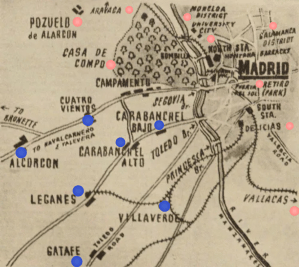
By the first week of November 1936, the war had reached the immediate geographical thresholds of the capital. Having secured their staging grounds at Alcorcón, Leganés, Getafe, and the Cuatro Vientos aerodrome just twenty-four hours prior, General José Enrique Varela’s columns launched their final coordinated push to breach Madrid’s outer defensive ring. Operating from their immediate jump-off points at Leganés and Getafe, Nationalist columns pushed northward into the southern suburbs, launching heavy probing attacks against Villaverde and Carabanchel Alto. Concurrently, forces positioned at Alcorcón and the newly captured Cuatro Vientos aerodrome advanced towards the western military complex of Campamento. Improvised Republican trade union and political militias engaged in fierce, street-by-street delaying actions. These defensive efforts were bolstered by aggressive counter-strikes from Soviet-manned T-26 tanks, which temporarily checked the Nationalist armour and infantry momentum.
In the skies, 5 November marked a critical tactical shift. Nationalist bombing wings, composed of Italian Savoia-Marchetti SM.81s and Fiat CR.32 fighters, supported by the German Condor Legion, attempted to strike military positions. For the first time, Soviet-supplied Polikarpov I-15 Chato fighters intercepted the Nationalist formations in force. Heavily disrupted, the Nationalist bombers dropped their payloads prematurely. Thwarted from their primary military targets, Nationalist artillery and aircraft retaliated by bombarding Madrid’s urban centre, striking residential areas, markets, and hospitals. Civilian casualties mounted rapidly, with municipal slates recording over 300 civilian deaths from the day’s raids.
The superior coordination, artillery, and professional training of the Nationalist columns overran the fractured Republican defensive lines, resulting in a swift cascade of territorial losses. Villaverde, positioned directly south of the city, was completely occupied by Nationalist columns by the end of the day, following the initial breaches of the 5th. Carabanchel Alto, just northwest of Villaverde, a vital buffer zone, was breached after ferocious hand-to-hand combat, with Nationalist forces consolidating total control of the area by late afternoon.
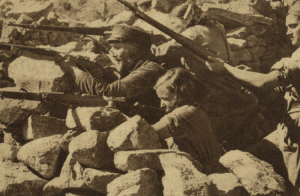
At Campamento, advancing from the Cuatro Vientos sector, Nationalist pincers overran this sprawling military encampment on the western outskirts, depriving the Republic of a major staging area and positioning Nationalist troops directly in front of the Manzanares River.
At Cerro de los Ángeles, when sweeping from the Getafe sector, Nationalist troops stormed and secured this strategic high ground. The capture granted Varela’s artillery commanding views and open firing lines over the entire southern approaches to the capital.
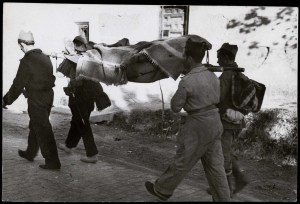
Shattered Republican militia units abandoned their perimeter positions and retreated across the natural barrier of the Manzanares River and into the dense urban core of Madrid, preparing for a desperate, final stand. The 48-hour engagement resulted in severe losses. During the capture of Carabanchel and Cerro de los Ángeles alone on 6 November, Nationalist columns suffered 426 casualties, a significant drain on their pool of Moroccan Regulares. Republican military losses were substantially higher but remained unquantified due to the breakdown of militia command and administrative structures. Hundreds of civilians died daily from the escalating bombardments. On the heaviest bombing runs, municipal records documented over 300 civilian deaths in a single day.
By the evening of 6 November, the loss of Campamento to the west and Villaverde to the south signalled that Madrid was on the verge of complete encirclement. Panic gripped the political leadership as rumours spread that a fifth column of Nationalist sympathisers inside the city would rise up the moment Varela’s columns breached the gates.
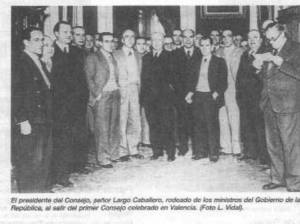
Concluding that the fall of Madrid was imminent, Prime Minister Francisco Largo Caballero and his cabinet decided that the survival of the Republic depended on safeguarding its leadership. In a hasty and secretive move, the government packed its archives and transferred the capital’s seat to Valencia. They left behind General José Miaja to head a freshly formed Madrid Defence Junta (Junta de Defensa de Madrid). Though left to manage what the fleeing cabinet assumed would be the city’s final hours, Miaja, the arriving International Brigades, and a mobilised civilian population would instead rally behind the cry of No Pasarán, turning the impending rout into a historic, years-long siege.
- Valencia
While the concept of moving the capital to Valencia was not a snap decision, Valencia still had plenty to do in the face of impending doom in Madrid. The sudden conversion of Valencia into the capital caused a massive, overnight population spike. An estimated 15,000 to 20,000 official personnel, comprising ministers, undersecretaries, administrative clerks, state police, telegraph operators, and their immediate families, flooded into the city on 6–7 November. An additional 2,000 to 3,000 international figures, including foreign embassy staffs (notably the massive Soviet delegation), international journalists, and early volunteers for the International Brigades, requisitioned the hotels along Calle de la Paz.
This administrative migration sat on top of a sweeping civilian crisis; within weeks, the influx of ordinary refugees fleeing the siege of Madrid pushed the overall number of displaced persons in the Valencia region well past 100,000, causing a severe strain on the local food supply and housing syndicates.
The evacuation of the national artistic patrimony (primarily the masterpieces of the Museo del Prado) had been triggered one night earlier. Following the same ministerial order that prompted the cabinet’s flight, the Ministry of Public Instruction officially ordered the evacuation of the Prado. The first truck loaded with masterpieces, under the direct responsibility of the Alianza de Intelectuales Antifascistas, including writer María Teresa de León, departed Madrid on the evening of 5 November and arrived in Valencia on 6 November, taking nearly 24 hours to complete the dangerous journey. When they arrived, the highly specialised bomb-proofing of the Torres de Serranos and the Colegio del Patriarca was still being hastily built. For the first several days, the crates containing priceless works by Velázquez, Goya, and El Greco had to be temporarily stored under armed guard in the central depositories of the Dirección General de Bellas Artes before being moved into the fortified medieval towers.
Valencian officials had to start the process of preparing the city’s architectural marvels to house the entire machinery of the Spanish State. The 15th-century Palacio de Benicarló (Palau dels Borja) would would set up for Prime Minister Francisco Largo Caballero to host the first Council of Ministers, while the Capitanía General building on Plaza de Tetuán was cleared out to serve as the official residence for President Manuel Azaña, despite having been the site of a shoot-out only a week earlier. Historic estates along Calle Caballeros and surrounding districts would be reallocated. The Palacio Marqués de Campo became the Ministry of Health, the Palacio de Trénor housed Agriculture, and the Palacio del Barón de Llaurí took over the Ministry of Interior. The municipal council would modify its own chambers at the Valencia City Hall (Ayuntamiento) and prep the historic Lonja de la Seda silk exchange to host upcoming emergency sessions of the Cortes Generales.
The sudden departure of the Republican government on November 6, 1936, provoked a complex mixture of initial shock, bitter feelings of abandonment, and a fierce, stubborn determination among the people of Madrid. Because the evacuation was kept a strict secret until the ministers were already gone, Madrileños woke up to a city under direct siege with no central leadership. The immediate reaction among ordinary citizens and frontline militia fighters was a profound sense of betrayal. The government had spent weeks broadcasting slogans like ¡No pasarán!, only to quietly pack up and leave for Valencia. The anger was so immediate that when some government cars tried to leave the city, anarchists and local communist militias blocked the roads at places like Tarancón. They forced several high-ranking officials out of their vehicles at gunpoint, branding them as cowards and demanding they return to the front. Popular street rumours and underground humour quickly labelled the evacuation not as a strategic relocation, but as a plain act of cowardice by politicians leaving working-class citizens to bear the brunt of the Nationalist bombs.
Once the initial shock passed, the feeling of abandonment paradoxically transformed into a powerful unifying force. The mindset shifted from relying on politicians to a collective realisation: We are on our own, so we must save ourselves. General José Miaja was left behind to form the Junta de Defensa de Madrid (Madrid Defense Council). Miaja, along with his chief of staff Vicente Rojo, became instant folk heroes. The people respected them because they stayed in the trenches while the cabinet fled. Rather than collapsing into panic as Franco’s forces expected, thousands of ordinary citizens, including women and the elderly, surged to the outskirts of the city to dig trenches, construct barricades out of cobblestones, and carry ammunition to the front lines in University City.
Left-wing parties and unions (like the PCE and CNT) capitalised heavily on the government’s exit. Their propaganda effectively argued that while the bourgeois politicians ran away, the true working-class proletariat stayed behind to fight the fascists. This drastically boosted the influence of communist and anarchist militias in organising the successful defence of the city. The government of Francisco Largo Caballero slipped out of Madrid in absolute secrecy in the dead of night on November 6. They didn’t tell the public, and they did not even notify the military command in charge of the city’s defence until they were already gone. You cannot plaster a city in posters shouting ‘Madrid will be the tomb of fascism,’ demanding that citizens fight to the last brick, while the leadership is simultaneously packing up cars to head to a sunny coastal city 300km away.
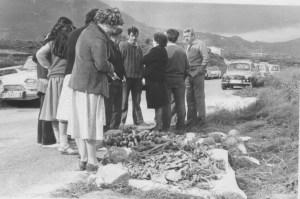
- Las Auchas, Labastida, Álava, La Roija
On 6 November 1936, 12 residents from various towns in La Rioja – Haro, Rodezno, Treviana, Anguciana, San Asensio, and San Vicente de la Sonsierra, were executed by Nationalist forces. They were shot along the road between Labastida and Rivas de Tereso, at a roadside spot known as Las Auchas. Their bodies were buried together in a roadside mass grave at that site. Because individual identification of the skeletal remains was impossible at the time they were exhumed, a local commission and the families agreed to bury them collectively. They were laid to rest inside a communal mausoleum located in the cemetery of San Vicente de la Sonsierra, La Rioja.
The murderers didn’t bury them, but a local resident did, and informed the families of the location. Almost 44 years later, Blanca Ramírez López, daughter of Martín Ramírez Apilánez, one of the victims began the fight to recover her father, and the exhumation was carried out by the families themselves on June 6, 1980, using picks and shovels. They gathered the skeletal remains and buried them together in a mausoleum in the cemetery of their village, San Vicente de la Sonsierra.
The burial at the San Vicente cemetery followed two days later on 8 November 1936. “I urge all families whose loved ones are left lying in the ground—just as ours were—to recover them. Do not let the potential suffering or the costs deter you… You cannot imagine the joy one feels when holding the remains of one’s own father—as I have held mine,” said Blanca Ramírez López, who was thus able to lay her father to rest.
On 6 November 1936 on the roadside, the local Falangists pulled the 12 from their prison cells, killing a mixture of local political leaders and organisers, almost all married with children to support –
- Leopoldo González Izarra, 42, from an industrialist and merchant in Haro where he owned a textile warehouse and a factory that made bottle covers (using straw and metal). President of the
- Nicolás Martínez de Sojo Bastida, 55, a farm worker from Anguciana
- Félix Urrecho Ruiz, 26, a sandal maker from Haro, member of the CNT
- Ismenio Moneo Tordomar, 58, a teacher in Haro, member of Izquierda Republicana. Arrested after his son, Ismenio, managed to escape in the infamous saca de la fuga on 14 October 1936.
- Francisco San Juan Quintana, 58, scrap metal dealer in Haro
- Braulio Antón García, 49, a postman in Rodezno and Izquierda Republicana councilman and appointed government delegate in April 1936.
- Vicente Rojas Carbonera ‘Bochincha’, 46, musician and farm worker in San Asensio, member of the CNT.
- Felices del Campo Ábalos, 29, farm worker from San Asensio, president of the Juventudes Socialistas Unificadas.
- Juan Martínez Ábalos, 33, town hall worker and secretary of Izquierda Republicana for San Vicente de la Sonsierra. His family owned the telephone exchange, which was later taken from them.
- Martín Ramírez Apilánez, 28, a farm worker in San Vicente de la Sonsierra, member of the CNT
- Ceferino Sagredo Hermosilla, 29, a farm worker from Treviana, and his brother –
- Cipriano Sagredo Hermosilla, 32, foreman at the cement factory at Treviana
The monument also bears the names of the other 19 individuals from San Vicente who were murdered. The murders are documented in the 2007 book by Jesús Vicente Aguirre González, ‘Nothing ever happened here. La Rioja 1936’
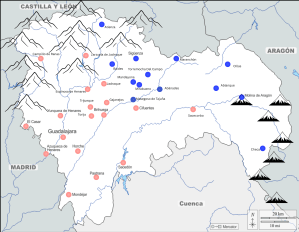
- Mirabueno and Mandayona, Guadalajara
While the eyes of the world were fixed on the dramatic Nationalist push against the gates of Madrid on 6 November 1936, a lesser-known but strategically significant operation was unfolding roughly 120 kilometres to the northeast. Operating in the rugged Guadalajara province along the Sigüenza Front, another heavily armed, professional war machine invading villages in Guadalajara, pitted against civilian workers thrust into a fight for survival.
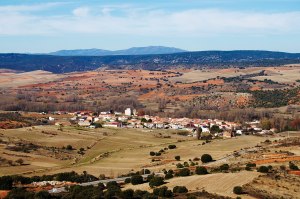
Following the Nationalist capture of Sigüenza in October, the frontline in north-eastern Guadalajara had temporarily stabilised. The local Republican forces held defensive high ground outposts linking Mirabueno and Mandayona to protect the Henares River valley and the strategic Aragon Highway (Carretera de Aragón) and could attempt a potential counter-attack while the main fascist vanguard battered the gates of Madrid. For the local population, the front line was a terrifying disruption of daily life. The villages sat on the edge of a rugged plateau, transformed overnight into an active combat zone where rural communities were caught directly in the crossfire of heavy weaponry.
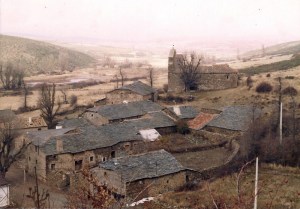
The Nationalist assault was spearheaded by the Soria Division, heavily armed, extreme-right Carlist militia volunteers from Navarra and Burgos, which would grow to number roughly 20,000 men in the sector. These were trained soldiers backed by organized logistics. Crucially, they held an absolute monopoly on heavy artillery and transport vehicles, allowing them to shell defensive positions from a safe distance before moving infantry forward. Holding the trenches around Mirabueno, population 300, and Mandayona, population 500, was a thin line of approximately 1,500 to 2,000 local Republican volunteers; local peasants, trade unionists from the UGT, and 100 young political militants from the Milicias de Juventudes that had been holding the forward trenches directly inside Mirabueno since early August under the tactical direction of Captain Francisco Martínez de Aragón.
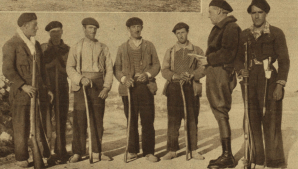
The Mandayona Militia was a native defence group made up of local workers and farmhands from Mandayona itself, who had organised to protect their newly formed agricultural collectives. Alongside them was the 20 de Julio Militia (PSOE), a socialist trade union militia battalion that had been deployed along the Guadalajara-Brihuega-Mirabueno corridor to reinforce the overextended sector with the La Pasionaria’ militia, a highly motivated communist unit composed mostly of workers from Madrid and regional hubs who filled the gaps between the hill outposts.
Due to a strict international arms embargo that prevented the legitimate democratic government from purchasing weaponry, these volunteers were severely outgunned. They lacked proper artillery, automated weapons, and formal defensive fortifications. Human bravery could not compensate for the material starvation imposed on them. When the Soria Division unleashed concentrated artillery bombardments on 5–6 November, the under-armed civilian militias were systematically blown out of their improvised positions, forcing a desperate retreat to avoid total annihilation.
In the official Nationalist War Diary (Parte Oficial de Guerra) issued immediately following the capture of the villages on 6 November, the Soria Division reported counting 50 Republican dead left behind on the field, alongside the capture of five automated machine guns and massive amounts of small arms ammunition abandoned as the outgunned volunteers were shelled out of their trenches. The under-armed retreat was so devastating because the volunteers lacked medical evacuation infrastructure. It wasn’t until a counter-offensive months later by the XII International Brigade that the Republic temporarily reclaimed Mirabueno, where they discovered mass graves from the November fighting and set up a mobile hospital at the nearby Adoratrices convent to handle the massive influx of wounded from the ongoing trench warfare.
- Granada Province, Andalucía
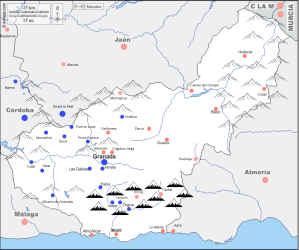
By the second half of October 1936, the chaotic, fluid skirmishes of the initial July coup had hardened into a brutal, heavily fortified front line splitting Granada province in two. Known historically as the Cerco de Granada (the Siege of Granada), this theatre pitted the Nationalist garrison, isolated in Granada city and a narrow western corridor, against Republican militias holding the northern crags, the eastern expanses, and the high Sierra Nevada. As the main assets of both armies were increasingly diverted north toward the colossal Siege of Madrid, the fighting in Granada during these two weeks became a desperate struggle to secure high-altitude observation posts and lock down geographic choke points.
The Siege of Peñón de la Mata was taking place in a jagged, isolated limestone formation rising 1,668 metres above the municipality of Cogollos Vega, directly overlooking the capital city. Having firmly occupied this eagle’s nest earlier in the month, Republican militias used its steep topography to establish heavy artillery observation posts. From this summit, they could monitor and shell Nationalist troop movements inside Granada city. The Nationalist objective was a total, uncompromised removal of this threat. The Republican defensive line was anchored by roughly 1,200 to 1,500 militia volunteers comprising local workers, union members, and socialist battalions from the eastern sector. The Nationalist attacking forces used a coordinated strike force of approximately 2,000 personnel, comprising regular infantry from the local Granada garrison, specialised artillery units, and Carlist Requeté paramilitary units
Throughout the final weeks of October, Nationalist forces launched systematic, uphill frontal infantry assaults backed by intensive artillery barrages and strafing runs from light aircraft. The Republican forces turned the natural limestone fissures and deep trenches into fortified machine-gun nests. Wave after wave of Nationalist attacks were repulsed by blistering crossfire. Combined casualties for this sector alone during the latter half of the month are estimated at 200 to 300 dead and wounded, with the Republican forces successfully holding the peak.
The rolling agricultural valleys and isolated farming cortijos of north-west Granada, spanned Montefrío, Íllora, Moclín, and Tozar, and following the Nationalist capture of Montefrío on 23 September, the region remained highly volatile. In late October, desperate Republican popular militias from the Jaén and Málaga sectors launched uncoordinated counter-attacks to crack the western Nationalist supply line. Conversely, the Nationalist column objective was to completely pacify the rural population and secure the vital corridor linking Granada to Nationalist-held Seville and Córdoba.
Nationalist mobile columns, heavily augmented by local Falange cavalry units and Civil Guard detachments, deployed around 1,500 highly disciplined troops. They faced fragmented, poorly equipped Republican militia bands and armed local peasants numbering close to 1,000 combatants. The fighting culminated in a fierce, chaotic series of engagements between 21 and 24 October 1936. Attempting to cross the open, rolling terrain without proper communication or artillery support, charging Republican militias were systematically broken by Nationalist machine-gun nests. The counter-offensive shattered completely. Republican forces suffered devastating losses, with over 300 casualties in a three-day span. Thousands of panicked agricultural day-labourers and their families fled the small villages, scattering into hidden mountain ravines and isolated cortijos to escape the advancing columns.
The military failures of the Republican forces on the battlefield directly accelerated a dark, highly calculated campaign of political terror in the Nationalist-controlled zones of the province. Governed under the iron fist of Civil Governor military commander José Valdés Guzmán and Public Order delegate José Nestares, the repression in late October shifted from chaotic street violence into a cold, bureaucratic machine. Executions were carried out via the saca system. Operating on highly specific blacklists provided by local right-wing informants, landowners, and traditionalist clergy, Falangist execution squads (including the notorious Escuadra Negra (Black Squadron) went directly to specified residential homes and overcrowded temporary prisons.
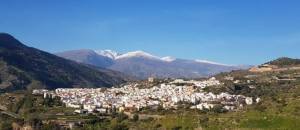
On 28 October 1936, sitting at the strategic gateway of the Alpujarra mountains, the Nationalist-controlled hub of Órgiva was highly vulnerable to nearby Republican mountain columns. On the night of 28 October, a targeted saca extracted nine permanent local residents directly from their cells, all targeted for their progressive municipal, union, or ideological peacetime activities. The nine men were driven under armed guard directly to the Barranco del Carrizal (The Carrizal Ravine), a massive limestone gorge outside the town. They were shot at the cliff’s edge, their bodies rolling into the depths where they were immediately covered in quicklime to eliminate documentation and avoid local civil unrest. This group formed a distinct chronological layer within a ravine that eventually held between 2,300 and 5,000 victims of the White Terror.
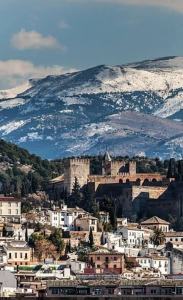
In Granada province, the topography didn’t just influence the fighting in late October 1936, the landscape dictated the entire military strategy, freezing the front lines into a permanent stalemate. Granada features one of the most extreme altitudinal drops in Europe. Over a distance of just 50 kilometres, the terrain plummets from the snow-capped, alpine peaks of the Sierra Nevada (over 3,400 metres high) down into the sea-level subtropical coast, passing through deep river ravines and a low, flat volcanic basin. This dramatic, fractured landscape affected the military operations across three specific topographic zones.
The high alpine peak walls of the Sierra Nevada is a towering mountain massif featuring Europe’s highest highway pass and peaks like Mulhacén (3,479m) and Pico del Veleta (3,396m). The terrain is barren, wind-scoured stone, covered in heavy snow by late October. The extreme altitude neutralised standard military manoeuvres. Heavy tanks, transport trucks, and rapid troop movements were completely impossible. Soldiers had to fight on foot or use pack mules to haul light machine guns up shear ice sheets and scree slopes. The Nationalist Grupo Alpino dug into the rocky ridges of the Veleta peaks while the Republicans dug into Mulhacén. The terrain forced a brutal, frozen, high-altitude trench stalemate where the main enemy for both sides was not gunfire, but severe frostbite and altitude sickness.
The tactical high ground remained at the Peñón de la Mata north of the capital city. These formations granted absolute visibility and a massive defensive advantage to whoever held the summit. Because the limestone crags are riddled with natural caves, deep fissures, and jagged rock faces, they acted as organic, bulletproof bunkers. Republican militias holding the Peñón de la Mata were immune to standard Nationalist infantry charges and light artillery. When Nationalist troops tried to storm the uphill slopes, they were completely exposed on the open terrain below. The natural rock fortress allowed a relatively small number of Republican volunteers to completely stall a major, well-equipped Nationalist assault force.
The bottleneck corridors of Poniente Granadino and the mountain passes are a labyrinth of narrow gorges, winding mountain roads, and rolling hills separating Granada city from the western provinces of Córdoba and Málaga, anchored by fortress towns like Montefrío and Loja. The landscape forced advancing armies into tight, predictable bottlenecks. To move troops or supplies, both sides had to use the few existing mountain passes, which were easily covered by hidden machine-gun nests and artillery batteries perched on the flanking hillsides. In the open valleys of the Poniente, the Nationalists used their superior organisation to slaughter charging Republican militias between 21 and 24 October. However, once the lines pushed into the tighter mountain throats, the terrain allowed the defenders to instantly stall the advance. This structural bottleneck is also what turned Órgiva into a closed border gateway to the Alpujarras, where the deep, concealed gorge of the Barranco del Carrizal was used precisely because its natural drops hidden from the main town allowed for the secretive, rapid disposal of execution victims.
While the brutal landscape was a massive, structural obstacle, it was not the only thing holding back the Nationalists in late October 1936, but it acted as a force multiplier. It amplified the severe tactical limitations, strategic choices, and resource shortages that both sides were experiencing during those specific two weeks. The Nationalists were held back by a combination of the terrain and three military factors. First, by late October 1936, General Franco and the Nationalist high command had made a definitive strategic decision that Madrid was the ultimate prize that would win the war. The vast majority of competent troops, heavy artillery, ammunition, tanks, and foreign air support (such as the German Condor Legion and Italian aviation) were systematically pulled away from secondary fronts like Granada and Jaén. The Nationalist garrisons in Granada and the vanguard columns in newly captured Alcalá la Real in Jaén were left understaffed. They did not have the heavy offensive machinery required to blast through fortified mountain passes, reducing them to localised, defensive operations.
Also, the landscape only worked for the Republicans because they successfully adapted to it. In the second half of October, the Republican popular militias shifted from disorganised street factions into an organised, entrenched defensive force. On positions like the Peñón de la Mata, the Republicans did not stand on a hill, they heavily fortified the natural limestone fissures with sandbags, machine-gun nests, and deep trench networks. Because the Nationalists lacked the heavy bombing assets (which were busy in Madrid) to clear these rock fortresses from the air, they were forced to launch bloody uphill infantry charges. The Republican defenders easily held the line because the terrain gave their machine guns a clear, open field of fire over the attackers below.
Thirdly, the Nationalists could not aggressively push forward into Jaén or deep into the eastern Alpujarra mountains because their own rear guard was highly unstable. Towns like Órgiva sat directly on a volatile, razor-thin border. The local population was heavily pro-Republican, and the surrounding mountains were full of bypassed militia holdouts and armed locals. Instead of projecting military force forward, Nationalist assets, including the Civil Guard and Falangist militias, had to be heavily deployed inward to maintain police control through terror. This was why the targeted executions of the nine residents of Órgiva took place on 28 October 1936. The Nationalists felt so exposed by the geography that they used targeted, administrative murder to crush internal town resistance before it could collaborate with nearby Republican front lines.
In Granada, November 1936 solidified the province’s reputation as one of the most rigidly frozen and claustrophobic fronts of the war. The isolated Nationalist island of the capital city remained securely locked down behind its newly reinforced land lifelines, while the surrounding Republican militias remained entrenched just kilometres away on the mountain peaks. High-altitude winter weather quickly set into the limestone crags of the Sierra de Huétor and the Alpujarras, reducing military operations to miserable static warfare. Soldiers on opposing mountain ridges endured freezing temperatures, exchanging intermittent rifle fire and minor border raids that resulted in zero tactical movement, transforming the magnificent mountain landscape into a permanent, heavily fortified stalemate.
Because the military coup succeeded in the capital city but was instantly surrounded by a Republican countryside, Nationalist forces implemented a brutal cleansing campaign to secure their lines. Historical estimates regarding the death toll from political repression of the White Terror places the total number of victims of repression in the Granada province between 8,500 and 11,500 deaths, and 5,860 to 6,000 victims have been explicitly identified by name through official wartime and post-war registries. The remaining thousands are documented through massive, unrecorded burials located in the province’s 135 identified mass graves. The most infamous site is the Víznar Ravine / Alfacar area, where up to 4,000 people (including Federico García Lorca) were executed and buried. Another massive epicentre of execution was the walls of the San José Cemetery in the capital, where between 4,000 and 5,000 people were shot by firing squads between 1936 and the mid-1950s. Historians estimate that well over 5,000 people were killed in 1936 alone in Granada. Immediately following the July 20 military uprising, the city witnessed a frenzy of extrajudicial killings known as paseos, averaging more than 50 executions per day during the summer months. The terror peaked between August and November 1936, as paramilitary squads like the Escuadra Negra swept through newly captured towns to eliminate left-wing politicians, union workers, teachers, and anyone suspected of Republican sympathies.
For the general population of the Granada province, the prevailing feeling was an overwhelming, paralysing sense of terror, vulnerability, and abandonment. The psychological reality depended heavily on which side of the frontline people found themselves, but across the entire province, the initial hope of fighting back quickly dissolved into a desperate struggle for survival. For the working class, left-leaning citizens, and families of union workers or republicans inside Granada city and towns like Loja, the dominant feeling was absolute, paralysed terror.
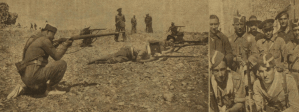
The civilian population quickly realised they could not fight back. The military coup was swift, and the brutal public executions of local leaders, like the city’s Republican mayor, Manuel Fernández-Montesinos, made it clear that any resistance meant immediate death.
Every night brought acute dread. Families sat in silence, listening for the sound of trucks pulling up to doors. People lived with the constant fear that a bitter neighbour or personal enemy would falsely denounce them to fascist squads like the Escuadra Negra just to settle a grudge. There was a profound psychological blow when the local population realised that the Republican militias stationed just a few kilometres away in the mountains were too ill-equipped to break through and rescue them. The frontline was practically in their backyard. From the hills of the Albayzín quarter in Granada city, trapped families could literally look out across the plains and see the peaks of the Sierra de Huétor and the Sierra Alfaguara, knowing their loved ones were entrenched right there. They could hear the echo of the artillery shells and rifle fire reverberating off the mountains daily. This proximity created an intense, agonising anticipation. Every time the sound of gunfire grew louder, a wave of hope would sweep through the hidden, pro-Republican households that this was the day their family members were finally breaking through the lines to liberate the city and end the nightmare.
In the eastern half of the province and up in the steep Alpujarra valleys, the emotional trajectory shifted from radical revolutionary fervour to crushing despair. In July and August, there was a brief, euphoric feeling that they could fight back and win. Local peasants, miners, and workers formed spontaneous anti-fascist committees, seized hunting rifles, and confidently marched toward the capital, chanting that they would liberate Granada. This confidence was violently shattered by Nationalist aviation operating out of the Armilla airbase. Towns like Guadix and Baza were repeatedly and mercilessly bombed from the air. For rural civilians who had never experienced modern warfare, the constant threat of fire and shrapnel raining from the sky created an agonising, daily state of shell-shock and panic. As Nationalist troops advanced through the western corridor, thousands of terrified, starving refugees flooded into the Republican zones, carrying horrific eyewitness stories of mass executions. This triggered a severe psychological shift among the locals from aggressive defiance to sheer survival mode, as resources dwindled and the reality of a long, brutal war set in.
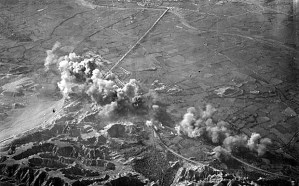
For the rural communities caught directly on the jagged frontline, such as the mountain villages around Órgiva, Pitres, and Cádiar, the feeling was one of complete entrapment.
Neighbours were suddenly split by a jagged line of trenches. Families were torn apart overnight, completely blind to whether their loved ones on the other side of the mountain were alive or dead, trapped in a war zone where the front line barely moved for nearly three years.
When the battle-hardened Nationalist columns swept through the province’s agrarian towns in August and September, the death toll escalated brutally. For example, following a brief occupation in Palma del Río, a local right-wing landowner single-handedly organised the execution of 300 Republican supporters in late August. Following the mid-October collapse of the Guadiato Valley miners’ front, the Nationalists executed between 600 and 800 people in the northern municipalities in a matter of weeks. In total, historians estimate that well over 7,500 of the province’s total victims were killed in 1936 alone, as both the unbridled paseos and the incoming professional military columns pulverised the local population to enforce compliance.
In the eastern and northern parts of the province that remained under Republican control, historians document roughly 2,000 right-wing executions. These were largely carried out in the chaotic initial months of the coup against local landowners, right-wing figures, and approximately 100 members of the Catholic clergy. These victims were able to re covered and dignified during or after the war.
While the baseline strategy of Francoist repression, using systematic terror to eliminate left-wing opposition, was applied across all of Spain, Granada and Córdoba suffered distinct structural dynamics that made their experiences uniquely tragic. The repression in Granada was shaped by its unique geography as an isolated Nationalist island surrounded by a sea of Republican territory. This created a specific form of terror. Because Republican militias were positioned just kilometres away on the mountain ridges, the Nationalist military garrison lived in constant fear of an internal uprising. This sparked a defensive, hyper-aggressive paranoia. The leadership decided that the only way a small garrison could hold a hostile city was through immediate, maximum terror. They actively wiped out the entire civic, cultural, and political fabric of the city to ensure no fifth column could ever form.
Granada had been the crown jewel of Andalucían cultural revival. The repression here uniquely targeted the intellectual and artistic elite. The most famous symbol of this was the execution of Federico García Lorca, but he was part of a systematic murders of the University of Granada’s faculty, progressive teachers, doctors, and engineers. The stark terrain of Granada also led to a unique execution landscape. Instead of using cemetery walls as the primary site, the Nationalists used the deep limestone gorges of the Viznar Ravine and Alfacar. These natural trenches became hidden mass graves for thousands, turning the beautiful landscape directly into a site of industrialised slaughter.
The contrast within the Granada province was visually and socially staggering. On one hand, you had the capital city, a bourgeois, academic, and deeply conservative Catholic stronghold that was simultaneously home to a glittering, progressive intellectual renaissance. On the other hand, just outside the city gates, the landscape dropped into the fertile plains of the Vega and rose into the isolated, rugged mountains of the Alpujarras, where rural day labourers lived in conditions that resembled feudalism. When the military coup succeeded in the capital but failed in the countryside, these extreme class divisions collided violently, creating a unique dynamic of repression that devastated both the city’s elite and the rural poor.
In the capital, the repression was highly targeted and ideological. The Nationalist leadership saw Granada’s progressive intelligentsia as a toxic, modern growth that threatened traditional Spanish values. They didn’t just want to control the city; they wanted to surgically excise its cultural brain. The military systematically hunted down the city’s top minds. They executed the Rector of the University of Granada (Salvador Vila Hernández), renowned professors, progressive doctors, and engineers. Schoolteachers, who had spent years trying to bring literacy to the rural poor, were viewed as dangerous subversives and were executed in massive numbers. The murder of Federico García Lorca was not an isolated tragedy; it was the ultimate expression of this urban class warfare. Lorca represented everything the conservative elite detested; he was avant-garde, empathetic to the marginalised, and connected to the wealthy but progressive bourgeoisie. By killing him in the hills of Alfacar, the regime sent a clear message that the old, rigid social hierarchy was being restored by force.
While the city elite were killed for their ideas, the rural population was slaughtered for their desperation. The social divide between the wealthy latifundistas (absentee landlords living luxury lives in the city) and the jornaleros (landless day labourers) was wider in Granada than almost anywhere else. During the Republic, rural workers had finally gained basic labour rights and small parcels of land to feed their starving families. When the coup hit, the wealthy landowners immediately collaborated with the Nationalist military and fascist Falange squads. They used the military occupation to settle class scores, acting as informants to point out any peasant who had demanded higher wages, joined a union, or failed to bow to the landlord. For rural families, the repression felt like a brutal return to feudal servitude. Peasants were executed not because they were highly educated Marxists, but simply because they were poor and had dared to ask for dignity. In the small agrarian villages dotting the Vega, entire generations of working-class men were lined up against church walls and shot, leaving behind shattered communities of widows and children who were then forced to harvest the landowners’ crops for pennies just to survive.
The ultimate, tragic intersection of these two worlds happened in the execution zones like the Víznar Ravine. In the dead of night, the trucks arriving at the ravines contained a heart-breaking cross-section of Granada’s fractured society. Brilliant university professors and world-renowned poets were pushed off the back of the same trucks as illiterate olive pickers and teenage goatherds. Tied together by wire, the urban intellectual elite and the rural peasantry faced the exact same firing squads, their bodies tossed into the same mass graves, permanently fusing the two extreme halves of Granada’s class system in the limestone dirt.

