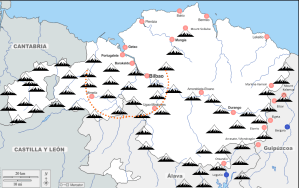
- Bizkaia and Gipuzkoa, Basque Country
On 2 November 1936, the Nationalist air command had executed a series of coordinated fighter sweeps and tactical reconnaissance operations over the strategic hubs of Otxandio and Amorebieta-Etxano. These operations were precise, calculated manoeuvres designed to blind the newly formed Basque Army (Eusko Gudarostea) and map out the defensive vulnerabilities of the Bizkaia rearguard.
To the Nationalist military planners, Otxandio and Amorebieta-Etxano represented critical neural nodes in the Basque defensive infrastructure. Situated on the border between the provinces of Bizkaia and Álava, Otxandio was a vital gateway. It had already secured a grim place in history on 22 July 1936, when it became the site of the first aerial bombing of a civilian population in world history. By November, it served as a primary staging ground for Republican troops dug into the surrounding mountain ridges.
Located further north, Amorebieta was a crucial logistical crossroads. Its rail lines and roads connected the capital of Bilbao to the front lines of the Duranguesado region. Any disruption here would effectively paralyse the movement of food, ammunition, and reinforcements to the frontline trenches. On 2 November, Nationalist aircraft, consisting of Italian-supplied fighters and early reconnaissance units operating out of captured aerodromes in neighbouring Gipuzkoa, roamed freely over these two municipalities.
The air operations on 2 November combined two specific aerial doctrines: tactical reconnaissance and aggressive fighter sweeps. Reconnaissance planes flew low over the valleys, photographing the landscape to identify hidden troop concentrations, artillery emplacements, and communication channels. They meticulously mapped the supply trucks moving along the mountain roads and the encampments of the Basque gudaris (soldiers).
Simultaneously, fighter aircraft executed sweeps, strafing targets of opportunity with machine-gun fire. These sweeps were designed to enforce total air superiority. Because the Basque government possessed virtually no fighter aviation to challenge the attackers, the Nationalist pilots could dive low over the fields and trenches with near-total impunity.
The tactical data gathered during the 2 November operations over Otxandio and Amorebieta-Etxano paid immediate dividends for the Nationalist command. By identifying where the Republican forces were concentrating their troops and how their communication channels functioned, the Nationalist forces were able to plan the highly disruptive bombing raids that struck neighbouring Elorrio and Markina-Xemein just two days later, on 4 November.
The architectural marvel of Republican defence in northern Spain was the Cinturón de Hierro (the Iron Belt), a vast fortification system of trenches, bunkers, and barbed wire designed to render the industrial capital of Bilbao impregnable. However, as the events of 4 November 1936 demonstrated, this formidable defensive perimeter possessed a fatal flaw; it was built to stop an invading army on the ground, leaving the sky wide open to a new, terrifying doctrine of aerial warfare. On that late autumn evening, while the ground war stalled along the mountain passes of Bizkaia, Nationalist aircraft successfully bypassed Bilbao’s defensive grid, executing a targeted air raid that struck at the literal engine of the Basque Republic.
Unlike the terror bombings that targeted the civilian plazas of rural towns like Elorrio or Durango, the 4 November strike on the Greater Bilbao area was highly strategic, aiming to cripple the industrial plants and logistical hubs operating on the city’s outskirts. Bilbao was the crown jewel of the Republican rearguard. Its blast furnaces, iron mines, and naval shipping docks along the Nervión River were actively churning out weaponry, ammunition, and armoured vehicles for the newly formed Basque Army (Eusko Gudarostea). The Nationalist air command, using the early operational elements of the German Condor Legion and Italian bombers, recognised that defeating the Basque Country required starving its factories of raw materials and cutting its distribution lines. During the 4 November raid, Nationalist planes penetrated deep into the metropolitan estuary. Ordnance was dropped with precision near key industrial facilities and transport infrastructure. The bombs targeted the railway arteries and docks that linked the outlying manufacturing plants to the heart of the city, attempting to paralyse the movement of both industrial output and frontline reinforcements.
The psychological impact of the 4 November raid on the population of Bilbao was profound. For months, the Basque government had assured citizens that the city’s geographic positioning and defensive lines offered safety. The raid shattered this illusion of safety, revealing several critical vulnerabilities in Bilbao’s defences. The Republic lacked the modern anti-aircraft batteries needed to create an effective umbrella over the sprawling metropolitan area. The Basque government possessed virtually no fighter aircraft to scramble and intercept the incoming Nationalist bombers, allowing the attackers to execute their runs with near-total impunity.
This raid served as a reconnaissance-by-fire exercise. The German and Italian pilots mapped out the approach corridors, noted the lack of aerial resistance, and calculated the vulnerabilities of Bilbao’s industrial belt, data they would use to systematically dismantle the city’s defences during General Emilio Mola’s massive spring offensive the following year.
The strategic targeting of Greater Bilbao on 4 November triggered immediate political ripples within the city. Faced with the reality that the war could drop from the sky at any moment, the Basque authorities were forced to accelerate construction on hundreds of underground civilian air-raid shelters across the city. Also, these early autumn raids on the capital stoked an intensely volatile atmosphere. Every time Nationalist planes struck the outskirts, anger boiled over in the city centre, frequently leading to heightened political tensions and retaliatory actions against right-wing prisoners held on local prison ships anchored in the very river the bombers were targeting. The 4 November air raid on Greater Bilbao remains a pivotal moment in the northern campaign. It proved that the frontline trenches were no longer the boundaries of combat; the modern industrial city, with its factories, docks, and civilian workforce, had permanently become the new front line.
When historians analyse the advent of modern total war and the weaponisation of aerial terror against civilians, the destruction of Gernika on 26 April 1937 universally dominates the narrative. Yet, the devastating strategy of using the civilian rearguard as human testing grounds was perfected months earlier. Long before the German Condor Legion and Italian Aviazione Legionaria razed the sacred Basque town, smaller municipalities across Bizkaia were subjected to a grinding, repetitive aerial campaign designed to break the Basque spirit.
On 4 November 1936, two municipalities, Markina-Xemein and Elorrio, became the primary targets of Nationalist aviation, enduring targeted raids that foreshadowed the systematic destruction of the region.
Late in the evening of 4 November, the silence over the municipality of Markina-Xemein was shattered by the drone of incoming Nationalist aircraft. The attack was executed in two consecutive, highly disciplined waves, timed precisely to maximise psychological distress, the first at 8:00pm and the second at 8:30pm. During this targeted double-assault, exactly 12 bombs were recorded striking the municipality. Rather than hitting frontline trenches, the primary targets of the raid were the immediate outskirts of the town and, most egregiously, the local civil and blood hospital. This raid formed part of a relentless, months-long psychological campaign conducted by the Nationalist forces. By the time the front lines finally moved past the area, Markina-Xemein had been singled out and bombed by Nationalist forces on 29 separate dates, terrorising local families and turning the scenic Basque hills into a landscape of constant alert.
Markina-Xemein was bombed for the very first time on 20 September 1936. Following that initial September raid, the aerial pressure intensified dramatically starting on 17 October. Local diaries from the autumn of 1936 frequently mention a dark, Nationalist aircraft with uniquely curved wings that locals nicknamed Egoker. This plane routinely flew out of the Nationalist-held aerodrome in Lasarte (Gipuzkoa), dropping payloads of up to 14 bombs at a time over the town’s centre, targeting the local parish, houses, and the Esperanza y Cía arms factory. The 4 November strike was roughly the mid-point of a brutal autumn offensive that saw the town attacked almost every other day.
Simultaneously on 4 November, Nationalist aviation executed a highly targeted tactical raid directly over the urban core of Elorrio. In a display of precision bombing meant to strike at the literal civic heart of the town, a heavy bomb landed directly behind the Town Hall (Casa Consistorial). While the structural walls of the municipal headquarters absorbed the brunt of the explosive force, the resulting blast pressure rippled violently outwards. The shockwave tore through the immediate town plaza, completely shattering windows and causing extensive structural glass damage across the historic square. The 4 November strike on Elorrio served as one of the brutal opening salvos for the municipality. As the Nationalist offensive intensified and the front lines pressed relentlessly against the broader Duranguesado region, the strategic and psychological value of the town escalated. Elorrio would ultimately be forced to endure a staggering 22 separate aerial bombing raids, cementing its place alongside Durango and Otxandio as the foundational testing grounds for fascist carpet bombing doctrine.
While Elorrio’s most infamous and lethal bombing would occur later on 31 March 1937, the town had already been brought into the active combat zone by the autumn of 1936. The 4 November raid was part of the very first wave of aerial operations hitting the town as the Nationalist Northern Army began testing the limits of the Basque defenses around the strategic Duranguesado and Intxorta mountain fronts. The very first aerial bombing of a defenseless civilian population in world history had already taken place just a few valleys over in the Basque town of Otxandio on 22 July 1936, just four days after the war began. By the time November arrived, the Nationalist forces had spent over three months refining their tactics of terror from above across dozens of Basque towns, using Markina-Xemein and Elorrio as frequent tactical targets long before the destruction of Gernika made global headlines.
The twin raids of 4 November 1936 illustrate that the terror bombing of Euskadi was an everyday routine long before it caught the attention of the international press. By targeting civic infrastructures like Town Halls and humanitarian sanctuaries like blood hospitals, the Nationalist air command sought a complete unraveling of the Republican rearguard’s societal fabric. For the populations of Markina-Xemein and Elorrio, November 1936 was the moment the sky permanently became a source of terror.
By early November 1936, the industrial town of Eibar had earned its reputation as a vanguard of Basque Republican resistance. Known historically as Spain’s premiere armaments manufacturing hub, its workers had long been highly unionised and fiercely loyal to the Republic. Because of its strategic location in the Ego River valley, Eibar formed a vital bottleneck blocking the Nationalist advance into western Bizkaia. On 5 November 1936, the Nationalist air command unleashed a wave of heavy, retaliatory bombing strikes against the town. This operation marked a critical shift in tactics: the air forces were deployed not just to terrorise the urban core, but to directly neutralise the lethal Republican artillery batteries dug into the sheer mountain peaks that formed Eibar’s natural fortress.
The geography of Eibar made it a nightmare for invading ground forces. The town is tightly cradled by steep mountains, including the strategic heights of Kalamua, Akondia, and Urko.
Throughout October, Republican militias and Basque gudaris had successfully transformed these jagged ridges into heavily fortified defensive lines. Crucially, they had hauled heavy artillery pieces up into the peaks. From these high-altitude vantage points, Republican gunners maintained absolute visual command over the surrounding valleys, accurately shelling Nationalist troop movements, supply convoys, and frontline infantry advances trying to push forward from captured territories in Gipuzkoa. Unable to dislodge the Basque gunners through ground assaults alone, the Nationalist command turned to the sky on 5 November.
The air raid on 5 November was explicitly categorised as a retaliatory mission. It was launched to punish the town for its stubborn resistance and to silence the artillery batteries that had been inflicting casualties on Nationalist regiments. Nationalist bomber squadrons, operating alongside German and Italian tactical support units, flew low over the valley walls. The pilots targeted the high ridges surrounding Eibar, dropping high-explosive payloads directly onto the suspected coordinates of the Republican gun emplacements. The thunder of the bombs echoing through the narrow mountain valleys created a terrifying acoustic chamber for the civilians trapped in the town below. However, the precision required to hit camouflaged artillery positions on narrow mountain ridges meant that many bombs missed their marks. Heavy ordnance overshot the peaks and crashed down directly into Eibar’s densely populated urban centre, shattering residential quarters and further decimating the town’s famed metalworking and armaments workshops.
The 5 November strikes demonstrated the evolving, lethal coordination between the Nationalist infantry and their supporting air fleets. While the bombs did not permanently destroy all the mountain fortifications, the battle for the Kalamua front would remain a bloody, deadlocked stalemate for months, the raid successfully disrupted the Republican communication lines linking the mountain peaks to the supply depots in the town centre.
The assault on 5 November cemented Eibar’s tragic status as one of the most heavily bombed towns of the northern campaign. By the time the front line finally broke the following April, Eibar had been reduced to a smoking field of rubble. The 5 November raid proved to the Basque defenders that their mountain strongholds were no longer safe; the Nationalist air forces were willing to bomb the very peaks of Euskadi to pave their path to Bilbao.
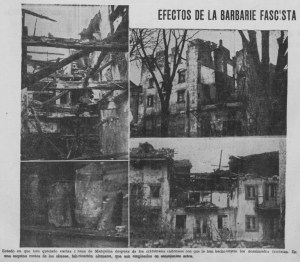
Markinaldeko Frentea
- Alicante, Valencia
On 5 November 1936, Alicante became the site of the first aerial bombing on Valencian territory during the Spanish Civil War. The attack occurred before dawn and was carried out by a German Heinkel He-59 seaplane. The aircraft belonged to the AS/88, a maritime reconnaissance and bomber unit of the German Condor Legion. Operating from a Nationalist-controlled base in Melilla, North Africa, the seaplane flew across the Mediterranean undetected and dropped ten bombs onto Alicante city.
Because the aircraft arrived at approximately 4:30 AM in total darkness, the pilot aimed for the commercial port area. The target was illuminated by the position lights of numerous merchant and military ships anchored in the bay. The bombs hit civilian and maritime infrastructure around the docks, missing the ships themselves but destroying nearby property. As the war progressed, this coastal zone, along with the nearby CAMPSA petroleum refinery located at the base of the Serra Grossa hills, became a frequent target for Nationalist aviation trying to disrupt Republican supply lines
The primary casualties of the raid were civilians. Two people were killed in the blast and another injured, and the strike caused property damage. Because the front lines of the war were still far from the Valencian coast at this stage of the conflict, the event demonstrated the reach of Nationalist-aligned aviation and its willingness to target urban areas behind Republican lines. While this initial raid was limited in scope, it marked the beginning of a prolonged bombing campaign against the city.
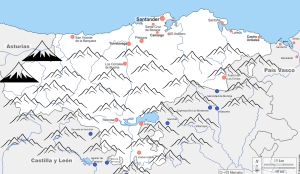
- Santander (Cantabria) and Burgos Border
In early November 1936, the northern mountains of the Burgos province remained frozen flashpoint in the Spanish Civil War. Following the initial July coup, the frontline in this region had fractured into a war of attrition. The combat actions at Villasante de Montija on 5 November and the Espinosa de los Monteros sector on 8 November illustrate the brutal reality of this early mountain warfare.
The primary objective for both factions was control of the strategic mountain passes of the Cantabrian Range, which connected the Nationalist-held plains of Castile with the vital Republican northern stronghold of Santander. Nationalist forces sought to push northward, clear the Republican defenders from the high peaks, and capture the mountain passes before the harsh winter weather made infantry movement impossible. Loyalist forces aimed to hold the high ground, using the natural terrain as a barrier to block any Nationalist advance toward the coast.
The lines were held by roughly 3,000 to 4,000 fighters consisting of the Santander Popular Militias (mainly left-wing union workers and political volunteers) alongside newly forming Basque battalions. While highly motivated and holding the superior geographical heights, they lacked cohesive military training and heavy artillery. Facing them were column units composed of Regular Army infantry, local Falangist volunteers, and highly motivated Carlist Requetés (monarchist militias), totalling around 2,500 to 3,000 men in the immediate sectors. Crucially, the Nationalists possessed superior tactical organisation and a decisive advantage in heavy artillery and ammunition supply.
The combat during this week highlighted the tactical stalemate of the Burgos front. On 5 November, the Nationalists unleashed their artillery superiority on Republican positions near Villasante de Montija. From their fortified positions in the valleys, Nationalist batteries heavily shelled the trenches of the Loma de Montija, aiming to weaken the Republican perimeter and disrupt their defensive lines. Three days later, on 8 November, the Nationalists launched a coordinated infantry assault to press the Republican positions in the rugged Espinosa de los Monteros sector. Moving uphill against fortified mountain ridges, the Nationalist forces attempted to breakthrough the Loyalist lines. However, leveraging their superior high-ground positioning and defensive crossfire, the Republican militias successfully repulsed the attack, forcing the Nationalist troops to retreat back to their valley bases.
The failure of the Nationalist advance on 8 November solidified the northern Burgos front into a complete stalemate. Unable to dislodge the Republican militias from the peaks, and with winter rapidly setting in, heavy operations were halted. This rugged frontline would remain virtually unchanged until the massive, decisive Nationalist Northern Offensive in the summer of 1937.
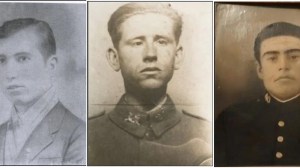
- Los Cerralbos, Toledo, New Castile (Castilla La-Mancha)
The rural areas of Toledo were subjected to brutal extrajudicial purges under the advancing forces of General Juan Yagüe and the Army of Africa as they headed for Madrid. The region had been quiet at the outbreak of war when the locals did not join the fascist uprising, but the September breakthrough of the military heading between Extremadura and Madrid had seen the region overturned with violence, and it had been noted that the rich were now free to ‘kill peasants to restore order.’ The tragedy that unfolded around 5 November 1936 in the small village of Los Cerralbos illustrated how everyday survival became fatal due to the hatred coming from the wealthy.
A 91-year-old resident of Los Cerralbos named Vicente recalled the story in 2006, of how witnessed the story first-hand of seven men collecting firewood one autumn day and headed out to see that they could find around the Finca de Los Parrales, a property outside the town. The group of approximately five men, including Pablo Arrogante Alía, 29, a trade unionist from nearby Lucillos, Teodoro Fernández Fernández, 26, a unionised, married day labourer with two small children and a pregnant wife, and brothers Baldomero Díaz Zapata, 51, and Eulogio Díaz Zapata, 60, both married, unionised day labourers with children, were found collecting sticks and marched back into town.
While in the town square, another local man, Lucio Jiménez Fernández, a 27-year-old, day labourer and secretary of the trade union association, got caught up in the commotion and tried to defend the men, and was also arrested. Among the group was a sixth man was quickly let go, as he was ‘from a good family.’ Fernanda Fernández Campo, who will celebrate her 92nd birthday in February 2027, knew that her father Teodoro had only gone to gather some broom bushes to heat their homes and that someone betrayed them, telling the family who owned the land that they were stealing. (Collecting dead branches and fallen timber to heat homes was a universally recognised customary right of the rural poor, known across Europe for centuries as the right of estover or recogida de leña. It was the gathering of waste material that had no commercial value to landowners.) The Los Parrales estate where the execution took place was a massive piece of land. While the ARMH identified that part of the property lines belonged to local teacher Petra Blázquez Zapata, a vast area bordering the property of the village’s traditional rich landowners.
Another who knew of the event was Petra’s son, Ángel Fernández-Santos, whose father was also a local teacher, and he told same story in 2006, that these men were marched out of town towards their Los Parrales estate to be executed at close range, in a town where there had been no violence, arrests, or hostilities among the community since the outbreak of war. The Second Republic had heavily invested in secular, progressive education, meaning that schoolteachers were usually the primary targets for execution. But Los Cerralbos was the home of Petra Blázquez Zapata and her husband Ángel María Fernández-Santos Jiménez, left-wing Republican intellectuals. He was an active socialist, an early organizer for the teacher’s union (FETE-UGT) in Toledo, and both he and his wife Petra Blázquez Zapata both taught and were deeply connected to the progressive Institución Libre de Enseñanza (Free Educational Institution). Ángel María Fernández-Santos Jiménez is sometimes referred to as the sixth man ‘from a good family’ who was let go instead of executed (he was later imprisoned for being a teacher, and was never allowed to work again, and became something of a ghost).
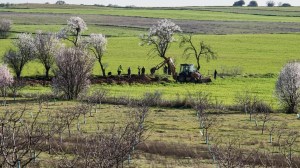
In 2021, the first dig was allowed to go ahead, but there was no surviving witness to point out the correct burial site, with an area of over 5,000sq to check and heavy equipment paid for by Association for the Recovery of Historical Memory and fundraising. The following year they tried again, finding handguns, long guns and bullet casings, but no bones. In 2026, Teodoro Dionisio Fernández’s great-granddaughter, Patricia, continued another search, but still no one was found, suggesting they bodies may have been hidden away or even reburied privately in the 1960s, as massive areas being searched have yielded no results, even after having used photo archives and aerial surveys of the land from WWII to present day.
- Aragón
During the Spanish Civil War, the Consejo de Aragón (Council of Aragon) was attempting to build a fully functioning, self-governing anarchist society while simultaneously fighting a war against General Franco’s forces. The official Spanish Republican government had collapsed in Aragon when the war broke out, and ordinary workers and peasants and their anarchist unions like the CNT took control. They did not just want to win the war; they wanted to eliminate capitalism and state control entirely. They collectivised the land, abolished private property, and in some villages, even abolished money.
Naturally, the powerful did not like this.
Because the regular army had rebelled, the Republic was still relying on voluntary militia columns to rush to the front lines to stop the fascists, most from neighbouring Catalonia. But as they marched through small farming villages and forcefully requisitioned what they needed to survive and fight. They took food supplies, livestock, grain, and civilian vehicles without authorisation or compensation, but from neccessity. This left local populations facing immediate shortages and deeply disrupted the local agrarian economies that the anarchists were trying to collectivise and stabilise.
Militias could, in theory, march into a town, overrule the decisions of the local inhabitants, and dictate how the village should be run. Ascaso noted that some militias were acting under a lack of desirable and precise discipline, treating the liberated areas as occupied territories rather than liberated partners. Some columns used their military power to forcefully impose their specific political ideology on a village. In the chaos of the early revolution, some armed groups carried out executions or arbitrary detentions of right-wing fascist sympathisers or class enemies, leaving the locals with the fall-out.
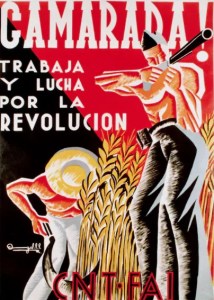
On the anti-fascist side, the Spanish Communist Party (PCE) and the moderate Republican government wanted to halt the social revolution. They wanted a standard, disciplined, hierarchical army and a centralised capitalist state to win the war (and to please their ally, the Soviet Union). To get rid of the anarchists, they needed to convince the public, and international observers, that anarchist governance was synonymous with chaos and terror.
They took the genuine, isolated incidents of abuse or looting in Aragon and used their control over newspapers and radio stations to blast them out as proof that anarchists were uncontrollable bandits. Yet the vast majority of the militia fighters were ordinary, highly idealistic workers who had volunteered to risk their lives to stop fascism. They were printers, factory workers, and dockers from Barcelona who genuinely believed they were fighting for a freer, fairer world. Most of them went out of their way to treat the local peasants with respect and solidarity.
The overarching threat was political. The anarchist leaders in Aragon knew that if the region dissolved into ‘lawless banditry,’ the central Republican government in Madrid (and communist factions) would use it as an excuse to militarily crush the Council of Aragon. Ascaso desperately needed to prove that an anarchist-led government could maintain strict public order, protect its peasantry, and run a structured, stable economy while winning a war.
By 5 November 1936, Joaquín Ascaso (the anarchist leader of Council of Aragon) issued a decree – Disposición General. Para los pueblos de Aragón rescatados al fascismo. Un llamamiento cordial a las columnas que operan en dichos pueblos. (General Disposition. For the towns of Aragon rescued from fascism. A cordial appeal to the columns operating in those towns.) Despite the polite language in the title, the text written by Joaquín Ascaso was a strict administrative command and a harsh critique of the militias’ supposed overreach into civilian life.
The plan was to achieve two things, to protect the peasants, and wanted to draw a hard line telling front-line soldiers: ‘You fight at the front; you do not get to dictate how these villagers run their lives, their farms, or their local councils.’ Second, he wanted to legitimise the council and prove to the rest of the world (and the central government in Madrid) that anarchists were not just chaotic rioters. He wanted to show they could maintain law, order, and structured civilian administration. It was a balancing act: trying to run a free, stateless society while imposing enough rules and discipline to win a brutal civil war.
(In August 1937, less than a year after Ascaso’s decree, the central government sent a heavily armed communist military division into Aragon, to ‘restore order’ and protect the peasants from ‘anarchist banditry.’ Their actual action? They forcibly dissolved the Council of Aragon, arrested Joaquín Ascaso and hundreds of other anarchist leaders, tore down the collective farms, and returned the land to private owners. The reality of thousands of peasants peacefully running their own villages, sharing tools, and voluntarily collectivising land was completely overshadowed by the loud, chaotic actions of a few, and the ruthless political ambitions of those who wanted the anarchists gone.)
- Huelva, Andalucía
Beyond the grand strategies and territorial shifts of the Spanish Civil War, the true nature of the Francoist repression was defined by its relentless, daily continuity. On any given calendar day, the machinery of the regime reached deep into local towns to permanently silence trade unionists, professionals, and ordinary citizens. The executions recorded on 5 November offer a window into this systematic cross-provincial terror, ensuring that these individuals are remembered not as isolated numbers, but as interconnected communities of victims.
In the provincial capital of Huelva, the day was marked by the executions of local residents Juan Barranco Núñez, Francisco González Rodríguez, José Jurado Pérez, Juan Macías Romero, Enrique Martín Rodríguez, and Sebastián Palma Ortega. They were joined at the execution walls by people brought from further afield: Manuel Aguilar García from Cumbres de San Bartolomé, Francisco Martín Vázquez and Fernando Medero Pérez from Villanueva de los Castillejos, and the local doctor from Lucena, Bartolomé Pulido Dávila. Simultaneously, the purge rippled through the towns and rural spaces of the province, leaving behind hidden graves that disrupted entire families – in Almonaster la Real: The community lost Marcelino Gato Romero, Julián Martín Ochoa, and Clemente Martín Vázquez on this day. In the Sierra d’Aracena: Godofredo S. Sierra Soto, originally from Puerto Moral, was taken and executed in Aracena. In La Granada de Río-Tinto: Alberto Domínguez Soto and Esteban Victoriano Romero Vázquez, both from nearby Campofrío, met their deaths. The reach of the repression meant that some were displaced entirely before being killed; José Márquez Navas, a native of Alosno, was transported across the regional line to be executed in Badajoz.
Acknowledging these names on the specific anniversary of their deaths reveals the calculated, methodical cadence of the repression. By mapping these names back to their hometowns, from the mining communities to the remote mountain villages, we see that 5 November was not an exceptional day of violence; it was simply another day in the deliberate dismantling of Huelva’s democratic society.

