For the Battle of Madrid, see here
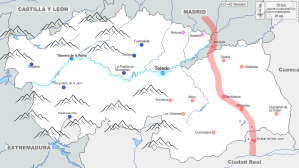
- Toledo Province, New Castile
Pre-war Toledo province was a classic snapshot of España profunda (deep Spain), deeply traditional, overwhelmingly agrarian, and structurally fractured. Life was dictated by the seasons, the Catholic Church, and severe social tensions. The province’s economy relied strictly on dry-farming agriculture, specifically the production of wheat, barley, olive oil, and wine. However, the land was not owned by the people who worked it. The southern and central parts of the province operated under the latifundia system, massive, sprawling estates owned by a small group of absentee aristocratic landowners and the Catholic Church.
The backbone of the population consisted of landless day labourers. These families lived in precarious poverty and illiteracy across these rural districts was incredibly high among the population of 490,00 people. The population of its capital city, Toledo, was only 30,000, not at all an urban mass capable of giving opportunity. By 1936, approximately 25% of the Spanish population was completely illiterate, but this figure is highly misleading because it includes urban centres like Madrid or Barcelona or Valencia. In the rural interior of Toledo province and neighbouring Ciudad Real, illiteracy skyrocketed to between 40% and 50%, with female illiteracy tracking even higher.
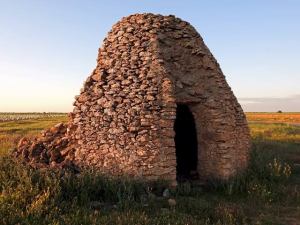
When historians talk about pre-war rural poverty in Toledo and Cuidad Real, we talk about absolute, biological destitution. There was La Parona (the Dead Months). Day labourers were only hired for seasonal harvests (wheat in summer, olives in winter). For 4 to 6 months of the year, there was zero work. Families literally starved, surviving on scraps, wild foraging, or running up debts at the local tavern (often owned by the landlord’s manager). Families did not live in houses; they lived in chozas (mud-brick huts with thatched roofs) or stone hovels with dirt floors shared with livestock. There was no running water, no sewage, and no electricity. Physical deprivation was so severe that military records from the era show conscripts from Castile-La Mancha suffered from widespread stunted growth and undernourishment. An entire generation was physically smaller than their wealthier, urban counterparts due to a childhood diet consisting almost entirely of bread, garlic, olive oil, and gazpacho water.
Before 1931, rural schools were practically non-existent. A single, dilapidated room might serve 80 children, and teachers were paid so little they often lived on neighbourly charity. Children were sent to the fields by age eight to help the family survive. When the Second Spanish Republic took power in 1931, they viewed education as the silver bullet to fix Spain. They launched a massive campaign, building over 7,000 schools nationwide and deploying Misiones Pedagógicas (Cultural Missions) trucks loaded with books, projectors, and reproductions of Prado museum paintings into remote Toledo and Ciudad Real villages. For many peasants, this was the first time they had ever seen a film or held a book. But by 1936, this project was violently cut short.
Outside of the capital city, modern medical care was a luxury of the rich. If a rural town had a doctor, they were paid directly by the wealthy local elites. Poor labourers could rarely afford a consultation, let alone medicine. Curable diseases like tuberculosis, typhus, and gastroenteritis swept through rural communities regularly. Infant mortality rates in these provinces were staggering; it was completely normal for a mother to lose two or three children before they reached adulthood due to contaminated water or simple infections. If you broke a bone or suffered an agricultural accident, you relied on local folk healers (curanderos) or prayers.
When the Second Spanish Republic was declared in 1931, it also promised sweeping Agrarian Reforms to break up the large estates and redistribute land to the peasants. This turned Toledo province into one of the most volatile regions in Spain. Rural workers unionised rapidly under the socialist Federación de Trabajadores de la Tierra (FNTT) (part of the UGT). General strikes, land seizures, and violent clashes between peasants and the Civil Guard became common. When conservative governments stalled the reforms between 1933 and 1935, rural resentment deepened. When the left-wing Popular Front won the February 1936 election, impatient peasants began forcibly occupying estates across the province.
Daily life was also split by a deep cultural chasm. For local merchants, estate owners, and the deeply entrenched Catholic clergy, the Republic was an existential, godless threat to traditional Spanish values. For the impoverished agrarian workers, the Church was seen as an oppressive partner to the landowners who kept them poor. In July 1936, these decades of pent-up class hatred exploded with Republican militias initially executing local landowners and priests. When Franco’s Army of Africa swept through the province to lift the siege in September and October, they enacted a terrifying, systematic revenge on behalf of those wealthy elites, executing the day labourers who had dared to claim the land. By November 1936, the old landlord-dominated social hierarchy was ruthlessly restored by military force.
When the military coup launched on July 17, 1936, the majority of Toledo province remained under the control of the Second Spanish Republic, but the military governor of Toledo, Colonel José Moscardó, refused to hand over arms to Republican militias and retreated into the alcázar, the city’s imposing stone fortress. For 70 days, Moscardó, roughly 1,000 to 1,300 Nationalist combatants (mostly Guardia Civil and Falangists), and hundreds of civilian women and children endured an intense Republican siege. They survived starvation diets, disease, and heavy bombardments that reduced the historic structure to rubble.
In September, Franco made the controversial decision to divert his battle-tested Army of Africa away from their direct advance on Madrid to relieve Toledo, and changed the momentum of the war. On 27 September, troops under General José Enrique Varela stormed Toledo, breaking the siege. The Nationalist victory instantly became a foundational political myth for Franco’s regime. However, the takeover was accompanied by a furious, systematic purge; Varela’s forces executed over 800 Republican civilians and wounded militiamen in the immediate aftermath.
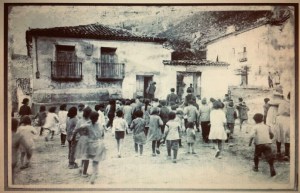
When the Nationalists took over the province, it was not a military win; they systematically rolled back the Republic’s educational reforms. Teachers were among the first to be executed by Nationalist purges. For the elite, reclaiming Toledo meant putting the peasants back in the fields, taking away their books, and restoring a quiet, illiterate submission. Under the military occupation, the pre-war conservative order was aggressively reinstated. Catholic religious practices, which had been suppressed or driven underground during the Republican militia phase, were celebrated publicly to legitimize the Nationalist cause. Local populations had to explicitly display loyalty to Franco’s newly consolidated authority to secure food rations and ensure their own safety.
By November 1936, the immediate frontline had drifted just north of the province, meaning Toledo was a highly militarised rear guard. The capital city of Toledo was physically shattered. The grand Alcázar fortress was levelled, and surrounding neighbourhoods, streets, and houses were heavily damaged or choked with debris from months of artillery fire and underground mine explosions. Surviving residents were left digging through the wreckage of their homes. With the Nationalists firmly in control, life was dictated by an atmosphere of intense fear and administrative terror. An organised cleaning-out of red sympathisers, union workers, and left-leaning politicians replaced the chaotic violence of late September. Intellectuals, reformists, and anybody suspected of supporting the Republic were jailed or summarily executed.
Throughout November, the province functioned as the vital logistical nervous system for the Nationalist assault on Madrid. The main Toledo highway (the Toledo Road Axis) became a bustling military corridor. Columns of the feared Moroccan Regulares and the Spanish Foreign Legion, backed by Nazi German and Fascist Italian supply lines, clogged the provincial roads as they pushed north toward Getafe and the capital’s southern gates. Toledo was a frontline province. While the city of Toledo was experiencing the post-conquest winter repression and military occupation, just a few dozen kilometres to the east, rural workers in Republican-held villages were still armed, desperately digging trenches, and bracing for the next Nationalist wave.
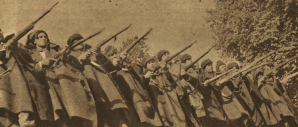
By November, the young, fit, and highly motivated urban worker militias who had rushed from Madrid in July had been heavily depleted, wounded, or pushed north to defend the capital itself. What was left holding the secondary lines across the dusty plains of eastern Toledo were the pueblo militias, often called the Milicias de Retaguardia or Milicias Populares Locales. On one side was a flawless, professional military machine advancing along the Tagus River; on the other side, waiting in the dry dirt, was a ragtag collection of impoverished, illiterate, and aging grandfathers, wrapped in civilian blankets and leaning on walking sticks, holding old rifles they barely knew how to shoot, desperately trying to protect the tiny plots of land the Republic had promised them.
In these local pueblo militias, men literally operated in shifts. The three men with walking sticks were not unarmed bystanders; they were waiting for their comrades to get tired, go on rest rotation, or fall in battle so they could inherit the rifle. Until then, the sticks were their only support in the rough, dry terrain. But the southern and eastern front in Toledo froze in November 1936 due to the mountains and the flat open plains. Because their front was stable, these local defensive units held their positions until the very end of the war in March 1939. But in November 1936, the mood in the remaining Republican-held eastern pocket of Toledo province was a grim cocktail of shock, biting physical misery, and a looming sense of dread.
Morale was at an all-time low. The spectacular fall of Toledo city and the catastrophic collapse of the siege of the Alcázar at the end of September had sent a massive psychological shockwave through the rural communities. The local militias were terrified of Franco’s Moroccan Regulares and Legionnaires. Rumours of their brutal tactics, mutilations, and rapid motorised advances had triggered a massive wave of internal refugees fleeing eastward into the La Mancha plains. By November, the Republic’s best troops and resources were diverted north to save Madrid. The aging, poorly armed peasants left behind in eastern Toledo felt completely abandoned. They knew they were a secondary line holding a front with very few weapons, creating an atmosphere of desperate, defensive resignation.
By November, the Meseta Central (the La Mancha plateau) was into an intensely cold winter. Absolutely nothing to block the biting, icy winds sweeping down from the mountains. Men in the trenches had to endure freezing night-time temperatures with no proper winter uniforms, relying on thin civilian blankets or heavy woollen shawls draped over their shoulders. Hunger was widespread and constant. The war had completely shattered the delicate agrarian cycle of the province.
The summer wheat harvest of 1936 had been heavily disrupted by the outbreak of the war and the sudden collectivisation of the fields. Millions of tons of grain were left rotting or unharvested because the young farmhands were fighting or dead. What little food was produced in the villages was immediately requisitioned by the Republic to feed the besieged population and defenders of Madrid. Local families and militias in eastern Toledo subsisted on bare-minimum rations, mostly dry bread, starchy chickpea stews, garlic, and vinegar water. The arrival of thousands of penniless refugees from the western fallen towns strained the food supply to its absolute breaking point.
Repression was active, paranoid, and severe. Because the Nationalists were right on their doorstep, the Republican militias and local revolutionary committees were terrified of spies, saboteurs, and fascist sympathisers hidden among them. Anyone perceived as conservative, wealthy, or overly religious was in immediate danger. Priests who hadn’t fled, local estate managers, right-wing political sympathisers, and wealthy farmers who refused to give up their grain were rounded up. Many were taken on paseos and executed at night on lonely stretches of the flat provincial highways or against cemetery walls. While the chaotic street violence of July and August had passed, the repression in November was cold, systematic, and fuelled by the desperation of a losing army.
Because so many working-age men had been mobilised or killed, rural civilian life was entirely driven by women. Women had to take over the brutal manual labour of the fields. In November, this meant attempting to sow the winter wheat and harvest the olive groves under freezing winds. Without their labour, the towns would have faced immediate starvation by spring. At home, a woman’s day was consumed by queues. Standing for hours in the freezing cold outside local bakeries or distribution centres to secure a single loaf of bread or a handful of chickpeas for her children was standard. Schooling completely collapsed. The Republic’s new schools were turned into improvised military barracks, hospitals, or refugee centres. Children as young as seven or eight were put to work fetching water, gathering firewood from scarce brush, or helping tend to the collective fields.
The civilian population of eastern Toledo had swelled drastically due to thousands of internal refugees fleeing the brutal advance of Franco’s Army of Africa from the west. Small agricultural towns suddenly found their populations doubling. Refugees were crammed into local churches, abandoned barns, municipal buildings, and the homes of locals who were forced to share their already scarce space. With no running water, primitive sewage systems, and severe overcrowding, villages became breeding grounds for disease. Scabies, lice, and winter respiratory infections ran rampant, and there was virtually no medicine or clean clothing to combat them.
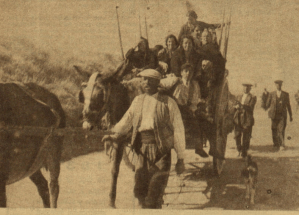
For the peasants who remained, daily life was dictated by the radical social experiment of collectivisation, orchestrated by the CNT and UGT. In many Toledo villages, regular Spanish currency was declared invalid or seized. It was replaced by local committees issuing vouchers, coupons, or tokens stamped by the town’s revolutionary council. A civilian would trade these vouchers at the People’s Store for basic rations based on the size of their family. Private businesses and large farms were completely seized. Everything, from the local bakery and blacksmith to the olive oil mills, was run collectively. While some poorer peasants initially welcomed this as the realisation of their revolutionary dreams, by November, the romance had vanished; it was a rigid, heavily managed system driven by wartime desperation.
The vibrant, deeply religious cultural life of rural Castile-La Mancha was completely wiped out and driven underground. The Catholic Church, which had dictated the rhythm of daily life for centuries, was entirely suppressed. Church bells, which traditionally told civilians when to wake, eat, and pray, were silent or melted down for ammunition. Going to Mass, praying openly, or wearing a religious medal could result in being branded a fascist and dragged away on a paseo. Neighbours who had lived alongside each other for decades stopped talking. A culture of intense paranoia took hold. A careless comment about the lack of food, a complaint about the local committee, or being seen as insufficiently revolutionary could lead to a denunciation. Civilians learned to keep their heads down, wear the proletarian blue boiler suit if they had one, and look as poor and unassuming as possible to avoid drawing the attention of the armed militia patrols.
Behind Nationalist lines, the world was very different. The very first thing the Nationalists did upon occupying a Toledo village was dismantle the Republic’s Agrarian Reforms. The landless peasants who had been given plots of land to farm were forcibly evicted. The massive latifundias were immediately handed back to their original wealthy landlords or their managers. Any peasant caught holding a Republican land voucher or found to have participated in a collective farm was treated as a criminal.
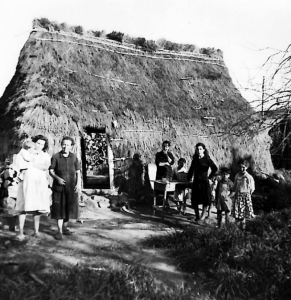
Under Nationalist rule, the Catholic Church was fully restored to absolute social power. Attending Sunday Mass was a civilian loyalty test. Local priests worked directly with the military and the Falange to compile blacklists of who had skipped church, who had married in a civil ceremony under the Republic, or whose children were unbaptised. To secure essential food rations or work permits, civilians had to obtain a certificate of good conduct signed by the local parish priest.
The physical environment was heavily militarised. Towns like Talavera de la Reina and Torrijos were flooded with troops, and the streets were patrolled by Falangists wearing blue shirts and red berets. Curfews were strictly enforced, and the right to gather was entirely banned. Humiliation was weaponised against the families of leftists; wives and daughters of executed or missing Republicans frequently had their heads shaved, were forced to drink castor oil, and were made to clean military barracks or parade through the streets while being mocked by guards. The defining contrast of Toledo province in November 1936 is striking; while the Republican east was a landscape of starving, freezing grandfathers waiting in dusty trenches with shared rifles, the Nationalist west was an occupied zone where a whisper could get you shot, your land was stripped away, and the old feudal order was violently locked back into place.
- Cuidad Real
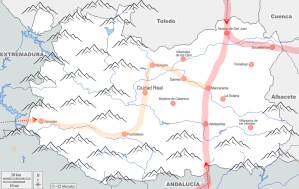
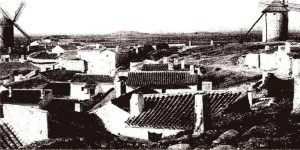
Located roughly 200km south of Madrid, it was Spain’s third-largest province by land area, nearly 20,000 square kilometres of windswept plains, vineyards, and southern mountain ranges. On the eve of the war in 1936, Ciudad Real had roughly 500,000 inhabitants living in large, tightly packed rural towns surrounded by miles of empty farmland. The capital city of Ciudad Real was relatively small, home to around 25,000 to 30,000 people. It functioned mainly as a quiet administrative and market town for civil servants, landowners, and merchants. Several agricultural and industrial towns in the province, such as Valdepeñas, Tomelloso, and Puertollano, rivalled or exceeded the capital in size.
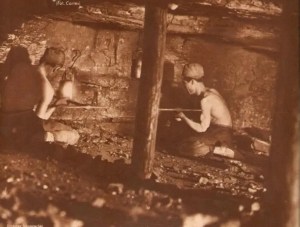
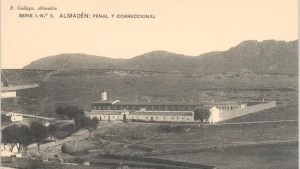
Agriculture was the backbone of daily life. Across the flat plains of La Mancha, farmers grew wheat, barley, olives, and vast expanses of grapes. Land ownership was heavily unequal – a small class of wealthy aristocratic and bourgeois latifundistas controlled huge estates, while the majority of the population worked as impoverished, seasonal day labourers. In the rugged Sierra Morena mountains along the province’s southern edge, life looked completely different. Towns like Puertollano (a major coal-mining and early industrial centre) and Almadén (home to the world’s oldest and richest mercury mines) were gritty, working-class enclaves with strong socialist and trade union traditions. Because Ciudad Real sat squarely between Madrid and Andalucía, the arrival of the 19th-century railway transformed towns like Alcázar de San Juan and Manzanares into vital transport hubs. Railway workers formed an organized, politically active working class alongside the miners.
In the years leading up to July 1936, life in Ciudad Real was shaped by deep social tension beneath a quiet exterior. Extreme rural poverty among landless farmworkers clashed with the conservatism of large landowners and the Catholic Church, making agrarian reform and labour rights the defining political issues in the province right up to the outbreak of the war. Before 1931, politics in Ciudad Real was controlled by caciquismo, a system where wealthy landowners and local political bosses dictated elections and employment. The arrival of the Second Republic introduced universal suffrage, secular education, and legal protections for trade unions, upending centuries of rural deference.
The socialist UGT (specifically its landworkers’ federation, the FNTT) and the PSOE expanded rapidly across the province, organising both Puertollano miners and landless day labourers in the wine-producing towns. For the first time, farmworkers negotiated minimum wages, eight-hour workdays, and restrictions on hiring cheap outside labour. Because Ciudad Real was dominated by massive latifundios, the Republic’s 1932 Agrarian Reform Law promised to redistribute uncultivated land to impoverished peasants. In practice, bureaucratic delays and fierce opposition from landowners meant very little land actually changed hands.
When a right-wing coalition won power in late 1933, local landowners rolled back wage gains, dismantled municipal councils, and blacklisted union members. When farmworkers joined a nationwide agricultural strike in June 1934, and later protested during the October 1934 crisis, hundreds of local unionists were arrested, deepening social bitterness across the province. In the February 1936 general elections, the left-wing Popular Front coalition won a decisive victory in Ciudad Real. Released political prisoners returned to their towns, and socialist mayors were restored to local town halls.
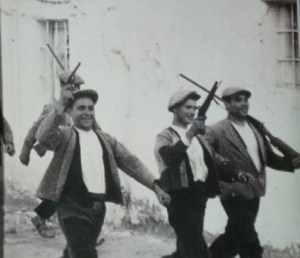
Tired of waiting for slow legal reforms from Madrid, thousands of landless peasants across Ciudad Real took matters into their own hands in March and April 1936, peacefully occupying and ploughing large estates. Rather than evicting them, the Popular Front government legalised many of these settlements retroactively, alarming conservative landowners and the local Catholic hierarchy. By early summer 1936, the province was deeply polarised. Right-wing youth groups (including the growing fascist Falange) clashed periodically with socialist and communist militias, though Ciudad Real experienced far less lethal political street violence than Madrid or Andalucía.
Ciudad Real had no major army barracks and the armed forces in the province consisted almost entirely of the Guardia Civil and Assault Guards, dispersed in small posts across dozens of towns. When the military uprising began on 17–18 July 1936, local right-wing conspirators and segments of the Civil Guard hesitated. Meanwhile, the Civil Governor in Ciudad Real quickly coordinated with socialist leaders, railway workers in Alcázar de San Juan, and miners from Puertollano. Armed with hunting shotguns, mining dynamite, and weapons distributed by loyal authorities, columns of miners and union militias secured the capital, key railway junctions, and telegraph lines within days. Without a regular army garrison to rally around, the rebellion never got off the ground. By late July, Ciudad Real was firmly in Republican hands, transforming overnight from a neglected agricultural province into the secure interior anchor of the Republic.
With the traditional state apparatus weakened by the coup, real power in towns and villages shifted to local Comités del Frente Popular run by socialist UGT/PSOE, communist PCE, and anarchist CNT leaders. These committees organised militia patrols, issued travel passes, and controlled local food supplies. What had been partial land occupations in the spring became sweeping collectivisation after July. Hundreds of large estates abandoned by wealthy landowners were seized and converted into agricultural collectives managed by union committees. In towns like Puertollano and Alcázar de San Juan, workers took direct control of coal mines, utilities, and workshops.
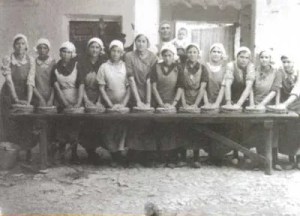
Because the Catholic Church was widely viewed by the local working class as an ally of the wealthy landowners and the military rebels, churches across the province were closed, stripped of religious imagery, and repurposed as supply depots, union halls, or refugee shelters. Traditional religious festivals were suspended, streets were renamed after revolutionary figures, and formal titles like Don were replaced with comrade or compañero.
Though Ciudad Real saw almost no fighting during the July coup itself, the weeks that followed brought severe rear-guard violence. Driven by fear of fifth columnists and anger over news of Nationalist atrocities in neighbouring Extremadura and Andalucía, armed militia groups carried out widespread arrests and executions. Historical research by the University of Castilla-La Mancha (Memoria Democrática UCLM) documents roughly 1,800 to 2,200 victims of rear-guard violence across Ciudad Real province during the entire war, with the overwhelming majority killed between August and September 1936. The victims included around 150 to 160 priests, monks, and nuns, including the Bishop of Ciudad Real, Narciso de Esténaga, who was killed near Peralvillo in August 1936, wealthy estate owners, former caciques (local political bosses), right-wing politicians, and members of the Falange or CEDA, and Guardia Civil officers suspected of supporting the July rebellion.
Most killings took place via prisons sacas and roadside paseos. While local committees often struggled to restrain uncontrolled militia squads during late summer, the Republican government steadily reasserted legal order from October onward, replacing arbitrary arrests with formal Tribunales Populares. By November 1936, killings had largely ceased.
Even without battles on its own soil, Ciudad Real bled manpower. Thousands of young miners, railwaymen, and farmworkers volunteered or were conscripted into militia columns, such as the Batallón Puertollano and Batallón Mancha, fighting in the Sierra de Guadarrama, Toledo, and the Córdoba front. By October 1936, these militias were reorganised into regular units of the Popular Army, notably the 2nd Mixed Brigade.
By autumn 1936, the province began feeling the strain of supporting a nation at war. Basic goods like sugar, coffee, soap, and textiles became scarce, prompting local committees to introduce early rationing cards. At the same time, the first major waves of displaced civilians fleeing the fall of Badajoz (August) and Toledo (September) began arriving in La Mancha, turning quiet provincial towns into crowded sanctuaries. Because the province had intact railway lines, abundant farmland, and no active fighting, tens of thousands of displaced civilians poured into its towns.
The first massive wave arrived from the west after General Yagüe’s Army of Africa swept through Badajoz and Cáceres. Terrified families fled reports of summary executions, crossing into Ciudad Real on foot, by mule cart, and on packed trains through towns like Almadén and Puertollano. In September 1936, when Nationalist forces captured Toledo and relieved the Alcázar in late September, thousands of residents from towns like Talavera de la Reina and Toledo city fled south across the plains of La Mancha into Ciudad Real. In October–November 1936, as German and Italian bombers pounded Madrid and street fighting engulfed its western suburbs, the Republican government actively encouraged, and later organised, the evacuation of women, children, and the elderly. Ciudad Real, sitting directly down the main southern railway line, absorbed huge numbers of madrileños.
By November 1936, local populations in towns like Valdepeñas, Manzanares, Tomelloso, and the capital had swelled dramatically, in some municipalities increasing by 20% to 30%. Local Popular Front committees and newly created Comités de Refugiados housed families in confiscated mansions and estates of absent landowners, closed churches, convents, and seminaries, schools, theatres, and bodegas, and in private homes, where local families were required or asked to take in billeting guests. Hundreds of unaccompanied or orphaned children from Madrid and Extremadura were placed in organised rural colonies across the province, cared for by teachers and women’s organizations like Mujeres Antifascistas.
Ciudad Real produced wheat, wine, and olive oil, feeding tens of thousands of extra mouths, while simultaneously shipping food north to Madrid, strained local supplies. By November 1936, municipal councils introduced stricter rationing for bread, meat, milk, and fuel, leading to long morning queues outside bakeries and supply depots. The arrival of urban madrileños and impoverished Extremaduran peasants into conservative, tight-knit Manchegan towns created a mix of genuine solidarity and quiet friction. While local unions organised clothing drives and shared harvests, tensions occasionally flared over crowded housing, rising food prices, and scarce medical supplies, especially as winter set in and illnesses like typhus and tuberculosis became harder to contain. According to local historical studies of Ciudad Real during the Civil War, the capital city’s population jumped from roughly 27,000 inhabitants in 1936 to around 40,000 during the war, an increase of roughly 13,000 displaced people in the capital alone.
Across the entire province of Ciudad Real, historians estimate that between 50,000 and 80,000 refugees were sheltered by late 1936 and early 1937, representing roughly 10% to 15% of the province’s baseline population. During the summer and autumn of 1936, hundreds of thousands of civilians fled ahead of General Yagüe’s Army of Africa. Many passed through Ciudad Real’s railway hubs (like Alcázar de San Juan) only briefly before continuing to Valencia or Alicante, while others settled informally with relatives or in requisitioned buildings before the Republican Comité Nacional de Refugiados began issuing official ration and census cards in late 1936 and 1937. Large towns along railway lines and main highways, such as Valdepeñas, Manzanares, Tomelloso, Puertollano, and Alcázar de San Juan, absorbed the highest numbers, routinely housing several thousand refugees each and stretching local housing and sanitation to the breaking point.
The name Ciudad Real literally translates to ‘Royal City, ‘granted in 1420 by King Juan II of Castile. Following the July 1936 uprising, local socialists, communists, and anarchists viewed a royalist name as incompatible with a revolutionary Republic. Across both the capital and the wider province, local Popular Front committees, trade unions, and regional newspapers began referring to the capital, and by extension the province, as Ciudad Libre (Free City), Ciudad Libre de la Mancha, and occasionally Ciudad Leal (Loyal City). The name appeared on local stamps, ration cards, press mastheads, and municipal correspondence. According to municipal records, the socialist mayor of Ciudad Real, Calixto Pintor Marín, formally petitioned Spain’s Ministry of the Interior (Ministerio de la Gobernación) to make Ciudad Libre the official legal name of the capital and province. Madrid actually denied the formal request, preferring to avoid administrative confusion during wartime, even though local authorities continued using Ciudad Libre in everyday civic life until Nationalist troops entered the city on 29 March 1939.
The push to rename Ciudad Real was part of a broader symbolic overhaul across the province’s towns and villages. Dozens of municipalities stripped references to saints, royalty, or conservative figures from their town names and street signs. For example, Alcázar de San Juan (named after Saint John and the medieval fortress) became Alcázar de Cervantes, Campo de Criptana became Campo Libre, and Santa Cruz de Mudela became simply Mudela. Immediately after the Nationalist victory in late March 1939, Francoist authorities restored all traditional, religious, and royalist names.
Historical accounts, letters, and local press from the autumn of 1936 describe a deeply divided emotional landscape; a mix of fierce revolutionary hope, constant low-grade anxiety, quiet dread, and growing exhaustion. For landless farmworkers, miners, and railwaymen, the summer and autumn of 1936 brought an intoxicating feeling of empowerment. For the first time in generations, they were no longer deferring to wealthy landowners or local political bosses. Working on collectivised estates, running town committees, and calling their home Ciudad Libre gave many a genuine sense of pride and ownership over their own lives.
Beneath that revolutionary optimism lay daily worry. Almost every working-class family had husbands, sons, or brothers fighting in the trenches around Madrid, Toledo, or Córdoba. People gathered anxiously outside union halls and railway stations waiting for newspapers, letters, or casualty lists, knowing that bad news could arrive on any afternoon train. By November 1936, initial euphoria had given way to the grind of wartime scarcity. Standing in long queues for bread, sugar, and coal while sharing cramped towns with tens of thousands of refugees tested people’s patience, even among committed supporters of the Republic.
For anyone associated with the political right, the Catholic Church, or the old landowning class, life in Ciudad Real during late 1936 was defined by fear and self-censorship. Having witnessed the wave of nocturnal arrests and roadside executions in August and September, surviving conservatives kept their heads down, hid religious items inside their homes, and avoided drawing attention in the streets.
With churches closed and religious funerals banned, devout families experienced a profound sense of cultural disorientation and private grief. Those who had lost relatives in the late-summer sacas could not mourn openly without risking suspicion of being fascist sympathisers. Behind closed doors, many conservatives listened quietly to Nationalist radio broadcasts (such as General Queipo de Llano’s broadcasts from Seville), hoping the fall of Toledo and the siege of Madrid meant the war, and the social revolution to give equal rights, would soon be over and they could return to undisputed control, as those workers and rights activists would be dead.
Because most refugees from Extremadura, Toledo, and Madrid were working-class families, union members, or left-wing supporters fleeing Franco’s advancing armies, local conservatives often viewed them as ideological enemies. To right-wingers who had lost their land, businesses, or social standing in the July revolution, these newcomers looked like reinforcements for the very people who had dismantled their world. In towns across Ciudad Real, local committees frequently housed refugees inside the confiscated mansions, estates, and spare rooms of wealthy conservative families. Having strangers billeted in their homes, or watching their family properties turned into crowded refugee shelters, created deep personal bitterness among the local upper and middle classes. In Nationalist-held territory, Francoist propaganda portrayed the Republican zone as a chaotic wasteland of criminals and reds. Hardline Nationalists often viewed refugees who fled eastward rather than welcoming Franco’s troops as guilty by association, assuming anyone who ran away had something to hide. Some pragmatic conservatives also realised that treating billeted refugees decently offered a layer of protection. In a town run by socialist and communist committees, having a Madrid refugee family vouch that a conservative homeowner was peaceful and helpful could shield that homeowner from suspicion or further property seizures.
The tens of thousands of refugees from Extremadura, Toledo, and Madrid carried raw trauma into Ciudad Real’s quiet towns. Many had fled with only the clothes on their backs after seeing their villages bombed, and their families and neighbours executed. While grateful to be out of immediate danger, urban madrileños often felt stranded and alien in rural Manchegan towns, struggling with unfamiliar country routines, crowded living quarters, and the uncertainty of whether they would ever see their homes again. If you walked through a town square in Ciudad Real in November 1936, the surface looked remarkably calm, farmers heading out to the olive groves, trains rumbling through the junctions, cafés serving wine. Yet emotionally, the province was suspended in tense waiting. People were living in a bubble of relative physical safety while knowing their entire future hinged on the outcome of the desperate battle raging 200km north in the streets of Madrid, and they could do little to help.
When Franco’s troops occupied Ciudad Real in March 1939, the ideological view came roaring back with devastating force. Those refugees who had remained in Ciudad Real, especially union activists or officials from Extremadura and Madrid, were rounded up alongside local Republicans. Returning right-wingers and local Falangists used denunciations to settle scores from 1936. Between 1939 and the mid-1940s, Francoist military tribunals executed roughly 3,800 to 4,000 people in Ciudad Real province alone, nearly double the number killed during the 1936 rear-guard terror, targeting both local leftists and displaced refugees trapped when the front collapsed.
- Valencia
Sisters Josefa Fernández Asensio, 64, and María Fernández Asensio, 69, were murdered were arrested at home in Valencia, by a man later identified as Vicente Gil Ponce and another man, and processed at an improvised police headquarters just around the corner from their home in the central city. As was typical for conservative held in these makeshift prisons, they were moved the same day to Benimaclet, a village 4km northeast of the city (now a suburb of Valencia city) where they were stopped at the local garbage dump. Josefa resisted being taken out of the vehicle and fought the men, and was found dead of stab wounds to the chest, hands, and face. María died from a gunshot wound to the head and several to the chest.
Historians of the Spanish Civil War point to several intertwined social, political, and practical reasons why elderly civilians were disproportionately represented among the victims of the 1936 rearguard violence in Valencia. When the war broke out in July 1936, younger men of military age were mobilised to the front lines, went into hiding, or fled Republican territory. Elderly parents, retired professionals, and older unmarried siblings, like the Fernández Asensio sisters, often could not flee or chose to stay behind to watch over family homes and property. Unlike younger political activists who had underground networks or the physical means to escape, elderly residents remained at their registered addresses, making them easy targets when militia patrols arrived with arrest lists.
In 1930s Valencia, membership in Catholic lay organisations (such as Acción Católica), conservative political parties (Derecha Regional Valenciana), or rentier and landowning classes skewed heavily toward older generations. Revolutionary committees viewed anyone fitting these social or religious profiles as ideological enemies of the Republic, regardless of age or physical frailty. Militia groups and checas frequently targeted wealthier households to seize cash, jewellery, and real estate. In many documented Causa General cases, including the Fernández Asensio sisters, who had property connections in Buñol and central Valencia, murder followed the looting or expropriation of the victims’ homes. These opportunities really would have appealed to the most base individuals of society, who took the chance of social revolution to kill and steal from old ladies.
Following the military uprising in July 1936, local police and courts were replaced by armed neighbourhood committees. In small towns and city districts alike, long-standing personal disputes, landlord-tenant conflicts, or workplace resentments were often settled through denunciations to militia patrols. Executions in Valencia spiked sharply in November 1936 after the Republican government evacuated from Madrid to Valencia and news arrived of Nationalist advances and air raids. Local militias frequently carried out retaliatory killings against detainees or suspected conservative sympathisers in response to front-line defeats.
- Badajoz, Extremadura
When people look at a date like 13 November 1936, three months after the initial fall of Badajoz, and ask why these specific people were only being killed then, historians point to several deliberate structural shifts in how the Nationalist forces consolidated power. When General Yagüe’s columns stormed Badajoz in August 1936, the killings were an immediate, military-driven atrocity meant to terrorise the population and eliminate any immediate threats behind the advancing front line. Soldiers simply checked men’s shoulders for bruises from rifle recoil; if they had them, they were shot immediately. If you were found the company of someone part of the groups who tried to defend the city from invasion, you were shot. If a local in a position of power or a priest pointed out you or your house, you were all shot.
As the days and weeks par, there criteria changed. Neighbours could still point out neighbours for executions, but many men had managed to flee. Their wives, daughters, mothers could be raped and murdered in their place (assuming they had survived the Army of Africa’s initial arrival). Also, schoolteachers could be rounded up, women with jobs, union members, every day could bring a new wave of terror as they decided how many they would murder.
By November 1936, Badajoz was now an occupied, pacified rear-guard territory. The violence shifted from immediate slaughter to a deliberate, organized state slaughter. The Nationalist high command established the Junta Técnica del Estado and Emergency Summary Courts-Martial. In the chaotic first days of an occupation, many people managed to hide, blend in, or stay quietly inside their homes. It took weeks and months for the new local authorities, often consisting of returning conservative landowners, the local Civil Guard, and right-wing Falangists, to construct detailed blacklists. If you had missed the initial violence or had been forgotten by those who wanted to see fellow locals dead, your time was still coming.
A civilian like Rafael León Romero (the innkeeper from Azuaga) survived the initial August wave because he was not an immediate combatant. But over the next three months, local right-wing committees scrutinised every village resident’s past, and arrested him twice on rumours he had weapons on site (he did not, he had a wife and seven young children). He was re-arrested and taken from his home, and the local judge told his wife she did not need to worry about this new arrest. The next day, a Guardia Civil member knocked on her door to return her husband’s watch and keys they found in his pocket before they killed him.
If the Nationalists had shot every worker, labourer, and leftist sympathiser in August, the rural economy would have completely collapsed. Landowners needed day labourers to harvest the autumn crops. Historians note that the Francoist repression was intentionally drawn out over months and years to serve a psychological purpose; permanent compliance through ongoing fear. By spacing out executions over a long timeline, the remaining population was kept in a state of perpetual terror. It sent a clear message to the working class that survival was not guaranteed just because the initial storm had passed; absolute submission to the new regime was required every single day.
By November, many people who had initially fled into the countryside or hid in nearby hills due to hunger, exhaustion, or winter cold were forced to return to their villages to find food and see their families. Others had successfully escaped across the border into Portugal in August, only to be systematically rounded up by the Portuguese authorities under Salazar’s regime and quietly handed back over to Franco’s forces over the subsequent months. Once returned to occupied territory, they were placed in prisons to await their turn before a firing squad. They were killed in November because the Nationalist regime had transitioned from winning a campaign to remaking society. This required the systematic, bureaucratic elimination of anyone who represented or wished to remember the social changes of the Second Republic, and that paperwork took time to execute. The criteria for death could change each and every day, until every person was finally eliminated.
One 13 November, in Azuaga, innkeeper Rafael León Romero was killed alongside Alberto Trenado Alejandre, 63, a day labourer, and Antonio Valiente Gutierrez, 48, bricklayer. Antonio Sanchez Lopez was killed in Fuente del Maestre, Antonio Tavero Risco, 40, a carpenter was murdered in Ribera del Fresno.
On 13 November in Badajoz city, the Nationalists murdered –
- Cesáreo Ardila Robles, 25, a painter originally from Merida
- Miguel Cruz Álvarez, 36, a local day labourer
- Mateo Durán Álvarez, 24, a day labourer originally from Jerez de los Caballeros
- Antonia Fernández Generelo, 55, a housewife originally from Higuera de Vargas, likely as a stand-in for her husband or son
- Ricardo Gamero Méndez, 42, a local day labourer
- Juan Gamero Rivero, a local day labourer
- Marcelo González Piñero, 30, listed only as a local employee
- Julián González Sanz, 35, a day labourer originally form Zarza la Mayor in Cáceres
- Manuel Huertas Berrocal, 26, a local shop assistant
- Arturo Hurtado Torvisco, 31, a local bricklayer
- Rafael Jiménez Hernández, 27, listed only as a local employee and member of the Socialist Youth
- María Pachón Margarita, a local woman no information given other than dying on 13 November 1936
- Antonio Silva, no information given other than dying on 13 November 1936, not even the dignity of a second surname
- Juan Salazar Molina, 47, a shearer originally from Zalamea de la Serena
- Justo Serrano Santamaría, 48, listed only as an employee, from just over the border at Almadén, Ciudad Real
- Francisco Vázquez Valverde, 28, a day labourer originally from Albalá in Cáceres

