Outside Madrid, the battle around San Bartolomé de Pinares was ongoing, in the Basque Country, the Battle of Elgeta continued, and in Jaén, Moclín was attacked by Nationalist troops as part of the Olive Country attack.
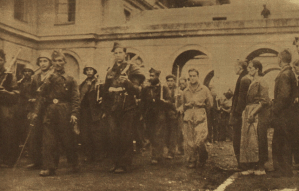
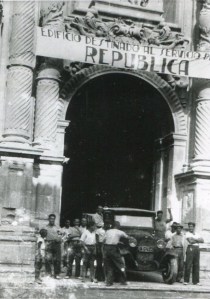
The company of ‘Voroschilof’ miners setting off towards the city. The heroic captain of this company, Colombiano Machado, fell shortly afterwards, mortally wounded, via Ahora, Biblioteca de Espana
Oviedo, Asturias
On 4 October 1936, the highly volatile northern theatre of the Spanish Civil War erupted into a frantic inferno when Republican forces launched their largest, most desperate coordinated offensive to breach the besieged city of Oviedo. For nearly three months, a pocket of roughly 3,000 Nationalist troops and armed right-wing volunteers under the command of Colonel Antonio Aranda had been tightly encircled inside the Asturian capital. On the morning of 4 October, the surrounding Republican miners and militias decided to unleash an all-out assault to crush the garrison before Nationalist relief columns could arrive from Galicia.
The Republican offensive was orchestrated by the Comité de Guerra de Gijón and driven by the formidable Asturian Miners’ Militias, politically radicalised industrial workers who had mastered the tactical use of industrial explosives during the Asturian Revolution of 1934.
On 4 October, the Republic deployed an overwhelming force of over 10,000 militiamen to strike the city from multiple directions. The assault was defined by distinct tactical phases – lacking heavy artillery, the miners advanced behind rolling barrages of improvised dynamite grenades. Specially organised grupos de dinamiteros (dynamite squads) crawled house-by-house, blowing holes through exterior walls to bypass Nationalist street barricades.
.
To shatter the psychological resolve of the defenders, Republican heavy artillery batteries positioned on Mount Naranco began a merciless, continuous shelling of the city centre. Concurrently, Republican aircraft flew low over the rooftops, dropping incendiary devices and bombs onto the urban core. The primary objective on 4 October was to completely sever the remaining water and power conduits entering Oviedo, turning the interior of the city into an unsustainable, unliveable trap.
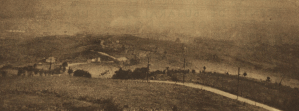
from El Naranco the outline of the city of Oviedo can barely be seen, lost in the dust and columns of smoke raised by our artillery and aircraft projectiles, via Ahora, Biblioteca de Espana
By the afternoon of 4 October, the outer perimeter of the Nationalist defence cracked. Republican militias successfully penetrated the working-class suburbs of San Lázaro and El Milán. What followed was a brutal, intimate form of warfare. Combatants fought room-by-room and floor-by-floor inside apartment complexes, hospitals, and municipal buildings.
.
Colonel Aranda’s surviving Nationalist defenders, completely outmatched in numbers, retreated into a tightly compressed core of fortified concrete buildings in the centre of Oviedo. Aranda issued an absolute order – no retreat, no surrender, and no quarter. Nationalist snipers were positioned in church bell towers, firing down into the advancing miner columns, while the civilian population huddled in cellars to escape the crossfire and collapsing masonry. The offensive launched on 4 October was the closest the Republic ever came to capturing Oviedo. The fighting initiated on this day triggered two weeks of apocalyptic urban slaughter. The city was left largely in ruins, plagued by starvation, typhus, and a lack of fresh water over the coming weeks of battle.
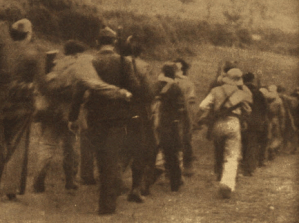
Miners marching to Oviedo, via Ahora, Biblioteca de Espana
An appeal was printed in the 4 October Ahora newspaper in newspaper, which had be told to those in Oviedo: ‘The military discipline which you have voluntarily accepted demands this of you, but, if possible, an even more powerful obligation comes from the noble human meaning contained in the political and social doctrines you share, for which you are fighting and for which so many have died. We are not fighting to obtain revenge; we die, if necessary, to achieve a victory that will allow us to establish tomorrow upon more just foundations.Our triumph will be all the more important the cleaner we can show it to the eyes of the whole world that is watching us. Men of Asturias! All militiamen of the People’s Army! Because of your clean history, because of the living memory of the comrades who fell in October, who today rise in their graves, eager to witness the old struggle revived, proud to contemplate the fruits of their heroic sacrifice; because of all that you are and all that you represent, you cannot disappoint the hopes placed in you. To the world you are the miners of Asturias; there are no differences between you. To all those to whom we appeal, we ask for, and from all we expect, the final effort that will carry us to victory.’
Montija–Espinosa, Burgos
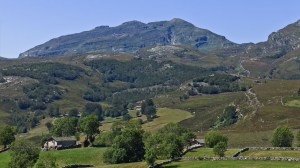
While international attention in October 1936 was heavily fixated on the Siege of Madrid, the Burgos province served as a major, highly contested buffer zone. The mountainous northern fringes of the province, collectively known as the Las Merindades region, remained directly on the frontline. The sector comprises a rugged, high-altitude landscape connecting northern Burgos to the Republican-controlled province of Santander (now Cantabria). Throughout the autumn of 1936, Republican forces consisting of local trade union militias and regular troops deployed continuous, grinding counter-attacks along these peaks. Their goal was to puncture the Nationalist line, relieve pressure on other northern regions, and potentially push down toward the Nationalist stronghold of Burgos.
The Falangist Centuria Montañesa at Loma de Montija, via Abanderado Falangista
On 4 October 1936, the Montija–Espinosa sector in northern Burgos province stood as a crucial, blood-soaked gateway on the Northern Front of the Spanish Civil War. While international attention was fixated on the impending Siege of Madrid, this rugged mountainous territory, collectively known as the Las Merindades region, became the stage for a grinding, positional war of attrition that devastated local communities.
.
By October 1936, the frontline in northern Burgos had completely stalled into a brutal mountain gridlock. The positions on 4 October were dictated by the local geography with the Nationalist forces established in the city of Burgos to the south. From there, they pushed north to secure the town centres of Espinosa de los Monteros and the southern plains of the Merindad de Montija valley. Their main objective was to guard and control the N-629 highway, the strategic spine connecting Burgos to Santander/Santoña. The Nationalist area was held by a patchwork of regular army units under the Burgos command, heavily reinforced by political militias. Notable among them were the Centuria Montañesa and Centuria Menesa, right-wing paramilitary units made up of Francoist sympathisers who had fled Republican territory, alongside local Falangists and Guardia Civil.
.
Espinosa_de_los_Monteros does not have terrain for the fainthearted, via Turismo Burgos
Republican loyalists, primarily comprised of Basque and Santander trade union militias, held the high, rugged peaks of the Cantabrian Mountains directly to the north. Operating from their stronghold in Santander, these columns launched aggressive raids down into the valleys to puncture the Nationalist line and relieve pressure on other northern sectors. Elements of the Octubre Battalion (predominantly leftist railway workers and miners) launched sudden, coordinated mountain assaults using units numbering anywhere from 300 to 1,000 men to harass Nationalist outposts. Republican militias held the northern mountain ridges and the high peaks, launching assaults down into the valleys from their stronghold in neighbouring Santander (Cantabria).
The Montija–Espinosa sector was characterised by a deadlocked frontline where regular military skirmishes over mountain passes coexisted with intimate, localised violence in the valleys below. The Nationalists successfully held their ground, keeping the gate to Burgos closed and setting the stage for a year-long war of attrition in the northern mountains. On 4 October, Franco’s air force and artillery units heavily shelled Republican-aligned pockets in the valley. Local diaries note that residents had to set up a lookout in the church bell tower in nearby Bercedo just to give civilians a warning to hide when the planes approached. The deaths recorded in areas often blurred the line between combat casualties and civil repression. Because both Montija and Espinosa were split by the fluctuating front lines, the surrounding hills became sites of hasty military burials, while towns caught in the crossfire saw waves of executions and reprisal killings against suspected spies or sympathisers.
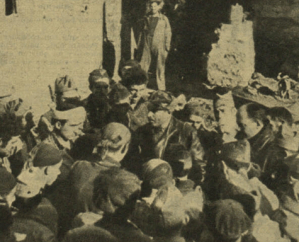
Durruti meeting his men as they ask for clothing and shoes, via Ahora, Biblioteca de Espana
Villafranca de Ebro and Osera de Ebro, Zaragoza, Aragon
On 4 October 1936, during the opening months of the Spanish Civil War, Nationalist forces executed an offensive reconnaissance operation in the Zaragoza province, successfully occupying the strategic Republican-held outposts of La Puntaza and Los Calabazares. The fighting took place in the Villafranca de Ebro / Osera de Ebro sector, just east of Zaragoza. This territory was a highly volatile zone on the Aragon Front, where the infamous anarchist Durruti Column (Columna Durruti), a few hundred militia members of the 26th and 27th Centurias, had dug into the hills with the ultimate goal of advancing on and capturing nationalist-held Zaragoza. They were completely outmatched in equipment, defending the hills with just two machine guns and roughly 150 bullets per soldier. They held out for hours until their ammunition was totally exhausted.
.
The operation was a heavily coordinated offensive reconnaissance led by Nationalist Lieutenant Colonel Gustavo Urrutia. The Nationalist strike team numbered roughly 4,000 men. It consisted of the 19th Infantry Battalion, the Tercio del Pilar Carlist unit, five companies of the right-wing Falange of Aragon (specifically including cavalry and local banners), three tank companies, and heavy artillery. They operated with direct aerial support.
The Nationalist command deployed this force to test the strength of the anarchist lines, seize high ground, and cut off the critical tactical road running between the frontline towns of Osera de Ebro and Monegrillo.
.
The Nationalist columns successfully stormed and overran the Republican positions at La Puntaza and Los Calabazares. While local anarchist militia accounts note they managed to temporarily contain the deeper thrust toward the towns themselves, the capture of these specific geographic heights gave the Nationalists a vital tactical foothold. This breakthrough forced the Republic to frantically strip other quiet sectors of ammunition to plug the gap two days later when the Nationalist cavalry pushed even further toward Farlete.
.
The ultimate objective of Urrutia’s broader advance over those days was to secure towns like Osera de Ebro, Monegrillo, and Leciñena. As the Nationalist columns pushed the front line forward and entered these rural communities, paramilitary Falangist death squads and military authorities immediately executed left-wing sympathisers, union members, or families suspected of supporting the Durruti Column. The direct link to repression is captured in the military journals of the Nationalist commanders themselves. Following the capture of these sectors, Lieutenant Colonel Urrutia recorded in his official logs that after occupying the towns, his forces stayed behind to judge the conduct of some of its inhabitants, a standard euphemism for immediate execution. Those deemed hostile to the Nationalist uprising were shot and buried in unmarked mass graves near the villages or along the roadside. The area is strangely void of significant mass grave sites, and people were often killed and buried in single or double graves, and have been left unmarked, forgotten, built over, and used as farmland, erasing these people from history. One exception in the group is Leciñena, who had already suffered heavy repression in September, had another mass grave opened on 14 October, for four men and three women. The whole area remains unexhumed to this day and the bulk of the graves are not among the 335 registered sites in the province.
.
This battle was highly significant, both strategically and symbolically, because the action at La Puntaza and Los Calabazares on 4 October 1936 was deeply important, as Zaragoza was the crown jewel of the Nationalist rebellion in northeastern Spain. The legendary anarchist leader Buenaventura Durruti had marched his militia column from Barcelona with one obsessive goal, to liberate Zaragoza and establish a direct anarchist commune across Aragon.
By September 1936, the Durruti Column had successfully advanced right up to the gates of the city, capturing the nearby frontline towns of Villafranca de Ebro and Osera de Ebro just 30km from the city. La Puntaza and Los Calabazares were the specific geographic hills overlooking the critical Osera-Monegrillo road and the Ebro valley floor and by overrunning these two outposts on 4 October, the Nationalist strike column successfully halted the anarchist momentum. It seized the high ground overlooking the main highway, effectively blinding Durruti’s scouts and creating a defensive buffer that ensured Zaragoza would remain safely in Nationalist hands for the remainder of the war.
.
The battle exposed a devastating reality that ultimately doomed the Republican faction, showing their military incompetence and structural vulnerability of decentralised, voluntary militias. The anarchist centurias holding the hills were fiercely brave but utterly untrained in heavy combat logistics. They famously refused to adopt standard military discipline or hierarchies, believing them to be anti-revolutionary. They fought for the belief they could win an establish freedom for the masses, but without training and equipment, their enthusiasm could not bridge the gap.
On 4 October, the Nationalist force didn’t just win; they demonstrated the overwhelming superiority of a modern, organised army. They hit the anarchist volunteers with combined artillery, armour, and air support. The defenders were left with barely 150 bullets per man, running completely dry of ammunition within hours. This battle was a wake-up call that forced the Republican government to eventually dismantle the independent militias and forcibly integrate them into a regular, unified Popular Army.
.
Because the Nationalist counter-strike successfully captured La Puntaza and Los Calabazares, the rapid war of movement in north-eastern Spain ended. The front lines froze into a static, gruelling trench stalemate across the arid Aragon hills. The battle of 4 October was the moment the Anarchist dream of capturing Zaragoza died. It proved that ideological passion could not withstand professional military hardware, and it cemented a brutal, static front line that bled the region dry for the next two years.
The defeat on 4 October 1936 at La Puntaza and Los Calabazares deeply frustrated Buenaventura Durruti, but it did not make him retreat. Instead, it triggered a massive, pragmatic transformation in how he viewed both the war and the anarchist revolution.
His direct reaction unfolded across three distinct phases over the days immediately following the battle. Historically, Durruti and his fellow anarchists fiercely rejected traditional military hierarchies, ranks, or state control, viewing them as inherently authoritarian. However, seeing his brave but untrained centurias ruthlessly dismantled on 4 October by professional, combined-arms tactics (artillery, aviation, and armour) shattered his idealistic views on spontaneous warfare. The next day, Durruti rushed to the regional headquarters in Bujaraloz.
Rather than doubling down on anti-authoritarian isolation, he explicitly voted for and endorsed the creation of the Regional Defence Council of Aragon. Durruti publicly stated that a centralised body was an absolute, unpleasant necessity to establish a single military command structure. He realised that without tightly coordinated logistics, the independent militias would simply be picked off piece by piece by Franco’s regular army.
.
Realising that his vanguard positions could not advance on Zaragoza without heavy ammunition and coordinated artillery support, Durruti temporarily paused the war of movement. He pivoted his energy into stabilising the territory he already held.
If his column could not militarily conquer Zaragoza, they would make the surrounding Aragon villages an unassailable anarchist showcase. He poured his focus into stabilising agricultural collectives and ensuring the supply lines from Barcelona were weaponised for a long, defensive trench stalemate rather than a rapid offensive. The failure of October 1936 hardcoded Durruti’s growing belief that the social revolution was meaningless if they lost the war. Just two weeks after the defeat, on 19 October 1936, his famous speech was published internationally in the Spanish Revolution journal, encapsulating the hard-nosed pragmatism he adopted after the Aragon front froze: ‘Forward against Fascism! Fascism should not be discussed. It should be destroyed!’
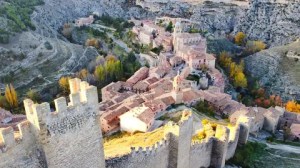
Villarquemado today
Niebla, Huelva, Andalucia
Early October 1936 trace an intense, highly systematic expansion of Francoist rearguard repression across the provinces of Huelva, Seville, and Badajoz. While the mass killings of areas as Nationalist troops had slowed some, people were being rounded up, or removed from prison cells as the criteria for executions changed to ‘clean up’ southern regions as much as possible. Because Huelva fell rapidly to Nationalist forces following the advance of the Columnas de Campaña from Seville, the violence here was not a consequence of frontline combat, but a calculated campaign of political cleansing focused on regional agrarian leaders, left-wing symapthisers, and female republicans. The contextual dynamics for each of these documented actions reveal distinct operational traits.
On the night of 3-4 October was one of the most tragic and explicitly gendered acts of terror in the region. A substantial group of left-wing detainees from Bollullos Par del Condado was transported to the nearby municipality of Niebla in Huelva for execution. The squad targeted prominent local female republicans, including Teresa Albarrán García (a 47-year-old impoverished widow supported by municipal charity), Josefa Barragán Rosado, Josefa González Ramírez, Purificación Lagares Camacho, and Leonor Martín Díaz.These women were targeted because they had participated in local public demonstrations, vocally supported the Republican land reforms, or were related to union leaders who had fled to the hills. Their executions were designed to smash the social fabric of Republican families.
The women, along with a young man named Rafael López Domínguez who was executed in the same truck profile, were buried anonymously in a collective mass grave located within the Antiguo Cementerio de Niebla. This old municipal cemetery is no longer active as a traditional burial ground. Over the years, parts of it have been modified or left as a memorial space. The regional cartography marks it as an official fosa containing an estimated 35 identified victims (33 men and 2 women, though historical counts fluctuate slightly) who were brought from surrounding towns like Bollullos Par del Condado to be executed against the isolated walls of Niebla.
The documented social profiles of these women explain exactly why they were singled out by the Falangist squads during the night saca of 3–4 October 1936, were targeted to smash left-wing community solidarity and punish families who embraced the Second Spanish Republic. Teresa Albarrán García, known as La Reverte, was born in 1889, and was a 47-year-old widow who lived at Calle Canalejas No. 56 in Bollullos. By 1934, she was registered as a poor widow receiving survival charity from the municipal public assistance fund. Though she held no official political membership card, she was recognized locally as a passionate leftist who walked at the front of public workers’ demonstrations, placing deep hope in the agrarian and educational promises of the Republic.
Josefa Barragán Rosado, known as Macofia, was targeted during the same raid and thrown into the truck alongside Teresa.Josefa González Ramírez (Known as “La Pobita”): Arrested from her home during the same midnight sweep. [1]
Purificación Lagares Camacho (Known as “La de Diego las canales”): A local woman whose execution was heavily tied to her family’s involvement in local agrarian and rural syndicates. [1]
Leonor Martín Díaz (Known as “La de Colilla” or “Mujer de Pedro Cañuela”): Explicitly targeted because of her husband’s activities. In the rearguard terror, when left-wing men or union organizers fled into the hills to escape execution, Nationalist squads routinely kidnapped, tortured, and executed their wives, mothers, or sisters as a proxy punishment. [1, 2]
🛻 The Last Route
In the early hours of 4 October 1936, these five women were forced into the back of a commercial transport truck in the plaza of Bollullos. They were driven down the dark highway to the outskirts of Niebla, executed by a paramilitary firing squad against the municipal cemetery wall, and unceremoniously dumped into a single trench pit. [1]
Because the site is a registered mass grave rather than an individual plot, finding them requires searching historical registries under the Fosa del Antiguo Cementerio de Niebla rather than individual municipal cemetery records
In the Huelva Basin (Valverde, Calañas, El Campillo, Riotinto, Aljaraque areas) was the strategic mineral core of the British-operated Rio Tinto Company mines. The mining syndicates had strongly backed the Second Republic, making their union workforces prime targets for the incoming Falangist and military columns. Figures like Gregorio Carrasco Méndez, Juan Martín León, and Manuel Jesús Navarro Moreno were rounded up in sweeping structural arrests designed to permanently decapitate the mining unions and agrarian collectives.
The Extraditions to Badajoz (Calañas / Fregenal de la Sierra in Extremadura) and executions of people such as Francisco Manovel León at Fregenal de la Sierra highlights how the borders between military provincial commands were used to move prisoners. Detainees from northern Huelva were routinely routed across provincial lines into Badajoz to be executed away from their hometowns, obscuring the local record of their deaths.
The Cañaveral Executions Seville targeting people like Manuel Leche Ibáñez and Isidro Leche Pérez, both from the outlying municipal zone of Cañaveral, shows how people werea still being transported directly into the city of Seville. They were processed through the central military commands controlled by General Queipo de Llano and executed against the walls of the San Fernando Cemetery or the La Macarena trenches.
The coordinated executions across a broad web of towns like Bollullos, El Campillo, Aroche, Valverde, Cumbres Mayores, Calañas, and Zalamea, shows a synchronized nights of sacas. Local right-wing authorities and Falangist squads cleared out municipal lockups simultaneously, utilizing isolated country crossroads and agrarian estates as execution sites to terrorize the local peasant populations.
Cañaveral and La Palma/Bonares: Concurrently, Isidoro Bonilla Plaza and Marcelino Borrero Bravo were murdered in Cañaveral, while José Madrid Bellerín and José Soriano Díaz were taken away from La Palma del Condado to be executed and buried in unmarked trenches in adjacent Bonares.
5 October: The Eucalyptus Grove Execution (Almonte)
The Victim:Antonio Díaz Cano, a 31-year-old local civilian from Almonte.
The Incident: He was formally extracted from the Almonte municipal prison in the middle of the night. Instead of being transferred to a formal judicial court, he was driven down the Almonte–Rociana road. The execution squad pulled him from the vehicle and shot him in an isolated eucalyptus grove flanking the highway. This method of roadside execution (paseo) ensured the bodies were easily found by locals, reinforcing a culture of total compliance through fear.
Chucena: On the same day, Pedro Pinto Romero, a resident of La Palma del Condado, was tracked down, captured, and executed within the nearby territory of Chucena to eliminate any immediate local resistance.
Niebla, Huelva, Andalucia
Villarquemado,Teruel, Aragon
The tragic events in the municipality of Villarquemado highlight the methodical execution of the White Terror by Francoist forces during the autumn of 1936. Unlike regions fractured by shifting lines, the province of Teruel saw immediate, crushing control established by the military rebellion in July 1936. What occurred in Villarquemado between 4 October and 7 October 1936 was a calculated, state-sanctioned purge of the town’s democratically elected civil leadership and their families.
.
On 4 October, Nationalist paramilitaries and military authorities carried out a sweep explicitly targeted at the municipal leadership of the Second Spanish Republic. The killings on this day were designed to permanently break the local political infrastructure. Nicolás López Aguar, the 62-year-old former Republican mayor of Villarquemado had served as the town’s leader from the dawn of the Republic on 14 April 1931 until February 1936. Because of his pioneering role in establishing local Republican governance, he was viewed as a primary ideological enemy by the rebels.Teófilo Villel Sánchez, aged 40, had succeeded López as the active mayor in February 1936. By executing both the past and present heads of the town hall simultaneously, the Francoist forces sent an absolute message of total political eradication to the populace. Documented alongside the mayors, Benedicto Olivas Vicente was swept into the same extraction as an active left-wing sympathiser and executed alongside them on this date.
.
The logistics of the Villarquemado executions connect directly to one of the most notorious mass grave networks of the Spanish Civil War in Aragon, Los Pozos de Caudé. Rather than hiding the bodies near local village cemeteries, Nationalist forces transported the victims of both the 4 October and 7 October massacres to an abandoned mining site located a few kilometres outside the capital city of Teruel. The deep, vertical extraction shafts of the old mines were used as ready-made mass graves. Hundreds of victims from the surrounding alignment of villages, including the mayors and the Cruzado family, were shot at the lip of the shafts and dropped into the darkness to hide the scale of the execution campaign. This site is now recognised as a major sanctuary for historical memory in Aragon, honouring the hundreds of individuals from the region who disappeared down the shafts during those first brutal months of the conflict.
.
Onda, Castellon, Valencia
On 4 October 1936, a tragic and highly specific episode of violence occurred in the eastern province of Castellón. In the early hours of the day, 26 residents from the town of Onda were executed in the neighbouring municipality of Bechí (Betxí). In October 1936, the entire province of Castellón was firmly under the control of the Second Spanish Republic. The executions were part of the Red Terror against individuals suspected of being right-wing sympathisers, landowners, or Catholics. Many Red Terror attacks were spur-of-the-moment or retaliation events, but this was a meticulously planned operation where the victims were targeted directly by name using blacklists compiled weeks in advance. The wave of arrests leading up to the 4 October execution was orchestrated by local revolutionary committees in Onda, often dominated by local anarchist factions like the Columna de Hierro (Iron Column) or radical unionists, using municipal census data, tax records, and parish registries to compile precise lists of individuals marked for liquidation. Their primary targets were specific pillars of conservative society, the Catholic priests (such as young coadjutor Miguel Canelles Ten), local landowners, businessmen, and figures openly associated with right-wing or traditionalist political parties.Most of the 26 victims had already been systematically hunted down, arrested at their homes or hiding places over the preceding weeks, and held in makeshift local prisons or revolutionary headquarters in Onda.
When the committee decided to execute them, and waited until the dead of night, arrived at the holding cells with their specific list of names, called the 26 individuals forward one by one, and loaded them onto trucks bound for the Bechí municipal border. Local history records that local committees often intentionally used outsiders to carry out these executions. Militiamen from neighbouring villages or specialised execution squads (such as the notorious Nueve Inseparables from nearby L’Alcora) were brought in to perform the actual shootings. This was done to prevent local community member from having to pull the trigger on people they had known for years, reinforcing the deliberate and bureaucratic cruelty of the event. They were taken to a secluded rural roadside or the exterior wall of the Bechí municipal cemetery, where they were shot.
Because the bodies were dumped outside their home municipality, the burial arrangements created a legacy of confusion and pain typical of Spanish Civil War mass graves. Following the execution, local authorities or gravediggers in Bechí were left to hastily bury the 26 bodies in an unmarked mass trench to prevent disease, often without registering the names of the deceased. Following the war, General Franco’s regime investigation the Causa General., through the Causa General files for the municipality of Onda, identified several local left-wing militants as the guards and drivers who loaded the 26 victims into the trucks. Many of those identified as the directly responsible ringleaders were either killed in the later stages of the war or fled into exile to France and North Africa in 1939 to escape Francoist firing squads.
.
Following General Franco’s victory in 1939, the Nationalist regime made a concerted effort to locate and exhume victims of Republican violence. The bodies of the 26 ondenses were subsequently recovered from Bechí, identified by relatives where possible, and transferred back to their home town of Onda. Today, they are commemorated as martyrs by the local parish community of La Asunción de Nuestra Señora de Onda.
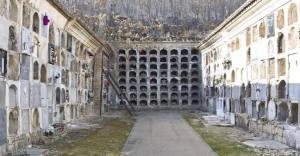
Cemetery of San Eufrasio, via Cadena Ser
El Portichuelo, Jaén
The executions at El Portichuelo on the road between Jaén and Los Villares is another harrowing example of a targeted rearguard saca (prisoner extraction) occurring between 2 and 4 October 1936. Like the massacre at Bechí, this event occurred deep within territory controlled by the Second Spanish Republic. El Portichuelo is a mountain pass and winding geographic bottleneck on the road connecting the provincial capital of Jaén to the smaller town of Los Villares. It provided a quiet, hidden site away from population centres.
.
Disagreements in victim counts are common in rearguard massacres due to the lack of official record-keeping by execution squads. While standard historical studies catalogue 24 victims (and explicitly note that two individuals miraculously survived the firing squad by feigning death or escaping into the brush), the Diocese of Jaén’s official martyr records place the number higher, counting 32 men killed. Among those selected for the saca was Pedro José Pardo Barrón, a 44-year-old diocesan priest serving as the vicario parroquial of the parish of San Juan Bautista in Los Villares. Given the high profile of his death, his case was officially recognised by the Vatican.
.
The trajectory of the bodies mirrors the post-war retrieval pattern seen across Spain.
Following the executions, the bodies were thrown into a makeshift mass grave (fosa común) near the roadside at El Portichuelo. After Franco’s victory in 1939, the Causa General oversaw the location and exhumation of victims of Republican violence. The remains of several victims, including Father Pardo Barrón, were moved to the Cemetery of San Eufrasio in the city of Jaén.
The basilica in Elche in 1936. The town would later become a base for refugees fleeing the Nationalist armies
Elche, Alicante, Valencia
On 4 October 1936, a major collective execution took place in Alicante city, where 17 right-wing residents from the nearby town of Elche (ilicitanos) were put to death by firing squad.
The event represented a specific transition phase in rearguard violence during the Spanish Civil War: the shift from lawless roadside paseos to institutionalised, state-sanctioned wartime justice via the newly created Tribunales Populares (Popular Tribunals).
.
In the opening months of the war, the Republican government struggled with uncontrolled violence by radical militias in the rearguard. To restore state authority and centralise justice, the Republic established the Tribunales Populares in late August 1936. These courts were composed of professional magistrates alongside a popular jury made up of representatives from various anti-fascist political parties and trade unions. While designed to formalise legal procedures, these tribunals operated under extreme wartime paranoia, heavy political pressure, and a highly expanded definition of treason or rebellion.
.
The 17 victims from Elche had been arrested weeks prior amid a sweep of right-wing sympathisers, business owners, and Catholics. In September 1936, the Tribunal Popular de Alicante put a group of over 30 residents from Elche on trial, formally charging them with conspiracy for military rebellion. The trial took place against a backdrop of panic. As Franco’s Army of Africa advanced rapidly toward Madrid, fears of an internal fifth column (hidden nationalist saboteurs) peaked in Republican strongholds like Alicante.
.
Unlike the anonymous burials associated with roadside paseos, the records of the Tribunal Popular de Alicante preserve the exact profiles of the 17 men executed on Sunday, 4 October 1936. They represented a cross-section of Elche’s conservative, middle, and working classes – shoemakers, shop assistants, merchants, bank employees, accountants, teachers and farmers. The executions were carried out simultaneously in the capital city of Alicante, and the bodies were initially buried there. Following the end of the war in 1939, the bodies of these 17 victims were exhumed and repatriated back to Elche for a major collective funeral.
.
Cartagena, Murcia
On 4 October 1936, a critical turning point in the Spanish Civil War occurred when the Spanish merchant vessel Campeche docked at the Mediterranean port of Cartagena, delivering the first major documented shipment of Soviet military hardware. This arrival marked the official commencement of Operation X, a covert Soviet military supply program designed to bolster the embattled Second Spanish Republic against the Nationalist forces of General Francisco Franco, who were already receiving heavy backing from Nazi Germany and Fascist Italy.
.
In the opening months of the civil war, western democracies championed a policy of non-intervention, establishing an international embargo that severely restricted the Republican government’s ability to purchase arms legally. Meanwhile, Franco’s Nationalist rebels faced no such shortages, benefiting from a steady stream of German and Italian aircraft, artillery, and personnel. Recognising that the Republic faced imminent collapse without external aid, Joseph Stalin and the Soviet Politburo authorised a secret logistics network at the end of September 1936 to supply military material to Spain.
.
The Campeche, a Spanish commercial tanker, was chosen for the inaugural run to bypass international scrutiny. It departed from the Black Sea port of Feodosiia in late September, carrying a diverse and heavily packed cache of weaponry cleared from Soviet military depots.
When the ship berthed in Cartagena on 4 October, its holds yielded a massive quantity of vital infantry and artillery equipment, including six British-made 115 mm howitzers accompanied by 6,000 artillery shells, 240 German-pattern grenade launchers and roughly 100,000 hand grenades, over 20,350 rifles (consisting of a eclectic mix of older international models like Vetterli, Arisaka, and Lebel) alongside millions of rounds of ammunition, and approximately 350 heavy and light machine guns, including Maxims, Hotchkiss, and Vickers models, to fortify defensive lines.
.
The arrival of the Campeche broke the logistics isolation of the Spanish Republic and set the stage for an influx of even heavier Soviet machinery. Just eight days later, on 12 October 1936, the Soviet cargo ship Komsomol arrived at the same port, delivering the first batch of 50 T-26 light tanks and specialised military advisors. Together, the initial shipments arriving through Cartagena provided the immediate material and firepower necessary for the Republic to organise the defence of Madrid. While the diverse models of small arms initially created a logistical puzzle for ammunition distribution, the Campeche shipment permanently altered the geopolitical landscape of the war, transforming the Spanish conflict into a proxy battleground for Europe’s major ideological powers.
Related
Got a comment, question or suggestion? Know who took a photo? Have questions about a particular date or event? Cancel reply