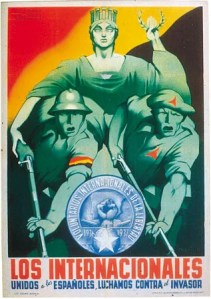
By 19 October 1936, the underground recruitment pipeline orchestrated by the Communist International (Comintern) in Paris had shifted into high gear. Volunteers arrived in Spain as a in clandestine, highly fractured waves to evade the watchful eyes of non-intervention border guards. Known colloquially as the Red Express, night trains departed from the Gare d’Austerlitz in Paris, packed with men pretending to be tourists or migrant workers. They travelled south to Perpignan, crossed the Pyrenees on foot or via local buses, and converged at the international transit hub in Figueres and Portbou. From there, the Republican railway network funnelled them directly into the central depot at Albacete.
A massive, single contingent of over 700 volunteers rolled into Albacete station on 22 October. This wave was heavily Germanic, comprised of political exiles fleeing Nazi rule, alongside a substantial group of Polish miners who had been working in the industrial centres of north-eastern France and Belgium.
The first highly organised groups from Central and Eastern Europe arrived via sea and rail between 24-27 October, including Balkan volunteers, Czechs, and a highly dedicated unit of Polish communists. Smaller, isolated packets of British intellectuals and workers, such as the poet John Cornford’s initial group, also trickled in during this window.
Upon stepping off the trains, these thousands of disparate individuals were immediately subjected to a rigid, top-down command structure managed by seasoned Comintern operatives. The supreme leader of the Albacete base was André Marty, a French Communist deputy appointed directly by Moscow. Marty was a ruthless, deeply paranoid Stalinist who viewed every non-communist volunteer with suspicion, establishing a harsh penal system to enforce absolute compliance. Assisting Marty in organising this chaos were two prominent Italian communists: Luigi Longo, who served as the Inspector General, and Giuseppe Di Vittorio, the chief political commissar. Together, they divided the arriving volunteers by linguistic groups to bypass the immense communication barriers.
While the Red Express rail line brought thousands over the Pyrenees, the maritime route was equally crucial for volunteers circumventing strict border blockades. During late October 1936, the Mediterranean Sea served as a high-stakes pipeline for the International Brigades.
The most iconic maritime pipeline was operated by the Republican transport steamships, notably the Ciudad de Barcelona. Operating under constant threat of interception by Nationalist cruisers, these vessels made secret runs from Marseilles directly across to the ports of Barcelona and Valencia.
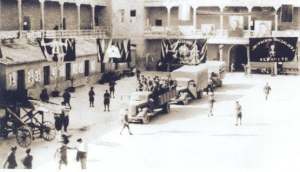
On 21–23 October the Ciudad de Barcelona docked in Barcelona harbour carrying over 500 foreign volunteers. This boatload was highly international, packed with Italian anti-fascists, German exiles, and early contingents of British and French recruits who had been assembled at transit hotels in Marseilles. Photographers captured striking historical images of these dense boatloads of men packed tightly on the decks, cheering and raising their fists in the popular front salute as the ships pulled up to the quayside.
On 25 October, a secondary wave of smaller transport vessels arrived at the port of Valencia. These boats carried mixed groups of Polish, Hungarian, and Czechoslovakian volunteers who had travelled across Europe under the guise of commercial sailors or tourists. Upon disembarking at the docks, the volunteers were greeted by local Republican committees before being immediately marched to transit camps or local sports stadiums. Within 24 to 48 hours of their boat arriving, they were packed onto steam trains heading inland to the central clearing depot at Albacete to meet the rest of the growing brigade.
On 22 October, the Prime Minister of the Spanish Second Republic, Francisco Largo Caballero, had formally legalised the International Brigades. That same day, Marty and Longo consolidated the loose linguistic groupings into a singular paramilitary force, the 9th Mobile Brigade (9ª Brigada Móvil). It was divided into four battalions, each led by trusted veteran officers – the Edgar André Battalion, made up of roughly 600 German and Austrian anti-fascists, commanded by Hans Kahle, a former World War I lieutenant, the Commune de Paris Battalion, consisting of roughly 500 French and Belgian volunteers, led by the French commander Jules Dumont, the Garibaldi Battalion, comprising nearly 500 Italian exiles, commanded by the charismatic republican Randolo Pacciardi, and the Dąbrowski Battalion, featuring roughly 400 Polish, Hungarian, and Balkan fighters, led by the Polish commander Tadeusz Oppman.
From 23 to 28 October, these battalions were marched out to satellite villages surrounding Albacete to Madrigueras and Tarazona de la Mancha for a severely compressed training cycle. Because actual weapons were fiercely hoarded, the men spent these days drilling with wooden broomsticks and replica rifles. Veterans of the Western Front tried to teach raw intellectuals the basics of trench construction, squad movement, and air-raid dispersal under the watchful eyes of their assigned political commissars. The primary reason for the lack of firearms was a massive logistical logjam at the coast. The brand-new Soviet weapons destined for the brigade, including Mosin-Nagant rifles and Maxim machine guns, were sitting in crates at the port of Cartagena, having just been unloaded from the Soviet cargo ship Komsomol. Fearing Nationalist air raids, the local port authorities held the weapons in coastal caves and warehouses.
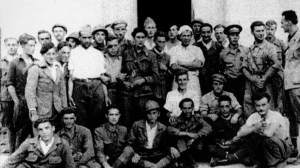
The transition from the romanticism of the boats and trains to the reality of daily life in Albacete was a harsh awakening for the volunteers. Between 23 and 30 October, the concept of structured military training was entirely undermined by a severe lack of basic infrastructure, critical supply shortages, and a widening cultural gulf between the foreign idealists and the conservative local populace. Life in the satellite villages like Madrigueras, Tarazona de la Mancha, and Mahora was defined by extreme discomfort. The autumn of 1936 brought bitter, damp cold to the high plains of La Mancha. The volunteers were packed into unheated, requisitioned convents, abandoned churches, and drafty barns. Sanitisation quickly broke down; with hundreds of men crammed into single stone buildings with no running water or proper latrines, outbreaks of dysentery and body lice became rampant well before anyone saw combat. Men slept huddled together on the bare stone floors or on thin straw mats that quickly grew damp and rotten.
There was almost no functional military clothing. A few lucky veterans received surplus French army uniforms or heavy leather jackets, but the vast majority of the brigade spent late October in the civilian clothes they had worn when leaving Paris, Marseilles, or Brussels. Factory workers drilled in worn-out denim overalls, and intellectuals marched through the mud in threadbare tweed suits and thin-soled city shoes that quickly disintegrated. The command lacked heavy winter coats and sturdy boots; many volunteers resorted to wrapping burlap sacks around their feet to ward off frostbite during early morning drills.
Food was equally scarce and strictly rationed. The Albacete base command struggled to feed an unexpected army of 5,000 men on short notice. The standard daily fare consisted of a watery, unseasoned stew made of chickpeas, lentils, and a few scraps of tough mule meat or donkey fat, accompanied by a small portion of stale, coarse bread. Coffee was non-existent, replaced by a bitter chicory substitute. For the urban volunteers, particularly those from France and Germany used to substantial diets, the constant hunger and lack of protein caused a noticeable drop in physical stamina just as their training grew more intense.
For the native inhabitants of Albacete and its surrounding villages, the sudden influx of thousands of foreign soldiers was an overwhelming, destabilising shock. Albacete was a deeply traditional, largely agrarian, and socially conservative province. Almost overnight, its quiet streets were flooded with thousands of loud, politically radical foreigners who spoke no Spanish and brought an aggressive, urban political culture with them. The local economy and infrastructure buckled under the weight, as the International Brigades requisitioned grain stores, livestock, and wine supplies, leaving the civilian population facing severe shortages and soaring food prices.
The foreign volunteers, largely staunch anti-clerical communists and anarchists, frequently defaced or looted churches, using sacred spaces as stables, kitchens, or latrines. This deeply offended the religious sensibilities of the peasantry. André Marty’s intense paranoia trickled down into the community. Under his direction, the Servicio de Investigación Militar (the brigade’s secret police) set up checkpoints, strictly monitored the movements of locals, and viewed any complaints from the villagers as potential fascist subversion. While the local Republican authorities put on a brave face of international solidarity for official photographs, the everyday reality for the Albacete locals was a tense, uncomfortable occupation by an army they could not understand, which was rapidly consuming the vital resources they needed to survive the coming winter.
It truly was a tragic situation for the Spanish populace. For the ordinary people of Albacete and its surrounding villages, the war was no longer a distant political conflict in Madrid; it was an intimate, daily struggle for survival taking place in their own backyards in a way unique to the violence felt in the rest of the country. The arrival of the International Brigades exposed a profound tragedy; the local peasantry found themselves caught between their loyalty to the Republican cause and the immediate, destructive reality of hosting a starving, foreign army. These villagers were already living on the margins, and having their hard-earned winter food stores, livestock, and homes requisitioned by thousands of non-Spanish-speaking soldiers created a deep sense of vulnerability and isolation.
Also, the psychological toll on the locals was immense. They watched their sacred community spaces defaced, lived under the constant fear of Nationalist air raids attracted by the troop concentrations, and had to navigate a suffocating atmosphere of political paranoia and secret police checkpoints. It was a stark, unromantic reminder that in total war, the civilian population often bears the heaviest, most silent burden, even at the hands of the forces arriving to defend them.
As Nationalist forces breached the town of Navalcarnero on 26 October, threatening to encircle Madrid, the original Comintern strategy to train the men until December collapsed. Longo ordered an emergency truck convoy to rush the weapons from Cartagena to Albacete. Between 28 and 30 October, the crates were finally pried open at the base. The men were issued their rifles just hours before their scheduled deployment. On 30 October, the 9th Mobile Brigade was officially designated the XI International Brigade under the overarching military command of Soviet General Emilio Kléber (Manfred Stern). In the darkness of 31 October, Kléber ordered his 1,900 freshly armed, largely untested men onto trains bound directly for the besieged capital.
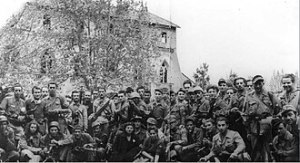
In the freezing darkness of 31 October 1936, the strategic timeline for the International Brigades violently dissolved. The original Comintern blueprint, to keep the foreign recruits drilling in the fields of La Mancha until December, was abandoned as General Franco’s Nationalist forces advanced past Brunete. The Spanish capital was on the verge of total collapse, forcing an immediate, emergency mobilisation of the newly formed XI International Brigade. Exactly 1,900 foreign volunteers were selected for this first wave. The men chosen were predominantly the seasoned veterans of the German Edgar André Battalion, the French and Belgian Commune de Paris Battalion, and the Polish-led Dąbrowski Battalion. Because of their immediate readiness, the Italian Garibaldi Battalion was held back in Albacete as a reserve unit, meaning the vanguard was a heavily Franco-Germanic shock force.
The transit was a chaotic, multi-modal logistical sprint. The troops were packed tightly into wooden-benched third-class railway carriages and a mismatched fleet of requisitioned civilian delivery trucks and omnibus vehicles. The convoy moved blacked-out along the vulnerable rail and road networks connecting Albacete to Madrid, traveling under constant fear of interception by Nationalist cavalry or Italian-manned Fiat fighter planes.
The psychological state of the men inside those dark carriages was defined by a stark disconnect between political euphoria and tactical blindness. The vast majority of the 1,900 volunteers had virtually no understanding of the military reality awaiting them. They were highly literate, urban idealists, dockworkers from Marseilles, exiled trade unionists from Berlin, and university intellectuals, who viewed the conflict through a romanticised lens of anti-fascist duty.
As the trains rolled toward the capital, the men sang The Internationale and La Marseillaise in a chorus of competing languages, genuinely believing they were arriving to participate in a grand, triumphant defence of a city. They were completely unaware that they were being deployed as an emergency buffer force to plug holes in a disintegrating frontline. Crucially, they had been handed their mismatched Soviet Mosin-Nagant and obsolete Mexican rifles only hours prior; many spent the journey frantically trying to figure out how to clean the heavy factory grease from their barrels or swap ammunition clips that did not fit their weapons. They did not know the topography of Madrid, they had never fought as a cohesive brigade, and they had no idea that within a week, nearly half of their number would be dead or wounded in the scrublands of the Casa de Campo and the stone buildings of University City.
By the final hours of 31 October 1936, the trains and requisitioned trucks carrying the 1,900 men of the XI International Brigade ground to a halt. To avoid the highly vulnerable, bombed-out urban rail termini inside the city centre, the Republican command routed the convoys to the outer western and southern edges of the Madrid province.
The primary disembarkation points during these final hours of October were the suburban stations and fields surrounding Vallecas and Vicálvaro, just east of the city limits, as well as tactical staging grounds near Alcalá de Henares. The men stepped off the wooden carriages into the pitch-black, freezing autumn night, completely isolated from the civilian population of the capital. The scene at the peripheral rail sidings was one of absolute military confusion. There were no welcoming committees or cheering crowds on the outskirts; instead, the volunteers were met by harried Republican staff officers shouting conflicting orders in a language the foreign troops could not comprehend. General Emilio Kléber and his staff spent the remaining minutes of October frantically trying to sort the multilingual battalions, the German Edgar André, the French Commune de Paris, and the Polish Dąbrowski, into defensive positions along the muddy ridges.
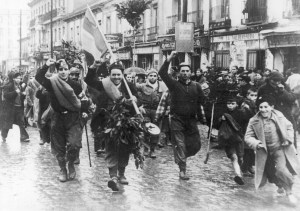
As the midnight clock struck, marking the end of October, the men lay huddled in the open fields and makeshift trenches just miles from the capital. Looking toward the western horizon, they could see the flashing artillery fire and hear the distant, continuous thunder of General Varela’s Nationalist batteries pounding the city’s outer defences. They had reached the gates of Madrid, completely untried and utterly exhausted, waiting in the dark for the dawn of a new month that would bring their immediate, brutal introduction to the front lines.
As the historic month of October 1936 drew to a close, a powerful historical myth began to solidify, the idea that the foreign volunteers of the International Brigades were the saviours of a helpless Spanish Republic. While the propaganda machinery of the Comintern naturally elevated these international units to heroic status, this narrative profoundly obscured a deeper, far more staggering truth. Long before the first foreign train arrived in Albacete, and long before the XI Brigade ever reached the muddy ridges of the Madrid periphery, the ordinary people of Spain had already achieved the near-impossible.
For over three months, the Spanish populace had borne the terrifying brunt of a professional, brutal military coup entirely on their own. When the Nationalist generals revolted in July, the Republic’s regular army largely defected, leaving the defence of the country to everyday civilians. These were untrained fighters, factory workers, trade unionists, farmers, and students, who had to transform themselves into a militia overnight. Armed with little more than outdated hunting rifles, pistols, and home-made explosives, these ordinary citizens stood directly in the path of a devastating slaughter orchestrated not just by a highly trained military elite, but by their own neighbours, landlords, and traditional authorities.
The exceptional nature of this domestic resistance cannot be overstated. While the Western democracies hid behind the cowardice of the Non-Intervention Agreement, effectively blocking the Republic from buying arms, the Spanish people fought completely isolated. They faced a terrifyingly modern war machine, which was already being heavily subsidised by imported troops and sophisticated German and Italian hardware. Yet, through sheer, raw courage and staggering human sacrifice, these fragmented civilian militias successfully stalled General Franco’s vanguard, contesting every village and crossroads from Seville to the gates of Madrid.
The International Brigades did not arrive to find a passive population waiting to be rescued; they arrived to find a nation of exhausted, grieving, yet fiercely defiant citizens who had already bled dry to hold the line. The foreign volunteers undoubtedly brought vital military structure and a psychological boost at a critical hour, but the true foundational bedrock of the anti-fascist struggle remained the quiet, exceptional heroism of the Spanish people themselves.
- The Catalonian Provinces
The opening months of the Spanish Civil War unleashed a wave of rearguard violence across Catalonia that left deep scars on local communities. Decades later, historians and digital memory projects continue to piece together the timelines of these tragic events. Among the most intense episodes of this early violence took place on the night of 31 October 1936, a date remembered in Girona’s municipal history as the Nit de les Roses (Night of the Roses).
In October 1936, Girona’s provincial prison was temporarily operating out of a former seminary building. On the final night of the month, a series of sacas, the forced removal of prisoners from their cells, took place. According to records maintained by the Ajuntament de Girona, prisoners were extracted in two groups from both the seminary prison and the vicinity of the city cemetery. The first individual to be targeted was Martín Batalla Poch, who was executed separately from the others. A second group, consisting of five men, Ramón Adroher Guytó, Antonio Busquets Norat, Camilo Conde Carvallo, Luís Domènech Pujol, and Luís Picó Boada, was loaded onto transport vehicles and driven out of the city toward the Orriols area, where they were killed.
A further group of ten men, heavily associated with the cemetery site itself, lost their lives during this period of intense repression. They were José Barceló Casademont, Vicente Cano Serra, Joaquín Font Fargas, Alberto Gomis Llambias, Pedro Granés Carós, Valentín Güell Maymí, Joaquín Lloret Plana, Luis Alfonso Noguera Massa, Ramon Tarrés Feliu, and José Montserrat Torrent Sala.
Following the end of the civil war, the victorious Francoist regime erected memorials at the Girona cemetery to honour those killed in the rearguard. However, these monuments require careful navigation by modern historians. One memorial listed Martín Batalla Poch independently, while a separate plaque grouped the five men executed in the Orriols area together. Because the dictatorship frequently conflated different categories of deaths, combining battlefield casualties with political executions, the numbers and precise context on these monuments can be misleading. Untangling the propaganda from the true historical timeline remains a primary objective for local archives.
Further south, the municipality of Tarragona was experiencing its own wave of rearguard violence during the same autumn. Unlike the highly specific dates documented in Girona, the timeline in Tarragona for October 1936 remains less precise, embedded within a broader, continuous wave of executions and secret burials.
Data from the Banc de la Memòria Democràtica confirms that the Tarragona cemetery contains a validated mass grave (fosa) directly linked to this repression. Between July 1936 and February 1937, 145 individuals from outside the local area were killed within the Tarragona municipality. A substantial number of these victims were buried directly in the cemetery grounds. The story of Tarragona’s victims took a dramatic turn more than two decades later. In 1959, under the direct orders of the Francoist state, the mass grave was disturbed. The remains of 81 bodies were exhumed from the Tarragona cemetery and transferred to the crypts of the monument at Valle de los Caidos/Cuelgamuros (the Valley of the Fallen), where they were reinterred as part of the regime’s efforts to centralise the war’s dead.
Following the defeat of the pro-Nationalist military uprising in Barcelona on 19–20 July 1936, the official Catalan government (the Generalitat) effectively lost its monopoly on violence.
Power fractured into the hands of autonomous revolutionary bodies, heavily dominated by anarchist militias like the CNT-FAI, alongside communist and Marxist groups. Between July and December 1936, a wave of preventative, ideological, and anti-clerical violence swept through the region, accounting for roughly 87% of all rearguard killings that would occur throughout the entire three-year conflict. Historians estimate that 8,352 individuals were killed behind the lines in Republican Catalonia. However, this violence did not hit the territory uniformly. Because Catalonia’s four provinces possessed vastly different industrial layouts, political dynamics, and geographical proximity to the fighting fronts, each experienced the terror of the rearguard in different ways.
As the epicentre of Catalan industry and revolutionary politics, Barcelona province bore the heaviest burden of the repression, recording between 4,500 and 5,000 victims. Here, the rearguard violence was deeply urban and institutionalised through factory committees. The primary victims were industrial elites, owners of large businesses, factory managers, and right-wing political organisers. Violence in Barcelona was highly organised by neighbourhood Comités de Investigación and militias operating out of seized buildings. These groups orchestrated the notorious paseos to remote urban edges (such as the cliffs of Montjuïc or the highway to Vallvidrera) to execute them.
The vast majority of the 1936 rearguard repression murders in Catalonia took place within Barcelona Province, which accounted for between 4,500 and 5,000 of the region’s estimated 8,352 total victims. Within this area, the executions were heavily concentrated at several notorious killing fields and makeshift burial sites located right on the geographic periphery of Barcelona city. The primary locations where these murders occurred include were Montcada i Reixac Cemetery, where between July 19, 1936, and May 1937, approximately 1,200 victims were buried. The cemetery served as the central dumping ground for the bodies of priests, right-wing individuals, and property owners who had been rounded up in the capital and executed.
The Carretera de la Arrabassada, a winding mountain road leading up the Collserola hills directly behind Barcelona city was the most notorious site for the paseos. Militia patrol committees would drag suspects out of their homes or clandestine prisons, drive them up into the secluded bends of the Arrabassada, and execute them along the roadside before their bodies were moved to the Montcada cemetery. Also popular was the moats and cliffs of Montjuïc Castle overlooking the sea, along with the isolated areas around the Vallvidrera Funicular, were frequently used by execution squads. Hundreds of right-wing sympathisers and military figures who had participated in the failed July uprising were taken to the Santa Elena moat of the castle and shot.
In the Port of Barcelona, the floating prison ship Uruguay also became a major hub of repression. Initially intended to hold political prisoners securely, it was repeatedly boarded by armed anarchist and communist militia fighters who bypassed formal revolutionary justice to summarily execute prisoners directly on board or on nearby docks.
While Barcelona was the urban focal point of these atrocities, it is worth noting that outside of Catalonia, other Republican centres suffered similar patterns of concentrated rearguard violence during the bloody summer and autumn of 1936. For instance, in the capital city of Madrid, up to 60% of all street-side execution victims were killed during the exact same peak window of August and September 1936, mirroring the chaotic breakdown of public order seen in Barcelona
In stark contrast to Barcelona, Lleida Province saw an estimated 1,200 to 1,400 deaths, a figure that represents the highest per capita casualty rate relative to its smaller population. Lleida’s violence was defined by deep-seated agrarian class conflict and radical anti-clericalism, followed by large rural landowners (caciques), and right-wing agrarian politicians. The social friction between wealthy property owners and poor tenant farmers boiled over instantly once central authority collapsed. Because Lleida was highly religious, the destruction of churches and the hunting of priests was exceptionally severe here, leaving the provincial capital and its agricultural valleys profoundly traumatised in the war’s initial months.
Tarragona Province experienced between 1,000 and 1,100 rearguard deaths. Its geopolitical position altered the style of its repression, as it served as a vital transit corridor connecting Barcelona to the Aragon front and the rest of Republican Spain. They targeted maritime business owners, conservative farmers, and suspected right-wing sympathisers moving through transit hubs. Repression in Tarragona was highly volatile, often fuelled by armed militia columns passing through local railway stations en route to the front lines. If a militia column received news of a Republican defeat in Aragon, they frequently retaliated against the local prison populations or conservative notables in nearby towns during their brief stops.
Recording the fewest casualties, between 900 and 1,000 deaths, Girona Province faced a dynamic heavily influenced by its proximity to the French border and its exposure to naval warfare. Locals mostly targeted rural elites, local clergy, and individuals caught attempting to flee the country across the Pyrenees. Because Girona sat on the escape route to France, its militia check-points were hyper-vigilant, treating any internal travellers with immense suspicion. As seen in the Nit de les Roses, violence in Girona was frequently reactive. Major spikes in executions were often direct, emotional responses to external events, such as Nationalist naval bombardments on nearby coastal towns like Roses, which triggered immediate, retaliatory extractions from the provincial prisons.
By late December 1936 and early 1937, this fractured landscape of terror began to shift. Horrified by the international damage caused by uncontrolled executions, the Generalitat, under the leadership of President Lluís Companys, gradually asserted control over the militias. The autonomous revolutionary committees were systematically dissolved and replaced by formal, state-controlled Tribunals Popular. While political imprisonment and institutional trials continued, the chaotic sacas and roadside executions that defined the bloody summer and autumn of 1936 were largely brought to an end, cementing a grim chapter in Catalonia’s wartime history.
The reason Nationalist families of repression could get their loved ones back after the war is simple: they were on the winning side. When General Franco won the war in 1939, his regime treated the victims of the Republican rearguard as sacred heroes and martyrs (Caídos por Dios y por la Patria). The dictatorship actively helped these families in several ways. The regime launched a massive investigation called the Causa General to document every single crime committed by the Republic. The government paid to dig up the mass graves at killing sites like Montcada or the Girona seminary almost immediately after the war. Officials worked to identify the bodies, gave them proper Catholic funerals, and built grand memorials for them in local cemeteries. Families were allowed to mourn openly.
Later, in 1959, the regime wanted to fill its massive new monument and Franco crypt with bodies to show national atonement. They dug up many of these local graves again to move them there. While this was done without family permission, it meant the bodies were carefully boxed, counted, and tracked in official state records, which is why we have their names today. Atrocities and violence committed against civilians on either side of a conflict are equally tragic, and no act of terror can be justified or considered better than another. However, from a historical standpoint, the families of those killed in the Republican rearguard were granted a vital opportunity for closure that was strictly denied to others.
Because their loved ones were viewed as martyrs by the victorious Franco regime, the state actively funded exhumations, identified the remains, and provided proper burials and public memorials immediately after the war. While the violence itself was devastating, this official recognition allowed these families the freedom to mourn openly, reclaim their dead, and begin a process of healing that families on the losing side are still fighting to achieve today.

