- Deifontes, Granada, Andalucía
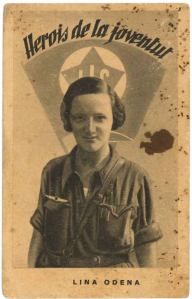
Paulina Ódena García, known to history as Lina Ódena, stands as one of the most prominent icons of female resistance during the Spanish Civil War. She was the first Spanish Republican woman to die in battle against the Nationalist forces. Her deliberate decision to take her own life rather than face capture instantly transformed her into a premiere national symbol of Republican female heroism and martyrdom.
.
Born into a working-class family in Barcelona on 22 January 1911, Ódena originally trained and worked as a seamstress. Her political awakening came when she joined the Communist Party of Spain (PCE) in 1931 and rapidly rose through the ranks. Recognising her intelligence and organisational capability, the party selected her as a delegate to travel to the Soviet Union, where she underwent rigorous ideological and operational training at the prestigious International Lenin School in Moscow. Upon her return to Spain, she was appointed General Secretary of the Communist Youth of Catalonia and was a prominent figure during the October Revolution of 1934, which forced her underground into the network of the International Red Aid. By 1936, she was a seasoned leader, even accompanying the legendary Dolores Ibárruri on high-profile Popular Front (Frente Popular) electoral campaign tours.
.
When the right-wing military coup erupted in July 1936, Ódena was in Almería. She immediately assumed military leadership by integrating herself with an armed column composed largely of Republican airmen from the Armilla Air Base. Pinned to her signature worker’s overalls was an aviation insignia—a visual marker that cemented her distinct wartime image. She led these troops with ferocious intent through the early campaigns at Motril and Guadix, earning a reputation as a hardened combatant.
.
New historical details paint a precise picture of her death on 14 September 1936 (often alternatively cited as 13 September). Ódena was scouting near the Granada front, travelling by car toward the town of Deifontes. Near the Cubillas Reservoir, her driver made a critical navigation error, turning onto the Jaén Highway. The car drove straight into a hidden Nationalist checkpoint controlled by a fierce contingent of fascist Falangists and Moorish Regulares. Realising she was completely surrounded—and well-aware of the brutal treatment, including torture and sexual violence, that Nationalist forces inflicted on female captives—the 25-year-old shot herself in the temple, dying instantly to deny the fascists a victory.
.
Following her suicide, Nationalist forces seized her vehicle and took it to the San Jerónimo barracks. They arrested her driver and a military judge ordered her body to be taken to Granada, where she was buried in the municipal cemetery. Meanwhile, the Republic elevated her to an untouchable status of secular sainthood, promptly naming the prominent Lina Ódena Battalion in her honour.
.
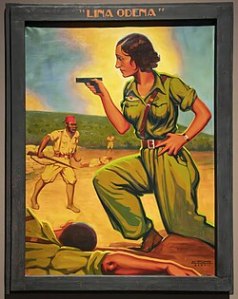
Her sacrifice quickly became a tool of international diplomacy. A famous oil portrait of her in her signature overalls, armed with a pistol and painted by the artist J. Pons, was prominently displayed at the Republican Pavilion during the 1937 Paris International Exposition alongside works like Picasso’s Guernica. Her image was heavily featured in photomurals created by Josep Renau to rally women to the anti-fascist cause. Though Falangist propaganda attempted to tarnish her memory by falsely claiming she had committed suicide merely to escape punishment for the alleged murder of a Catholic priest, Lina Ódena’s refusal to surrender ultimately redefined the role of the milicianas, ensuring her place as the ultimate archetype of Spanish Republican heroism.
.
- Grazalema, Cádiz, Andalucia
By September 1936, the Nationalist military rebellion had swallowed most of the province of Cádiz in western Andalucía. However, the rugged, towering peaks of the Sierra de Cádiz remained a fierce bastion of Republican resistance. Perched high within this mountainous terrain was Grazalema, one of the strongest and most strategically vital Republican positions left in the region. For the Republican militias, the mountain town was a natural fortress. For the Nationalist command, it was an intolerable thorn in their side that blocked the path to the major Republican stronghold of Ronda and prevented total control over the southern mountain passes. To break this stronghold, the Nationalists orchestrated a multi-pronged assault combining air superiority, regular army columns, paramilitary militias, and local law enforcement.
.
The offensive launched on 12 September 1936 with a display of psychological and physical terror. Nationalist aircraft swarmed over Grazalema, dropping payloads of bombs across the town to panic the population, disrupt defensive lines, and soften up the Republican rear guard before the infantry advanced. Simultaneously, a massive Nationalist ground force was concentrating just to the west along the Villamartín–Algodonales axis. This attacking force brought together regular army troops deployed from the city of Cádiz, armed Guardia Civil brought in from the right-wing hub of Jerez de la Frontera, and various auxiliary Nationalist formations, including local Falangist and Carlist volunteers. Thousands of men and heavy munitions stood poised at the base of the mountains.
.
On 13 September, the ground assault officially commenced. A primary Nationalist column of Regulares de Larache, under the command of Ignacio Caballero Muñoz, pushed up the steep, winding mountain roads toward Grazalema. Caballero’s vanguard unit successfully pierced the outer perimeter and fought its way into a section of the town. However, the Nationalist commanders underestimated the terrain and the resolve of the defenders. Utilising their highly advantageous, elevated positions on the surrounding crags, the Republican militias launched a fierce, coordinated counter-attack. They effectively cut off the advanced vanguard from the rest of the column, isolating the Nationalist troops inside the town. Throughout 13 and 14 September, heavy and bloody fighting raged across the heights. Pinned down, the isolated vanguard found themselves outmanoeuvred by local fighters who knew every ridge. By the night of 14 September, the vanguard’s situation grew desperate as their ammunition supply fell critically low.
.
The tide of the battle turned under the cover of darkness during the night of 14–15 September. A fanatical Falangist relief unit, the Primera Bandera de Falange de Cádiz operating under the command of Fernando Zamacola, launched a high-risk, aggressive push through the mountain passes. Zamacola’s men successfully broke through the Republican cordons, punching a hole in the line to deliver much-needed ammunition and reinforcements to the trapped vanguard.
.
With the isolated troops resupplied, the main Nationalist body launched a final, coordinated push on 15 September. Fresh infantry units and battle-hardened Moorish Regulares smashed directly into the Republican rear. Outgunned and facing encirclement, the remaining Republican militias were forced to abandon their mountain trenches and trigger a general withdrawal. The immediate battle for the town concluded with the Nationalists recording approximately 30 casualties among their own ranks, while Republican combat losses were significantly higher but uncalculated.
.
The fall of the town triggered an immediate humanitarian crisis and a wave of political violence. Terrified of the incoming colonial troops, hundreds of civilian families and defeated Republican supporters fled Grazalema. They scrambled eastward through the rocky terrain toward the neighbouring city of Ronda in Málaga province, 30 km away, and other remaining Republican zones. Tragically, their sanctuary was short-lived; the Nationalist offensive was relentless, and Ronda itself fell just a day later, on 16 September. For those who stayed behind or were captured, the occupation marked the beginning of a brutal purge as Nationalist forces initiated systemic arrests and extrajudicial executions. Modern historical research has laid bare the horrific reality of this aftermath, most notably exemplified by the tragic execution of the Fifteen Roses of Grazalema, a group of local women tortured and murdered by the occupying forces.
.
Modern historical research has laid bare the horrific scale of the post-battle violence in the area: approximately 209 victims have been formally associated with the Nationalist repression in Grazalema and the neighbouring village of Benamahoma. Forensic studies have located at least 122 victims buried in known mass graves within Grazalema itself, highlighting the grim cost of the Nationalist consolidation of Cádiz.
.
- Huelva, Andalucía
In the second week of September 1936, the Spanish Civil War in the southwest entered a brutal new phase. Following the initial July coup, the province of Huelva and its vital mining basins had remained a bastion of Republican resistance. However, by September, Nationalist forces under General Gonzalo Queipo de Llano launched a systematic, multi-pronged offensive designed to eradicate the remaining Republican pockets, secure strategic communication lines, and impose control through calculated terror.
.
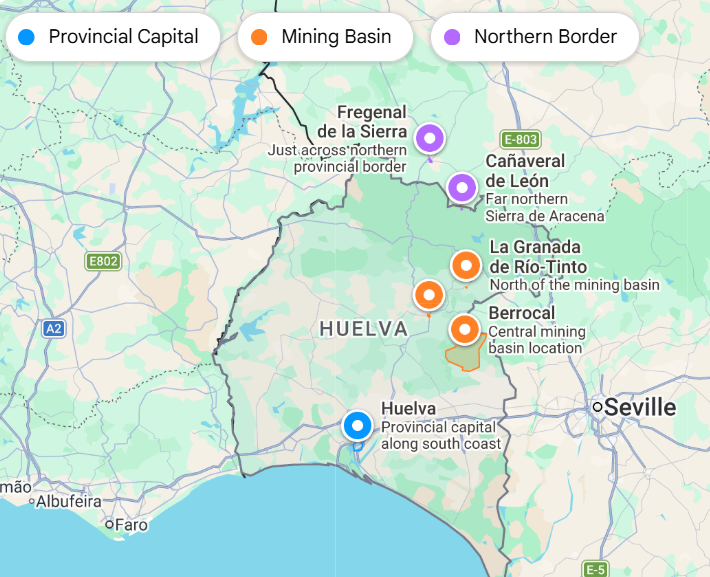
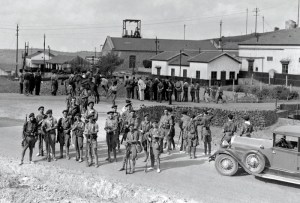
Between 8 and 18 September, a rapid succession of town captures and administrative crackdowns effectively shattered the Republican northern front, anchoring a dark period of Nationalist repression. The Nationalist advance in Huelva was spearheaded by highly disciplined, motorised columns of roughly 500 to 800 elite troops, including Spanish Legionnaires and Moroccan Regulares. While fewer than 1,000 elite troops were needed to smash through the disorganised Republican militias at the front lines, their numbers swelled immediately following the occupation of a town. As soon as a town like La Granada de Riotinto was captured—or when the vital pocket at Berrocal, which had previously fallen during the late-August sweeps, was structurally integrated into the lines – local Falangists and Requetés flooded in. These were the execution squads; often numbering in the hundreds per district, they acted as auxiliary police, remaining untraceable and unpunishable for their horrific acts against their own townspeople.
.
The occupation of La Granada de Riotinto between 8 and 15 September exposed the devastating human cost of the Nationalist advance. Immediately following the capture of the town, a wave of systematic arrests and executions began. While the chaos of the front lines left the precise dates of individual deaths uncertain, subsequent historical excavations and archival research have linked at least 24 victims to two mass graves in the area, a grim testament to the immediate nature of the post-war purge.
.
The military suppression of the mining region carried significant tactical weight. The fall of Berrocal had eliminated one of the last surviving Republican-controlled enclaves north of the basin, effectively blinding the local resistance and severing contact between remaining loyalist pockets. Simultaneously, further north, Nationalist forces entered Cañaveral de León. Its occupation systematically choked out the surviving Republican pocket in the northern Sierra, forcing remaining loyalists to flee into the mountains or face immediate capture.
The offensive was not contained entirely within Huelva’s provincial borders. The Nationalist capture of Fregenal de la Sierra in the neighbouring province of Badajoz directly sealed the fate of the northern Huelva frontier. By taking this key hub, Nationalist forces solidified their logistical communications and created a continuous line of control immediately north of the dwindling Republican positions, leaving the remaining resistance entirely encircled.
In the recently occupied mining district of Zalamea la Real, the targets of repression were highly selective, focusing on local leadership to decapitate any future resistance.
.
On 15 September, Antonio Falcón Millán, a former Republican-era town councillor, was summarily executed. His death underscored a broader campaign to systematically eliminate pre-war democratic officials. As news of the bloody purges and the actions of Falangist execution squads reached the provincial capital, public anger boiled over into open protests. In response, the Nationalist military governor, Gregorio Haro Lumbreras, moved decisively to crush civil dissent. Invoking the bando de guerra (martial law), Lumbreras issued a decree threatening to violently disperse any public gathering of more than three people. This effectively criminalised public mourning, solidarity, and protest, ensuring the regime could continue its cleansing operations in complete silence. Many local Guardia Civil units in Huelva province defected to the Nationalists or were integrated into the occupying columns to manage the local population and enforce martial law.
.
The events of mid-September 1936 across Huelva illustrated that the Nationalist campaign was never merely about territorial gain. The synchronised nature of military operations stretching from Cañaveral de León down to Berrocal, combined with immediate political executions and draconian civil censorship in Huelva city, reveals a coordinated doctrine of total war. By 18 September, with the northern frontier anchored at Fregenal de la Sierra, the Republican pocket had been successfully crushed, clearing the path for decades of military dictatorship. Because those rounded up for execution were routinely taken outside their home areas, the exact numbers killed remain uncalculated, and many who were taken to be executed in isolated locations have yet to be found.
.
- Badajoz, Extramadura
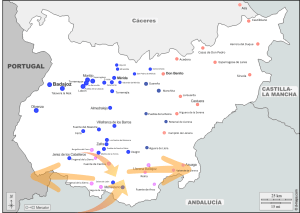
The collapse of the southwestern Badajoz pocket on 14 September 1936 triggered the Columna de los Ocho Mil (Column of the Eight Thousand), the Spanish Civil War’s first major civilian mass exodus. As Nationalist forces compressed the remaining loyalist zone, approximately 8,000 civilians and protecting militias began an extraordinary and perilous cross-country trek to reach safety.
.
On 14 September 1936, the twin falls of Segura de León and Burguillos del Cerro marked the definitive collapse of Republican resistance in southwestern Badajoz. These operations were spearheaded by a highly aggressive Nationalist column led by Civil Guard Commander Ernesto Navarrete. The capture of these two towns transformed local military skirmishes into a humanitarian catastrophe, forcing thousands of defenceless people into the open.
When Navarrete’s forces approached Segura de León, the local Republican militias quickly realised they were entirely outmatched by the Nationalists’ heavy weaponry and professional tactics. They chose to retreat rather than face a futile urban siege. The departure of the militia triggered immediate panic among the town’s leftist sympathisers, working-class families, and agrarian labourers. Terrified by the notorious reputation of Nationalist columns, over 500 residents fled Segura de León in a matter of hours. These refugees used rural cattle trails and the old Fregenal road to escape. Carrying whatever belongings they could pack, they headed toward the nearby railway hub of Fregenal de la Sierra, which they mistakenly believed would remain a safe Republican stronghold. For those who stayed behind or could not flee, the occupation brought swift retribution. The Nationalist forces immediately instituted martial law, initiating a wave of summary executions (fusilamientos) targeting democratic local officials and union organisers.
.
The fall of Burguillos del Cerro on the exact same day was a devastating tactical blow. Geographically, its capture slammed the door shut on any organised retreat toward the Portuguese border or western safe zones. By occupying Burguillos, the Nationalists completely severed communication and physical contact between the remaining Republican pockets in Fregenal, Jerez de los Caballeros, and the frontier. The loyalists were officially boxed into a shrinking triangle.
.
According to meticulous historical research, notably published in the collection coordinated by historian Francisco Espinosa Maestre, the Nationalist occupation of Burguillos del Cerro was met with extreme brutality. Over 200 local citizens were summarily executed in the weeks following the takeover. Stripped of leadership and surrounded on all sides, the town became the epicentre of a desperate gathering. Thousands of fleeing families from the surrounding region converged on Burguillos and Fregenal, forming a massive, terrified human tide. Realising that staying meant certain death, this column of 8,000 men, women, and children slipped out into the darkness on the night of 15 September. They began a gruelling, 100-kilometre trek across enemy territory toward the relative safety of Azuaga, launching one of the most tragic human exoduses of the war.
.
According to local testimonies compiled by historical groups like Todos los Nombres and highlighted in documentary projects by Producciones Morrimer, local families opened their homes to shelter the fleeing masses. Resources were dangerously thin; people pooled milk from the few local cows and shared whatever bread remained to sustain the crowds sleeping on floors and in stables.
.
By the morning of 15 September, panic set in. Word reached Valencia del Ventoso that Nationalist forces had completely severed the paths to the west and blocked the Portuguese border, where early escapees were already being arrested and handed back to the regime. The town was now effectively surrounded on three sides by Nationalist territory and the hostile border. The single remaining exit was a desperate, 100-kilometre gamble across open fields toward the east, aiming for the Republican-held zone of Azuaga.
.
On 15 September, the first groups formed a cohesive front. Rather than scattering into small, vulnerable bands, the local leadership and armed militias decided to unite the civilian mass into a single, massive march. The spine of the column’s defence was anchored by the highly organised, armed volunteers who had retreated from the Huelva mines, integrating with local Badajoz labourers to form a defensive perimeter around the civilians. Setting off directly from the outskirts of Valencia del Ventoso, the human wave began moving under the cover of the rolling hills. They deliberately avoided main roads to bypass Nationalist motor patrols, steering a massive column of thousands of men, women, children, and elderly people into the cross-country wilderness.
.
Because Valencia del Ventoso served as the birthplace of this mass escape, it faced severe, systemic retribution once Nationalist troops finally secured the empty town. Post-war archival data preserved by memory organisations shows that at least 91 local residents from Valencia del Ventoso were subsequently rounded up, subjected to consejos de guerra (military courts-martial), and executed or sentenced to decades of forced labour for their perceived complicity in sheltering the column.
.
Approximately 8,000 refugees, mostly defenceless families, agricultural workers, women, children, and elderly people, fled together in what became known as the Columna de los Ocho Mil (Column of the 8,000). Leaving Valencia del Ventoso on 15 September 1936, this massive civilian tide attempted a desperate 100-kilometre cross-country escape across hostile, Nationalist-dominated territory to reach the safety of Republican lines in Azuaga. Thousands of children, pregnant women, and frail elderly people walked on foot over rough dirt paths, through olive groves, and across rocky hillsides. Many wore worn-out shoes or went barefoot as the September heat beat down during the day and temperatures plummeted at night. Food supplies ran out almost immediately. Refugees relied on wild blackberries, stagnant well water, and whatever scraps they managed to carry in small bundles or cloth sacks from their abandoned homes. A small, outnumbered group of local militiamen and armed workers walked at the front, flanks, and rear of the column. They carried hunting rifles and a few pistols, but they lacked heavy ammunition or a coordinated command structure to protect a line stretching for miles across the open country.
.
The refugees walked under the cover of darkness or twilight, resting in ravines and riverbeds during the harsh midday sun to avoid being spotted by Nationalist reconnaissance planes. Along the secret paths, elderly people and sick children who could no longer walk had to be left behind with sympathetic local shepherds or hidden in field huts, knowing capture meant certain death or imprisonment. After two days of relentless walking, the physical exhaustion of the crowd met a brutal end near the border of the Llerena district.
.
- María de Huerva, Zaragoza, Aragon
The Barranco Salado at María de Huerva, just south of Zaragoza, became a significant execution and burial area during the Nationalist repression. One documented episode occurred on 14 September 1936, when eight residents of La Cartuja Baja were killed and buried in two adjoining graves near the ravine. Seven of these victims are known by name: Vicente Martínez Muñoz, Florentín Clavería Gómez, Julio Clavería Gómez, Nicolás Clavería Martínez, Teodoro Moreno Ginés, Manuel Gutiérrez, and Eduardo Domeque Moreno.
.
These eight victims, however, represent only one group killed in the area. A separate mass-grave record places a much larger burial site at the bottom of the Barranco Salado, near the old N-330 Zaragoza–Valencia road and the Puente de las Canales, situated between María de Huerva and the present El Plano industrial estate. The exact number buried there remains unknown, but local and memorial investigations suggest that the victims may have been numerous, possibly exceeding one hundred. They reportedly came from several surrounding communities, including Belchite, Cadrete, and Fuendetodos.
.
The Foro por la Memoria de Aragón conducted searches in the area but failed to locate the remains. Changes to the ravine, flooding, and construction associated with the old road have heavily complicated the search; the suspected burial area now lies either within the watercourse itself or beneath the road embankment. The Barranco Salado appears to have been more than the site of a single execution on 14 September; it was likely one of the rural locations around Zaragoza used repeatedly for killing and disposing of prisoners during the repression.
.
At La Muela, west of Zaragoza, another unmarked grave is believed to contain a group of men brought from the nearby town of Épila, which suffered heavily under Nationalist repression. The victims were killed and buried on the edge of a field known as Los Almendros de Solans, beside the road leading from La Muela towards the Zaragoza–Madrid highway. Neither the number of men buried there nor the precise date of their deaths has been established.
.
The road was traditionally known as the Camino de Ahogado, after the nearby Pozo del Ahogado, but the events of 1936 gave it another name among local people: the Camino de los Afusilaos (Road of the Shot). The grave itself was never formally marked and is believed to lie between the field boundary and the cultivated ground. The site has not been exhumed. Although the identities of the victims remain uncertain, the belief that they came from Épila is significant, as it provides another example of prisoners being taken away from their own communities and killed at isolated sites elsewhere in Zaragoza province.
.
- Burgos, Old Castile
The Nationalist repression in the northern Burgos province rapidly reached the small rural communities of the Merindades. During September 1936, residents from several villages were taken to Villatomil (Medina de Pomar), close to the border of the Merindad de Cuesta Urria, where they were killed and buried together in a mass grave. Unlike the repeated, large-scale prison transfers (sacas) from the Burgos provincial jail to the notorious site at Monte de Estépar, the Villatomil executions specifically targeted people drawn directly from the surrounding rural municipalities.
.
One specific group of executions can be dated to approximately 14 September 1936. The victims killed and dumped at the Villatomil grave site on this date included Aniceto Alonso Condado (from Cebolleros), Pedro Fernández Rebolledo (from Mijangos), Lucas Pereda Ruiz (from Prado la Mata), Avelino Presa Mardones (from Ael), and Juan Sevilla Alonso (from Mijangos).
.
A further group of victims brought to the site came from Moneo. While the exact calendar dates of their deaths remain uncertain, records from September 1936 document seven specific victims: José de la Cámara del Río, Hipólito de la Cámara del Río, Emilio García García, a individual identified only by the surname García Sedano (whose given name remains unverified), Arsenio López Vivanco, Cecilio López Vivanco, and Tomás Martínez del Río.

