See here for the International Brigades
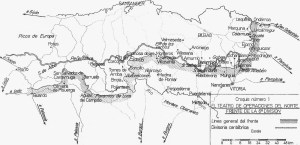
- Loma de Montija, Burgos
The attacking Republican forces comprised approximately 3,500 to 5,000 combatants. Because this front spanned the border of Cantabria and Burgos, the force was made up of the Popular Militias of Santander, reinforced by Basque volunteers and unified left-wing political battalions (UGT, CNT, and communists like the young Felipe Matarranz). They were eager but suffered from a lack of heavy artillery and centralised communication. The Republican command initiated operations on 10 October by targeting the Nationalist lines across the mountainous terrain of the Loma de Montija / Noceco–Espinosa subsector. This assault stood out as one of the most sharply defined Republican operations in Burgos that month.
However, the initial breakthrough quickly encountered a ferocious Nationalist counter-offensive. The defending forces had 2,000 to 3,000 men embedded in fortified mountain positions, including the First Centuria Catalana Virgen de Montserrat, a paramilitary Falangist unit composed of approximately 118 volunteers who had fled Republican Catalonia to join the Nationalist forces in Burgos, and they launched an aggressive counter-assault that successfully drove back the Republican columns and seized the strategic village of Montecillo.
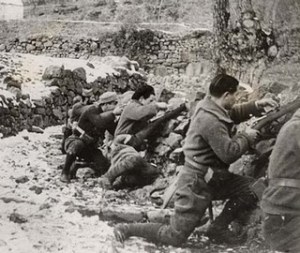
- Monte de Estépar, Burgos
- Guillena, Seville, Andalucía
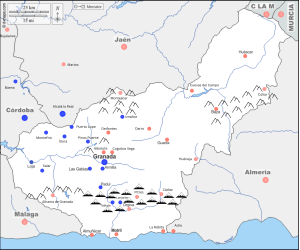
- Deifontes, Granada, Andalucía
In mid-October 1936, the focus of the war in southern Spain shifted to the rugged mountains north of Granada. Between 12 and 20 October 1936, Republican loyalist forces launched a major tactical offensive along the Deifontes–Calicasas sector. Designed to sever Nationalist communications, capture strategic transport links, and threaten the rebel hold on Granada city itself, the operation resulted in brutal mountain fighting that initially forced a Nationalist retreat before settling into a stubborn stalemate.
By October 1936, the province of Granada was deeply fractured. Nationalist rebel forces held Granada city, but they were largely encircled by Republican territory. The primary rebel supply line and connection to the north ran through a narrow, precarious corridor cutting through the rugged terrain of the Sierra Arana. The Republican high command targeted two vital tactical nodes just 15km north of Granada: the Calicasas railway station and the towering high-ground position of Cuesta de las Cabezas. By capturing these heights and the railway line running through the Guadalquivir-Guadalmedina basin, the Republic aimed to choke off the Nationalist garrison in Granada, rendering the city indefensible.
On 12 October 1936, Republican infantry columns, supported by local anti-fascist militias and light artillery elements, launched a synchronised surprise assault across the valley floor. The Assault on Cuesta de las Cabezas: Republican troops pushed rapidly up the steep, rocky slopes of the Cuesta de las Cabezas. Despite pre-prepared rebel trenches, the sheer momentum of the Republican advance overwhelmed the defenders. Simultaneously, a flanking column advanced along the railway tracks, storming the Calicasas railway station. Caught off guard by the scale of the offensive, Nationalist frontline commanders ordered an immediate tactical retreat, abandoning their forward bunkers and falling back to secondary defensive ridges closer to the capital.
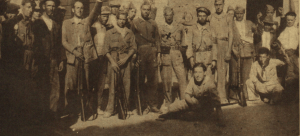
The initial triumph of 12 October quickly ground to a halt as the reality of mountain warfare set in. Over the next seven days, the character of the battle transformed from a dynamic breakthrough into a gruelling war of positions. Recovering from the initial shock, Nationalist forces brought up reinforcements from the Granada garrison, utilising superior artillery positions on the higher mountain ridges to shell the newly captured Republican lines at the station. Between 13 and 20 October, the landscape between Deifontes and Calicasas became a continuous grid of minor skirmishes. Both sides launched small-scale night raids and artillery duels over individual rocky outposts and olive groves.
Lacking the heavy weaponry, armour, and centralised coordination needed to exploit their initial success, the Republican offensive exhausted its momentum. By 20 October, the lines locked firmly into place. While the Republic had successfully pushed the frontline forward and forced a localised Nationalist retreat, the operation concluded without a significant, permanent territorial breakthrough. The October fighting in the Deifontes–Calicasas sector perfectly mirrored the wider tragedy of the early war in Andalucia. It proved that while Republican militias possessed immense bravery and the tactical capability to execute localised breakthroughs, they lacked the logistical depth to turn a successful assault into a decisive campaign. The front lines established by the end of this October week would remain largely unchanged for the remainder of the war, locking the northern gateway to Granada in a permanent, bloody stalemate until 1939.
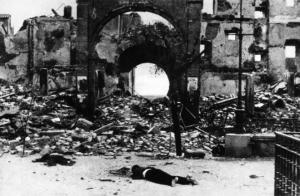
- Sigüenza, Guadalajara
Over forty-eight desperate hours in mid-October 1936, the brutal siege of the Cathedral of Santa María de Sigüenza came close to its bloody climax. Located in the northern province of Guadalajara, the fortress-like medieval cathedral had become a final, claustrophobic pocket of Republican resistance behind rapidly advancing Nationalist lines. Faced with structural collapse under heavy artillery fire, starvation, and a lack of ammunition, the besieged Republican militia forces split between those willing to risk everything on a desperate midnight breakout and those left behind to face absolute encirclement.
By October 1936, the strategic town of Sigüenza was completely surrounded by General Emilio Mola’s Nationalist forces advancing from the north toward Madrid. Refusing to surrender, a garrison of roughly 800 Republican defenders, consisting of CNT anarchists, UGT socialists, and communist militia columns, alongside scores of civilian families, retreated inside the town’s massive 12th-century cathedral. With its thick stone walls and imposing fortress towers, the cathedral was structurally ideal for a siege. However, by the second week of October, the position had become a tomb. Nationalist artillery batteries placed on the surrounding heights systematically pulverised the gothic roof, water supplies ran completely dry, and the stench of unburied corpses filled the nave.
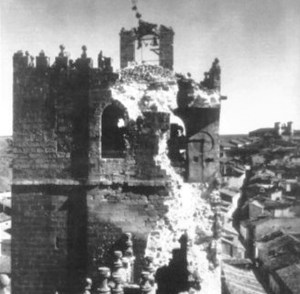
Realising that no Republican relief column from Madrid would arrive in time to lift the siege, the leadership of the defence decided to split the garrison. On the night of 10 October 1936, a vanguard of approximately 150 battle-hardened defenders launched a daring, high-stakes breakout under the cover of total darkness. Slipping through a breach in the cathedral perimeter, the 150 militia members stealthily bypassed the Nationalist forward trenches and sentries encircling the plaza. Utilising their intimate knowledge of the rugged local terrain, this contingent successfully cut through the rebel encirclement, marching through the freezing night toward the distant Republican lines in the Guadalajara mountains. The escape, however, was only a partial success. The noise of the breakout quickly alerted the Nationalist command, who instantly sealed the perimeter. Around 500 to 600 remaining defenders, many of them wounded, exhausted, or civilian non-combatants, remained trapped inside the smoke-filled ruins of the cathedral.
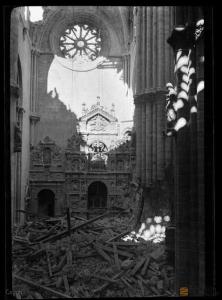 Two days later, on 12 October 1936, the conditions inside the sanctuary crossed the threshold of human endurance. With Nationalist infantry beginning to breach the outer chapels, the remaining leadership attempted to replicate the success of the October 10 escape. Driven by sheer desperation, the defenders organised two separate, back-to-back breakout attempts over the course of the day. Unlike the midnight run two nights prior, the Nationalist forces were fully prepared. Machine-gun nests covering the cathedral exits opened fire the moment the militia members rushed into the open plazas. Both breakout attempts failed catastrophically. Dozens of Republican volunteers were cut down on the steps of the cathedral, forcing the survivors to retreat back into the pitch-black, battered interior of the church.
- Almudévar–Tardienta, Huesca, Aragon
- Leciñena, Zaragoza, Aragon
The fluid fighting rapidly transformed the arid hills from a loose manoeuvring ground into a heavily fortified network of trenches, the lines that would later be immortalised in global literature. For months following the summer coup, Republican anarchist militia columns (primarily the Ascaso Column and Catalan volunteer detachments) had pushed deep into western Aragon, threatening the Nationalist capital of Zaragoza from the east. Recognising the vulnerability of their flank, the Nationalist high command in Zaragoza launched a heavily coordinated, rapid offensive on 10 October 1936.
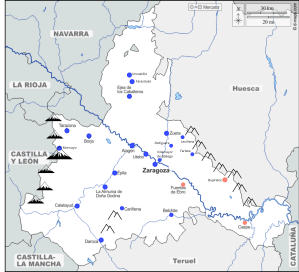
The Nationalists wanted to eliminate the dangerous Republican enclave at Leciñena, which sat uncomfortably close to the Zaragoza supply lines. By driving a professional wedge through the plain, the Nationalists aimed to secure the western approaches to the Sierra de Alcubierre, capture the vital high pass, and push the loose anarchist militia lines back into the mountains where they could be easily contained. Up to 10 October, the loose collections of Catalan and Aragonese anarchist militias operated on an offensive doctrine of fluid advance. Their plan was to use Leciñena as a forward staging ground to launch raids westward toward Perdiguera and eventually sever the primary transport links to Zaragoza. They had not prepared deep, integrated rearguard defence lines on the plains, relying instead on the natural barrier of the mountains behind them.
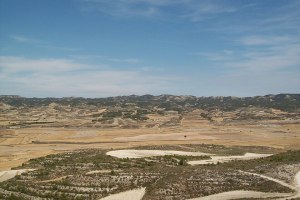
The flat basins of Perdiguera to Leciñena is part of the arid Monegros desert. It consists of wide, parched, completely open agricultural plains and low clay hills with virtually no natural tree cover and this terrain heavily favoured the Nationalists. Because there was nowhere for infantry to hide, the professional rebel troops could easily spot militia movements from afar and utilise their superior long-range artillery and aviation to shred advancing or retreating Republican groups. But the Sierra de Alcubierre sliced diagonally across the landscape with a rugged limestone mountain range. It is defined by steep, pine-scrub ravines, rocky cliffs, and a singular vital highway pass (El Puerto de Alcubierre). This terrain heavily favoured the Republicans once they retreated into it. The jagged, rocky topography neutralised the Nationalist advantage in cavalry and rapid motorised columns, allowing the retreating militiamen to dig shallow trenches into the limestone cliffs and establish an unassailable defensive wall.
In the area, the Nationalists had approximately 3,500 to 4,000 combatants. The spearhead was composed of seasoned regular army infantry columns from the Zaragoza garrison, supported by highly aggressive, politically motivated Falangist shock militias such as the Tercio de Doña María de Molina. As always, they also possessed an overwhelming advantage in organised field artillery batteries and early aviation support from German-supplied Junkers transport-bombers. The Republican volunteers had 4,500 to 5,500 militia made of an uncoordinated mix of volunteer columns. The core of the defence at Leciñena was held by the anarchist Karl Marx Column (composed largely of PSUC/UGT volunteers from Barcelona) and elements of the Ascaso Column (CNT-FAI). While holding a slight numerical advantage, they suffered from a severe lack of communication gear, no unified staff command, and little to no heavy weapon support.
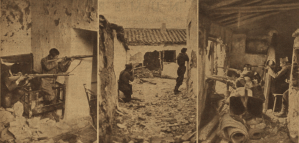
The Nationalist brought along the standard combined-arms tactics and before sending infantry forward, they subjected Leciñena and the forward crossroads to intensive, concentrated artillery barrages designed to break the militias’ morale. They used cavalry and motorised trucks to rapidly outflank the wide, open sides of the Republican positions on the flat plains, threatening to cut off their escape routes back to the mountains. Meanwhile, the Republicans relied heavily on localised bravado and static checkpoint defense. Lacking centralised radio networks, individual groups fought fiercely for specific buildings or stone walls inside Leciñena but were completely unaware when neighboring positions were being flanked. Once the Nationalist columns bypassed their sides on the open plains, the Republican tactics collapsed into a disorganised but necessary tactical withdrawal up into the high ridges where numbers could be concentrated.
On 12 October 1936, the military operations in the Perdiguera–Leciñena–Sierra de Alcubierre sector culminated in a decisive territorial shift that established the permanent baseline for the Aragon Front. The day’s events brought an end to the dynamic, three-day Nationalist offensive and solidified the geography of the sector into a frozen war of positions. Following their capture of the town of Leciñena the day before, Nationalist shock columns under the command of State Major Lieutenant Colonel Darío Gazapo completed their primary tactical objective when Nationalist forces pressed eastward from the valley floor and officially captured the Puerto de Alcubierre (the strategic mountain pass cutting through the range). The Nationalists immediately set up fortified defensive machine-gun posts and dugouts to the left and right of the main highway pass. This was designed to permanently block the Republican columns from ever utilising the road to march on Nationalist-held Zaragoza.
Faced with the loss of the pass and withering Nationalist artillery crossfire on the low plains, the Catalan and Aragonese Republican militias (including elements of the anarchist Ascaso Column and the Karl Marx Column) completed their withdrawal. The militiamen scrambled up into the highest, most rugged crests of the Sierra de Alcubierre mountain wall (specifically areas like Las Tres Huegas). On 12 October, the Republicans began carving out a hasty network of shallow, stone-lined trenches and bunkers directly into the high limestone ridges, as the Republican planned their counterattack on 14 October.
As the frontline severed the region, the dark human toll of rearguard repression occurred directly inside Leciñena itself before the town was fully locked down by the Nationalist garrison. Before completely evacuating the urban centre to retreat into the high cliffs, retreating Republican militiamen executed 14 right-wing local citizens whom they had held imprisoned in the town. One of the most immediate measures adopted by the incoming Nationalist military authorities was the execution of local civilian non-combatants suspected of union affiliation or leftist sympathies. Forensic entries and historical registries document the summary execution of seven local neighbours, four men and three women, on 14 October 1936, just 48 hours after the town fell. Their remains lie in a specific, documented mass grave inside the cemetery and have since been formally honoured with a memorial plaque listing their names – Leonor Calvo Murillo, Asunción Pérez Giménez, Juliana Giménez Marcén, Escolástico Marcén Berdún, Mariano Solanas Sancho, Leandro Solanas Letosa, and Calixto Solanas Letosa. Beyond the immediate courtyard executions, the Nationalist repression specifically targeted the town’s democratic leadership. The Republican Mayor of Leciñena, Mariano Murillo Bagüés, was hunted down and executed alongside prominent town councillors and local residents, including Miguel Guardiola Blanco and Eugenio Tolosana Marcén.
For the families of Leciñena who had supported the legitimate Republican government, the Nationalist takeover brought permanent fragmentation. Many surviving left-wing residents were systematically rounded up and processed through the infamous Torrero Prison in Zaragoza. Dozens of Republican refugees from Leciñena fled north across the French border during the later stages of the war. A highly documented cohort of these local exiles was subsequently captured by Nazi forces in France and deported directly to the Mauthausen-Gusen concentration camp complex in Austria, where several perished in the crematoriums.
- Alcoy, Alicante, Valencia
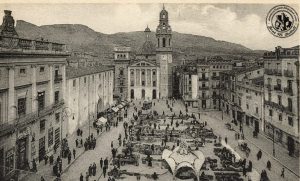
Immediately following the July 1936 military coup, legitimate local government authority collapsed in Alcoy. In its place, the powerful anarcho-syndicalist unions (CNT-FAI) and socialist factions (UGT) established the Comité Revolucionario de Defensa (Revolutionary Defense Committee) to assume total military, political, and judicial control over the municipality. Throughout September and early October, this committee directed the systematic rounding up of local conservative figures.
.
By mid-October 1936, the central Republican government under Francisco Largo Caballero was desperately trying to rein in the chaotic, autonomous regional militia committees to form a unified Regular Army. On 12 October 1936, the CRD in Alcoy was officially dissolved and replaced by the more bureaucratic Consejo Económico Político Social (Economic, Political, and Social Council).
Alcoy was a deeply polarised industrial manufacturing hub (textiles, paper, and metallurgy) with a fierce history of labour strikes. When the war broke out, the targets of the 77 executions were highly specific to the town’s social structure. The Industrial Bourgeoisie, wealthy factory owners, directors, and managers who had locked horns with the unions during pre-war labour disputes, alongside the clergy, monks, priests, and nuns, particularly when local committee seized the historic Church of Santa María as their primary headquarters, executing several religious figures associated with it, along with the local chaplain of the hospital, Miguel Aracil Colomer. Also targeted was the town’s premiere elite conservative social club (Círculo Industrial) which was seized by the anarchists. Its deep subterranean coal cellars were converted into a notorious impromptu political prison and interrogation site, which also held members of the political party Derecha Regional Valenciana, or individuals suspected of supporting the July military coup.
The Comité Revolucionario de Defensa (CRD) of Alcoy wielded absolute political, economic, and judicial power over the city from 27 July to 12 October 1936, leaving a highly documented trail of rearguard repression, and directly linked to 77 violent deaths during its 11-week reign. Prisoners were typically rounded up, processed through makeshift tribunals, and taken outside the municipal boundaries to be executed along local roadsides or isolated ravines. The unchecked extrajudicial violence of the CRD came to an end on 12 October 1936, when the central Republican government officially dissolved the autonomous militia committees across the Valencian region. The CRD was replaced by the institutionalised Consejo Económico Político Social, which drastically curbed random rearguard killings in favor of formal wartime judicial protocols.
The CRD’s repression had been as much financial as it was physical. Under the guise of financing the war effort, the committee operated a specialised Hacienda (Treasury) Department. This office managed the systematic extraction of wealth through forced monetary ‘donations’ from wealthy right-wing families who paid under the threat of execution. The total expropriation and industrial collective hijacking (incautación) of privately owned local mills and textile factories.

