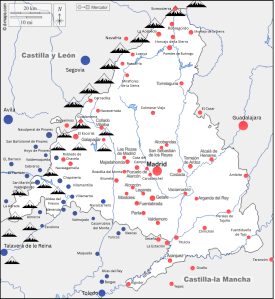
- Madrid Front
Between 19 and 23 October 1936, the war reached a critical inflection point. Moving away from desperate, uncoordinated delaying actions, the Republican government attempted its first large-scale, highly organised counter-offensive to break the Nationalist spearhead. The resulting clash across the Madrid-Toledo border regions forever shattered the romanticism of the volunteer militias, forcing the Republic into the grim reality of a total, structured war state.
The frontline was defined by a frantic race for the keys to the capital. Each faction pursued clear, uncompromising operational goals. The Republican central command sought to launch a massive, asymmetric counter-blow to completely unhinge the Nationalist advance. By targeting the vital junction of Illescas, the Republicans intended to cut the main highway linking the Nationalist spearhead to their newly captured base in Toledo. Success would isolate the rebel vanguard, buy Madrid precious time to fortify its streets, and potentially force a massive Nationalist retreat. The Nationalist command sought to maintain their lightning-fast momentum. Their objective was to secure critical crossroads towns to serve as heavy staging platforms, logistical springboards, and defensive anchors for the final, direct assault on the capital’s urban core.
On 19 October, having realised that fragmented delaying actions were bleeding the Republic dry, Colonel Vicente Rojo (Chief of Staff of the Ministry of War) finalised his secret operational blueprint in Madrid. Rojo’s plan was to catch the Nationalist Army of Africa in a classic pincer manoeuvre. He assembled a strike force of over 7,500 men. This force was a forced marriage of diverse political units under professional military guidance led by regular army Colonel Ildefonso Puigdengolas, and composed of Republican Assault Guards and socialist militias, striking south from the Madrid border. The southern arm was led by Communist commander Juan Modesto, spearheading the attack with the elite 5th Regiment and newly arrived Soviet T-26 tanks, driving west to catch the rebels in the flank.
Unaware of the scale of the gathering storm, Nationalist Colonel Fernando Barrón kept his veteran Cavalry and Motorised Column localised inside the strategic crossroads town of Illescas, population 3,800 stuck in the middle, conducting routine reconnaissance sweeps toward the surrounding plains of La Sagra.
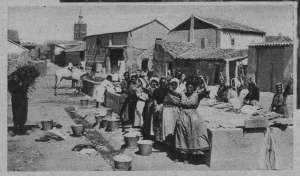
At dawn on 20 October, the Republican counter-offensive commenced with a massive, unpredicted artillery bombardment with up to 7,500 militia, an amalgamation of the 5th Regiment (communist shock troops), regular Assault Guards, and various socialist/anarchist militias. They were backed by 20 artillery pieces and a vanguard of newly arrived Soviet T-26 tanks.
The fight began with a massive Republican artillery bombardment that caught the Nationalists’ roughly 1,200 to 1,500 veteran troops by surprise. Modesto’s Soviet T-26 tanks drove directly across the flat, open olive fields, easily outgunning the Nationalist light armoured cars. The Republican infantry surged forward, successfully shattering Barrón’s outer defensive pickets and forcing the Nationalists to retreat into the sturdy brick masonry houses of the town centre. By afternoon, the fight devolved into a brutal, room-by-room bottleneck as the Nationalists used the town’s buildings as improvised machine-gun fortresses to halt the Republican advance.
To prevent the Nationalist high command from diverting reinforcements from the south, Colonel Vicente Rojo ordered simultaneous auxiliary assaults. On the western flank, Rojo had ordered a diversionary tactic at Chapinería. The goal was to threaten the Nationalist left flank and prevent them from sending reinforcements east to Illescas. The Republicans there has approximately 2,000 to 2,500 militia fighters, mostly local socialist and anarchist volunteers from the Madrid rearguard who lacked heavy training. They had no tanks and very little artillery, while the Nationalists had roughly 800 to 1,000 entrenched troops from Lieutenant Colonel Sáenz de Buruaga’s column, heavily armed with localised machine-gun nests dominating the rocky approaches. The Republican militias launched a fierce, spirited assault directly against the Nationalist lines at Chapinería. However, because they were charging uphill into the rocky foothills of the Alberche valley, they were completely exposed. The entrenched Nationalist machine guns pinned the militias down in the open brushwood. The fight became a static, bloody gridlock; the Republicans successfully kept the local Nationalist garrison busy, but they failed to break through or capture the town.
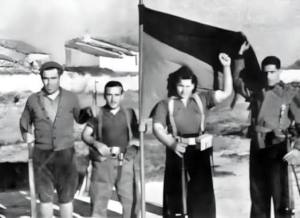
To the far north, along the freezing mountain peaks bordering Segovia, the Republican command ordered localised attacks to ensure General Emilio Mola’s northern army remained completely pinned down. The Republicans had 1,500 mountain militias and regular alpine troops holding the high passes, monitoring about 1,200 Carlist Requetés and traditional regular soldiers who held the opposing ridges. Compared to the slaughter on the southern plains, the actions here were smaller but highly intense. Small Republican alpine detachments launched raids and mortar barrages against Nationalist high-altitude lookouts and machine-gun nests. Shrouded in autumn mountain fog, these skirmishes did not result in any territorial changes, but they achieved their tactical goal: they terrified the Nationalist northern command into keeping their troops in place, ensuring no northern rebel units could be spared to help defend Illescas.
On 21 October, things were looking very different, a strategically catastrophic engagement of the day for the Republic. While the Republican high command focused its attention on Illescas, the Nationalist Army of Africa exploited a gaping vulnerability on the Republic’s western flank. With 1,500 to 2,000 highly mobile, veteran troops under Lieutenant Colonel Eduardo Sáenz de Buruaga, the strike force was composed of elite Spanish Foreign Legionnaires, battle-hardened Moroccan Regulares, and motorised cavalry units faced off with a fragmented and poorly organised defensive Republican force of roughly 1,200 to 1,500 raw militia fighters, primarily local socialist and trade union volunteers, stripped of heavy weapons, anti-tank guns, and air support.
Using their rapid, motorised column manoeuvres , Buruaga launched a lightning-fast armoured and cavalry thrust pushing northwest from the Toledo axis. The Republican militias, completely exposed on the open terrain without adequate fortifications, were overwhelmed by the speed and violence of the colonial troops. The defensive lines pierced instantly. By afternoon, Nationalist forces completely captured Navalcarnero, population 4,200. The Nationalists immediately consolidated their positions, turning the town into a massive, fortified logistical stronghold that permanently anchored their left flank and opened a direct highway corridor to the western gates of Madrid.
South at Illescas, following the previous day’s breakthrough into the outer town, the main Republican assault group attempted to deliver a finishing blow to Colonel Fernando Barrón’s garrison before reinforcements could arrive. The fighting intensified into a gruelling urban meatgrinder. Deprived of the open space needed for tank manoeuvres, the Republican Soviet T-26s could only fire directly down narrow, debris-choked streets. The Nationalist Regulares and Legionnaires turned heavy brick convents, town halls, and stone residences into heavily fortified machine-gun nests. Every house had to be cleared by the Republic with hand grenades and close-quarters bayonet fighting. Although Modesto’s men maintained severe pressure, they failed to break the absolute core of the Nationalist defensive perimeter before nightfall, leaving the town locked in a smoky, bloody gridlock.
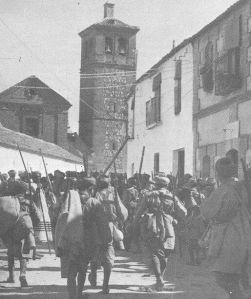
To the west and north, the auxiliary fronts functioned as tense holding actions as both high commands watched the unfolding disaster at Navalcarnero. At Chapinería, the previous day’s Republican momentum evaporated. Panic rippled through the militia lines as rumours of the nearby collapse of Navalcarnero began to spread, threatening to cut them off from Madrid. The fighting ground to a complete halt, shifting into a tense, defensive standoff.
Along the Guadarrama Ridge, the front remained entirely static. Heavy autumn mountain fog and freezing temperatures reduced visibility to near zero. Sporadic, blind mortar duels and sniper fire echoed across the peaks, keeping Mola’s northern forces pinned down but yielding no territorial changes.
By 22 October, the frantic pace of the Nationalist advance temporarily stalled out. After two days of continuous combat, both armies reached a point of physical exhaustion, shifting the day’s priority from active manoeuvres to a critical race for reinforcements and defensive fortifications. Following their push into Illescas’ outer fringes, the Republican columns under Juan Modesto and Ildefonso Puigdengolas suffered a massive coordination breakdown. Lacking field radios, they struggled to align their infantry movements with their Soviet T-26 tanks in the tight, debris-choked urban alleys. The Republican pressure decreased temporarily. Recognising that his vanguard inside Illescas was dangerously exposed to the Republic’s numerical superiority, General Francisco Franco rushed elite Nationalist reinforcements up the southern highway from Toledo. Major Sáenz de Tella’s veteran column of Moroccan Regulares and General José Monasterio’s cavalry successfully slipped into Illescas under the cover of darkness, completely reinforcing Colonel Fernando Barrón’s garrison.
Meanwhile, following their capture of Navalcarnero the day before, the Nationalists did not press forward immediately. Instead, they spent 22 October forcefully digging in. They turned the town into a massive, heavily fortified logistical platform, securing their left flank and assembling ammunition depots for the next phase of the push. At Chapinería, the Republican militia offensive completely evaporated. Panic over the nearby fall of Navalcarnero forced the volunteer units to abandon their uphill assaults and scramble into defensive huddles, rightly terrified of being cut off from Madrid.
On 23 October, the deceptive calm vanished as the battle reached its bloody, definitive conclusion. Realising that the Nationalist net was closing, the Republican command ordered a final, desperate surge. The Republican pressure at Illescas increased sharply at dawn. Modesto’s shock troops threw everything they had left against the town’s perimeter. However, they slammed directly into the newly reinforced Nationalist defences. The veteran Moroccan Regulares launched brutal, close-quarters counter-attacks with bayonets and hand grenades, systematically driving the Republican infantry out of the urban centre. As the broken Republican battalions began a chaotic retreat, they were caught completely exposed on the flat, coverless olive fields of the La Sagra plains. Utilising total air superiority, Italian and German aircraft conducted low-flying, systematic strafing runs. Without anti-aircraft protection, entire Republican units were decimated. Exploiting the complete rout of the Republican southern flank, Nationalist armoured units and cavalry pushed aggressively north-eastward along the main highway, capturing the adjacent town of Yuncos by nightfall.
By the midnight logs of 23 October, the large-scale Republican effort to retake Illescas was dead. The town remained firmly in Nationalist hands and would never change hands again. The Republic had lost over 1,500 men across these few days and was stripped of its final outer geographical barriers, leaving the road to Madrid completely open.
The geographic theatre of this four-day battle was composed of historic agricultural towns whose civilian populations were suddenly swallowed by total war. Illescas’ population of roughly 3,800 inhabitants with trapped in the thick of the fighting. The intensity of the open-country combat and the use of heavy artillery resulted in severe losses. While exact, day-by-day spreadsheets are missing from wartime logs, historians estimate over 1,500 total casualties (killed and wounded) occurred during this five-day window. The Republican militias suffered the vast majority of these losses; charging across the flat plains of La Sagra without adequate anti-aircraft defence, entire battalions were decimated by Nationalist machine guns and air strikes.
The fate of the hundreds of Republican soldiers who perished on the open plains of La Sagra during the chaotic retreats of 23 October 1936 is one of the most grim and long-lasting tragedies of the war. Because the Nationalist forces under General Franco and Colonel Barrón took absolute control of the territory following the collapse of the Illescas offensive, the handling of the enemy dead followed a cold, systematic protocol designed for military logistics and political intimidation. In the days immediately following the 23 October retreat, the thousands of bodies scattered across the flat olive groves and fields presented a major sanitary and operational hazard. Nationalist military commands ordered local captured Republicans, forced laborers, or municipal gravediggers from towns like Illescas, Yuncos, and Navalcarnero out onto the plains. The bodies were gathered using carts, brought to roadside ditches, or thrown directly into the very defensive trenches the Republicans had dug to protect the capital. The corpses were piled into these mass graves and heavily covered in quicklime. This chemical process was used by the Nationalist authorities to accelerate decomposition and prevent the spread of disease across the strategic agricultural corridors.
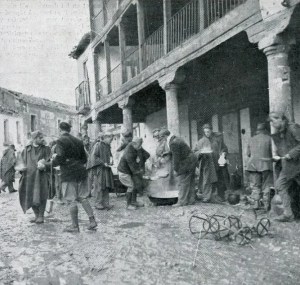
The bodies on the plains were soon joined by the victims of the rearguard purges. As the Terror Azul (Blue Terror) swept through Navalcarnero and Yuncos, local union leaders, left-leaning peasants, and suspected sympathisers were executed against cemetery walls or on roadsides. Their bodies were frequently dumped directly into the same mass pits containing the soldiers who had fallen in battle. However, in the late 1950s, a bizarre bureaucratic project altered the geography of these graves. When Franco constructed the evil Valle de los Caídos near Madrid, he wanted it to house tens of thousands of bodies from both sides of the civil war to serve as a monument to his victory. Boxes of bones were taken from the roadside pits of the Toledo-Madrid borderlands and shipped to the monument’s crypts without the consent or knowledge of the victims’ families. Today, the plains of La Sagra remain a deeply complex historical landscape. While some bodies were moved to the Valley of the Fallen in the 1950s, many hundreds of Republican soldiers and local victims remain exactly where they fell in October 1936, buried in unmarked agricultural fields, beneath modern paved roads, or in hidden pits outside municipal cemeteries.
As the frontline fluctuated, horrific waves of political repression unfolded on both sides of the wire. In newly captured hubs like Navalcarnero and the outskirts of Illescas, the Moroccan Regulares and Falangist execution squads implemented immediate, systematic killings. Anyone suspected of union membership, left-wing voting records, or harbouring Republican militia members was rounded up. Executions against cemetery walls were rampant, leaving hundreds of local peasants buried in undocumented roadside mass graves.
Inside the nearby Republican-held villages and the capital itself, the panic of the failing offensive triggered acute paranoia. Believing that local right-wingers, hidden Catholics, and landowners were functioning as a traitorous fifth column actively guiding the Nationalist bombers, local defence committees launched immediate paseos. Suspected sympathisers were taken from local lockups and executed in rural ditches, a dark prelude to the systematic prison extractions that would peak the following month.
The definitive failure of the Illescas counter-offensive yielded massive, long-term strategic consequences. It proved to the Republican high command that passion, numbers, and improvised organisation were entirely insufficient to break a professional, modern army.
The loss of Illescas and Navalcarnero permanently stripped the Republic of its outer geographical barriers. The steel trap was now set. With these two vital hubs firmly in Nationalist hands, the road to the capital was wide open, setting the stage for the harrowing, legendary siege of the city itself just two weeks later.
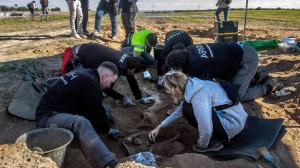
Less than 20km south of Illescas and Yuncos on the plains is the town of Recas, which has two surviving mass graves beside each other, nicknamed los catorce de Recas (the fourteen of Recas). The first fosa held seven who were murdered on 19 October 1936 – brothers Miguel Díaz García and Demetrio Díaz García plus Isidro Díaz, and Marcelino Muñoz, Eulogio Ortiz, Gregorio del Moral, and Daniel Bargueño. When the Nationalist troops entered the town, all seven were rounded up for being on the committee as part of the February 1936 elections. They were taken to the town hall early in the morning before being loaded on truck to a barren location on the Reacas y Villaluenga road and executed. The Association for the Recovery of Historical Memory (ARMH) carried out the exhumation in May 2003 and found all seven, who were reburied with full dignity, and was shown on Documentos TVE in 2004, titled Graves of Oblivion. This documentary was the first of its kind to be broadcast nationwide, focusing on such exhumation efforts; consequently, the events in Recas had a significant impact across the country as historical memory was fully gaining its right to full attention and respect. The exhumation at Recas was the first of 16 digs carried out in the region of Castilla-La Mancha prior to the enactment of the 2007 Historical Memory Law.
Exactly one month later, on 19 November 1936, as the bloody front line froze into trenches just north of the area, a second wave of political clean-up struck the town. Another seven men of left-leaning councillors, working-class peasants, and family members were arrested and shot very close to the original seven, though technically located on a property near the municipality of Villaluenga de la Sagra, in an area known as Los Tintos. They took Gabriel Zurita Martín and his son Juan Zurita Martín, Domingo Díaz and Pedro Díaz, Florentino Recio Fernández, Jerónimo Cedillo Zurita, and José María Seseña (also known as Barahona, a prominent municipal council member).
What makes the Fourteen of Recas particularly significant in modern historical archaeology is how their memory survived the dictatorship even though most mass graves were dug up to fill Franco’s crypt walls. In the late 1970s, shortly after Franco’s death, the families of the victims secretly braved local taboos to build makeshift concrete slabs and monuments directly on top of the unmarked dirt plots where they knew the bodies lay in the open field. They carved the names of the dead into the cement to guarantee the graves would never be forgotten. Decades later, these concrete visual anchors enabled the ARMH to step in and find the site and the other seven men in the neighbouring pit to be exhumed.
In November 2021, forensic teams returned to the Los Tintos field to exhume the final seven under the cement marker, successfully retrieving the remains of all seven. In 2023, one of the victims, Florentino Recio, was identified through DNA testing, and his remains were handed over at the municipal cemetery in Recas by volunteers from the ARMH, closing a multi-generational cycle of trauma for the village.
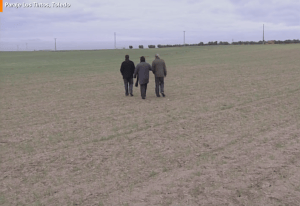
- Santa Eulalia de Gállego, Huesca, Aragon
On the consecutive days of 19 and 20 October 1936, this machinery of rearguard repression operated simultaneously at opposite ends of Spain. In the northern province of Huesca, Aragón, the executions of 19 October took place under a cloud of intense military volatility. Republican anarchist and socialist militia columns were actively besieging the provincial capital of Huesca. For the Nationalist forces controlling the surrounding rural corridors, extreme paranoia dictated daily operations. Anyone suspected of left-wing, union, or Republican sympathies was treated as an internal enemy.
This frontline anxiety manifested bitterly in Santa Eulalia de Gállego, where ten residents from the nearby town of Almudévar were rounded up and executed. Neighbours were purged from their home communities and executed across municipal lines to sever local ties and spread terror through the region. A few kilometres away, in Plasencia del Monte, a mass execution claimed the lives of 13 men.
Among them was Valentín Zaborras Santamaría, the Maestro de Primera Enseñanza, a 36-year-old schoolteacher from nearby Aniés. The Second Republic had elevated village teachers as champions of progress, secularism, and social mobility. To the Nationalist faction and its conservative Catholic allies, these educators were viewed as ideological vectors of subversion. By executing teachers like Zaborras, the regime sought to violently dismantle the democratic and secular reforms of the previous five years.
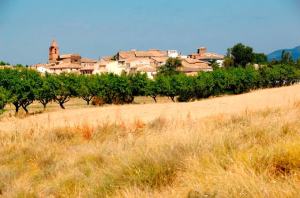
The mass grave at Plasencia del Monte contains at least 30 men and women murdered between the summer and autumn of 1936. Twenty-four of these individuals perished in the two consecutive massacres (in which 11 and 13 people were killed, respectively) and were residents of various nearby towns. Among the other six were two residents of Plasencia itself, murdered on August 24, 1936, and four residents of Ayerbe, murdered on 17 October. Several people from Riglos or Ayerbe were also buried at this site. The grave has recently been commemorated with the placement of a marble plaque, which identifies two of the victims by name and refers to the rest of their companions collectively. Identified as buried at Plasencia are Valentín Zaborras Santamaría, Francisca Lorés Gracia, Antonio Barraca Lasierra, Blas Orleáns Cinto, León Marcuello Espada, Ricardo Bretos Ferrer, Benito Morlans Marcuello, and sister María del Carmen Obejero Coiduras and Alicia Obejero Coiduras.
On the same day that 13 people were gunned down in Plasencia, another 13, who had been transported alongside them in the same truck, carried on to Esquedas, and lined up another 13 against the north right wall of the local cemetery. Only one name is known, Félix Lanuza Ferrer, as his daughter has placed a plaque in his honour. According to a local source at Esquedas, at least one of the bodies was removed years ago and taken to an unknown burial, but the other 12 remain in place.
The road in the area are lined with mass graves, most of which are undated, but occurred during the few months of the war, though some stretch as far as 1950, when those in hiding were finally found. Nearby at Bolea, six or seven locals of Almudévar who were murdered between 21-23 October 1936. Their names were José Abad Alastruey, Francisco Benedé Oliva, José Abiol Sarasa, Alejo Abad Zandundo, Antonio Escartín Ramón, and Luis Lisa Tolosana (2110-26) and José Juan Pérez (22/10/36). Their bodies were collected by the infamous Ambulance 24, it remains possible all of them were actually transported to the Las Mártires cemetery in Huesca.
The Ambulancia 24 was a vehicle operated by the Huesca branch of the Red Cross. While the Red Cross is universally recognised as a humanitarian organisation, in Nationalist-controlled Huesca during the Spanish Civil War, its local resources, specifically its ambulances and drivers, were co-opted by the military authorities and Falangist death squads. Instead of treating the wounded, the Ambulancia 24 essentially functioned as a grim, mobile body-collection unit. Its primary role was to drive out to the execution walls, roadsides, and rural ditches to retrieve the bodies of those who had been murdered in sacas.
The logistical protocol in Huesca was deeply cynical. Prison records from the provincial capital show that many detainees were officially logged as being puesta en libertad (set free). In reality, this was a euphemism for a saca as they were handed directly over to executioners. Within hours of their logged release, the Ambulancia 24 would be dispatched to collect their remains from local walls or nearby ditches, logging the deaths in Civil Registries days, weeks, or even months later. Because Ambulancia 24 was centralised in Huesca capital, its drivers routinely brought collected bodies back to the city’s collective mass graves rather than leaving them in the villages where they were shot. For example, historical records show that after a massive execution of 95 people on August 23, 1936, the Ambulancia 24 spent the day hauling bodies directly to these mass trenches. The Ambulancia 24 seen in the area indicates that their original rural graves were cleared out or bypassed entirely, and their remains are likely commingled within the massive, layered collective graves of Las Mártires. Fosa de Las Mártires I had 1,230 bodies, but 820 were stolen to line the walls of Franco’s crypt, and the rest are left were they were tossed. The nearby Huesca cemetery has 773 stolen at the same time. Only five names are known from that site – Alejandro Bajo Álvarez, Inocencio Fernández Menéndez, Ángel Duesca Romero, Luciano Conde Rodríguez, and José del Cerro Ainsa.
- Huelva, Andalucía
While Aragón functioned as an unpredictable combat zone, the southwestern province of Huelva, Andalucía, presented a entirely different landscape of repression. Home to the massive Riotinto mining basin, a historic hotbed for fiercely organised socialist and anarcho-syndicalist trade unions had not slowed its cold, bureaucratic, and highly centralised murder spree. On 19 October, civilians were systematically arrested across various municipalities, including Cañaveral, San Juan, Bonares, and Zufre, and funnelled directly into the provincial capital of Huelva. Nine of the men victims later identified are Rafael Alisedo Rameu, Juan Camps Olivera, Francisco Carbajo Agudo, Ángel Gómez Quintero, Antonio Márquez Rodríguez, Antonio Mora Martín, Pedro Muñoz Coto, Aquilino Rufo Vázquez, and José Vidosa Calvo. These men, alongside dozens of unrecordesd victims, were taken to the La Soledad Cemetery in Huelva, shot against the white walls, and buried in mass graves. La Soledad became a centralized repository for the state’s violence, holding the remains of hundreds of rural citizens brought to the capital specifically to be disappeared.
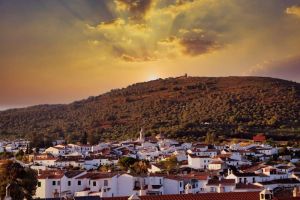
On 20 October, the terror shifted deeper into the rugged terrain of the Sierra de Huelva. In the mountainous mining municipalities of Higuera de la Sierra, Almonaster la Real, and Zalamea la Real, five more killings were officially logged. The victims, Cándido García Ruiz, José Antonio González Cabezas, Rafael González Cabezas, Bautista Pichardo Núñez, and Cristino Vargas Tovar, were caught in what had effectively become a counter-insurgency zone. Over the summer, thousands of workers and union miners had fled into these high-altitude hills to escape the advancing Nationalist columns. By October, the regime was actively hunting down these refugees, treating any remaining mountain residents with lethal suspicion to prevent the formation of early guerrilla resistance cells.
In Higuera de la Sierra, the grave is in a small garden area enclosed by very high hedges and contains the remains of at least 27 victims from Higuera, Zufre, and La Granada, individuals who were executed by firing squad between August 1936 and October 1937. Among these victims are the 16 Roses of Zufre killed in 1937. In 2019, exhumation efforts were carried out, resulting in the recovery of the bodies of 20 victims of political repression. All 27 are known victims – Nazario Santos García, Lidia García Durán, Francisco Conde Garzón, José María Díaz Fernández, Anastasio Martín Cabezas, Bernabé Rufo García, José Luis Díaz Cubero, Evaristo Fernández Brito, Cándido García Ruiz, Antonio Abad García, Francisco González Alsubidei, Juan Peña Mesa, Felipa Rufo Alcaide, Marcelo Brito Cortés, Francisca Cerca Rodríguez, Teodora Garzón Núñez, Remedios Gil Cortés, Modesta Huerta Santos, Josefa Labrador Arroyo
José Mayofret Domínguez, Manuel Muñoz Navarro, Elena Ramos Navarro, Bernabela Rodríguez Ruiz, Dominica Rodríguez Ruiz, Amadora Sánchez González, Mariana Sánchez Vázquez, and Andrés Pérez Martín.
In Almonaster la Real, there was a civil cemetery for Republicans to be placed in a mass grave where those baptised or who committed suicide were usually placed. Today, the site is overgrown with weeds and can be reached by descending a set of stairs, where a plaque dedicated to the victims was installed in November 2001. It is believed that this mass grave contains the remains of most of the 76 individuals who were executed by firing squad from Almonaster and its surrounding villages of Santa Ana, Cortegana, and Linares. In 2025, a ground-penetrating radar identified several areas with soil disturbances consistent with the presence of mass graves, and the site remains ongoing.
Zafra, Badajoz, Extremadura
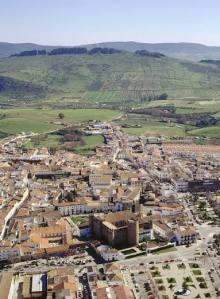
This very same day, a parallel atrocity occurred just across the regional border in Zafra (not to be confused with Zufre in Huelva, which is 82km south, but suffering the exact same problems at the same time.) Zafra experienced a large, concentrated execution day resulting in 14 deaths of local prisoners and detainees on 20 October. Like Huelva, victims were executed and buried collectively within the Zafra cemetery walls. This high-volume execution day in Extremadura served as a stark reminder that even as the initial shock wave of the July coup subsided into autumn, localised rearguard purges remained unyielding. Zafra itself has no mass graves and the men locations remains unknown. (If you are looking for mass graves details in Extremadura, most were covered in the early August posts as the Army of Africa moved north).
- Burgos
The northern reaches of the Burgos province in the rugged region of Las Merindades, provided another theatre of terror. Here, the repression remained relentless precisely because the Northern Front was actively raging nearby. This rural, decentralized terror must be analysed separately from the massive, state-administered executions occurring inside Burgos city’s central prisons. On 19 October, Felipe Gómez Sáinz, a local blacksmith from Salinas del Rosío, was taken and murdered near Medina de Pomar. Blacksmiths, much like tradesmen and factory workers, were heavily targeted due to their frequent leadership roles in local agrarian and labour unions. On the following day, a coordinated sweep across neighbouring valleys caused the disappearance and murder of three more individuals in separate Merindades cases – Arsenio Fernández Zamanillo from Bricia, executed at the site of Las Pradillas, Toribio Martínez López from Hornillayuso, Sotoscueva, and José Gómez Arenal from Loma de Montija.
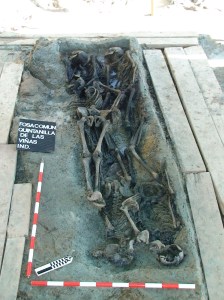
As October drew to a close, the violence left deep scars in the southern and eastern sectors of the Burgos province. However, researching this specific time period requires meticulous chronological separation by historians. In Mount Costaján, the repression continued to systematically dismantle Republican municipal and labour networks throughout the Ribera del Duero region. Many of these victims were cast into the notorious La Andaya fosa cluster, a massive site of mass graves. Aranda de Duero has the railway workers’ mass grave near Mount Costaján where 59 railway workers were buried in October 1936. These men, employees of the Madrid to Zaragoza and Alicante Railway Company (MZA) and mostly members of the CNT and UGT unions, were murdered by Falangists. It was the street sweepers of Aranda who provided them with a burial. The burial site named La Leguais just outside Gumiel de Izán. The men had been marched there in groups of six and thrown on one long trench. All were found in 2011 and one, Ticiano Alameda García, aged 45, a railway worker from Zafra, was returned to his family. Among the victims, one was found holding a crucifix, with the remains of a cassock nearby. It is believed to be Father Revilla, a priest who had spoken out against the abuses committed by the Falangists. In 2018, the national railway company, Renfe, paid tribute to them with a sculpture, and in 2021, it released a documentary titled Children of Iron. Just down the road from this site is the Monte Costaján, which was found to hold 81 victims, which were privately exhumed in 2003. That itself is just north of La Lobera, which was exhumed in 2004, finding 46 victims from August 1936.
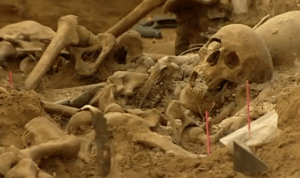
The area surrounding Salas de los Infantes in southeast Burgos functioned as another severe node of repression. Salas de los Infantes operated as an independent, secondary prison centre. This detention site served as a vital feeder mechanism, funnelling political prisoners directly into the broader provincial network of executions and forced disappearances. The town itself has no known mass grave sites, which sits at the hearty of a network of smaller graves, which 3 -12 or more victims each, with their dates unknown, most unexhumed.
Juan Montero Gutiérrez, Universidad de Burgos

