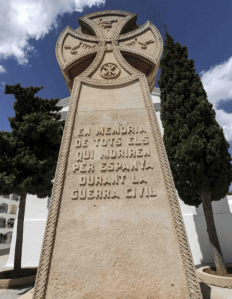
- Balearic Islands
The outbreak of the Spanish Civil War in July 1936 instantly fractured the Balearic Islands, transforming the idyllic Mediterranean archipelago into a brutal, strategically vital battleground. While the heavy, active combat over the islands was short-lived, it set the stage for a dark period of systematic execution and concealment. By late 1936, the lines of control were frozen, giving rise to an institutionalised campaign of terror whose physical legacy remains buried in the soil of Mallorca and Ibiza today.
When the military uprising against the Second Spanish Republic began in July 1936, the Balearic Islands immediately split along political and military lines. General Francisco Franco’s Nationalist forces successfully seized control of Mallorca and Ibiza. However, Menorca remained fiercely loyal to the Republican government, leveraging its heavily fortified naval base at Mahón to secure a strategic foothold in the Western Mediterranean. In August 1936, the Republic launched a major amphibious counter-offensive known as the Battle of Mallorca (or the Bayo Expedition). Thousands of Republican militia troops landed on Mallorca’s eastern coast in an attempt to reclaim the island. The operation failed catastrophically. Aided by early military intervention from Fascist Italy, Nationalist forces repelled the Republican troops, forcing a chaotic evacuation by early September. Immediately following this victory, Nationalist forces retook Ibiza and Formentera, cementing their absolute control over the entire archipelago, with the sole exception of the isolated Republican stronghold of Menorca.
By November 1936, active frontline combat on the islands had completely ceased, replaced by a cold, administrative consolidation of power. On 28 November 1936, General Franco would sign a formal pact with representatives of Benito Mussolini. In exchange for Italy’s continuous military aid, Franco granted Italy strategic leverage over the Western Mediterranean, effectively turning Mallorca into an Italian military protectorate. Throughout November, Italian forces consolidated their air operations at the Son Bonet airfield in Mallorca. The Aviazione Legionaria regularly used the island as a launching pad to execute destructive bombing raids against Republican targets on the Spanish mainland, specifically Catalonia, and to enforce a strict maritime blockade. With the threat of a Republican invasion gone, November 1936 marked a transition from the chaotic violence of the summer to a highly organised, institutionalised campaign of Francoist repression. Falangist militias and military tribunals began systematically purging the civilian population of suspected left-wing sympathisers, union members, and Republican loyalists.
The executions carried out during late 1936 were intentionally shrouded in secrecy. Victims were taken from prisons in the middle of the night and transported to designated execution walls and makeshift burial grounds. Nationalist Serving as the primary dumping ground for prisoners transported from central detention facilities across Mallorca, executions took place directly against the cemetery and church walls. In November 1936 alone, dozens of victims were systematically shot and buried in communal pits. Modern excavations by historical memory organisations have since uncovered more than 100 bodies at this single location.
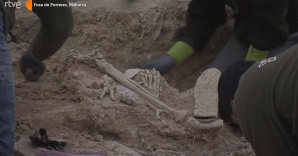
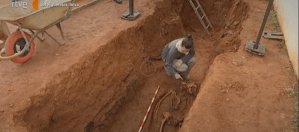
The Porreres mass grave is 20 meters from the municipal cemetery, against the exterior wall at the head of the church was the exact spot where numerous mass executions of men and women, who were not from the town, took place. Many of those who were executed came from Can Mir prison, Bellver Castle, and the Can Sales women’s prison between September 1936 and April 1937, backed up by testimony from local residents who witnessed the executions. Victims were transported and deposited into one of the mass graves located within the grounds of the old municipal cemetery of Porreres. According to oral testimonies, the bodies were covered with earth and quicklime, in an effort to destroy all evidence.
So far, 114 victims have been located, and 23 of those have been identified. In 2016, the first 49 victims were recovered, and 14 of them were identified – Joan Canyelles Capllonch, Jaume Capó Amengual, Rafel Cifre Torres, Llorenç Coll Sastre, Gabriel Ferriol Gelabert, Guillem Frau Moragues, Mariano Galiana Galiana, Joan Losa Campomar, Gaspar Macià Ventaloni, Baltasar Moyà Bauzà, Ignasi Picornell Femenies, Miquel Ques Torrens, Tomàs Seguí Seguí and Pedro Vallespir Amengual. The second investigation in 2018 uncovered 65 bodies were exhumed, and nine of them identified – Jaume Ordines Arrom, Miquel Cabot Dolç, Jordi Colom Estarellas, Bartolomé Matas Alemany, Antoni Company Oliver, Miquel Pasqual Quetglas, Llorenç Martorell Suárez, Gabriel Picornell Serra and José Mercadal Marqués.
Also in November, Sant Antoni de Portmany and Eivissa cemeteries saw retributive executions peaked through the autumn months. Local residents who had not fled after the brief Republican occupation were lined up against cemetery walls, executed, and buried in unmarked communal pits. But to handle the volume of killings outside formal municipal boundaries, Nationalist forces frequently used the island’s geography to hide bodies quickly. Prisoners were pulled from transport trucks and shot directly into roadside ditches. In rural Mallorca, disused water wells and deep natural caves were used as ready-made mass graves, while isolated coastal beaches were used near maritime towns. Because Nationalist forces deliberately left those killed in late 1936 unrecorded, the scale of the tragedy remained hidden for decades. Today, through forensic archaeology and DNA testing, these gravesites are finally being uncovered, shedding light on the true human cost of the war in the Balearics, but most remain unmarked and unrecovered.
The repression in Ibiza began on September 20, 1936, after he landing of Nationalist troops under the command of the Italian Arconovaldo Bonacorsi. Between September 20, 1936, and June 6, 1937, 70 people were executed at the old cemetery of Ibiza, located in the Figueretes neighbourhood. According to Civil Registry records, multiple killings, involving between two and four at a time, took place on September 23, October 2, October 9, October 22 and 27, November 3, and November 24, 1936, as well as on March 27 and June 11, 1937. On other dates, the killings appear to have been individual. Among the victims were two women, Bárbara García Loreto and Eulàlia Marí Torres.
From local witnesses, it appears most of these executions occurred in Vila against the cemetery wall. Victims were brought there from across the island in carts or in a ‘sinister’ black vehicle that became infamously well-known among the local population. The murders were never investigated, nor were they reported at the time. The Ibiza Cemetery’s register contains no entries between mid-1936 and mid-1941 and zero evidence regarding the specific burial sites within the cemetery grounds. In 2020, the remains of Josep Vidal Ramón were exhumed and identified, and in 2022, three other victims were recovered, with Bartolomé Costa Serra and Mariano Castelló Castelló identified. In 2025, three more victims were exhumed.
Historical consensus estimates that between 2,000 and 3,000 people were killed by Nationalist political repression in the Balearic Islands, with the vast majority of these deaths occurring during the brutal window of 1936. Academic research by historian Bartomeu Garí Salleras indicates that approximately 2,340 people were systematically eliminated on Mallorca over the course of the conflict. The overwhelming majority were executed during the peak of the White Terror between August and December 1936, following the failed Republican landing attempt. In Ibiza Formentera, during a particularly bloody 38-day window of fluid territorial control between August and September 1936, around 120 people were executed by local factions on Ibiza. This was followed by retaliatory Nationalist executions that continued into the late autumn months throughout in spring 1937. Menorca did not suffer the Nationalist White Terror in 1936, as it remained a Republican stronghold until the end of the war. (Its wave of Francoist repression came later, resulting in roughly 200 executions when the island finally fell in 1939).
Menorca held one of the most heavily fortified strategic positions in the Mediterranean. The massive 19th-century Fortress of Isabella II on La Mola guarded the entrance to Mahón harbour. Armed with high-calibre Vickers coastal defence guns, its batteries could easily sink incoming enemy transport ships, making a direct naval landing suicidal for Nationalist forces. Following the 1936 coup, Republican troops and local workers aggressively expanded the island’s passive defences. They dug an intricate network of trenches, bunkers, and machine-gun nests along vulnerable beaches like Son Saura and Algaiarens to completely close off potential landing zones.
Mahón possesses the finest deep-water natural harbour in the Mediterranean. Because the Republican government retained control of the base, along with a significant portion of the Spanish Republican Navy’s heavy fleet early in the war, the Nationalists could not approach the island by sea without risking a major naval engagement. While Menorca successfully prevented soldiers from landing on its shores, it was not completely safe. It suffered heavily from aerial bombardment launched by the Italian Aviazione Legionaria based in nearby Mallorca. To survive this, the population built extensive underground air-raid shelters underneath towns like Alaior and Mahón. Because of these deterrents, General Franco chose to isolate and blockade Menorca rather than attempt a bloody amphibious assault. The island only surrendered at the very end of the war in February 1939, following a British-mediated negotiation aboard the warship HMS Devonshire once the rest of the Republic had fallen.
While the right-wing Nationalist purge was the primary driver of civilian deaths, the short-lived Republican militia occupations of the summer also engaged in violence. Historians count roughly 323 victims of leftist violence in the Balearic Islands, mostly consisting of local Catholic clergy, landowners, and right-wing political sympathisers targeted before the Republic’s retreat in September. In total, across all forms of wartime political purges and excluding active military combat casualties, nearly 3,000 civilians lost their lives to rearguard repression on the islands.
- Alt Urgell, Lleida, Catalonia
In the early months of the Spanish Civil War, the rugged borderlands of Alt Urgell became a landscape of desperate flights and sudden, violent ends. Among those caught in the chaotic wave of wartime repression was Pere Sobré Rabassa, a priest from the small village of Noves de Segre, whose attempt to find sanctuary in neutral Andorra ended in his summary execution on 3 November 1936.
As the conflict erupted in July 1936, Catalonia was gripped by a revolutionary surge. For members of the clergy, landowners, and those perceived as sympathizers of the military uprising, the situation quickly became life-threatening. The Pyrenees passes leading into Andorra, transformed into vital but perilous escape corridors. Father Pere Sobré was one of many who chose to risk the high-altitude mountain trails to escape the anticlerical violence down in the valleys. However, the border passes were heavily patrolled by local revolutionary militias and republican guards tasked with sealing the frontier.
Sobré was discovered by a patrol near Civís, in the municipality of Les Valls de Valira. Stripped of his chance at asylum he was taken to the nearby Santa Magdalena ravine (barranc de Santa Magdalena), where he was executed. Today, the site of his death remains part of the mapped historical memory of the Lleida province, serving as a stark reminder of the local tragedies that played out across the mountain passes of the Pyrenees during the dark autumn of 1936.
- Oviedo, Asturias
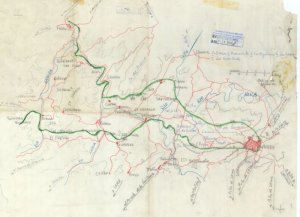
Between November 3 and November 4, Republican militias launched a series of aggressive actions designed to choke off the newly established Nationalist bottleneck, the Grado Corridor, and push the Nationalist garrison to its breaking point on the outskirts and urban centre of Oviedo, the strategic high ground of El Escamplero, and the mountain pass of La Cabruñana. The Republican contingent had roughly 10,000 fighters around the province primarily drawn from the Antifascist Worker and Peasant Militias and Asturias’ miner unions. They faced a entrenched Nationalist garrison inside Oviedo and along the corridor numbering roughly 2,500 to 3,000 men, composed of regular army soldiers, Guardia Civil, and Moroccan Regulares.
The offensive opened on the night of 3 November with Republican forces executing stealth incursions on the outskirts of Oviedo and the rugged slopes of El Escamplero. Lacking a reliable supply of standard military ordnance, the Republican vanguard relied heavily on the dinamiteros. Creeping through the dark under heavy machine-gun fire, these shock teams used hand grenades and industrial mining dynamite to clear Nationalist trenches at close range.
The following day, the Republicans scaled up the operation into a multi-pronged assault. Republican artillery systematically shelled Nationalist-held strongholds inside the urban centre of Oviedo to suppress Nationalist defences under Colonel Antonio Aranda. Under cover of the barrage, miner militias struck again at Escamplero and the immediate city limits, using close-quarters grenade tactics to try and breach the perimeter.
Westward at the La Cabruñana pass, Republican forces applied intense operational pressure. This pass was the gateway for the Nationalist logistics pipeline winding from Galicia. By forcing the enemy to defend La Cabruñana, the Republicans aimed to halt the flow of Nationalist reinforcements and ammunition into Oviedo. These intense actions yielded tactical frustration for the Republicans and a costly defensive victory for the Nationalists. While the Republican forces achieved momentary panic and successfully disrupted the Nationalist supply lines, they failed to capture the strategic high ground of El Escamplero or sever the Grado Corridor permanently. The Nationalist garrison, backed by superior heavy artillery and tactical aviation, successfully repelled the assaults. Though nothing shifted on the map, the actions of November 3–4 proved that the fall of Oviedo would not be quick, setting the stage for a stalemate for another year.
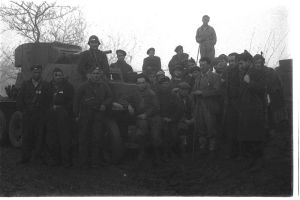
Museum of the Asturian People Collection: Constantino Suárez
- Jaca, Huesca, Aragon
In November 1936, Jaca in northern Huesca was deep within firmly held Nationalist territory, heavily locked down, and functionally impossible to escape from for targeted Republicans. The main Aragon Front was roughly 50 to 60km to the south-east. In the opening weeks of the war,, Republican militias advancing from Catalonia had successfully taken the eastern half of Aragon, encircling the provincial capital of Huesca. However, the Nationalist forces held a strong, deep defensive wedge stretching north from Zaragoza through Ayerbe and up into Jaca. By November 1936, this frontline had largely frozen into a grinding trench stalemate. For an unarmed civilian on foot, crossing 50km+ of heavily patrolled, mountainous Nationalist rearguard territory to reach Republican lines was virtually impossible.
Geographically, Jaca sits only about 30km south of the French border. To a desperate person, escaping north over the Pyrenees mountains into France seemed like the logical choice. However, in November 1936, this route was a death trap. Jaca was a historic fortress town with a massive military presence, including the Ciudadela and several active infantry barracks. The entire mountain passage leading to France (the Somport Pass) was heavily fortified, heavily guarded, and aggressively patrolled by Nationalist troops and Civil Guards. By November, the high mountain passes of the Pyrenees were already hit by freezing temperatures, ice, and heavy snow. Attempting to cross these rugged mountain peaks without professional winter gear, maps, or logistics meant risking death by exposure.
On November 3, five local men from Jaca were executed by firing squad against the cemetery wall and buried together in a common grave, officially catalogued today as Fosa Común XIII (Mass Grave 13) -Eugenio Benedicto Escartín, a prominent railway worker and active socialist organizer in the region, Benito Bandrés Caudevilla, Máximo Mainer Borau, Ramón Otal Bastarós, and Bonifacio Vicente Montes.
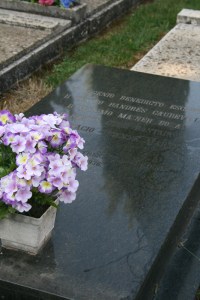
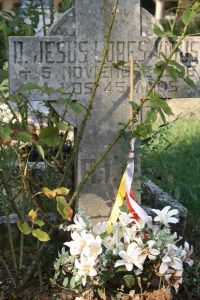
Two days later, on 5 November, a second cohort was brought to the cemetery wall. This execution is recorded in Fosa Común XII (Mass Grave 12, the Rose Bush Grave) and is notable for a slight discrepancy between official state records and local memory. The official Sistema de Información del Patrimonio Cultural Aragonés (SIPCA) catalogue estimates five victims in this plot. However, direct family testimonies and local oral history insist that six men were killed together that morning. Tweo victrims have been ifentified – Jesús Lorés Visús, a local baker, and Mariano Sánchez Oliván. In Jaca’s collective memory, this specific grave became known for a wild rose bush that naturally grew from the soil over the winter of 1936. According to local lore, the seeds came from the pockets of Jesús Lorés, who was known to collect flowers from his garden every morning before opening his bakery, just as he had on the morning of his arrest. They are at least 312 people murdered by the Nationalist in Jaca cemetery in six large areas of collective pits, which have been covered in more recent tombs and thus cannot be recovered.
- Ferrol, A Coruna, Galicia
By November 1936, the war for control of the Iberian peninsula’s vital shipping lanes had intensified into a brutal campaign of naval elimination. For the captured crew of the Republican submarine B-6, the conflict culminated inside the heavily fortified walls of the Nationalist naval base at Ferrol. There, on the night of 3 November 3 and the early hours of 4 November 1936, ten sailors were executed together by firing squad at Punta del Martillo, located within the Ferrol Naval Arsenal.
The ten men were specialised naval personnel bound by a shared tactical catastrophe. On 19 September 1936, the Republican submarine B-6 was operating off Cape Peñas (Asturias) when it was cornered on the surface by a formidable Nationalist naval formation, including the destroyer Velasco and the armed tug Galicia. After an artillery duel left the submarine critically damaged, the commander ordered the vessel scuttled to prevent its capture. The surviving crew members were fished out of the water by Nationalist ships and transported to Ferrol, the primary naval stronghold of Nationalist forces, where they were promptly subjected to a military trial for ‘rebellion.’
Official naval registers track the execution of these ten specific crew members on 3 November 1936.
• Juan Cumbrera González – Segundo Maquinista (Second Marine Engineer)
• Andrés Navarro Barcelona – Segundo Maquinista (Second Marine Engineer)
• Fernando Pascua Galiano – Segundo Maquinista (Second Marine Engineer)
• Teodoro López Camazón – Auxiliar de Torpedos (Torpedo Specialist)
• Víctor Bermúdez Bouza – Auxiliar de Máquinas (Engine Room Specialist)
• José Guerrero Jiménez – Auxiliar de Radio (Radio Operator)
• José Chorro Muñoz – Cabo de Artillería (Artillery Corporal)
• Luis Preciado Rodríguez – Cabo de Electricidad (Electrical Corporal)
• José Navarro Díaz – Marinero / Fogonero (Sailor / Stoker)
• Pedro Vera Rodríguez – Marinero / Fogonero (Sailor / Stoker)
The ten submariners were executed late in the evening at Punta del Martillo, and the paperwork for the bodies was logged by the Arsenal’s civil registry or the cemetery staff until the following morning, represented the deaths the technical elite of the Republican navy who, in the eyes of the Nationalist courts, had committed treason by using state military assets to defend the Republic.
- La Parte de Sotoscueva, Ojo Guareña, Burgos
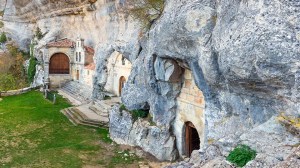
In the rural, high-altitude valleys of northern Burgos, the arrival of late autumn in 1936 brought a calculated shift in the mechanics of the White Terror. As the frontlines near the Cantabrian border hardened into a frozen winter stalemate, Nationalist forces and local Falangist death squads turned their attention inward. Their objective was the systematic elimination of left-wing sympathisers, agrarian unionists, and working-class activists trapped behind their lines. In the municipality of Merindad de Sotoscueva, this campaign relied on a terrifying geological feature to make its victims disappear, the deep, vertical limestone chasms (simas) of the Ojo Guareña cave complex.
The landscape of the killings was defined by isolation and a vast subterranean world. The home of the victims was La Parte de Sotoscueva, a small agrarian hamlet amidst severe limestone cliffs and reliant on mountain farming. Just kilometres away lay Sima Dolencias, a sheer, vertical drop plunging dozens of metres into total darkness. Surrounded by thick mountain brush and oak trees on a rugged karst plateau, this chasm formed part of the massive 100km Ojo Guareña underground network. For execution squads, it was an ideal tactical landscape. It required no digging, left no visible graves, and allowed bodies to be completely erased from the surface world.
On the night of 3 November 1936, the purge targeted four married peasant farmers from La Parte. Tied together by socioeconomic class and familial networks, these men had actively supported local municipal land-use and agrarian reforms spearheaded by the socialist UGT (Unión General de Trabajadores) during the Second Republic. Their public alignment with rural labour activism made them immediate targets. The four victims were Paulino Gómez Ruiz, 51, Francisco Gómez Martínez, 58, Bonifacio Gutiérrez-Barquín Sáinz-Maza, 42, and Francisco Ruiz Fernández, 45.
Local oral histories collected by historical memory groups preserve the brutal reality of their final hours. Bonifacio Gutiérrez-Barquín was intercepted by a Falangist unit while constructing a stone border wall on his property. His hands were bound behind his back in front of his home, while his wife, Máxima, was tied to a structural post inside their portal as their eight children wept. The squad looted the farm, driving away their cattle and pigs, before marching Bonifacio toward the high plateau.
Their deaths were witnessed by a local shepherd from the neighbouring village of Villamartín, who hid in the dense mountain brush near the mouth of the pit after hearing approaching vehicles. In the moonlight, the shepherd clearly recognized Paulino Gómez Ruiz aligned at the edge of the chasm before the rifles fired, sending the four men into the abyss. Whether they died from the gunfire or the catastrophic fall into the dark labyrinth remains historically uncertain.
The tragedy of 3 November was the opening salvo of a bloody month across the Sotoscueva valley. As November progressed, the structural cleansing of the rearguard intensified. Armed squads seized Julio Cámara Marín, 34, from his home in Villamartín de Sotoscueva, executing him near the historic cave-hermitage of San Bernabé. That same night, a local woman named Felipa Alonso Pereda was forcibly disappeared from her home in an identical manner. More would come in later November.
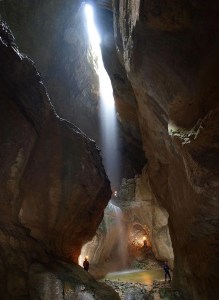
Today, Sima Dolencias stands as a silent, natural monument to the geometry of the conflict. Officially registered on the Spanish National Mass Grave Map, the cavernous mouth of the chasm is enclosed by a double protective wire fence to protect passersby on the mountain paths bordering the agricultural fields. Because the floor of the abyss connects directly to a shifting, active subterranean river system, recovering the physical remains of the four farmers of La Parte poses a monumental forensic challenge. Nearly a century later, the site remains an un-exhumed mass grave, keeping the final reality of November 1936 locked beneath the Asturian stone. The situation regarding surveys and exhumations at Sima Dolencias is deeply complicated by a mix of extreme subterranean geography, historical industrial tampering, and modern archaeological tourism.
Forensic historians investigating the chasm uncovered a devastating piece of local history that explains why a standard physical recovery of the 1936 victims may be impossible, In the early 1950s, a Spanish industrial company operating out of Luchana (Bizkaia) obtained permission to clear out the deep vertical shafts of Ojo Guareña. Operatives descended into Sima Dolencias and systematically cleared out massive piles of historical animal and human bones to process them into agricultural fertilisers at a factory locally nicknamed La Huesera (The Bone Yard). This commercial clearing severely disturbed the stratigraphy at the base of the chasm, likely destroying or scattering the skeletal remains of the Civil War victims along with older archaeological layers.
The chasm itself has been extensively mapped. The Edelweiss Speleological Group (GEE) has surveyed Sima Dolencias continuously from 1956 to the present day, using GPS tracking and 3D mapping. Their deep-cave explorations confirm that the bottom of the 40-meter vertical drop is not a static dirt floor. It connects straight into a dynamic, active underground network of shifting mudbanks and subterranean rivers. Over nearly a century, any remaining bone fragments not taken in the 1950s have likely been washed deep into the unmapped recesses of the 110km+ labyrinth. Because the site cannot be systematically exhumed like a traditional shallow dirt grave, it has been integrated into the protected Ojo Guareña Natural Monument. Today, the Basque and Castilian Speleological Services run official guided tracking tours through Cueva Palomera, where visitors trek for over two hours specifically to stand at the base of Sima Dolencias. It is famous among cavers as the only point in the deep cave system where a massive beam of natural light pierces through the ceiling from the surface world. The families and local memory associations have placed markers near the double-fenced surface perimeter, accepting the chasm itself as the permanent, natural tomb for the ‘missing’ farmers.
Because the cave system is incredibly vast, archaeologists from institutions like the Spanish National Research Centre on Human Evolution (CENIEH) have discovered thousands of years of human prehistory preserved in pristine condition just a short distance from Sima Dolencias. Long before modern humans ever stepped foot in Europe, Neanderthals used the outer entries of the Ojo Guareña system as an annual hub. In excavations wrapped up in late August 2026, international teams spent 11 consecutive summers digging through a single, massive Neanderthal layer spanning over 140 square meters. They found animal bones, heavy flint tools, and fire hearths proving that Neanderthals returned to this exact cave network generation after generation for thousands of years.
Deep inside Cueva Palomera (about 1,200 metres from the entrance, passing right near the paths under Sima Dolencias), sits one of the rarest archaeological treasures on Earth the La Sala de las Huellas (The Room of Footprints). Discovered in 1969, this gallery contains over 1,200 fossilised prehistoric human footprints perfectly preserved in the soft mud floors. Using advanced non-invasive 3D laser scanning to protect the fragile mud, scientists dated the tracks to between 4,200 and 4,600 years ago (the Bronze Age). They tell the story of about ten prehistoric explorers walking barefoot through the pitch-black maze, carrying torches. Dropped fragments of their burning wood torches have even been found nearby, dating back as far as 19,000 years ago into the Upper Palaeolithic.
In deep, hard-to-reach chambers like Sala Keimada and Sala de las Pinturas, humans treated the deepest recesses of the cave as an exclusive sacred sanctuary. Radiocarbon testing confirms that human groups repeatedly visited these restricted chambers across eight distinct cultural phases (Upper Paleolithic, Neolithic, Chalcolithic, Bronze, and Iron Ages) of 11,500 year ago. Prehistoric visitors intentionally left the cave art of their ancestors completely untouched, adding their own drawings alongside them. Deep inside, archaeologists found a ritual structure made of upright stone slabs leaning against each other, as well as the preserved skeleton of a domestic piglet left in a small pools of water as a religious offering 2,100 years ago. For over 13,000 years, the human species viewed the deep, dark galleries beneath the Merindad de Sotoscueva as a place of sacred reverence, ritual art, and sanctuary. It was only during the madness of November 1936 that the modern world twisted this protective, sacred subterranean geography into an industrialised execution trench.
Directly at the surface site of the execution and disappearance, a permanent metal memorial plaque has been installed on the protective wire fencing that surrounds the mouth of the chasm. The plaque formally lists the names of the workers from La Parte executed in November 1936. Placed by families and the association Las Merindades en la Memoria, it designates the deep natural chasm not merely as a geological feature, but as a sacred communal cemetery Because many victims from the wider Sotoscueva and Villarcayo valleys were taken to different execution points during November 1936, a major central monument was erected on the Alto de la Mazorra mountain pass. This is a prominent stone and metal monolith overlooking the rugged mountain valley. It serves as a collective memorial for all those murdered in the area during the autumn purges, honouring those who disappeared into the simas of Ojo Guareña. For the broader comarca, a commemorative wall and floral repository exist inside the municipal cemetery of Villarcayo, which served as the judicial and detention hub where many local blacklists were processed before prisoners were extracted for their final journeys to the chasms or the mountain passes.

