For the March on Madrid, see here
For the Battle of Sigüenza, see here
For the Battle of Elgeta, see here
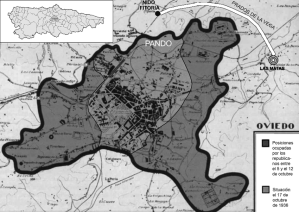
- Oviedo, Asturias
By 8 October, the style of combat inside the Asturian capital altered entirely. Rather than advancing through open streets swept by lethal machine-gun fire, Republican miners advanced directly through the city’s architecture. In a brutal display of subterranean-style urban warfare, the attackers used industrial dynamite, repurposed from the local coal mines, to blast holes through the adjoining stone walls of residential homes, systematically clearing rooms with pistols, knives, and stray bayonets. Through these terrifying, house-to-house methods, the strategic railway district of La Argañosa fell completely to the Republicans. Nationalist troops abandoned the entire western sector, executing a chaotic retreat into a tight municipal core and completely losing control of the city’s industrial periphery.
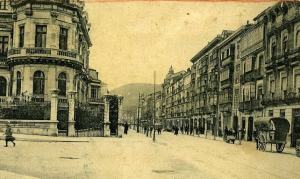
As the physical space of the battlefield shrank on 10 October, the density of the violence exploded into deadly sniper duels and intense machine-gun crossfire. The broad defensive ring collapsed into a tight, irregular pocket as the Asturian miners squeezed the defenders down the major urban avenues of Calle Uría and Calle del Rosal. Republican forces suffered exceptionally heavy casualties on this day; entrenched Nationalist machine guns firing from upper-floor balconies and sandbagged windows turned the exposed, wide avenues into literal death traps, piling bodies in the gutters.
.
The battle shifted from a fight for territory to a raw struggle for basic human survival on 11 October. Through relentless attrition warfare and vital infrastructure sabotage, Republican forces successfully captured the city’s primary water reservoir. This tactical movement completely cut off the Nationalist garrison and trapped population from fresh water. Combined with a total breakdown of municipal sanitation, a deadly typhoid outbreak immediately began to sweep through the congested ranks of the remaining defenders and terrified civilians taking shelter in basements. The loss of the reservoir on 11 October and the subsequent urban compression on 12 October 12 pushed the physical suffering of both combatants and trapped civilians to an extreme peak.
.
By 12 October, Colonel Antonio Aranda’s Nationalist forces had been driven out of virtually every commercial and residential quarter in Oviedo. They were compressed into a final, desperate grid retaining less than twenty per cent of the city, centred tightly around the robust stone structure of the Oviedo Cathedral and the adjacent civic square. The fighting dissolved into brutal hand-to-hand combat over rubble piles and desperate last stands in ruined hallways. The crisis reached a breaking point as the Nationalists depleted ninety per cent of their ammunition, completely exhausting their machine-gun rounds and leaving sentries to guard the perimeter with nothing but empty rifles and bravado. Out of the roughly 3,000 Nationalist troops that Colonel Antonio Aranda had originally organized in July, fewer than 600–700 able-bodied fighters were left on the front line by 11–12 October. The rest were dead, severely wounded, or incapacitated by disease.
.
The force of Asturian miners and militias originally numbered around 10,000, but they also sustained massive casualties, losing thousands of men to the heavily fortified Nationalist machine-gun nests along the main avenues. However, because they could continuously cycle in fresh mining workers and local left-wing volunteers from the surrounding Asturias province, they maintained an active force of at least 4,000 to 5,000 combatants pressing the city centre.
.
.
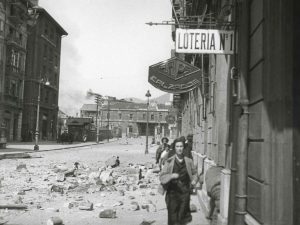
The civilian population of Oviedo, which was roughly 80,000 before the war, bore the ultimate brunt of the fighting during these 48 hours. People were drinking highly contaminated water from stagnant puddles, broken fire hydrants, or shallow city wells. A severe typhoid epidemic had already broken out at the end of September, but without fresh water for sanitation, it exploded exponentially on 11 and 12 October. The disease swept through the dark, overcrowded basements, apartments, and church vaults where families were hiding. Hundreds of civilians died from the fever in total agony, completely isolated from any medical care. Because the Nationalists were compressed into less than twenty percent of the city layout around the Oviedo Cathedral, the civilian neighbourhoods became the direct front line. Heavy Republican artillery and aerial bombing constantly pounded the city centre. Civilians were frequently crushed in the ruins of collapsing buildings or caught in the lethal crossfire of machine guns on major streets like Calle Uría. By 12 October, the interior of Oviedo was described as a living graveyard. The stench of unburied bodies in the rubble, the lack of water, and the screams of typhoid patients created an environment of utter desperation.
.
- Fuenteguinaldo, Salamanca, Old Castile
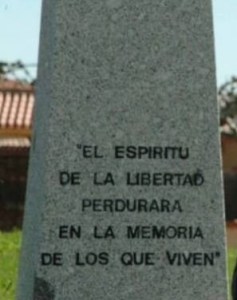
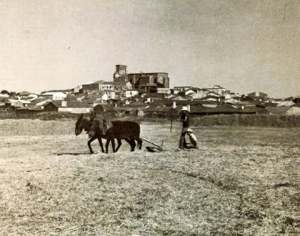
On 7 October 1936, a joint force of Falangists, Guardia Civil, and local Carabineros launched a house-by-house roundup in the town of Fuenteguinaldo. The targets were drawn up on a list made by the local priest, targeting ‘read and atheists’ local elected officials, republicans, and members of the left-wing trade union hub, the Casa del Pueblo. The victims were taken directly from their homes in the rural village of in the southwest Salamanca province in the afternoon and evening. One of the men was Alejandro Zato Salicio, a 32-year-old tinsmith who had been installing windows at the church, and was grabbed in front of his wife and children without explanation. As a tinsmith, it was said he was once made a communist hammer and sickle for someone, and had never personally engaged in any politics. The others in the pit were all day labourers – Timoteo Feliciano Mateos Ríos (single, age 29), Ramón Castaño Durán (age 24, father of three), José Alfonso González (father of one) and Agapito Carreño González (age 25, a councillor and father of two) and his brother-in-law Juan Valiente Salvador (age 32, father of one), Valentín Rodolfo Expósito (age 41, father of two and member of the workers’ union), León Pacífico José Flores (age 34, father of five) and his brother-in-law León Herrero Galán (age 37, leader of the workers’ union and father of four), Simón Moreiro Herrero (age 29, father of two), Bartolomé Mateos Alonso (single aged 34), Nicolás Sánchez Martín (age 33, father of one), Matías Mendo Mateos (age 39, father of four), Evaristo José Sánchez Pérez (age 29, father of two and councillor, brother of the local mayor), Nicolás Marcos Morán (age 37, father of two), Antonio Álvarez Martín, and Antonio Cánovas Mesa. In many cases, it was the children who witnessed their fathers’ being dragged away and were able to keep the search for them alive.
.
It was later uncovered that, on the night of the military coup, 19 July 1936, the local Republican mayor Francisco Sánchez Pérez had gathered a group of men to help him protect the town in case fascists take to take over (and was later punished with 25 years in prison). Those men were his brother Nicolás Sánchez Pérez, and Agapito Carreño, Nicolás Marcos, Juan Valiente, Valentín Rodolfo, Matías Mendo, Simón Moreiro, and Bartolomé Mateo. Once the fascists took over and the Guardia Civil sided with them, these men were targeted solely for keeping a night watch against potential killers, the rest of being in a worker’s union.
.
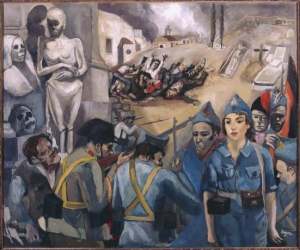
The men were placed in prison at Ciudad Rodrigo at 9pm that night, though as Alejandro Zato Salicio was originally from Ciudad Rodrigo, he spotted someone he knew while being transferred and they spoke, meaning his family could later trace their fates. At around 4am on 8 October, a witness saw approximately what looked like 20 people outside Monastery of La Caridad. Later surviving papers showed the prisoners had been marked as transferred, victims of a saca, and were simply marked as disappeared after being killed and placed in the pit outside the monastery wall. Witnesses claimed to have heard between 20 and 22 shots fired. The families of the men walked the 25km north to Ciudad Rodrigo, but could not get near the gravesite. Juan José Francisco Alfonso, a bailiff who had spoken to the detainees, and may have been Zato’s contact, was arrested himself that night and beaten with rifle butts, and was found dead of his wounds soon after.
.
Alejandro Zato Salicio’s family later received a death certificate listing his death as 1944 as attempts to hide sacas was being processed, though authorities pressured widows to say their husbands died of natural causes, which most women refused. . The killings left behind 13 widows and 32 children, including Zato’s three, and one, only a few months old when his father and namesake was murdered, died the following year, as did a child of another victim. Zato’s widow and five others petitioned for charity and compassion in 1938, stating all the families were living in extreme poverty, without even bread or clothing. All requests for support were denied for all the families.
.
Local mayor Francisco Sánchez Pérez had lost his brother Evaristo José Sánchez Pérez to the pit, and he, his children, and his nephew continued to fight for justice after Franco died in 1975, as did José Zato Benito, son of Alejandro Zato Salicio. In 2006, Alfonso Gómez, a witness to the gravesite, had been waiting to help. When he was eight and working on a farm, two other boys warned him that dead people would grab his legs and showed him where they knew bodies were buried. It took six visits and 18 months of searching before bullets were found on 10 October 2006, and today all 14 men are buried properly in Fuenteguinaldo. As for the other three victims, who for years were suspected of escaping Nicolás Marcos Morán, Antonio Álvarez Martín, and Antonio Cánovas Mesa, are now believed to have been buried 25km away in a grave at Aldeanueva de Portanobis near Castillejo de Martín Viejo, where three bodies were found but could not be identified due to damage.