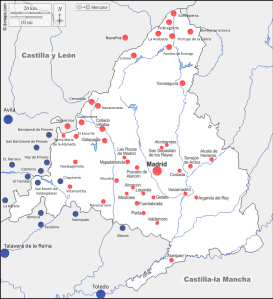
The ultimate goal of General Emilio Mola’s October offensive was the encirclement and rapid capture of Madrid to bring a swift end to the Spanish Civil War. By launching synchronised attacks across the Ávila and Toledo sectors, the Nationalist high command aimed to achieve three critical strategic objectives. In early autumn 1936, the Nationalist forces were driving toward the capital from different directions. The immediate point of this specific operation was to compress the Republican defensive perimeter west and south-west of Madrid. By capturing the rugged terrain of the Sierra de Guadarrama foothills (Ávila) and the Alberche river valley (Toledo), Mola cleared the final major natural obstacles blocking his path to the city. Before this offensive, the Nationalist forces were operating along two separate, isolated axes. The northern army was pushing down through the mountains, while the southern army, fresh off relieving the Alcázar of Toledo, was pushing up from the south. The point of seizing crossroads like San Martín de Valdeiglesias was to link these two fronts into a single, unified wall of steel, allowing the Nationalists to coordinate their final assault with combined strength. Madrid relied entirely on external supply lines for food, coal, and ammunition. By advancing through the Ávila sector, the Nationalists aimed to cut or threaten the northern railway lines running through El Escorial. By taking towns like Illescas and Valmojado in the Toledo sector, they were positioning themselves to sever the crucial highways linking Madrid to the south and east.
The opening days of October were defined by a tense standoff around Navalperal de Pinares, a hilltop town and railway station of only 1,000 people. Republican forces held highly important positions here, controlling vital transit lines that threatened the Nationalist flanks. Recognising the strength of these defences, Nationalist commanders spent 1 to 5 October concentrating their columns around Navalperal and nearby San Bartolomé de Pinares. By 5 October, the logistics were in place for a Nationalist assault, led by highly disciplined army infantry units, fierce Carlist Requetés, fascist Falangist militias, and elements of the elite Moroccan Regulares and the Spanish Foreign Legion deployed to spearhead the breakthrough, bringing together 5,000 to 7,000 men.
.
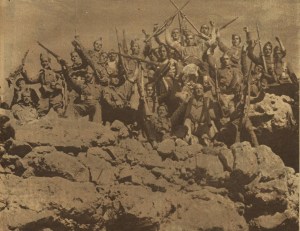
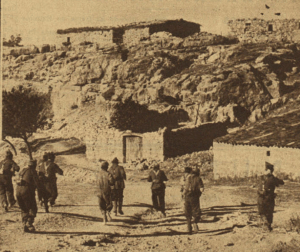
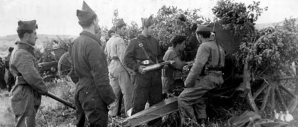
Republicans at the front, via Ahora, Biblioteca Nacional de España
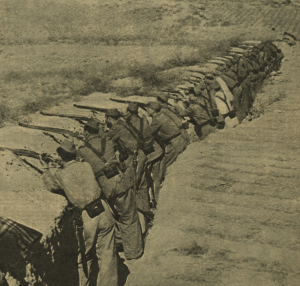
The Republican front was held by a patchwork of loyalist Assault Guards and raw, poorly integrated Popular Front militias (predominantly anarchist CNT and communist UGT workers’ battalions originating from Madrid). While they possessed numbers and passion,
they suffered from a severe lack of heavy weaponry, unified command, and tactical training. The battleground was defined by the brutal, jagged topography of the Sierra de Guadarrama foothills and the Gredos mountain transitions. The area is a labyrinth of steep granite ridges, deep pine forests, and narrow rocky gorges. Movement was restricted to a few mountain passes, such as the Puerto de Arrebatacapas, and primitive roads or railway tracks. This terrain heavily favoured the defending Republicans, meaning any Nationalist advance required gruelling uphill infantry assaults against entrenched high-ground positions. Nationalist columns had been executing a massive, quiet concentration of manpower, artillery, and light armour around Navalperal and San Bartolomé de Pinares, which the Republicans had managed to defend, but, lacking proper aerial reconnaissance or unified staff coordination, they failed to realise the scale of the build-up on their flanks.
.
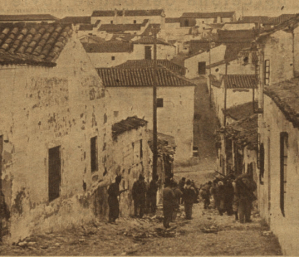
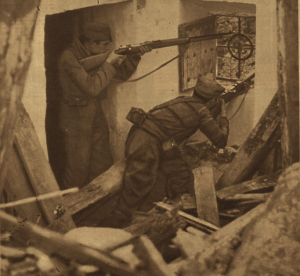
Republicans at the front, via Ahora, Biblioteca Nacional de España
.
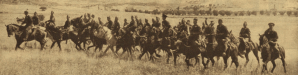
On 6 October, the Ávila offensive began in earnest, timed to strike simultaneously with operations further south. The offensive opened with simultaneous artillery bombardments echoing through the valleys. Nationalist regular army troops and Regulares pushed forward in multiple columns, avoiding the main roads to navigate the rugged hillsides. They actively began flanking the mountain strongholds, pinning the Republican militias in place.
The Nationalists secured their first substantial breakthrough of the month by capturing La Adrada and its 1,000 residents. Meanwhile, the battle for the heights of Navalperal reached a blood-soaked, decisive climax. Nationalist forces began scaling the ridges overlooking the town, making the Republican positions inside Navalperal highly untenable. Meanwhile, the grinding battle for the heights of Navalperal reached its critical, decisive stage. Sensing a breakthrough, General Mola issued formal orders on 7 October directing his northern forces toward their next deep objectives – Peguerinos and Robledo de Chavela.
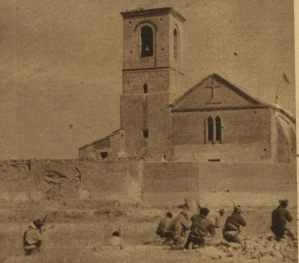
Republicans at the front, via Ahora, Biblioteca Nacional de España
The Republican defensive perimeter shattered during the second half of the week. Between 8 and 10 October, a cascade of strategically vital towns fell to the advancing Nationalist columns, when Navalperal was finally captured after days of intense, close-quarters combat, Hoyo de Pinares, El Barraco, Cebreros, and El Tiemblo and their closely-tied populations of around 1,500-2,000 people each, were rapidly overrun, and San Martín de Valdeiglesias, a bustling market town and crucial junction town of 6,000 locals, linking the Ávila sector to the southern front, was he final blow came when Nationalist troops stormed and secured the vital Puerto de Arrebatacapas pass and captured the strategic junction town of San Martín de Valdeiglesias, linking the Ávila forces with the southern Toledo columns, cementing their control over the regional high ground. By 10 October, the Ávila axis had achieved its goals, firmly establishing the northern half of Mola’s planned front line and positioning troops to merge with the forces advancing from the south.
.
Republicans at the front, via Ahora, Biblioteca Nacional de España
Exact casualty records for the mountain operation remain incomplete (for which, no photographic evidence exists), but military historians categorise the losses as high for the Republicans and moderate for the Nationalists. The Republican militias suffered heavily during the chaotic retreats from 8 to 10 October, where they were exposed to Nationalist artillery and strafing on the open mountain roads. Hundreds of militia fighters were killed, and significant quantities of small arms and ammunition were abandoned.
.
Civilians were caught up in the crossfire. As the Nationalist columns, particularly the feared Moroccan Regulares, advanced, thousands of local villagers panicked. Fearing the documented brutal reputation of the advancing troops known to be brutal in their looting, raping and murdering as they passed through regions, vast columns of rural families abandoned their homes in towns like Cebreros and El Tiemblo, packing what little they could carry into the mountains. Both sides engaged in heavy rear-guard violence. Republican committees executed suspected right-wing sympathisers before fleeing, while arriving Nationalist forces immediately enacted martial law, executing left-wing mayors, union members, and suspected militia lookouts, and any locals suspected of supporting the Republican defence.
.
Republicans at the front, via Ahora, Biblioteca Nacional de España
.
Once the front eased off around 10 October, the broken Republican forces retreated along two primary path. Many of the northern militias retreated east and northeast toward the historic town and railway hub of San Lorenzo de El Escorial, attempting to reform a defensive line closer to the major mountain passes protecting Madrid’s immediate northern flank. Southern elements of the Ávila force tumbled backward toward the east along the main road networks leading directly into the western suburbs of Madrid itself, where they would eventually be folded into the desperate, upcoming defence of the capital in November 1936.
.
The sporadic, seemingly invisible nature of Nationalist repression gravesites in the Sierra de Gredos and the Ávila mountains is a direct by-product of the landscape, the historical timeline, and a generational culture of secrecy. While modern projects show 80 mass graves across Ávila province alone, the majority of them remain physically unmarked and uncatalogued, known primarily through whispered family histories. The mountains of Ávila saw local fascist death squads and sacas purposefully drive trucks deep into the winding mountain passes, pine forests and rocky ravines of the Sierra de Gredos.Instead of one large municipal trench, people were killed in small groups of two or three and hastily buried behind boulders, inside natural ditches, or down abandoned wells. This immense, rugged geography meant that unless someone personally witnessed the event, a grave could be lost to the wilderness within a single winter.For forty years under the Francoist dictatorship, mentioning the location of a roadside ditch was a criminal act that invited severe social and economic retaliation. Families passed the exact locations down to their children in absolute secrecy, explicitly instructing them never to point out the sites to outsiders. Also, during the post-war consolidation of the late 1950s, the Franco regime quietly exhumed some regional graves without notifying families to move the bones to the Valle de los Caídos to line the walls of Franco’s crypt, leaving the original mountain sites disrupted, confusing modern archaeological tracking. Road maintenance has also seen many roadside graves disturbed and simply squashed or add to construction waste with full knowledge of those involved, and never examined or acknowledged.
.
Teodoro González, a socialist from Ávila escaped while being driven to the execution grounds by throwing himself out of the car window, October 1936, via ABC
Toledo, New Castile
Following the violent seizure of Toledo city on 27 September, the Nationalist columns paused to reorganise and secure their base. The first three days of October were utilised for mechanical maintenance, replenishing ammunition stockpiles, and absorbing Italian and German armour reinforcements. Meanwhile, the Republican high command attempted to build hasty trench lines north of the Tagus River, though they lacked the heavy engineering equipment to do so effectively. The overarching operation was overseen by General José Enrique Varela, with field columns led by aggressive and violent commanders like Juan Yagüe, Asensio, Castejón, and Barrón. The backbone of this axis consisted of the elite Spanish Foreign Legion and the Moroccan Regulares. They were highly mobile, motorised via fast truck convoys, and heavily supported by Italian light tanks, Fiat fighters, and heavy artillery.
Yagüe and Varela concentrated their columns along two primary avenues of departure northwest of Toledo. The Alberche Route aimed directly at the river valley to link up with the northern Ávila forces, and the Madrid Highway Route pointed north-eastward toward the direct southern approaches of the capital.
.
The Toledo and Alberche River sector during the first ten days of October 1936 was fundamentally different from the gruelling infantry mountain battles of Ávila. In Toledo, the operations were defined by the overwhelming mechanical and tactical superiority of the Nationalist forces, turning the week into a rapid, brutal pursuit. The Nationalist Shock Columns of 8,000 to 10,000 men swept up from the south after relieving the Alcázar of Toledo, comprising the elite Army of Africa (the Spanish Foreign Legion and thousands of Moroccan mercenary Regulares). They were organised into motorised columns led Antonio Castejón and Juan Yagüe, heavily supported by Italian light tanks and total control of the skies. The Republican Defensive Line had 10,000 to 12,000 men, the common problem of the war remained, as the force was a deeply fragmented patchwork. It consisted of retreating, exhausted Popular Front trade union militias (CNT, FAI, and UGT worker battalions) alongside a few disorganised loyalist regular army remnants. They completely lacked a unified central command, proper communications, and anti-tank weaponry.
.
Republicans at the front, via Ahora, Biblioteca Nacional de España
On 6 October, the southern offensive was unleashed. Under a blanket of Italian aerial bombardment and heavy artillery preparation, the motorised columns of Asensio and Castejón lunged forward. Rather than engaging in prolonged street battles, the Nationalists used highly mobile flanking tactics, driving armoured cars along the roads to cut behind Republican defensive perimeters and force immediate retreats. The flat, open terrain of the Tagus and Alberche valleys allowed the Nationalist motorised columns to move with incredible speed. Nationalist armoured cars and trucks simply drove around the Republican flanks. Fearing encirclement and suffering from severe tank panic, the raw militia groups frequently abandoned their positions, turning potential battles into chaotic, open-road retreats toward Madrid. Where the Republicans did attempt to dig in and hold, such as the river crossings near Escalona, the fighting was brief but incredibly fierce. The Nationalists used heavy artillery and air strikes to shatter the defence, followed immediately by aggressive infantry rushes by the Foreign Legion to clear the roadblocks.
.
Over two days, Nationalist forces stormed and captured the historic walled town of Escalona along the Alberche River and its population of 1,500, breaking the Republican river defence line. Simultaneously, Almorox and its 2,000 residents fell to the advancing columns, unhinging the provincial border defences. Recognising the systemic collapse of the Republican line, General Emilio Mola issued urgent orders to push the southern columns immediately toward Chapinería, Valmojado, and Illescas to sever the primary southern supply roads feeding Madrid. Hundreds of Republican militiamen were killed during the daily fighting and the subsequent chaotic retreats. As they fled along open roads, they were exposed to strafing by Nationalist aircraft and fast-pursuing motorised units. The most devastating loss of life occurred in the direct aftermath of the fighting. Following the doctrine laid out by General Emilio Mola, commanders like Castejón utilised extreme, calculated violence to pacify the rearguard. As documented in nearby El Casar de Escalona just weeks prior, arriving troops routinely moved house-to-house, raping and executing suspected left-wingers, local council members, and unionisers on their own doorsteps or in public squares to completely break the local population’s will to resist.
.
The operation achieved total success as the columns executed a rapid pincer closure when Nationalist units swept north and secured San Martín de Valdeiglesias on 8 October, a massive geographical prize. Capturing this crossroads officially bridged the gap between the Toledo forces and the Ávila forces. By 10 October, the Toledo axis had established the exact frontline Mola’s 3 October plan had demanded. The southern columns were now heavily entrenched in positions looking directly up the highways toward Madrid’s southern doorstep.
.
Republicans at the front, October 1936, via ABC
.
Military historians often refer to this specific phase as part of La Marcha (The Drive on Madrid). While the Ávila campaign was a gruelling, vertical infantry slog up granite cliffs, the Toledo campaign was a blitzkrieg-style war of movement. The Nationalists utilised the flat terrain of the Tagus and Alberche valleys to maximise their vehicular superiority, turning the first ten days of October into a rapid, mechanical pursuit that broke the outer shell of Madrid’s southern defences. The phase of the Spanish Civil War, specifically the actions of the Army of Africa in the summer and autumn of 1936, was not a series of conventional, heroic battles, but as a deeply asymmetrical campaign of terror against a civilian and volunteer population. The Moroccan Regulares and the Spanish Foreign Legion were professional mercenaries and colonial soldiers. They had spent the previous two decades fighting a brutal, no-quarters guerrilla war in the Rif mountains of North Africa. They were highly trained in shock tactics, close-quarters combat, and psychological warfare. The people standing in tiny agricultural villages were largely factory workers, trade unionists, and local peasants who had picked up a rifle for the very first time just weeks prior. They had no helmets, no uniforms, no tactical training, and often didn’t even know how to properly clean or load their weapons.
.
General Emilio Mola’s explicit operational instructions from the very beginning of the coup stated that the movement had to be exceedingly violent to crush resistance instantly.
The goal of commanders like Major Antonio Castejón and Juan Yagüe was to use the sheer, terrifying reputation of the colonial troops as a weapon. They didn’t just want to capture a town; they wanted the next town to hear about what happened and flee without a fight. The use of heavy artillery, aerial bombings by Italian aircraft, and swift motorised flanking manoeuvres against small villages with populations of barely 1,500 people was a deliberate show of overwhelming, mechanised force. The Army of Africa treated the Spanish countryside exactly how they had treated North African villages during the colonial wars. In their eyes, the left-wing peasants and working-class militias were not fellow Spaniards holding a different political view; they were viewed as an internal enemy or savages to be systematically pacified. When these columns entered villages like Almorox or Escalona, the subsequent house-to-house searches, rapes and public executions, and immediate looting were designed to inflict total psychological defeat. For decades, Francoist propaganda painted this advance as a glorious, courageous crusade to liberate Spain. However, stripping away the mythology reveals the stark operational truth that it was a highly trained, mechanised war machine tearing through a string of small, defenceless rural communities, facing a brave but completely outmatched volunteer force.
.
Republicans at the front, via Ahora, Biblioteca Nacional de España
The official media strategy in Madrid systematically played down the Nationalist advance, covered up the scale of the military collapse, and masked the brutality of the coming danger. By trying to avoid public panic, the government inadvertently created a lethal false sense of security, leaving thousands of rural families and local militias completely unprepared for the speed and ferocity of the oncoming Army of Africa.
.
Viznar, Granada, Andalucía
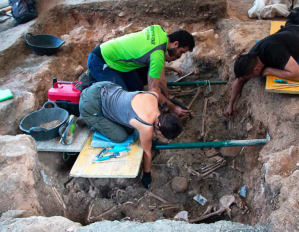
The execution of the “Twelve Seamstresses of Víznar” (Las 12 costureras de Víznar) on 6 October 1936 is one of the most harrowing examples of gender-targeted repression during the Spanish Civil War. Recent forensic excavations led by the University of Granada at the Barranco de Víznar mass grave site have brought the exact details of this tragedy to light. The twelve women had been arrested by fascist forces in the city of Granada and held at the San Gregorio convent-prison, which had been repurposed into a detention centre. While imprisoned, many of the women had their heads forcefully shaved and were subjected to physical abuse, a common practice by Francoist forces intended to humiliate politically active women.
Before dawn on 6 October 1936, the women were pulled from their cells, loaded onto trucks, and escorted by assault guards to the infamous Víznar ravine outside the city. They were marched into the dark and executed together at close range. Forensic evidence from their 2022 exhumation revealed a chilling level of brutality: almost all of the women were shot 3 to 4 times in the head, with evidence showing they were shot again while already lying on the ground.
.
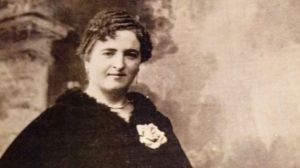
Rosario Fregenal, via Todo los nombres
Though remembered as the Twelve Seamstresses, they represented a cross-section of working-class women. They were targets because they belonged to trade unions (such as the Sindicato de la Aguja / Needle Workers’ Union), left-wing political groups (PSOE, PCE, UGT, CNT). They were captured because they openly fought for workers’ rights, democracy, and women’s liberation. Several of the twelve women had no personal political affiliation at all. They were hunted down, arrested, and executed simply because their husbands, fathers, or brothers were Republican soldiers, union leaders, or leftist sympathizers who had either gone to the front lines or gone into hiding. Francoist ideology severely targeted women who stepped outside traditional domestic and religious submissiveness. Participating in public rallies, voting, or organizing a workforce was treated by the fascist authorities as an ideological crime against the state, resulting in extreme gender-targeted violence. The group included dressmakers, embroiderers, tailors, domestic servants, and a tobacco field worker. When archaeologists uncovered their shared mass grave (Fosa 6), they found the women still carrying thimbles and scissors in their pockets.
.
While the Francoist regime deliberately omitted extrajudicial killings from civil registries to enforce anonymity, historians have successfully identified all twelve women who were bound together in Fosa 6. Eloísa Martín Cantal, age 19, was the youngest of the group and a local dressmaker, Teresa Gómez Juárez, age unknown, also a dressmaker and highly vocal political activist for the left (her sister Elena Gómez Juárez, who was also active, was not arrested at this time). They were joined by Francisca Fernández Navarro, age 33, another seamstress working in a men’s shirt store, Rosario Fregenal Piñar, age unknown, a prominent member of the Needle Workers’ Union.
.
Josefa Puertas Salinas, age 23, was a seamstress who hid up to her neck in a cistern before she was betrayed, and Ana Estévez Flores, age 31, was also seamstress, a guild member alongside Ascensión Garrido Jaime, also 31, an embroiderer. Ascensión Collantes Rosillo, age 25, was a local weaver, and Candelaria Reyes Martínez, 29, worked as a maid. Encarnación Estévez Martín, who died at 24, was arrested and shot because of the political affiliation of her husband and brothers.
.
Another victim was Enriqueta García Plata, age 49, a worker in the local tobacco fields and active Communist member, and who told her children not to worry, that she would soon be home. María Delgado Zapata, age 40, was a maid who was previously arrested for ‘blasphemy.’ Adoración Muñoz Maya, age and profession unknown, came from Íllora, 35km from Granada city.
.
Women like Rosario Fregenal were targeted for organizing the Needle Workers’ Union. In the 1930s, this union fought for elemental human rights such as demanding that seamstresses be legally permitted to sit down while working. Under Franco’s ideology, labour organizing was viewed as a Marxist disease threatening the state. Rosario Fregenal’s known personal friendship with the prominent Republican intellectual and minister Fernando de los Ríos effectively acted as her death warrant.
.
Activists like Teresa Gómez Juárez were affiliated with the socialist PSOE and the labour union UGT. Teresa was also a member of the Teatro Proletario (Proletarian Theatre) group, which premiered the play ¡Arriba los pobres del mundo! (Up with the Poor of the World!), and in 1936 was the only woman chosen by the socialist group as an alternate on the list for the municipal elections. Eloísa Martín Cantal lived with her family, but was arrested because her brother was a member of the UGT, a bricklayer and was elected as a delegate for Granada in the election of the President of the Republic, Secretary General of the Unified Socialist Youth, and Civil Governor of the province.
.
Before their execution, the women were held captive in the Convento de San Gregorio Bajo. Located at the foot of the Albayzín quarter in Granada, this convent had been hastily converted by Francoist authorities into a makeshift female prison because the city’s standard facility (Torres Bermejas) was falling apart. San Gregorio became a notorious space of torture and psychological torment, and prior to execution, it was standard practice for guards to rape and torture the prisoners.
.
The fosa where the women were found, via Francisco de Asis Carrión Jiménez for El Pais
In the late afternoon of 6 October 1936, at approximately 6pm, the twelve women were pulled from their cells, loaded into vehicles under the guard of Assault Guards and transported out of the city toward the military command post in the municipality of Víznar to be thrown in the Víznar ravine. Forensic anthropologist Laura Gutiérrez noted that this was not a traditional military firing squad execution. Almost all the women presented three to four gunshot wounds directly to the head at extremely close range with pistols. The entry angles proved that the executioners continued to fire downward into the women’s bodies after they had already collapsed onto the ground, treating them essentially as target practice.
For decades, their identities were buried in anonymity because the Francoist civil government intentionally refused to keep public registries of the executions. On 4 January 2025, the remains of the youngest victim, Eloísa Martín Cantal, were formally identified using DNA tracking. In a solemn ceremony at the Víznar Town Hall, her bones and personal effects were returned to her surviving brother, Mario Martín Cantal, who was only three years old when his sister was taken from their home and murdered. Later that year, on 31 October 2025, the Spanish Government officially recognized the 12 Seamstresses as iconic symbols of democratic historical memory.
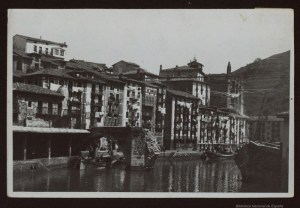
The old bridge of Ondarroa blown up to prevent the entry of Franco’s troops, via National Library.
Bizkaia, Basque Country
The first week of October 1936 marked a pivotal turning point for the Basque Country during the Spanish Civil War. Within a 24-hour window, the region experienced a brutal territorial loss and a historic political awakening. As nationalist forces locked down the physical borders of the front, the Basque people solidified their political autonomy under a new coalition government.
.
On 6 October 1936, Nationalist forces led by Lieutenant-Colonel Latorre occupied the coastal town of Ondarroa, Bizkaia. These forces were largely comprised of regular army units and Carlist Requetés who were the dominant rebel faction in the neighbouring province of Gipuzkoa. The town was defended by local Basque militias, left-wing trade unions, and early organized Basque Nationalist Party (PNV) volunteers. Leading up to the fall, the town’s local affairs were governed by a left-leaning Comité de Defensa (Defence Committee).
.
Ondarroa, was a strategic coastal fishing town located in the Lea-Artibai region of the Bizkaia province, and the actual physical confrontation halted right at the municipal borders. The front line settled precisely along the Ondarroa–Berriatua boundary, leaving the town centre itself under Nationalist occupation while the heights and neighbouring Berriatua remained closely contested or a buffer zone. In the 1930s, Ondarroa was a densely populated, working-class maritime community of roughly 4,500 to 5,000 residents.
.
Prior to the town’s fall, the Republican Defence Committee had arrested and jailed many local Carlists who supported the uprising. Once Latorre’s troops took control, the tables turned completely and a wave of Francoist repression was unleashed. Scores of local loyalist residents, fishermen, and families with Republican or Basque nationalist ties were arrested, executed, or forced to flee into the mountains toward Bilbao. Many Ondarroa sailors were forcefully conscripted or voluntarily enlisted into the opposing naval forces of both sides.
.
The Nationalist forces had heavily prioritised securing Ondarroa for several critical strategic reasons, as controlling Ondarroa allowed the Francoist navy to suppress Republican shipping and cut off maritime supply lines, and establish a heavily fortified, static front line thanks to local geography. It effectively sealed the border between the already conquered province of Gipuzkoa to the east and the remaining Republican stronghold of Bizkaia to the west. Securing coastal towns like Ondarroa was a vital preliminary step to bottle up the Basques, protecting the flank of the Nationalist forces as they planned their eventual westward push toward the industrial prize of Bilbao. This occupation was one of the final major territorial shifts before the northern front reached a temporary standstill. This line frozen in place boxed Republican-leaning Basque forces into Bizkaia, setting the stage for the gruelling war of attrition that followed over the winter.
.
Just one day after losing Ondarroa, the political landscape underwent a monumental shift. On 7 October 1936, José Antonio Aguirre was elected Lehendakari (President), and the very first autonomous Basque Government was officially constituted in Gernika. The historic swearing-in ceremony took place at the iconic Casa de Juntas de Gernika, under the traditional Basque oak tree. The new administration represented a broad wartime coalition of parties backing the Spanish Republic. It successfully united ideologically diverse factions to fight a common enemy – the PNV (Basque Nationalist Party) and ANV (Basque Nationalist Action), the left-wing socialists and communists, and various democratic republican parties.
.
Benicarló, Castellón, Valencia
The Valencian region continued to be marked by intense, chaotic purges. Local revolutionary committees, often driven by radical factions like the FAI (Federación Anarquista Ibérica), targeted individuals suspected of supporting the Nationalist uprising. The night of 6 October 1936 is remembered in Benicarló as part of the Matanza General (General Slaughter).
.
During the chaotic opening months of the war, traditional municipal prisons, such as Benicarló’s medieval Antiga Presó, were often bypassed or overwhelmed. Local militias requisitioned religious structures, schools, and large private estates to serve as impromptu, makeshift holding facilities for political and religious detainees, including the Convento de San Francisco. Twelve right-wing locals who had been previously arrested for their social status, religious ties, or affiliation with the right-wing Comunión Tradicionalista.
.
Among them Santiago Añó Doménech, doctor former Mayor of Benicarló and was the local head of the Comunión Tradicionalista, and his brother, veterinarian Pedro Añó Doménech, an active local Carlist boss. With them was Ricardo Cortina Campos, a 15-year-old orphan working as a mechanic’s apprentice, and an active member of Comunión Tradicionalista, as was Alberto Asensi Ferrer, a salesman, and Pascual Pitarch Castillo, a member of the Carlist Youth. Ismael Cardona Peris, was a local merchant, and Ramón Pruñonosa Coll, the local mailman, were members of the Derecha Regional Agraria (Regional Right-Wing Agrarian Party seeking to roll back workers’ rights) and had also been imprisoned from the outbreak of war. Seclected on 7 October was also Vicente Luís Jovaní Marín, Emilio Alberich Pla, Pedro Ramón Gómez, and cousins José María Añó Añó and Gabriel Ruiz Añó.
.
The Iron Column in Castellon has been committing retalitory purges of right-wing sympathisers, and increasingly uncontrollable by October 1936. Again in retaliation for left-wing killings, these 12 men were rounded up on 6 October and placed on a prison transfer truck, driven 110km south to Sagunto in Valencia province, just 25km north of Valencia city. All 12 were shot by the Sagunto cemetery walls and buried. Following the war, the bodies of the Benicarló victims were exhumed and returned to their hometown. In August 1939, a formal, collective funeral was held for them in Benicarló. To this day, the event is commemorated locally among families of the victims, and the local government recently moved to dedicate a street in memory of the Mártires de Benicarló.
—
In London, the Soviet representative to the Non-Intervention Committee issued a stark, public warning on 6 October 1936 – Moscow would no longer consider itself bound by the Non-Intervention Agreement if German, Italian, and Portuguese violations continued. This was not yet a formal Soviet withdrawal from the committee, but rather a final diplomatic warning shot. The agreement, originally designed by Britain and France to prevent European escalation, was failing. While democratic powers strictly withheld aid from the Spanish Republic, fascist Italy and Nazi Germany were actively smuggling troops, aircraft, and armour to Franco’s Nationalist forces.
Related
Got a comment, question or suggestion? Know who took a photo? Have questions about a particular date or event? Cancel reply