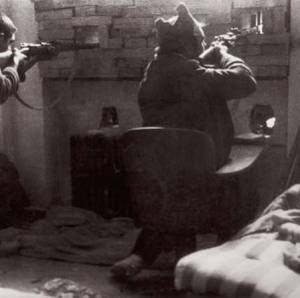
On November 17 and 18, 1936, the Siege of Madrid reached its most intense and bloody phase as Nationalist forces fought room-to-room in University City (Ciudad Universitaria). Having crossed the Manzanares River and seized high ground like Cerro de Garabitas, Nationalist troops under General José Enrique Varela pushed into the northern university campus. They captured buildings such as the School of Architecture. Republican Counter-Entrenchment: Republican defenders, bolstered by trade union militias, communist units, and the International Brigades, dug in across the campus faculties of Medicine, Pharmacy, and Dentistry, turning lecture halls and libraries into fortified trenches. The war was literally room to room.
The Republicans had to defend the capital at all costs. Use the concrete architecture of the newly constructed university campus as an improvised fortress line. The goal was to bottle up and destroy the Nationalist vanguard, consisting of Moroccan regulares and Spanish Foreign Legionnaires, before they could cross the campus and reach the urban centre. Under the centralized oversight of General Miaja and Colonel Rojo, the Republicans committed roughly 14,000–15,000 combatants to the sector. The XI International Brigade, including the Edgar André and Commune de Paris battalions, and the Durruti Column alongside the Central Army Militias of approximately 11,000 fighters, mostly men, composed of regular Spanish Republican Army remnants and CNT/UGT and Communist Party 5th Regiment militias.
University City was the pet project of the recently deposed king, designed to be Europe’s finest modern educational hub. Most of these buildings, the Clinical Hospital, the School of Architecture, and the Faculties of Medicine and Pharmacy, were monumental, multi-story structures. They were massive, blocky concrete monoliths, hundreds of metres long, featuring vast basement networks, wide grand staircases, and rows of enormous windows. Because they were largely unfinished, they were surrounded by gaping construction trenches, piles of building materials, and mounds of raw earth. The campus looked like a futuristic city emerging from a wasteland, situated on a high plateau just across the river from Madrid’s dense urban centre.
When two armies crash into a single massive concrete building, the concept of a front line vanished. War became a claustrophobic, three-dimensional nightmare of geometry. In the sprawling Clinical Hospital, the front line was a ceiling. Nationalist Moroccan troops occupied the ground floor, while Republican militias and international volunteers held the third and fourth floors. Soldiers used the building’s infrastructure as weapons. Republicans would prime heavy explosives, place them inside the hospital lifts, and send the elevator down to the ground floor to detonate among the Nationalists. Every window was barricaded with whatever was at hand, often thick, leather-bound university textbooks from the libraries. Soldiers fought in near-total darkness, blinded by choked clouds of pulverized concrete dust, plaster, and toxic cordite smoke. Soldiers would strap mirrors to the ends of rifles to peer down corridors, or simply blind-throw a grenade around a door frame, wait for the blast, and charge into the dust with bayonets.
The sheer volume of humanity crammed into this campus was staggering. Across an area roughly the size of a few dozen football fields, over over 10,000 Republican defenders were locked in a death match with thousands of elite Nationalist troops. Over these 48 hours, nearly 1,700 Republicans were killed or severely mangled trying to hold these hallways. Because the fighting was constant and trapped inside, corpses could not be evacuated. They were stacked in the back of lecture halls and laboratories alongside the wounded, adding the smell of decay to the chemical stench of gunpowder.
For the individuals trapped in University City on November 17 and 18, the experience was a surreal distortion of reality. Many of the Republican militiamen were young Madrileños who, just months earlier, been living normal lives. Every rifle shot and grenade blast was amplified tenfold by the hard concrete walls, echoing endlessly down the corridors. Soldiers quickly went deaf, relying on frantic hand signals and the vibrations in the floor to know where the enemy was. It was also a war of nerves, hearing the muffled voices of enemies through the floorboards beneath your feet or the drywall. Soldiers spent hours in terrifying anticipation, staring at a hole blown through a wall, knowing that at any second, a face would appear to throw a grenade. Outside, the late autumn weather was biting cold. Shivering, bleeding, and choked by dust, these people were no longer fighting for a grand geopolitical ideology, they were fighting for the next five metres of a hallway, utterly consumed by the immediate, terrifying geometry of survival.
On 17 November, the Republicans suffered heavily from Nationalist artillery stationed on the Garabitas hills in Casa de Campo. Varela’s forces established had successfully seized the School of Architecture, while Republicans successfully held and fortified the faculties of Medicine, Pharmacy, and Dentistry. In a famous piece of working-class lore, British and international volunteers discovered that thick, old university library books (like the works of Voltaire and Kant) could stop a bullet if stacked 350+ pages deep, using them to reinforce window barricades. On 18 November, the sprawling Hospital Clinic became a literal vertical frontline. The Nationalists managed to capture the ground floors. Republican forces held the upper floors, leading to surreal, horrific combat where both sides traded grenade fire down elevator shafts and stairwells. Though the Nationalists pushed a narrow wedge into the university, the Republican lines held. The Nationalists completely failed to achieve a breakout into the city proper.
The human cost from the Republican POV was catastrophic. The forces were essentially trading lives for time and space. Combined Republican casualties (killed and severely wounded) for this 48-hour window exceeded 1,700 men. The XI International Brigade lost nearly a third of its active combat strength (1,900) over these few days. The Durruti Column was functionally decimated. Having fought without relief since 15 November, their numbers in the sector dwindled from 1,400 active fighters down to just a few hundred effective men by the evening of 18 November. Nationalist forces, by comparison, suffered roughly 700-800 casualties in the same window, heavily targeted by accurate Republican sniper fire from the upper university windows.
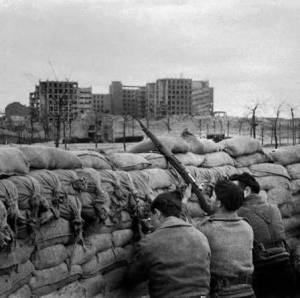
For the Republic, November 17 and 18 proved that the Army of Africa was not invincible. Despite the political blow of Germany and Italy officially recognizing Franco as Spain’s ruler on 18 November, the defenders on the ground achieved their ultimate objective: they broke the momentum of the fascist blitzkrieg. But because the fighting was so chaotic and desperate, commanders had to lead from the front lines. Over these two days, the XI International Brigade lost a devastating number of its senior officers and battalion commanders. Men who had survived years of political persecution in Germany, Poland, and France were wiped out in a matter of hours inside the university corridors.
Several prominent Madrid academics, professors, and left-wing intellectuals who had taken up arms to defend their university died barricaded inside their own faculties. For the Republican press, publishing the names of these dead professors alongside young student-militias underscored the tragedy; the cradle of Spanish enlightenment was literally burying its own teachers. The physical geography of Madrid meant that the civilian population lived on the knife-edge of this horror. Madrileños felt their city vibrate with a low, continuous roar as they men died. The acoustic echo of dynamite exploding inside concrete buildings bounced off the city streets. At night, the sky to the north-west flickered with a sickening orange glow from the burning faculties. Tramlines that usually carried students to class were repurposed as makeshift ambulances, rolling into central Madrid stained with blood, carrying mangled volunteers. Metro stations were packed with families sleeping on the platforms for safety, while just above ground, cafes remained open, serving coffee to journalists and citizens who listened to the distant thud of the university collapsing block by block.
For the anarchists, the near-total annihilation of their column over November 17 and 18 was not just a military defeat, it was an existential, agonizing heartbreak. The Durruti Column were the legends of the anti-fascist resistance. They had successfully smashed the military uprising in Barcelona and swept across the Aragon front. They arrived in Madrid with an aura of revolutionary invincibility. To watch these fierce, proud street-fighters get utterly dismantled by standard, mechanical artillery and cold concrete geometry in less than 48 hours sent a shockwave of grief through the entire anarchist movement.
These men were ideological guerrillas used to wide-open spaces, fast movement, and revolutionary fervour. Being trapped in dark, freezing university basement corridors, unable to see the enemy, and being blown apart by faceless artillery shells broke their spirit. By the night of November 18, the survivors were described as hollowed-out ghosts, weeping, hyperventilating, and deeply traumatized by the sight of hundreds of their closest comrades pulverized into the rubble of the campus.
Usera and Carabanchel in the Southern Sector, unlike the chaotic breakthrough at the university, had locked the frontline into a stalemate. It resembled World War I trench warfare. Nationalists and Republicans had dug trenches just meters apart across narrow streets in a war of snipers and miners. Troops on both sides spent November 17 and 18 digging tunnels underneath each other’s positions to plant crates of dynamite, blowing up entire houses from below. Telephone connections between these occupied suburbs and central Madrid had not even been fully cut yet, meaning soldiers could occasionally hear civilian phones ringing in the rubble.
At the Western Sector at Casa del Campo, remained the Nationalist supply artery for university City. General Varela had his heavy artillery parked on the Cerro de Garabitas, the highest hill in the park. On November 17 and 18, Republican militia units launched frantic counter-attacks into the woods. They were trying to claw their way to the top of Garabitas to silence the cannons. The fighting here was deeply disorienting, men were stalking each other through the trees in the late autumn fog, fighting hand-to-hand around stone fountains and royal hunting lodges. The Republicans failed to retake the hill, leaving the Nationalist artillery free to shell the city.
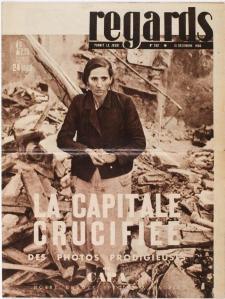
While the outer ring of Madrid was fighting off infantry, the heart of the city was experiencing a historic horror. November 17 and 18 marked some of the heaviest civilian bombardments in history up to that point. Grand Vía, with its crowded apartment buildings and public plazas. had German Ju-52 bombers from the Condor Legion launch a massive, coordinated incendiary raid that lasted from 9:00pm on 17 November until 2:00am. They struck the Carmen Market, burning it to the ground, and pulverized residential blocks. Over 1,000 civilians were killed or wounded in that single night’s raid. The streets of central Madrid were filled with thick black smoke, shattered glass, and thousands of homeless families dragging suitcases through the dark. People lived entirely underground; the city’s metro stations became massive subterranean cities where tens of thousands of citizens slept on the tracks, listening to the muffled thuds of the bombs and artillery detonating above.
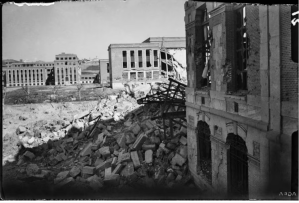
Despite the horrific casualties, the suffocating smoke, and the terror of the bombardments on 17 and 18 November 1936, the overwhelming feeling among the Republican defenders and the civilian population was not a sense of impending defeat, but a fierce, almost fanatical belief that they would win. Before November, the Nationalist Army of Africa had swept across Spain like a bulldozer, crushing every militia in its path. Everyone expected Madrid to fall in a matter of days. Now, untrained working-class militias had been holding off elite professional soldiers for over a week. The fact that they were standing toe-to-toe with Franco’s best troops inside the university buildings gave the defenders an intoxicating surge of confidence. They felt that if they could survive this, they could survive anything.
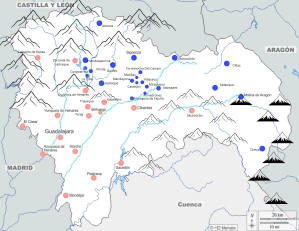
Between 13 and 18 November 1936, Nationalist columns pushed southward and westward across the rugged river valleys of northern Guadalajara Province, capturing six small agricultural and former mining villages – Jirueque, Congostrina, Pinilla de Jadraque, La Toba, Medranda, and Hiendelaencina.
Unlike the massive set-piece battles of 1937, the Nationalists’ November 1936 engagements in northern Guadalajara continued with mobile, battalion-sized tactical columns operating under the umbrella of the Soria Division, commanded regionally by General José Moscardó, the attacking forces were organized into mixed columns drawn from the Army of the North. The Republican defence was in the middle of a painful transition from partisan militias to the structured Spanish Republican Army, which had only been formally decreed in October 1936.
Volunteer militia battalions raised in Madrid and Guadalajara, including the Pasionaria, Numancia, Alicante Rojo, and Leones Rojos battalions, alongside the Grupo Cascorro company and scattered CNT-FAI anarchist and POUM detachments retreating from Sigüenza. Approximately 1,000 to 1,800 militiamen held the scattered outposts and ridge lines across the six-village arc, severely lacking heavy artillery, reliable communications, and fortified trenches. All eyes were on Madrid and these militia had to manage with what they had.
Nationalist columns advancing south from the Atienza–Sigüenza corridor attacked and occupied Jirueque. Rather than continuing straight south into the heavily defended Henares valley toward Jadraque, their objective was to outflank Republican positions along the Bornova River and seize the high plateau around Hiendelaencina. Launching a coordinated multi-pronged advance two days later across the rolling hills between the Cañamares and Bornova rivers, Nationalist troops rapidly overran four neighbouring villages in a single day. Medranda and Pinilla de Jadraque fell as Republican outposts pulled back toward the rail line and river crossings. La Toba and Congostrina were occupied with minimal resistance after Republican defenders evacuated their forward positions to avoid encirclement. Simultaneously, a Nationalist column pushed further northwest to assault Hiendelaencina. Dug into the stony ridges and abandoned silver-mining ruins overlooking the Bornova gorge, Republican defenders repulsed the initial attack, forcing the Nationalists to regroup.
After bringing up reinforcements and artillery support over the preceding 48 hours, Nationalist forces renewed their assault on Hiendelaencina. Outflanked by the Nationalist capture of Congostrina and La Toba to their southeast, the Republican garrison could no longer hold the town. Nationalist troops entered Hiendelaencina on 18 November, securing the western anchor of their new front line. These towns along this path each only had a population of between 200 in Pinilla de Jadraque through to 800 in Hiendelaencina, so this was more of an army rolling through innocent isolated towns that had not seen any violence, nor had any chance to defend themselves.
Like much of rural Castile in 1936, these municipalities were deeply divided between conservative, Catholic smallholders who welcomed or tolerated the Nationalist advance, and local leftist unions, miners, and agricultural workers aligned with the Popular Front. By November, several of these villages had already been militarized for months, hosting Republican militia garrisons, committee headquarters, and fortified outposts. While Nationalist officers recorded the November 1936 advance as a series of routine manoeuvres between road junctions, the arrival of the front brought executions, political purges, and forced displacement to these small communities. When Nationalist columns took towns like La Toba, Medranda, and Hiendelaencina, they arrested local mayors, union members, and suspected Republican sympathizers. Detainees were either shot locally and buried in unmarked graves or transported to prisons in Sigüenza and Soria for execution.
Knowing that reprisals followed every shift in the front line, many families abandoned their homes and livestock as the Nationalists approached. Residents with ties to left-wing parties or miners’ unions fled south toward Jadraque, Guadalajara, or Madrid. Because the front froze along the Bornova River in late November 1936, the remaining villagers lived inside an active war zone until March 1939. Homes were shelled during artillery exchanges, and military garrisons seized local grain and animals to feed the troops.
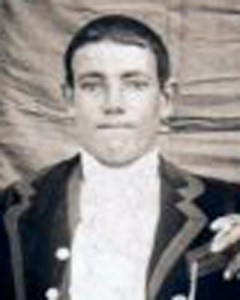
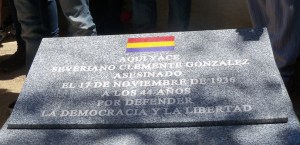
On the night of November 17, 1936, a requeté militia unit searched the village of La Toba, population 600, and detained Severiano Clemente Gonzalez, a baker from nearby Medranda, population 400, who was a supporter of the Popular Front. They took him to a spot nicknamed La viña del tío Morillas (Uncle Morillas’s Vineyard), and executed him. They also took a man named Maximiliano del Olmo, a farmer and secretary for the Medranda branch of the UGT, who managed to flee and was perused through the hills and river, and alone reached Republican-held territory, dodging gunfire all the way. Del Olmo was caught in 1941 and sentenced to 30 years prison, but served only one year as Franco looked to ease prison numbers. He passed away in the 1980s, after telling the story of what happened to the local baker. In 2009, del Olmo’s grandson interviewed local resident Pedro González, and started looking for the baker’s gravesite in 2011. In July 2012, Severiano Clemente was identified and buried properly in Medranda cemetery.
- Villadangos del Páramo, León , Old Castile (Castilla y León)
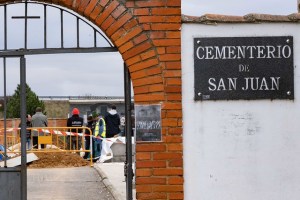
On 17 November 1936, the oak woods (El Monte) surrounding the quiet village of Villadangos del Páramo, León, ended its time as a killing field. Following the July 1936 right-wing military coup against the democratic Spanish Republic, fascist death squads ran a campaign of terror. They used the remote roadsides of Villadangos to execute prisoners captured from across the region, throwing their bodies into a mass grave in the village’s San Juan cemetery. While most mass graves from the Spanish Civil War are shrouded in historical guesswork, Villadangos is unique due to an extraordinary paper trail dating the deaths of its victims’ deaths between 31 August 1936 and 17 November 1936. The record is due to the quiet courage of the town’s municipal judge and the local doctor who refused to let the victims completely vanish, they logged every body brought from the woods into the town’s official Civil Registry.
Villadangos del Páramo sits directly along the N-120 highway, the main arterial road connecting the city of León to Astorga and Galicia. In 1936, the Falangists used trucks to transport prisoners from various temporary lockups, local village jails, and the massive San Marcos concentration camp in León. The death squads needed execution sites that were easily accessible by motor vehicle under the cover of night, yet far enough away from major population centres to avoid immediate interference. The roadsides right off the N-120 provided the perfect logistical loop: drive out, execute, dump, and return to base before sunrise.
Just outside the village of Villadangos lay a vast, dense area of low oak woods at El Monte. his area provided complete visual and auditory cover for night-time executions. The squads could pull their trucks off the main road into the dark paths of the woods, carry out the shootings out of sight, and leave the bodies scattered in the brush for the local villagers to stumble upon the next morning. Because the coup succeeded rapidly here, the fascist squads had total, uncontested control of the local infrastructure. They knew the local authorities in Villadangos, even if personally horrified or acting out of administrative duty like the judge, would not or could not stop them. The cemetery was essentially requisitioned as an open-air graveyard for the regime’s enemies.
While the executions happened in the dark, the consequences were meant to be seen. Leaving bodies along the roadsides and in the woods of Villadangos served a psychological purpose: paralyzing the rural population with fear. By forcing the local villagers of Villadangos to routinely collect the bloodied bodies of strangers from their fields and bury them in a collective trench, the regime sent a clear, unwritten warning to the entire region that this is what happens to those who support the Republic.
Because the execution squads brought victims from outside villages, the Villadangos locals did not know their names. Instead, the registry recorded John-Doe forensic descriptions alongside the date the bodies were found. The causes of deaths were all listed as cranial trauma or internal haemorrhage. They recorded the height, approximate age, dental features, and hair colour, noted things like their clothing and pocket items. Decades later, historical memory groups matched these 1936 dates and clothing descriptions with missing persons reports filed by grieving families, successfully putting names to the nameless entries.
The transfers happened over 23 nights of terror over a span of two and a half months. Week by week, fascist death squads pulled up to the local oak woods, conducted executions, and left the bodies for the locals to collect. The first on 31 August was the first discovery of two unknown men were found dead, and collected by shocked locals. October was by far the most violent period of the purge, accounting for 50 of the victims over ten nights. Many victims came via the San Marcos Hostal in León, which had been converted into a massive, brutal concentration camp. Fascists would select a mixed group of detainees who had originally been arrested in different corners of the province, group them together in a cell, and drive them out to the Villadangos woods as a single collective batch.
On 22 October, 10 men were shot together at Pozo Mulgar. Thanks to cross-referencing the physical clothing descriptions with family archives, historians learned that these ten men were pulled from completely separate lives hours before. Some were agrarian organizers from Vegas del Condado, while others were dragged from the city of León, miles away. They had likely never met until they were thrown into the back of the same truck.
The last official entry of this wave of extrajudicial killings was recorded on 17 November 1936, when one unknown man was found shot and abandoned. While the town judge and doctor documented his death to ensure a record existed, they could not identify his name. He was brought to the cemetery after being executed in the nearby oak hills. Like most of the others, his cause of death was mechanically listed by the local doctor as cranial trauma. He was the final victim, and one of just five people executed in Villadangos during that final month of November 1936, down from fifty the month before as the killing system changed tactics. The men executed during this late period were almost exclusively prisoners driven out in trucks from the San Marcos concentration camp in León capital After this date, the nature of the Francoist repression shifted away from impromptu roadside paseos toward a more bureaucratized system of centralized prisons, like the San Marcos concentration camp, and military court-martials.
The registry accounts for an estimated 86 victims (including two who were killed post-war). The men ranged from young day-labourers to middle-aged fathers. Most were captured from nearby towns and transport hubs across the León province, such as Valencia de Don Juan, Alija del Infantado, San Andrés del Rabanedo, and Mansilla de las Mulas. Democratic socialist councillors, trade unionists, mayors, intellectuals and professionals who supported secular education and social progress, plus day labourers and railway workers who had unionized for better wages were the typical targets.
- Urbano González Soto and Marcelino Quintano Fernández. They were democratic socialist city councillors from Valencia de Don Juan and captured and executed together in September 1936 alongside local resident Victorio de la Riva Seco (and his brother Primitivo de la Riva Seco who was arrested in Villaornate)
- Sixto Rodríguez, a teacher from Toral de los Guzmanes, and Ramón Martínez Farrapeira, the local Villadangos teacher were both murdered.
- José Álvarez-Prida, an intellectual, writer, and lawyer from León was arrested and shot in the woods.
- Federico Sacristán Rodríguez, a postman in León was targeted for his civil service ties.
- Gerardo Vega Vaca, a regional healthcare practitioner Benavides de Órbigo
- Alija del Infantado (known in 1936 as Alija de los Melones) lost a large group of their day labourers – Matías del Río Pérez, Vicente Fernández, Luciano (José) Llamas Astorga, Marcelino Rabanal, José Pérez Alija, Donato Alija, Constantino Ferrero Lera and his brother Francisco Ferrero Lera, and Teófilo Pérez.
- Known in historical archives as the home of Los Seis de Mansilla (The Six of Mansilla de las Mulas), trade unionists and porganizers pulled from their homes on the night of 16-17 October – Santos Francisco, Epifanio González, Tomás Toral Casado, Francisco Candanedo Marcos, Laurentino Castrillo, Genaro Nachón, and María del Carmen Casimira Marcos, one of the few documented female victims in the grave.
- From Vegas del Condado, Rufino Juárez Fernández and Epifanio Llamazares Cármenes were killed together on 22 October, both initially listed as unknown, but identified later by their clothing records.
- From San Andrés del Rabanedo and Trobajo del Camino was day labourers Ignacio Barrientos and Benigno González.
- Jesús Agustín Prieto Salvadores of San Martín del Agostedo managed to hide in a household cellar for weeks before being caught.
- Some victims were single people from their local towns, with little or nothing in common with each other – Eduardo Prieto of Navatejera, Feliciano Álvarez of Sahagún, Domingo Cañón Gutiérrez of Villasabariego, and Eladio Quiñones Blanco of San Cristóbal de la Polantera, Miguel Álvarez Cembrano of Valdevimbre, Plácido Martínez or Foloso de la Robera, and Florentino Álvarez García, who was a 20-year-old killed after the operation closed on 27 November, but was hastily added to the grave site.
- Two anti-Francoist resistance fighters (maquis) were also dumped in the collective site – Venancio Pérez Delgado, 9 September 1945, and Evelio Reguera González, 9 February 1947.
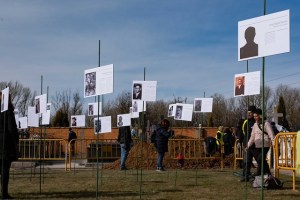
When the Asociación para la Recuperación de la Memoria Histórica and the victims’ families formally requested to exhume the grave, they met strong resistance from the modern town. In August 2021, a local neighbourhood council held a vote over digging and a majority of the local residents voted No to the exhumation. Backed by the local mayor, opponents claimed digging would disrupt the peace of the cemetery and potentially damage the modern family pantheons and niches that had been built over the years. The dispute turned into a bitter national news story, pitting families’ rights against local institutional resistance. The regional government and legal experts stepped in, ruling that Spain’s national Historical Memory Law superseded any local village vote. If your grandfather was one of the murderers, you probably would not like people looking too closely.
The ARMH finally broke ground on 24 February 2022, but the physical reality of the cemetery presented another hurdle. Over the course of 80 years, the cemetery had expanded. Modern concrete graves, headstones, and paved walkways had been deliberately constructed directly on top of the historical mass grave. Because the team could not legally dismantle modern family tombs, a massive portion of the trench was inaccessible. The team was only able to exhume a fraction of the site, recovering the remains of 10 individuals. Archaeologists found the bodies thrown haphazardly into the dirt in overlapping, arbitrary positions. Despite heavy bone degradation caused by decades of intense soil humidity, personal effects like lighters, combs, pencils, and cufflinks were recovered.
Though 86 individuals are fully documented as being dumped there, only 10 bodies were successfully exhumed. So far, two men have been definitively identified using DNA technology matching living relatives, Valencia de Don Juan councillors Urbano González Soto and Marcelino Quintano Fernández, identified in August 2023. The remaining eight recovered bodies continue to undergo anthropological and genetic testing.
On 26 November 2022, a public homage was held at the San Juan cemetery. Dozens of descendants from all over Spain gathered to unveil a permanent memorial plaque. Printed clearly on the stone are the names of all 86 documented victims. While dozens of those men remain trapped forever beneath the concrete walkways of the modern cemetery, the plaque ensures that their names, their dates of death, and the truth of what happened in the woods of Villadangos are no longer hidden. The execution site north of the town has been converted into the local industrial park.