- Madrid
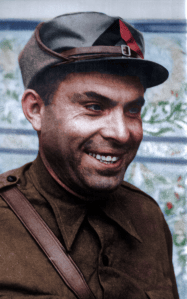
While everyone was gathering and deciding what version of the story they were going to share, Buenaventura Durruti was still alive, filled with large doses of morphine for the intense pain he must have suffered Various versions of his last hours passed with militiaman Ragar claiming Durruti lost consciousness at 2:00am on 20 November. Doctor Bastos claimed Durruti’s last words were, ‘they’re going away now,’ in reference to the quietening of the aerial bombing attacks that had been happening all over the city (though he later told Durruti’s partner that his final words were ‘Mimi’ after her, which she did not believe). According to militiaman Ricardo Rionda, Durruti final words were, ‘too many committees’, talking of how layers of bureaucracy was hampering the defence of Madrid.
Durruti died at 4:00am on 20 November 1936, with Dr Santamaria at his bedside. He soon completed the autopsy, and found the 9mm bullet had gone in through under his left nipple, making it a miracle he survived as long as he did, and whoever aimed to kill him had just slightly misjudged their mark. Gunpowder stains on Durruti’s leather jacket showed Santamaria that the gun was fired at point blank range, no more than a few metres away maybe less. He believed maybe the surgery had been possible after all, but the likelihood was survival would have remained unlikely. José Buenaventura Durruti Dumange was dead at age 40, the killer was unknown, and the anarchist revolution would never recover.
The Madrid CNT held an urgent meeting as Durruti took his last breath, and were (rightly) worried the news of Durruti’s death would undermine morale while the Nationalist offensive was still taking place. At 05:00am, Antonio Mora arrived at the Durruti Column headquarters and informed Antonio Bonilla that Durruti was dead. Meanwhile, Cipriano Mera had not arrived in Valencia until 06:00am and found the anarchist ministers at the Metropolitan Hotel to break the news. CNT leader Juan Garcia Oliver had opposed the decision to send Durruti and the column to Madrid, was reportedly saddened at the news but unsurprised it had happened, but Frederica Montseny was distraught and held herself responsible for his death, because she had urged Durruti to go to save Madrid. The three then went to meet Mariano Rodríguez Vázquez, who quickly chose Ricardo Garcia Sanz, a logntime Durruti ally and militant to succeed Durruti as the commander of the Column, and commanded that no one should be told of Durruti’s death, only that he had been wounded, and not to give out any speculation on who was the shooter.
But inside the anarchist ranks and at the Hotel Ritz field hospital, the atmosphere was volatile. Durruti’s men deeply distrusted the medical staff, at one point drawing their weapons in the lobby after mistaking a bottle of wound disinfectant for poison. Within the Durruti Column, shock quickly turned into suspicion, with whispers circulating that he had been shot by Nationalist fifth columnists, assassinated by Soviet NKVD agents, or killed by a stray bullet from his own side. Simultaneously, rumors spread among Communist and International Brigade ranks that Durruti had been shot by disgruntled members of his own column. Just moments before being shot, Durruti had stepped out of his car to harshly reprimand a group of militiamen who were retreating or resting near a wall, leading to immediate whispers that a resentful soldier had fired on him.
Quiet suspicion also fell on the men in the car almost immediately, particularly on Sergeant José Manzana, though it was suppressed publicly on 20 November 1936 to avoid fracturing the anarchist movement. Inside Durruti’s black Packard at the moment he was shot were his driver Julio Graves, his military adviser José Manzana, and Antonio Bonilla in another car (along with all the other people and theories). Almost as soon as they arrived at the Hotel Ritz, several factors caused whispers of suspicion, whether of an accident or foul play, to centre on the car’s occupants.
Manzana, a former regular army artillery sergeant who served as Durruti’s chief military adviser, had a Naranjero (MP-28) submachine gun slung over his shoulder. Because Manzana was nursing a wounded finger on his right hand resting in a sling/scarf, whispers quickly circulated that he had fumbled the notoriously hair-trigger weapon as Durruti got back into the car. When doctors examined Durruti on the night of 19 November and the morning of 20 November, they privately noted powder burns on his shirt and skin—indicating a shot fired at point-blank range (roughly 35cm claimed the doctor) rather than from a Nationalist sniper across University City. Those who saw the body or spoke to the doctors immediately realised the bullet had to have come from someone standing right beside him or sitting inside the Packard.
Even on 20 November, the survivors’ accounts struggled to hold together. While Manzana and Graves maintained that Durruti was struck by heavy machine-gun fire from Moroccan Regulares inside the Hospital Clínico, others who heard their story noticed there was no bullet hole in the car’s bodywork or glass to match the angle of the wound, which also threw out the fifth columnist theories. Unlike Durruti’s long-time anarchist comrades from Barcelona, Manzana was a professional military man who pushed for the militarization of the militias, a stance that made him deeply unpopular with hard-line anarchists. On 20 November, suspicious militiamen quietly questioned whether Manzana’s role in the shooting was truly an accident or a deliberate hit aligned with Communist/state efforts to rein in the militias
While CNT leadership enforced a strict media blackout in Madrid and Barcelona to prevent panic at the front, they ensured his immediate family in Barcelona was informed in person. Émilienne Morin had recently returned from the Aragon front to Barcelona to care for their young daughter, Colette. On 20 November, a representative from the CNT visited Morin at her home to deliver the news privately that Durruti had been killed in action. Durruti’s parents and siblings lived in his hometown of León, which had fallen to Nationalist forces at the very start of the war in July 1936. Because León was behind enemy lines and cut off from Republican communications, his extended family there did not receive direct notification from the CNT and would have only learned of his death later through radio broadcasts or press reports once the news became public on 21 November.
Part 3 tomorrow will continue the story of Durruti’s death
The University city siege was at a standstill, with both sides of the battle firmly dug in with little likelihood of change. Even with the Durruti Column pulling back from the frontline, the Nationalists could not dislodge the Republican defenders, either in the University buildings, or anywhere else along the western and south sectors. Having suffered heavy losses among his troops, General Franco halted major frontal assaults, locking the campus into a static frontline that lasted until the end of the war in 1939.
Frustrated by the stalled ground offensive, Franco shifted to psychological warfare designed to terrorise Madrid’s population into surrendering, reportedly declaring he would destroy the city rather than leave it to the Marxists. From 19 to 23 November 1936, German Condor Legion bombers (primarily Junkers Ju 52s) escorted by Italian Fiat CR.32 fighters pounded Madrid day and night. Nationalist artillery on Cerro de Garabitas simultaneously shelled the city centre, hitting main arteries like the Gran Vía. Bombardments struck working-class residential neighbourhoods, hospitals, and infrastructure, while deliberately sparing the wealthy Salamanca district, where Nationalists believed sympathisers lived (they did).
Contemporary press dispatches on 20 November reported over 500 civilian deaths and more than 1,200 wounded in the preceding days, with historian Hugh Thomas estimating roughly 2,000 civilian deaths from the broader November aerial campaign, with 500 alone in the 19-23 November period of sustained attacks, with another 1,200 wounded. Lacking formal civil defence, neighbourhood committees and unions organised residents to dig out basements and convert underground Metro stations into air-raid shelters.
Because dozens of foreign correspondents (including Ernest Hemingway and Louis Delaprée) were stationed in Madrid, these raids became the first mass urban bombings documented in real time for a global audience. Rather than forcing a surrender, the attacks hardened civilian resolve and unified the city’s defenders. According to contemporary dispatches from The New York Times, University City combat resumed on the afternoon of 20 November in a chill, drizzling rain. Both the Medical School and the Casa de Velázquez (the French students’ residence) were on fire. Republican forces claimed to have recaptured the ruined Medical School after losing it to Nationalist troops the previous night. Republican troops retreated across the Manzanares River in the Casa de Campo sector on 20 November while reporting minor advances on the north-western edge of the city.
- Alicante, Valencia
(I am personally choosing not to share a photo of Primo de Rivera)
José Antonio Primo de Rivera y Sáenz de Heredia, the Spanish national syndicalist politician who founded the Falange Española, later Falange Española de las JONS, was finally executed on 20 November 1936. He was the eldest son of General Miguel Primo de Rivera, dictator of Spain from 1923 to 1930, and worked as a lawyer from 1927 to 1933 before entering politics, initially supporting the already toppled monarchy.
Primo de Rivera was a committed fascist. He believed the the liberal state was unjustified, did not believe in democracy and repeated claimed the violence was necessary to take Spain back from the people and place in the hands of the elites. He bounced around various small right-wing groups in the quest for attention and leadership, and by 1935, was endorsing violence against Jews and Freemasons, dressing in new blue-shirt Falange uniform to mimic Italian fascists, and spouting fascists beliefs, songs, and calls to violence against the population.
The Falange won only 0.7% of the vote in the 1936 elections. On 14 March 1936, he was arrested in Madrid and charged with illegal possession of firearms, and transferred to Alicante on June 5, 1936, away from Madrid’s Cárcel Modelo to the Reformatorio de Adultos de Alicante, deep in republican territory. The conspiracy to overthrow the Spanish government was well underway and Primo de Rivera remained in contact with General Emilio Mola, and wanted his Falange members front and centre in any uprising to hurt the Spanish public. But the military uprising and subsequent violation of the country went ahead with him; but his Falangist supporters were front and centre in every town as people were killed for being left-wing.
Once the military coup began in July 1936 and Alicante remained firmly under Republican control, Primo de Rivera was placed in strict solitary confinement. His younger brother, Miguel Primo de Rivera, and Miguel’s wife, Margarita Larios, were also imprisoned in Alicante. His youngest brother, Fernando Primo de Rivera, had already been killed three months earlier during the Madrid Cárcel Modelo massacre on the night of 22-23 August, where Jose Antonio would have also been, had the Alicante transfer never taken place. By all accounts, neither he nor the Primo de Rivera family knew Fernando had been killed.
Meanwhile, informal discussions regarding a potential prisoner exchange at Alicante, reportedly involving Prime Minister Francisco Largo Caballero’s son, who was held by Nationalist forces, never succeeded. Historians remain divided on whether Franco deliberately stalled exchange efforts to eliminate a political rival or whether the Republican government and local Alicante authorities refused to release him. One of the few outsiders permitted to speak with him was American journalist Jay Allen of the News Chronicle, whose prison interview was published in October 1936.
During the autumn, Republican authorities discovered pistols hidden inside Primo de Rivera’s cell, resulting in a separate weapons investigation and the arrest of former prison director Teodorico Serna alongside five prison officials for suspected collusion. On 3 October, 1936, the Spanish Supreme Court appointed Madrid magistrate Federico Enjuto Ferrán as special investigating judge to lead the formal inquiry into Primo de Rivera’s alleged participation in the military rebellion. Formal charges of conspiracy against the Republic and military insurrection, both capital offenses, were filed that same day, followed by a preliminary judicial hearing on 3 November.
Primo de Rivera stood trial alongside his brother Miguel and sister-in-law Margarita Larios. The trial opened on 16 November, prosecuted by state prosecutor Vidal Gil Tirado, with three judges, Eduardo Iglesias del Portal (president), assisted by Enrique Griñán Guillén and Rafael Antón Carratalá, and 14 lay jurors representing Popular Front organisations and unions. Primo de Rivera was charged with conspiracy and military rebellion against the Second Republic, specifically, helping prepare and instigate the July 1936 insurrection. Acting as his own defence lawyer, he denied direct participation in the July military uprising, arguing that he had been locked in strict solitary confinement in Alicante since June and cut off from the coup’s execution. His brother and sister-in-law likewise denied the charges against them.
The verdict was delivered at around 2:30am of 18 November, with Primo de Rivera sentenced to death by firing squad. His brother received 30 years’ imprisonment (later reported in some summaries as life imprisonment) for aiding the rebellion, while Margarita Larios was sentenced to six years’ imprisonment. Notably, the three judges on the panel formally recommended that José Antonio’s death sentence be commuted to life imprisonment, though the lay jury’s capital verdict stood.
After receiving his death sentence, Primo de Rivera spent his final two days in his cell composing personal letters and drafting will. In the document, he defended his political intentions, requested a Catholic burial, wrote of how his bother Miguel was innocent, divided his estate among his siblings (Miguel, Carmen, Pilar, and Fernando), and named Falangist colleagues Raimundo Fernández-Cuesta and Ramón Serrano Suñer as his executors.
The recommendation for commutation was forwarded to the Republican cabinet (then seated in Valencia). In a cabinet vote, the majority of ministers rejected clemency, with only the two Izquierda Republicana ministers voting to spare his life. Historians note debate over whether local authorities in Alicante proceeded with the execution at dawn before receiving final written confirmation from Prime Minister Largo Caballero or without awaiting further cabinet intervention.
At dawn between 6:20-6:40am on 20 November, 33-year-old Primo de Rivera was brought into a courtyard of the Alicante prison alongside four other condemned prisoners. Facing a firing squad of Republican militiamen and Assault Guards , he was shot and killed. His body was initially buried in a common grave in the Alicante municipal cemetery.
In the Nationalist zone, Franco’s regime tried to conceal news of his death from the public for two years, referring to him officially in speeches and press as El Ausente (The Absent One). Republican newspapers and foreign correspondents in Spain reported his trial, death sentence, and 20 November execution right away. His death was published in major international newspapers, including The New York Times and British papers, within days of the firing squad. In Nationalist territory, censored newspapers and radio dismissed foreign and Republican reports of his death as Marxist propaganda.
Concealing his death gave Franco crucial political leverage. With the Falange’s charismatic founder absent, Franco was able to merge the Falange with the Carlists under his own absolute command in April 1937 without facing opposition from Primo de Rivera’s loyalists, who might have resisted the takeover had they immediately realised their leader was dead and could be replaced by an independent successor. Franco’s regime finally admitted his death on 16 November 16, 1938, ahead of the second anniversary of his execution, once Franco’s control over the unified single party (FET y de las JONS) was completely secure and Primo de Rivera could safely be elevated into an official state.
Later during the Civil War, Primo de Rivera’s remains were disinterred and moved to a second grave site within the same Alicante cemetery, where they remained until Nationalist forces captured the city at the end of the war in March 1939. Following Franco’s victory, Primo de Rivera’s remains were exhumed in November 1939 for one of the regime’s grandest political spectacles, transforming the physical remains of José Antonio Primo de Rivera into the central sacred relic of his regime’s state mythology, using his corpse to construct a ‘cult of the fallen,’ bind the Falange to his personal dictatorship, and visually equate his rule with Spain’s imperial and Catholic past.
In November 1939, seven months after Nationalist victory, Franco staged a 10-day, 467km funeral procession carrying Primo de Rivera’s coffin on foot from Alicante to the Royal Monastery of El Escorial. Teams of blue-shirted Falangist militiamen took turns carrying the coffin on their shoulders day and night, lit by torches and bonfires along rural roads while church bells tolled and artillery fired salutes in every town along the route. State newspapers, radio, and newsreels covered the march relentlessly, framing it as a religious pilgrimage rather than a standard state funeral. By turning Primo de Rivera into the Protomártir (First Martyr) of the Nationalist Crusade, Franco elevated him into an untouchable, quasi-saintly figure whose memory could no longer be used by living Falangist rivals to challenge Franco’s leadership. Franco had Primo de Rivera buried directly in front of the high altar of the Basilica of San Lorenzo de El Escorial, placing the Falange founder inside the royal monastery symbolically linking Franco’s new dictatorship to Spain’s 16th-century Golden Age empire under Philip II. During the televised and photographed ceremony, Franco personally presided over the burial, positioning himself as the sole heir and guardian of Primo de Rivera’s legacy.
Primo de Rivera’s body and name were woven into daily public life across Spain for nearly four decades. Borrowing from Italian Fascist ritual, state rallies and school assemblies began with a roll call in which a leader shouted ‘José Antonio Primo de Rivera!’ and the crowd answered ¡Presente! signalling that his spirit lived on inside Franco’s movement. Franco’s regime mandated that the name ‘José Antonio Primo de Rivera’ be carved at the very top of stone plaques (Caídos por Dios y por España) affixed to the exterior walls of Catholic parish churches across virtually every town and village in Spain, physically fusing his martyrdom with Catholic identity. The anniversary of his execution became one of the regime’s most solemn annual commemorations, marked by state-sponsored Masses, youth parades, and speeches by Franco. (After Franco himself died on November 20, 1975, 20-N became a joint memorial date for both men.)
In March 1959, Franco moved Primo de Rivera’s remains a final time under the dictatorship, against the wishes of some traditional Falangists, to the newly completed Valle de los Caídos. By transferring the body from the royal pantheon of El Escorial into Franco’s own monumental basilica (built largely by Republican political prisoners), Franco asserted complete ownership over Primo de Rivera’s memory. Primo de Rivera was placed beneath a plain granite slab at the foot of the high altar, a space designed so that when Franco died in 1975, the dictator was buried directly opposite him, visually cementing the two men as twin pillars of the regime in death.
Following the 2019 state exhumation of Francisco Franco and the passage of Spain’s 2022 Democratic Memory Law, which banned figures linked to the 1936 coup and dictatorship from occupying places of honour in public mausoleums, Primo de Rivera’s family requested a private relocation. In April 2023 (the 120th anniversary of his birth), his remains were exhumed from the renamed Valle de Cuelgamuros and reburied alongside his siblings and relatives in a private family plot at Madrid’s San Isidro Cemetery.
- Murchante / Fustiñana, Navarra
In Murchante in southern Navarra, near the border of Aragon and La Rioja, local power had been seized by a wartime council led by Falangist chief Hilario Simón after the uprising. Throughout the summer and autumn of 1936, residents deemed hostile to the Nationalist movement faced dismissals, public humiliation, and summary execution, part of a wider campaign across the Ribera Navarra region.
On November 20, 1936, Nationalist authorities carried out a coordinated roundup in Murchante, arresting seven residents – Hilario Chueca Ayala, 50, day labourer, Roque Jarauta Chueca, 57, Genaro Ochoa Lorente, 31, Julio Orta Simón, 59, local tobacconist, Antonio Pérez Ullate, 32, Ricardo Rosel Aguirre, 71, and Mauricio Simón Arriazu, 28. Immediately after their detention in Murchante, the seven men were transported a few kilometres northeast to the city of Tudela and entered into the district prison.
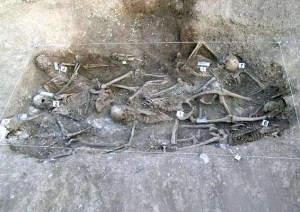
Under the cover of darkness that night, the seven prisoners were removed from the Tudela jail and driven to a rural area known as the Corraliza Vecinal, situated beside a country track north of the neighbouring town of Fustiñana. All seven men from Murchante were shot at close range with 9mm Largo firearms and buried together in a pit.
Assets belonging to the executed men were seized by supporters of the regime; Julio Orta’s tobacco shop was handed over to a Requeté chaplain who had actively participated in wartime executions elsewhere in Navarra. Just days after the seven men were killed, dozens of additional Murchante residents were rounded up and imprisoned inside the town’s schoolhouse, where they were held for three months relying on food brought by their relatives. For the families, the absence of official death records or legal proceedings left an enforced silence that hung over Murchante for generations.
For nearly seven decades, the fate of the seven men from Murchante lived on primarily through family memory and oral testimonies from residents of Fustiñana who knew where the grave lay. In October 2005, relatives of the victims and the Aranzadi Science Society began searching the Corraliza Vecinal. The team located the burial pit and exhumed all seven skeletons. Forensic analysis confirmed that all seven men had died from gunshot wounds to the head fired from 9mm Largo weapons.
On 21 November 2005, families gathered at the Fustiñana execution site to plant an olive tree and install a commemorative plaque, and the following month, the seven men were laid to rest together in a collective memorial tomb in their hometown of Murchante. Their story and their families’ decades-long search were later documented in the 2007 film Tras un largo silencio (After a Long Silence).
- Santander (Cantabria) – Burgos Front
In late autumn 1936, while major campaigns raged in central Spain, the Northern Front along the border between Republican-held Santander and Nationalist-controlled Burgos settled into harsh mountain trench warfare. Seeking to disrupt Nationalist supply lines, relieve pressure on neighboring sectors, and seize desperately needed weaponry, Republican commanders launched a series of offensives across the rugged Alfoz de Bricia moorlands. One of the sharpest of these engagements took place on the night of 20 November, 1936, when a Republican assault column struck Nationalist positions in the village of Cilleruelo de Bricia.
Located in northern Burgos province just south of the Cantabrian border, Cilleruelo de Bricia occupied a strategic position along road networks connecting the Castilian plateau with the northern coast. Throughout autumn 1936, Republican militias and reorganised army units operating out of Santander repeatedly probed Nationalist outposts in the Alfoz de Bricia valley. Because the Northern Front was geographically cut off from the rest of the Spanish Republic, Republican units suffered from chronic shortages of rifles and ammunition, making surprise raids on isolated garrisons a vital means of resupply.
On the night of 20 November 1936, a Republican force numbering roughly 365 men moved through the cold mountain terrain to launch a surprise attack against the Nationalist garrison stationed in Cilleruelo de Bricia, which had 100 Falangist volunteers from Acción Popular arrive only the day before the assault. Using the cover of darkness, the Republican attackers penetrated the village’s outer defences and pushed into the streets, catching the defenders off guard. Fighting continued through the night and into the early morning hours of 21 November.
According to Republican military records, the intense close-quarters engagement inflicted approximately 80 casualties on the defending forces and enabled the attackers to seize more than 100 rifles, a significant haul for the poorly armed northern militias. Despite losing control of the village streets and suffering heavy losses, a pocket of surviving Nationalist defenders managed to fall back and barricade themselves inside Cilleruelo de Bricia’s stone parish church. Without heavy artillery, and with Republican commanders declining to use dynamite to blow up the church, the attackers were unable to dislodge the final holdouts.
As morning broke on 21 November, the tactical situation shifted rapidly against the Republican column. Having expended much of their ammunition during the night’s firefight and facing the arrival of Nationalist reinforcements, most notably the mobile column commanded by Colonel Antonio Sagardía, the Republican troops were forced to abandon the village and retreat back toward their lines in Cantabria.
Though the raid did not permanently alter the frontline in northern Burgos, the 20 November exemplified the nature of warfare on the Northern Front in late 1936 as fast, brutal night actions fought in freezing mountain conditions, where capturing a hundred rifles was often as valuable as holding territory.
Burgos, Old Castile (Castilla y Leon)
On November 20, 1936, the newspaper Diario de Burgos reported on a large public demonstration in the city of Burgos celebrating the Nationalist movement’s closest foreign allies: Germany, Italy, and Portugal. Serving as the administrative and political capital of General Franco’s Nationalist zone during the Spanish Civil War, Burgos became the stage for a highly orchestrated display of diplomatic triumph and ideological solidarity.
On November 18, 1936, Nazi Germany and Fascist Italy formally severed ties with the Spanish Republic in Madrid and officially recognised Franco’s Junta Técnica del Estado in Burgos as the legitimate government of Spain. Franco’s foreign affairs secretariat announced the recognition to the public the following day. For the Nationalist leadership, recognition by two major European powers lent crucial international legitimacy to their violent rebellion, even as Franco’s forces were stalled on the outskirts of Madrid and relying heavily on German Condor Legion aircraft and Italian military aid to sustain their offensive.
In response to the diplomatic announcement, large crowds poured into the streets of Burgos, marching through the city centre in a demonstration heavily covered by the local Nationalist press, including Diario de Burgos on 20 November. Demonstrators carried flags and shouted cheers in support of Germany, Italy, and Portugal, alongside vivas for Franco, Adolf Hitler, and Benito Mussolini.
Though Portugal had not yet extended formal de jure diplomatic recognition on 18 November (it would formally break relations with the Republic in October 1936 and recognise Franco later), António de Oliveira Salazar’s Estado Novo regime was celebrated alongside Berlin and Rome for acting as an indispensable early lifeline, allowing Nationalist forces to transport troops and German weapons across Portuguese territory and broadcasting pro-Nationalist propaganda over Portuguese radio.
Like many wartime rallies in the Nationalist rear guard, the gathering was organised by Falangist and Carlist militias alongside municipal authorities to project domestic unity, bolster morale during the grinding Siege of Madrid, and signal Spain’s alignment with Europe’s authoritarian powers. By publicly celebrating Germany, Italy, and Portugal in the streets of its provisional capital, the Nationalist regime underscored that its path to power was bound not only to military victory on the battlefield, but also to its emerging alliance with Europe’s fascist and authoritarian states.
- Zamora, Old Castile (Castile and León)
Shortly before midnight on 20 November 1936, Falangist militiamen arrived at the Provincial Prison of Zamora (Prisión Provincial de Zamora) and removed nine detainees, three women and six men, in a saca. The nine prisoners were transported to the Municipal Cemetery of San Atilano on the edge of the city, where they were shot against the cemetery walls and buried in a common trench.
All nine victims were being held in the Provincial Prison of Zamora at the time of their removal, though their paths and lengths of imprisonment varied –
• Julia Cifuentes Veledo, 29, had been held in the provincial prison for nearly three months. Originally from Villalpando, she had been arrested on 24 August, alongside her mother, (who was eventually released), and transferred to the Zamora facility.
• Ramona Ortiz Juan, 45, a widow and mother of two young daughters from Bamba, had initially been detained in the prison in Toro before being transferred to the Provincial Prison of Zamora prior to 20 November.
• Fidela García Sánchez, 33, originally from La Aldehuela in Salamanca and a resident of Zamora with a young daughter, was also confined in the Zamora provincial prison leading up to the night of the execution.
• Brothers Florencio Esteban Martín, 24, and Manuel Esteban Martín, 27, both day labourers of Zamora.
The remaining four men executed alongside them are not named in surviving public summaries. During sacas in Zamora and across Nationalist-held territory, Falangist authorities routinely obscured the identities of those taken for execution. The mass grave at the Cementerio de San Atilano containing the victims has never undergone an official forensic exhumation. Over the decades following the war, portions of the cemetery grounds where saca victims were buried in unmarked pits were reused or built over with newer burial niches and structures, complicating modern archaeological recovery efforts.
One of the nine victims is known to have been recovered by relatives, as in 1941, Julia Cifuentes Veledo’s family succeeded in locating and privately identifying her remains, recognising her, and reburied her in a separate grave within the Zamora cemetery. The remains of Ramona Ortiz Juan, Fidela García Sánchez, Florencio and Manuel Esteban Martín, and the four unnamed men remain unrecovered in the cemetery grounds along with 875 others.