- Madrid
For months, the Republic’s defenders had been dismissed by foreign observers as an undisciplined, chaotic assembly of workers. But by 15 November 1936, the defence of the capital had transformed into a highly structured, scientifically planned operation. Under the strategic direction of Colonel Vicente Rojo and the Junta de Defensa de Madrid (Madrid Defence Council), the city was divided into rigorous tactical sectors. The Republican forces were not deficient in organisation or courage, but the unprecedented deficit in heavy machinery, artillery, and modern aircraft compared to the heavily subsidised, professional units of the invading Army of Africa was an impossible deficient to ignore.
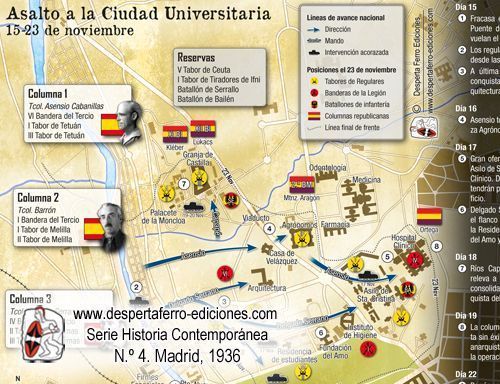
On a pivotal Sunday, that asymmetry collided with defensive resolve as the conflict escalated into the bloody Battle of Ciudad Universitaria (University City). Colonel Rojo’s defensive grid split the active western front into three tactical responsibilities. At the Northern Sector (Plaza de España / Parque del Oeste), commanded by Colonel Barceló, a force of 5,000 disciplined militia combatants and 5th Regiment cadres held the high concrete embankments, successfully locking down the northern approaches. At the Southern Sector (Usera / Carabanchel), commanded by communist officers Enrique Líster and Juan Modesto, 8,000 highly trained shock troops fortified the permanent stone bridges across the Manzanares River, denying the enemy a flanking route. The Central Western Assault Sector (University City), directed by General Emilio Kléber, this was the ultimate focal point of the day’s combat.
While foreign press often reported the arrival of thousands of fresh international volunteers, the tactical reality on 15 November was starkly different. A week of brutal, close-quarters combat in the open woods of the Casa de Campo had severely depleted the International Brigades. By the morning of 15 November, the XI International Brigade’s front-line strength had been ground down to just 1,350 combat-ready troops. The German/Austrian Edgar André Battalion had 450 rifles remaining, tasked with anchoring the university’s northern perimeter. The French/Belgian Commune de Paris Battalion had 500 rifles remaining, holding the immediate river approaches. The Polish/Hungarian Dabrowski Battalion had 400 rifles remaining, held in immediate tactical reserve. Additionally, elements of the newly arrived XII International Brigade (including the Thälmann and Garibaldi battalions) provided an extra 1,000 men to secure adjacent support lines.
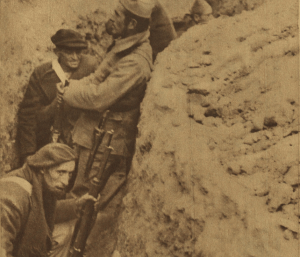
The Nationalist objective for 15 November was absolute: General José Varela unleashed three elite columns (6,000 to 7,000 veteran Moroccan Regulares and Spanish Foreign Legionnaires) to smash across the Manzanares River and seize a direct highway into Madrid. The battle opened with a ferocious, asymmetric artillery bombardment from Nationalist batteries secured on the Garabitas heights. Lacking equivalent heavy artillery to suppress the enemy guns, the Republican defenders did not break. Instead, the Commune de Paris and Edgar André battalions executed a methodical, fighting withdrawal through the shifting terrain of the Casa de Campo, extracting a heavy toll for every metre the invaders took.
In November 1936, the Manzanares River was historically shallow, muddy, and often ridiculed as a glorified ditch. Because Madrid sits on a high, dry plateau, the Manzanares is naturally a very small river. During the hot Spanish summers, it completely dries up into a trickle of mud. November is historically a rainy season in central Spain. On 15 November 1936, there was actual water in the river, but its size and nature dictated exactly how the battle played out. The river was roughly 20 to 30 metres wide, but it was very shallow, mostly knee-deep to waist-deep in the areas near University City. Because of the autumn rains, the water was freezing cold, choked with thick grey mud, and moving with a fast current. It was too deep and sticky for a soldier to casually stroll through while carrying heavy military gear, but it was small enough to cross if an army brought basic engineering tools.
Prior to the war, parts of the Manzanares River running past the city had been canalised. The banks were steep, vertical walls made of smooth, reinforced concrete. Even if the water was shallow, a Nationalist soldier trying to cross had to slide down a concrete wall, wade through freezing mud, and then use ladders or ropes to climb up a vertical concrete wall on the Republican side, all while being shot at from the university windows.
Asensio’s column used the deep trenches and thick tree cover of the northern Casa de Campo to mask their advance from the Republican observers perched on the high ground of the Parque del Oeste. They moved toward a sharp loop in the Manzanares River right next to the newly constructed University Sports Stadium. At this specific northern point, the river was not yet encased in the steep, vertical concrete canal walls found further south toward the city centre. Here, the banks were natural, sloped, and lined with thick mud and scrub, making it the ideal tactical location to launch watercraft.
Around 12:00pm, under a massive protective screen of point-blank machine-gun fire and artillery shells fired from the batteries on Cerro de Garabitas, the vanguard of Moroccan Regulares made their move. They launched small, canvas-and-rubber inflatable boats into the freezing, muddy water. A few swimmers waded across the narrow, waist-deep current under heavy fire to tie thick guide ropes to the trees on the Republican side. Once the lines were secured, the Regulares used the ropes to quickly pull the inflatable boats back and forth across the 25-metre gap, ferrying waves of infantry across the river in minutes.
As soon as the first wave of infantry established a small defensive perimeter on the eastern bank, Nationalist military engineers rushed to the water’s edge. Working frantically in the mud while taking sniper fire from the university windows, they threw together light, pre-fabricated wooden footbridges. These narrow wooden walkways were floated on empty oil drums and anchored to the banks. They were just wide enough for soldiers to cross in single file. By mid-afternoon, hundreds of Foreign Legionnaires and Regulares were sprinting across these footbridges on foot, bypassing the water.
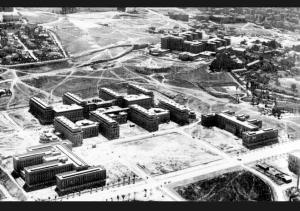
Once across the river, the Nationalist troops were at the base of the University City campus. They were faced with a steep, muddy incline leading up to the first major academic structure: The School of Architecture. Republican militia units and the Commune de Paris battalion fired furiously from the upper windows of the building, but they were pinned down by the point-blank artillery firing directly over the river from Garabitas. Using hand grenades and dynamic shock tactics, the Moroccan troops scaled the muddy slope, breached the ground-floor windows, and overwhelmed the immediate defenders By 4:00 pm, the Nationalists had officially established their bridgehead inside the building. This breakthrough triggered Colonel Rojo’s emergency response, forcing him to deploy the Durruti Column straight into the surrounding campus to halt a total collapse of the western front.
By the late night of 15 November 1936, the fighting transitioned from a dynamic war of movement into a stalemate. By midnight, the campus was physically divided down the middle. Colonel Asensio’s troops held the heavily damaged School of Architecture at the edge of the river bank. They had transformed the classrooms into heavily fortified machine-gun nests to protect the narrow footbridges connecting them to the Casa de Campo. Just a few hundred metres away, the XI International Brigade and the newly deployed Durruti Column successfully held a defensive crescent of adjacent campus buildings. They fortified the multi-story Clinical Hospital, the School of Medicine, and the School of Philosophy and Letters.
As darkness fell, heavy artillery firing from Cerro de Garabitas slowed down to avoid hitting their own men, and the combat shifted to terrifyingly close quarters. In some sectors, the front line ran through individual buildings. Nationalists might hold the ground floor while Republicans barricaded the stairwells and held the second floor. To survive the night, Republican troops used thousands of heavy, leather-bound academic textbooks from the university libraries, stacking them in windows and doorways to serve as bulletproof breastworks.
The cost of holding the line on 15 November was staggeringly high, dictated entirely by the Republic’s equipment deficits. Total Republican military casualties for the day exceeded 800 men killed or severely wounded, with the XI International Brigade losing nearly a third of its remaining active strength. Nationalist casualties were estimated at 300 to 400 troops, cut down while trying to cross the exposed river.
While the infantry traded grenade fire in the dark, the rear guard of Madrid successfully stabilised the tactical situation. Under cover of night, Republican engineering units rushed down to the river banks south of the campus. They used heavy timber and iron to further fortify the bridges at Usera and Carabanchel, ensuring the Nationalists could not launch a secondary armoured push. Civilians and union workers navigated the pitch-black streets of Madrid, dodging sporadic artillery shells, to bring boxes of ammunition, hot stews, and dynamic coffee directly to the frontline fighters barricaded in the university halls.
At dawn on 16 November, under a heavy protective mist and relentless point-blank shellfire from the batteries on Cerro de Garabitas, Colonel Asensio and Colonel Delgado expanded their thrust north-eastward into the heart of the campus. Armed with hand grenades and dynamite packs, Moroccan Regulares and Spanish Foreign Legionnaires charged out of the School of Architecture. Their objectives were the massive, newly constructed School of Science, the School of Philosophy and Letters, and the sprawling Clinical Hospital. By midday, Nationalist troops successfully breached the ground levels of the Philosophy and Letters building and pushed their way into the lower corridors of the multi-story Clinical Hospital.
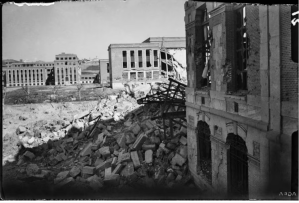
Colonel Vicente Rojo and General Emilio Kléber recognised that fighting the professional Army of Africa in the open courtyards was a death sentence due to Nationalist air and artillery superiority. They ordered a strict Fortress Strategy. Within the School of Philosophy and Letters, the XI International Brigade (primarily the German Edgar André and French Commune de Paris battalions) barricaded every hallway. Finding themselves without sandbags, the foreign volunteers discovered that thick, leather-bound academic books—specifically dense volumes of German philosophy, metaphysics, and encyclopaedias—were dense enough to absorb Mauser rifle bullets if they had 350 pages. They stacked thousands of library books into window frames to create improvised firing slits. Inside the massive Clinical Hospital, the battle became intensely three-dimensional. Republican militiamen and International volunteers held the upper floors while Nationalist Regulares infiltrated the basements and ground floors. Troops fought with bayonets and grenades in elevator shafts, laboratory rooms, and operating theatres.
The morning of 16 November saw the full deployment of the Durruti Column, roughly 3,000 anarchist combatants tasked with driving the Nationalists back across the river, groups of anarchists launched furious, open-air counter-attacks across the campus meadows toward the School of Architecture. Lacking the armour or heavy machine guns needed to suppress the enemy, the charging anarchists were cleanly targeted by the Nationalist machine-gun nests and the point-blank artillery firing from Garabitas. The column suffered devastating casualties through the afternoon but effectively clogged the campus centre, preventing the Nationalists from breaking out into the city streets.
The XI International Brigade lost another significant portion of its remaining active combatants through 16 November. Combined Republican military casualties for the 24-hour period exceeded 900 men killed or wounded. Nationalist columns suffered roughly 400 casualties, with several field commanders wounded by accurate Republican sniper fire from the upper university faculties.
Thwarted by the fierce room-by-room resistance on campus, Franco’s German and Italian bomber squadrons flew continuous waves over central Madrid. On 16 November, the targets shifted systematically from the front lines to the city infrastructure. Heavy bombs struck the central Puerta del Sol and telephone exchanges, killing over 200 civilians in an attempt to cut communication lines between Rojo’s headquarters and the university. Despite the escalating horror, the civilian supply grid held. Under cover of twilight, organised trade union groups pushed carts loaded with ammunition and crates of hot soup across the Paseo de la Castellana and directly into the rear basements of the University faculties, ensuring the exhausted defenders could maintain their positions through the night. By the end of 16 November, the Nationalists had gained several campus buildings, but their primary objective, a clean breakthrough into central Madrid, remained completely blocked by a wall of reinforced concrete, stacked library books, and dug-in international resistance.
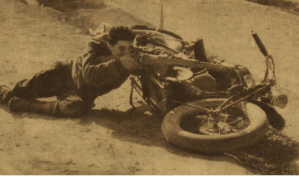
Meanwhile, the Southern Sector was the most heavily urbanised and populated frontline zone. It was commanded by the Republic’s most disciplined officers, Enrique Líster and Juan Modesto, leading the battle-tested 5th Regiment and approximately 8,000 to 10,000 well-entrenched militia troops. General Varela used his southern columns (forces under Colonels Yagüe and Barrón) to launch continuous probing attacks. Their goal was to convince the Republican command that the real invasion was coming from the south, forcing Rojo to keep his best troops tied down away from the University. In the working-class streets of Carabanchel, the fighting was agonisingly close-quarters. Nationalist troops used explosives to blow holes through the interior walls of terraced houses, advancing room-by-room without stepping into the street. Simultaneously, heavy fighting raged around the Puente de Toledo and Puente de Praga stone bridges.
Líster’s men did not budge. They had spent months turning these brick neighbourhoods into a labyrinth of barricades, tank ditches, and machine-gun bunkers. Every time Nationalist infantry tried to storm a bridge or cross the flat open terrain of Usera, they were cut down by disciplined Republican crossfire. The Southern Sector successfully functioned as an immovable anchor. Because Líster and Modesto completely denied the Nationalist armour any access to the southern bridges, Varela was blocked from using his tanks to exploit the breakthrough happening up north at the university.
Commanded by Colonel Barceló, this sector held the high ground immediately south of the University City campus, overlooking the Manzanares River banks and protecting the direct entrance to Plaza de España. Because it stood right next to the University City assault point, the Nationalists used their heavy artillery on the Garabitas hills to ruthlessly shell the Republican trenches inside the Parque del Oeste. Barceló’s 5,000 militia combatants were tasked with an essential tactical role: providing suppressive flanking fire. On 15 and 16 November, as Moroccan Regulares scrambled across the river toward the School of Architecture, Republican machine-gunners in the Parque del Oeste fired downwards into the flanks of the crossing columns.
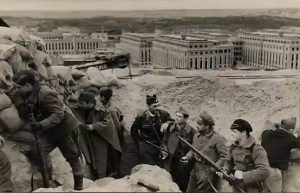
To stop this flanking fire, Nationalist troops launched sharp uphill infantry charges into the park’s wooded slopes. The fighting dissolved into brutal, hand-to-hand trench combat among the upturned dirt and shattered trees of the park. Despite taking heavy casualties from artillery shrapnel, Barceló’s forces held the crest of the park. By maintaining control of this high ground, they prevented the Nationalists from widening their narrow university bridgehead toward the Plaza de España.
By the night of 16 November, the strategic genius of Rojo’s layout was proven. The Nationalists had thrown incredible weight at Madrid, but because the Northern and Southern sectors refused to break, the Army of Africa found themselves trapped inside a tight, bloody, academic bottleneck at the university campus, unable to fan out into the wider city.
At the same time, the civilian population was caught in a relentless, two-pronged trap of modern industrial warfare. Throughout 15 and 16 November, German-supplied Junkers Ju 52s and Italian Savoia-Marchetti bombers flew in tight, unopposed formations over the city. They dropped a highly lethal mix of 250kg high-explosive bombs and thousands of small incendiary canisters. They systematically carpet-bombed the densely populated, working-class residential districts of Cuatro Caminos, Tetuán, and Vallecas. The bombs tore through the fragile roofs of multi-story apartment blocks, collapsing entire buildings onto families taking shelter in their basements.
Simultaneously, the heavy Nationalist artillery batteries secured on the heights of Cerro de Garabitas pointed their barrels directly over the river and into the city centre. They fired directly down the Gran Vía, the city’s main commercial artery, which local citizens bitterly renamed Avenida del Quince y Medio (Avenue of the 15.5cm Shells) or Howitser Avenue.
Shells detonated in crowded marketplaces, outside bakery lines, and into tram cars, showering the streets in shrapnel and shattered glass.
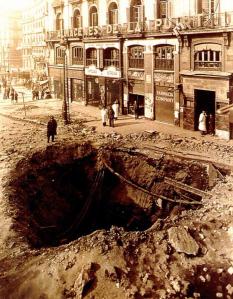
With the surface world turned into a lethal zone of flying masonry and fire, the civilian population was forced to adapt instantly to survive. The deep underground tunnels of the Madrid Metro (specifically stations like Gran Vía, Sol, and Cuatro Caminos) were transformed into massive, subterranean cities. Over these 48 hours, tens of thousands of families moved their lives downstairs. Entire platforms were packed shoulder-to-shoulder with mattresses, bundles of clothes, and crying children. The air was thick with the smell of damp earth, sweat, and fear. While the ground above shook from the impact of 250kg bombs, the deep concrete-and-stone construction of the Metro stations held, saving thousands of civilian lives.
The military objective of the asymmetric slaughter was to cause panic, spark a civilian uprising, and force the Republican government to surrender the city. It achieved the exact opposite. The shared trauma of 15 and 16 November forged an unbreakable bond of civilian solidarity. Following every air raid, neighbours, teenagers, and women formed spontaneous rescue brigades. Operating entirely by hand or with simple shovels under active artillery fire, they dug furiously into the smoking rubble of collapsed tenements, listening for the muffled screams of survivors trapped in the cellars.
Instead of fleeing, women’s committees organised large-scale communal kitchens inside the safest stone basements. They baked bread and brewed pots of hot coffee, which young runners then carried directly through the shelled streets into the frontline trenches at University City to keep the soldiers fed. As civilian casualties spiked, thousands of citizens queued up outside makeshift clinics along the Paseo de la Castellana to donate blood for both wounded soldiers and crushed civilians, defying the bombs to ensure the city’s medical network did not collapse.
By the night of 16 November, the streets of Madrid were covered in shattered glass, burning debris, and the bodies of its citizens. Franco had succeeded in inflicting massive, heart-breaking casualties, but he had failed to break the morale of the population. The suffering of those two days turned the civilian rear guard into a disciplined extension of the military apparatus, solidifying the mantra that would define the siege that Madrid would rather die on its feet than live on its knees. But an estimated 150 to 200 civilians were killed on 15 November, and as the bombing intensified to cut off communication lines, the civilian death toll exceeded 200 to 250 men, women, and children. For every person killed, an estimated three to four were severely maimed, flooding the city’s under-supplied hospitals with over 1,500 civilian trauma cases in just 48 hours.
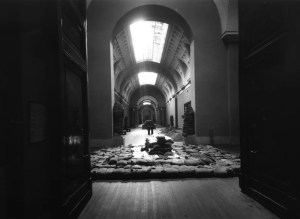
On 15 November, Nationalist forces used German Junkers Ju 52 bombers to launch intense, systematic carpet-bombing raids targeting working-class northern districts like Cuatro Caminos, hitting the hospital at Cuatro Caminos, killing 53 people and injuring more than 150. On 16 November 1936, multiple incendiary bombs and shells struck inside the museum’s immediate perimeter and hit the building’s façade (particularly the Murillo gate area). Because the museum’s staff had heroically dismantled and sandbagged the collection in October, the interior art remained safe, but the building’s masonry and nearby structures took heavy blast damage, and the human casualty is unkown.
As the bombs fell on 15 and 16 November 1936, the radio waves and street microphones of Madrid became a second front line. The Republican leadership recognised that keeping civilian morale from breaking was just as important as holding the trenches at University City. The most powerful weapon against panic was the voice of Dolores Ibárruri, alongside fierce radio addresses by the head of the Madrid Defence Council, General José Miaja.
Dolores Ibárruri stood before microphones in makeshift broadcast studios while the walls shook from German bomb blasts, her voice was broadcast over loudspeakers installed on street corners and deep inside the crowded Metro stations. During this mid-November crisis, she delivered her most iconic rhetorical broadsides that Spanish people would rather die on their feet than live on their knees. On 15 November, she made a direct, fierce appeal to the women of Madrid. She told them that if their husbands or sons wavered out of fear, the women must take up weapons themselves. She famously told the civilian populace to prepare boiling oil and heavy kitchen knives to drop on the Nationalist troops if they managed to breach the river into the residential streets. Her speeches did not hide the danger; she spoke directly about the dead children in Cuatro Caminos, using the shared grief to transform civilian terror into a fierce, defensive fury.
While Ibárruri provided the emotional soul of the defence, General José Miaja provided the structural reassurance. Miaja had stayed in the city when the central government fled to Valencia. This act alone massively boosted civilian trust. On 15 and 16 November, he took to the radio to deliver short, blunt, and highly effective military status updates designed to crush fascist rumours. Nationalist radio stations in Toledo were broadcasting propaganda into Madrid, claiming Franco’s cavalry was already sitting in the Plaza de España. Miaja went on the air to directly contradict this, stating: ‘Madrid is secure. Our lines at the river are unbroken. Do not believe the fascist lies designed to make you panic.’ Miaja also travelled to rally the retreating militia units himself. Word of this spread like wildfire through the civilian soup kitchens, instantly lifting morale.
Because the Nationalist artillery on Cerro de Garabitas was actively targeting the electrical grids, delivering these morale-boosting speeches required immense civilian ingenuity. The Unión Radio Madrid station maintained its broadcasts using emergency backup generators. The Republican Ministry of Propaganda ran heavy audio cables down into the depths of the Metro platforms. When La Pasionaria’s voice crackled over the underground speakers, the thousands of families packed onto the train tracks would fall completely silent. Observers recorded that her speeches would routinely end with thousands of civilians standing up in the dark, raising their fists, and shouting back the defining slogan of the battle: No pasarán. These speeches successfully re-framed the asymmetric suffering of 15 and 16 November. Instead of feeling like helpless victims of an invading army’s technology, the civilians were made to feel like the vanguard of a global fight against fascism, turning their endurance into a deliberate act of military resistance.
The asymmetric slaughter of civilians in Madrid and the desperate defence of the university campus shattered any illusion that the Spanish Civil War was a local conflict. While German and Italian bombs tore apart the residential quarters of Cuatro Caminos, the world’s major democratic powers chose a policy of deliberate blindness. Driven by an intense fear of sparking a general European war, London and Paris strictly adhered to the Non-Intervention Agreement. They banned the sale of weapons to the Spanish Republic. Even as British and French journalists filed horrifying frontline reports detailing the civilian casualties from German-supplied Junkers bombers, official government circles treated both sides with equal diplomatic distance. This effectively starved the Republic of legal means to defend its airspace. In Geneva, the League of National proved completely useless. Republican diplomats pleaded for international intervention, arguing that the open military participation of Germany and Italy violated international law. Their appeals were met with bureaucratic delays and empty debates. The leaders of Europe actively chose to ensure the Spanish people would be killed by Franco, Hitler, and Mussolini.
On 18 November, just days after the university assault, Adolf Hitler and Benito Mussolini officially recognised General Francisco Franco’s Nationalist regime as the legitimate government of Spain. Behind closed doors, German Luftwaffe commanders closely analysed the effects of the carpet-bombing over Madrid on 15 and 16 November. They discovered that while targeting civilians did not break the Republic’s military lines, it caused immense infrastructural damage. The tactical lessons learned over Madrid’s Gran Vía directly laid the doctrinal foundation for the devastating Blitzkrieg terror tactics Germany would later unleash across Europe in 1939.
While governments remained paralysed, the global public reacted with profound fury and solidarity. The reports of civilian heroism and the slaughter of children electrified the international working class and intellectual communities. The defence of Madrid on 15 November acted as a massive recruiting tool. Across Europe, the United States, and Latin America, thousands of young anti-fascists bypassed their governments’ travel bans to smuggle themselves into Spain, eager to join the International Brigades. Famous international writers and journalists in the country, such as Ernest Hemingway, Martha Gellhorn, and George Orwell, sent dispatches that captured the romantic, tragic essence of the defence. They framed the citizens of Madrid not as victims, but as heroic defenders of human civilisation against modern barbarism (since, well, that was the truth).
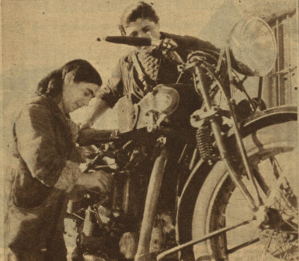
- Women at the Madrid Frontline
By mid-November, as Colonel Vicente Rojo was trying to turn the militias into a structured regular army, the government began a controversial push to move women away from the direct frontline trenches and into vital support roles like logistics, medical care, and manufacturing. However, on 15 November, many milicianas refused to leave and were still actively firing rifles from the windows of University City and the trenches of the Parque del Oeste.
For the International Brigades organised by the Comintern in Albacete and La Roda, the rules were much more traditional and strictly managed. The Comintern strictly prohibited women from registering as frontline infantry soldiers or cavalrymen. The thousands of foreign volunteers waiting in Albacete to be handed rifles were entirely male. While women could not fight in the international trenches, hundreds of foreign women volunteered and were legally part of the International Brigades as specialised medical personnel. On 15 November, foreign female doctors, nurses, and ambulance drivers (many from France, Britain, the US, and Central Europe) were operating right behind the front lines in Madrid. They worked in blood-soaked makeshift field hospitals, frequently coming under direct artillery fire from Cerro de Garabitas while treating wounded soldiers.
If you looked at the Republican lines on 15 November 1936, you would see Spanish women actively fighting and dying with rifles in the university faculties, alongside foreign women working heroically as frontline medical officers, while the actual infantry ranks of the International Brigades remained strictly male. The Unión de Muchachas (The Young Women’s Union) was a communist-organised battalion consisted of highly motivated young women (mostly aged 14 to 25) deployed to the Southern Sector. They were placed on the frontline trenches at the Puente de Segovia and near Getafe on the Carabanchel front. Along with Enrique Líster’s 5th Regiment cadres, these women formed the bulk of the Republican forces holding these barricades.
Armed with standard rifles and improvised dynamite packs, they engaged in heavy, close-quarter firefights from behind sandbagged street blocks. Military reports from that weekend record that they were among the most disciplined units on the southern line, holding their ground against superior fascist firepower. The defiance of these women is perfectly personified by figures like Julia Manzanal. At 17 years old, she became the political commissar for the Batallón Municipal de Madrid during the siege. Armed with a rifle and a pistol, she fought directly on the front lines, managed trench defences, and personally conducted frontline reconnaissance and espionage to track Nationalist troop movements.
By mid-November, the Prime Minister, Largo Caballero, had begun issuing decrees to systematically fold the independent worker militias into the regular, male-dominated Popular Army. Because of this institutional push, many standard histories state that women were completely withdrawn from the front lines by November. But the reality on the ground was far different. On 15 November, units like the Unión de Muchachas flatly ignored administrative paperwork. They refused to retreat to the traditional roles of cooks or laundresses, remaining dug into the stone structures of Carabanchel to defend their city with their lives.
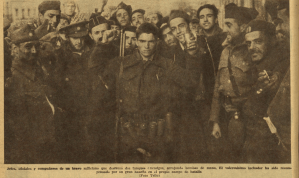
Milicianas knew that if they were captured alive by the Nationalist forces (especially the Moroccan Regulares or the Foreign Legionnaires), they would face horrific, systematic sexual violence and humiliation. A common psychological torture tactic used by the Nationalists upon capturing Republican women was to forcibly shave their heads, leave small tufts of hair to tie political ribbons in, and parade them publicly through conquered towns. By pre-emptively shaving their heads and wearing bulky male militia overalls, these young women attempted to fully blend in as male soldiers to avoid immediate identification if their trench was overrun.
While the caption leaves this fighter anonymous to protect them or frame them as a generic symbol of the Republic’s bravery, historical combat records from that exact week note a highly decorated young individual who matches this feat – Mauricio López Bruno. However, Mauricio is widely suspected by modern historians focusing on the milicianas to have been a female fighter operating under a male alias to stay in the frontline trenches, exactly like Julia Manzanal assumed the name Chico. An intensely young, fiercely stoic fighter, standing surrounded by older male officers who are looking at them with genuine awe and raising their fists in the anti-fascist salute, honoring a historic feat of asymmetric warfare carried out by someone who hid their true identity just to have the right to fight.
- Albacete, Murcia (Castilla la-Mancha)
Comintern records and French border-crossing archives from the central headquarters at Albacete showed there were approximately 3,000 to 4,000 international volunteers (including the 300 permanent staff arranging the voluneeters) inside the Albacete province on 15 November 1936 who had not yet been sent to the Madrid front. This uncommitted pool was different from the battle-tested veterans dying in University City. They were committed but untrained and untested recruits distributed across Albacete and its surrounding rural training villages such as Madrigueras, Mahora, Tarazona de la Mancha, and La Roda.
The vast majority, about 2,000, were young laborers, miners, and left-wing political exiles who had manged to get into the country over the preceding ten days. Many had never held a rifle in their lives. They were waiting for uniform shipments, basic medical checks, and entry-level drilling. Because the Comintern insisted on segregating battalions by language to allow them to understand commands, hundreds of volunteers were stuck idling in rural depots waiting for enough of their countrymen to arrive to form a viable, cohesive unit. Another 1,000 men were part of the continuous wave of French and Belgian volunteers flooding across the Pyrenees. Because they arrived faster than any other nationality, they outpaced the Comintern’s ability to organise them. They were sitting in temporary barracks waiting to be formally structured into what would become the 14th International Brigade (La Marseillaise.
The unarmed specialist units, about 500 men, included the early horse-handlers and provisional cavalry squads being cobbled together in La Roda, alongside medical personnel, cooks, and truck drivers. They were technically ready for deployment but were completely immobilised because Albacete lacked the physical rifles, machine guns, vehicles, or saddlery to properly outfit them. While General Kléber’s 11th Brigade was literally facing annihilation in Madrid due to a severe shortage of fresh rifles, thousands of highly motivated international volunteers were sitting uselessly in the Albacete rear guard purely because the Republic lacked the weapons and infrastructure to organise them fast enough.
- Pamplona, Burgos, Old Castile (Castilla y León)
In an address that came to be known historically as No más sangre (No More Blood), Olaechea broke the ecclesiastical silence. Forgiveness! Forgiveness! The Bishop explicitly demanding an end to the lawless, extrajudicial murders of suspected leftists. He carefully balanced his sermon to avoid looking like a traitor to the Nationalist state, distinguishing these lawless street killings from executions officially imposed by formal military tribunals. Despite this careful distinction, the message was clear, and the political backlash was immediate. The sermon provoked intense fury among hard-line Nationalist military factions who viewed any call for mercy as a dilution of their political cleansing campaigns. Olaechea was subjected to immediate institutional criticism and quiet, lingering threats against his bishopric.
Franco recognised that executing or publicly humiliating a prominent bishop would destroy the regime’s international image as the protectors of the Christian faith, so the central military command suppressed any physical retaliation against Olaechea. Because he had already proven his core loyalty to the fascist rebellion, the regime treated his sermon as an internal theological dispute about order, rather than political treason. In 1946, Olaechea was promoted to the highly prestigious position of Archbishop of Valencia, one of the largest and most influential dioceses in Spain and attempted to reframe himself as the archbishop of the workers, building low-cost housing developments, established schools, and funded social safety nets for poor families. The trade unionists, the teachers, the workers, and the democrats who would have argued with him or voted against his worldview were not getting assistance, because they were either buried in unmarked mass graves, languishing in Franco’s vast network of concentration camps and prisons, or living in forced exile abroad. The low-cost housing was reserved strictly for ‘good, Catholic, obedient’ families who could prove their loyalty to the Church and the State.
It was not universal welfare; it was a reward system for the conservatives who conformed and turned a blind eye to murder. Olaechea and the Church could pretend they were champions of the working class without ever having to grant those workers actual rights, freedom of speech, or democracy. It was an incredibly effective way to keep the surviving population quiet and dependent on the very institutions that had blessed the war in the first place.

