The tragic events in the municipality of Villarquemado highlight the methodical execution of the White Terror by Francoist forces during the autumn of 1936. Unlike regions fractured by shifting lines, the province of Teruel saw immediate, crushing control established by the military rebellion in July 1936. What occurred in Villarquemado between 4 October and 7 October 1936 was a calculated, state-sanctioned purge of the town’s democratically elected civil leadership and their families.
.
On 4 October, Nationalist paramilitaries and military authorities carried out a sweep explicitly targeted at the municipal leadership of the Second Spanish Republic, killing former local mayor Nicolás López Aguar, the 62-year-old who had served as the town’s leader from the dawn of the Republic on 14 April 1931 until February 1936. Because of his pioneering role in establishing local Republican governance, he was viewed as a primary ideological enemy by the fascists.Teófilo Villel Sánchez, aged 40, had succeeded López as the active mayor in February 1936. By executing both the past and present heads of the town hall simultaneously, the Francoist forces sent an absolute message of total political eradication to the populace.
.
Three days later, the purge expanded beyond political figures to target extended families, ensuring that any remaining resistance or generational memory was thoroughly suppressed. Regina Cruzado Salesa was just 20 years old, and arrested and executed on 7 October 1936 together with her 58-year-old father and roughly 30 other local residents from Villarquemado in a massive collective shooting outside the town boundaries.Regina’s story remains one of the most poignant symbols of the war’s human cost in Teruel.
.
Regina was identified in local accounts as a young Republican. Following the military uprising, Francoist forces sought to completely eliminate members or sympathisers of any left-wing, socialist, union, or Republican organisations. Teruel was a deeply conservative and traditionalist region, and anyone who had openly embraced secular, modern, or progressive political ideas under the Second Spanish Republic was branded a subversive or a red. In the early months of the war, Francoist death squads frequently practiced collective punishment against entire families. If a father or brother was accused of being a union activist or an anti-fascist, the entire household became a target. For the perpetrators, wiping out whole family units served to ensure that no one was left behind to seek vengeance, carry on the family’s political legacy, or pass down stories of resistance to the next generation.
.
Historical research by the Museo de Teruel notes that Regina was a young woman with notable cultural interests and intellectual aspirations. She wanted to study and better herself. Under the strict, traditionalist, and heavily patriarchal ideology of the Francoist movement, a young woman who was educated, politically conscious, or active in local cultural circles was viewed with deep suspicion. The fascists prioritised punishing women who broke out of traditional, silent conservative roles. The primary mechanism of the rearguard purges in small villages like Villarquemado was to install a culture of absolute, paralysing fear. By killing a total of 42 people from a small town in one day, including prominent figures, fathers, and young 20-year-old woman, the military command ensured that the remaining population would remain entirely submissive, terrified, and silent for decades.
.
The fact that Regina was ordinary, preparing her trousseau sheet for a future marriage (an heirloom-quality bed sheet traditionally prepared as part of a bride’s collection of linens, clothing, and household goods for her trousseau, often called a a hope chest or glory box in English), is exactly what makes her targeting so jarring. It shows that the violence was an ideological dragnet that swept up ordinary people who dared to think differently. The devastation of the Cruzado Salesa family of Villarquemado is a raw look at the multi-generational trauma of the civil war. The family was tight-knit, humble, and highly cultured; the father, Julio Cruzado Español, ran the village carpentry workshop while the mother, Modesta Salesa, worked as a local butcher. Both parents deeply valued reading and education, which inspired their children to embrace progressive, libertarian social ideals during the Second Republic. The Libertarian Youth organisation was being formed in the town, and Regina and her siblings were able to participate, but the Nationalist fascists especially hated women, because they did not accept women being educated and being able to participate in public and political life. The outbreak of war was an excuse to put women back in their place.
.
Regina and her father were arrested in a sudden, coordinated sweep on the evening of 6 October 1936, and would only live a few more hours. Julio was respected in the village, but because of his children’s open involvement with Republican cultural movements, including Regina helping embroider the town’s very first Republican flag, the Francoist authorities marked him for elimination alongside his daughter. At dawn on 7 October 1936, Julio was lined up and shot with Regina and 40 other neighbours.
.
Modesta Salesa endured the unfathomable grief of losing her husband and daughter in a single afternoon. She survived the war, shielding the remaining children through the terrifying post-war years. Her two sons had learned the carpentry trade from their father before he was murdered and they managed to survive the war and kept the family carpentry business open. The shop remarkably remains open to this day in Villarquemado, run by the fourth generation of Julio Cruzados.
.
Regina’s sister Mónica survived the initial October 1936 sweeps, but her life became one of extraordinary danger. Her husband fled across the lines to fight for the Republic, leaving her behind in Francoist-controlled Villarquemado. Driven by the execution of her father and sister, Mónica secretly became a high-level operative for the SEIP (the Republican military intelligence service).
.
Mónica turned her family home in Villarquemado into a clandestine logistics hub right under the noses of the Francoist military garrison. She actively recruited local informants and sub-agents (such as Elpidio Villate and Antonio Fernández) to gather highly sensitive data on Nationalist troop movements, artillery placements, and political alignments. Republican scouts and secret couriers would slip through the mountain trenches at night, sneak into Villarquemado, and shelter at Mónica’s house. She would hand over the gathered intelligence files, which the couriers would carry back across the front lines to the Republican commanders. Her network was so effective that Francoist counter-espionage documents later labelled her the Mata Hari of Villarquemado out of sheer professional astonishment at the scale of her operation.
.
Mónica Cruzado Salesa smuggled highly actionable tactical and strategic military intelligence directly from the Nationalist rearguard to the Republican command centre. Because Villarquemado sat at a geographic bottleneck near the heavily fortified city of Teruel, the data her network collected was vital for planning Republican artillery strikes and counter-offensives. According to documented Francoist military tribunal files unearthed by researchers Alberto Laguna and Victoria de Diego in their book La Guerra Encubierta, Mónica tracked the arrival, identity, and departure of Nationalist infantry and cavalry divisions passing through the Teruel corridor. In a war where surprise manoeuvres were critical, knowing exactly how many soldiers were stationed in a specific village, or if a sector was being reinforced by Franco’s elite Moroccan troops Regulares, allowed Republican commanders to know exactly where the Nationalist lines were weak.
Operating directly out of her village house, Mónica and her paid agents (who held formal identification cards issued by the Republican intelligence service, the SIEP) monitored the flow of military cargo along the local transport links. She documented the locations of secret Nationalist ammunition dumps and fuel caches, trains and supply trucks carrying heavy hardware toward the frontline trenches, and tactical details regarding local infrastructure that could be targeted for sabotage to freeze Francoist logistics.
Mónica gathered what intelligence agencies call political and human intelligence. She mapped out the internal power dynamics of the local Francoist commands, tracking which local leaders were conducting purges, the level of control held by local Falangist paramilitaries, and the general state of security in the rearguard. This helped the Republic identify which areas might be sympathetic to clandestine operations or prone to internal friction.
Mónica’s downfall came in December 1938 due to the intense paranoia, infiltration, and pressure that defined the final phases of the Battle of Teruel. The Nationalist counter-espionage apparatus (S.I.P.M.) launched a massive dragnet to root out the leaks feeding the Republican army. They began aggressively interrogating locals and monitoring households of known reds whose relatives had fled to the Republican zone. Mónica’s network was ultimately compromised when one of the couriers or sub-agents was captured trying to cross the trenches. Under brutal interrogation or the threat of execution, the captured agent broke and gave the military authorities the exact location of the Villarquemado safehouse. Nationalist authorities raided her home, discovering physical evidence of espionage, including files and official agent sheets. Mónica, along with her brother Julio and several local collaborators, was arrested.
.
Because she was an incredibly high-value intelligence target, Mónica was not immediately executed like her sister Regina. Instead, she was thrown into the brutal Santa Eulalia concentration camp. She underwent relentless military interrogations, with officers attempting to map out the entire Republican spy network in Aragon. Remarkably, she survived the camp and the war, which had gradually transitioned from active military operations into a bureaucratic detention centres. Prisoners who avoided execution were systematically re-sentenced by hasty military tribunals. The exact day she was given her papers to leave Teruel was an administrative, clerical action rather than a public event. Sentences of destierro (forced exile) were managed through closed police registries
but the regime’s retribution was long; she and her husband were sentenced to an undisclosed number of years of imprisonment followed by decades of forced internal exile, banned from returning to their home province for much of their lives. Where she lived or when she died remains a mystery.
.
The family carried a heavy, silent memory for decades. Regina’s unfinished white trousseau sheet, splattered with blood, was left behind when she was dragged to the firing squad, and hidden and meticulously protected by the family for over 80 years. In recent years, Regina’s niece, Regina Cruzado Iranzo, stepped forward to donate the blood-stained embroidery to the Museo de Teruel, transforming a private family tragedy into a permanent public testament to the victims of the war.
On 7 October 1936, a total of 13 women from Villarquemado were executed alongside Regina and her father Julio. While the exact list of all 13 individual names remains difficult to comprehensively isolate because they were unceremoniously dropped into the Pozos de Caudé mass graves, local registries and oral histories document who these women were collectively and highlight a few of their specific fates. The women shot that morning were predominantly young members of the town’s newly forming Juventudes Libertarias (Libertarian Youth) or the wives, sisters, and daughters of left-wing organisers. They were targeted directly by the Nationalist military forces for defying traditional societal expectations. Local historians emphasise that the Francoists explicitly focused on women who sought a secular education, engaged in cultural or intellectual spaces, and participated in public or political activities. Among the group was a woman named Teresa, whose execution captures the deeply personal and horrifying nature of the rearguard terror in Teruel. The paramilitary detachment arrived in trucks from neighbouring Cella to round up political targets, looking for Teresa’s daughter, Inés. Inés had fled to the town of Épila because she was being aggressively pursued by one of the prominent right-wing repressors. When the squads arrived at the house in Villarquemado and realised Inés was missing, they arrested her mother, Teresa, out of spite and substitution. Teresa was loaded onto the trucks, driven to the outskirts of the town, and shot as a proxy punishment for her daughter’s refusal to comply.
.
The logistics of the Villarquemado executions connect directly to one of the most notorious mass grave networks of the Spanish Civil War in Aragon, Los Pozos de Caudé. Rather than hiding the bodies near local village cemeteries, Nationalist forces transported the victims of both the 4 October and 7 October massacres to an abandoned mining site located a few kilometres outside the capital city of Teruel. The deep, vertical extraction shafts of the old mines were used as ready-made mass graves. Hundreds of victims from the surrounding alignment of villages, including the mayors and the Cruzado family, were shot at the lip of the shafts and dropped into the darkness to hide the scale of the execution campaign. This site is now recognised as a major sanctuary for historical memory in Aragon, honouring the hundreds of individuals from the region who disappeared down the shafts during those first brutal months of the conflict. For forty years under the dictatorship, the memory of these 13 women from Villarquemado was suppressed. Today, their lives are collectively honoured by 13 commemorative pieces in the El estruendo del silencio (The Thunder of Silence) exhibit, ensuring that the collective loss of the village’s women is never forgotten.
.
Historical organisations like the Asociación Pozos de Caudé estimate that at least 1,005 civilian bodies were cast into the mass grave network at Los Pozos de Caudé. The horrifying scale and historical memory of this specific site involve a remarkable documentation effort and a tragic collective legacy for the women of the region. The highly precise baseline estimate of 1,005 victims is preserved thanks to an extraordinary act of dangerous, quiet resistance.
.
The primary artesian well was an immense shaft, measuring 87 metres deep and 2 metres wide. Throughout late 1936 and 1937, Francoist death squads routinely drove trucks of prisoners to the edge of the pit under the cover of darkness, executed them, and dropped them into the shaft. A local shepherd from the nearby village of Concud slept near the area with his herd. Witnessing the arrival of the execution trucks night after night, he began secretly tracking the slaughters in a private pocket notebook. He learned to distinguish the sharp crack of the military rifles from the single pistol shots used as a coup de grâce. His hidden jottings provided a foundational mathematical record that allowed modern post-war historians to cross-reference testimonies and verify the staggering tally of lives lost in the pit. While the vast majority of the 1,005 bodies belonged to male Republican mayors, unionists, and field labourers, the wells became a symbol of systemic gender-specific repression. The 13 women dragged from Villarquemado on 7 October were part of a calculated campaign targeting progressive, politically active, or free-thinking women across the Teruel plateau.
.
Other documented stories of women cast into the Caudé shaft include: the Stolen Youth of Cella (The 13 Roses of Teruel). Mirroring the fate of Villarquemado, the neighbouring town of Cella saw its own wave of ideological purges. Francoist forces rounded up 13 young Republican women from Cella. Among them was a heavily pregnant young woman. The entire group was executed along the road and thrown directly down into the 87-metre Caudé shaft, entirely destroying a generation of the town’s young women. Historical registers explicitly note the targeting of entire maternal lines to extinguish familial resistance. María Pérez Macías and her young daughter, Pilar Sánchez, were hunted down in their home village, driven out together, and cast into the darkness of the well.
.
The physical fate of the bodies inside the shaft highlights the long, complex history of Spanish memory. In 1958, without notifying or asking permission from the families of the victims, the Francoist regime sent military teams to quietly extract thousands of skeletal remains from mass graves across Aragon, including the Pozos de Caudé. Truckloads of these bones were transferred to the massive underground crypts of the Valle de los Caídos near Madrid to line the walls of the dictator’s monument. Teruel province alone saw nearly 3,000 bodies taken for this purpose. Today, the site at Caudé features a monument constructed in 1980, standing over the remains of the wells to ensure that the shepherd’s notebook, the unfinished sheet of Regina, and the names of the over 1,000 civilian victims are preserved forever.
Republicans later in the La Serena battle, via Hoy
Higuera de la Serena, Badajoz, Extremadura
In a crucial defensive victory for the Republicans, forces successfully repulsed a major Nationalist assault on Higuera de la Serena on 7 October 1936. The engagement, which marked a rare structural success for Republican columns during the brutal autumn campaign in Extremadura, allowed loyalist militias to check the enemy’s momentum and firmly consolidate their defensive network across the strategic Higuera–Valle de la Serena axis.
.
Following the devastating fall of Badajoz earlier in the summer, the principal dividing line between the two factions in the Extremadura province had hardened into a tense, jagged frontline. The Nationalist faction, leveraging mobile columns and coordinated artillery, sought to breach the Republican rearguard to expand their corridor toward Madrid and tighten their grip on the region’s agricultural hubs. On 7 October, Nationalist units positioned in the occupied strongholds of Retamal and Campillo de Llerena launched a heavily supported tactical push directly across the Guadámez River valley with between 1,000-1,500 men. Their primary objective was to overrun the Republican garrison at Higuera de la Serena, a movement that would have unhinged the local network of pro-government towns.
.
Unlike recent encounters in the province where fragmented loyalist forces suffered from rapid encirclement, the Republican defenders in the Serena sector maintained cohesive positions for 1,500 – 2,000 hastily organised volunteers dispatched from the judicial regional capital of Castuera. Utilising the natural defensive advantages of the rugged river basin and localised fortifications, the militias absorbed the initial shock of the Nationalist vanguard. The Republican defensive line capitalised on a strategic Roman-era watchtower ridge (Torre Vigía) that offered sweeping views to control the river crossing.
.
Nationalist troops advancing from Retamal attempted a swift breakthrough across the river basin, striking the advance outposts at Cortijo de Tamburrero. The fighting quickly evolved into short-range, intense exchanges of rifle and machine-gun fire. The exterior whitewashed walls of the cortijos and local stone walls were hastily converted into defensive barricades and rifle pits. Rather than retreating, the Republican militias used their higher ground and newly dug trench lines to pin down the advancing Nationalist vanguard, frustrating the rebel attempt to storm the town directly. By late afternoon, the Nationalist thrust was entirely blunted, forcing the attacking columns to withdraw back toward their starting lines.
.
The victory at Higuera de la Serena on 7 October 1936 was the exact catalyst that permanently stabilised the frontline in this sector. Following this battle, the frantic, fast-moving war of mobile columns that had characterised the summer of 1936 came to an abrupt halt in eastern Badajoz. The stabilisation transformed the region into a fixed trench war almost entirely unchanged for nearly two years (from October 1936 until July 1938). It became known historically as a forgotten front (frente olvidado). Because the lines were fixed, both sides built extensive fortifications. For many months at a time, combat slowed down to minimal activity. Soldiers lived in stone trenches and makeshift bunkers. The routine consisted of sporadic sniper fire or occasional artillery shells to test the enemy’s positions, while soldiers spent their downtime teaching illiterate troops how to read and write. By holding the line at Higuera, the Republican forces preserved a massive territorial bulge known as the Bolsa de la Serena (The Serena Pocket). This pocket allowed the Republic to maintain control over strategic agricultural collectives and mineral resources deep in the Extremadura region.
.
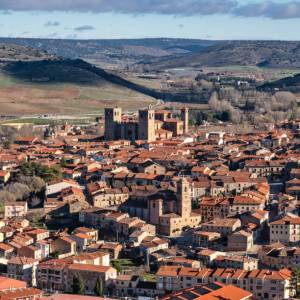
Aerial view of Siguenza with the castle above and cathedral below, via Wikimedia Commons
Sigüenza, Guadalajara
The Battle of Sigüenza (7 August – 15 October 1936), located northeast of Madrid in the province of Guadalajara, the historic town of Sigüenza sat directly on the main highway and railway lines connecting Madrid with Zaragoza and Soria. For General Emilio Mola’s Nationalist forces, capturing the town had been essential to severing Madrid’s northern supply lines and establishing a massive C-shaped encirclement around the Republican capital. For the Republic, a decentralised mix of regular soldiers, railway workers, and political volunteers (including many milicianas) fought desperately to hold the line. By late September, Nationalist heavy artillery and severe aerial bombing shattered the urban perimeter, forcing the remaining Republican defenders to collapse inward.
Following the collapse of the outer urban perimeter at the end of September, the Nationalist columns closed the trap over the first week of October by successfully cut off all remaining rural hinterlands, secondary roads, and footpaths. With the Republican forces entirely isolated inside the town centre and starved of external supply lines, Nationalist commanders systematically positioned their heavy artillery and organised ground units for a final, multi-pronged clearing operation.
During the intensive fighting of 1–9 October 1936, approximately 4,000 to 5,000 Nationalist troops flooded the area. These were highly organised, battle-hardened units led by Colonel Marzo and Colonel Jimeno, with of elite regular infantry, Moroccan Regulares, and right-wing Carlist Requetés. They held absolute air superiority, backed by early German and fascist Italian air support. They occupied the valleys, major outlying roads, and the rolling hills overlooking the city. They had successfully pushed the Republicans out of the surrounding rural villages, establishing a dominant, elevated crescent shape just outside the town’s borders. Because they successfully swept through the outer valleys and captured the surrounding high ridges in September, they held an extreme geographic advantage. They placed their heavy artillery on the flat-topped moorlands and high hills overlooking the town. This allowed them to look straight down into the valley, trapping the Republican forces in a geographical bowl where every street barricade was visible to rebel spotters and exposed to relentless downward shelling.
.
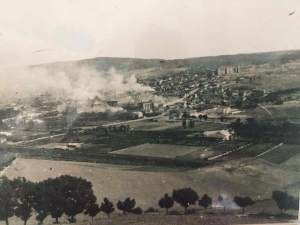
Bombing of Sigüenza, via WIkimedia Commons
Only 1,500 to 2,000 Republican volunteers fighters initially defended the broader Sigüenza area under the command of Feliciano Benito. Rather than a cohesive army, this was a fragmented mix of loyalist civil guards, urban railway workers, and political militia volunteers (such as the anarchist Columna del Rosal and POUM militia units). By October, they were completely outgunned, nearly out of ammunition, and entirely cut off from reinforcements in Madrid. But they controlled the town’s urban streets, the medieval fortress-castle, and the sprawling, thick-walled Sigüenza Cathedral. The town itself is built onto a steep slope. The massive Sigüenza Castle sits at the very highest point, the historic Sigüenza Cathedral sits slightly lower on the incline, and the civilian residential areas roll down into the valley floor. From their base in Sigüenza, Republican militia volunteers, particularly militant railway workers and anarchists, had been launching highly disruptive guerrilla raids on nearby Nationalist army bases. The rebel command wanted to permanently eliminate this volatile pocket of resistance behind their front lines before launching their final, full-scale assault on Madrid.
On 1 October, Nationalist columns intensifies their pincer movement from the north and west. With their absolute air superiority, using German and Italian-backed aircraft to systematically bomb the outskirts. They smash the Republicans’ forward trenches and prevent them from reinforcing their outer lines. The following day, Nationalist troops were able sweep through the peripheral valleys and seize the remaining secondary roads. Crucially, they permanently cut the main railway line, Madrid’s vital northern artery. With this track severed, the Republican defenders are completely starved of incoming ammunition, food, or heavy weapons.
.
On 3 October, the Nationalists’ artillery batteries took up position on the high, rocky ridges overlooking the town. They unleash a concentrated bombardment directly into the valley floor. Under a devastating, downward artillery bombardment, holding the outer perimeter became suicidal. Feliciano Benito ordered a tactical withdrawal from the lower valley floor. Republican militias pulled back up the steep, rocky slopes into the dense, narrow medieval streets. Here, they began converting ancient stone houses into fortified firing nests.
.
On 4 October, autumn rains suddenly arrived. Despite freezing weather, the anarchist and POUM militias refused to stay on the defensive. Taking advantage of the rocky, uneven mountain terrain they knew well, small Republican guerrilla squads launched daring, muddy counter-raids into the crags to disrupt the Nationalist advance. They managed to temporarily slow the enemy down, but at a high price in ammunition they could not replace, and were forced to retreat as the Nationalists infantry squeezed the eastern flank. Within another day, the Nationalist artillery on the surrounding moorlands establishes a total crossfire over the town, and they could see down into virtually every major intersection of the town. Every attempt by the Republicans to shift positions or fortify a street corner is instantly met with high-explosive shelling. As the relentless shelling shatters civilian homes on the lower slopes over several days, hundreds of terrified local residents fled upward into the historic centre. The town’s narrow, steep medieval streets became choked with a chaotic mix of retreating militia fighters, wounded soldiers, and panicking families looking for cover.
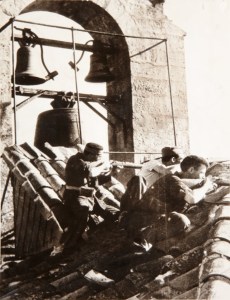
Republican militia on top of the cathedral, via Wikimedia Commons
With the final pathways out of the mountains cut by 7 October, the Republicans knew a breakout was impossible. Turning their focus to survival, militias completely transformed the fortress-like Sigüenza Cathedral into a massive military bunker. Up in the medieval bell towers, they positioned their last remaining machine guns, preparing to hold the line. Every single road, dirt track, and mountain footpath leading out of the valley is now firmly under Nationalist control. With the Republican pocket entirely isolated from the outside world, Nationalist commanders halted the shelling briefly to position their elite Regulares and Requetés along the town limits, preparing the final multi-pronged ground assault.
The final phase of the battle on 8-9 October transformed the rugged mountain town into a scene of claustrophobic, brutal urban warfare. Over these 48 hours, the numerical and technological superiority of the Nationalist forces collided directly with the desperate, house-by-house resistance of the Republican militias. Armed with overwhelming firepower, Nationalist troops stormed the city limits from multiple directions. They used intense, short-range artillery shelling to blow holes directly through the Republican street barricades. The Republican fighters, including the POUM militia units under Mika Etchebéhère and the anarchist squads, put up a fierce rearguard action. Standing on the steep, climbing medieval steps and firing from windows, they forced the Nationalists to fight for every single block. However, outflanked and rapidly running out of rifle cartridges, the Republican defensive lines began to shatter.
.
Recognising that total annihilation was minutes away, Republican commander Feliciano Benito ordered a fighting retreat up the hill. Hundreds of exhausted militia fighters, wounded soldiers, and roughly 200 terrified local civilians flooded through the doors of the massive, fortress-like Sigüenza Cathedral. As the last defenders dragged themselves inside, they slammed the heavy oak doors shut. They piled up massive church benches, heavy altarpieces, and loose masonry to seal the entryways against the approaching enemy, converting the medieval sanctuary into their final redoubt.
.
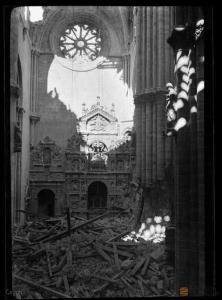
Ongoing damage at Sigüenza cathedral, via Wikimedia Commons
By midday on 9 October, Nationalist troops successfully cleared the remaining pockets of street resistance and secured the town’s high castle. Colonel Marzo officially sent a victory telegram to General Francisco Franco, declaring that the city of Sigüenza had been successfully captured by the Nationalist uprising. While the town was firmly in Nationalist hands, the battle was not over. It transformed into a literal medieval-style siege, with approximately 500 Republican fighters and 200 civilians trapped inside the cathedral’s stone walls. Refusing to surrender, the trapped Republicans positioned their remaining machine guns in the high, narrow slits of the cathedral’s medieval bell towers, trading sniper fire with the Nationalist troops occupying the surrounding plazas. As night fell on 9 October, the defenders themselves in the dark, tending to dozens of wounded people with virtually no medical supplies, clinging to a desperate hope that a relief column from Madrid would break through the mountains to save them, and began five days of relentless bombardment, breaking down the cathedral piece by piece as the interior filled with smoke.
Related
Got a comment, question or suggestion? Know who took a photo? Have questions about a particular date or event? Cancel reply