While General Emilio Mola’s dual pincer movement was crushing the outer defensive rings of Madrid, a separate, equally brutal operational campaign unfolded in the olive-rich valleys of southern Spain. Between 1 and 3 October 1936, Nationalist columns in eastern Andalucía executed a series of fast-moving territorial captures designed to secure the critical Granada–Córdoba corridor, permanently altering the provincial borderlines of Granada and Jaén. The primary objective of the southern Nationalist command during the opening days of October was the total consolidation and fortification of Alcalá la Real and its neighbouring mountain stronghold, Montefrío. Alcalá la Real, historically a heavily contested border fortress town sitting at the strategic intersection of several Andalusian provinces, became the anchor point for a newly established front line.
.
This operation was a fragmented, brutal struggle across a steep, agricultural labyrinth.
Here is what the combat area was actually like, how populated it was, and the nature of the troop presence. The region connecting Alcalá la Real, Montefrío, and Moclín is defined by the Subbaetic mountain systems, a landscape of jagged limestone peaks, rocky defiles, and steep, rolling valleys. The terrain was covered in sprawling, dense olive groves. Militarily, this meant visibility was incredibly low at ground level. A column could march within a few hundred metres of an enemy position completely unseen, making the area a nightmare for conventional movements and perfect for sudden, terrifying ambushes.
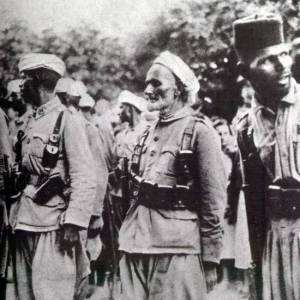
Army of Africa Regulares, date unknown
Towns like Alcalá la Real were anchored by massive medieval fortresses (like the Fortaleza de la Mota), built high upon rocky outcroppings. Whoever held the high ground dominated the primitive roads snaking through the passes below, forcing any attacking force into brutal, uphill infantry assaults. The area was characterised by a sporadic, rural network of small agricultural villages and isolated olive-milling estates (cortijos). In 1936, the hub town of Alcalá la Real had a concentrated population of around 8,000 to 10,000 people, while neighbouring Montefrío and Moclín were quiet, tightly knit peasant communities of a few thousand. For centuries, this exact region had historically served as the physical, militarised frontier between the old Christian kingdoms and the Moorish Kingdom of Granada. In October 1936, it suddenly woke up to find itself a modern front line again. The quiet rhythm of the olive harvest was entirely shattered by the roaring of Italian aircraft and artillery.
.
After the fall of Alcalá la Real on 30 September, still operating under the regional influence of General Gonzalo Queipo de Llano’s Southern Army, the Nationalist columns were the same mix of regular army garrisons from Granada, highly ideological fascist Falangist militias, and mobile detachments of the Army of Africa sent up from the coast. They lacked sheer volume, but they possessed a critical weapon of air superiority, using aircraft to aggressively target the mountain corridors. The Republican defence was spearheaded by the local Jaén militias, predominantly un-uniformed socialist and communist olive-harvesting peasants who had formed volunteer workers’ battalions. They lacked heavy artillery and centralised radios, depending heavily on their intimate, lifelong knowledge of the hills and rocky hideouts to slow the Nationalist advance.
.
By heavily garrisoning these hilltop municipalities, Nationalist troops wanted to erect a permanent wall between the left-wing stronghold of Jaén and the newly secured Nationalist territories of Granada and Córdoba. Faced with overwhelming fire superiority, the local Republican militia units abandoned their forward lines. Alcalá la Real was now in Nationalist hands, along with its 16,000 residents, and locals towns had no way to defend themselves.
The Republican workers’ and peasants’ militias (mostly local anarchist CNT and socialist UGT groups) had fallen back to Montefrío, home to 14,000 people and a Republican safe zone. Rather than abandoning the town, the local militia groups took up positions along the winding entry passes and the craggy rocky heights surrounding the town plaza. The resistance was short-lived but highly violent. The Nationalist columns used coordinated artillery to blast the militia outposts on the hills. Overwhelming firepower forced the remaining armed defenders to retreat southwest into the open countryside.
.
The resistance infuriated the arriving Nationalist forces. Once Montefrío was fully occupied on 1 October, the White Terror repression immediately. Historical records from the Todos los Nombres grave database show that in the month of September/October 1936 alone, at least 33 people were summarily executed in Montefrío. Modern archaeological teams have actively exhumed mass graves, such as the one at the privately owned Los Martínez estate, uncovering the remains of executed villagers alongside personal items like thimbles, shoe soles, and bullet casings. The owners of the estate either were part of the killing crew, or had allowed the groups to be brought to the land and hidden in mass graves, similar to the killings in Extremadura by local landowners.
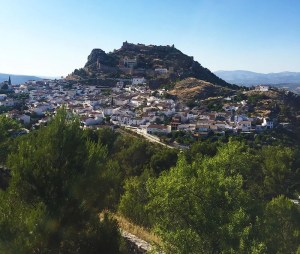
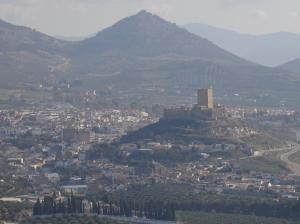
Moclín today, via Wikimedia Commons
On 3 October, Moclín saw even more conventional, organised military resistance because it served as the literal geographical shield protecting the approach to the Republican interior, and its population of 5,000 made it safe for fleeing families. The Republican forces attempted to make a major stand around the strategic approaches to the town, specifically near Puerto Lope. Republican planes flew missions over the valleys to bomb advancing Nationalist truck convoys, resulting in intense dogfights and anti-aircraft artillery duels.
The fighting escalated in ferocity along the natural mountain pathways linking Moclín to the approaches of Alcalá la Real.
.
Republican aircraft attempted to bombard the advancing Nationalist truck convoys to halt their momentum. However, Nationalist anti-aircraft batteries and superior fighter coverage successfully repelled the aerial counterattacks. By the end of the day, Nationalist units cleared the approaches, successfully securing the Granada–Córdoba transit corridor.
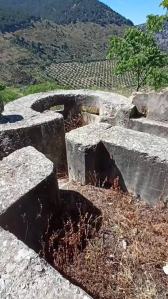
Despite a fierce defence, the Nationalist columns overran Puerto Lope and successfully captured the main town of Moclín by 4 October. But the resistance at Moclín was so strategically significant that immediately after its fall, the Nationalists brought in military engineers to build one of the most extensive búnker and trench networks in Andalucía. Known today as the La Cantera trench route, they dug miles of concrete-reinforced trenches, machine-gun nests, and pillboxes directly into the limestone facing the Republican lines. This front line became so heavily fortified after the 3 October battle that it barely moved for the rest of the three-year war.
Bunkers outside Moclín, via Wikimedia Commons
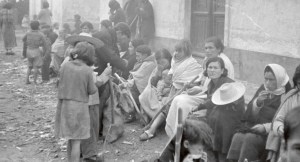
Shattered and disorganised, the Republican forces withdrew northward toward the historic fortress town of Alcaudete and the open, rugged olive countryside surrounding it, attempting to dig in and re-establish a secondary line of defence. As control of the region flipped to the Nationalists, the territorial shift was accompanied by a catastrophic humanitarian crisis. Terrified by reports of the fast-approaching Nationalist columns, and the severe military execution policies associated with the southern command, a massive civilian flight erupted out of Alcalá la Real and its surrounding southern agrarian hamlets. Thousands of peasant families, day laborers, and municipal workers abandoned their homes in a state of absolute panic. Packing what few possessions they could onto carts or carrying them on foot, this sea of refugees trudged along the dirt roads toward Alcaudete, seeking safety in the shrinking Republican zone. The sheer volume of people moving on the roads leading north toward Alcaudete and Martos was staggering. Historical demographic studies show that up to 70% to 80% of the civilian populations completely abandoned these towns. Considering Alcalá la Real and Montefrío had a combined baseline population of over 30,000 residents at the time, historians estimate that at least 15,000 to 20,000 local civilians instantly transformed into refugees during this single weekend.
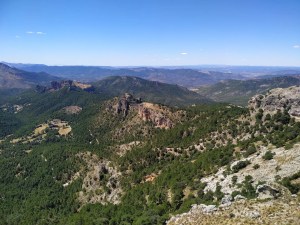
The terrain into Alcaudete, via Wikimedia Commons. The town would never fall to the Nationalists
The situation was severely worsened because these frontier towns were already packed to the brim with prior refugees. When the military coup initially succeeded in the city of Granada back in July 1936, thousands of left-wing peasants, day laborers, and families from the surrounding Granada plains fled westward into the mountains, believing the Republic would hold the high ground. Towns like Montefrío had essentially become massive, informal refugee camps. When the Nationalist columns smashed through on 1 October, this entire pre-existing layer of displaced people was uprooted a second time, mixing with the fleeing locals to choke the dirt roads. They poured directly into the Province of Jaén, which remained firmly loyal to the Republic. Because Jaén was a rear-guard province securely behind the lines for most of the war, it became the primary ground for the entire displaced population of western Andalucía. Regional archival studies show that as the war progressed, nearly 1 million internally displaced refugees poured into Jaén province from Seville, Córdoba, Cádiz, and Granada.The capital, Jaén city, had a normal baseline population of only 30,000 inhabitants in 1936. Within months, the arrival of these columns of refugees caused the population to nearly double.
.
Eyewitness accounts describe the road from Alcalá la Real to Alcaudete during those first days of October as a literal sea of human misery. Because it was the height of the autumn olive transition, thousands of families walked barefoot or rode on wooden carts piled high with mattresses, cooking pots, and terrified children. They suffered immensely from a lack of food, and because the Nationalist air force completely dominated the skies over the corridor on 3 October, these columns of slow-moving civilians were frequently terrorised by Italian-supplied aircraft tracking the roads. They arrived in Jaén completely destitute, triggering a severe local food shortage and forcing the Republican government to construct emergency air-raid shelters underneath the province’s historic stone churches to protect the massive influx of people.
.
The terrtain in Jaen to cover to escape the oncoming army, via Wikimedia Commons
Serving as the direct military headquarters for the loyalist Columna Peire, Alcaudete was the first major collection point. It was completely overwhelmed within 48 hours as schools, stables, and abandoned churches were turned into temporary field camps. Located just slightly further north-east, Martos became a massive civilian buffer zone. The town immediately began expanding its infrastructure, setting up a specialised military hospital to treat wounded militia members and refugees arriving from the front line. The provincial Republican authorities quickly began dispersing families further into the rich agrarian plains of the Jaén countryside (known as La Campiña). Refugees were systematically divided and sent to neighbouring medium-sized towns like Torredonjimeno, Porcuna, Andújar, and Linares. The local left-wing workers’ committees (Comités Populares) in these towns requisitioned large farming estates (cortijos) and properties belonging to wealthy right-wing landowners who had fled or been imprisoned. Multiple families were packed into single rooms, and local bakeries were nationalised to produce basic bread rations.
.
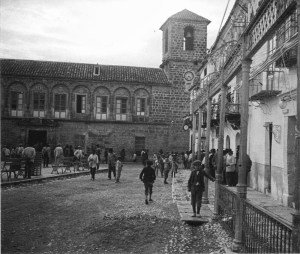
The Town hall building in Torredonjimeno
The provincial government used the city’s railway links and administrative networks to register refugees, distribute basic identity papers, and allocate international food aid. The true impact on Jaén city wasn’t just the sheer number of people on its streets, but the extreme danger it brought. Because the city was packed with vital administrative networks and a dense population, it became a prime target for Nationalist air strikes. To handle the crisis, the city was forced to dig an extensive network of underground air-raid shelters beneath public plazas and churches to protect the civilian population. By scattering the civilian population across dozens of rural olive-growing municipalities rather than allowing them to pool in the capital, the Republican zone successfully prevented an immediate outbreak of famine, though the social friction and overcrowding would strain the region for the remaining three years of the war.
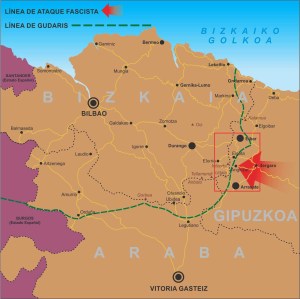
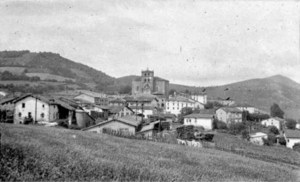
The frontline attacking into Elgeta, via Askatasunaren Bidea
Gipuzkoa and Bizkaia, Basque Country
While the autumn of 1936 witnessed catastrophic territorial losses for the Spanish Republic across the southern and central plains, a completely different military reality unfolded in the rugged valleys of the Basque Country (Euskadi). Between 3 October and 8 October 1936, a fiercely determined coalition of Basque nationalist volunteers (Gudaris) and leftist militias stood their ground along the provincial borders of Gipuzkoa and Bizkaia. At the centre of this historic stand was the small town of Elgeta, population 1,100 (though only 600 in town), and the imposing mountain ridges known as The Intxortas. The Battle of the Intxortas stood out as a massive clash involving tens of thousands of troops on both sides, was defined by a highly disciplined, organised, and fiercely courageous defensive stand.
.
Following the fall of San Sebastián in September, Francoist forces under General Emilio Mola pushed westward, aiming to breach the natural gateway into the industrial heartland of Bizkaia and its capital, Bilbao. The scale of the battle would be massive. The Nationalists had their elite Carlist Requetés (Navarrese brigades) and regular Nationalist infantry, numbering well over 10,000 to 15,000 assault troops, heavily backed by Italian artillery and the early precursor elements of the German Condor Legion.
Elgeta, October 1936, via Askatasunaren bidea
To absorb this onslaught, the Basques massed thousands of defenders across the Eibar-Elgeta ridge. This was a heavily concentrated wall of manpower designed to act as the ultimate shield for the province of Bizkaia. The Basque forces holding the mountain line were a highly structured coalition operating under the direct authority of the newly formed Basque Autonomous Government led by Lehendakari (President) José Antonio Aguirre. The defenders were organised into formalised, ideologically diverse battalions of approximately 500 to 600 men each, operating under the local coordination of leaders like Major Pablo Belderrain: The Gudaris were Basque nationalist volunteers belonging to the Euzko Gudarostea (the Basque Army), closely tied to the PNV (Basque Nationalist Party). They were deeply religious, disciplined, and motivated by a desire to defend their homeland and autonomy against Franco’s centralist forces. Fighting alongside the Catholic Gudaris were socialist (such as the locally organised Amuategui Battalion), communist, and anarchist (CNT) worker battalions. The Intxortas was a native Basque defence, young men from the factories of Eibar, the shipyards of Bizkaia, and the rural valley farmsteads of Gipuzkoa.
They held a critical psychological advantage: they were fighting on their own soil. They knew every mountain path, rocky ravine, and weather pattern of the Sierra de Gredos and Intxortas heights, which they used to maximise their defensive capabilities.
.
On 3 October, the offensive opened with an intense combined-arms bombardment designed to terrorise the defenders and shatter their lines. Francoist aircraft unleashed heavy air raids directly targeting the urban and military fronts of Eibar and Elgeta. The Euskadi Bombing Atlas records two distinct aerial attacks on Eibar and two on Elgeta that day. While contemporary wartime reports did not confirm immediate casualties, the psychological impact was severe. Simultaneously, Francoist heavy artillery opened fire on the primary Republican defensive positions surrounding the Intxortas peaks, acting as the immediate tactical precursor for a massive ground assault.
.
4 October 1936, via Askatasunaren bidea
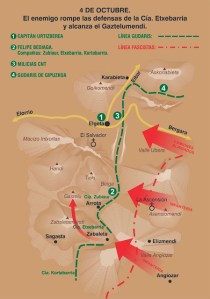
On 4 October, one of the most critical and celebrated military events of the autumn in Euskadi commenced. Launching their offensive from the direction of Bergara, Francoist columns, heavily reinforced with armoured vehicles and regular infantry, launched a major frontal assault against the Intxorta positions. The combat quickly dissolved into a brutal, close-quarters infantry war across a complex network of mountain ridges, but rather than succumbing to tank panic or retreating when the Nationalist armoured vehicles attacked from Bergara, the Basque and Republican battalions held their positions with iron discipline. Utilising an ancient ox-cart path along the crest of the mountains, the defenders spent weeks carving out an advanced, deeply sophisticated network of trenches, foxholes, and machine-gun nests directly into the rocky hillsides.
.
The hilltops had been deforested, creating open fields of fire. As the Navarrese columns and armored cars charged uphill, the Gudaris and socialists held their fire, waiting until the enemy reached point-blank range near a local hermitage before opening up with heavy machine guns and mortars. Every single Nationalist assault on 4 and 5 October was bloodily repulsed. The Basque fighters successfully neutralised the Nationalists’ mechanical and armor superiority through sheer positioning and stubbornness. Over the course of 4 and 5 October, ferocious fighting raged across the specific peaks and sectors of Intxorta Andi, Intxorta Txiki, Gaztelumendi, Asentzio, and Zabaleta, but disciplined defence successfully repelled every single wave of the Nationalist infantry, completely preventing the hoped-for fascist breakthrough.
.
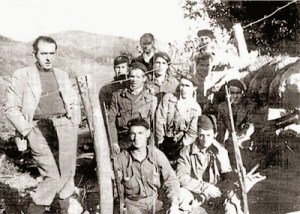
Felipe Bediaga (first left), commander of the Arana Goiri Battalion, the first military unit of the Basque Nationalist Party (PNV). He led the Battle of Elgeta on October 4th from the front line, via Askatasunaren Bidea
.
By 5-8 October, the Nationalist high command had to accept a harsh reality that their sweeping offensive from Gipuzkoa toward Bizkaia had effectively stalled against the rocks of Elgeta. The strategic importance of this failure cannot be overstated. By breaking the momentum of the Francoist advance, the Basque defenders saved Bilbao from immediate encirclement in the autumn of 1936. The fluid war of movement on the Northern Front officially came to an end. The military front line effectively stabilised and hardened along a permanent geographic wall: the Eibar–Elgeta–Intxortas–Kalamua–Saturrarán line.
.
On 8 October, the final sporadic skirmishes around the Kalamua–Zirardamendi–Aiastia sector ceased, and the front became completely static. The human cost of the preceding weeks of positioning was heavy; at least twelve Gudaris and leftist militiamen had lost their lives during the intense September–October fighting in this specific mountain sector alone.
From 8 October onward, the war in Euskadi transformed into a prolonged, frozen period of positional trench warfare. The Elgeta–Eibar front line became an unbreakable shield. For the next six months, young volunteers would peer through sandbagged loop-holes in the freezing mountain fog, holding the exact same rocky positions. This front line would remain fiercely unbroken until the massive, German-backed Francoist spring offensive of March and April 1937, cementing the Battle of the Intxortas as an enduring symbol of Basque anti-fascist resistance. The fight they put up was so ferocious that it completely broke the momentum of Mola’s autumn offensive, but for now, the amateur factory workers and Basque volunteers of Elgeta successfully created an unbreakable wall, turning the Intxortas into an enduring symbol of anti-fascist resilience.
.
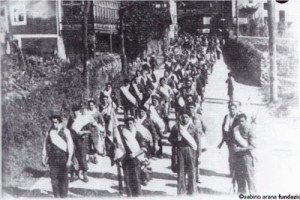
Arratia Company of the PNV, marching out of Elgeta front, having never fired a round in battle, and couldn’t speak Spanish, yet took on the army and won, 4 October 1936, via Askatasunaren Bidea
Comarca de los Vélez, Almería
In the autumn of 1936, Almería remained firmly under the nominal control of the Second Spanish Republic. However, a severe institutional breakdown allowed regional and municipal revolutionary committees to govern with unchecked authority. Between 3 October and 5 October 1936, a violent wave of political repression swept through the northern and coastal towns of the province, targeting local elites, right-wing sympathisers, and religious figures.
.
On 3 October 1936, extrajudicial violence officially spilled deep into the northernmost reaches of the Almería province. The day was marked by a brutal intrusion in the Comarca de los Vélez. Armed left-wing milicianos originating from nearby Huéscar (Granada) invaded the town of Vélez Rubio. Despite desperate attempts by the local Vélez Rubio town council and native militias to intervene and protect their neighbors, the invading force overrode them. The milicianos rounded up and summarily executed 25 local civilians at an isolated mountain pass known as Las Cumbres.
.
This event shattered any remaining rural security and served as the direct catalyst for identical purges across the province’s northern districts. Simultaneously, the small coastal fishing and mining hub of Garrucha housing roughly 3,500 inhabitants at the time, experienced its darkest historical hour. Over the night of 3–4 October, the local revolutionary committee orchestrated a synchronised saca , dragging 14 prominent local detainees from their cells. These 14 men were predominantly local prohomes, administrative figures, and conservative civilians who had occupied municipal roles during prior decades. Local historical works and oral testimonies have meticulously preserved the names of the victims, marking this as the primary wartime atrocity in Garrucha.
.
On the morning of 4 October, the executioners moved to systematically erase the evidence of the crime. The 14 bodies were transported to the Garrucha Municipal CemeteryThe victims were dumped into collective graves under conditions of maximum secrecy. To permanently prevent future identification and suppress information, the executioners flooded the graves with quicklime (cal viva) before filling the trenches with dirt.
.
The events at Vélez Rubio and Garrucha were not isolated incidents. Throughout early October, a sporadic wave of extrajudicial killings rippled through the northern-provincial rearguard, targeting landholders, local Guardia Civil, and Catholic clergy, including the parish priest of Garrucha, Juan García Cervantes, who was martyred during the wider autumn purge. This lawless environment only began to fully ease toward the end of October 1936, when the central Republican state slowly reassumed authority over provincial town councils, permanently shutting down the autonomous committees and stabilising the rear front.
Related
Got a comment, question or suggestion? Know who took a photo? Have questions about a particular date or event? Cancel reply