- Barcelona, Catalonia
On Sunday, November 22, 1936, the revolutionary city of Barcelona came to a complete standstill as hundreds of thousands of workers poured into the streets to mourn Buenaventura Durruti, the legendary anarchist militant, metalworker, and militia commander who had died two days earlier in Madrid while leading his column in the defence of the capital.
Throughout the night and into Sunday morning, his coffin lay in state inside the Casa CNT-FAI, the grand former employers’ headquarters on Via Laietana that had been seized by the anarcho-syndicalist unions in July. Draped in the red-and-black flag of the Confederación Nacional del Trabajo (CNT), the bier was flanked by an honour guard of militiamen from the Durruti Column. Thousands filed past in solemn silence before the doors were closed to begin the public cortege.
At 10:00am on 22 November, pallbearers carried Durruti’s coffin down the steps of the Casa CNT-FAI to the strains of the anarchist anthem Hijos del Pueblo (Sons of the People), played by a massed municipal band. Estimates placed the crowd at 500,000 people, nearly half the population of Barcelona at the time, bolstered by delegations arriving from across Catalonia and the Aragon Front. Because no official protocol or police force was permitted to direct the march, the immense gathering organised itself spontaneously.
The procession wound slowly up Via Laietana toward Plaça de Catalunya, before turning down the tree-lined promenade of La Rambla. Every balcony, lamppost, and rooftop along the route was crowded with onlookers, many holding clenched fists raised in salute. Militiamen, factory workers, women’s collectives, and columns carrying towering floral wreaths moved shoulder to shoulder at a funeral crawl, stretching across kilometres of city streets.
By early afternoon, the head of the procession reached the lower end of La Rambla at the Columbus Monument (Mirador de Colom), overlooking the harbour. Here, the cortege paused for formal eulogies delivered from a draped platform to the vast sea of mourners below.
The speakers reflected the fragile wartime alliance holding the Republic together. Juan García Oliver, Durruti’s lifelong comrade from the Los Solidarios affinity group who had recently entered the Republican government as Minister of Justice, urged workers to channel their grief into discipline and victory over fascism. Lluís Companys, President of the Generalitat of Catalonia, paid tribute to Durruti’s courage and sacrifice in defending Madrid, framing his death as a shared loss for both Catalonia and the Republic. Vladimir Antonov-Ovseyenko, the Soviet Consul-General in Barcelona (and a veteran of the 1917 Bolshevik Revolution), spoke on behalf of the USSR, signalling Moscow’s recognition of the anarchists’ decisive role on the battlefield. Federica Montseny gave a speech and called of greater discipline among Republicans anarchists to win the war.
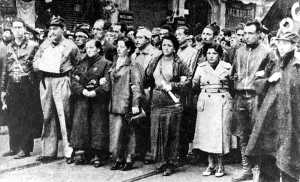
After the speeches concluded, the procession turned southwest toward Montjuïc, the steep hill overlooking the port where Barcelona’s municipal cemetery sits. However, the sheer scale of the crowd, combined with narrow approach roads, torrential emotion, and lack of centralised crowd control, slowed the march to a near standstill. By the time the coffin and its immediate escort reached the gates of the Montjuïc Cemetery, darkness had fallen and rain began to sweep over the city. With hundreds of thousands of mourners still packed along the slopes and roads below, cemetery officials and CNT leaders realised a proper interment was impossible that night.
Durruti’s coffin was placed temporarily inside the cemetery chapel overnight. The following day, with far smaller crowds present in the rain, Buenaventura Durruti was finally laid to rest in the cemetery at Montjuïc next to his best friend Francisco Ascaso. For the Spanish anarchist movement, the two-day farewell marked both its zenith of popular power and a sobering turning point: within six months, the revolutionary fervour visible on the streets of Barcelona in November would fracture violently during the May Days of 1937.
In 1977, Émilienne Morin revealed that Durruti is not in his grave; his body was moved in February 1939 before the Nationalists took Barcelona, for his own protection. Durruti is one of the only military leaders to die on the in battle during the Spanish Civil War, and even then, it seems more likely his own friend killed him by accident.
- Cartegena, Murcia
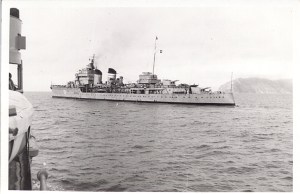
At approximately 9:00 am on 22 November, in the outer roadstead of the naval base at Cartagena, the Republican light cruiser Miguel de Cervantes lay anchored near Escombreras. One of the three modern Príncipe Alfonso-class cruisers in the Spanish fleet, the Miguel de Cervantes was among the Republic’s most valuable naval assets, vital for protecting coastal supply lines and contesting Nationalist control of the seas. Unbeknown to the cruiser’s lookouts, an Italian Regia Marina submarine, the Evangelista Torricelli, had slipped into Spanish waters. Commanded by Lieutenant Commander Giuseppe Zarpellon, the Torricelli was operating clandestinely under Mussolini’s orders, a direct violation of the August 1936 Non-Intervention Agreement signed by Italy, Germany, Britain, and France.
Manoeuvring into attack position at dawn, the Torricelli fired torpedoes at the anchored Republican warships. One torpedo slammed directly into the starboard side of the Miguel de Cervantes, blowing a massive hole in its hull (a second torpedo aimed at the nearby cruiser Méndez Núñez missed its mark). Several Republican sailors were killed instantly in the explosion and were later interred in a collective grave funded by the fleet at Cartagena’s Cementerio de Los Remedios.
Though the Miguel de Cervantes remained afloat, the strategic blow to the Republican Navy was severe. Because Cartagena’s dry dock was shorter than the cruiser’s 176-metre hull, naval engineers had to physically lengthen the dockyard infrastructure before full repairs could be completed. As a result, one of the Republic’s premier warships was side-lined for sixteen months, not returning to active service until March 1938. Republican divers subsequently recovered fragments of the torpedo, providing undeniable physical proof of Italian submarine warfare, yet London and Paris declined to take action through the Non-Intervention Committee.
- Málaga, Anadalucia
Since the military uprising of July 1936 and the rapid Nationalist advance through Cádiz and the Campo de Gibraltar, thousands of Spanish civilians had fled across the border seeking sanctuary inside the British territory of Gibraltar. Overwhelmed by severe overcrowding, sanitation pressures, and acute housing shortages on the Rock, British colonial and naval authorities organised periodic maritime evacuations to resettle displaced families in safer ports. On 22 November the Royal Navy G-class destroyer HMS Griffin departed Gibraltar bound for Republican-held Málaga. Aboard the warship were 157 Spanish refugees, 36 families, who were ferried eastward along the coast to be disembarked in government-controlled territory.
- Vitoria-Gasteiz and Zuazo de Kuartango, Álava, Basque Country
Antonio García Lorencés was one of roughly 200 people killed in Álava during the Nationalist repression of 1936, murdered in a saca on 22 November 1936. His death occurred during a decisive phase of the Spanish Civil War when rebel authorities in Vitoria-Gasteiz systematically eliminated republican, socialist, and anarchist leaders to secure their rear guard.
As a journalist and director of Álava Republicana, García Lorencés represented the vocal, progressive press that had championed the Second Spanish Republic in a largely conservative province. Alongside the murder of journalists like García Lorencés, the rebels dismantled the local media ecosystem. Republican papers were shut down or seized, such as the daily La Libertad, which was absorbed by the Falange and transformed into the propaganda organ Norte, joining the Carlist Pensamiento Alavés.
Álava was overwhelmingly rural, Catholic, and conservative. Left-wing parties and unions (PSOE, UGT, CNT) were small, isolated mostly in Vitoria-Gasteiz, and never posed a credible threat of armed revolution in July 1936. Once the military took Vitoria on 19 July without a fight, there were simply far fewer left-wing activists to target. Because the local population was deeply intertwined through conservative and Catholic networks, many left-leaning residents had relatives, neighbours, or employers within the Carlist Requeté, the Basque Nationalist Party (PNV), or the local clergy. Local priests and conservative notables frequently vouched for detainees, sparing them from execution lists in favour of fines or prison sentences. With the northern front stabilising just miles north of Vitoria (around Legutio and the Gorbea massif), rebel commanders quickly realised they needed a stable, productive rearguard to supply troops rather than a province paralysed by mass terror.
In Vitoria-Gasteiz, political detainees were held in facilities like the Prisión Provincial de Vitoria or the Convento de los Carmelitas. During a saca, Falangist or Carlist Requeté militias arrived at night with lists of prisoners authorised for transfer or release, only to drive them to remote roadsides, mountain passes, or cemetery walls to be shot without trial. While the peak of chaotic killings occurred in August and September 1936, sacas continued into the late autumn as military tribunals slowly began replacing extrajudicial executions with formal court-martials.
By autumn 1936, Álava was a critical frontline buffer bordering Republican-held Bizkaia. Rebel commanders sought to neutralise anyone suspected of disloyalty, including teachers, trade unionists (particularly from the CNT and UGT), civil servants, and republican politicians. Victims taken from Vitoria’s prisons were frequently executed at the wall of the Santa Isabel Cemetery (where nearly 200 people were shot over the course of the regime) or abandoned in ditches and mountain passes such as Azáceta, Altube, and Urbasa.
Cipriana Lataburu Murga was one of the few women executed during the Nationalist repression in Álava, killed on 22 November 1936, in Zuazo de Kuartango (Zuhatzu Kuartango). Zuazo de Kuartango is a small, rural municipality in the Añana valley (western Álava). Rural executions often involved local militias (Requetés or Falangists) acting on local denunciations, neighbourhood feuds, or suspicion of aiding Republican sympathies.
Out of the roughly 200 people executed in Álava during the war, only 10 were women. While hundreds of Alavese women suffered imprisonment, public humiliation (such as head-shaving and forced ingestion of castor oil), and economic ruin, lethal violence against women was rare in the province, making Lataburu Murga’s death stand out in local historical memory registries, as there is no available knowledge about why she would have so specifically targeted.
Historians estimate that around 200 residents of Álava were killed in the repression (a lower death toll than in neighbouring provinces, largely due to the lack of a local war front and the moderating influence of local conservative/Catholic networks). However, physical executions were paired with massive economic repression with heavy fines and asset seizures, and professional purges that ruined thousands of families.
Historical memory recovery in Álava is institutional, scientifically rigorous, and smaller in scale than in neighbouring provinces, with roughly 25 catalogued graves and fewer than a dozen exhumed so far. Because Álava had fewer mass killings than nearby Navarra, Bizkaia, or Gipuzkoa, its recovery efforts are defined less by massive pits and more by scattered roadside burials, municipal cemetery transfers, and targeted DNA identification led by the Basque Government’s Gogora Institute and the Aranzadi Science Society.
Most executions in Álava were night-time sacas involving small groups of 1 to 15 people dumped in mountain passes (like Azáceta or Altube) or rural ditches. Small, unmarked graves in dense forests or karst terrain are often harder to pinpoint decades later than large cemetery pits. • Many victims executed at the Santa Isabel Cemetery wall in Vitoria-Gasteiz, or initially buried in rural ditches, were quietly moved into common ossuaries (osarios) inside municipal cemeteries during the 1940s and 1950s, or lost beneath later cemetery expansions, making individual recovery nearly impossible. In several rural Alavese villages, families quietly retrieved their relatives’ bodies themselves during the late dictatorship or immediately after Franco’s death in the late 1970s, meaning those sites never entered modern archaeological registries.
- Santander (Cantabria) – Burgos Front
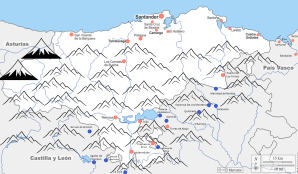
Following initial probing attacks starting November 18–21 by Republican columns advancing from Arija and Cantabria, Republican forces occupied Cilleruelo de Bricia (Burgos) and pushed into neighbouring Espinosa de Bricia (Santander). Because Espinosa sat in a depression below the ridge line and Cilleruelo commanded the high plateau, the fighting was intense and destructive. Nationalist reinforcements soon counterattacked from the south, forcing Republican troops to withdraw from Cilleruelo and leaving Espinosa heavily contested.
These engagements were small-unit, column-scale battles fought over tiny mountain hamlets, each home to only a few dozen to a couple of hundred residents, that sat astride the vital Burgos–Santander highway. Despite the miniature size of the villages, the fighting was fierce because whoever held the high plateau controlled the mountain passes into Republican Santander.
Cilleruelo de Bricia and Torres de Arriba/Abajo sat directly along or overlooking the main road connecting Nationalist Burgos to Republican Santander via the Puerto del Escudo and Puerto de Carrales passes. In October 1936, Nationalist Colonel Antonio Sagardía had pushed onto the Bricia plateau, creating a wedge threatening the Republican industrial hub of Reinosa and the Ebro reservoir. The Republican November offensive aimed to push Sagardía’s troops off the plateau and straighten the line. As part of a broader late-November push across the Northern Front (coinciding with attacks in Asturias and Villarreal/Legutio in Álava), the Republican Ejército del Norte sought to pin down Nationalist troops so they could not be sent to reinforce the siege of Madrid.
Attacks were carried out by ad-hoc columns and newly formed militia battalions advancing from Arija and Cantabria, typically numbering a few hundred to roughly 1,000–1,500 men per sector. The initial Republican column that marched out of Arija on November 18 toward Bricia consisted of 365 men (three companies plus a small infantry section and 62 pack animals), later reinforced by additional militia companies (such as the Tercio Chico column in Valdebezana). They were chronically short of rifles, artillery, and ammunition.
Initially, the plateau was held by scattered Nationalist detachments of Guardia Civil and Falangist militias. Following Colonel Sagardía’s arrival in October, the sector was defended by the Sagardía Column (later the 62nd Division) and battalions from regular regiments like the Regimiento de Infantería de San Marcial. Individual village garrisons often numbered only 50 to 150 men, supported by rapid mobile reserves brought in by truck from Burgos when an outpost was attacked.
Because the surrounding plateau was treeless, rocky, and bitterly cold at over 1,000 metres elevation, stone villages were the only shelter from winter frost and artillery. Both armies fortified individual stone houses, church bell towers, and dry-stone field walls, meaning taking a ridge required fighting house-to-house through villages of barely twenty families.
Shifting slightly northeast into the Valle de Valdebezana (near the Carrales pass) two days later, Republican units, including the Tercio Chico column, launched an assault aimed toward Soncillo and the Bricia salient. Aided by a diversionary attack at Quisicedo, they successfully captured both Torres de Arriba and Torres de Abajo. Nationalist forces immediately attempted to retake the two villages on 25 November, but Republican defenders held their positions and repulsed the counterattack, though they had lost at least 80 men in the fighting.
- Badajoz, Extremadura
Located right on the Portuguese border northwest of Badajoz, Alburquerque (see here for the background on the region) fell to rebel forces in August 1936, yet executions continued heavily throughout the autumn. The ten men killed across these two days continued repression targeted a cross-section of the local working and middle classes
22 November – Ángel Martín Astudillo, 38, a schoolteacher José Gómez Bernal, 29, a farmer, Alejandro Román Ferrera, 40, and Toribio Vaca Domínguez, 37.
23 November – Felipe González Resmella, 23, Antonio Lara Coriano, 23, Elías Refolio Román, 67, Juan Aparicio Méndez, 39, all day labourers, alongside bricklayer Rufino Aceituno Serrano, 44, and farmer Julio González Guerra, 30.
•Ángel Joven Nieto was 64-year-old landowner, president of the moderate republican party Unión Republicana in Badajoz, and head of the local Masonic triangle Renovación. Freemasons were prime targets of Nationalist paranoia; Joven Nieto was denounced and executed on 23 November alongside Francisco Cervantes de la Vega, Humberto Delicado Sánchez, and Avelino Pizarro Madera.
Located in southern Badajoz along the main Seville–Mérida highway, Fuente de Cantos had been experiencing severe repression since the Army of Africa stormed through the area in August. On 23 November, Elena González Ronquillo, 53, a housewife, Manuel González Ronquillo, 44, a day labourer, and Mariano González Ronquillo, 35, Salustiano Iglesias Lozano, Luis Moreno Hidalgo, and Rafaela Ruiz Melo were all executed. The execution of multiple siblings, including women, underscores how intensely personal and family-targeted the reprisals in southern Badajoz became.
- Sierra de Alcubierre , Huesca, Aragon
- Oviedo, Asturias
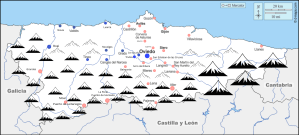
On 22 November, an air raid on Oviedo was a major preparatory bombardment ahead of the Republican Ejército Popular del Norte offensive launched four days later to cut the narrow Grado corridor and re-encircle the city. Although the famous three-month Siege of Oviedo had been broken on 17 October when Nationalist relief columns from Galicia forced a narrow land corridor through Grado, Oviedo remained a tight, vulnerable salient surrounded on three sides by Republican territory and subjected to relentless bombing until October 1937.
By mid-November 1936, Republican commanders in Asturias had reorganised their militias into 25–30 regular battalions to launch a major November–December offensive aimed at strangling the Grado supply corridor and capturing Oviedo. The 22 November bombardment by nine Republican aircraft, operating out of northern airfields such as Carreño/Gijón or Santander, was designed to disrupt Nationalist command centres, barracks, and munitions production days before the ground infantry assault began on 26 November.
Unlike Madrid or Barcelona, Oviedo had virtually no effective anti-aircraft defences or fighter cover in late 1936, allowing Republican bombers and converted transports (such as Breguet XIXs, Fokkers, and newly arrived Soviet aircraft in the north) to strike the compact city in daylight with relative impunity.
The Fábrica de Armas de la Vega (Arms Factory) and the Pelayo Barracks were the primary military objectives essential to the Nationalist garrison’s ammunition and troop staging.
Also, the Monte Naranco Foothills and El Villar were high ground immediately overlooking the city’s northern perimeter, where Nationalist defensive trenches and artillery batteries faced Republican lines, and needed to be broken.
In Oviedo city, the Cárcel Modelo de Oviedo and Hospital Clínico, located on the western/northwestern edge of the city (the Ciudad Naranco / Llamaquique sector, close to both the Pelayo barracks and the Naranco approaches), these facilities sat directly in the flight path and blast zone of inaccurate high-altitude bombing. The seven prisoners killed and 96 injured inside the Oviedo prison were predominantly Republican and left-wing detainees held by the Nationalist garrison, meaning Republican bombs struck their own imprisoned supporters locked inside the overcrowded jail. Alongside the prison casualties, the wounding of two women and two children reflected the broader reality of Oviedo’s war experience, where documented bombing fatalities across Asturias mounted steadily and roughly 1,000 Oviedo civilians died from air and artillery bombardments during the conflict.
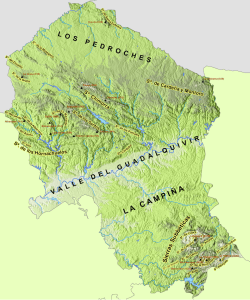
- Cordoba, Andalucía
According to historical reconstructions of Córdoba’s Provincial Prison archive, detainees held in the Provincial Prison (and the Alcázar de los Reyes Cristianos) were signed out at night by Falangist squads or Civil Guards under euphemistic transfer or release orders on 21November 1936. The prisoners were driven by truck to the Arroyo del Moro,the dry creek bed and open ground immediately bordering the northern wall of the Cementerio de la Salud on Córdoba’s western outskirts. This site was Córdoba’s primary execution ground during the autumn of 1936 (the same spot where French socialist journalist Renée Lafont had been shot weeks earlier). in the early hours of 22 November, the Nationalists executed Isabel Cano Artero, Francisco Moreno Carmona, Francisco Carmona Quero, Pedro Moreno Granados, Antonio Muriel Arjona, Juan Frías Labrador, Manuel Vida Ávila, and Francisco Sánchez Barrián.
Their bodies were recovered at dawn and entered into the burial books in mass grave trenches such as the Cuadro Virgen de los Dolores or Cuadro San Ramón. Córdoba capital suffered one of the highest per-capita repression rates in Spain, with over 4,000 people executed in the city alone during the war.
Late November was a period of static trench warfare and skirmishing on the Córdoba Front. Following the Nationalist capture of the Guadiato mining valley, Peñarroya-Pueblonuevo, in mid-October 1936, the front line in Córdoba had temporarily stabilised along a diagonal line running from Pozoblanco / Los Pedroches (Republican) down through Villaharta / Cerro Muriano (just north of Córdoba capital) and across the Guadalquivir valley toward Bujalance and Jaén.
Official war communiqués from November 21–22 report artillery exchanges, mortar fire, and rifle skirmishes along the Sierra Morena ridges (specifically around Villaharta, Cerro Muriano, and Obejo north of the capital) and in the Peñarroya / Valsequillo sector, with no towns changing hands. Both sides were regrouping ahead of the massive December 1936 Aceituna (Olive) Offensive, which Queipo de Llano launched on December 13–14 to conquer the rich agricultural towns of the eastern Córdoba countryside (Bujalance, Montoro, Villa del Río).
On 24 November, regular Nationalist troops occupied the municipality of Fuente-Tójar, bringing the town under Nationalist military control. In the days that followed, two large-scale prison removals took place in Córdoba city. On 25 November, twelve prisoners were extracted from custody, among them Francisca Arroyo Varo, María Aroca Muñoz, and María Vega Remujo. Two days later, on 27 November, a second group of seventeen prisoners was removed from prison in the city; their bodies were formally recorded at the San Rafael Cemetery on 28 November. Burial ledgers at Córdoba’s two main cemeteries, San Rafael and La Salud, document 2,311 named victims executed in the city during the war and postwar period (including at least 1,457 registered at San Rafael), though historians estimate the true number of people buried in the mass graves of those two cemeteries exceeds 4,000.