- Balearic Islands
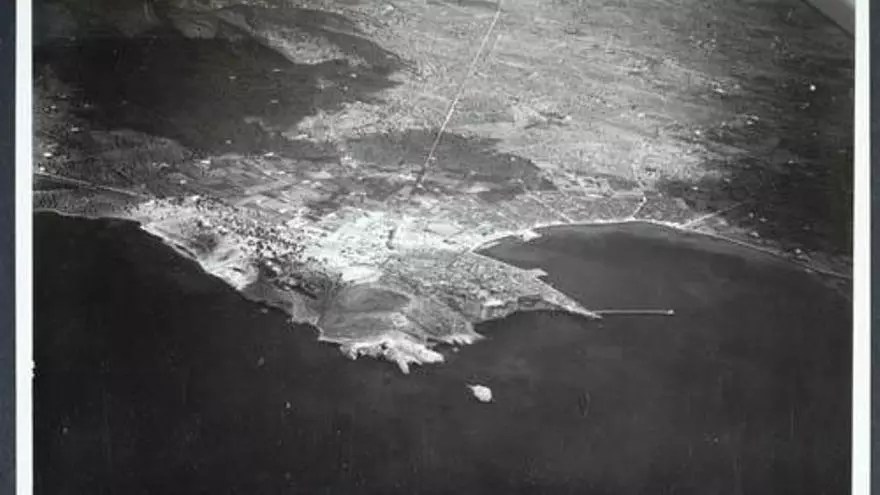
By September 1936, the Balearic Islands had become a fractured and bloody front line in the western Mediterranean. While Mallorca quickly fell under Nationalist control, the neighbouring island of Ibiza was held by Republican forces. However, the Republic’s hold on Ibiza was fragile and isolated. Operating out of their newly established bases on Mallorca, fascist Italian air forces, allied with General Franco, initiated a campaign of terror bombing to break Republican morale and prepare the island for a Nationalist invasion.
The assault on Ibiza began on 12 September 1936 with a preliminary airstrike. Italian aircraft flying from Mallorca swept over Ibiza Town, dropping bombs to test the island’s air defences and map out strategic targets. The true devastation struck the following morning, 13 September. Three heavy Savoia-Marchetti SM.81 bombers executed a massive, coordinated attack on the civilian and logistical heart of the island. The bombers unleashed approximately 2,000kg of high-explosive bombs directly onto the port and the surrounding town. Around 40 people were killed in the raid, though contemporary accounts suggest the final death toll may have been higher. The single most devastating strike occurred when a heavy bomb directly impacted Fonda Can Cires, a local inn and gathering place. The building collapsed instantly, killing approximately twenty people trapped inside.
.
As smoke rose from the ruined streets of Ibiza Town, panic and rage swept through the ranks of the Republican defenders. The local anarchist and socialist militias, traumatized by the slaughter of civilians and lacking a centralised military command, looked for a target for immediate retaliation. On the night of 13 September, an armed mob of Republican militiamen climbed the steep streets into Dalt Vila, the historic high-walled fortress overlooking the city. They forced their way into Ibiza Castle, which was being used as a makeshift political prison.
Inside the castle cells sat a large cohort of locals who had been rounded up over the summer under suspicion of supporting the July military uprising. What followed was a brutal, extrajudicial massacre of 93 prisoners. The victims represented a broad cross-section of the island’s right-wing and traditionalist society, including military personnel and Guardia Civil who had shown sympathy for the coup, local Catholic clergy and religious figures, active members of the fascist Falange party, conservatives, landowners, and prominent citizens deemed class enemies working with the incoming Italian bombers.
.
The dual tragedies of 13 September shattered any remaining stability on the island. The massacre at Ibiza Castle completely dismantled the Republic’s moral authority among the moderate local population, while the heavy Italian bombing proved that Ibiza was completely defenceless against modern air warfare. Recognising that a Nationalist invasion was imminent and that the island was untenable, the Republican militias abandoned Ibiza just days later. On 20 September 1936, Nationalist forces landed on the island and took control without facing major military resistance, immediately initiating their own severe wave of post-occupation reprisals against remaining left-wing supporters.
.
- Olivares de Duero, Valladolid, Old Castile
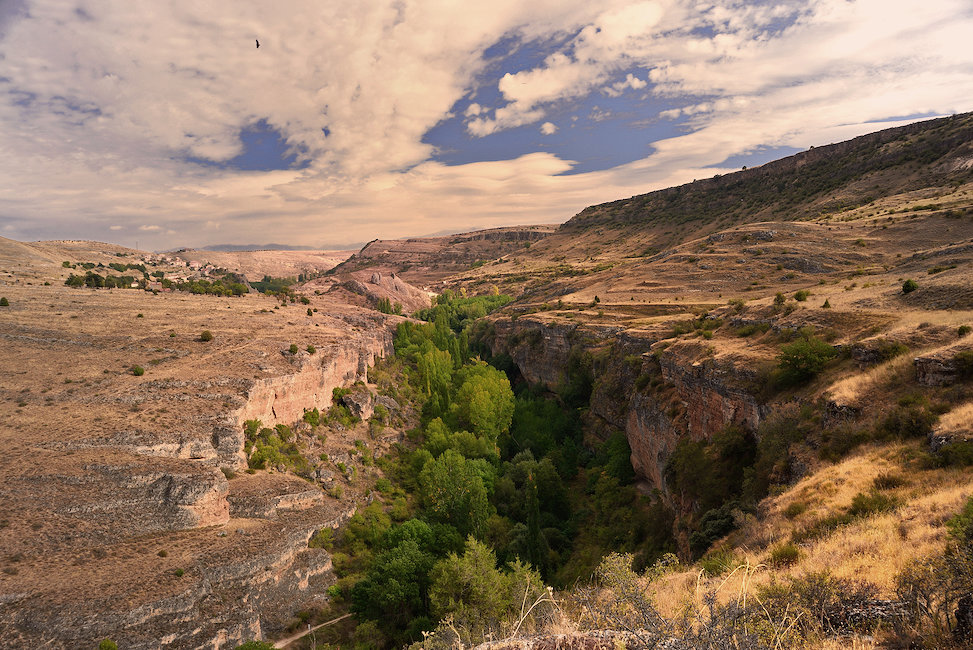
On 13 September, a group of men from Olivares de Duero were taken to the monte de La Planta, outside Quintanilla, and shot by Nationalist supporters. They had been detained the previous day by a Falangist patrol from Peñafiel. The six identified victims were Gonzalo Gómez Benavente, Félix Cortijo Toribio, Marcial Lázaro Miguel, Mauricio Lázaro Miguel, Gaudencio Toribio Sinovas and Teodoro de Diego González. One of the men initially survived the shooting, and a local forest guard found him wounded and concealed him in his house for two weeks. When the wounded man eventually died, the guard carried his body back to the site and buried him above the others. The mass grave was located on La Planta hill in the municipality of Quintanilla, on the VA-202 road towards Cogeces del Monte, lose to the fence of a property and surrounded by old pine trees. It was clearly defined as a mound rising from ground level. All seven victims have been identified and reburied.
.
These ordinary men had been trapped deep in Nationalist territory with no hopes of escape. The town of Quintanilla near their mass grave site renamed itself Quintanilla de Onésimo in July 1941. Onésimo Redondo Ortega was a prominent Spanish fascist political leader and co-founder of the national-syndicalist movement JONS, later integrated into Franco’s fascist state party. Dubbed the Caudillo of Castile by the Francoist regime, his legacy was heavily weaponised, culminating in a colossal monument that dominated the landscape of Valladolid for over half a century until its final demolition under modern memory laws. He was not much of a hero, dying on 24 July 1936, just days into the conflict, when he drove straight into an ambush with Republican militiamen in the town of Labajos, and the 31-year-old was shot and killed instantly.
.
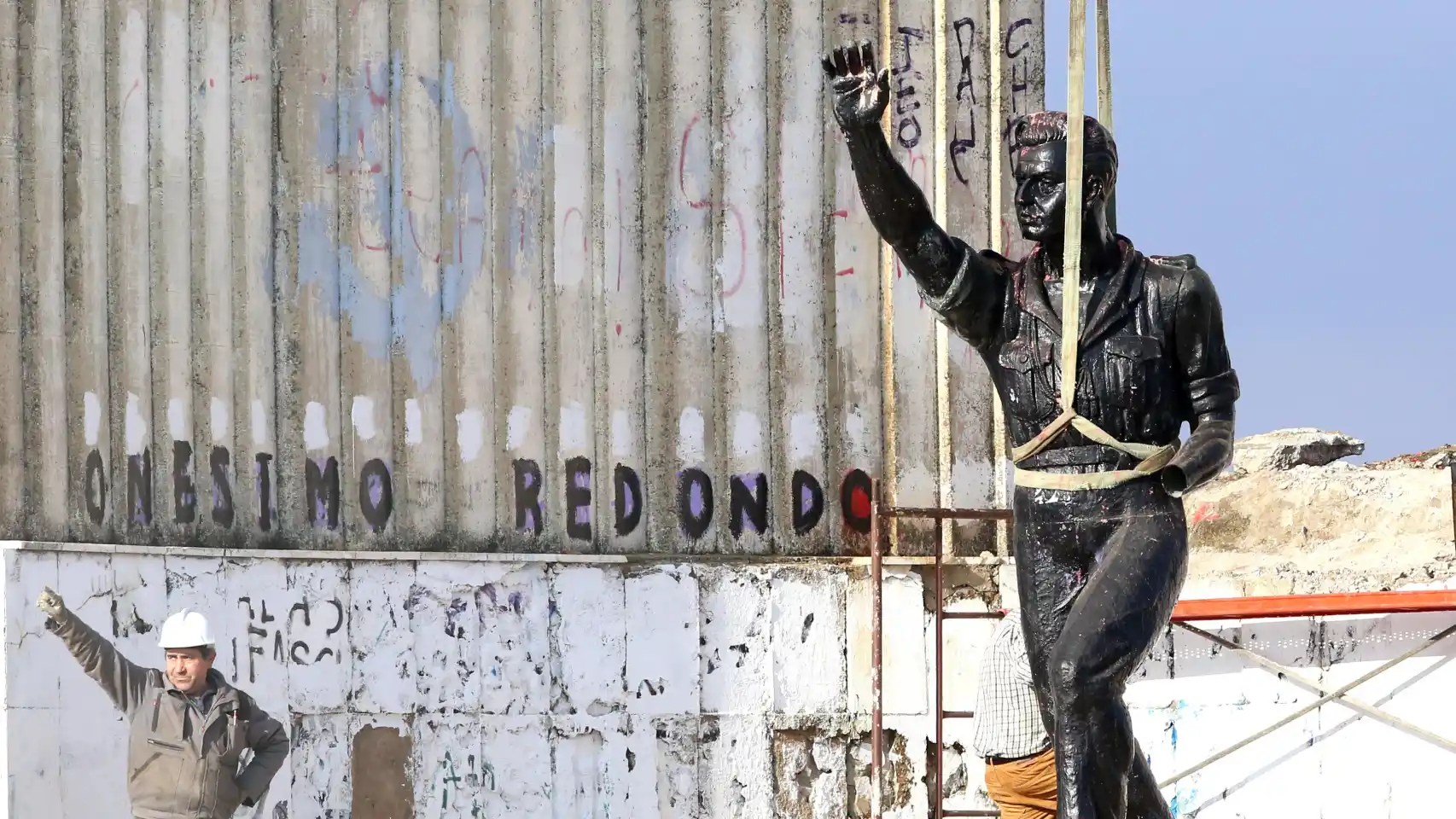
Franco’s propaganda machine immediately elevated him to a top-tier martyr of the crusade and renamed his hometown. Dictator Franco personally inaugurated a massive tribute on 24 July 1961 at the peak of the Cerro de San Cristóbal in Valladolid, a statue 31 metres tall, it was deliberately designed to be visible from virtually anywhere in the city, and bearing the Falangist symbol of the yoke and arrows. At the base stood five large bronze figures, with Redondo positioned in the centre raising his arm in the fascist salute, flanked by archetypes of a student, a farmer, a worker, and a militia fighter. The ugly thing was finally torn down in February 2016, despite locals trying to save it. Quintanilla de Onésimo retains its fascist-era name because local municipal leaders have repeatedly resisted administrative changes, and previous court rulings have allowed the town to delay or bypass modifications despite pressure from Spain’s memory laws.
.
- Malaga, Andalucía
In September 1936, the opening months of the Spanish Civil War, the western interior of Málaga province stood as a crucial stronghold of loyalist resistance. Towns such as Campillos, Teba, Almargen, and Cañete la Real were heavily fortified by local committees and Republican militias. At the heart of this defensive enclave sat the mountain city of Ronda, acting as the regional political and population nucleus for tens of thousands of citizens.
.
However, the Republican defensive network was dangerously fractured. While total manpower was high, it was spread thin across disjointed mountain villages, leaving individual locations exposed. Sensing this vulnerability, the Nationalist Army of the South, coordinated by General Gonzalo Queipo de Llano and led on the ground by General José Enrique Varela, launched a swift, devastating offensive designed to eliminate the Ronda front and establish a direct corridor to Granada.
.
On 12 September 1936, the Nationalist General Staff in Seville had issued the general order to advance. The following day, 13 September, Varela’s columns pushed aggressively westward from their headquarters in the deeply penetrated Antequera sector. Nationalist units overran Sierra de Yeguas and entered Campillos the same evening, forcing local militias to retreat. Campillos was highly strategic, controlling vital road and rail networks linking Antequera to the wider Ronda district. Concurrently, rebel columns occupied Almargen. By capturing Almargen, the Nationalists effectively tightened the vise from the northeast, severing communication lines and rendering the Republican front highly unstable.
.
With the northern flank compromised, the offensive pressed farther southwest into the mountains. On 14 September, the Nationalist columns attacked and occupied Cañete la Real. The fall of this rugged municipality stripped Ronda of its northern buffer zone, putting the Republican command centre under immense strategic pressure. Cut off from reinforcement, this sparked a desperate, massive exodus of civilian refugees fleeing down the mountains toward Málaga city.
.
As the front line rapidly rolled toward Ronda, the Nationalist rearguard enacted a system of immediate, lethal political cleansing. In Campillos, the repression began the exact night the town was occupied. Armed squads, frequently aided by local fascist Falangists, Moorish Regulares, and landowners operating as ;Volunteer Mounted Police,’ which were more like the wealthy killing innocents for entertainment, rounded up left-wing sympathisers, union members, and municipal officials. This initial wave of unchecked violence is historically termed the terror caliente (hot terror, as it was the height of summer), characterised by summary executions without even the semblance of a military tribunal. Victims were marched to the Campillos municipal cemetery, shot against the walls, and buried in unmarked trenches.
.
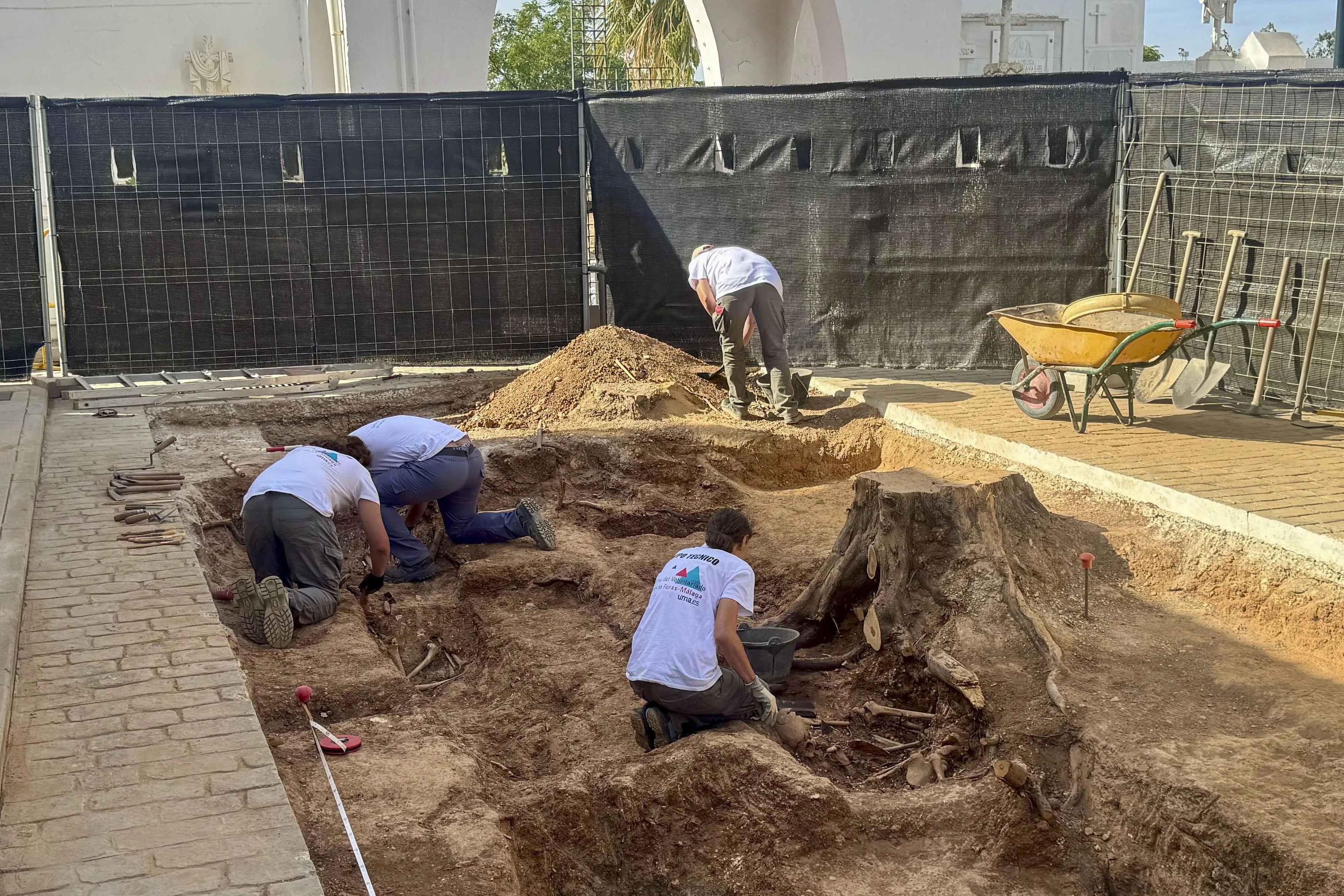
For decades, the true scale of the tragedy at Campillos was obscured. Recent systematic exhumations managed by technical teams from the University of Málaga (UMA) have exposed initial estimates anticipating roughly 70 to 100 bodies. However, the completion of the first grave’s exhumation phase alone yielded 113 bodies. Because the second, parallel grave is matching in size, experts now estimate the total death toll at the site to be around 200 victims. Forensic analysis of the skeletal remains shows indisputable evidence of extreme execution-level violence, and it was discovered that over 20% of the bodies recovered belonged to women. In standard Civil War mass graves, female victims generally account for only 3% to 5% of remains. This stark variance underscores the brutal, all-encompassing nature of the terror caliente as it tore through families in the northern Málaga countryside.
.
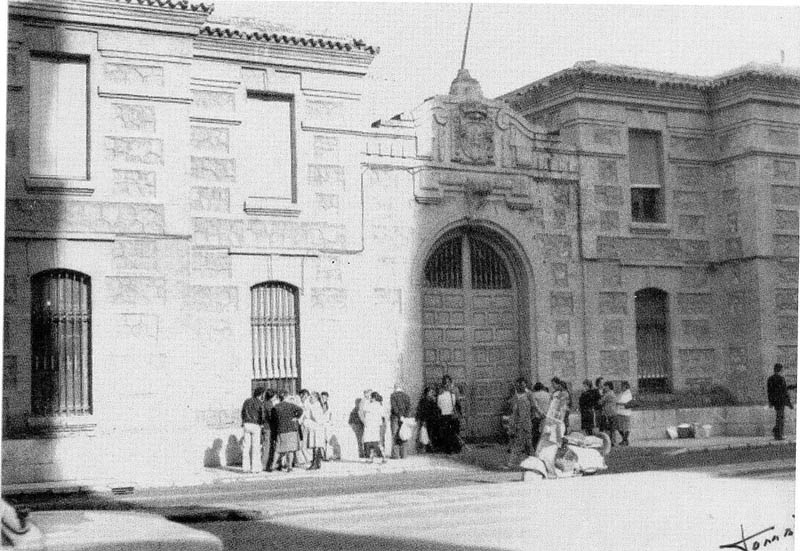
- Murcia
On the night of 12–13 September 1936, ten right-wing prisoners, headed by the provincial leader of the fascist Falange, Federico Servet Clemencín, were executed inside the Murcia Provincial Prison (Cárcel Vieja). The executions took place around 1:00am under immense pressure from a massive, armed civilian mutiny that besieged the building. This occurred despite a government telegram arriving from Madrid that explicitly ordered a temporary suspension of the sentences. The incident, which culminated in the bodies of several high-profile victims being dragged through the city streets, was later reconstructed in minute detail by Francoist military judges and historical investigations.
.
In the opening months of the Spanish Civil War, the Republican government established Tribunales Especiales Populares (Special Popular Tribunals) to try citizens suspected of participating in or aiding the military coup of 18 July 1936. In Murcia, the tribunal placed 24 defendants on trial for their roles in organizing the local civil plot to back the rebellion. On 11 September 1936, the court handed down its swift verdict – 14 defendants sentenced to varying prison terms, while ten were condemned to death by firing squad. Chief among those facing the death penalty was Federico Servet Clemencín, a prominent figure known for his ‘dialectic of fists and pistols’ who was accused of actively trying to persuade the local military garrison to rise against the Republic. Other notable condemned prisoners included Dr Ángel Romero Elorriaga, a prominent physician and president of the conservative Acción Popular, and Sotero González Lerma, the parish priest of the local Church of Nuestra Señora del Carmen.
.
According to historical analyses published by outlets like Público and documented by the Historical Memory Association of Murcia, popular anger in the city had reached a boiling point. A massive influx of civilian refugees fleeing Nationalist wartime atrocities in Badajoz and Granada had driven the local working-class population to a state of panic and fury.
In the late hours of 12 September, the low, roaring sound of caracolas (conch shells), traditionally used in the Murcian orchards to sound alarms for floods, echoed across the countryside. This time, the shells called the population to arms. A massive, angry crowd rapidly gathered and marched toward the gates of the Murcia Provincial Prison, demanding the immediate execution of the fascist conspirators.
.
Inside the prison, local authorities faced an impossible dilemma. A high-priority government telegram had arrived from the central authorities in Madrid, commanding an immediate stay of execution while the cases were legally reviewed. However, the civilian mob outside had grown completely unmanageable, threatening to breach the gates and massacre every right-wing inmate inside the facility. Fearing total loss of control, the prison administration and guards relented to the pressure of the mutiny. At approximately 1:00 a.m. on 13 September, the ten condemned men were brought out and shot inside the prison courtyard or within their cells.
.
The executions inside the prison did not pacify the crowd. The mob breached the perimeter, seizing the corpses of Servet, Romero, and Father González. In a macabre display of collective rage, the bodies were dragged through the main thoroughfares of Murcia and hung in public view before being discarded. Following the end of the Civil War, the event became a primary focus of Franco’s judicial apparatus. Post-war military investigations, such as the Causa General summaries housed in the Historical Archive of Murcia, meticulously reconstructed the exact chain of command, identifying the militia leaders and the prison officials who allowed the executions to take place. The Francoist dictatorship heavily weaponised the ‘Night of Murcia’ in national propaganda, transforming Federico Servet into the ultimate provincial martyr, naming neighbourhoods after him, and using the event to justify a brutal, decades-long campaign of post-war executions against anyone linked to the Republican judicial system.
.
- Toledo, New Castile
By the second week of September 1936, the Siege of the Alcázar of Toledo had devolved into a gruelling war of attrition. Major Vicente Rojo Lluch’s surrender conditions on 9 September had failed, as had the 11 September offer of a priest to offer absolution. The final attempt to breach the garrison’s resolve came from the international diplomatic corps. On 13 September, the Chilean diplomat Aurelio Núñez Morgado, acting as the dean of the international embassy network in Madrid, attempted to broker a humanitarian evacuation corridor. Núñez Morgado’s objective was to safely extract the roughly 500 women and children sheltering in the damp basements, shielding them from the heavy artillery and the underground mines being excavated by Asturian workers. For a third time, Moscardó rejected the offer. The Colonel claimed that the civilian women and children had chosen to remain of their own free will and would share the fate of the garrison. With the failure of the Chilean envoy, the diplomatic phase of the siege came to an end. The refusal to compromise set the stage for the destructive mine detonation and infantry assault that followed on 18 September.

