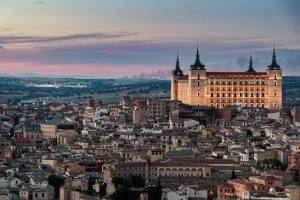
By the second week of September 1936, the Siege of the Alcázar of Toledo had devolved into a gruelling war of attrition. Trapped inside the massive stone fortress, roughly 1,300 Nationalist defenders under Colonel José Moscardó, alongside approximately 500 women and children, faced relentless Republican artillery fire and the threat of underground mines. Desperate to resolve the siege before the advancing Army of Africa arrived, the Republican government attempted a different approach. Over five dramatic days, a series of military, religious, and diplomatic envoys crossed the lines under flags of truce, attempting to dismantle the fortress’s resistance with words rather than explosives.
.
Inside the Alcázar since the outbreak of the war in July were 600 Guardia Civil men, who formed the well-trained backbone of the defence under their own regional commander. They were joined by 150 Regular Army officers, 35 local Falangists, 25 monarchists, 10 Requetés, 40 local peasants, and roughly six military cadets. Trapped beside them were 520 women (primarily the wives, daughters, and relatives of the Guardia Civil and officers), 50 children, and another 100 men too old or incapacitated for active combat. Additionally, the garrison held roughly 30 to 50 left-wing hostages.
.
The academy housed horses and mules for transport and training. When normal food supplies ran out in August, the garrison began slaughtering these animals one by one under the supervision of the veterinary staff. Because the upper kitchens were exposed to enemy fire, cooking was moved down into the damp, dark basements. Wood was scarce, so soldiers burned old furniture, window frames, and wooden beams from the ruined academy rooms to boil the tough, stringy horse meat. The barley and oats originally meant for the horses were diverted to human consumption, ground down in makeshift hand mills to bake hard, dark bread biscuits.
Water was much more precious than food. The entire population relied on a single deep well located in the central courtyard of the fortress. Accessing the well meant crossing an open stone patio exposed to Republican snipers and machine guns; water carriers faced lethal danger every time they made a trip with buckets. Water was measured down to the drop. Each person received a tiny, strictly controlled ration each day, often just a few sips served in bottle caps or small metal cups. Officers eventually used vinegar or diluted wine to wet the lips of the wounded and children to help ease their thirst.
With hundreds of people packed into close, unventilated cellars, maintaining hygiene was an existential challenge. Moscardó enforced strict waste-disposal routines and utilised lime to prevent outbreaks of typhus or dysentery. The women sheltering in the basements organised work details. They washed clothes, mended uniforms with scraps of fabric, cared for the sick, and helped distribute the meagre rations to the children. Their husbands and fathers had chosen to bring them inside the fortress for safety at the outbreak of the war, trading the uncertainty of the militia-controlled streets for a life of cleaning duties under the constant threat of falling bombs and artillery fire.
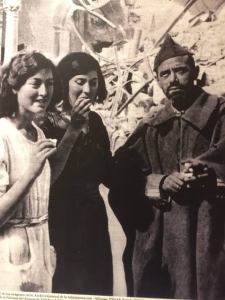
The conditions in the cellars were dark, damp, and lacked basic medical supplies. Despite this, two infants were delivered safely by the garrison’s medical staff. To commemorate their extraordinary birthplaces, the parents gave the children deeply symbolic names, including Restituto Valero Ramos (often called Restituto Alcázar Valero), and Milagro del Alcázar (or Josefa del Milagro). Another very young child born right before the siege began was named Jose Manuel Alcázar and also survived the siege in the cellars. Archival photographs of the relief of the siege famously show the military governor, Colonel José Moscardó, triumphantly holding Restituto Valero Ramos up for the press cameras. (In a twist of historical irony, Valero Ramos grew up to serve as an officer in the Spanish military under the Francoist regime, only to be formally expelled in the late 1970s during Spain’s transition to democracy. He had secretly joined the Unión Militar Democrática (UMD), an underground organisation of democratic military officers who opposed the remnants of the dictatorship, rebranding his legacy from a symbol of Nationalist myth into a proponent of democratic reform!)
.
The first formal diplomatic opening of the month occurred on 9 September 1936, when Major Vicente Rojo Lluch crossed the battered plaza under a flag of truce. Rojo was a highly respected Republican military officer and a former professor at the Alcázar’s infantry academy, making him uniquely suited to speak to the defenders in their own language. Rojo was blindfolded and led into the subterranean offices of his former colleague, Colonel Moscardó. He offered an honourable surrender with the safe passage of all women and children, and the guarantee that the officers would face regular courts-martial rather than summary execution. Moscardó flatly refused to yield the fortress. However, recognising the psychological weight of their long isolation, the Colonel made a counter-request, asking Rojo to arrange for a priest to be allowed inside the citadel to administer sacraments and baptise the children.
Republican authorities granted the request, hoping a man of the cloth might convince the defenders to stand down. On 11 September, Father Enrique Vázquez Camarasa, a prominent left-leaning canon from Madrid, was permitted inside the Alcázar for three hours. Camarasa’s visit quickly transformed into a profound spiritual event. Surrounded by hollow-eyed soldiers and terrified families in the dim basement galleries, he performed a mass absolution for the entire garrison and baptised the newborns. He then delivered a sermon that went beyond religious comfort, directly urging the defenders to surrender to prevent further bloodshed and save their families. His words failed to move the officers. Before Camarasa departed, the garrison leadership chose unanimously to hold their positions.
The final attempt to breach the garrison’s resolve came from the international diplomatic corps. On 13 September, the Chilean diplomat Aurelio Núñez Morgado, acting as the dean of the international embassy network in Madrid, attempted to broker a humanitarian evacuation corridor. Núñez Morgado’s objective was to safely extract the roughly 500 women and children sheltering in the damp basements, shielding them from the heavy artillery and the underground mines being excavated by Asturian miners. For a third time, Moscardó rejected the offer. The Colonel claimed that the civilian women and children had chosen to remain of their own free will and would share the fate of the garrison. With the failure of the Chilean envoy, the diplomatic phase of the siege came to an end. The refusal to compromise set the stage for the destructive mine detonation and infantry assault that followed on 18 September, cementing the Alcázar as a symbol of absolute, uncompromising resistance.
.
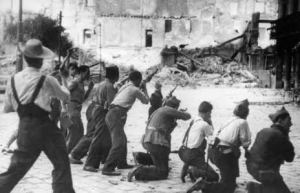
The Republic did not have a regular army outside the gates; it still relied on a loose coalition of the improvised but passionate workers’ militias organised by political parties and unions, specifically the anarchist CNT-FAI and socialist UGT. For the militiamen stationed behind the sandbags, life consisted of long stretches of boredom broken up by violent bursts of close-quarters fighting near local landmarks like the Santa Cruz Museum and Zocodover Square. International photographers who visited the lines captured snapshots of young men and women smoking, reading revolutionary pamphlets, and throwing improvised hand grenades over barricades made out of horse saddles. Because the militias rejected traditional military hierarchy, coordination was difficult. Orders from professional officers were often debated by committee before being executed. This lack of centralised military command frustrated the Republican leadership as they tried to finalise operations against the fortress, but despite all of this, their commitment to saving the city could not be questioned.
.
With the local right-wing infrastructure holed up inside the Alcázar, the streets of Toledo experienced an immediate shift in social power. Revolutionary committees took over local administration, and private estates were confiscated. Labour unions quickly collectivised local industries, including Toledo’s prominent Fábrica de Armas (Arms Factory). Just hours before the gates of the fortress slammed shut, Republican forces successfully stripped the factory of truckloads of ammunition, ensuring the besieging militias were heavily armed. Everyday commerce was rapidly repurposed to supply the thousands of troops outside the walls. Concurrently, strong anticlerical currents swept through the city; churches, monasteries, and religious spaces were converted into military barracks, supply depots, or makeshift casualty clearing stations.
.
For ordinary citizens who had not fled, life in Toledo was tense and highly insecure. Because Republican forces cut off the water pipelines feeding into the Alcázar, the supply to nearby civilian sectors was heavily disrupted. Photographic evidence from the period documents long lines of local women and children waiting by municipal fountains in front of the Town Hall to fill ceramic jars and metal buckets.
.
As General Varela’s Army of Africa made its rapid, brutal push northward through the Tagus Valley, thousands of rural refugees flooded into Toledo and Madrid. These displaced populations carried horrific accounts of Nationalist massacres, fuelling a climate of panic. Yet, because Toledo was easily accessible by train and car from Madrid, it became a bizarre focal point for global media. Foreign journalists, politicians, and writers travelled from the capital on day trips to view the spectacle of the siege. Local cafés and taverns outside the immediate combat zones did brisk business serving wine and meals to reporters waiting for updates. This intersection of civilian life and military theatre peaked on the night of 17 September. When the Asturian miners finalised their explosive tunnels, Republican authorities patrolled the streets with loudspeakers, ordering an immediate evacuation of the eastern quarters. Hundreds of residents gathered on the outer ridges of the Tagus gorge, waiting through the night to watch the massive explosion at dawn.
.
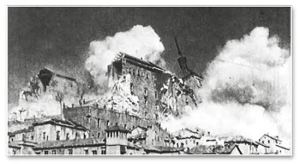
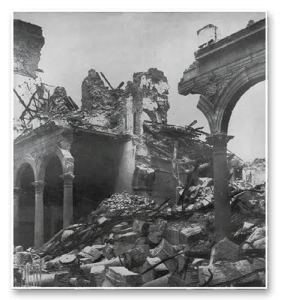
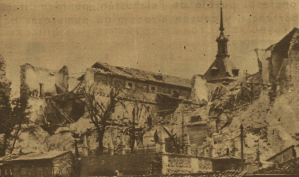
Specialised coal miners from Asturias had been brought in by the Republican high command to excavate two horizontal mine shafts through solid granite toward the southwest tower of the Alcázar. The excavation required 33 days of continuous labour, exposing the miners to structural collapses, asphyxiation, and the threat of counter-mining by the defenders. The psychological strain on the Nationalist garrison inside had been immense. Trapped in subterranean galleries, the defenders spent days listening to the rhythmic, echoing thud of picks beneath their feet, fully aware of what the noise portended. By the night of 17 September, the preparation phase concluded. The miners packed the subterranean chambers with a massive combined payload of nearly 10,000kg of high explosives, wired directly to electrical detonators. At approximately 6:30 AM on 18 September, the plunger was depressed. The detonation sent a massive shockwave that rattled the ancient structures of Toledo, shattering glass windows for miles around and generating a boom rumoured to be heard as far away as Madrid. When the air cleared, the entire great southwest tower had toppled into complete ruin, and the western façade of the quadrangular fortress lay completely sheared away, reduced to a monumental mountain of brick and stone debris.
.
The military operation that followed was a high-intensity offensive. Republican Prime Minister Francisco Largo Caballero travelled directly from Madrid to witness the destruction first-hand and oversee what was intended to be the final, decisive breakthrough. To clear a path for the infantry, Republican artillery batteries immediately poured a ferocious, 15-minute barrage into the flaming ruins. As the artillery fire ceased, a major assault force of over 1,500 organised union militiamen surged up the hill, spearheaded by armoured cars and tanks. Believing the explosion had completely eradicated the garrison, the infantry swarmed the smoking breaches. However, the assault quickly ran into a tactical paradox that would later characterise the Battle of Stalingrad; reducing a stone fortress to heavy rubble often favours the defenders. While the upper towers had collapsed, the vast majority of Moscardó’s garrison had survived the blast by sheltering deep within the thick, vaulted cellars of the academy.
.
As the Republican militias attempted to scramble over the steep mounds of loose masonry and shattered stone beams, their advance was completely broken up by the obstacle course of terrain. From the jagged lips of the craters and surviving basement slits, the Nationalist defenders emerged with machine guns and rifles, unleashing a devastating crossfire. The chaotic infantry charge stalled on the slopes of the debris, and despite the absolute destruction of their landmark fortress, the defenders successfully repelled the onslaught.
As the Republican militias grew increasingly desperate, the broader focus of the war expanded beyond the city limits. Throughout August and early September, the core of the Nationalist military might, the Army of Africa, had been carving its way northward from Seville. Composed of battle-hardened Moroccan Regulares and the ruthless Spanish Foreign Legion, these columns operated with absolute professional efficiency and psychological brutality. Led initially by Lieutenant Colonel Juan Yagüe and later overseen by General José Enrique Varela, this force executed a scorched-earth campaign up the Tagus River valley.
As the columns made their way toward Toledo, they engaged in a series of swift, devastating encounters against poorly trained, improvised Republican worker militias. Towns like Zafra, Almendralejo, Mérida, and Badajoz had already fallen, followed in early September by the strategic captures of Talavera de la Reina and Santa Olalla. The Army of Africa’s advance was defined by tactical velocity and systematic rearguard pacification. The columns avoided protracted urban sieges by using flanking manoeuvres, scattering the militias with concentrated artillery and air support from German-supplied aircraft. In every captured town, the shock troops implemented a doctrine of deliberate terror. Left-wing municipal officials, trade unionists, and suspected Republican sympathisers were systematically rounded up and executed by firing squads, leaving a trail of mass graves across the landscape. By mid-September, this relentless advance had reached the outer boundary of the Toledo province, directly threatening the Republican rearguard.
.
By 20 September, the Army of Africa had advanced to the town of Maqueda, located at a critical crossroads. From Maqueda, the highway to the north offered an unobstructed, 40-kilometre path directly into the under-defended capital of Madrid. To the southeast lay Toledo and the besieged Alcázar. In a move that sparked intense debate among his military peers, General Franco ordered his columns to halt their advance on Madrid and pivot toward Toledo. Militarily, the decision was highly controversial; it granted the Republican authorities in Madrid nearly a month of breathing room to fortify the capital and organise the International Brigades. However, Franco recognised that the political and psychological value of the Alcázar far outweighed immediate tactical gains. The global press had turned the 1,300 trapped Nationalist defenders into a living myth of anti-communist resilience. By presenting himself as the liberator of the historic fortress, Franco secured absolute ideological authority over the Nationalist faction.
.
Inside Toledo, the Republican militias knew their window of opportunity was slamming shut. Panicked by news of the approaching African columns, they launched a sequence of aggressive, desperate assaults to crush the garrison before Varela arrived. On 20 September, Republican forces brought thousands of litres of gasoline and improvised flamethrowers to the Alcázar ruins. They sprayed the liquid fuel directly into the lower slits and basement windows of the intact outposts, igniting a massive blaze that filled the cellars with suffocating, toxic smoke. The defenders held their breath behind wet rags, refusing to abandon the burning walls. On 23 September, the Asturian miners detonated a second major subterranean mine, targeting the northern façade of the structure. The explosion caused localised structural collapses, but the subsequent infantry charge was instantly cut to pieces by Nationalist machine-gun fire originating from deep within the rubble.
.
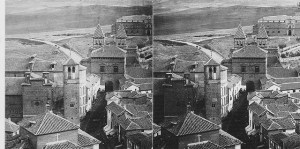
The Puerta de Bisagra over the main road in and out of Toledo where the Army of Africa would approach the city, via Alfonso Begué, Toledo Olvidado.
On the morning of 26 September, the forward vanguard of the Army of Africa broke through the outer ridges of the valley. General Varela’s professional columns systematically surrounded the city, cutting off the Republican highway links and rail lines back to Madrid. On 27 September, Varela’s professional shock troops surged into the streets of Toledo. The arrival of the Nationalist relief column was met with resistance, though the Republican worker militias collapsed rapidly under the assault. As the battle-hardened Moroccan Regulares and Spanish Foreign Legionnaires pushed into the city, heavy small-arms fire and artillery exchanges echoed across Zocodover Square and the surrounding alleys. Realising they were completely outflanked and outgunned by the advancing professional army, the remaining Republican forces initiated a retreat eastward out of Toledo.
.
The Moroccan troops and Legionnaires fought their way through the barricades of Zocodover Square and reached the smoking ruins of the infantry academy, establishing physical contact with Colonel Moscardó’s haggard garrison. Emerging from the pitch-black cellars into the sunlight, a skeletal Moscardó saluted Varela and delivered the phrase that would become the central myth of the Francoist regime, Sin novedad en el Alcázar (Nothing new to report at the Alcázar). While the relief of the fortress was celebrated globally as a triumph of military and nationalist endurance, the immediate aftermath inside the city was devastating. The entry of the Army of Africa triggered an intense wave of retributive violence through the streets of Toledo. The shock troops carried out systematic sweeps, executing any remaining militia members or citizens suspected of participating in the siege. In one of the most notorious incidents of the day, Nationalist troops entered the Hospital de Tavera and summarily executed over 200 wounded Republican militiamen in their hospital beds using hand grenades and firearms. Varela’s forces executed more than 800 unarmed people in the immediate hours and days following their entry into the city.
.
Physical contact with the garrison was established immediately on 27 September. When Varela’s men cleared the immediate rubble and approached the battered entrance, Colonel José Moscardó emerged from the dark, soot-stained basement vaults to officially meet and salute the arriving officers, marking the formal end of the 71-day siege. The systematic evacuation of the surviving women, children, and wounded soldiers from the deep crypts followed shortly after safety was secured. Approximately 65 Nationalists were killed in action during the siege, dying from direct artillery hits, sniper fire, and mine explosions, while about 430 more suffered various wounds and injuries over the course of the entrapment. Among the roughly 500 women and children sheltering in the deep cellars, zero were killed by enemy combat, and the five civilian deaths that did occur inside the walls were entirely from natural causes related to illness or old age.
Conversely, all of the left-wing hostages held inside the Alcázar had been executed by the Nationalists just before the siege was lifted. Their treatment and eventual fate were heavily suppressed or entirely omitted from Francoist wartime propaganda to project an image of the fortress solely as a noble refuge for innocent civilians. For the 71 days of the siege, these hostages were kept deep inside the dark subterranean cellars, with at least one journalist later claiming they were found chained to railings. As the Army of Africa broke through the outer Republican lines, the Nationalist garrison executed the prisoners to prevent them from being liberated or providing information to the arriving forces.
However, historical research later proved that the Republican Civil Governor of the province, Manuel María González López, did not enter the fortress as a hostage. Instead, he actively sought sanctuary and refuge inside the Alcázar alongside his wife and children to escape the revolutionary chaos unfolding in the streets of Toledo. Colonel Moscardó himself later testified that González López was actively involved in, or deeply sympathetic to, the military conspiracy. In the final days leading up to the uprising, the Governor deliberately stalled and misdirected orders from the central government in Madrid, which was desperately demanding that Toledo’s prominent Arms Factory ship its ammunition reserves to protect the capital. By delaying the shipments, González López granted Moscardó the crucial window of time needed to securely move those ammunition crates inside the Alcázar walls.
Because of his hidden collaboration, González López and his family lived a completely different reality than the regular left-wing hostages inside the crypts. While the actual Republican trade unionists and workers were kept in squalor and ultimately executed, the Civil Governor and his family were held under a privileged regime of house arrest. They were given separate quarters, shielded from the general prisoner population, and treated with deference by the officer corps. On 27 September, González López and his family were quietly and safely evacuated. He returned to his home region of Galicia, entirely unmolested by the new regime. To guarantee his safety from overzealous Falangist squads in the rearguard, Colonel Moscardó personally signed an official certificate of loyalty to the Nationalist cause for him, effectively granting the former Republican governor complete immunity and exposing the myth of his captivity once and for all, and lived until old age in comfort, a sadly recurring theme for fascists, their sympathisers, and those who sought to harm the innocent people of Spain.
.
On the day of the uprising and González López’s staged arrest, his secretary, Conchita, learned that her boss was confined inside the Alcázar. Acting out of pure professional loyalty and entirely unaware that González López had secretly entered the fortress voluntarily as a coup collaborator, she presented herself at the gates to continue serving him. The Nationalist officers admitted her, but she was quickly separated from the Governor’s inner circle. Unlike the traitor Governor’s family, who spent the 71-day siege in relative comfort and connivance with Colonel Moscardó, Conchita made no attempt to hide her political allegiances. Throughout her confinement, she expressed clear sympathy for the Spanish Republic. Relegated to the standard, squalid subterranean cells alongside the other left-wing worker hostages and political prisoners rounded up from the streets of Toledo, Conchita met a grim fate. She was summarily shot by a Nationalist firing squad during the chaos of the city’s liberation, while her boss was safely escorted back to Galicia.
.
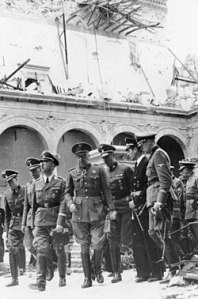
The days following the relief of the Alcázar on 27 September 1936 transformed Toledo from a battlefield into a scene of intense retributive violence, high-stakes military rebranding, and a massive international propaganda spectacle. Over the next 48 hours, Moroccan Regulares and Legionnaires conducted house-to-house searches. They hunted down any remaining Republican militia members, trade unionists, or left-wing sympathisers who had failed to flee toward Madrid, resulting in the murder of over 800 civilians. On 29 September, Franco flew directly to Toledo. He walked through the smoking ruins of the Alcázar, shook hands with a haggard Colonel Moscardó, and posed for a flurry of international press photographs. Just one day later, on 30 September, the Nationalist National Defense Junta formally appointed Franco as the Generalísimo (Supreme Commander) of the armed forces and Head of State of the rebel government. The myth of the Alcázar had successfully secured his absolute dictatorship over the Nationalist faction.
.
The revolutionary experiment that had taken over Toledo’s streets in August and September was completely eradicated. Local revolutionary committees were dissolved, and their members were arrested. Factories, including the prominent Toledo Arms Factory, were stripped of union control and placed under strict military administration to fuel the Nationalist war machine. The anticlerical environment evaporated overnight. Catholic icons, banners, and statues were re-installed throughout the public squares, and the clergy returned to conduct public masses of thanksgiving alongside the newly installed military authorities.
By early October, Toledo became a primary hub for international journalists, fascist dignitaries, and right-wing sympathisers from across Europe. The Nationalist high command organised guided tours of the ruins, using the hollowed-out towers and the stories of the subterranean births to craft an enduring narrative of anti-communist resilience that successfully swayed international public opinion.
.
Hubert Renfro Knickerbocker, a Pulitzer Prize-winning American journalist who covered the Spanish Civil War from the Nationalist side, wrote for an anti-communist newspaper empire. He published The Siege of Alcazar: A Warlog of the Spanish Front, labelling Republican forces ‘Reds’ and the rebel forces as the heroic ‘Whites.’ His writing focused heavily on the suffering of the women and children in the cellars, despite them being relatively safe from direct infantry combat, and framed the fascist takeover of Toledo as a glorious victory for Western civilisation. British military man and author Geoffrey McNeill-Moss arrived in Toledo immediately after the siege was lifted to meet Colonel José Moscardó. He wrote the definitive English-language account of the event, The Epic of the Alcázar, which solidified the fascist myths of the siege for the English-speaking world. McNeill-Moss entirely omitted the executions of left-wing hostages and the post-liberation hospital massacres, painting a pristine picture of military chivalry. William P. Carney, assigned to the Nationalist side, became a fiercely partisan reporter for their cause. Carney’s dispatches systematically bypassed Republican censorship by phoning his pieces in from French border towns. His heavily pro-Nationalist stance caused major internal rifts at The New York Times with his colleague Herbert Matthews, who was reporting from the Republican lines. The Daily Mail’s Harold Cardozo travelled directly with the vanguard of the Spanish Foreign Legion and the Moroccan Regulares, detailing the notoriously violent shock troops as professional, orderly, and fiercely courageous. The famous Greek novelist Nikos Kazantzakis was dispatched to Spain in October 1936 by the prominent Athens newspaper Kathimerini. Though he claimed to be impartial, he created romanticised tales of the Nationalist defenders of the Alcázar, comparing them to the historic Greek heroes of the Siege of Messolonghi, heavily praising Franco’s uprising as a necessary ‘crusade.’
.
In a time when Spaniards were dying at the hands of their own countrymen, powerful nations like Great Britain, France, and the United States chose non-intervention, hoping fascism would just be a passing phase. The fascist propaganda espoused by international correspondents helped aid this ideology to take root in Europe, eventually arriving on their own doorsteps.
.
For decades under the Francoist dictatorship, the memory of those executed by General Varela’s Army of Africa during the capture of Toledo was rigorously suppressed. Instead, the regime focused its public monuments exclusively on celebrating the ‘Heroes of the Alcázar.’ Modern efforts to commemorate the Republican casualties include the memorial at the Nuestra Señora del Sagrario Cemetery, located at the Plaza de San Eugenio within Toledo’s municipal cemetery. A formal monument was inaugurated there on 6 February 2019. The plaque explicitly reads: ‘In recognition of those who were victims of the Spanish Civil War and those who suffered from the repression of the authoritarian regime of Franco.’
The cemetery houses several mass burial areas, including the infamous Patio 42 (often called the Patio of Silence or Patio of Charity). These pits hold the remains of at least 1,343 recorded victims, which includes those killed in the immediate, violent street-cleansing sweeps (razias) by the troops in late September 1936, as well as subsequent post-war court-martial executions. In May 2022, a public historical search database was published containing biographies, professions, and exact burial locations for over 1,000 of the victims identified within Toledo’s cemetery registries. To this day, there is no dedicated, standalone on-site monument inside the historic Hospital de Tavera complex to mark the estimated 200+ wounded militiamen and civilians executed in their beds. Those victims are instead broadly incorporated into the names remembered at the collective cemetery monument.
.
In modern-day Spain and Toledo, the Siege of the Alcázar is viewed through a deeply polarised lens. This memory contrasts a lingering right-wing romanticism of the garrison’s resistance with critical democratic historical memory that emphasises the brutal rearguard violence and propaganda myths of the Francoist regime. The retention of specific symbols, such as the surviving bullet marks, the monument to the besieged outside the fortress, and Moscardó’s preserved office, serves as an ongoing touchstone for those who view the garrison as noble defenders. Conversely, modern scholarship has successfully dismantled several core propaganda elements, such as the exaggeration of the number of military cadets inside the walls and the concealment of left-wing hostage executions. Critics highlight the severe civilian cost and the violent retaliatory purges carried out by the Army of Africa upon entering Toledo, viewing the site as a monument to radicalisation rather than chivalry
Parallel to the tourist crowds visiting the fortress and its panoramic views, local historical memory associations in Toledo actively campaign for and maintain separate municipal cemetery memorials to honour the hundreds of Republican citizens and wounded fighters executed by the relief forces.
Related
Got a comment, question or suggestion? Know who took a photo? Have questions about a particular date or event? Cancel reply