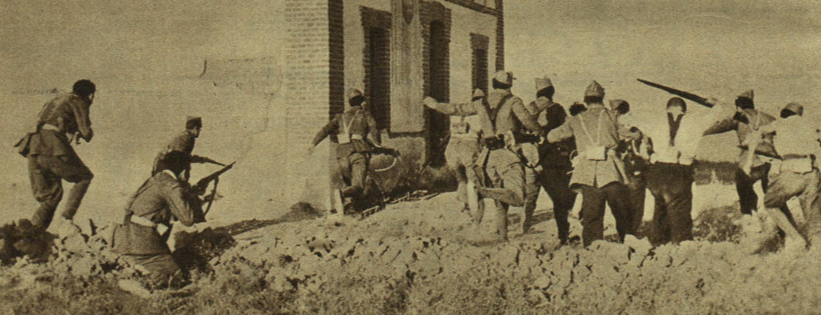
- Valle del Tiétar, Avila
A Nationalist advance into the Valle del Tiétar in early September 1936 was executed by the Columna Monasterio, a highly organized rebel strike force under the operational command of Colonel José Monasterio Ituarte. Formed in the provincial capital of Ávila in mid-August, this column consisted of approximately 1,200 to 1,500 men, blending regular army troops, Guardia Civil units, and heavily armed right-wing civilian militias, notably the fascist Falange and Carlist Requetés. Monasterio’s forces were ordered to break through the southern mountain passes to secure the flank of the primary Nationalist push toward Madrid.
Moving south from Ávila, the column advanced over the Puerto del Pico pass, descending directly into the isolated Republican pocket of the Valle del Tiétar.The first catastrophic impact of this military descent occurred when the column captured Arenas de San Pedro on 8 September. Upon occupying the town, Nationalist forces immediately unleashed the Falange militias to systematically target the local democratic leadership. Out of thirteen members of the Republican municipal corporation, eleven were summarily executed. Among the dead was the town’s mayor, Serafín Felipe Gómez, a local blacksmith. This near-total destruction of the council effectively wiped out the elected Republican administration, instantly replacing civic governance with Nationalist military control.
The following day, 9 September, the column pushed eastward along the valley floor, causing a much larger massacre at the Cuesta de La Parra, a stretch of road running between Mombeltrán and La Parra. In the wake of the troop movements, a large group of civilians who had taken refuge in Arenas de San Pedro during the fighting attempted to return to their home villages. Monasterio’s forces intercepted the refugees on the road, separated the men from the women and children, and shot approximately 30 to 36 men by the roadside. Far from being combatants killed in battle, these victims were entirely civilians caught behind the rapidly moving front lines. Among the dead, at least six men from Cuevas del Valle have been identified: Bibiano Jiménez Gómez, Magín Luis Sánchez Martín, Emeterio González Rodríguez, Emilio Gaspar Gómez Fernández, Andrés Vicente García Gómez, and Pedro Martín Beades.As the column secured its supply lines, the accompanying repression expanded to include collective punishment and retaliation against the families of those who had managed to escape.
On that same day, 9 September, Nationalist forces stationed at the strategic checkpoint of Venta Rasca, near Puerto del Pico, executed Juan Fernández Gómez, a fifteen-year-old boy from Cuevas del Valle. The teenager’s father had been a member of the local Republican defence committee and had successfully fled into the mountains before the troops arrived. Unable to capture the father, the Nationalists executed his young son in his stead, burying Juan in a mass grave with other victims at Venta Rasca.
The purge of local administration continued on 10 September, as elements of the column consolidated their hold on Mombeltrán. Four prisoners connected to the town were marched to Las Añaíllas and shot. Surviving historical evidence identifies three of the victims through their civic and professional roles: a local pharmacist, the town night-watchman, and an employee connected to the telegraph service. It is highly probable that Mariano Herrero González, who had served as the temporary municipal secretary, was the fourth man executed, though historical documentation of his exact fate remains less definitive.
Simultaneously, rearguard paramilitary units pushed deeper into the northern mountains around Navarredonda de Gredos to stamp out any lingering resistance. On 10 September, Nationalist forces there executed Santiago Martín Flores, whose daughter, Agapita Martín Beades, belonged to one of the targeted families of Cuevas del Valle. In the days that followed, several other relatives of families connected to Cuevas del Valle were hunted down, killed, and buried across the Navarredonda area.
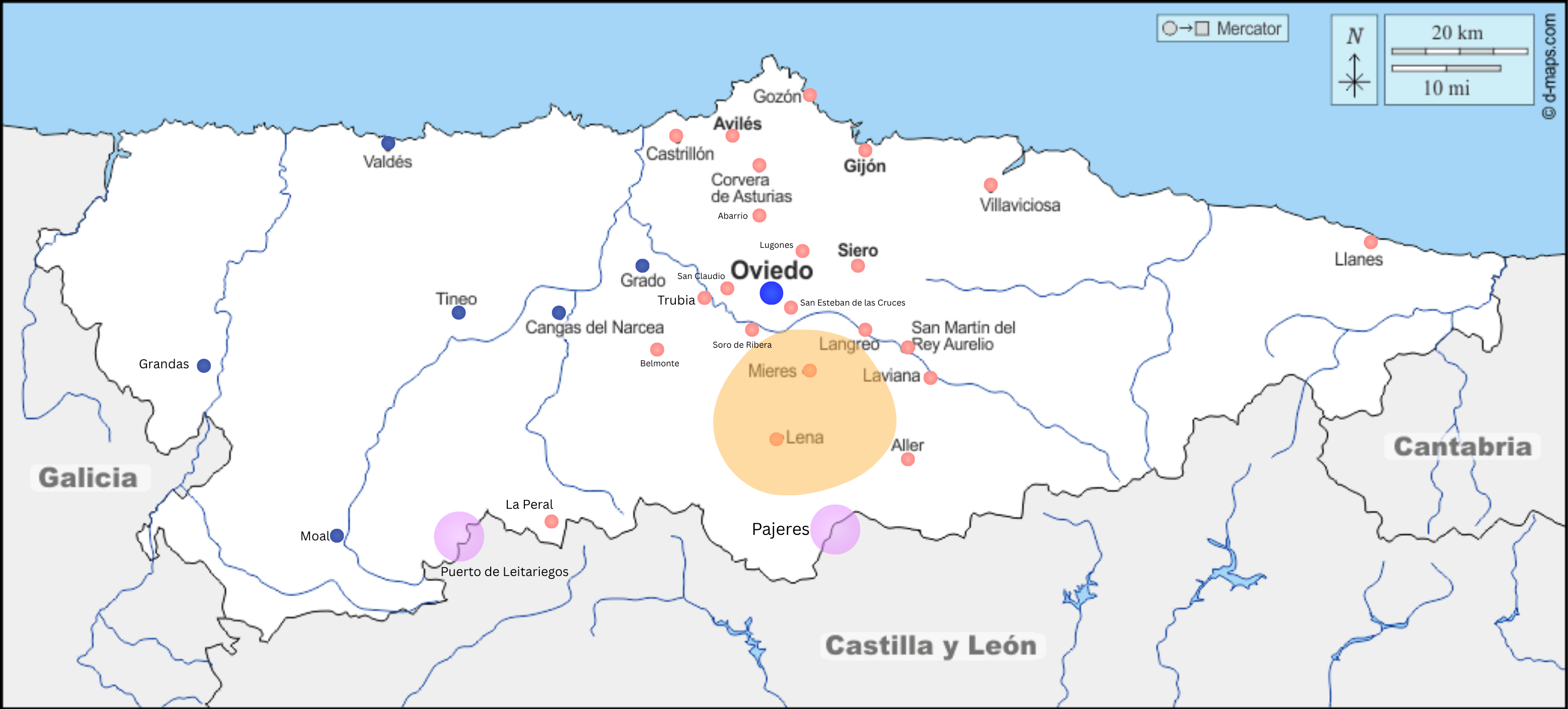
- Oviedo, Asturias
On 8 September 1936, Republican forces launched one of the heaviest attacks yet made against the Nationalist perimeter around Oviedo. More than 3,000 Republican troops were committed to the main assault against the positions at San Esteban de las Cruces, with the principal attacks directed against El Bosque and the height of El Calderu. Secondary attacks were launched farther east towards La Cadellada and El Mercadín, forcing Colonel Antonio Aranda’s defenders to fight across a broad section of the southern and south-eastern perimeter rather than concentrating entirely on one position.
The attack had been prepared by a prolonged bombardment. Republican artillery fired from positions on the Naranco, Sograndio, Lugones and La Grandota, while aircraft operating from Republican-held bases on the Asturian coast attacked the Nationalist positions and the city. Republican forces also brought improvised armoured vehicles into the assault. The attack was consequently supported by infantry, artillery, mortars, aircraft, and armoured vehicles rather than consisting simply of militia advancing with rifles.
The Nationalist positions at El Bosque and El Calderu were held by a relatively small force. The defence included men of the Guardia Civil, soldiers of the Regimiento de Infantería Milán, Assault Guards, and other volunteers incorporated into the defence of Oviedo. The Guardia Civil played a particularly important role in this sector. The Nationalist reconstruction of the battle gives approximately 250 men defending the immediate San Esteban positions, including around 100 Guardia Civil and the remainder from the Milán regiment and other forces.
The Republican bombardment was followed by infantry attacks against the trenches. At El Bosque and El Calderu, the defenders waited until the attacking troops came within rifle and machine-gun range before opening fire. Fighting became close at several points, with Republican troops reaching the defensive works and Nationalist troops attempting to drive them back. Among the Nationalist defenders killed was Lieutenant Maderuelo of the Guardia Civil, who was commanding one of the positions at El Calderu. Corporal Francisco Javier Alonso Sádaba of the Milán regiment was also killed during the fighting. The Nationalist line nevertheless held.
The attack continued for approximately twelve hours on 8 September. Republican troops renewed the assault on 9 September, committing additional men and extending the attack towards the Bosque del Cementerio, El Campón and the line towards Villafría. The fighting consequently spread beyond the original positions at San Esteban. Nationalist defenders at El Campón and elsewhere were repeatedly attacked while Republican artillery continued to strike the perimeter.
The Republican assault failed to open a route into Oviedo. The Nationalist defenders retained San Esteban, El Bosque and El Calderu, although the fighting had inflicted serious casualties on both sides. Nationalist sources claimed very high Republican losses, including 65 dead on 8 September and more than 200 casualties on 9 September, but these figures come from wartime Nationalist reporting and should not be treated as independently established totals.
The Republican command did not abandon the attempt to break into the city. On 10 September, the focus shifted towards the Loma del Canto and the nearby position at Las Cruces, on the northern side of the defensive perimeter. The attack was supported by artillery, aircraft, and armoured vehicles. Two of the Republican armoured vehicles involved were the Trubia tanks, built at the Trubia arms factory, together with an improvised armoured vehicle based on a Landesa tractor. The attack failed to take the Nationalist positions, and the Republican armoured vehicles were disabled during the fighting. The fighting on 10 September coincided with another intense bombardment of Oviedo. Republican artillery and aircraft attacked the city throughout the day. More than 200 artillery shells were reported to have fallen on Oviedo, while aircraft dropped large numbers of bombs and incendiaries. Buildings in Calle Uría, Calle del Rosal, Calle Caveda, around the Government Civil, the Hospicio and the Carmelite convent were damaged or set on fire.
One of the bombs struck the Casa del Chorín, at the corner of Calle Foncalada and Calle Caveda, where large numbers of civilians had taken shelter in the basement. The bomb entered through the building’s courtyard and exploded among the people sheltering below. Contemporary and later accounts give differing casualty figures, but dozens of people were killed and many more wounded, with some accounts placing the dead at around eighty or more and others giving substantially higher figures.
Republican attacks continued on 11 September. Abuli came under a strong assault, while Nationalist positions at La Cadellada and El Mercadín were also attacked. The defenders at Abuli included around 100 Guardia Civil and Falangists, who held the position. Republican aircraft continued bombing the city and the Nationalist positions, while Nationalist aircraft from León appeared over the area and forced the attacking aircraft to withdraw.
On 12 September, Republican forces renewed their attacks against the Oviedo perimeter. The pressure was now being applied at several points rather than concentrated entirely on San Esteban de las Cruces. The Nationalist line nevertheless remained intact. The Republican forces had brought considerable numbers, artillery, air support, mortars and improvised armour against a relatively compact defensive system, but they had been unable to force a decisive breach during the fighting of 8–12 September.
The failure left Oviedo still enclosed by Republican forces but still in Nationalist hands. The fighting had consumed large numbers of men and ammunition without opening the route into the city. Aranda’s defenders retained the positions around San Esteban de las Cruces, El Bosque, El Calderu, El Campón, La Cadellada, El Mercadín and Loma del Canto, while the Republican forces continued to hold the surrounding countryside and the heights from which they could bombard the city.
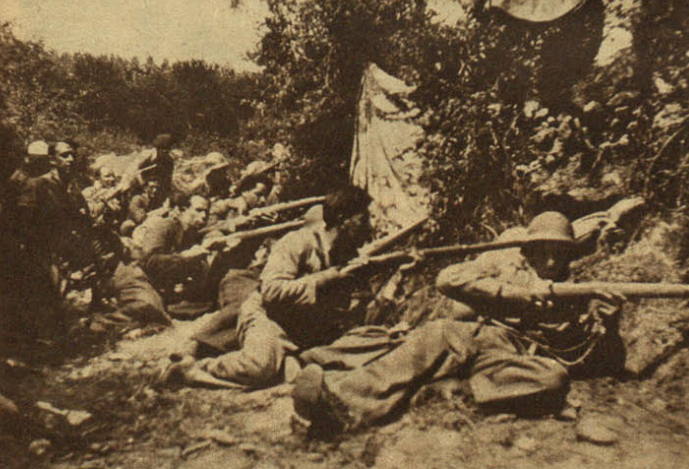
- Salt, Girona, Catalonia
This specific action was carried out under the authority of the local anti-fascist revolutionary committee in Salt, a town directly adjacent to the provincial capital of Girona. During the chaotic summer and autumn of 1936, the official Republican state police structure completely collapsed in Catalonia. Power shifted entirely to localized Comités de Milicias Antifascistas (Anti-Fascist Militia Committees).
.

