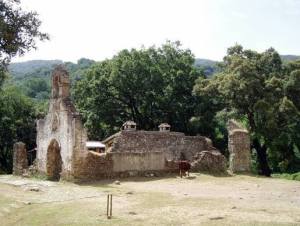
- La Sauceda, Cádiz Province, Andalucía
By the autumn of 1936, the isolated mountain valley of La Sauceda, nestled between the provinces of Cádiz and Málaga, had become a desperate beacon of hope. In the wake of the July military coup, thousands of leftists, union workers, and rural families from surrounding towns fled deep into the Los Alcornocales mountains. The population of this small enclave swelled to thousands as refugees sought safety in what had become one of the last pockets of Republican resistance in the region. However, its geographical isolation would not shield it forever, and by late October, the Nationalist military command finalised plans to permanently eliminate this mountain stronghold.
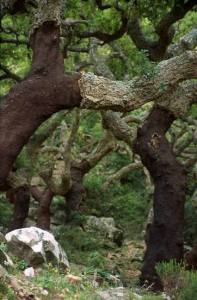
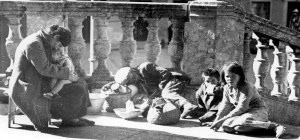
Before the devastating assault on 31 October 1936, living conditions for the refugees packed into the Valle de La Sauceda were precarious, overcrowded, and defined by a desperate struggle for basic survival. The valley became an open-air refugee camp in the dense, mountainous wilderness of Los Alcornocales. The daily realities for the thousands of families trapped there were shaped by severe hardships. The valley’s normal population was small, consisting of isolated peasants and farmers living in thatched-roof stone huts (chozas). As Nationalist forces captured surrounding towns like Jimena and Cortes de la Frontera, thousands of displaced families flooded the valley seeking protection. The existing infrastructure collapsed instantly under the weight of the influx. Families were forced to sleep in makeshift tents, out in the open under the cork oak trees, or packed tightly into existing agricultural shacks, completely exposed to the elements.
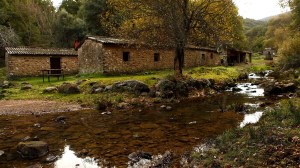
By October, La Sauceda was one of the last remaining Republican pockets in the entire region, completely surrounded by municipalities controlled by Francoist troops. The valley was subjected to an effective economic blockade. Traditional trade and supply lines were completely severed. Refugees could not leave the mountains to find food, medical goods, or clothing without facing immediate arrest or execution by Nationalist patrols. With thousands of mouths to feed and zero incoming supplies, food scarcity quickly became a crisis. The population had to survive off whatever the immediate mountain landscape could provide. Refugees relied on gathering wild acorns, small-scale subsistence crops like cabbages, and consuming whatever local livestock remained. Clean drinking water was available due to the valley’s natural streams, but the lack of proper sanitation and medical supplies created a high risk for disease.
Even before the ground troops marched on 31 October the refugees lived in a constant state of fear. The dense woods and rugged terrain provided excellent ground cover from the Nationalist military, but it offered no protection from the sky. In the weeks leading up to the final attack, Nationalist aircraft routinely circled the mountain pass, conducting scouting missions and launching terrifying aerial bombardments on the towns and valleys below to break the refugees’ morale.
The destruction of La Sauceda began in earnest with a brutal precursor on 30 October 1936, when planes subjected the valley and nearby Cortes de la Frontera to severe aerial bombings. What followed on 31 October 1936 was a coordinated, overwhelming ground assault. Four distinct Francoist military columns converged on the valley from multiple directions, quickly overwhelming the poorly armed local defenders and trapped refugees. The attack was a highly coordinated, dual-phased military operation designed to wipe out the final pocket of left-wing resistance in the region. On the morning of 31 October, four rebel Breguet XIX aircraft arrived over the isolated mountain hamlet, dropping bombs directly onto the civilian population. This raid is regarded by regional historians as one of the earliest instances of airborne terror targeting a concentrated civilian community during the war.
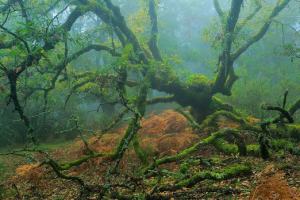
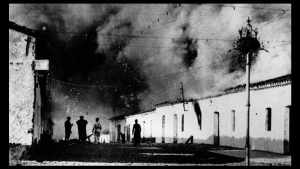
Immediately following the bombardment, four Nationalist military columns marched on the valley from surrounding municipalities. The columns converged on the Puerto de Gáliz (the mountain pass key to controlling the valley) from surrounding from the North at Ubrique, led by Second Lieutenant (Alférez) José Robles Alés (the Guardia Civil chief of Ubrique). This column occupied the nearby Cortijo El Marrufo just before moving into La Sauceda. From the West (Jerez de la Frontera) men were led by Cavalry Commander Salvador Arizón Mejías (the Marquess of Casa Arizón and military commander of Jerez). From the South (Jimena de la Frontera) Infantry Commander Fermín Hidalgo Ambrosy brought in a group, while from the Southwest (Alcalá de los Gazules) Infantry Captain Antonio Fernández Salas, commanded the National Militia Battalion of Cádiz. The troops systematically looted and burned down the homes, completely erasing the village from the landscape. According to research by local historians, the combined strength of these four columns totalled between 2,000 and 3,000 men.
The Nationalist force that assaulted La Sauceda was a toxic, highly effective mixture of regular army units, specialised police forces, and fanatical local volunteer militias. Rather than being a unified force imported from elsewhere, the columns relied heavily on a combination of professional military leaders and local collaborators who knew the geography and the people. The backbone of the operation was made up of the Spanish Army and the Guardia Civil, who provided the heavy coordination and tactical leadership. While the entire operation overseen Cavalry Commander Salvador Arizón Mejías, Second Lieutenant José Robles Alés, as the active chief of the Civil Guard in Ubrique, was intimately familiar with the political landscapes and families of the surrounding mountain towns, allowing him to identify and target specific Republican figures.
A huge portion of the ground troops consisted of fascist militias and Requetés recruited directly from the surrounding municipalities. These men were volunteers from towns like Jerez de la Frontera, Ubrique, Alcalá de los Gazules, and Jimena de la Frontera. This local element made the subsequent repression exceptionally intimate and brutal. The right-wing volunteers marching into the valley were often the neighbours, landlords, or political rivals of the fleeing refugees. They knew exactly who the union leaders, leftist mayors, and outspoken peasants were. This local knowledge is why the execution lists at the Cortijo El Marrufo were handled with such terrifying efficiency, the executioners did not need to guess who they were looking for.
While the ground troops were Spanish, the initial destruction came from an imported force. The aerial bombardment on 30 October 1936 was carried out by planes belonging to Nazi Germany’s Condor Legion. These German crews provided the initial shock and technological terror that broke the mountain pass, clearing the way for the local and regular Spanish columns to move in for the final ground sweep.
Oral testimonies, regional archive searches, and investigations led by local historians estimate that between 300 and 600 people were executed and buried in clandestine mass graves across the La Sauceda valley and the Cortijo El Marrufo between November 1936 and February 1937. The population had swollen dramatically with displaced families arriving from a dozen surrounding towns, including Jimena, Cortes de la Frontera, Ubrique, Alcalá de los Gazules, Algar, Benaocaz, and San José del Valle. When the columns finally breached the valley after the aerial bombings, hundreds of these hidden families were captured in the mountains.
They did not just kill the inhabitants; they burned a centuries-old village so thoroughly that it completely ceased to exist on physical maps. It was the total deletion of a community’s history, homes, and future and not by some invading army. The men sweeping through the valley were local police and right-wing neighbours from the very next towns. They knew the victims’ names, their faces, and their families, making the violence deeply personal and vindictive. The used an estate’s private Catholic chapel as a holding cell to lock up terrified women and children while their husbands and fathers were systematically shot in the fields right outside. For the people of La Sauceda and the surrounding mountains, the valley was their identity. These were agrarian, rural families whose entire existence, their livelihoods, ancestral traditions, folklore, and daily rhythms, was woven into the dense cork oak forests and rivers of Los Alcornocales. By systematically burning the stone chozas to the ground, slaughtering the livestock, and completely dismantling the physical village, the Nationalists deliberately tore this identity out by its roots. The survivors were stripped of the physical anchors of their memories. To lose a home is devastating; to have the very earth where your family lived for untold generations and then transformed into a forbidden, blood-stained crime scene forces a permanent exile of the soul.
Before 31 October 1936, the valley represented solidarity. It was a sanctuary where families shared whatever meagre resources they had, huddled together under the trees to survive the blockade. The raid permanently shattered these communal networks. By scattering the survivors across different regions, sending men to forced labour camps, and executing local leaders, the Nationalist forces ensured that the social fabric of La Sauceda could never be rewoven. The survivors were forced into isolation. They could no longer lean on their neighbours for comfort, because their neighbours were either dead or terrified into silence. The collective memory of the community was deliberately fractured, leaving individuals to carry the immense weight of their trauma entirely alone. The physical destruction of the village was done on purpose to ensure that the punishment would outlive the war. The regime wanted to make it impossible for the community to ever reconstitute itself. Survivors were barred from returning to rebuild, and the name of La Sauceda was effectively scrubbed from official records. Survivors were denied the ability to pass down their heritage to their children. To survive meant living with a dual horror, the burning memory of the massacre, and the enforced law of silence that criminalised their grief. They were forced to act as though the place they loved, and the people they belonged to, had never existed at all.
When thousands of nameless refugees flooded into La Sauceda, they were already running from the ruins of their own lives in other towns. By the time the military columns arrived on 31 October, these people had already been stripped of their homes, their possessions, and their local status. They had been reduced to a mere statistic, a massive, floating number of displaced souls trying to survive in the mountains. But the true atrocity of La Sauceda is that the Nationalist forces then proceeded to erase even that number.
The refugees trapped in the valley suffered a unique and terrifying form of historical exile. Because they had fled from a dozen different municipalities across Andalucia, they had no official paperwork, no census records, and no local registry in La Sauceda. They were anonymous. In the eyes of the Nationalist military high command, they were not individuals with families, histories, or faces; they were simply a mass of subversives to be cleared from a strategic zone.
The epicentre of this post-assault repression shifted directly to Cortijo El Marrufo, located within the municipality of Jerez de la Frontera. Throughout November 1936, El Marrufo was turned into an execution camp and a highly organised site of extrajudicial murder. Men and women taken from La Sauceda were systematically marched to the estate. There, they faced interrogation, brutal physical abuse, and execution. The bodies of the victims were hastily dumped into unmarked mass graves scattered across the private estate, hidden away from public view. So total was the destruction of the area that the village of La Sauceda itself was systematically dismantled and burned, effectively wiping the historic settlement off the physical map.
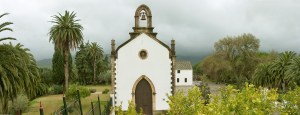
In 1936, the Cortijo El Marrufo belonged to the Guerrero family, a powerful dynasty of wealthy right-wing landowners originally from Grazalema who had established themselves in Jerez de la Frontera. The Guerreros were among the largest terratenientes (landowners) in the entire region. They owned a vast network of 32 distinct country estates across the province of Cádiz, totalling over 6,140 hectares of land. The Cortijo El Marrufo alone spanned roughly 800 hectares of farmland, pastures, and dense cork oak forests.Because of the family’s wealth, the estate was highly developed. It featured a sprawling, casa señorial (manor house), multiple large storage barns, stable blocks, and its own private Catholic chapel. This extensive layout is exactly what made it so attractive to the Nationalist military; once the territory was taken, the owner ceded the property to Nationalist forces, who easily repurposed the large barns into barracks, the chapel into a holding cell for captive women and children, and the estate grounds into a hidden execution camp.
When the executioners at El Marrufo began their work, they did not keep registries. There were no death certificates, no court martials, and no written logs of who was being led out into the fields to be shot. By refusing to write anything down, the perpetrators executed a deliberate strategy of total oblivion. They ensured that these refugees were stripped of their humanity twice – first, when the war reduced their identities into a vague, uncounted number of displaced people, and second, when the massacres erased that number entirely from the official record. To this day, when historians look at the graves of La Sauceda, we are forced to speak in frustrating, broad estimates of between 300 and 600 dead. That massive gap in the numbers is the physical scar of a crime designed to be perfect. By burning the village and slaughtering an uncounted population, the regime did not just take their lives; they took their data. They left hundreds of families across Spain wondering for generations where their relatives had vanished to, ensuring that those who died as nameless refugees in the winter of 1936 would remain ghosts, denied even the basic dignity of a statistic.
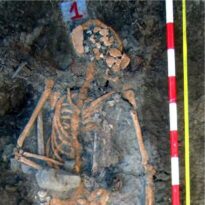
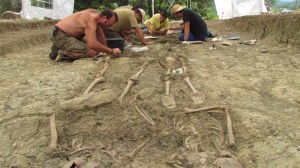
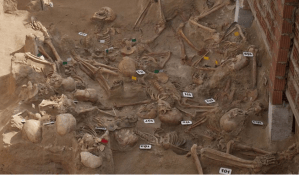
In the summer of 2012, archaeologists located seven hidden mass graves within a 3,000-square-meter area of the El Marrufo estate. They successfully exhumed just 28 bodies (23 men and 5 women). While these 28 individuals were recovered and later identified, they represent only a small fraction of the total number of people believed to be buried throughout the surrounding mountains. Compounding the mystery is the fact that thousands of the people trapped in the valley were anonymous refugees fleeing from other parts of Andalucía. Many had no local ties, meaning that when they disappeared, there was no one left in the immediate area to record their names or report them missing, and likely anyone who knew them before they fled was also dead.
Ultimately, because the town of La Sauceda was entirely burned to the ground and its population dispersed, executed, or forced into slave labor, the full, precise human cost of the massacre remains one of the silent mysteries of the conflict. In modern times, the estate passed into the hands of another prominent Jerez family, the González-Gordon family (well-known in the region for their historic Tío Pepe sherry empire). When memory associations and forensic teams began searching for the mass graves in 2010–2011, the owner, Javier González-Gordon, formally granted permission for the archaeological teams to enter the private estate, dig up the fields, and exhume the bodies of the victims. Behind some farm buildings, which still stand today, lies a small slope where an iron cross was once placed. It is estimated that more than 300 victims may have been buried there. The Andalucian government has designated this site as a Place of Memory., and seven mass sites have been found so far. In late November 2012, the 28 recovered remains were moved to a mausoleum, the Pantheon of Dignity located in the La Sauceda cemetery, and have been DNA matched to their families.
In La Sauceda, or where it once was, the mass grave is believed to be located at kilometre 56–57 of the Jerez de la Frontera–Cortes de la Frontera road, in the vicinity of the former village. The decision to conduct survey sin the area came from the account of an elderly woman who identified a mass grave in this immediate vicinity. During the 2012 field season, four pieces of ballistic evidence were discovered, most of which were long-gun shell casings clearly consistent with those used during the war, but so far, no one has been found.
During the first three months of the Spanish Civil War (July–October 1936), Cádiz province was rapidly consolidated into a strategic, heavy Nationalist stronghold. Unlike other Andalucian provinces split by long-lasting trench lines, the actual military conflict inside Cádiz was remarkably brief. Because the military coup succeeded in nearly half of the province’s municipalities within 48 hours, the wartime history of Cádiz during this period is defined by the rapid crossing of the Strait of Gibraltar, naval blocks, and highly severe rear-guard repression.
The military uprising in Cádiz was swift, organised, and ruthlessly efficient. Led by Military Governor José López-Pinto, rebel forces declared a state of war on 21 July 1936. Loyal Republican authorities, including Civil Governor Mariano Zapico, barricaded themselves inside government buildings but were quickly forced to surrender after rebel forces brought in heavy artillery. The critical turning point for the province occurred when the rebel destroyer Churruca successfully crossed from Spanish Morocco, landing the battle-hardened troops of the Army of Africa directly into the ports of Cádiz and Algeciras. This influx of professional soldiers instantly crushed local working-class strikes and militia resistance.
Throughout August and September 1936, the primary purpose of Cádiz province was logistical rather than combat-focused. It functioned as the vital landing strip and gateway for General Francisco Franco’s army entering mainland Spain. Nationalist forces prioritised anchoring the coastal thoroughfares connecting Algeciras, Tarifa, and Cádiz city to ensure a constant flow of troops and supplies from North Africa. Despite early blockades by the Republican navy, the combination of Nationalist ships and Italian/German aircraft secured control of the skies and the waters of the Strait, allowing the Nationalists to push their vanguard columns quickly out of Cádiz toward Seville and Córdoba.
The only prolonged combat in the province took place in the rugged interior of the Sierra de Cádiz. While the low plains and coastal strips fell in July, the mountain villages held out slightly longer. Throughout August and September, Nationalist columns and local Civil Guard units systematically moved through the hills, capturing towns like Olvera, Grazalema, and Jimena de la Frontera. The very last pocket of organised Republican territory in the province was the rural village of La Sauceda, which was subjected to a crushing aerial bombardment on 31 October 1936, effectively concluding all formalised military manoeuvres inside the provincial boundaries.
Because the armed conflict wrapped up so quickly, historians emphasise that war in Cádiz was essentially synonymous with repression. Because there were no active front lines to maintain, paramilitary assets were deployed inward to systematically cleanse the civilian population. Modern archival research logs between 4,000 and 4,600 total victims murdered by Nationalist forces across the province during the conflict. The vast majority of these deaths occurred in the frantic, unrecorded sacas and summary executions of these first three months.
In Cádiz city, executions were carried out against the massive stone walls of the Puerta de Tierra (Earth Gate). To enforce total civilian compliance, these executions were publicized in local newspapers and treated as highly public warnings to the community. On 6 August 1936, Civil Governor Zapico and his loyal staff were officially executed here under military court orders. In the mountain sectors like Grazalema and Villamartín, the repression targeted agrarian trade unionists. This phase was marked by brutal collective atrocities, including the systematic execution of large groups of women (such as the 15 women taken to a roadside fosa outside Grazalema) to completely dismantle the social base of the left-wing peasant syndicates.
In the 19 municipalities of the mountainous northern sierra, historical censuses show that over 1,000 extrajudicial deaths occurred during the Terror Caliente. Statistical analysis of Civil Registries shows that 79% of all victims who died in the sierra during the entire war were killed within this single six-month window. In Cádiz city and the nearby naval hub of San Fernando, researcher Alicia Domínguez has meticulously documented 563 political murders carried out strictly between July and December 1936. This initial campaign of sacas halted abruptly by early January 1937. In Sanlúcar de Barrameda, for example, the final unrecorded saca took place on 4 January 1937, after which the regime shifted its violence toward formal military court-martials. Official Andalucian maps have successfully verified 118 separate mass graves scattered across Cádiz province, which hold the physical remains of these early-war victims.
- Huelva Province, Andalucia
By the end of October 1936, Huelva province was fully consolidated under Nationalist military control, serving as one of the earliest and most brutally pacified regions of the Spanish Civil War. Because of its powerful industrial mining centers and deeply rooted left-wing labour unions, the province was subjected to a highly systematic campaign of territorial conquest and administrative murder orchestrated by General Gonzalo Queipo de Llano’s Nationalist forces.
The military campaign across Huelva province had moved rapidly from the coastline up into the high mining basins and mountain ranges between July and September 1936. The military coup initially faltered in the capital because the local Guardia Civil remained loyal to the Republic in Huelva city. However, Queipo de Llano dispatched a heavily armed column led by Major Ramón de Carranza. Supported by artillery, Carranza’s troops easily overran the city on 29 July, forcing the immediate arrest and subsequent execution of the Republican Civil Governor, Diego Jiménez Castellano, and the loyal mayor.
The centre of the province was dominated by the immense, highly unionised copper mines of Riotinto, Nerva, and Zalamea la Real. Local miners mounted a fierce, desperate resistance, using construction dynamite as improvised weaponry against the advancing forces. They famously organised the Columna Minera to march on Seville, but they were ambushed and decimated by Nationalist troops at La Pañoleta. On 25–28 August, combined Nationalist regular columns, Legionnaires, and Falangist paramilitaries heavily crushed the mining basin, forcing thousands of workers to flee into the northern hills.
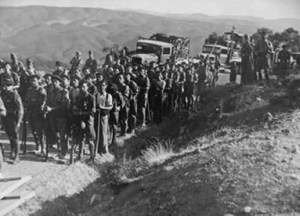
The final conventional military operations took place in the rugged Sierra de Aracena in the north of the province. Advancing Nationalist troops methodically cleared the mountain passes village by village, officially declaring Huelva fully pacified on 19 September 1936. By October 1936, conventional frontline warfare had completely ceased in the province. The remaining resistance shifted entirely underground into early Maquis mountain guerrilla factions (such as the Los Alacranes and Cerreño bands) that hid out in the high oak forests.
Once the towns and villages were captured, the Nationalists stopped relying on chaotic frontline shootings and implemented a cold, terrifying logistical network of human transfers to the provincial capital for systematic execution. Captured miners, trade unionists, and agrarian workers across the province were loaded into commercial cargo trucks or train cars and systematically shipped down to Huelva city. The provincial jail was immediately saturated, forcing the military command to use improvised processing zones. Chief among these was the Santa Fe Barracks (Cuartel de Santa Fe) in the centre of Huelva capital. Recent architectural excavations have exposed its hidden network of tunnels, pitch-black solitary confinement pens, and makeshift cells that were used throughout autumn 1936 to torture and interrogate provincial prisoners before their names were cleared for the nightly sacas. To hide the daily body counts and protect the civilian informants or company supervisors who provided the blacklists, these individuals were intentionally kept off civil death registries. To the state, those shipped to the capital simply ceased to exist.
The disproportionate nature of the violence in Huelva is staggering when analysed alongside its actual population density at the time. Modern historiographical consensus led by researchers like Francisco Espinosa Maestre documents 6,019 explicitly verified victims murdered by the Nationalist forces across the province. Out of that provincial total, between 1,200 and 2,000 extrajudicial executions occurred strictly against the stone walls of the San Sebastián and La Soledad cemeteries inside Huelva city during the autumn and winter of 1936. Today, the mass grave at La Soledad cemetery stands as the largest closed mass burial site in the entire province, holding the remains of thousands of these transferred victims.
Because the province fell so early in the war, the left-wing revolutionary committees had little time to execute coordinated actions. Documented casualties of the Red Terror across the entire province of Huelva number between 100 and 400 individuals, mostly tied to the chaotic burning of churches in the first few days following the initial 18 July coup.
- Seville Province, Andalucia
The stark reality of Seville province in the first three months of the Spanish Civil War was a campaign of absolute, industrialised, top-down terror orchestrated by General Gonzalo Queipo de Llano, resulting in at least 6,614 political murders in 1936 alone. Unlike the chaotic bottom-up militia violence seen in Catalonia, Seville served as the military blueprint for systematic political cleansing, designed to secure the south as a springboard for the Army of Africa and to permanently crush the working-class resistance.
Following the coup on 18 July, working-class neighbourhoods like Triana and Macarena erected barricades. Armed with virtually no weapons, they held out until 22 July against regular troops and newly arrived Moroccan legionnaires. Once breached, the rebels took no prisoners, executing anyone suspected of resisting. Most of the city’s democratic council, including Mayor Horacio Hermoso, were promptly shot. In the Aljarafe and River Lowlands, armed military columns began radiating outward from the capital each morning. They rapidly captured immediate ring towns like Camas, San Juan de Aznalfarache, Santiponce, La Algaba, and Alcalá del Río. Captured local leaders and municipal councilors were trucked back to the capital for execution.
From the coup in and August 1936, Queipo de Llano began his the local radio network (Radio Sevilla) to broadcast terrifying speeches, explicitly promising sexual violence against Republican women and death to leftists. This psychological warfare was backed by the infamous Brigadillas de Ejecuciones (Execution Squads) of the fascist Falange, who hauled people from their homes nightly. Armed columns pushed east and south along the main roads toward Córdoba and Málaga. They targeted the highly unionised agricultural heartlands of Seville. Towns like Carmona, Marchena, and Arahal fell in rapid succession. In Arahal, the local resistance was met with an exceptionally brutal retaliatory purge. Columns swept through Osuna and Morón de la Frontera, systematically arresting agricultural day-labourers. On the final day of the month, a column of 67 dynamite miners travelling from Huelva to aid the Seville resistance was ambushed and captured at La Pañoleta; all were executed.
By September, rural executions had been long underway. As the plains were secured, military forces pushed north into the rugged mining and mountainous zones of the Sierra Norte, where thousands of Republican families had previously fled to hide. Towns like Cazalla de la Sierra, Constantina, and El Real de la Jara were captured following brief, desperate mountain standoffs. Nationalist units conducted sweeps through the valleys and large, isolated country cortijos. Refugees trapped in the hills were either shot on site or captured and routed into the expanding provincial prison system. Military columns under landowners like Ramón de Carranza marched town by town through the agricultural heartlands of the province. As towns fell, fields were turned into open execution grounds. Left-wing agricultural day-labourers were systematically purged to return absolute control to the wealthy elite.
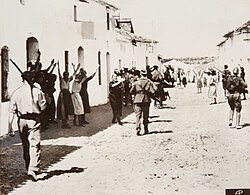
By early October, active military combat within Seville province had ceased. The entire territory was long-suppressed and under the absolute rule of Queipo de Llano. The focus shifted from chaotic battlefield roundups to an organised, administrative execution machine. Overflowing provincial prisons, like La Ranilla, were systematically emptied. The San Fernando Cemetery in Seville became the central destination for this human pipeline. Records show major spikes during these specific dates, where dozens of working-class citizens harvested from the pacified rural towns were executed in mass groupings at dawn.
With Seville completely pacified and secure by 31 October 31, the Nationalist columns and logistical networks were fully prepared to pivot their forces eastward, setting the stage for the imminent winter campaigns against neighbouring provinces like Málaga.
The historical reality of Seville in the autumn of 1936 refutes any myth of orderly military governance. Queipo de Llano ruled the province as a personal fiefdom through a dialectic of violence and forced destitution. The regime systematically eliminated thousands of primary breadwinners from working-class families. Surviving family members had their properties, savings, and belongings stolen through forced donations to support the Nationalist war machine. Left-wing widows and orphans were completely excluded from employment and public life, forced to rely on coercive, humiliating state charities designed to force ideological submission to the new regime. By the end of October 1936, Seville province had been completely transformed from a bastion of union and democratic power into a silent, terrorised logistical hub where the walls of the Macarena cemetery served as daily firing-squad backdrops.
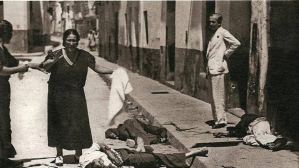
In the late summer and autumn of 1936, the psychological atmosphere across Seville, Cádiz, and Huelva was a suffocating mix of profound claustrophobia, a dawning realisation that there was no physical escape, no rescue and a desperate, fractured impulse to fight back. As General Queipo de Llano’s columns methodically strangled western Andalucia, the initial revolutionary optimism of July evaporated, replaced by a terrifying sense of geographical encirclement.
For the working-class population, union members, and families of the left, the geography of southwest Spain quickly became a deadly trap. By late August, the Nationalist forces had formed a solid wall of territory, cutting off any path to safety. In Cádiz, the Atlantic Ocean and the Mediterranean were heavily patrolled by Nationalist naval cruisers like the Almirante Cervera. Fleeing by water was impossible. For the people of Huelva, the natural instinct was to flee west across the Guadiana River into neighbouring Portugal. However, they met a brutal reality; Portugal’s dictator, António de Oliveira Salazar, was a staunch supporter of Franco. Portuguese authorities actively arrested Spanish refugees crossing the border, bound their hands, and handed them right back to Nationalist firing squads at the border towns.
Queipo de Llano’s nightly radio broadcasts from Seville echoed across the radios of all three provinces. His booming voice was intentionally designed to make people feel like the regime was omniscient and inescapable. Despite the terrifying odds, the feeling was not one of passive surrender. There was a fierce, albeit desperate, desire to fight back. However, because the Republic had failed to distribute weapons to the unions early enough, the resistance was tragically mismatched.
In the cities of Seville (in the Triana and Macarena districts) and Huelva, workers initially felt they could hold out. When the coup began, workers launched general strikes, tore up cobblestones to build barricades, and used whatever vintage hunting rifles or dynamite they had. In Huelva, a column of miners famously organised a dynamic convoy to drive toward Seville to help break the coup. But their resistance was crushed by professional soldiers using heavy artillery and the elite, brutal troops of the Moroccan Army of Africa.
When the towns fell, the impulse to fight back shifted into the landscape. Thousands of people from Seville, Cádiz, and Huelva refused to wait for the nightly paseos. They chose to fight by surviving. They fled into the rugged, dense mountain ranges, most notably the Sierra de Huelva and the Los Alcornocales mountains between Cádiz and Málaga. These refugees became the huídos (the fled ones). For a brief moment in August and September, they truly believed they could build a mountain wall to resist the fascists. They turned isolated valleys like La Sauceda into makeshift democratic strongholds, sharing food and forming small, desperate defence committees.
By October 1936, the feeling shifted from a belief in a fair fight to the grim realisation of a slaughter. The people realised they were not fighting a regular army, but an extermination campaign. When the German planes began dropping bombs on mountain refuges and the four military columns converged on places like La Sauceda on 31 October, the final illusion of a defensive stronghold shattered. The resistance was not broken because the people lacked the will to fight; it was broken because they were completely isolated, starved out by blockades, and hunted by regular army units with a level of industrial firepower that a civilian population could simply no longer withstand.
Historical consensus confirms that Andalucia suffered some of the most concentrated, systematic, and officially encouraged sexual violence of the entire Spanish Civil War. While gender-based violence occurred across Spain, the repression in the south was uniquely brutal due to the combination of the Africanista military culture, explicit instructions broadcasted over the radio, and the absolute power given to local execution squads and guards.
Historians such as Paul Preston and local memory researchers describe this as a targeted campaign of sexual repression. It was designed to punish women not only for their political affiliations but for daring to challenge traditional patriarchal and social hierarchies during the Second Republic. Unlike other fronts where sexual assault was an unwritten by-product of military occupation, in Andalucía, it was explicitly weaponised as psychological warfare by the high command. General Gonzalo Queipo de Llano famously used his nightly broadcasts on Radio Sevilla to taunt Republican men by promising that his troops would sexually assault their wives and daughters. In his July 23 broadcast, he notoriously declared that the Moorish Regulares and Legionnaires would show the ‘communist and anarchist women what real men are.’ This language was so graphic that right-wing newspapers of the era refused to print his transcripts verbatim.
The military coup in the south relied heavily on the airlift of the Army of Africa. Francoist officers routinely granted these units a right to pillage and allowed mass rapes as a deliberate tactic to terrorise town populations into immediate surrender. This occurred systematically across the path of the columns moving through the provinces of Seville, Cádiz, Huelva, and toward Málaga. The horror did not end when the front lines passed. In the months that followed, as thousands of local men were executed or imprisoned, women were forced into positions of absolute vulnerability to keep their families alive.
Historians have documented countless oral histories of what is now recognised as administrative sexual extortion. Left-wing widows, mothers, and sisters had to approach local Falangist leaders, Guardia Civil, or prison commanders just to request a meeting with a locked-up relative, beg for food rations, or ask for a death certificate. Power was so heavily skewed that accepting to sexual assault was frequently the only currency a woman had to request the prevention of the execution of her son or husband, and even then, the promises were broken, and the relative was shot anyway.
For thousands of Andalucian women who were not murdered, the regime designed public punishments to destroy their honour and social standing. Women were rounded up, had their heads completely shaved, were forced to drink castor oil, and were marched down the main streets of their home villages while being jeered at by local right-wing neighbours. It was a form of social execution. By stripping these women of their dignity, hair, and privacy, the regime permanently marked them as defeated and forced them into a state of lifelong submissiveness.
Because of the immense social stigma and trauma surrounding rape in 1930s Catholic Spain, the vast majority of survivors chose to take these secrets to their graves, never speaking of it especially to their own children. It is only through modern exhumations, such as the female victims recovered from the mass graves at El Marrufo, and recent regional compensation programs enacted by the Junta de Andalucía that the full, devastating scale of the war’s violence against women has finally been laid bare.
Unwanted pregnancies were a tragic, hidden reality resulting from this widespread sexual violence. However, the way these pregnancies were handled highlights the profound social and political cruelty of the era. In 1930s Spain, pregnancies arising from wartime rape or ongoing sexual extortion resulted in two outcomes. For the women who survived these assaults and carried the pregnancies to term, the birth of a child was met with immense trauma, compounded by strict social isolation. In the deeply conservative, nationalist Catholic society established by the regime, abortion was strictly illegal and classified as a crime against the state. Victims of sexual assault faced a devastating double burden; they had to endure the physical and emotional reality of an unwanted pregnancy, while navigating a culture that deeply stigmatised unwed mothers. Many of these children were raised in absolute secrecy, often passed off by families as orphans, younger siblings, or cousins be cared for to protect the mother from severe social ruination. The deep-seated shame surrounding sexual violence in 1930s Spain meant that these children grew up without ever knowing the true nature of their origins, a secret that mothers carried to their graves.
For women held in prisons or marginalised by the state due to their leftist background, these pregnancies fed directly into one of the regime’s darkest policies: the systematic theft of babies. Under the influence of right-wing military psychiatrists like Antonio Vallejo-Nájera, the regime officially believed that Marxism and democratic sympathies were a mental malady passed down genetically through mothers. To purify the nation, the state empowered organisations like the Patronato de Protección de la Mujer (Women’s Protection Board) to take newborns away from undesirable or politically suspect mothers. Thousands of babies born to imprisoned or extorted women were declared dead at birth by complicit doctors and nuns. In reality, these infants were secretly placed with wealthy, staunchly right-wing families loyal to the regime, a criminal network that began during the war and quietly persisted for decades, with babies being stolen into the 1980s, and some claims of even 1991.
Tragically, many pregnant victims never had the chance to give birth. Modern forensic archaeology across Andalucía and southwestern Spain has provided grim physical verification of the fate of pregnant captives. In recent mass grave excavations, forensic anthropologists have uncovered the skeletal remains of executed women containing the tiny, distinct bones of 7-9 month-old fetuses. These discoveries provide irrefutable proof that the military columns and local execution squads routinely marched heavily pregnant women to firing squads without hesitation.
Spain passed an Amnesty Law in 1977. This law released political prisoners from the dictatorship, but it had a massive, devastating catch; it also gave total legal immunity to all Francoist officials, police, and executioners for the crimes they committed during the war and the repression. It remained illegal to prosecute anyone for the massacres at places like El Marrufo. The political elite feared that digging up the past would trigger a new civil war (they were right to think so). So, the unwritten rule of Spanish society became silence. While the families of the Nationalist side had already buried and honoured their dead 40 years prior, the families of the Republican victims were told to keep quiet. If a family wanted to find their grandfather in a roadside ditch, they had to do it themselves, secretly, using their own hands and own money, with no help from the police or the courts. Spain became the country with the second-highest number of mass graves in the world (after Cambodia), left untouched for decades.
It wasn’t until the year 2000, when grandchildren, rather than the traumatised children, began asking questions, that the silence truly began to break. The 2007 Historical Memory Law and the more recent 2022 Democratic Memory Law finally started to implement some of those pillars. The Spanish state finally took over the responsibility of funding mass grave excavations, removing Francoist statues, and mapping the fosas. Sites like El Marrufo were only excavated because of this modern push, led by grandchildren who refused to let the memory die.
Because this took nearly 70 to 80 years to even begin, true healing was denied to the actual survivors. The mothers who suffered sexual extortion, the widows who were publicly shamed, and the siblings who looked for their missing family members almost all died in old age before the state ever acknowledged their pain or gave them their loved ones back. Spain is still deeply divided over this today, proving that trying to force a society to heal by pretending nothing happened only leaves the wound to fester across generations.

