- Brunete, Madrid
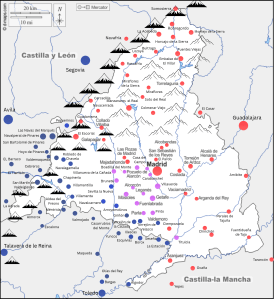
On 30 October 1936, the Madrid front experienced a massive, coordinated Nationalist offensive that broke the Republican defensive lines at both ends of the front, setting the stage for the direct siege of the capital. Following the collapse of a major Republican counter-attack led by Enrique Líster the day prior at Parla, General Francisco Franco’s forces capitalised on their momentum to execute a pincer movement. In the Western Sector, the Perales valley and Brunete, Nationalist troops pushed through, breaching the outer defensive loop, and Brunete and its surrounding villages operationally fell on this day, though fighting inside the town itself textually delayed Nationalist consolidation for another 48 hours. In the southern and eastern Sectors, the Nationalist advance completely overwhelmed Republican militia positions. Three key strategic towns fell in rapid succession: Humanes, Parla, and Valdemoro heading into 30 October.
The fighting occurred across open, rolling agrarian plains and dry river valleys south-west of the capital. This flat, exposed geography lacked natural fortifications, leaving the Republican militias completely defenceless against combined-arms manoeuvres and air power. Brunete was the anchor of the Republican western defence line, meant to block the Nationalist advance toward the Extremadura highway and the north-western approach to Madrid. Brunete was a small, tightly-knit agricultural farming village, with a population hovered around 1,500 residents. Most worked the surrounding dry agrarian plains, growing wheat and chickpeas. The heart of the village was its compact, historic Plaza Mayor constructed of heavy granite buildings, narrow alleys, and a central stone church (Nuestra Señora de la Asunción). It was this dense, stone core that allowed trapped Republican fighters to physically stretch the battle into a multi-day house-to-house clearing operation.
Because Brunete lacked a permanent military garrison, the initial defensive force was highly improvised. The Republicans deployed roughly 1,200 to 1,500 raw militia fighters to dig into the exposed dirt perimeters around the village. These were trade union volunteers (mostly local socialist and anarchist militias) lacking anti-tank weaponry, proper communication systems, or air support. To break this anchor of the western approaches, Nationalist Lieutenant Colonel Eduardo Sáenz de Buruaga launched a highly concentrated mobile assault force of roughly 1,500 to 2,000 elite troops.
Because the terrain offered virtually no natural cover, Varela did not launch a slow, predictable frontal assault on the town. Instead, he deployed a rapid flanking encirclement.
Nationalist forces used combined-arms tactics:, of light Italian tankettes and artillery suppression pinned the militias down from the front while fast-moving columns swept through the Perales valley to cut off the town’s rear supply lines. Fearing total encirclement and slaughter, a well-founded fear given the brutal reputation of the Regulares, the outer Republican defence perimeter collapsed within hours. The broad lines shattered, sending a mass of panicked militiamen retreating towards Boadilla del Monte.
Operationally, the battle for the town was decided on this day. The Nationalists breached the town lines, smashed the organised perimeter, and severed the highway connections. The Republican command structure considered Brunete effectively lost. Operationally, the battle for the town was decided on this day. The Nationalists breached the town lines, smashed the organised perimeter, and severed the highway connections. The Republican command structure considered Brunete effectively lost.
The fall of Brunete immediately triggered the harsh realities of the Nationalist repression. Following the town’s operational fall, Varela’s forces carried out immediate summary executions. Local authorities, union members, and captured militiamen who could not escape were lined up against cemetery walls or shot in the streets. For the civilian population who hadn’t already joined the human sea of refugees fleeing toward Madrid, it meant the sudden imposition of strict martial law, ending any revolutionary or Republican activity in the sector.
The area was absolutely choked with internal refugees fleeing from the south and west. By October, a massive internal displacement crisis hit the outskirts of the capital. Panicked civilian families, carrying what few belongings they could pile onto wooden carts or carry on foot, were still funnelling into the villages surrounding Madrid. When the Nationalist columns struck the Brunete sector on 30 October, the village was was a chaotic bottleneck of local farmers, retreating militiamen, and thousands of destitute southern refugees desperately trying to escape eastward toward the relative safety of Madrid. This human sea of misery severely hindered Republican efforts to establish clear fields of fire or maintain order, turning the eventual retreat into a panicked, intermingled stampede along the roads toward Boadilla del Monte.
- Valencia
The days of 29 and 30 October 1936 in the Valencia region represented a critical transition phase during the Spanish Civil War. The nature of the violence in the Republican rear guard had split into two separate realities; the continuation of clandestine, executions of right-wing or religious prisoners, and a massive internal explosion of political warfare between competing anti-fascist factions.
Executions of political and religious targets during these days occurred both in unrecorded sweeps and via the newly established Tribunales Populares. On 27 October, a Franciscan friar (Ofmval), Salvador Fortuño Almela, had been hunted down and detained in nearby Manises since 13 October. On the night of 27 October, he was taken to the Picadero de Paterna outside the capital and shot. His remains were later recovered and transferred back to Manises for burial. The same day, a 58-year-old independent transport worker named Daniel Ballester Vicent, from the inland town of Utiel, was targeted and killed in Valencia. Archival records indicate he was blacklisted due to his affiliation with Miguel Primo de Rivera’s conservative party, the Unión Patriótica.
Documents from the post-war Francoist investigative ledger Causa General log José Vicente Gil’s execution within the municipality of Quart de Poblet. Due to the rapid, clandestine disposal methods used by execution squads at the time, his burial place was difficult to establish. On 29 October, the execution lines at the Paterna shooting range continued aggressively, killing Luis Viejo Navarro, 22-year-old military professional originally from Badajoz, he was executed following a formal capital sentencing passed down by the Valencia Popular Tribunal. Alongside him was Juan José Gómez Correcher, a prominent local Falangist militant from Valencia, was executed at the Picadero with his young son, Luis, and several Catholic priests, who had been held in makeshift detention centres or private hiding spots, were extracted on the night of 29 October and executed under the general anti-clerical sweeps sweeping the province.
But the biggest issue was the 29 October murder of Republican-allied Tiburcio Ariza González. Ariza was a prominent, highly active miliciano belonging to the Fourth Centuria of the notorious, ultra-revolutionary anarcho-syndicalist Columna de Hierro (Iron Column). While in Valencia on a medical leave on to extract shrapnel from his foot, he was cornered, unarmed, in a bar in the Barrio del Pilar by the Guardia Popular Antifascista (GPA, a newly created security force dominated by communists and socialists designed to restore bourgeois order, colloquially called los guapos). When Ariza resisted being handcuffed, the security forces shot and killed him on the spot.
Tiburcio Ariza’s body was found in the Assut de l’Or irrigation channel, in the Turia riverbed, (a bit of the ‘dam’ building lingers in the park, wonderful piece of Valencian history, it is at the Serreria Bridge at the Arts and Sciences). The perpetrators of the murder were not identified even though records would show which GPA guards were on duty that day, and there would have been witnesses, the arrest was not calm or quiet. Jesús Hernández claimed in exile that Ariza was found hanging from a pine tree in Saler (El Saler is only 9km away, though at that time the trees around El Saler/Pinedo or even Nazaret were much closer to the end of the Turia so that is likely were his henchmen tossed the body, making both locations roughly the same).
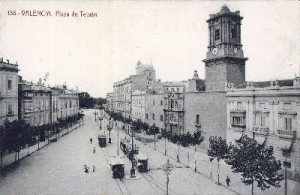
Outraged by the murder of their delegate, the Iron Column organised a massive funeral procession on Friday, 30 October. They marched into Valencia city from their military encampments and brought an armed combat unit and two improvised armoured tanks directly into the city centre to head the procession as a show of absolute defiance. Knowing the heavily armed anarchists were marching through town, the Communist Party (PCE) and state security leadership, under the tactical coordination of Commander Manuel Eixea, set up a deliberate, multi-layered defensive trap. They heavily fortified the Plaza de Tetuán, positioning a combat battalion that had recently returned from the Madrid front inside the square. Communist militants took up hidden firing positions inside the upper-floor windows of the PCE headquarters (the seized Palacio de Cervelló) and the neighbouring Capitanía General military building (the former Royal Convent of Sant Domènech).
The communists had been pre-warned that 20,000 people were going to march, and when the funeral procession did not break off at the traditional location for processions from the nearby convent, worry sunk in as they headed toward government buildings. Children marched at the front of the procession, then, armed militiamen guarding an armoured truck carrying the coffin, followed by militia from the CNT 13 and Torres Benedito columns. When the massive funeral procession arrived at the mouth of the Plaza de Tetuán, a young Communist militant reportedly fired a protest shot at the anarchist vanguard. This instantly triggered a massive, chaotic exchange of gunfire. For over half an hour, submachine guns, rifles, and pistols turned the historic square into a deadly funnel. Anarchist milicianos dove for cover behind statues and building columns, returning heavy fire toward the windows above. In the basements of the PCE headquarters there had been the cache of weapons ready for the arriving the International Brigades.
Municipal history sources show a death toll of 35 dead and over 80 wounded by gunfire, predominantly anarchist milicianos alongside several state guards, including anarchist commanders like José Pellicer. Almost all of the 31 identified victims are listed as found dead at local cemeteries or died of wounds in hospital between 31 October – 5 November. This event stands as a crucial milestone showing the violent, internal war within the war before the central Republican government officially moved its capital to Valencia in November 1936. The Sucesos de Octubre (October Events) turned the heart of Valencia into a literal warzone because it was an organised, military showdown between two heavily armed factions within the Republican camp fighting for control of the regional government.
No investigation into the event was ever conducted. Those responsible were José Antonio Uribes Moreno, a leader of the PCE in Valencia who was later exiled, Manuel Eixea Vilar (1881, member of the PCE was was hot just after the war, Ricardo Zabalza Elorga, the Civil governor of Valencia, who was shot just after the war, and Enrique Torres Herrero (1908-1980). The Valencian bullfighter Enrique Torres Herrero, 18 years old at the time and a member of the Unified Socialist Youth (JSU) who was later exiled. None faced any punishment for the attack, and the Iron Column victims have been largely forgotten.
Photographic evidence of the event is impossible to find, but the images of the locations are readily available (beautiful places hiding serious crimes).
- Torres de Carrizal, Zamora, Old Castile
In October 1936, the Puente de los Seis Ojos (Bridge of the Six Eyes) near Torres del Carrizal in Zamora, Spain, became the site of a brutal mass execution known as La matanza del Puente de los Seis Ojos (The Massacre of the Six-Eyes Bridge). On the night of 30 October 1936, Nationalist forces executed seven local residents from Torres del Carrizal at the bridge. The victims were targeted as part of the systemic nationalist repression against left-leaning individuals, union members, and supporters of the Spanish Republic following the military coup in July of that year.
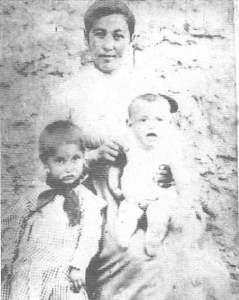
Moisés Pulido Luengo, president of the municipal council, had his case dismissed and he regained all his assets, though his wife was of course murdered in his place. His father-in-law Antonio Cereceda González , – President of the Sociedad Obrera, survived the war in prison and was also alive to receive his assets back in 1943.
Aureliano Sastre Pérez – brother of bridge victim Segisfredo Sastre Pérez had all charge dismissed, along with Felipe Lorenzo Manzano & Paulino Lorenzo Manzano, whose mother, María Manzano González, was executed at the bridge. The same for Bernardino Vara Rodríguez, brother of bridge victim Serapio Vara Rodríguez. Also acquitted that day was a woman, Sabina Vara Peña, a cousin of bridge victims Serapio Vara Rodríguez and Alejandro Peña Vara, who must have been arrested on a different date to her relatives.
When Franco passed the Responsabilidades Políticas law in February 1939, it was designed to retroactively strip the assets, savings, and homes of anyone who had supported the Republic.
However, the regime’s court systems opened over 400,000 separate files. A tiny regional judiciary, like the one in Zamora, suddenly found itself drowning in hundreds of thousands of active property seizures, bank accounts to track, and small family farms to evaluate. By 1943, the court system was utterly paralyzed by its own administrative greed. By late 1942 and early 1943, the regime realized that pursuing low-income day labourers and small-town political figures from places like Torres del Carrizal was costing the state more money in legal fees, storage, and administrative paperwork than the properties were actually worth.
The regime began systematically throwing out thousands of cases if the accused person’s total assets fell below a certain monetary threshold (usually 25,000 pesetas). Dismissing the files of regular working-class citizens allowed the Tribunales Regionales to focus entirely on heavy economic extortion against wealthier Republican targets, businesses, and organizations. By early 1943, the Axis powers were losing ground in World War II. Franco began to fear that if Nazi Germany collapsed, Allied forces might turn their focus toward Spain. To make the dictatorship appear more respectable, less lawless, and structurally stable to the international community, the regime began issuing mass dismissals of political case files to clean up its international human rights profile.
- Salamanca, Old Castile
Simultaneously, the air raids surrounding Toledo on and around 30 October were tactical operations directly tied to the chaotic ground warfare happening along the Rio Tajo (Tagus River). Nationalist forces under General Varela had captured Toledo and relieved the besieged Alcázar at the end of September. By late October, the primary Nationalist vanguard had marched north past Toledo toward Madrid, leaving Toledo’s southern and eastern flanks highly exposed to Republican counter-offensives. Republican forces launched an aggressive ground push supported by aerial bombing. The Republican bombers targeted Nationalist troop concentrations, artillery batteries, and the crucial rail infrastructure around the Toledo train station, which the Republicans successfully re-occupied during that window. The intense bombing forced the military governor of Toledo to issue emergency protocols on the exact same days. This included deploying a continuous, frantic ringing of church bells across the city to warn civilians to immediately seek cover in basements or cellars.
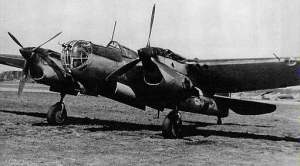
The reason these high-altitude, long-range strikes occurred during this specific week is down to a single hardware deployment. Prior to late October, the Republican air force was flying slow, outdated French Breguet XIX biplanes, which were easily torn apart by Italian-built Nationalist fighters. Everything changed days before the attack, when the first shipment of Soviet Tupolev SB-2 fast twin-engine bombers, Katiuskas, arrived. These planes were so advanced and fast that they could outrun the Nationalist biplane escorts, allowing the Republic to strike deep targets like Salamanca completely unhindered for the first time.
- Vigo, A Coruña, and Ourense, Galicia
In Vigo, the tribunal targeted the backbone of industrial and transportation labour organising. Humberto Solleiro Rivera, a railway worker and highly effective organiser for the Unión General de Trabajadores (UGT), was executed following a brief military conviction. In an unusual turn for the period, his wife, the prominent feminist and activist Urania Mella, had her death sentence commuted to life imprisonment, surviving the darkest years of the post-coup environment.
Further south, in the border town of Tui, a major six-person repression cluster was executed on the same morning. The central figure was Dr. Darío Álvarez Limeses, a prominent local general practitioner, intellectual, and member of Izquierda Republicana who had co-authored key medical texts on global pandemics in 1918. Following brief military proceedings for resisting the coup, Dr. Álvarez Limeses was marched to the firing squad alongside five other local Republican figures – Alejo Diz Jurado, Serafín Fernández Costas, Julio Fernández Fernández, José Felipe Muñoz, and Manuel Domínguez León. All six men were shot together on 30 October 1936.
While other provinces carried out public or staggered executions, the landlocked province of Ourense centralised its firing squads in the provincial capital. Throughout October, the Campo de Aragón within Ourense city served as the principal, high-volume execution hub for the region. Modern archaeological and historical documentation of this specific site highlights the sheer scale of the provincial cleansing. Over the wider period of the repression, the Campo de Aragón saw the systematic execution of 133 individuals by military firing squads. The gender breakdown, 132 men and one single woman, reflects the systematic gendered nature of the Nationalist repression, which aimed to execute the male labour, military, and political workforce while subjecting female dissenters to imprisonment, public humiliation, or targeted extrajudicial killings.
- Quintanilla de Combarros, Brazuelo, León
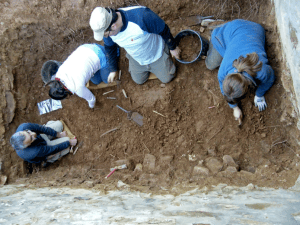
The historical event tied to the mass grave at Quintanilla de Combarros details the tragic reality of extrajudicial executions carried out by falangists during the opening months of the Spanish Civil War. On 23 October 1936, three residents from the nearby town of Destriana were detained by a local group of falangists. They were meant to be transferred to the military barracks in Astorga, where they were held until the end of the month. But at dawn on 30 October 1936, instead of being processed, the three men were driven to a nearby rural area known as La Cuestona (near Combarros) and xecuted. Following the murders, sympathetic local residents moved their bodies to the exterior walls of the Quintanilla de Combarros cemetery to provide them with a hidden, basic burial.
The three men murdered were Salvador Pérez Turrado, 41, Higinio Marcos Pérez, 45, and Tomás Martínez Prieto. The grave was officially located and exhumed in February 2009 by the Association for the Recovery of Historical Memory (ARMH). Forensic teams successfully recovered the remains of all three individuals. In May 2010, following proper verification, the remains were formally handed back to their surviving families. They were reburied alongside other victims of the civil conflict in a memorial ceremony held at the cemetery in their native town of Destriana.