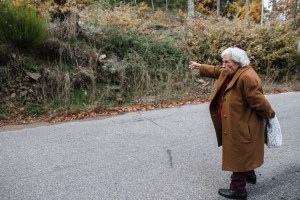
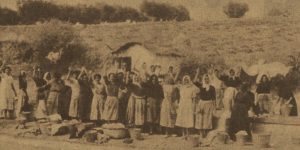
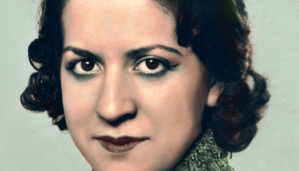
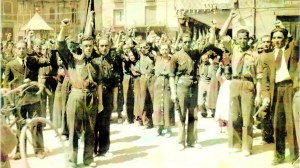
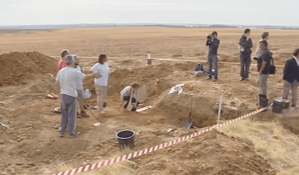
Felipa Peinado at the site where she knew her family had been dumped, via ARMH
Casillas, Ávila, Old Castile
Casillas is a small, historically isolated mountain village located in the south-eastern corner of the province of Ávila, within the autonomous community of Castilla y León, Spain. Geographically nestled in the dense chestnut and pine forests of the Valle del Tiétar region, its unique topography and socioeconomic evolution heavily shaped the dramatic events of 1936. Prior to the offensive, Casillas was a deeply divided farming community of around 1,400 residents, nestled in the dense forests of the Valle del Tiétar comarca, just south of the Sierra de Gredos. This southern strip of Ávila had initially remained loyal to the Second Spanish Republic, and Casillas was home to an active left-wing local leadership, including a chapter of the socialist party led by the village pharmacist, Julio Peinado.
When the military coup erupted in July 1936, the strategic mountain passes surrounding the region became highly contested zones. Nationalist columns steadily advanced from Valladolid and across the Guadarrama territory to choke off Madrid. By the final phase of this relentless October push, local Republican militia defences dissolved under heavy fire, leaving the civilian population entirely exposed. As Nationalist forces simultaneously choked off adjacent territories like San Martín de Valdeiglesias and Navalperal de Pinares, the surviving Republican columns found themselves completely outmanoeuvred and cut off. Upon entering the village on 10 October 1936, Franco’s forces immediately initiated a brutal purge, the White Terror, to systematically eliminate anyone associated with the Popular Front.
Right-wing sympathisers within the village pointed out their left-wing neighbours to arriving military squads. Julio Peinado, only 32 years old, and his father Saturnino Peinado were targeted immediately. Alongside several other local union members and suspected loyalists, they were rounded up and summarily executed over 10 and 11 October. The bodies of the victims were dumped into roadside ditches and mass graves scattered along the rough mountain transit routes, such as the AV-P-703 highway running through Casillas.
For decades after the war, a strict, terrified pact of silence blanketed Casillas. The families of those executed were forced to live alongside the neighbours who had denounced them, walking the same narrow streets every day. Felipa Peinado, who was only six years old when her father and grandfather were murdered, refused to let their memory disappear. Known locally in the mountain village as la loca (the crazy woman), her decades-long, uncompromising refusal to abandon the search made her a powerful embodiment of the generational trauma surrounding Spain’s hidden mass graves.
Felipa’s fame in Spanish activist circles escalated into legend in 1996. The regional government, the Junta de Castilla y León, had deployed heavy road-construction machinery to widen the local highway. Realising that the bulldozers were about to permanently pave over the exact regional roadside ditch where she had been secretly told her father was buried, Felipa physically stood in the path of the excavators. Her solitary, fierce defiance ground the construction to a halt and successfully preserved the site from being erased under layers of asphalt.
Even in her late 80s, Felipa remained fiercely active. She worked alongside the Association for the Recovery of Historical Memory to launch formal archaeological digs. Her struggle continually exposed deep modern political friction, when, in late 2018, the association launched a new dig based on Felipa’s testimonies, aiming to locate three missing neighbours, including a villager named Regino and his nephew. Following the dig, the conservative-led Provincial Deputation of Ávila sparked nationwide outrage by sending the volunteer group an official invoice for €150.25, a unique administrative fee labelled as an exhumation tax. Human rights groups and the Historical Memory Association publicly shamed the council for penalising a grieving family for trying to find their dead. Facing a massive wave of media blowback, the administration ultimately backed down, claiming the bill was an administrative error, and renounced the fee.
.
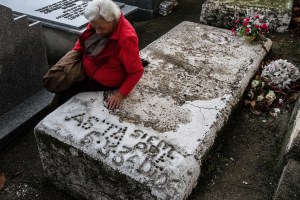
Though some archaeological prospections in the rough mountain terrain were agonisingly unsuccessful, Felipa’s lifelong stubbornness eventually achieved a rare, historic victory. She successfully forced the legal recovery of her father and grandfather, along with other neighbours. Today, if you visit the municipal cemetery of Casillas, you will find a grave marked simply “5 y 3”. It stands as a testament to the two distinct sets of victims exhumed due to her unyielding crusade, turning a woman once mocked as crazy into the permanent moral compass of her entire region.
.
Felipa Peinado at the grave of the 5 and 3, via ARMH
The March on Madrid from Ávila and Toledo
The three-day window between 10 to 12 October 1936 marked a precise moment the civil war shifted from a fluid, mountain campaign into a desperate, localised slaughter. During these 72 hours, the Republican military front line ceased to exist in the western valleys in Ávila and Madrid border, giving way to the cold mechanics of territorial consolidation and political cleansing. The fighting also shifted from a broad multi-directional advance into a highly focused squeeze play centred on the Madrid-Toledo-Ávila triangle.
.
Having pushed past through the Puerto de Arrebatacapas mountain pass the defensive shields of Piedralaves and Sotillo de la Adrada, Colonel José Monasterio’s cavalry units of 12,000 to 14,000 (across all zones) Foreign Legion troops, Moroccan Regulares, and motorised infantry columns under General Delgado Serrano, backed by specialised machine gun sections and intense German and Italian aviation support bombers marched up the winding stone streets of Casillas. The Republican Del Rosal Column of 6,000 to 8,000 fragmented milicianos had completely evacuated the sector 48 hours prior, retreating east toward Madrid. Monasterio’s men faced zero incoming fire. The town hall, school, and local jail were instantly commandeered by the advancing columns to establish a makeshift headquarters. Local right-wing sympathisers presented military officers with carefully compiled lists of names, including Felipa Peinado’s family.
.
Simultaneously, from the south (Toledo axis), General Varela’s vanguard cleared the town of Escalona, driving a wedge through the Almorox sector to push the Republican defence lines further back into Madrid province. Operating on instructions from the high command, the Monasterio Column pressed directly out of the valley slopes to enter San Martín de Valdeiglesias. San Martín was the crowning prize of the early October surge, a massive tactical highway junction connecting the provinces of Ávila, Toledo, and Madrid. As Nationalist cavalry linked up with Varela’s infantry columns moving from the south, a massive sweep of the surrounding forests was ordered. Fragmented bands of Republican volunteers, missing their units and lacking ammunition, were hunted through the woods. Leftist journalists who had embedded with the militias, including prominent sports-writer-turned-war-correspondent Ángel de Guzmán, were killed during the chaos of San Martín’s final fall.
.
Ángel de Guzmán was an anarcho-syndicalist journalist and captain of the confederal militias during the Spanish Civil War. Before the war, he worked as a journalist alongside his brother, the prominent libertarian writer and historian Eduardo de Guzmán, at the Madrid newspaper La Libertad. When the military coup erupted in July 1936, Ángel joined the anti-fascist resistance, transitioning from writing to taking up an active military leadership role within the Confederal Militias linked to the CNT. He fought directly on the central and western fronts as the Republic scrambled to hold back Franco’s columns. As noted in the tactical progression of the battle, Ángel de Guzmán was killed in action facing Nationalist forces on the battlefront during the chaotic military collapse near the San Martín de Valdeiglesias axis. His brother Eduardo later detailed the immense personal and political heartbreak of losing Ángel in his famous wartime and post-war historical trilogies.
.
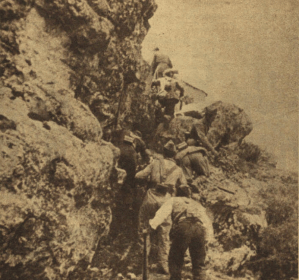
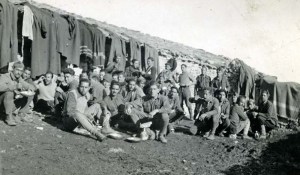
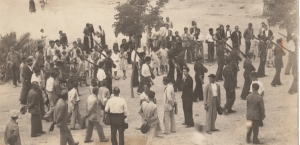
Republicans mountain-scaling at the front, via Ahora, Biblioteca Nacional de España
This link-up dissolved the 13km gap that had previously separated the Nationalist northern and southern armies. Surviving Republican militia bands found themselves entirely outflanked in the surrounding pine forests and valleys, forcing a highly disorganised, chaotic retreat down the highway toward the secondary defensive lines of Brunete and Navalcarnero. Meanwhile, having captured the strategic regional high ground and the vital highway hubs, the Nationalist columns spent 12 October establishing a unified, fortified front line along the Alberche River network. Street-level military fighting in the immediate sector slowed into a defensive consolidation phase as Varela’s columns standardised their supply lines, but by the end of 12 October, the entire western gate to the capital was blown open, positioning the Nationalist military vanguard within direct striking distance of Madrid’s final outer defensive ring.
.
The military victory achieved by the Nationalists between 10 and 12 October 1936 was an absolute strategic catastrophe for the Second Spanish Republic, fundamentally altering the trajectory of the battle for the capital. The victory was profoundly serious because it marked the permanent loss of the natural mountain buffers protecting Madrid from the west. By securing San Martín de Valdeiglesias, the Nationalists finally linked the Army of the North with the southern columns fanning out from Toledo, creating a unified, iron front line. It completely blocked the Republic’s ability to manoeuvre in the region and placed the Nationalist vanguard directly on the Alberche River, within a few days’ march of Madrid’s final suburban defences.
.
The fragmented Columna Del Rosal was squeezed into a pocket at Sotillo de la Adrada under heavy tactical bombardment. Lacking heavy artillery and running out of ammunition, whole battalions disintegrated during the retreat. Unknown hundreds of militiamen were hunted down killed trying to cross open roads. Due to their vast superiority in mechanised armour, cavalry mobile tactics, and continuous air support provided by Italian and German aviation, the Nationalist columns under Monasterio and Varela suffered very light casualties while securing these territories.
.
San Martín de Valdeiglesias, as the primary regional hub, it saw immediate municipal liquidation. Prominent Republican civilians and stranded rearguard figures were dragged into the town’s public square and summarily executed on the spot without trial. Following its capture on 9 October, Sotillo de la Adrada suffered heavily under the occupation. Local union organisers and sympathisers were methodically identified by right-wing neighbours and executed. Casavieja and Piedralaves had already been heavily ‘softened’ by Nationalist aerial bombings during the final push, and the subsequent street-by-street occupations resulted in targeted summary executions, while El Tiemblo and Cebreros continued to experience rapid roundups as the Nationalists secured the highways leading into Madrid province.
.
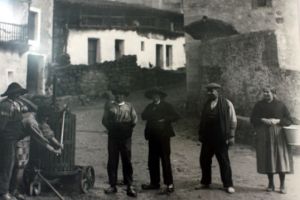
Casavieja life, date unknown
While Casavieja was able to identify a small mass grave from the time period, all the other locations, with the exception of Casillas do not have identified mass grave locations. San Martín de Valdeiglesias in Madrid province also has been unable to identify any mass grave sites from the battles, though Cenicientos, 16km south was able to recover six unknown people who were exhumed and placed in the walls at Valle de los Caídos.
During the rapid Nationalist advance between 10 and 12 October 1936, the sheer number of Republican militia casualties created a massive logistical and health hazard. To prevent disease, Nationalist burial details used whatever terrain was available, primarily roadside ditches, natural ravines, and dry riverbeds along the Alberche River network. Franco’s forces used heavy machinery or forced local captive laborers to dig shallow, massive trenches directly parallel to the combat paths. Bodies were piled in unceremoniously, often still wearing their ammunition belts and boots. In the dense pine forests and rough mountain foothills around San Martín de Valdeiglesias, many Republican soldiers who died retreating from the Monasterio Column were simply left where they fell. Because these areas were isolated, many skeletal remains were slowly buried by decades of natural soil shifting, forest growth, and erosion, making them some of the hardest graves for modern historical memory groups to locate today. The bodies of many anonymous Republican battlefield casualties were secretly dug up from the Madrid and Ávila trenches by the Francoist regime for now Valle de Cuelgamuros).
.
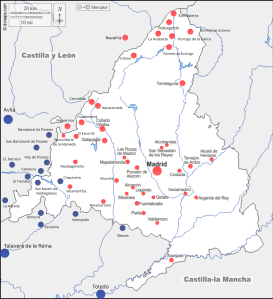
Madrid and surroundings areas as of 15 October 1936
Madrid
The official media strategy in Madrid systematically played down the Nationalist advance, covered up the scale of the military collapse, and masked the brutality of the coming danger. By trying to avoid public panic, the government inadvertently created a lethal false sense of security, leaving thousands of rural families and local militias completely unprepared for the speed and ferocity of the oncoming Army of Africa. The media landscape of early October 1936 was a combination of censorship, delusion, and weaponised optimism.
When towns like Almorox, Escalona, and Navalperal fell between 6 and 10 October, the official news broadcast via Unión Radio Madrid and leftist newspapers (like Claridad or El Socialista) did not report a defeat. Instead, they relied on euphemisms. Defeats were broadcast as elastic defence or orderly strategic retracements. The chaotic retreats of untrained militias fleeing tank panic were routinely framed as tactical manoeuvres designed to draw the enemy into a trap.
.
The Republican government tightly controlled foreign and domestic press dispatches. Journalists who attempted to report the true speed of the Nationalist advance or the absolute panic on the roads were branded as defeatists, fifth-column saboteurs, or fascists. The Ministry of Propaganda believed that keeping public morale high was the absolute priority. However, by continuously reporting that the situation is completely under control, they effectively blinded the population. Because the news downplayed the devastation, the consequences for the tiny villages in the path of the Nationalist pincer were catastrophic. Had the media been honest about the ruthless methods of the Moroccan Regulares and the Foreign Legion, entire populations could have been evacuated eastward toward Madrid days in advance. Instead, many villagers stayed in their homes, believing the radio reports that the Republican militias were successfully holding the line just a few kilometres away.
When Nationalist motorised columns bypassed the roads and burst into villages like Casillas or San Martín de Valdeiglesias, civilians were caught completely by surprise. Local left-wing mayors, union members, and families were found sitting in their homes or working in the fields, making it tragically easy for right-wing informants to round them up.
This dangerous dynamic only broke in late October and early November, when the Nationalists literally reached the southwestern suburbs of Madrid. Only when the sound of artillery could be heard in the streets of the capital did the government drop the false optimism. They shifted from playing down the war to a hyper-realistic rallying cry of ‘No pasarán!’ They finally admitted that the danger was at the doorstep, triggering a massive, frantic scramble to build barricades and evacuate many to the east, a warning that came weeks too late for the tiny, conquered villages of Ávila and Toledo.
Newspapers continued to post inspirational photos of life near the front, despite Madrid’s imminent danger, via Ahora, Biblioteca Nacional de España
Palencia, Old Castile
Following the military uprising of July 1936, the province of Palencia fell largely under Nationalist control, driven by local military authorities and Falangist militias. However, the northernmost reaches of the province, bordering the staunchly Republican-held territory of Santander (Cantabria), became a volatile frontline. The Aguilar de Campoo and Barruelo de Santullán sectors remained highly strategic. This region combined vital rail infrastructure with lucrative coal mining basins, where heavily unionised mining populations fiercely resisted the Nationalist advance before many were forced to retreat into neighbouring Republican territory. By October 1936, the war of movement had ground down into a gruelling war of positions along what would become known as the Northern Front. On 10 October 1936, this quiet sector erupted as Republican forces launched a major tactical offensive on the Palencia front, specifically targeting Nationalist strongholds in the villages of Nestar, Cabria, and Menaza.
.
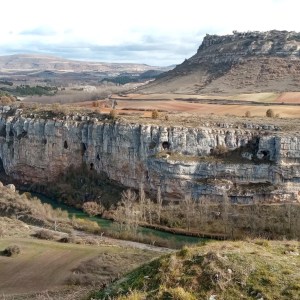
The reality of the terrain at Cañón de la Horadada outside Aguilar de Campoo, via kamoot
On the morning of 10 October, Republican columns advanced out of their mountain strongholds to execute a coordinated, three-pronged assault against the Nationalist positions at Nestar, Cabria, and Menaza. These small villages formed a defensive arc safeguarding the approaches to Aguilar de Campoo. The offensive was characterised by intense artillery exchanges and desperate close-quarters fighting. Republican forces, drawing heavily on local volunteer militias and miners who possessed intimate knowledge of the rugged geography, initially succeeded in putting severe pressure on the Nationalist lines. The attacking force comprised roughly 2,000 to 3,000 combatants. Because this sector sat on the border with Santander, the troops were reinforced by columns deployed from the Republican-held northern mountains. The overall operations on the Republican side of the Palencia/Santander border were overseen by Captain García-Viana, a professional military officer who remained loyal to the Republic, working alongside political commissars from the regional Popular Front committees.
.
The Nationalist defenders, relying on fortified enclaves and hastily deployed reinforcements, scrambled to prevent a complete breakthrough that would compromise the entire provincial border. The defensive lines were held by a smaller, entrenched force of approximately 1,000 to 1,500 men. However, what they lacked in sheer troop numbers they made up for in structural organisation. The defenders were a combination of infantry units originating from the Palencia garrison, alongside local Requetés and Falangist paramilitary squads.
.
Directly adjacent to the frontline villages lay the prominent coal-mining hubs of Barruelo de Santullán and Guardo. These towns had heavily unionised populations with a fierce history of left-wing radicalism. In fact, many of these miners had participated in the failed 1934 Asturian Revolution. When the 1936 coup happened, these populations launched massive strikes and formed the vanguard of the Republican resistance. By October, many civilians from these towns had either fled north into the mountains to escape Nationalist repressions or actively joined the militia lines.
.
The target villages of Nestar, Cabria, and Menaza themselves were small, deeply conservative, rural hamlets with populations numbering only a few hundred residents each. Historically anchored in traditional agriculture and Catholicism, the local peasantry in these immediate lowlands was broadly sympathetic to, or coerced into supporting, the Nationalist cause. By 10 October, the immediate frontline villages had been largely evacuated of women, children, and the elderly, effectively turning the centuries-old stone houses of Nestar, Cabria, and Menaza into fortified outposts and machine-gun nests. Those civilians who remained in the wider Aguilar de Campoo sector lived under a strict state of martial law, experiencing constant requisitioning of food and property by the Nationalist military authorities.
.
Republican soldiers at the frontline, via Aruz
.Though the attack on the Nestar–Cabria–Menaza line represented the most significant Republican push in the Aguilar/Barruelo sector that autumn, but recognising that their regional position was fractured, Nationalist commanders launched a coordinated flank operation on 12 October to shore up their defences. The operation yielded immediate tactical successes when forces swept into Cillamayor, effectively closing a dangerous geographic gap that had existed between the Barruelo and Aguilar sectors. Simultaneously, Nationalist detachments secured the neighbouring village of Matalbaniega, extending their buffer zone and reinforcing the local perimeter. This double success unified their local fronts and secured the broader Palencia–Burgos frontier. By plugging these gaps, the Nationalists successfully locked down the connection between their Palencia positions and their entrenched units around La Lora and Valderredible to the east.
.
On 13 October, the Republican press claimed that their forces had achieved fresh breakthroughs in the northern theater, specifically pushing back into the Nestar / Aguilar de Campoo area. According to these Republican reports, forward units had captured new terrain and managed to damage vital railway communications feeding the Nationalist war machine.
However, unlike the heavily documented, back-and-forth fighting over the previous three days, the exact scale and permanence of this final 13 October Republican advance remains historically ambiguous. While rail infrastructure was likely sabotaged by mobile Republican squads, the core defensive web newly established by the Nationalists around Cillamayor effectively prevented a total systemic breakthrough, leaving the Palencia–Burgos frontier locked in an enduring war of positions. The trenches separating the Nationalist-dominated plains of Palencia from the Republican mountains of Santander would remain active and blood-soaked for another thirteen months, until the final collapse of the Northern Front in the summer of 1937.
.
Amparo Barayón, via Estado de Memoria Democrática, Junta de Castilla y León
Zamora, Old Castile
In the opening months of the Spanish Civil War, the city of Zamora became a bastion of Nationalist repression. Behind the front lines, a systematic campaign of terror was unleashed against anyone suspected of republicanism, intellectualism, or social non-conformity. Over forty-eight hours in October 1936, this brutality was sharply illustrated by the ordeal of Amparo Barayón, a prominent 32-year-old pianist and feminist, whose life was systematically dismantled by Francoist forces before her extrajudicial execution.
.
Amparo Barayón was married to the renowned anarchist intellectual and novelist Amparo Barayón. Seeking safety when the military coup broke out, she fled to her conservative hometown of Zamora with her two young children, while Sender remained behind to fight for the Republic in Madrid. Instead of safety, she found a trap. Following a denunciation by her own brother-in-law, Miguel Sevilla, she was arrested by local authorities on 28 August 1936 and held in inhumane conditions with her seven-month-old infant daughter, Andrea. On 10 October 1936, the state’s cruelty took a bureaucratic and deeply personal turn. Local prison authorities forcibly removed seven-month-old Andrea from her mother’s custody and transferred her to a local orphanage. This act was driven by the early Nationalist doctrine that, ‘Reds have no right to raise children.’
.
Left alone in her cell, Barayón penned a final letter to her husband that said: ‘Do not forgive my killers, who have stolen Andreina from me, nor Miguel Sevilla, who is to blame for having denounced me. I do not feel sorry for myself, because I am dying for you. But what will become of the children? They are yours now. I will always love you.’
.
The day after her child was stolen, on 11 October 1936, Barayón’s captors orchestrated her final transfer under the false pretence of moving her to Bermillo de Sayago. Instead, she was delivered to a Falangist death squad led by Martín Mariscal. She was executed alongside two other local women from Zamora who had fallen into the crosshairs of the fascist purge, Juliana Luis García, aged 61, and Antonia Blanco Luis, aged 25. The three women were driven to the walls of the San Atilano Cemetery in Zamora and shot by a firing squad that allegedly included Segundo Viloria, a former suitor whose advances Barayón had rejected years prior. In a final indignity, a Catholic priest refused to grant Barayón absolution or last rites on the basis that her civil marriage to Sender was living in sin in the eyes of the Church. Their bodies were dumped unceremoniously into a common grave mixed with quicklime.
.
The destruction of the Barayón family was near-total; Amparo’s two brothers, Antonio and Saturnino, had already been executed by Francoist squads in the weeks leading up to her death. Following the murders, the Francoist state opened a legal case against her corpse to seize her assets, formally cataloguing her as a spy to justify her murder. Her children, Andrea and Ramón Jr., survived. In 1938, they were recovered from Nationalist territory via the International Red Cross and reunited with their father in exile. Decades later, her son Ramón Sender Barayón returned to Spain to investigate the tragedy, publishing his findings in the memoir A Death in Zamora. The sudden, violent deaths of Amparo Barayón, Juliana Luis García, and Antonia Blanco Luis remain a haunting symbol of how the Spanish Civil War targeted women for their political ideals and a means to tear apart the fabric of Republican families.
.
Just 70km north, the northern hub of Benavente had seen its municipal jail packed with left-wing trade unionists and supporters of the Second Spanish Republic. To streamline their processing, the Nationalist security forces transferred these detainees to the provincial capital. There, on the in the early hours of 10 October 1936, they became the targets of a mass, coordinated execution. Because the Francoist regime went to great lengths to conceal the scale of its rearguard executions, historians heavily rely on first-hand accounts to reconstruct the true chronology of the terror. The primary breakthrough for mapping the fate of the Benavente prisoners comes from the written prison memoirs of survivor Pilar Fidalgo Carasa. Pilar, who was imprisoned alongside the victims, provided a detailed record of the inner workings of the provincial prison. In her testimony, she explicitly identified the night of 9 October 1936 as the moment the prison gates opened for a collective saca.
Under the cover of darkness, a large, synchronised group of Benavente acquaintances was marched out of their cells by Falangist paramilitary units and Guardia Civil. They took Epifanio Rodríguez Rubio, aged 55, a day-labourer, Frente Popular city councillor, and accountant for the local Socialist group, Felipe Martínez Abad: aged 59, a bricklayer and fellow Frente Popular city councillor for the PSOE, Ildefonso López Fernández, aged 43 , a local industrialist, librarian, and correspondent for the republican newspaper La Tarde, Enrique Villarino Santiago, a local member of the Communist Party, Francisco Fernández Merino, aged 25, a local baker., Luciano García Guerra, aged 48, an industrial vendor and member of the local Socialist Group, Marcelo Carbajo Lora, aged 31 years old, an accountant and prominent contributor to the progressive publication El Pueblo, a man nickanmed Burgos, aged only 18 and son of the local shoemaker, who was from a socialist family, Félix Vara Carnero, a local worker, Narciso Ibáñez Frontela, the local painter, Alejandrino Pérez Prada and Teófilo Infestas Riaño, locals who had been arrested early in the war, and Vicente (or Venancio) Alonso, a political detainee whose wife, María Garea González, was also imprisoned in the women’s wing and executed separately. There may have been several others on the trip that night, but Pilar, in her trauma, was unable to name them.
.
The men were put in Sala de Justicia, cramped room late on 9 October, a space used for interrogation and torture, a makeshift chapel where the prisoners were forced to hear Mass, and the staging room where they were shackled before being loaded onto the flatbed trucks. Instead of being driven to the local cemetery pit, the men were trucked 70km south to the massive pit in Zamora city, at San Atilano, where they became faceless victims among the 860-1000 people murdered outside the local cemetery, which remain undignified and unexhumed. Franco and his supporters may all be long dead, but plenty of people from subsequent generations have worked hard to ensure the ghosts of Zamora stay buried.
.
Pilar Fidalgo Carasa herself survived the White Terror. Her life became defined by a harrowing prison ordeal, a rare wartime release, international activism, and decades of political exile. Pilar was a qualified schoolteacher and governess originally from Benavente but on 6 October 1936, Falangist squads arrested her at her home because she was the wife of José Almoina Mateos, a prominent local intellectual, tutor, and the founder of the socialist PSOE branch in Benavente, whom the Nationalists had been unable to capture, as he fled on the day of the outbreak of war towards Asturias, abandoning his family. Just eight days prior to her arrest, she had given birth and went to prison with her newborn daughter, Helena where they spent seven months. During this window, she endured the psychological torture of the late-night sacas, witnessing her friends and political leaders from Benavente being systematically dragged to the firing squads. She also befriended Amparo Barayón during their shared incarceration, comforting her right up until Barayón’s execution.
.
In May 1937, Pilar, her three children and her mother were granted a rare lifeline. They were released from the rebel zone as part of an official international prisoner exchange, swapped for the family of a prominent Nationalist supporter from Valladolid which had been arranged by a group that included Pilar’s husband, who had been living safely in Santander and Bilbao. Upon crossing safely into France, she immediately used her freedom as a weapon to expose the clandestine nature of Franco’s rearguard, and gave a comprehensive, sworn deposition detailing the horrors of the Zamora prison at the Republican Consulate in Bayonne.
In 1939, her testimony was published in London as a prominent humanitarian pamphlet titled A Young Mother in Franco’s Prisons. The book, which featured a cover illustration by Pablo Picasso taken from his Dream and Lie of Franco series, became a vital historical anchor, offering the world an immediate, uncensored look at the systemised executions taking place behind the lines.
With the collapse of the Second Republic, Fidalgo and her husband, José Almoina, could never return to Spain. They moved in the Dominican Republic before relocating permanently to Mexico in 1947, but in 1960, Pilar’s husband José was assassinated in Mexico City, a hit widely attributed to secret agents working for the Dominican dictator Rafael Trujillo, whom Almoina had heavily criticised in his own writings. Pilar Fidalgo remained in Mexico for the rest of her life, raising their five children. She only ever returned to Spain briefly late in life to visit the graves of her parents, and passed away in 1990 at the age of 86. Her written words remain one of the most critical legal and historical tools used by modern archaeologists to track down and identify the missing prisoners of Zamora.
Seville, Andalucía
By October 1936, the provincial capital of Seville had solidified into the core logistical command hub for the Nationalist coup in southwest Spain. Under the uncontested regional command of General Gonzalo Queipo de Llano, the chaotic violence that marked the immediate aftermath of the July uprising evolved into a highly institutionalised, bureaucratic apparatus of extermination. A central tenet of this strategy was the structural pipelines through which political prisoners, left-wing unionists, and municipal workers were aggressively extracted from outlying rural villages and funnelled directly into Seville city. This process streamlined the mechanics of the firing squads and ensured strict control over mass grave records. By October 1936, all areas of Seville province were already long-suppressed and the project had turned to emptying overflowing prisons, and killing relatives of those who had already died or had fled.
.
On 23 July 1936, the Count of Villacreces, attempted an assault on Coria del Río aboard a boat with 90 soldiers, and was killed after machine-gunning the riverside promenade, killing four women. Yet these women were not considered repression victims. The town was captured by Nationalists the following day. The town lost 180 people to execution, and another 300 fled, via Canal Sur
The San Fernando Cemetery served as the final destination for this human pipeline. Within its walls, the dates of 9 and 10 October 1936 recorded a devastating surge in collective, state-sanctioned killings. On the morning of 9 October 1936, the administrative execution machine recorded 19 formal executions, working-class citizens harvested from the pacified rural territories of Seville province. When Seville’s towns fell in July and August, thousands of working-class families could not cross the provincial borders and had fled into the rugged mountains (like the Sierra Norte) or hid inside large, isolated country cortijos. In October 1936, the cavalry and mobile military units systematically combed these rural hiding spots, capturing these internal refugees and loading them into trucks bound for local cemeteries or the capital.
.
One town affected by this was Coria del Río, where agrarian labour organisers were being systemically rounded up. Coria del Río had a population of roughly 10,500 people in 1936 and was characterised by a long-standing, left-wing and anarcho-syndicalist (CNT) tradition. Because the local day-laborers had participated in strikes and land-reform demands during the Second Republic, they were viewed with intense hostility by the local right-wing land-owning elites. There was no active combat or frontline resistance inside Coria del Río, and all died during the social cleansing campaigns executed behind the front lines against unarmed civilians. A substantial portion of the victims from Coria del Río did not die within their home village boundaries. Instead, they were swept up by local Falangist squads and channelled into the centralised execution pipeline leading directly into the provincial capital of Seville.
.
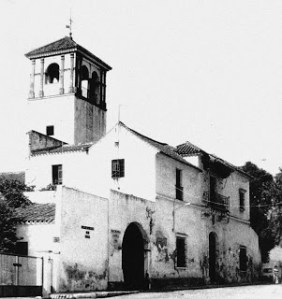
The Town Hall in Tomares, via Historia de Tomares
The 17 people killed were immediately deposited into the expanding, unmarked communal pits including the historical Pico Reja mass grave, which remained permanently open on the cemetery’s north-western boundary throughout the autumn of 1936 to absorb the daily influx of bodies. On 10 October 1936, the firing squads at San Fernando Cemetery continued processing prisoners arriving from the surrounding municipalities, including day labourers from the town of Tomares taken from their homes.
The large-scale killings on 9 and 10 October 1936 are heavily studied by Spanish Civil War historians to dismantle the myth of the rearguard terror being a series of uncontrolled, spontaneous wartime excesses. The victims were systematically logged, transferred via military transport, shot according to strict schedules, and buried using quicklime layers within the cemetery. This consolidated a regional total of at least 3,028 documented murders during the first six months of Queipo de Llano’s rule. The forensic exhumations of the Seville pits (such as Pico Reja) have since provided physical evidence of this systematic methodology, recovering hundreds of bound skeletons with ballistic impacts that align with the autumn 1936 cemetery registry records.
.
In Tomares, a small suburb situated just 2km west of Seville in the Aljarafe region, historical records document 39 residents killed as a direct result of the Francoist rearguard repression.
While Seville province fell into Nationalist hands almost immediately in July 1936, the surrounding Aljarafe comarca became slaughterhouse for unarmed civilians. Even though there was no warfare or frontline combat in Tomares, local right-wing elements, Falangist squads, and Guardia Civil columns conducted thorough domestic sweeps. Historians have documented nearly 1,000 murders across the villages of the Aljarafe alone.
.
The bodies of the Tomares victims were systematically deposited into the mass graves of Seville city, thrown face down into the dirt, and having their hands bound behind their backs with thick wire, providing undeniable proof of the absolute lack of basic human dignity afforded to these small-town workers.
.
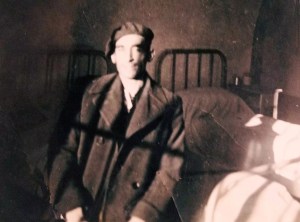
Amando Modino, prisoner of Valderas, via ileón
Valderas and La Bañeza, León, Old Castile
Valderas, located in the southern flatlands of León province, was a highly progressive, politically active town under the Second Republic, which made it an immediate target for ideological cleansing by the incoming military authorities. Rather than shooting activists locally, Nationalist forces arrested residents and transferred them to the military facilities in Astorga (a strategic military crossroads further northwest in the province). Once processed through these military installations, a group of five Valderas neighbours was marched to the Astorga Cemetery and executed on 10 October 1936 – Pacífico Villar Pastor, Teófilo Álvarez García, José Gómez Chamorro, Vicente Rodríguez González, and Germelino de Lera Caballero.
The limpieza of Valderas continued systematically through the summer, autumn and winter months of 1936 and local historical research estimates that around 90 residents from Valderas were killed through a mix of firing squads, night-time paseos, and forced disappearances. They were part of a group of 19 men in total from surrounding areas who were put in the Astorga fosa I, all of which have since been recovered and dignified.
The case of the La Bañeza prisoners provides a historical template of how the Nationalist regime used centralised prisons to make people vanish while they were supposedly awaiting legal due process. The victims had been arrested in the commercial town of La Bañeza during the summer sweeps of July and August. They were initially held in the local La Bañeza jail before being transferred to the infamous San Marcos Convent in León city. San Marcos had been converted by the regime into a massive, overcrowded concentration camp and central repository for political prisoners. The prisoners were explicitly told they were being moved to León for judicial processing or formal military court-martials, providing a false sense of security to both the inmates and their families.
La Bañeza May Day celebration in 1936, via ileón
On the night of 9 October 1936, prison administrators opened the gates of San Marcos for a coordinated saca. A group of 11 people, ten men and one woman, was pulled from their cells, shackled, and loaded onto trucks. Some of these individuals had tragically been moved from the local La Bañeza jail into San Marcos that very same day, showing how fast the elimination pipeline moved. In the early, pitch-black hours of 10 October 1936, the transport trucks drove down the main León–Valladolid highway. The 11 prisoners were pulled out by the roadside, shot en masse, and left in the dirt near a rural farming estate known as the Finca Arroyo de Valdemuza in the municipality of Izagre. Local residents discovered the bodies by the highway and buried them on-site in a shallow common trench.
The Izagre mass grave was successfully opened and forensically excavated in 2008 by memory archaeologists. One of the victims was exhumed by relatives in 1959 and the remains of the others were recovered in September 2008, and nine were identified. Among them was María Alonso, who was still wearing her glasses and one earring; her sister Josefina, who attended the exhumation, had the other. A monolith commemorating the victims was unveiled in April 2010.
By mid-October 1936, the sheer volume of arrests across León province had completely overwhelmed the physical capacity of facilities like San Marcos. To manage the bottleneck, the military regime ran two systems simultaneously. While irregular executions like the Izagre saca cleared out cell blocks under the cover of night, official military prosecutors continued opening formal Causas. Thousands of Republican prisoners survived the bloody month of October 1936 trapped in limbo, sitting in crowded cells while remaining under active, terrifying investigation into November and December, completely unaware of whether their names would appear on a legal court order or a midnight execution blacklist.
The 2008 recovery of the La Bañeza victims in Fosa en la finca arroyo de Valdemuza, via Agrupación de familiares de Víctimas del Franquismo de la Comarca Bañezana
Related
Got a comment, question or suggestion? Know who took a photo? Have questions about a particular date or event? Cancel reply