- Granada, Andalucía
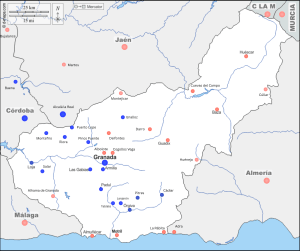
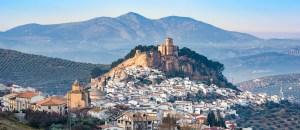
Following the collapse of the nearby western frontier towns (like Montefrío and Íllora) to the Nationalists in late September, the Republican forces were in a defensive panic. Fearing that the Nationalist columns would successfully sweep north out of Granada city and open a clear path toward Jaén, Republican popular militias scrambled into the high peaks of the Sierra de Cogollos. In early October 1936, the Republicans officially occupied the Peñón de la Mata. Because it was a natural limestone eagle’s nest, they realised they could use its high altitude (1,668 metres) to perfectly look down upon and monitor the movements of the Nationalist garrison inside Granada city. Throughout October, Nationalist forces launched repeated infantry assaults backed by artillery to dislodge them. The Republicans successfully repelled the October charges, and the crag remained a brutally contested, blood-soaked front line for most of the war.
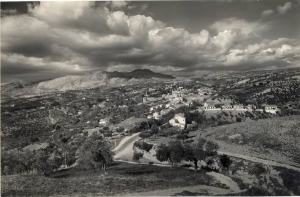
Meanwhile, as small rural locations in north-west Granada continued to fall to the Nationalists, local Falangist squads routinely conducted paseos. They arrested people from their homes or rural hideouts at night, loaded them into trucks, and executed them along rural roadways. The physical geography of the western frontier, the Poniente Granadino, consists of vast rolling agricultural plains interspersed with deep mountain valleys and massive isolated farming cortijos. When the towns fell, thousands of day-labourers, peasants, and their families did not follow the organised Republican retreat north toward Jaén. Instead, they hid in these isolated cortijos, hoping the storm would blow over. But in October 1936, Nationalist cavalry units and Falangist patrols systematically combed these large estates. Anyone found without proper local identification, or flagged by an estate owner as a troublemaker, was shot on site. This accounts for the hyper-localized rural executions, such as the murder of Antonio González Pérez at the rural hamlet of Brácana.
A cornerstone of the October clean-up was the extraction of prisoners from rural zones to prevent local uprisings. Trucks constantly moved between towns like Íllora, Montefrío, and Alhama de Granada, transporting high-profile prisoners (such as former Republican mayors, doctors, and schoolteachers) directly to the overcrowded Provincial Prison of Granada or makeshift convent-jails. Once processed in the capital, they were systematically funnelled into the daily dawn sacas, ending up against the San José Cemetery walls or in the mass graves of the Barranco de Víznar.
Just outside Granada city sat El Fargue, the most vital gunpowder and munitions factory in southern Spain. The military garrison had seized it early, but its workforce was deeply socialist. Throughout October 1936, the management and military administrators executed a completed an ideological and physical ‘clean-up’ of the factory floor. Historians have documented that at least 170 to 450 factory workers were systematically weeded out, arrested, and executed at the nearby Víznar ravines during these sweeps to ensure the production lines were completely compliant and cleared of saboteurs.
However, by late September 1936, a major production crisis hit the facility. To sustain the Nationalist war effort, the factory’s production demands were rapidly multiplied by five, and its workforce had to be expanded from roughly 500 to over 1,600 workers. Due to intense speedups and the sudden lack of skilled labour, critical workplace accidents began occurring. The military director of the facility, Colonel Paradas Fustel, recognised that the Falange was executing the very engineers and chemical workers needed to manufacture explosives. He intervened directly, threatening the Falangist squads and issuing a famous warning: ‘Do not think we are making noodles here. We make gunpowder, and accidents are not casual.’ His intervention successfully forced a halt to the indiscriminate executions of the staff to protect the military supply lines, and as a result, the October killings slowed right down
The rugged Alpujarras region south of Granada city saw a separate, highly aggressive campaign led by Nationalist forces to drive a wedge between the mountains and the Republican-held coast. Órgiva and Barranco del Carrizal served as the southern equivalent to the infamous Víznar ravine. In late September and throughout October 1936, Órgiva became the primary execution dump for the southern half of the province. Regular army units, Guardia Civl, and Falangists brought truckloads of prisoners captured from surrounding towns like Lanjarón and Cádiar. Historians estimate that up to 4,000 people were executed and buried in quicklime in this single ravine, with active forensic excavations underway. In nearby Tablate, a tiny, deserted historic village that controls the stone bridge acting as the gateway to the Alpujarras. It was used as a swift execution site during the early October advances. Local families famously managed to secretly track a mass grave here (guided by a 9-year-old shepherd boy who witnessed the killings) and later moved the remains to the Órgiva cemetery.
- Jaca, Huesca
There are 28 registered mass graves associated with the municipality of Jaca, the majority of these trenches are located directly inside the walls of the Jaca Municipal Cemetery. In total, only one of these graves has been legally exhumed, while 27 remain unexhumed. The physical distribution and structural layout of the Jaca cemetery shows individual trenches catalogued numerically (such as Fosa I – Fosa XV), but they are not randomly scattered. The cemetery’s graves are physically clustered into six large collective burial sectors spanning the original layout of the graveyard before its modern expansion. This includes dedicated corners, such as the old northeast corner near the main entrance and the historical southeast perimeter. Combined, these cemetery trenches hold the bodies of at least 312 documented victims of the Francoist rearguard repression.
Because Jaca was used as a centralized hub to process prisoners captured across the wider Pyrenean valleys, the trenches contain local Jaca residents, and large groups of trade unionists and peasants transported from nearby villages like Biescas, Berdún, and Murillo de Gállego. A significant number of these historical trenches are now considered practically irrecoverable by forensic teams. Over the decades following the war, newer, modern civilian family niches and stone sepulchres were built directly on top of the old 1936 burial sectors. Consequently, researchers focus their preservation and commemorative efforts strictly on the gravesites that remain clearly visible and accessible, such as Fosa XV.
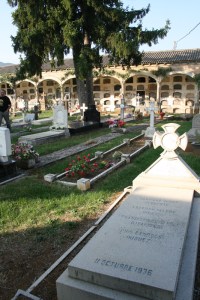
Fosa XV inside the Jaca Municipal Cemetery holds the remains of seven local men who were executed together on 11 October, but could identify only four – Santiago Muñoz Clemente, Esteban Valero, Francisco Plagaro, and Luis Bandrés Iñiguez. All local men who had been rounded up after the Nationalists took the area and had been held in the local jail, though the unidentified other may have come from isolated villages around Jacetania and Pyrenean valleys, making them hard to trace.
On the early morning of 14 October 1936, the Nationalist military forces inside Jaca carried out the 15th officially recorded saca originating from the city’s wartime makeshift prison network. Operating under direct military oversight from the garrison based at the Castillo de San Pedro citadel, the extraction unfolded in the pitch-black hours before dawn Following a strict, numbers-based routine, prison guards entered the crowded cell blocks, woke the targeted detainees, and read their names aloud from pre-compiled Falangist blacklists. The prisoners were shackled inside the staging area, loaded onto flatbed transport trucks, and driven under armed guard to the execution lines before dawn.
- Mallorca, Ibiza, and Menorca, Balearic Islands
In October 1936, the Balearic Islands were a highly volatile and fractured front line in the opening months of the Spanish Civil War. The islands were split by opposing factions, creating a dramatic dynamic between the neighbouring islands of Mallorca and Menorca. When the military coup launched in July 1936, the Balearic Islands split – Mallorca and Ibiza quickly fell under the control of the Nationalists. Menorca remained fiercely loyal to the Spanish Republic, serving as a critical strategic naval base for the government in the western Mediterranean. In August and September, Republican forces attempted an ambitious landing to recapture Mallorca (the Battle of Mallorca). However, heavily backed by Italian aircraft and fascist paramilitary forces led by Arconovaldo Bonaccorsi (the Red Count), the Italian fascist paramilitary leader sent by Mussolini, effectively terrorised the island. Alongside local Falangists, they established an absolute dictatorship after the Nationalists crushed the Republican offensive and forced a chaotic evacuation by 12 September 1936.
Following their victory over the Republican landing, the Nationalist authorities in Mallorca unleashed a brutal, systemic campaign of political repression. Falangist militias conducted widespread killings, executing between 2,000 and 3,000 left-wing sympathisers, unionists, and Republican supporters. Mass executions took place against church walls and victims were dumped into mass graves such as the large site in Porreres. This intense climate of terror forced thousands of civilians, defeated militia members, and targeted families to look for any means of escape. The Italian air force (The Balearic Falcons) transformed Mallorca into a major strategic launchpad. Throughout October, Italian Savoia-Marchetti bombers stationed at the San Joan airbase in Palma regularly struck Republican targets on the Spanish mainland of Catalonia and Valencia.
As the lone Republican stronghold in the archipelago, Menorca was effectively isolated but highly active:, and the Republican authorities were actively investigating locals suspected of sympathising with the Francoist rebellion. In the chaos of the early war, a revolutionary committee coexisted alongside formal military judicial processes. Individuals accused of military rebellion or participating in the initial July coup were systematically rounded up, imprisoned, and tried. Prisons, including the infamous floating prison ship Atlante moored in the Mahón harbour, held right-wing sympathisers, priests, and military officers. The judicial files preserved in PARES (the Portal of Spanish Archives) detail this period, cataloguing both formal death sentences handed down by Republican tribunals and the tragic instances of killings carried out by leftist militias.
Because of the proximity, Menorca became the logical, life-saving sanctuary for people fleeing the Nationalist purge in Mallorca. Starting around 11 October 1936, small fishing boats, cargo vessels, and makeshift rafts began arriving in Maó and other Menorcan ports packed with Mallorcan refugees. The majority of the people arriving in Menorca were ordinary citizens caught on the wrong side of the sudden military divide. They generally fell into three categories -left-wing political activists, town council members, trade unionists (such as members of the CNT or UGT), and outspoken supporters of the Second Spanish Republic, or defeated militia members, the volunteers and sympathisers who had supported the failed August-September Republican landing (the Battle of Mallorca) and were left behind when Captain Alberto Bayo’s forces abruptly evacuated the island on 12 September. The third group were vulnerable civilians, entire families, particularly women and children, whose husbands or fathers were hunted, missing, or already executed by Falangist squads.
The refugees primarily originated from the eastern coast of Mallorca (zones like Son Servera, Manacor, and Porto Cristo). This region had been the main battleground of the failed Republican landing. When the front lines collapsed, local civilians who had collaborated with or welcomed the Republican troops suddenly found themselves trapped in territory targeted for harsh Nationalist retribution. But crossing the Menorca Channel was highly dangerous, desperate, and clandestine. Refugees used anything that could float. This included small wooden fishing boats requisitioned commercial cargo vessels, small motorboats, and even makeshift rowing boats.
Escaping by sea was an immense risk. The waters between the islands were actively patrolled by Nationalist naval forces and pro-Nationalist Italian aircraft, which sought to intercept and capture fugitives. Navigating these waters required slipping away under the cover of darkness. Yet, between 11 October and 26 December 1936, hundreds of refugees officially cleared the administrative hurdles in Maó. Because Menorca itself was isolated and facing food scarcity, the Republican authorities logged every arrival carefully to manage rationing, arrange housing in seized properties, and coordinate their eventual transit to the larger, safer Republican mainland (primarily Barcelona).
- Gea de Albarracín, Teruel
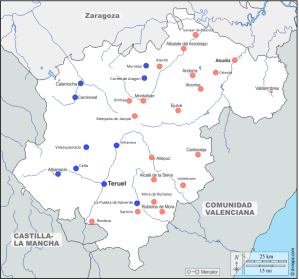
By October 1936, the province of Teruel in Aragón had become a highly fractured, militarised zone. The towns of Gea de Albarracín and Cella were experiencing the terrifying realities of Nationalist repression. Both Gea de Albarracín and Cella were firmly under Nationalist military control, positioned dangerously close to the volatile Aragón front lines. Just weeks prior, in mid-September, local Falangists and the Civil Guard had initiated severe roundups, such as the Black Day of Cella, where death squads went house-to-house arresting local left-wingers. Neighbours and local right-wing sympathisers actively denounced anyone associated with the Popular Front or municipal Republican leadership.
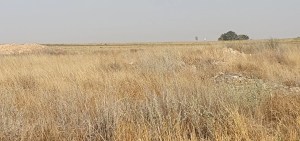
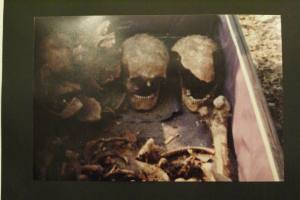
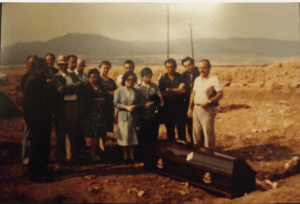
Men like Higinio Benedicto and Vicente Benedicto were hunted specifically due to their status as elected left-wing municipal officials, but the others were targeted for being trade union members, working-class republicans (such as farmers or tradesmen), or simply family members of people who had fled when the military coup took place. No charges were formally documented; they were deemed subversives to be permanently removed to secure the Nationalist rearguard. Immediately following their executions on 11 October 1936, their bodies were dumped into a makeshift mass grave at La Venta del Ratón in the municipality of Cella. On 24 August 1979, the relatives personally came together and exhumed the remains from the roadside trench. The following day, they transferred the bodies to the municipal cemetery of Gea de Albarracín and today they rest beneath a headstone bearing their names, and they are remembered as having died for freedom and democracy.