Following the sudden accidental death of the Nationalists’ presumed leader, General José Sanjurjo, in July 1936, the Nationalists lacked a single figurehead. The Junta de Defensa Nacional was formed in Burgos on 25 July to serve as a placeholder government. However, by September, key military leaders recognised the need for unified command. Boosted by his successes in transporting the elite African Army across the Straits of Gibraltar and his political backing from Nazi Germany and Fascist Italy, Franco emerged as the clear candidate. Following a pivotal meeting of generals near Salamanca in September, Franco was officially designated Caudillo (supreme leader) and Generalissimo.
.
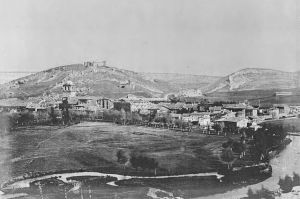
On 1 October, during an investiture ceremony at the Captaincy General in Burgos, Franco officially took the reins. He established a new administrative state structure that systematically dismantled the old Junta, transferring its executive, legislative, and judicial authorities directly into his own hands. Franco was no longer just one general among equals; he had successfully laid the groundwork for a totalitarian dictatorship. With political power secure, Franco immediately addressed the fractured Nationalist military front. On the very same day of his investiture, a landmark decree formally split the Nationalist forces into two massive, geographically distinct operations. The Army of the North was under the absolute command of General Emilio Mola. This force was tasked with securing the Basque territory, Cantabria, and Asturias, before ultimately pressing down on Madrid, and the Army of the South was under the command of General Gonzalo Queipo de Llano. This division controlled the captured territories of Andalusia and Extremadura, operating out of Seville.
.
By dividing the military commands between Mola and Queipo de Llano, two powerful generals with strong personalities and distinct political ambitions, Franco achieved a masterstroke of political leverage. He successfully pacified his potential rivals by giving them immense localised military power, while positioning himself directly above them as the ultimate arbiter of the war effort. The events of 1 October 1936 in Burgos effectively ended any illusions that the Nationalist uprising was merely a temporary intervention to restore order. It transformed a chaotic coalition of Carlists, Falangists, monarchists, and conservative military officers into a highly disciplined, centralised war machine under a singular dictator.
.
Beneath the high-stakes political ceremonies, the bureaucratic gears of the Nationalist state were grinding through the penal system. Inside Burgos prison, a group of 37 political prisoners was formally recorded as being genuinely released and safely returned to the city. For modern historians, this specific entry provides a profound archival breakthrough. It establishes a stark, documented contrast with the deceptive paperwork used to mask sacas (unauthorised prisoner removals), revealing how administrative language was intentionally weaponised to conceal extrajudicial massacres. During the opening months of the Spanish Civil War, Nationalist prisons were severely overcrowded with thousands of real and suspected political opponents, trade unionists, and left-wing sympathisers. To manage this influx, military authorities and right-wing death squads carried out regular clearances.
.
However, prison administrators maintained meticulous ledger books. When analysing these archives today, researchers encounter a chilling linguistic divide that separates survival from slaughter. The 37 prisoners processed on 1 October were explicitly recorded with precise, verified administrative destinations. The paperwork confirms they were physically released, checked out of the penal system, and safely returned to their homes or workplaces in Burgos under strict surveillance or conditional liberty. In contrast, later groups of prisoners were frequently logged in the official prison registers as being liberated, transferred to another facility, or released by order of the military authority. In reality, these entries masked a saca. These prisoners were not freed; they were handed over directly to Falangist militias or military execution squads, driven to isolated provincial killing sites, such as the notorious hills of Estépar, and summarily shot.
.
The ability to distinguish between a genuine release and a disguised execution is a critical tool for historical memory organisations and forensic teams. If historians were to take early Nationalist prison ledgers at face value, thousands of executed individuals would simply appear to have been legally set free in the autumn of 1936. By isolating verified events like the 1 October release of these 37 individuals, researchers can cross-reference the names with post-war census records, tax files, and local family testimonies to confirm their survival.
Once a baseline of paperwork is established, the anomalies become glaring. When a subsequent ledger logs a massive group of prisoners as released simultaneously at midnight, without any matching civil registry or residential records following that date, historians can confidently identify a hidden saca. This paperwork trail provides the exact geographical and chronological clues needed to locate hidden mass graves across the Burgos province.
.
Ultimately, the events inside Burgos prison on 1 October 1936 reveal that the White Terror was not merely a collection of uncontrolled, chaotic outbursts by rogue soldiers. It was a highly organised, institutionalised process. Even as Franco was consolidating his dictatorial powers down the road at the Captaincy General, his administrative state was perfectly capable of tracking who was being genuinely integrated back into society and who was being systematically erased, leaving behind a paper trail that modern forensics is finally using to dismantle decades of enforced historical silence.
.
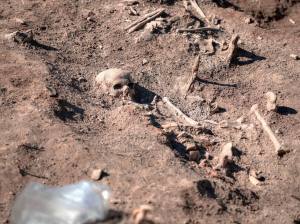
Monte Estepar exhumations continue to arouse anger, via Bratislav Braca Stefanovic
Valencia
As the Spanish Civil War raged into its third bloody month, the embattled Second Spanish Republic found itself fighting a political war for national unity. On 1 October 1936, inside the temporary wartime capital of Valencia, the Republican Cortes (parliament) passed a monumental piece of legislation: the Statute of Autonomy of the Basque Country. This single decree instantly fundamentally altered the political landscape, legally recognising the Basque region’s right to self-govern and triggering the rapid creation of the first-ever Basque Autonomous Government.
.
The Basque quest for home rule (Estatuto de Estella) had been a central, turbulent fixture of Spanish politics throughout the 1930s. Conservative Basque nationalists, primarily represented by the Basque Nationalist Party (EAJ-PNV), had historically clashed with the Republic’s secular, left-leaning central government. For years, regional autonomy bills languished or were blocked in parliament. However, the military coup of July 1936 completely upended the political chess board. With General Emilio Mola’s Nationalist forces rapidly advancing through northern Spain, both the central Republican government and the Basque Nationalists realised they needed each other to survive. The Republic desperately needed the Basque region’s heavy industries, arms factories, and fierce fighting spirit. In return, the PNV demanded immediate constitutional recognition of their autonomy. Recognising that ideological rigidity would mean military defeat, the Republican Cortes convened in Valencia and swiftly passed the statute on 1 October.
.
The political impact of the Valencia decree was instantaneous. The statute bypassed months of bureaucratic red tape and permitted the rapid mobilisation of a localised state apparatus.
Just six days later, on 7 October 1936, Basque leaders gathered at the historic assembly hall under the sacred Tree of Gernika. There, José Antonio Aguirre was sworn in as the very first Lehendakari (President) of the newly minted Basque Government (Eusko Jaurlaritza). Aguirre formed a wartime coalition government that united conservative Basque nationalists with socialists, communists, and republicans. Under the powers granted by the 1 October Statute, this new government took extraordinary measures to defend its territory, including creating an autonomous military force loyal directly to the Basque government, issuing its own distinct currency and managing regional customs, and reorganising local courts, managing food distribution, and establishing strict public order.
.
The passage of the Statute of Autonomy on 1 October 1936 remains one of the most poignant paradoxes of the Spanish Civil War. At the exact moment the Basque people finally achieved their dream of legal autonomy, their territory was progressively being choked off and surrounded by Francoist forces. Though the autonomous government would only rule over Basque soil for nine brutal months, the legacy of 1 October 1936 was profound. It proved that a deeply Catholic, conservative regional movement could align with a secular Republic in defence of democracy and self-determination. By passing the Statute in Valencia, the Second Spanish Republic set a precedent for regional devolution that would eventually serve as a blueprint for the modern Spanish Constitution and the Basque autonomy enjoyed today.
.
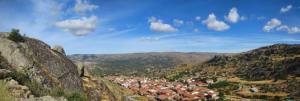
San Bartolomé de Pinares landscape, via Wikimedia Commons
San Bartolomé de Pinares, Ávila
At San Bartolomé de Pinares, Nationalist cavalry launched a fierce assault on Republican positions under the cover of heavy artillery, only to be bloodily repulsed in a textbook showcase of early wartime mountain defence. The engagement underscored a critical phase of the Spanish Civil War, the desperate Republican effort to lock down the Sierra de Guadarrama and Sierra de Gredos passes, denying the Nationalist forces a clear, northern gateway to Madrid.
.
By October 1936, the war of columns had given way to more entrenched fronts. San Bartolomé de Pinares and the neighbouring hub of Navalperal de Pinares sat squarely on the frontline of the Ávila sector. For the Nationalist forces under General Emilio Mola, capturing these mountain towns was vital to securing their flanks and establishing a staging ground to squeeze the capital from the north and west. The assault was driven by a mobile, combined-arms vanguard detached from the larger offensive advancing from Ávila and the Tiétar Valley. Typically, these localised strike forces consisted of several hundred men, specifically a cavalry column (usually one or two squadrons of about 100–150 horsemen each) supported by a few companies of infantry and dedicated artillery batteries and the clash involved a substantial portion of the Nationalist vanguard attempting to probe and punch through the local lines.
.
The Republican defence in this area heavily relied on mixed columns of regular army loyalists and highly motivated, though often undisciplined, popular militias—notably elements associated with the famous Columna Mangada. These defenders turned the rocky, uneven terrain of the sierra into a natural fortress. San Bartolomé de Pinares was one of four key hubs protected by the Columna Mangada, which had a total regional strength of roughly 5,300 men. The specific sub-garrison stationed directly at San Bartolomé consisted of two prominent militia battalions, the Asturias and the Sargento Vázquez, along with a regular infantry battalion led by Commander Luis Noé, an artillery battery (75mm and 105mm guns), and a mortar section. The immediate local defending force was roughly 1,500 to 2,000 milicianos and soldiers.
.
On the morning of 1 October, the Nationalist command attempted to smash through the Republican lines using a combination of traditional mobile shock tactics and modern firepower. Nationalist cavalry squadrons, backed by heavy artillery batteries, pressed hard against the Republican trenches. The strategy was designed to use artillery bombardment to unnerve the defenders, allowing the fast-moving cavalry to exploit the gaps, overrun the positions, and force a retreat. According to contemporary wartime dispatches from the Republican Ministry of War, the barrage was intense but the rugged topography worked heavily against the mounted attackers. The Republican lines held their ground, using well-placed machine-gun nests to cut down the advance and neutralise the mobility of the Nationalist horsemen. The Nationalist cavalry charge stalled under heavy fire, leaving their ranks fractured and exposed.
.
Recognising the immediate vulnerability of the retreating Nationalist forces, the Republican commanders ordered a swift, aggressive counterattack. Seizing the momentum, Republican militia and troops surged out of their defensive positions to pursue the fractured Nationalist columns. The manoeuvre was a decisive tactical success. Not only did the Republicans successfully secure their original lines, but they also cut off a segment of the retreating Nationalist force. The counter-offensive resulted in heavy casualties for the attackers and concluded with the capture of approximately 30 Nationalist prisoners, along with abandoned arms and equipment. But the engagement at San Bartolomé de Pinares on 1 October was a stark reminder of the limitations of traditional cavalry tactics in the face of modern defensive warfare and mountainous terrain. It proved that despite the Nationalists’ superior artillery coordination, determined defensive units utilising high-ground geography could successfully blunt the momentum of the Nationalist advance.
.
Though small in scale compared to the massive campaigns later in the war, the victory at San Bartolomé de Pinares provided a vital psychological boost to the Republic. It demonstrated that the northern gates to Madrid would not fall easily, forcing the Francoist high command to reconsider their strategy and dig in for what would become a brutal, multi-year siege of the Spanish capital. Nationalist forces did not accept the 1 October repulse quietly and dispatches planned an immediate re-launch of intense, coordinated attacks against nearby Navalperal and the surrounding heights on 6 October 1936. The Columna Mangada was plagued by a severe lack of reserves and ammunition. Under heavy pressure, the Republican troops were forced to abandon San Bartolomé de Pinares and retreat back toward Madrid.
.
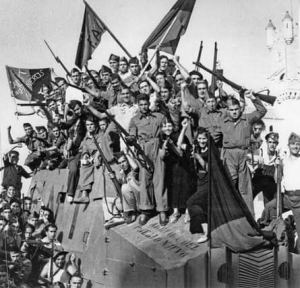
The joy of overthrowing Barcelona was starting to wear off
Barcelona, Catalonia
When the right-wing military coup attempted to seize Barcelona in July 1936, it was the armed explosion of the working class that saved the city. In the chaotic aftermath, real power on the streets of Catalonia shifted away from the official state structures and into the hands of the Comité Central de Milícies Antifeixistes (Central Committee of Antifascist Militias). For over two months, this revolutionary body effectively ruled the region. On 1 October 1936, this dual-power dynamic came to a sudden end. In a monumental political compromise, the Central Committee formally dissolved itself, initiating a complex process that transferred authority back to the official Catalan government, the Generalitat, and permanently altered the trajectory of the Republican war effort.
.
Following the defeat of the fascist Nationalists in July, Lluís Companys, the President of the Generalitat, famously met with leaders of the anarcho-syndicalist Confederación Nacional del Trabajo (CNT). Acknowledging that the anarchists controlled the streets, Companys offered to resign or work alongside them. The anarchists chose collaboration, leading to the creation of the Central Committee of Antifascist Militias on 21 July. Though nominally inclusive of all antifascist parties, the Committee was heavily dominated by the CNT and its militant wing, the Federación Anarquista Ibérica (FAI). The Committee acted as a de facto revolutionary government, and organised and dispatched militia columns to the Aragon front, managed public order, logistics, and weapons production through worker syndicates and coordinated the sweeping collectivisation of factories, transport, and agricultural land.
While the official Generalitat building remained open, true executive and military authority resided at the Committee’s headquarters.
.
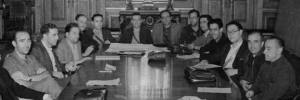
Comité Central de Milícies Antifeixistes, via unknown
By September 1936, the initial euphoria of the revolution faced harsh wartime realities. The decentralised militia system was failing to halt the professional, heavily armed advances of Francisco Franco’s Nationalist forces. Both the central Republican government and Soviet advisors argued that winning the war required a conventional, unified army and a single, centralised state authority. The anarchists themselves realised that the existence of an parallel revolutionary committee isolated them diplomatically and economically from foreign aid. To bridge this gap, a new Catalan coalition government had been formed on 26 September under Joan Casanovas, which, for the first time, directly included three anarchist ministers from the CNT. With the anarchists officially integrated into the formal cabinet of the Generalitat, the Central Committee of Antifascist Militias lost its political justification. On 1 October, the Committee voted to dissolve itself, declaring its mission accomplished now that the regional government represented the true antifascist consensus.
.
The dissolution of the Committee on 1 October was a defining milestone of the Spanish Civil War. It marked a tactical retreat for the anarchist movement, which voluntarily traded its independent revolutionary power for a seat at the table of bourgeois state governance.
With the Committee gone, the Generalitat progressively reasserted control over transforming the chaotic, politically autonomous militia columns into the regularised, disciplined East Army (Ejército del Este), and disarming local revolutionary defence committees and returning policing powers to professional internal security forces.
.
While presented as an act of antifascist unity to win the war, the dissolution of the Committee deeply fractured the Republican zone. Radical anarchist factions and members of the anti-Stalinist Marxist party (POUM) viewed the move as a betrayal of the revolution. This fundamental ideological rift, whether to prioritise winning the war first or carrying out the revolution simultaneously, would continue to fester under the surface, eventually exploding into open civil war within the Republican camp during the bloody May Days of 1937 in Barcelona.
.
Frente Norte (Northern Front), Palencia-Santander Border
On 1 October 1936, a quiet but vital defensive mobilisation was consolidating along the rugged heights of the Cantabrian Mountains. In the borderlands between Santander (Cantabria) and northern Palencia, Republican forces successfully reinforced a series of strategic mountain positions. This developing frontline became a crucial bulwark, successfully blocking the Nationalist forces advancing from the south and establishing a permanent, year-long stalemate known historically as the Frente Norte (Northern Front).
.
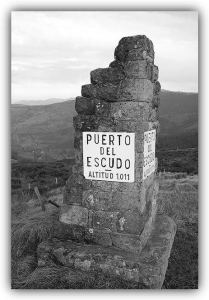
By early October 1936, the chaotic skirmishes of the war’s first weeks had given way to highly organised, localised frontlines. At the center of the Republic’s regional strategy was the Puerto del Escudo, a critical, steep mountain pass standing at over 1,000 meters elevation. As the primary gateway connecting the Castilian plateau directly to the coastal stronghold of Santander, holding this pass was a matter of survival for the Republic. Throughout 1 October, Republican units dug into the rocky terrain around the pass and the adjacent Campoo region. Backed by reinforcements streaming up from Santander, these troops turned the natural, sharp inclines of the sierra into a fortified defensive barrier. Their primary goal was to check any northern push from the Nationalist forces operating out of Burgos, effectively shutting down the Nationalists’ easiest avenue of advance.
.
Aguilar de Campoo, via unknown
Further west along the Cantabrian chain, the Palencia front crystallised into a highly structured defensive system. The Republican command divided this mountainous territory into three distinct administrative subsectors, the Guardo Subsector, the Cervera de Pisuerga Subsector, and the Puerto del Escudo Subsector. Among these, the Aguilar–Barruelo line stood out as the principal, most active operational sector in northern Palencia. The towns of Barruelo de Santullán and Guardo were prominent mining centres with a deeply entrenched, highly unionised workforce. Following the initial July coup, local trade-unionist miners had launched general strikes and fiercely resisted the Nationalist troops.
.
Though the Nationalists managed to control the low-lying towns in the valleys, hundreds of fiercely ideological miners fled directly into the surrounding mountains. Armed with light weaponry and their own commercial mining dynamite, these miners formed the backbone of the Republican columns holding the high ground. On 1 October, these specialised mining units worked alongside regular troops to construct fortified trenches and bunker systems overlooking the Santullán Valley, turning the industrial workforce into an elite mountain vanguard.
.
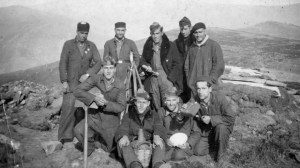
Nationalist fighters on the summit of Cocoto, near Barruelo, via Fernando Cuevas Archivo
The consolidation of the Palencia-Santander line on 1 October 1936 proved to be an extraordinary tactical success for the Republic in the short term. By successfully locking down the mountain passes at Puerto del Escudo and fortifying the mining subsectors, these detached columns denied Francisco Franco a rapid victory in the north. This makeshift wall of soldiers and miners successfully held the line for nearly a year. It created a massive, isolated Republican enclave in northern Spain that tied down tens of thousands of Nationalist troops. The mountain defences forged on this day would hold firm until August 1937, when a massive, highly coordinated Nationalist offensive finally breached the historic Puerto del Escudo pass.
.
Puerto del Escudo, via unknown
Guadiato, Córdoba, Andalucía
By October 1936, the war of fast-moving regional columns was transitioning into a highly strategic battle for industrial resources. In the province of Córdoba, the Republican-held Guadiato mining basin, centred around the vital coal and industrial hub of Peñarroya-Pueblonuevo, became a priority target for General Francisco Franco’s Nationalist forces.
Starting on 1 October 1936, a multi-pronged Francoist offensive squeezed the basin from two fronts: columns advancing from the northwest (Badajoz) and others striking up from the southeast (Córdoba capital). The subsequent week of fighting cracked open the Republic’s mountain defences, forcing a collapse that fundamentally shifted control of the region’s mineral wealth.
.
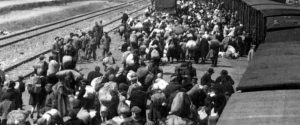
Locals trying to flee the region, via Memoria Democratica de Peñarroya-Pueblonuevo
The offensive opened with a decisive psychological and tactical blow on the western flank of the mining basin. On 1 October 1936, Nationalist troops advancing from the Badajoz sector successfully captured Fuente Obejuna. Known internationally as the historical setting for Lope de Vega’s classic play, the town held immense modern value as a defensive anchor safeguarding the western approaches to the Guadiato valley. The occupation of Fuente Obejuna triggered an immediate, brutal wave of political repression by Falangist and conservative factions against local unionised peasants, field workers (yunteros), and left-wing sympathisers. More critically for the war effort, its capture signalled the official beginning of the end for Republican control over the surrounding mining networks.
.
Belmez today, via Memoria Democratica de Peñarroya-Pueblonuevo
.
Simultaneously, Nationalist columns launched a parallel drive from the city of Córdoba, pushing north along the railway line that connected the capital to the Belmez coalfields. On 2 October 1936, Nationalist forces overran and occupied the Obejo railway station. The high command in Córdoba viewed Obejo as a nest of resistance (madriguera de rojos), from which Republican militias had regularly launched highly disruptive sabotage raids against the Nationalist-controlled rail infrastructure. By seizing the Obejo station, the Nationalists successfully secured their line of supply and communication, allowing them to funnel extra troops, heavy artillery, and weapons straight up toward the mountain passes.
.
The dual advance coalesced into a fierce, multi-day bottleneck between 2 and 8 October along the approaches to the Guadiato valley, specifically around the hamlet of El Vacar.
As the Nationalist columns under Colonel Eduardo Sáenz de Buruaga pushed deeper into the Sierra Morena, they encountered fierce, entrenched resistance from local Republican militias and UGT-affiliated miners. Armed with light weaponry and commercial mining dynamite, the Republican defenders turned the rocky terrain of El Vacar into a meatgrinder, effectively stalling Buruaga’s direct advance from Córdoba.
.
Obejo today, via Memoria Democratica de Peñarroya-Pueblonuevo
The fighting during this week was exceptionally bloody; numerous local volunteers, such as the prominent Villanueva de Córdoba socialist Evaristo Pozuelo Muñoz, lost their lives defending the ridge on 2 October. The Republican line held so stubbornly that the Nationalist high command was forced to alter its plans, calling in a third, auxiliary column from Posadas to break the deadlock. Though the Republican resistance at El Vacar bought the government precious days, the overwhelming weight of the Nationalist pincer movement proved unstoppable. By 8 October, the defences around El Vacar had cracked under the pressure of the combined Nationalist forces. With their flanks exposed by the fall of Fuente Obejuna to the west and Obejo to the south, the main Republican lines collapsed completely over the following days.
.
The military operations initiated between 1 and 8 October ultimately triggered a massive, desperate exodus. Fearing brutal reprisal, upwards of 10,000 miners, civilian refugees, and local officials fled into the night toward the safety of Republican-held Puertollano and Almorchón, leaving behind a vital industrial empire that would fuel the Francoist war machine for the remainder of the civil war.
.
Guareña prisoners being taken away, via unknown
Campillo de Llerena, Guareña, Badajoz, Extremadura
By late September 1936, the war in western Spain had evolved from a rapid, bloody race along the Portuguese border into a methodical campaign to anchor territorial gains. Following the infamous fall of Badajoz city in August, the Republican forces had been systematically pushed eastward toward the rugged mountains of the Sierra Morena and the Don Benito region. On 1 October 1936, a coordinated Nationalist offensive launched a series of decisive strikes across central Badajoz. By capturing the final Republican-held strongholds of Campillo de Llerena, Guareña, Cristina, and Valdetorres, the Nationalist forces successfully ironed out the frontline, creating a permanent, heavily militarised boundary that would remain largely unchanged for the next two years of the Spanish Civil War.
.
The offensive achieved its most significant strategic milestone on the southern flank of the province. The offensive was executed by motorised columns grouped under the Ejército del Sur (Army of the South). In central Badajoz (targeting Guareña, Cristina, and Valdetorres), the operations were led by the 4th Battalion of the Regimiento Castilla. In the south (targeting Campillo de Llerena), a combined column of Nationalist infantry, Falangist militias, and a cavalry detachment was used. Each mobile tactical column typically numbered between 1,000 and 1,500 highly trained, professional soldiers, backed by heavy artillery batteries and air support from the Italian and German airlifts.
.
On 1 October 1936, Nationalist forces entered and occupied Campillo de Llerena. The town held deep tactical importance as the last major, well-populated Republican stronghold in that sector of Badajoz. For weeks, local militias and remnants of the regular army had used the town as a base to disrupt Nationalist communications between Seville and Mérida. The fall of the locality marked the end of fluid manoeuvring in the south of the province. Recognising that holding the open town was no longer tenable against superior Nationalist fire, the remaining Republican forces executed a organised retreat. They withdrew directly into the surrounding, unforgiving sierras, such as the Sierra de Argallanes and Sierra del Argallén, where they dug into high-ground positions, transitioning from an offensive mobile force into a permanent, defensive mountain vanguard.
.
Simultaneously, Nationalist columns swept through the fertile agricultural heartland of central Badajoz, just south of the Guadiana River, to secure their northern flanks. Over the first few days of October, Nationalist units systematically occupied the towns of Cristina and Valdetorres with minimal resistance, catching disorganised local defence committees off guard. However, the advance hit a fierce bottleneck at Guareña. Unlike its neighbours, Guareña was a traditional stronghold of hundreds of organised leftist agricultural workers (yunteros) who were deeply committed to defending the land reforms achieved under the Republic. Armed with light rifles and absolute determination, local milicianos turned the streets and brick houses of the town into a stubborn defensive maze. The resistance was so intense that the advancing Nationalist columns were forced to halt their infantry charges.
.
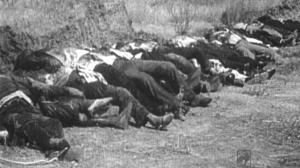
The Nationalist command deployed heavy artillery batteries, subjecting the town to a devastating bombardment to breach the barricades and shatter the defenders’ morale. Only after the artillery barrage tore through the town’s perimeter did Guareña finally fall into Nationalist hands. Because Guareña resisted stubbornly and required heavy artillery to overcome, the retribution was fierce. Once a town was captured, the Nationalists carried out selective sweeps based on lists drawn up by local right-wing informants. Mass executions were common immediately after occupation, with bodies buried in clandestine mass graves.
.
Historical preservation records note significant burial sites, such as the mass fosa at the Paraje La Mina, used to conceal the bodies of those executed during the sweeping cleanses, but can never represent the loss of the areas strongest and able-bodied workers. The neighbouring judicial hub of Llerena experienced what historians describe as an absolute slaughter, with over 400 civilians executed (including a disproportionately high number of women). Many were thrown into a massive mass grave at the Romanzal stream.
.
Firing squads in progress later in the war in Campillo de Llerena, via unknown
The repression in the mining basin (Fuente Obejuna, Belmez, Peñarroya) was uniquely severe because the industrial working class was highly organised and unionised. To the Nationalist command, miners were viewed as dangerous revolutionaries, and the anticipation of this brutal treatment is what triggered the massive civilian exodus of October 1936, where over 10,000 workers and their families abandoned their homes to flee through the mountains rather than risk falling into the hands of the advancing columns. Mass graves were intentionally left unmarked, and the Franco regime enforced decades of strict silence (desmemoria or dis-memory), making it illegal for families to mourn or search for the remains of their loved ones. Today, places like the Museo de la Guerra Civil in Campillo de Llerena and the Aranzadi Science Society work to exhume these regional mass graves, document the identities of the victims, and recover the suppressed history of the Extremadura front.
.
The operations carried out between 1 October and the first week of October 1936 brought the war of columns to an end in Extremadura. By capturing this final pocket of towns, the Nationalists achieved two critical objectives by securing a safe, continuous corridor connecting their southern armies in Andalucía with their northern operations in Castile, and pushing the Republican forces entirely out of the western plains and into the natural, rocky fortress of the eastern mountains. Once the Republicans established their new trenches along the high ridges of the Sierra Morena and the La Serena region, the Extremadura front stabilised completely. The chaotic advances that had defined the summer of 1936 were replaced by an entrenched, multi-year war of attrition, transforming the borderlands of Badajoz into a quiet but lethal frontline until the final months of the conflict.
.
In the municipality of Villafranca de los Barros, which had been occupied weeks earlier during the Nationalist advance toward Madrid, the initial military shock gave way to institutionalised political cleansing. On this day, local death squads initiated the first wave of systematic paseos (extrajudicial abductions and executions), resulting in the immediate deaths of at least seven local residents.
.
The reality of executions in Badajoz, via unknown
.
The events of 1 October marked a grim transition for the town, shifting from the chaotic violence of open combat into a calculated campaign to eliminate the social and political legacy of the Second Spanish Republic. Following the entry of Nationalist troops into the fertile wine-producing region of Tierra de Barros, local Falangists, landowners, and right-wing elements formed defence committees to systematically identify left-wing sympathisers. Unlike the immediate frontline executions of August, the paseos of October were deliberate nocturnal operations. Victims were extracted from their homes or temporary holding centres under the cover of darkness. They were driven to isolated roadsides, cemetery walls, or nearby estates, most notably the areas surrounding the neighbouring towns of Almendralejo or Ribera del Fresno, where they were summarily shot without trial or judicial oversight.
.
Historical research and local memory databases have successfully reconstructed the identities of the individuals targeted during this opening day of the October purges. The documented victims include Álvaro Cardizales García, José Cardizales Gutiérrez, Antonio Cuéllar Romero, Gabriel Lemo Sierra, Antonio Ríos Becerra, Concepción Soler Domínguez, one of the many women targeted during the rearguard cleanses, who frequently faced distinct public humiliation and gendered violence before execution, and an unidentified seventh victim whose name remains lost to the archives. The profiles of these individuals matched the broader pattern of the repression in Badajoz: they were primarily day labourers, members of agricultural trade unions (such as the FNTT-UGT), or individuals who had actively participated in or benefited from the Republic’s agrarian land distribution programmes.
.
The execution of these seven individuals on 1 October was merely the prelude to a protracted period of terror in Villafranca de los Barros, where historians estimate that the total number of victims of the Francoist repression ultimately surpassed 250 people. For modern forensic and historical teams working in Extremadura, 1 October represents a critical chronological marker. Isolating the specific date of these paseos provides the necessary archival data to cross-reference municipal death registers, which often used bureaucratic euphemisms like traumatic shock or left cause-of-death fields entirely blank, with regional mass graves. By reconstructing this first night of violence, researchers can slowly piece together the execution routes, helping families recover the remains and history of those who disappeared into the night.
.
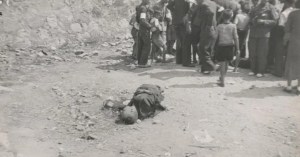
The public execution of a local Badajoz mayor earlier in the war shows how cold and callous reality became in these towns, via Moisés Domínguez Núñez archivo
Related
Got a comment, question or suggestion? Know who took a photo? Have questions about a particular date or event? Cancel reply