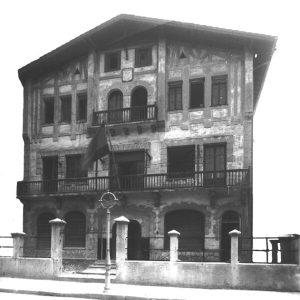
Headquarters in the Fueros batzoki, via Visit Barakaldo
Bizkaia, Basque Country
On 28 September 1936, the newspaper of the Basque nationalist trade-union movement, Solidaridad de Trabajadores Vascos (ELA-STV), resumed publication in Bilbao under the title Euzko Langile. The paper had previously been based in San Sebastián, but the rapid Nationalist conquest of Gipuzkoa forced its editorial staff, printing equipment, and core readership to flee westward into Bizkaia. Upon its debut in Bilbao with Issue No. 38, the front page carried the Basque subtitle ‘Langilletasuna, Kristautasuna, Euzkotasuna’, a profound ideological statement that would later be regularised in its print banner as ‘Obrerismo–Cristianismo–Vasquismo’ (Labour, Christianity, and Basque nationalism).
.
ELA-STV occupied a highly unusual, fascinating position within Republican-held territory. It organised Basque industrial workers while maintaining a devoutly Catholic and nationalist identity, operating alongside a broader loyalist labour movement dominated by the socialist UGT and the anarchist CNT. In the rest of war-torn Spain, the Catholic Church hierarchy had actively blessed the Nationalist uprising as a holy crusade against an atheistic Republic. ELA-STV and its press stood as a rare anomaly: devoutly religious citizens who were fiercely loyal to the anti-fascist cause. Its program combined the defence of workers’ economic interests with distinct Basque political demands, providing a vital medium for addressing laborers without forcing them to choose between their Catholic faith and organised trade unionism.
.
The resurrection of Euzko Langile in Bilbao reflected the physical and intellectual displacement of Gipuzkoa’s political infrastructure. Editors, activists, and unionists had moved west alongside tens of thousands of regional refugees. Amidst this influx, Bilbao instantly transformed into the principal publishing centre of the remaining Republican-held Basque territory. The city supported an unusually extensive and pluralistic political press, hosting active publications associated with the PNV, ELA-STV, PSOE-UGT, Communist Party, CNT, Acción Nacionalista Vasca, and various other anti-fascist organisations.
.
Arriving just nine days before the formal declaration of Basque Autonomy on 7 October 1936, the revitalised newspaper became a crucial arena for debating the future structure of the Basque Country. Despite the heavy shadow cast by the recent capture and eventual execution of the union’s premier intellectual theorist, the nationalist priest José Ariztimuño (Aitzol), Euzko Langile provided a defiant, unified voice for Christian labour as the province of Bizkaia braced itself for the long mountain siege ahead.
.
Oviedo, Asturias
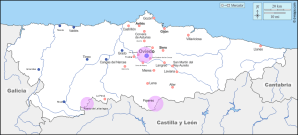
By the end of September 1936, the province of Asturias was locked in a brutal, claustrophobic war within a war, defined by the dramatic Siege of Oviedo and an impending geographical encirclement. The military situation in the northern province at the close of the month stood at a critical tipping point. By late September, the miners had returned in force. An estimated 10,000 Republican militia and miners had completely surrounded Oviedo, subjecting Aranda’s garrison of roughly 3,000 Nationalist troops and Guardia Civil to a suffocating siege. By the end of September, Oviedo was completely cut off from water, electricity, and fresh food supplies. Republican forces used their expertise with industrial dynamite to systematically blast their way through the city’s outer defences, reducing the capital to a landscape of urban ruins and forcing the population underground. Led by Republican union leaders such as Otero and Higinio Carrocera, the Popular Front militias, composed primarily of battle-hardened miners, intensified their heavy artillery bombardments and systematically compressed the outer defensive perimeters of the city. Republican forces relied heavily on their expertise with industrial dynamite. Rather than risking open-field charges against fortified nests, they began creeping into the outer suburbs, blasting through connecting interior walls of adjacent houses to advance without stepping into the street.
.
By mid-September, the Republicans had successfully severed Oviedo’s main water supply lines and captured its peripheral power infrastructure, and this tactical manoeuvre triggered a humanitarian disaster inside; the lack of water for basic sanitation caused a severe outbreak of typhus and typhoid by late September, decimating both Colonel Antonio Aranda’s defenders and the trapped civilian population. For the roughly 30,000 – 40,000 locals trapped inside Oviedo under Colonel Aranda’s Nationalist garrison, life had contracted into a subterranean struggle. Because Republican artillery and dynamite squads battered the city daily, the streets were entirely lethal. Civilians spent weeks living packed into damp cellars, basements, and the crypts of churches. They were surviving on rapidly diminishing rations of chickpeas, horse meat, and stale bread. A desperate black market emerged, where families traded family heirlooms, jewellery, and gold with soldiers for a single can of condensed milk or a handful of vegetables.
.
On 20–21 September 1936, a dramatic diplomatic attempt was made to save the thousands of civilians trapped inside the ruined capital. The Cuban consul in Asturias stepped forward to negotiate a temporary humanitarian ceasefire. Appalled by the severe water shortages, starvation, and the worsening typhus epidemic among the population, the consul managed to get the surrounding Republican miner militias to agree to a suspension of hostilities. The goal was to safely evacuate the pueblo indefenso (the defenceless civilian population) from the city centre before it was completely pulverised by artillery.Under a temporary white flag, the Cuban consul physically crossed the active front lines and entered the besieged Nationalist perimeter to pitch the evacuation directly to the rebel leader, Colonel Antonio Aranda Mata. Ultimately, the initiative failed. Colonel Aranda flatly refused to permit the evacuation of the civilians. From a military standpoint, Aranda knew that keeping the civilian population inside forced the Republican forces to hesitate before launching an all-out, indiscriminate bombardment, effectively using the populace as a human shield.
.
By the second half of September, this force was suffering a severe war of attrition. Over the course of the three-month siege, the Nationalist garrison suffered roughly 2,500 casualties (killed or wounded) out of its original 3,000 men. Lacking clean water, fresh medical supplies, or antibiotics, wounded Nationalist soldiers frequently succumbed to infections or illnesses in underground cellars, compounding the purely combat-related losses. By 29 September, Aranda’s garrison was an exhausted, bleeding skeleton force, holding on strictly by compressing their defensive line into the absolute core of Oviedo, praying that the approaching Galicia columns would reach them before their numbers completely collapsed.
.
Despite losing the capital, the vast majority of Asturias remained firmly Republican. The crucial port city of Gijón had been secured by the Republic in late August after the bloody storming of the Simancas barracks. This gave the Asturian Republican forces access to a major maritime port and the region’s formidable heavy industry and arms factories. Under the leadership of the Comité de Gijón (dominated by anarchist CNT and socialist UGT miners), the province operated as a virtually independent, revolutionary state, isolated from the central government in Madrid. Daily life was governed by local revolutionary committees in these areas. Money was widely abolished or replaced by committee-printed vouchers in many areas. Factories, bakeries, and transport networks were collectivised by the anarchist CNT and socialist UGT unions. For working-class civilians, this period initially felt like the birth of a new society, with communal kitchens feeding families and workers running their own neighbourhoods. Out of a total provincial mining workforce of roughly 30,000 to 40,000 coal and industrial miners, nearly a third immediately picked up arms to form the backbone of the military lines, while others maintained production in the collectivised basins to keep heavy arms factories running.
.
Despite the revolutionary optimism, constant danger loomed from above and out at sea. The Nationalist cruiser Almirante Cervera maintained a strict naval blockade off the coast of Gijón, regularly shelling the port and residential areas. Civilians lived in dread of the ship’s sirens, fleeing into improvised shelters whenever the vessel approached the shoreline. Also, a deep paranoia gripped the civilian population. Fearing internal sabotage or a fifth column of fascist sympathisers, revolutionary committees intensified their nightly patrols. Right-wing civilians, conservative sympathisers, and local clergy lived in absolute terror of the paseos, night-time roundups and executions in rural fields or over the cliffs of Gijón.
.
The existential threat to Republican Asturias by the end of September was a creeping Nationalist counter-offensive from the west. A Nationalist relief column of 19,000 Galician troops, the Columnas de Galicia, backed by Army of Africa Regulares and Spanish Foreign Legionnaires, was aggressively hacking its way through the rugged western Asturian mountains to break Aranda’s siege. They divided into distinct columns, with some tracking the northern coastline and others pushing through the deep inland valleys toward Grado. By late September, these Galician columns had successfully pushed past Navia and Luarca, and were threatening the key mountain passes. Republican forces were frantically diverting miners from the Oviedo front to the western peaks to stall the advance, knowing that if the Galician columns broke through, the Republic’s grip on the province would begin to fracture. Utilising the steep ravines and rocky peaks of western Asturias, small detachments of miners managed to completely stall the superior Nationalist relief column for roughly two weeks. Despite this fierce resistance, the superior firepower and coordination of the Nationalist troops eventually eroded the Republican blocking positions. By late September, the Galician columns broke through the final major geographic obstacles, advancing steadily until they were positioned 24km west of Oviedo. As the Columnas de Galicia fought their way closer, the Republican high command ordered an intense, sacrificial blocking operation. In the closing days of the month, small groups of miners intentionally blew up mountain passes and bridges, fighting to the death in the rocky gorges to slow down the relief trucks. Though the Galician force ultimately broke through the final checkpoints by 30 September, this frantic resistance delayed them just long enough to prevent them from lifting the siege before the month ended.
.
The Republican forces suffered immense casualties throughout September in all areas were fighting occurred. Because they were charging headfirst into a heavily fortified urban centres or against the oncoming Galician forces, many, especially the miners, paid a terrible price. Historical registries from the mining hubs of Mieres and Langreo show hundreds of deaths per week from active combat alone, totalling thousands of casualties over the course of the autumn campaign. When fighting the professional Columnas de Galicia on the western front, the lightly armoured miner columns were consistently outmatched by Nationalist artillery and air superiority, leading to heavy losses in the mountain passes.
.
As September ended, the military map of Asturias was at a dead lock. Colonel Aranda’s garrison had been reduced to a fraction of its original size, running low on ammunition, and compressed into the absolute centre of the city. However, the approach of the Galicia columns meant the Republicans were running out of time. This bottleneck directly triggered the massive, all-out Republican final offensive launched just days later on 4 October, desperate to crush Oviedo before the western trap snapped shut.
.
Santander (Cantabria)
Santander was still entirely under Republican control. Unlike neighbouring Asturias, Santander was completely unified behind the Republic during the opening months of the war. The entire province remained a solid Republican stronghold organised under its own autonomous committee, the Comisaría General, which coordinated defence, food rationing, and logistics. With no fighting inside the province itself, its borders formed part of the broader Northern Front. The actual frontline sat completely outside Santander’s southern border, high up in the rugged mountains separating it from Palencia and Burgos (which were firmly Nationalist). Republican militias from Santander successfully had marched south in July and August to fortify the critical high mountain gaps, such as Puerto de El Escudo and Puerto de Piedrasluengas. They locked down these passes, completely blocking Nationalist forces under General Mola from advancing into the province.
.
During late September 1936, Santander was functioning as a critical logistical rear-guard for the Republic. The capital city itself, Santander, accounted for roughly 70,000 of the 400,000 locals in the province, and the port of Santander was an essential hub for receiving sparse Soviet supply ships, food, and communication with the outside world. Because Santander was peaceful internally, it sent thousands of volunteer militiamen and desperately needed ammunition westward into Asturias to help fuel the siege lines surrounding Oviedo.
.
Early violence in the Republican zone was largely disorganised, driven by local revolutionary committees and angry mobs rather than an official government policy. By late September 1936, the newly formed local Comisaría General in Santander was actively trying to restore the formal rule of law, clear out unauthorised militias, and establish official Tribunales Populares (People’s Courts) to stop the random street killings. Groups had been hunting down local right-wing sympathisers, landowners, and factory owners who were suspected of supporting Franco’s rebellion. One of the most notorious symbols of this repression was the Alfonso Pérez, a commercial steamship anchored in the bay of Santander that the Republican authorities converted into a floating prison. It was packed with hundreds of political prisoners, Catholic priests, and military officers, who by September were already living in brutal, dangerous conditions.
.
Cartagena, Murcia
By September 1936, the Second Spanish Republic was in acute danger. Nationalist columns under General Francisco Franco were advancing rapidly toward Madrid, and Western democracies (Britain, France, and the US) had enacted a strict non-intervention embargo, cutting the Republic off from purchasing legal arms. To make matters worse, rumours swirled in Madrid that radical anarchist factions were planning to raid the central bank vaults to finance their own independent revolution. Prime Minister Francisco Largo Caballero and his newly appointed Minister of Finance, Juan Negrín, decided that the nation’s life savings had to be moved out of the capital immediately to a secure, loyalist stronghold.
.
On 13 September 1936, President Manuel Azaña and Juan Negrín signed a top-secret decree authorising the Ministry of Finance to relocate the central bank’s gold and silver reserves to wherever they deemed safest. The operation was kept strictly hidden from the public and even from most members of the government parliament. The Ministry moved the gold into to Cartagena, a heavily fortified coastal city located within the broader Murcia province. Cartagena was chosen because it was far from the active front lines and served as the absolute primary naval base of the Spanish Republican Navy, making it the most heavily guarded fortress in loyalist territory.
.
On 13–14 September, dozens of trusted locksmiths, metalworkers, and trade unionists descended into the subterranean vaults of the Bank of Spain in Madrid. They spent days packing 700 tonnes of pure gold (mostly historic international coins and ingots) into roughly 10,000 wooden ammunition crates. Each crate weighed about 65kg. On the night of 15 September, the massive treasure was quietly loaded onto a series of heavily armoured trains. Under intense military escort, the cargo travelled under the cover of darkness south-eastward through the country, arriving safely at the Cartagena rail docks.
.
Once the trains arrived in the Region of Murcia, the gold was hidden inside the Algameca Navy Arsenal in Cartagena. Specifically, the 10,000 crates were stacked deep inside underground ammunition magazines carved directly into the solid rock cliffs of the naval base. For over a month, this hidden coastal cave in Murcia housed one of the largest monetary treasures on the plane.
.
The initial domestic operation to move the gold out of harm’s way was completed on 20 September 1936, when the final trains arrived and the entire shipment was verified safe inside the Algameca naval arsenal bunkers in Cartagena. For the final ten days of September, the 700 tonnes of pure gold, tightly packed inside roughly 10,000 wooden ammunition crates, remained hidden deep within these solid rock cliff vaults. They were under the absolute protection of the Spanish Republican Navy’s primary fortress while the government debated whether to ship the wealth to Paris or Moscow.
.
While the move to Murcia was initially intended purely for safekeeping, the Republic’s desperate need for hard foreign currency to purchase Soviet aircraft, tanks, and ammunition quickly changed the gold’s destiny. Roughly one-quarter of the gold cases stored in the arsenal were shipped overland to the Bank of France (The Paris Gold) to buy liquid foreign currency, which started being moved from the country in late September 1936.
.
The remaining three-quarters, amounting to 510 tonnes of gold, were secretly loaded onto four Soviet transport ships docked at Cartagena in late October 1936. Overseen by Soviet NKVD secret agent Alexander Orlov and Spanish officials, the fleet sailed to Odessa, where the treasure was transferred directly into Stalin’s vaults in Moscow. It was entirely spent by the Republic to pay for Soviet military assistance, leaving Spain financially bankrupt at the war’s conclusion.
.
Teruel, Aragon
By late September 1936, the province of Teruel presented a starkly different strategic landscape than the industrialised police state of Zaragoza or the high-stakes valley warfare of nearby Guadalajara. Teruel was a vast, desolate, and mountainous frontier, frozen in a highly decentralised stalemate. The province was cut into two distinct zones, characterised by extreme terrain and a desperate, isolated Nationalist capital completely encircled by autonomous Republican militias. The Nationalists held the western rim of the province. However, their territory was essentially limited to the capital city of Teruel itself, the strategic mountain town of Albarracín, and a thin logistical corridor running west toward Guadalajara and south toward Nationalist-held parts of Valencia. The Republicans held the vast, sweeping eastern half of the province. Their territory encompassed the entire Bajo Aragón (Lower Aragon) region, anchored by the major towns of Alcañiz, Calanda, Valderrobres, and the rugged mountains of the Maestrazgo.
Related
Got a comment, question or suggestion? Know who took a photo? Have questions about a particular date or event? Cancel reply