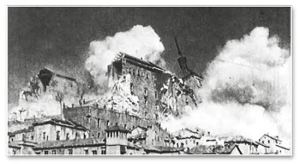
By 20 September, the Army of Africa had advanced to the town of Maqueda, located at a critical crossroads. From Maqueda, the highway to the north offered an unobstructed, 40-kilometre path directly into the under-defended capital of Madrid. To the southeast lay Toledo and the besieged Alcázar. In a move that sparked intense debate among his military peers, General Franco ordered his columns to halt their advance on Madrid and pivot toward Toledo. Militarily, the decision was highly controversial; it granted the Republican authorities in Madrid nearly a month of breathing room to fortify the capital and organise the International Brigades. However, Franco recognised that the political and psychological value of the Alcázar far outweighed immediate tactical gains. The global press had turned the 1,300 trapped Nationalist defenders into a living myth of anti-communist resilience. By presenting himself as the liberator of the historic fortress, Franco secured absolute ideological authority over the Nationalist faction.
.
Inside Toledo, the Republican militias knew their window of opportunity was slamming shut. Panicked by news of the approaching African columns, they launched a sequence of aggressive, desperate assaults to crush the garrison before Varela arrived. On 20 September, Republican forces brought thousands of litres of gasoline and improvised flamethrowers to the Alcázar ruins. They sprayed the liquid fuel directly into the lower slits and basement windows of the intact outposts, igniting a massive blaze that filled the cellars with suffocating, toxic smoke. The defenders held their breath behind wet rags, refusing to abandon the burning walls. On 23 September, the Asturian miners detonated a second major subterranean mine, targeting the northern façade of the structure. The explosion caused localised structural collapses, but the subsequent infantry charge was instantly cut to pieces by Nationalist machine-gun fire originating from deep within the rubble.
.
On the morning of 26 September, the forward vanguard of the Army of Africa broke through the outer ridges of the valley. General Varela’s professional columns systematically surrounded the city, cutting off the Republican highway links and rail lines back to Madrid. On 27 September, Varela’s professional shock troops surged into the streets of Toledo. The arrival of the Nationalist relief column was met with resistance, though the Republican worker militias collapsed rapidly under the assault. As the battle-hardened Moroccan Regulares and Spanish Foreign Legionnaires pushed into the city, heavy small-arms fire and artillery exchanges echoed across Zocodover Square and the surrounding alleys. Realising they were completely outflanked and outgunned by the advancing professional army, the remaining Republican forces initiated a retreat eastward out of Toledo.
.
The Moroccan troops and Legionnaires fought their way through the barricades of Zocodover Square and reached the smoking ruins of the infantry academy, establishing physical contact with Colonel Moscardó’s haggard garrison. Emerging from the pitch-black cellars into the sunlight, a skeletal Moscardó saluted Varela and delivered the phrase that would become the central myth of the Francoist regime, Sin novedad en el Alcázar (Nothing new to report at the Alcázar). While the relief of the fortress was celebrated globally as a triumph of military and nationalist endurance, the immediate aftermath inside the city was devastating. The entry of the Army of Africa triggered an intense wave of retributive violence through the streets of Toledo. The shock troops carried out systematic sweeps, executing any remaining militia members or citizens suspected of participating in the siege. In one of the most notorious incidents of the day, Nationalist troops entered the Hospital de Tavera and summarily executed over 200 wounded Republican militiamen in their hospital beds using hand grenades and firearms. Varela’s forces executed more than 800 unarmed people in the immediate hours and days following their entry into the city.
.
Physical contact with the garrison was established immediately on 27 September. When Varela’s men cleared the immediate rubble and approached the battered entrance, Colonel José Moscardó emerged from the dark, soot-stained basement vaults to officially meet and salute the arriving officers, marking the formal end of the 71-day siege. The systematic evacuation of the surviving women, children, and wounded soldiers from the deep crypts followed shortly after safety was secured. Approximately 65 Nationalists were killed in action during the siege, dying from direct artillery hits, sniper fire, and mine explosions, while about 430 more suffered various wounds and injuries over the course of the entrapment. Among the roughly 500 women and children sheltering in the deep cellars, zero were killed by enemy combat, and the five civilian deaths that did occur inside the walls were entirely from natural causes related to illness or old age.
.
Conversely, all of the left-wing hostages held inside the Alcázar had been executed by the Nationalists just before the siege was lifted. Their treatment and eventual fate were heavily suppressed or entirely omitted from Francoist wartime propaganda to project an image of the fortress solely as a noble refuge for innocent civilians. For the 71 days of the siege, these hostages were kept deep inside the dark subterranean cellars, with at least one journalist later claiming they were found chained to railings. As the Army of Africa broke through the outer Republican lines, the Nationalist garrison executed the prisoners to prevent them from being liberated or providing information to the arriving forces.
.
However, historical research later proved that the Republican Civil Governor of the province, Manuel María González López, did not enter the fortress as a hostage. Instead, he actively sought sanctuary and refuge inside the Alcázar alongside his wife and children to escape the revolutionary chaos unfolding in the streets of Toledo. Colonel Moscardó himself later testified that González López was actively involved in, or deeply sympathetic to, the military conspiracy. In the final days leading up to the uprising, the Governor deliberately stalled and misdirected orders from the central government in Madrid, which was desperately demanding that Toledo’s prominent Arms Factory ship its ammunition reserves to protect the capital. By delaying the shipments, González López granted Moscardó the crucial window of time needed to securely move those ammunition crates inside the Alcázar walls.
.
Because of his hidden collaboration, González López and his family lived a completely different reality than the regular left-wing hostages inside the crypts. While the actual Republican trade unionists and workers were kept in squalor and ultimately executed, the Civil Governor and his family were held under a privileged regime of house arrest. They were given separate quarters, shielded from the general prisoner population, and treated with deference by the officer corps. On 27 September, González López and his family were quietly and safely evacuated. He returned to his home region of Galicia, entirely unmolested by the new regime. To guarantee his safety from overzealous Falangist squads in the rearguard, Colonel Moscardó personally signed an official certificate of loyalty to the Nationalist cause for him, effectively granting the former Republican governor complete immunity and exposing the myth of his captivity once and for all, and lived until old age in comfort, a sadly recurring theme for fascists, their sympathisers, and those who sought to harm the innocent people of Spain.
.
On the day of the uprising and González López’s staged “arrest,” his secretary, Conchita, learned that her boss was confined inside the Alcázar. Acting out of pure professional loyalty and entirely unaware that González López had secretly entered the fortress voluntarily as a coup collaborator, she presented herself at the gates to continue serving him. The Nationalist officers admitted her, but she was quickly separated from the Governor’s inner circle. Unlike the traitor Governor’s family, who spent the 71-day siege in relative comfort and connivance with Colonel Moscardó, Conchita made no attempt to hide her political allegiances. Throughout her confinement, she expressed clear sympathy for the Spanish Republic. Relegated to the standard, squalid subterranean cells alongside the other left-wing worker hostages and political prisoners rounded up from the streets of Toledo, Conchita met a grim fate. She was summarily shot by a Nationalist firing squad during the chaos of the city’s liberation, while her boss was safely escorted back to Galicia.
.
.
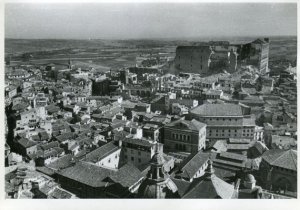
On 27 September 1936, news of the Nationalist relief of the Alcázar of Toledo produced a large public celebration in Zamora, where the military uprising had succeeded in July. The event brought together the army, Falange, municipal authorities, clergy, and civilians in a demonstration of support for the Nationalist war effort. The following day, the Ayuntamiento began systematically replacing Republican street names with names commemorating Nationalist leaders, martyrs, and military organisations.
.
For the celebration on 27 September, flags and organisational standards appeared in the Plaza Mayor, and a large procession moved through the centre of the city. Its route passed along Avenida de Requejo, San Torcuato, Sagasta, Ramón y Cajal, Plaza Mayor, Ramos Carrión, Rúa de los Notarios, and Plaza del Magistral, before continuing towards the Castillo and Gobierno Civil. Military personnel and Nationalist political organisations participated alongside civilians.
.
A military parade was then held before the city’s civil, military, and ecclesiastical authorities. The celebration presented the events at Toledo as a Nationalist victory even though the relief of the Alcázar was still being completed, as Franco’s troops entered Toledo on 27 September, while contact with the besieged garrison was established that evening and the formal relief was celebrated on the 28th. In Zamora, the news was already sufficient to bring a large crowd onto the streets.
.
The political transformation of those same streets became official on 28 September, when the Ayuntamiento de Zamora approved a broad programme of renaming. Names associated with the Republic and the political left disappeared from the city’s map. Plaza de Santiago Alba became Plaza de Sanjurjo; Calle del Riego became Calvo Sotelo; Avenida del 14 de Abril became Defensores de Toledo; Parque de Pablo Iglesias became Paseo de San Martín; Plaza de Galán y García Hernández became Primo de Rivera; Plaza de Haide de la Fuente became Fray Diego de Deza; Calle Ángel Galarza became Alfonso XII; Plaza del Cuartel de Caballería became Las Milicias; and Avenida de la República became Tres Cruces.
.
Several choices carried very specific political messages. José Calvo Sotelo, the right-wing monarchist politician murdered shortly before the military uprising, had already become one of the Nationalists’ principal martyrs. José Sanjurjo had led the failed military uprising of 1932 and had been expected to head the 1936 rebellion before his death in an aircraft crash on 20 July. José Antonio Primo de Rivera, founder of the Falange, was then imprisoned in Republican-held Alicante. Defensores de Toledo commemorated the Alcázar garrison whose relief Zamora had celebrated only the previous day, while Las Milicias explicitly honoured the armed organisations supporting the Nationalist rebellion.
.
The changes also deliberately removed names commemorating the political order being destroyed. 14 de Abril marked the proclamation of the Second Republic in 1931; Pablo Iglesias was the founder of the PSOE and UGT; Fermín Galán and Ángel García Hernández had been executed after the Republican uprising at Jaca in 1930; and Ángel Galarza was a prominent Republican politician from Zamora.
.
The two days consequently changed both the use and the identity of Zamora’s public spaces. On 27 September, Nationalist organisations physically occupied the streets with flags, uniforms, a procession, and military ceremony. On 28 September, the municipal government changed the names by which many of those streets, squares, avenues, and parks were officially known, removing prominent references to the Republic and replacing them with symbols of the new Nationalist order.
.
In Zamora, the city council began systematically stripping away the most overt fascist designations starting in 1985. Major arteries reverted to their traditional pre-war geographic or historical names rather than their Second Republic variants to foster local consensus. For example, Avenida de la República did not return to its 1931 name but was permanently designated as Avenida de las Tres Cruces. While many major cities changed their largest avenues early on, smaller cities and conservative strongholds left dozens of minor Francoist street names intact for decades. This changed with the passage of the 2007 Historical Memory Law under Prime Minister José Luis Rodríguez Zapatero. Article 15 of this national law explicitly obligated all public administrations and local city councils to remove any plaques, symbols, statues, or street names that exalted the 1936 military uprising, the Civil War, or the dictatorship. The law included a mechanism that allowed the central government to withdraw public subsidies and grants from municipalities that refused to comply.
.
The definitive erasure of the remaining Francoist nomenclature in Zamora city was completed under the administration of Mayor Francisco Guarido (of the Izquierda Unida party), who took office in 2015. In August 2016, the city council initiated the final legal proceedings to eliminate the last two lingering streets named after prominent Francoist officials (Calle de Alfonso Peña and Calle de Carlos Pinilla). Simultaneously, the town hall officially stripped Franco of his honorary title of ‘Adopted Son of the City’ and recognised 43 municipal workers who had been purged or executed by the Nationalists in late 1936. This sweeping process continues across the wider province of Zamora, where municipal councils utilize national mandates to continuously replace remaining Franco-era symbols with neutral regional identifiers.
.
The vast central agricultural plains of Spain of Castilla La-Mancha (formerly New Castile) and Castilla y Leon (formerly Old Castile) still house the highest concentration of remaining Francoist street names. Over three-quarters of the streets still dedicated to figures like Franco or José Antonio Primo de Rivera are tucked away in tiny rural villages with populations under 2,000. Several small agricultural settlements founded by the regime still legally retain their fascist suffixes. For example, Alberche del Caudillo (in Toledo) and San Leonardo de Yagüe (in Soria, named after the brutal Nationalist Butcher of Badajoz) have faced long, drawn-out legal battles and local resistance over changing their town names.
.
Both Soria in Castilla y Leon, and Cuenca in Teruel province, Aragon remain notable for dozens of small villages that still feature streets honouring Francoist leaders like Admiral Luis Carrero Blanco or General Mola. (I personally saw my first Falange Yoke and Arrows in Cuenca and was alarmed at how big it was, and that was 20 years ago)
.
While the left-wing capital cities of Andalucía changed their names early on, rural strongholds and conservative-led municipal governments have occasionally mounted direct pushbacks. In a highly publicised political dispute, a newly elected right-wing municipal administration in Córdoba City actually voted to reinstate several Francoist street names that had been stripped by the previous left-wing council, demonstrating how easily the urban map can become a ideological pendulum. Tiny outlying Málaga hamlets, such as Villafranco del Guadalhorce (Alhaurín el Grande), have seen localised resistance, where residents frequently argue that the names represent the history of their physical infrastructure rather than an endorsement of the dictatorship.
.
Eastern Spain features lingering pockets of resistance, particularly regarding minor urban elements. In Alicante and Castellón, main avenues have been thoroughly secularised, trade unions and historical memory associations regularly file lawsuits against small municipal town halls in these provinces for failing to strip the Falangist Yoke and Arrows insignia from old housing plaques and public edifices.
.
While Catalonia stripped all overt Francoist nomenclature from major streets and sculptures decades ago, a comprehensive regional census revealed that over 2,000 small-scale Francoist vestiges still exist on public view. Towns like Banyoles, Reus, and Palamós still house hundreds of vintage, metal housing department plates bearing the regime’s symbols stamped onto the facades of residential buildings constructed during the 1960s boom.

