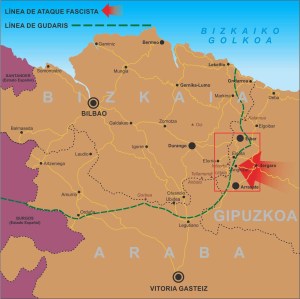
In late September 1936, the rapid Nationalist sweep across Gipuzkoa ground to a bloody halt in the rugged mountains guarding the province of Bizkaia. As the Nationalist columns under General Emilio Mola advanced toward the vital arms-manufacturing hub of Eibar and the strategic crossroads of Elgeta, they collided with a fiercely organised, heavily fortified Republican and Basque defence. Utilising the steep heights of Arrate, Kalamua, and Urko to negate the Nationalists’ logistical momentum, these localized militia units transformed the jagged landscape into a meatgrinder, inflicting heavy casualties on Nationalist commanders like Díez de Rivera and Tejero. The desperate fighting between September 26 and 30 would save Eibar from immediate capture and freeze the northern war effort into a surreal, seven-month mountain stalemate, pushing the front line directly into the backyards of the local civilian population.
.
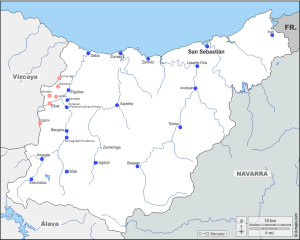
The Nationalist columns met a more concentrated Republican and Basque defence as they approached Eibar and Elgeta. The rugged terrain of the Ego River valley around Eibar and Elgeta served as a natural fortress that effectively neutralised the Nationalists’ mechanised and cavalry advantages. Republican forces held key elevated positions and utilised sophisticated mountain fortifications and improvised weaponry to halt the Nationalist advance.
.
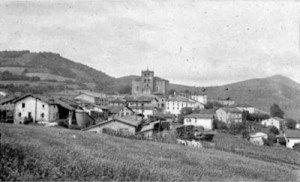
Elgeta in 1936
.
Eibar was an industrial town of roughly 13,000–14,000 inhabitants, with arms factories and a strongly organised Socialist and Republican working-class movement. Its factories and workshops were already contributing weapons, repairs and improvised armoured vehicles to the Republican war effort. Republican and Basque troops occupied the heights around Arrate, Urko, Kalamua and Elgeta, using the mountainous ground to cover the approaches to Eibar and the road towards Bizkaia. The Republican side included militia and newly organising Basque units, while several Nationalist groups attempted to advance against them from the territory captured further east and south.
.
Around Eibar, the Nationalist group commanded by Díez de Rivera suffered four men killed and24 wounded under Republican fire from the Arrate and Monte Urko positions. At Angiozar, Tejero’s group suffered 18 casualties in a single day and halted, partly because the southern Nationalist column under Alonso Vega had not moved far enough forward to support its flank.
.
Fighting also developed around Elorregi (San Prudencio), where Republican troops attacked the Nationalist group commanded by Saleta, and the town was a strategic crossroads and neighbourhood located just south of Bergara (Vergara) along the road leading toward Mondragón (Arrasate). This area is characterised by steep, heavily wooded valleys carved by the Deba River network. and acted as a geographical choke point. For the Nationalists, capturing it was required to link their advancing columns, flank the Republican strongholds, and push west toward the Basque province of Bizkaia. For the Republicans, holding this crossroad prevented the Nationalists from encircling the defence forces at Eibar and Elgeta.The assault was spearheaded by a column under the command of Commander Saleta. His unit was acting as the left flank of a broader Nationalist offensive overseen by General Emilio Mola. Saleta’s force had pushed through Bríncola, Telleriarte, and Oñati before advancing into Elorregi. But the defending force comprised a diverse, newly organising mix of Basque nationalist militias (such as the Arana Goiri battalion), socialist forces (UHP), communist militias (MAOC), and anaracho-syndicalist units.
.
On 26 September, Saleta’s troops successfully entered Elorregi, but rather than fleeing, the Republican and Basque troops launched a series of immediate, aggressive localised counterattacks. The Republican defence successfully halted further Nationalist momentum when the Nationalist advance became uncoordinated. While Saleta was being struck by Republican counter-offensives at Elorregi, the neighbouring Nationalist group under Commander Tejero hit a wall at nearby Angiozar. Tejero was forced to halt because Colonel Camilo Alonso Vega’s southern Nationalist column had failed to advance quickly enough to secure their shared flank.Republican troops used the high ground overlooking the roads to trap Saleta’s forces in the valley. This forced the Nationalists to stop trying to enter towns directly and instead shifted the fighting toward grinding, bloody infantry battles over individual mountain peaks and road junctions.
.
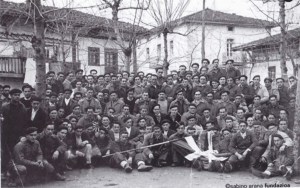
The Batallón Arana Goiri, led by Felipe Bediaga (first left) in Elgeta, via Sabino Orana Fundazioa
.
The fierce resistance at Elorregi, combined with the bloody defensive stands at Arrate and Elgeta, effectively broke the momentum of the Nationalist Blitzkrieg in the north. Unable to cleanly break through San Prudencio and the Intxortas mountains, the front line froze at the end of September 1936. This gave the Basque government the crucial seven-month window it needed to fortify the region and organize the official Basque Army (Euzko Gudarostea).
.
Nationalist units were now attempting to seize individual heights and road junctions rather than enter towns after a withdrawal. On 26–28 September, Díez de Rivera’s troops pushed towards the high ground immediately outside Eibar. The charge was led primarily by extreme-right Carlist Requeté militias, the 3rd Company of the Tercio de Lácar and the 400-man strong Tercio de Lesaca. Pushing up from the San Pedro valley, the Nationalists engaged in bloody, close-quarters infantry fighting. On September 26, supporting Carlist units seized the nearby Morkaiko mountain but suffered heavy losses (10 dead, 45 wounded). Over the next two days, the Nationalists pushed through intense Republican defensive fire. By September 28, the Tercio de Lesaca successfully captured the Sanctuary of Arrate, its surrounding summer colony buildings, and the adjacent Cantabria farmhouse. Simultaneously, the Tercio de Lácar secured the crest of Monte Kalamua. The Republican defenders, largely driven by the locally organised socialist Amuategui Battalion and Basque militias, had spent the preceding weeks carving deep trenches and bunkers into the mountain slopes. The Republicans heavily fortified the ridge descending from Arrate to the San Pedro hermitage. They deployed Spanish-designed 50mm and 81mm Valero mortars.
.
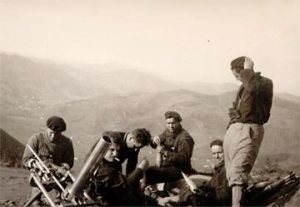
Gudaris from the San Andrés and Saseta Battalions, placing the multipliers on the grenades of their 81 mm “Valero” mortar, in the Markina Sector, via gerrazibilaeibarren
.
On September 29, the Carlist 4th Company of the Tercio de Navarra attempted to reinforce Arrate but ran directly into a ferocious Republican wall of fire. The mortar blasts and machine-gun fire were so devastating that the Nationalist reinforcements abandoned their attempt to secure Arrate, fleeing to cluster on the Kalamua summit for safety. Nationalist artillery heavily bombarded the historic Arrate church, severely damaging its stone facade, while the defenders positioned mobile artillery inside Eibar itself to shell the newly captured peaks.
.
The Republicans launched a massive, coordinated counteroffensive to retake Arrate before the Nationalists could dig in. While they failed to recapture the absolute peaks of Arrate and Kalamua, the sheer ferocity of the counterattack shattered the Nationalists’ momentum.. The Nationalists were left holding the summits, looking directly down into Eibar, but they were entirely trapped on the high ground. They could not advance down the slopes into the town due to the Republican trench lines dug just 80 metres below them. The bloody clashes at Kalamua and Arrate froze the northern front in place as the socialist Amuategui Battalion and newly organising Basque militia units sat entrenched, successfully blocking the roads to Durango and Bilbao. Below them lay Eibar, unconquered, defiant, and still producing weapons for the Republic. For the civilian population living directly behind the lines, a surreal new reality began. The front line was now in their backyards, and the high-altitude stalemate established in the final days of September would successfully freeze the northern war effort for the next seven months.
On 26 September 1936, Republicans from Soria who had escaped from the Nationalist-controlled province formally organised the Batallón Numancia in Madrid. The initiative was led by Benito Artigas Arpón, a Republican deputy for Soria who had also escaped the Nationalist takeover.
.
Approximately 400 Sorian volunteers formed the original core of the unit. They were men who had reached Republican territory rather than remain in Soria, where the military uprising had succeeded quickly and arrests and executions of Republican and left-wing activists were already under way. Volunteers from La Rioja and Navarre subsequently joined them, increasing the formation to battalion strength. The name Numancia, taken from the ancient Celtiberian city near modern Soria, gave the unit an explicitly Sorian identity even though it was being organised more than 200km away in Republican Madrid. Its creation brought together men displaced from their home province who were now able to take up arms on the Republican side of the war. Its formation also provides part of the other side of Soria’s September story – while Republicans who remained inside the Nationalist-controlled province faced imprisonment and repression, hundreds who had managed to reach Republican territory were organising in Madrid to fight against the uprising.
.
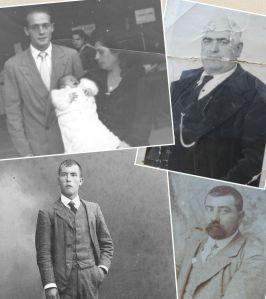
Enrique Ráfales Mejuto, Juan Caldú Martín, Salvador Meix Gimeno and Emilio Ferrer Cardona were four of the 13 residents of Valdeltormo who were shot dead between July and October 1936, via Valdetormo.com
Valdeltormo and Alcañiz, Teruel, Aragon
The opening months of the Spanish Civil War tore through the small rural communities of Aragon with a devastating mix of political score-settling and ideologically driven violence. While frontline columns engaged in heavy mountain warfare to the north, the republican rearguard in Teruel became the stage for a quieter, deeply intimate tragedy. On 26 September 1936, this cycle of ideological cleansing claimed the lives of eight conservative residents from the small village of Valdeltormo, executed along the cold stone facade of the Alcañiz cemetery wall.
.
By late September, Valdeltormo had fallen completely under the administration of anti-fascist worker committees. In small agrarian towns, longstanding social tensions, religious devotion, and political affiliations quickly became matters of life and death. On 23 September, local militia units moved through the village to round up prominent conservative figures. Among those targeted were the municipal leaders who formed the backbone of the traditional town administration, the local Mayor and town councillors, the municipal secretary, the village priest, targeted as part of the widespread anti-clerical violence sweeping the region. The detained men were stripped of their authority and immediately transported north to the regional Republican committee headquarters in Alcañiz, before being processed and locked away inside the local prison.
.
The prisoners’ stay in the Alcañiz jail was brief. During the volatile summer and autumn of 1936, the transfer of conservative prisoners to official detention centres rarely guaranteed their safety. Instead, jails frequently acted as temporary holding pens before the sacas. During the early hours of 26 September, local armed militiamen arrived at the prison gates. The eight men from Valdeltormo were extracted from their cells under the cover of darkness and driven directly to the municipal cemetery. Standing against the cemetery wall, all eight were executed by a firing squad.
.
Following the executions, the bodies of the eight victims were collectively buried in a common grave dug within the Alcañiz cemetery grounds. The execution of the local civil and religious leadership in a single night deeply traumatised the civilian fabric of Valdeltormo. Local records identify the men as former mayors Juan Caldú Martín and Salvador Meix Gimeno, town councillor Blas Boj Gómez, and local residents Lino Boj Margeli, Primitivo Gómez Foz, Pedro Giner Serres, Enrique Ráfales Mejuto, and Emilio Ferrer Cardona. This act of violence would dictate the town’s political landscape, ensuring that when Nationalist troops finally seized the region in early 1938, the cycle of retribution would spin violently in the opposite direction.
.
Málaga, Andalucía
*Like many places in 1936, photos from the actual September 1936 wave of captures in the western Serranía de Ronda are virtually non-existent. Because these early operations relied heavily on terror tactics and immediate political cleansing, the executing Nationalist columns had no desire to leave behind photographic records of their actions.
.
In late September 1936, the Serranía de Ronda, a rugged, mountainous region in the province of Málaga, became the stage for a rapid and devastating Nationalist offensive. Over three intense days of manoeuvring between September 26 and 28, a series of coordinated rebel captures shattered the local Republican militia defences. By systematically seising control of the vital Guadiaro and Genal river valleys, the Nationalist forces completely secured their logistical corridors, linking the rebel-held interior directly with the strategically vital coastal waters of the Campo de Gibraltar.
.
The collapse of the Republican mountain front occurred in rapid succession, with individual towns falling like dominoes to the advancing Nationalist columns. Commanded by the fanatical Carlist military officer Laval Redondo, this mobile group was infamous for its speed and severe retributive measures, and included a heavily armed paramilitary battalion of Carlist Requetés raised largely out of Jerez and Cádiz. They specialised in mountain warfare and led the actual physical assaults up the steep valleys of the Guadiaro and Genal rivers to capture towns like Gaucín and Algatocí. With the Carlists was a mobile column led by Captain Gumersindo Varela (of the Guardia Civil). His forces advanced from the western frontiers near Valverde del Camino and Ubrique, effectively acting as an anvil that squeezed the local Republican defence groups against the advancing Tercio Mora-Figueroa. Attached to these columns were smaller detachments of elite Moroccan Regulares. Used extensively by the Nationalist high command for their psychological impact and unmatched proficiency in close-quarters infantry combat, they were deployed to storm the final defensive ridges outside Cortes de la Frontera on 24 September.
.
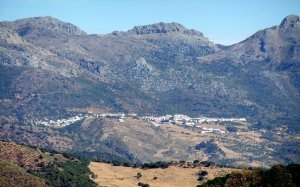
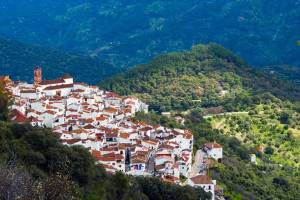
The view heading towards Cortes de la Frontera in the Serranía de Ronda
.
On 26 September, the offensive opened with a heavy push through the western reaches of the Serranía. Nationalist troops successfully captured the strategic town of Cortes de la Frontera two days earlier and on 26 September were ready to take over the town under Nationalist control, having executed 37 locals upon entering the town (none of which have been recovered as of 2026). This victory gave the rebels immediate command over a major mountain gateway, crucially strengthening and widening the primary Nationalist supply route heading south toward the Campo de Gibraltar.
.
Following the physical fall of Cortes de la Frontera, the Spanish Republican Air Force (Fuerzas Aéreas de la República Española – FARE) launched an immediate tactical response to disrupt the Nationalist advance. On September 27, a formation of four Republican aircraft, likely French-built Breguet XIX light bombers or Potez 540s operating out of the loyalist airfield in Málaga, flew over the Serranía. They dropped a total of 16 bombs directly onto the newly occupied structures of Cortes de la Frontera as a desperate attempt to destroy the Nationalist supply lines and artillery placements. The Nationalist columns under Laval Redondo were actively using Cortes as a staging ground to push further south and west toward the border of Cádiz province. By targeting the town, the Republic hoped to buy time for the retreating militias to dug in.
.
Also on 27 September, without pausing to consolidate their gains, the Nationalist columns immediately pushed deeper into the geography of the Guadiaro valley and Jimera de Líbar was occupied. By taking this town, the rebels secured the valley floor, opening up a direct path to encircle the remaining pockets of anti-fascist resistance higher up in the mountains. the mass grave pits in the region are small and have only been partially recovered, so many taken prisoners were likely removed form town. Only two were executed against cemetery walls, and one was later recovered and reburied.
.
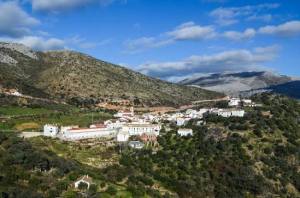
Jimera de Líbar, via minube
.
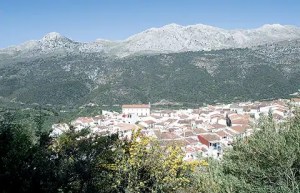
The climax of the three-day mountain blitz occurred on September 28, when Nationalist forces launched a multi-pronged assault to simultaneously occupy Atajate, Algatocín, and Gaucín. Gaucín, perched high on a rocky ridge, served as the ultimate southern sentinel of the mountain range. Its fall effectively signalled the total collapse of Republican authority across the western Serranía. In Algatocín, some in danger managed to escape, and as late as 1950, the Francoist government was till rounding up Republicans, shooting seven of them at the local cemetery in November 1950. In Gaucín, the local mass grave against the cemetery walls contains approximately 50 people, though only 44 have been identified, and most were most from the town, and may have come from Atajate and Algatocín. The province itself currently has 109 registered mass graves, and many remain unexhumed, and of those that have been recovered, most came from 1937 onwards, leaving the victims of the hot terror summer unaccounted for.
.
Aside from the cars and better roadworks, town like Algatocín have not changed much since 1936, via Malaga.us
.
The interaction between the occupying forces, most notably the Tercio Mora-Figueroa and the Moroccan Regulares, and the civilian population followed a deliberate blueprint designed to break any local allegiance to the Spanish Republic. The Tercio Mora-Figueroa acted as a mobile political purging unit rather than a standard frontline army battalion. Led by the prominent local landowning brothers Manuel and José Mora-Figueroa, the unit was composed of wealthy right-wing youths (señoritos) and fanatical paramilitaries. Upon entering towns like Cortes de la Frontera, Algatocín, and Gaucín, their primary operational objective was to locate, detain, and eliminate anyone tied to left-wing politics, land-reform committees, or agricultural trade unions.
.
The primary form of interaction with suspected leftists was immediate execution without trial. To prevent local emotional interference and shield the identity of executioners, the columns frequently utilised an institutionalised swapping system. Militiamen from outside provinces would carry out the executions in the newly captured towns, while the Tercio Mora-Figueroa conducted ’round-ups and clean-ups.’ Prisoners captured in the surrounding villages were routinely funnelled to regional hubs like Ronda, where they were shot against cemetery walls or dumped into unmarked mass graves. For the civilians who survived the initial wave of executions, interaction with the new authorities meant complete economic ruin. Acting under direct decrees issued by General Gonzalo Queipo de Llano, military tribunals immediately drew up lists of local residents labelled as having ‘Marxist ideals.’ In Cortes de la Frontera alone, official registries documented the total seizure and confiscation of land, homes, crops, and personal belongings of at least 91 families among the 1400 households in the town. The integration of the Moroccan Regulares into the occupying forces served a psychological purpose. The Nationalist high command intentionally endorsed these troops to engage in rape, looting and public displays of violence to strike terror into the townspeople, ensuring the remaining civilian population would offer absolute submission to the new regime.
.
Atajate, via Wikimedia Commons
.
The loss of these five key municipalities fundamentally shifted the balance of power in southern Andalucía. For the Republican defence, which relied heavily on poorly equipped, localised trade union and anarchist militias from Málaga, the loss of the high-altitude passes stripped away their greatest tactical advantage. They were entirely pushed out of the mountains and forced down toward the sea.
.
For General Francisco Franco’s Army of the Africa and the rebel high command, this three-day sweep accomplished two massive strategic goals. It created a secure, uninterrupted overland supply line from their landing ports on the southern coast up into the Andalusian interior, freeing them from the constant threat of Republican guerrilla ambushes from the heights, and by establishing a solid frontline along the mountain peaks of Gaucín and Algatocín, the Nationalists brought the war directly to the doorsteps of the remaining Republican-held coastal zone. As September 1936 drew to a close, the isolated Republican stronghold of Málaga found itself dangerously choked off, hemmed in by the sea on one side and an aggressive, newly consolidated Nationalist mountain wall on the other.
.
By the end of September, Málaga province was cleaved diagonally. The Nationalists controlled the entire western, northwestern, and inland interior (Ronda, Antequera, and the border with Cádiz). The Republicans were pinned down into the southern bowl, holding onto Málaga city, its eastern coastal road, and the immediate mountain walls looming directly above the sea.
.
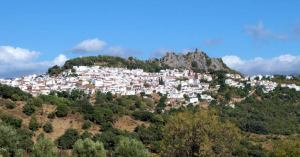
Gaucín, via Real Ronda
.
Tucked deep within the rugged, densely forested Los Alcornocales mountain range, La Sauceda sat squarely on the border between Málaga and Cádiz. Because the Nationalists had rapidly captured virtually every major town in Cádiz province by late September, this dense cork-oak forest became a natural sanctuary. By September 30, as towns like Gaucín, Algatocín, and Cortes fell, thousands of civilian refugees, peasants, women, children, and left-wing sympathisers fleeing the terror caliente, streamed into this mountain pocket on foot. They joined forces with hundreds of armed Republican militia remnants who refused to surrender. For a brief window, this valley existed as an isolated, self-governing Republican island completely surrounded by Nationalist-occupied territory. The refugees built makeshift huts in the woods, shared communal food supplies, and used the dense canopy to hide from rebel scouting planes. While this enclave successfully survived past 30 September 30, its fate was devastating. The Nationalist high command viewed this gathering of refugees and armed guerrillas on their flank as a major security threat to their supply routes to Gibraltar.
.
The enclave centered around La Sauceda and the adjacent El Marrufo estate was a geographically unique, high-altitude valley tucked deep within what is now the Los Alcornocales Natural Park. The area is a dense, wild wilderness dominated by ancient, old-growth cork oak and chestnut forests, steep ravines, and rugged limestone ridges. It sits isolated at an altitude of roughly 400 to 500 metres near the Puerto de Galiz mountain pass.
This valley formed a strategic blind spot where two provinces and four distinct municipal borders converged: Málaga (Cortes de la Frontera) and Cádiz (Jerez de la Frontera, Jimena de la Frontera, and Alcalá de los Gazules).
.
La Sauceda was an old, scattered hamlet of roughly 12 small residential nuclei where locals lived off traditional charcoal burning, cattle grazing, and cork harvesting. Cortijo El Marrufo, located just 4km away on the Jerez side of the border, was a massive, 800-hectare private agricultural estate featuring a large cortijo, a small chapel, and extensive livestock barns. For the first few weeks, the valley was a sanctuary. As Nationalist columns systematically captured the surrounding towns in September, between 800 and 2,000 people fled into this dense mountain pocket. The population was a mix of local hamlet residents, armed militia remnants, and hundreds of civilian families, including women, elders, and infants, fleeing the terror caliente. They pooled their resources, utilising a communal mill and bread ovens, sharing livestock, and sleeping in makeshift mountain huts or inside the valley’s chapel. The dense, foggy canopy of the cork forest provided physical cover, making it the very last Republican holdout in the entire region, but it would not last.
.
Castro del Río, Córdoba, Andalucia
In the final days of September 1936, the war across the rolling agrarian landscapes of the Córdoba province reached a devastating turning point. Following their capture of nearby Espejo, the Nationalist columns under the overall coordination of General Gonzalo Queipo de Llano launched a heavy offensive against Castro del Río, one of the largest and most fiercely organized anarcho-syndicalist strongholds in Andalusia. The fall of the town on 26 September 1936 fractured the local Republican defensive lines, pushing the active front line substantially eastward and unleashing a severe wave of political repression that left an indelible mark on the region’s landscape.
.
For the opening months of the war, Castro del Río had existed as a powerful centre of revolutionary agrarian reform, heavily influenced by the anarchist Confederación Nacional del Trabajo (CNT). Its local militias had successfully held off early rebel incursions, making the town a critical buffer zone protecting the wider Republican interior of eastern Andalusia.
However, following a brutal, coordinated pincer movement by Nationalist troops that shattered the defenses at Espejo, the rebel columns advanced directly into Castro del Río on 26 September. Outgunned and lacking heavy artillery support, the local militias were forced to abandon their fortified positions. The loss of the town dealt a massive blow to the loyalist war effort, instantly forcing the Republican front line to pull back toward the borders of Jaén province and handing the Nationalists total logistical control over the precious Guadalquivir basin.
.
The physical capture of Castro del Río was immediately followed by a systematic, pre-planned campaign of political cleansing. Armed Nationalist troops, backed by local right-wing paramilitaries, set up temporary classification tribunals to round up anyone associated with the anarchist committees, agricultural unions, or the democratically elected municipal government. Arrests and extrajudicial executions began the very afternoon of the occupation and continued unabated well into October. Rather than utilizing formal military courts, detainees were routinely extracted from makeshift holding cells at night, driven to nearby fields, and shot. Because of the sheer scale of the purge, the municipality of Castro del Río subsequently became home to numerous clandestine mass graves, marking the local countryside with hidden burial sites that historical memory groups are still working to fully document and exhume today.
.
The reach of the Nationalist repression extended beyond the town borders, pulling in prisoners who had been captured during the initial, chaotic fighting of the July military uprising. On 29 September 1936, just three days after Castro del Río fell, the Nationalist authorities inside the Nationalist-held provincial capital of Córdoba city carried out a symbolic, targeted execution of four prominent loyalist prisoners from the town.
The four men, Rafael Villatoro Rojano, Diego Aranda Bello, Diego Salido Jiménez, and Francisco Rojano Salido, had been held in custody since the early summer clashes. Their executions by firing squad beside the Córdoba cemetery wall served as a grim message of total subjugation to the newly captured town, cementing the end of revolutionary resistance in the region. The local cemetery mass grave has approximately 112 victims, though the pit was used 1936-1940. Another small pit exists just outside town in an olive grove, and the nearby town of Espejo also has two pits, one also with 112 victims, and a second one that is still to give up its secrets.
.
Because Castro del Río was a major anarcho-syndicalist stronghold with a high level of union organisation before its capture, this concentrated wave of executions effectively decimated the local workforce, causing a lasting social trauma that heavily contributed to the town losing nearly half of its population to flight, exile, and migration in the subsequent decades.
.
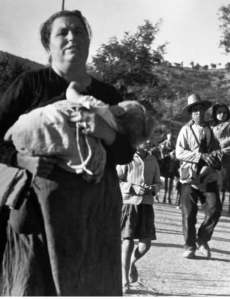
Families flee Cordoba in September 1936, via Robert Capa
Related
Got a comment, question or suggestion? Know who took a photo? Have questions about a particular date or event? Cancel reply