October 1936 marked a pivotal turning point in the Spanish Civil War, as the Second Spanish Republic rapidly centralized its resources, militarized its institutions, and locked in vital Soviet backing to counter the advancing Nationalist threat. Below is a structured, comprehensive article draft detailing these critical mid-October developments.
By 15 October 1936, the Second Spanish Republic found itself in an increasingly precarious position. With Francisco Franco’s Nationalist forces steadily advancing toward Madrid, the Republican government under Prime Minister Francisco Largo Caballero took a series of radical, decisive steps over a critical three-day period to secure international aid, consolidate military authority, and tighten wartime domestic security.
Facing the very real threat of Madrid falling to Nationalist forces, Prime Minister Largo Caballero made a momentous decision regarding the nation’s wealth. He formally requested that the Soviet Union accept the bulk of the Spanish gold reserves for safekeeping.
The gold, which had already been secretly moved from the Bank of Spain in Madrid to the secure naval base at Cartagena, constituted roughly 72.6% of the country’s total reserves. The Soviet government quickly agreed to the arrangement. This event initiated the transfer of 510 tonnes of gold to Moscow, a controversial historical episode known as the Moscow Gold. While intended to protect the Republic’s assets, the reserves were ultimately melted, sold, and used to fund Soviet military hardware and supplies, a move that heavily depreciated the Republican currency and left the government financially dependent on the USSR.
On 15 and 16 October 1936, to wage a more effective conventional war against a disciplined enemy, the Republican government aggressively restructured its fractured military command. The Minister of War assumed supreme command over all armed forces, seeking to dissolve the autonomy of independent workers’ militias and merge them into a singular, cohesive force. The government officially established the Comisariado General de Guerra, formally introducing political commissars into the Republican military ranks to bolster morale, ensure political alignment, and maintain discipline. These restructuring decrees were officially published in the Gaceta de Madrid on 16 October, marking a definitive shift away from revolutionary chaos toward a centralized, regular army.
On 17 October 1936, the ideological and logistical alliance between the Republic and the Soviet Union went public. Mundo Obrero, the official organ of the Spanish Communist Party, published an open letter from Joseph Stalin to Spanish Communist leader José Díaz. In this letter, Stalin publicly framed the Spanish conflict not merely as a domestic civil war, but as an international anti-fascist struggle that was the common cause of all advanced and progressive mankind. Coinciding with this public declaration, the city of Albacete began fully functioning as the headquarters and primary training centre for the newly arriving International Brigades. Idealistic volunteers from across the globe were now funnelled through Albacete, turning Stalin’s rhetorical international struggle into a physical reality on the battlefield.
As the military front lines consolidated, the government also moved to secure the internal front against sabotage, spying, and fifth-column subversion. On 17 October 1936, the government issued two significant decrees establishing a stricter wartime judicial apparatus. The first decree stripped military authorities of certain powers previously held under Article 171 of the Military Justice Code, transferring that jurisdiction directly to the Minister of the Interior to reinforce civilian government control. The second decree created three permanent Jurados de Guardia (Guard Juries) in Madrid. These bodies were heavily empowered to try public order offences defined by government wartime edicts (bandos). Using emergency summary procedures, they applied the stringent penalties of the Military Justice Code, drastically accelerating the speed of wartime trials and state executions.
These three days in October 1936 illustrated the Republic’s desperate evolution from a decentralized democracy into a centralised wartime state. By binding its financial survival to Moscow, formalizing its military hierarchy, adopting the political commissar system, and tightening judicial control over its citizens, the Republic successfully stabilized its defence, ultimately allowing it to hold Madrid during the brutal siege that lay immediately ahead.
Madrid and Toledo Fronts
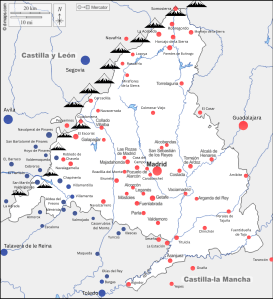
Following the fall of Toledo and the liberation of the Alcázar in late September, General Francisco Franco had handed field command of the push toward the capital to General José Enrique Varela. Between 15 to 17 October 1936, Varela launched a multi-pronged, synchronized offensive designed to smash through the outer provincial defences, completely outflank the rugged Sierra de Guadarrama, and establish a direct path into the heart of Madrid. These three days marked a psychological and territorial shift, as Nationalist forces had officially breached and secured positions deep inside Madrid province.
.
On the morning of 15 October, the Nationalist high command enacted a major structural reorganization of its northern approach. The Somosierra and Guadarrama sectors, which had seen bloody, gridlocked trench warfare since July, were ordered to remain quiet, holding their lines while Varela shifted the bulk of his mobile assets to the west and southwest. Varela’s immediate tactical objective was defined as a sweeping arc: Méntrida – Aldea del Fresno – Chapinería. By seizing this line, the Nationalists aimed to sever the communication and supply lines between Madrid and Extremadura, isolate the Republican forces dug into the Avila mountains, and secure the river crossings over the Alberche and Perales rivers.
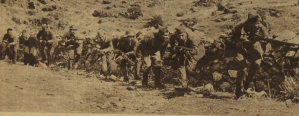
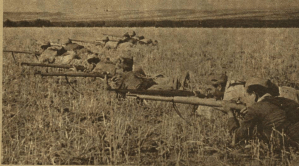
Republicans at the front 14 October 1936, via Ahora, Biblioteca Nacional de España
The fighting across the interconnected Ávila, Toledo, and Madrid fronts pitted two radically different military apparatuses against each other. The Nationalist forces had 10,000 to 12,000 elite troops actively engaged in the immediate advancing columns. Varela’s offensive relied heavily on battle-hardened units of the Spanish Foreign Legion and Moroccan Regulares) organized into highly mobile motorized columns supported by German-supplied Panzer I tanks and dominant Italian Aviazione Legionaria air support. The Republican militias had approximately 20,000 to 25,000 personnel scattered across defensive sectors, a fragile combination of regular army remnants and highly autonomous worker militias (CNT, UGT, and Communist fifth regiments). Though numerically superior, they lacked centralized radio communication, heavy artillery, and anti-tank weaponry, and were plagued by a severe shortage of ammunition.
.
Advancing eastward from positions in Ávila, Nationalist columns launched a sudden, brutal assault on the mountainous border towns of Madrid province. Valdemaqueda, population only 700, tucked in the pine-forested mountains, was quickly overrun on 15 October as Republican militia lines shattered under concentrated mortar fire. Just 20km south, Navas del Rey, population 900, and Chapinería, with 1,300 residents were positioned along the crucial Western highway, both towns also fell in rapid succession on 15 October. The capture of Chapinería was a devastating blow to the Republic; its elevated topography gave Varela’s artillery a direct panoramic view over the western approaches to the capital. Another 10km south of Chapinería, the 1,200 people of Aldea del Fresno, at the verge of the the Alberche and Perales rivers, was also assaulted on 15 October. Republican militias attempted to hold the stone bridge spanning the Alberche, but Nationalist cavalry outflanked their positions, forcing a chaotic Republican retreat toward Villamanta, 10km south-east of the town.
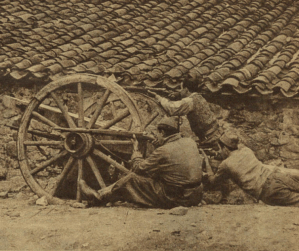
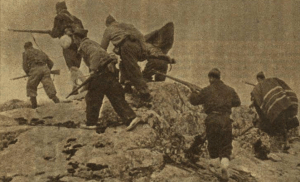
Republicans at the front, 15 October 1936, via Ahora, Biblioteca Nacional de España
Simultaneously, Varela pushed north from Toledo to widen the wedge toward Madrid’s southern flank. Méntrida, 13km south of Aldea del Fresno, over the border into Toledo province, was an historic wine-producing town with 2,900 residents, and fell on 15 October after a brief but intense firefight, securing Varela’s left flank. Another 12km south-east, Valmojado, population 1,600) and Casarrubios del Monte, population 2,000) were both captured on 16 October by the Nationalist southern motorized columns. By securing Valmojado, the Nationalists sat directly atop the main Madrid–Badajoz highway, completely choking off the Republic’s southern logistical artery.
.
While the Nationalist advance rolled over the lower valleys, it hit a concrete wall at Robledo de Chavela, deep in Madrid province. The town of 2,500, positioned near the strategic Escorial railway line, was heavily fortified by disciplined Republican units, including loyalist Guardia Civil and communist-led shock militias. Throughout 15 and 16 October, the town remained intensely contested. Wave after wave of Nationalist Regulares attempted to storm the rocky heights surrounding the town, only to be repeatedly repelled by Republican machine-gun nests. By 17 October, the Republican forces had successfully held Robledo de Chavela, creating a vital defensive bastion that prevented the Nationalists from executing a clean sweep toward El Escorial and the roads sweeping into Madrid city.
.
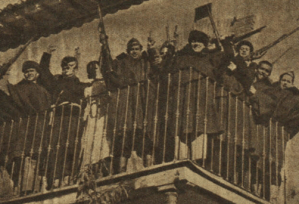
Republicans at the front, 15 October 1936, via Ahora, Biblioteca Nacional de España
Still, Varela achieved his core objective of breaching Madrid province. He effectively severed the Madrid-Badajoz highway, established solid bridgeheads over the Alberche River, and pushed the front line to within 30km of Madrid’s city limits. But the failure to capture Robledo de Chavela and press cleanly toward El Escorial left the Nationalist northern flank exposed, preventing a total encirclement of the Sierra defence forces. The Republic failed to coordinate a cohesive counter-attack, losing five critical towns in 48 hours due to the inability of fragmented militias to hold ground against motorized and aerial combined-arms tactics.
.
While exact battlefield rosters remain incomplete due to the frantic pace of the advance, historians estimate that the three days of fighting resulted in 1,200 to 1,500 total casualties across both sides, with the Republican militias bearing the vast majority of the deaths during the chaotic retreats from Chapinería and Aldea del Fresno. As the territories changed hands, brutal repression followed immediately in the wake of the armies. In the newly captured towns of Méntrida, Valmojado, and Chapinería, Varela’s columns implemented a systematic purge. Any local peasants, mayors, or workers suspected of union affiliation (UGT/CNT) or leftist voting histories were rounded up. In Méntrida and Chapinería, dozens were executed against the local cemetery walls or in the town plazas, their bodies dumped into unmarked ditches to pacify the local populations.
.
Behind the Republican lines in Madrid and the contested rearguard of Robledo de Chavela, the sudden Nationalist breakthrough sparked intense paranoia regarding a Fifth Column. On 15–17 October, right-wing sympathizers, landowners, and Catholic priests who had been kept under surveillance were pulled from local holding centres and prisons, leading to a sharp spike in extrajudicial night-time executions in the outskirts of Madrid to eliminate perceived internal threats before the final siege. The actions of 15–17 October 1936 effectively stripped the Republic of its geographical buffers, a prelude to the fighting in the coming weeks.
.
Between 14 and 17 October 1936, the strategic town of Illescas and the surrounding highway network became the epicentre of a brutal war of attrition. Here, fragmented but desperate Republican militias threw themselves into continuous counter-attacks to prevent Varela from breaking into Madrid province. Following a massive Republican push further west at Bargas, General Varela stabilized his left flank and ordered a lightning push directly up the N-401 (Toledo–Madrid) highway. Illescas was an essential agrarian and transport hub located 30km south of Madrid with 2,500 residents, and was identified as the next crucial target.
.
For the Nationalists, capturing Illescas would permanently unhinge the Republic’s southern defensive perimeter and provide an open, paved highway corridor straight to the capital. For the Republic, Illescas was a non-negotiable line in the sand; losing it meant allowing the enemy into the backyard of Madrid. Republican forces, composed of a patchwork of UGT and CNT militias backed by regular Assault Guards, launched immediate, pre-emptive counter-attacks along the outer roads connecting Illescas to neighbouring villages. Republican columns repeatedly struck the advancing Nationalist vanguards using makeshift armoured cars on 15 October. However, because the militias lacked synchronized radio communications, their counter-attacks were highly disjointed. Nationalist columns easily repelled the piecemeal assaults with superior machine-gun crossfire and mortar emplacements, forcing the Republican forces back onto the immediate approaches of the town.
Republicans at the front, 15 October 1936, Ahora, Biblioteca de España
The clash within the narrow Illescas–Yuncos corridor pitted raw numbers against professional military discipline. The Nationalist columns had 6,000 to 7,500 elite frontline troops operating in the immediate sector. The vanguard was led by the highly aggressive column of Colonel Fernando Barrón, supported by Colonel Helí Rolando de Tella’s African columns from Toledo and the sweeping flank manoeuvres of General José Monasterio’s elite cavalry. They were highly mobile, heavily armed, and supported by Italian-supplied aircraft.
The Republican Forces had 12,000 to 15,000 personnel deployed across the northern Toledo sector, but was a volatile mix of union militias (UGT/CNT) and regular forces under the overall command of General Sebastián Pozas (and locally under officers like Colonel Ildefonso Puigdendolas). While numerically superior, they suffered from low ammunition reserves and a lack of unified tactical discipline.
.
The Illescas–Yuncos corridor was a critical geographical bottleneck. Because Illescas sits just 30km south of Madrid, the Republican high command viewed the northern Toledo front not as a distant battlefield, but as the immediate southern gateway to the capital. Whenever the Nationalists threatened to advance up the Toledo-Madrid highway (the N-401), the government panicked and funneled thousands of fresh fighters down from the capital via trains and trucks within hours. Many other Republican militia was also men who had retreated from Toledo city after the siege in September, and into the towns of Bargas, Olías del Rey, Yuncos, and Illescas, creating a massive build-up of forces along the highway. Southern Madrid and northern Toledo were heavily industrialized agrarian and manufacturing hubs with massive, deeply loyal populations of workers. When the Nationalist threat neared, the two largest trade unions issued a total mobilization order. Entire factories and agricultural collectives formed their own makeshift battalions and marched straight to the trenches. But sheer numbers was not enough, as through the open fields of the corridor, the massive, tightly packed masses of Republican militiamen became easy targets for aerial strafing and artillery bombardment, turning their numerical advantage into a chaotic logistical bottleneck.
On 17 October 1936, General Varela officially unleashed his coordinated, multi-pronged offensive to permanently clear the N-401 highway. The Nationalist advance moved with devastating efficiency in two parallel directions: one directly up the main Madrid road and the other pushing northeast toward Seseña. Situated just south of Illescas, the small town of Yuncos and its 1,200 people fell rapidly to the intense pressure of the Moroccan Regulares and Legionaries. The town’s defenders, completely outmatched by the combined-arms tactics of the Army of Africa, were broken in two, triggering a chaotic and disorganized retreat northward.Seizing upon the momentum of the Yuncos breach, Barrón’s column slammed directly into the Illescas–Yuncos corridor. Republican militias launched desperate, frantic counter-attacks against the columns to plug the gap, but Monasterio’s fast-moving cavalry outflanked their trenches from the fields, threatening to cut off their line of retreat to Madrid.
.
By the evening of 17 October, the Republican counter-attacks had completely failed. The defenses within the corridor collapsed, leaving Illescas heavily exposed and virtually surrounded. The Nationalists secured the vital transport corridor, driving the broken Republican units back toward their secondary defensive line at Parla and Getafe. The four days of bitter fighting in the corridor resulted in an estimated 1,800 to 2,200 total casualties, with the Republican militias suffering catastrophic losses during the exposed highway retreats under Nationalist aerial strafing.
.
The territorial shifts across northern Toledo triggered immediate, systemic violence, just as they had further north. As Yuncos and the outer sectors of Illescas were secured, Varela’s columns initiated an immediate ideological ‘cleansing.’ Local union members, agrarian reformers, and municipal officials who had supported the Popular Front government were rounded up. Dozens were executed against local cemetery walls, while in the wider Toledo province, this campaign of terror reached a fever pitch, to break the back of local working-class solidarity through fear and silence.
.
The continuous defeats and territorial losses created intense paranoia and panic within the Republican ranks. The desperation was so severe that commanding officers struggled to maintain basic military order. Colonel Ildefonso Puigdendolas, the famed Republican officer who had successfully held Badajoz early in the war, was shot and killed near Illescas by his own retreating, mutinous militiamen while trying to prevent mass desertion at gunpoint.
.
The failure of the Republican counter-attacks between 14 and 17 October effectively handed the keys of northern Toledo to the Nationalist high command. With the Illescas–Yuncos corridor compromised, the physical buffer protecting Madrid from the south was eradicated, forcing President Manuel Azaña and the Republican leadership to begin planning their flight from the capital.
.
Republicans at the front, 16 October 1936, via Ahora, Biblioteca de España
Valencia
During this phase of the war, the official local Republican government in Valencia had largely lost control of public order to autonomous anarchist (CNT-FAI) and Marxist militias, who conducted localized sacas (right-wing sympathizers from both their homes or local prisons to be executed). On 14 October 1936, Desamparados Fuster Riera a 44-year-old housewife, of Catarroja, just 10km south of Valencia city itself, was executed due to her affiliation with the Derecha Regional Valenciana (DRV). The DRV was a powerful conservative, Catholic political party in the region. Following the July coup, anyone associated with it was systematically branded a fascist conspirator or an internal Fifth Columnist.
.
Francisco Muñoz Azorín, a 45-year-old tailor was executed within the city of Valencia just a day earlier. In the highly charged revolutionary atmosphere, independent tradesmen, business owners, and craftsmen were frequently targeted by radical squads under the suspicion of harbouring conservative or bourgeois sympathies. In Godella (a village which is now part of Valencia city near the port), the married couple Asunción Ríos Seguí Francisco Alcántara Díaz represented a network of conservative Catholic professionals from the town. Asunción Ríos Seguí was targeted due to her role within the DRV’s conservative women’s auxiliary group, the Secretariado de Protección y Cultura de la Mujer Trabajadora (Secretariat for the Protection and Culture of the Working Woman), while her husband Francisco Alcántara Díaz was a prominent 43-year-old right-wing lawyer. (Following the assassination of this couple, their children were evacuated to safety aboard the Argentine cruiser Tucumán in February 1937).
.
Valencia was the absolute stronghold of the Derecha Regional Valenciana (DRV), a powerful Catholic conservative party led by Luis Lucía Lucía. The DRV had thousands of meticulously registered members across the region. When the war broke out, the local leftist committees seized municipal government archives, tax registries, and political party membership logs.
Militias used these official lists to locate exact names and home addresses, which is why housewives like Desamparados Fuster Riera and specialized union leaders like Asunción Ríos Seguí were hunted down directly at their doorsteps. The committees viewed certain professions as structural threats to the new revolutionary order. In their strategic purges, victims were generally divided into clear, pre-selected categories. The intellectuals and lawyers were targeted because their legal training made them capable of orchestrating sophisticated, right-wing Fifth Column sabotage networks against the Republic. Former councillors were systematically executed to permanently dismantle the pre-war conservative and centrist local government infrastructure.
Godella, date unknown
.
Carmen Llorens Valls, a 64-year-old local also of Godella, was taken on the same day as a direct act of political retaliation against her family due to the actions of her son. An an anarchist squad from nearby Burjassot singled her out on 15 October 1936. Her son, Antonio Vergara Llorens, was a prominent regional leader for the DRV. When the civil war broke out, her son managed to successfully flee the local area to escape the leftist committees. Unable to capture their primary political target, the local anarchist FAI-CNT unit, led by a militant nicknamed El Cheneral, decided to punish the family instead. They targeted his elderly mother, holding her collectively responsible for her son’s right-wing leadership and flight. Beyond her family ties, Carmen Llorens Valls was an active affiliate of Acción Católica (Catholic Action). During the anti-clerical, revolutionary wave of autumn 1936, membership in prominent Catholic organizations was treated by radical militias as proof of fascist alignment or internal subversion. This religious affiliation, combined with her son’s high-profile political status. Alongside Francisco Alcántara Díaz and Asunción Ríos Seguí, were forced into a vehicle known locally as el coche de la calavera (the car of the skull) and driven to the outskirts of Valencia, where they were summarily shot. Their initial burial sites were pits scattered along the roadsides outside Valencia near the El Saler highway, but all were reinterred post-war on Franco’s orders.
.
At the same time, Enrich Albert Escribá, a farmer and municipal councillor for the Radical Party was executed in Almusafes, 25km south of the city. Though Alejandro Lerroux’s Radical Party was originally a centrist Republican faction, its coalition with conservative groups prior to the war caused its members to be viewed as class enemies by the wartime radical left. Despite the execution, he was still buried in a proper grave in his hometown. On the same day. Manuel Herrándiz Granero, a 75-year-old farmer and former municipal councillor from Bolbaite, was executed in neighbouring Chella, 75km south of Valencia city. As a former local politician, he represented the pre-war conservative or moderate political establishment that the local revolutionary committees were actively ‘liquidating’ to consolidate power.
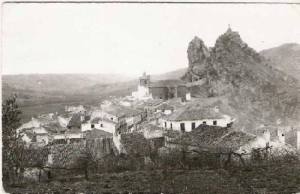
The incredible terrain of Castril, via Red Jaen
Castril, Granada, Andalucía
The death of Manuel Cabello Romero on 15 October 1936 showed the reality of the volatile mountain borders of the Granada and Jaén provinces in eastern Andalucía. When the military coup erupted in July, the Guardia Civil across Spain faced a lethal crisis of allegiance. In many rural towns throughout Andalucía, local Guardia Civil detachments initially remained neutral or pretended to support the Popular Front Republic while waiting to see if nearby Nationalist army columns would arrive to liberate them. By mid-October, with the front lines hardening and local anarchist-led committees exerting absolute power over rural villages, the small Guardia Civil garrison at Castril realized they were basically hostages in an increasingly hostile environment. Prior to the war, the town only had a corporal and three guards, and during the uprising, second in command Antonio Cabrera López was killed by militias, and the remaining three men were kept under house arrest, disarmed, and closely watched by the local revolutionary committees. On or about 15 October, the three surviving members attempted a desperate, armed escape from their local post, planning to trek through the rugged mountains to reach Nationalist lines or join larger, friendly security clusters.
.
The local Republican militias discovered the breakout and launched a fierce, armed ambush against the escaping guards. The first two guards were cut down in the dark by gunfire almost immediately after leaving the perimeter of the village. Manuel Cabello Romero was the only one who possessed the physical stamina to outrun the initial ambush. He successfully traversed 25km of mountainous terrain on foot, managing to cross the provincial boundary into neighbouring Jaén. But his reprieve was short-lived; he was cornered, captured, and executed by the pursuing militia forces in Pozo Alcón.
.
Across the broader Huéscar line to which Castril belonged, 30 out of 31 local Guardia Civil who attempted to navigate the regional mountains during those first three chaotic months were tracked down and executed by militias. The single survivor Alférez (Ensign) Jesús Pardo Pardo, who run the barracks in Huéscar. While the 30 guards under his command were relentlessly hunted down, captured, and executed by local militias over a gruelling four-day mountain pursuit towards Nationalist-held Granada city, navigating via the Castril rivulet towards the Negratín area and aiming to cross the rugged peaks of Sierra Harana. Amidst the chaos of the ambush that claimed his last remaining men at Venta del Amparo, Alférez Pardo managed to slip through the perimeter. Severely dehydrated, exhausted, and operating completely alone, he spent days moving exclusively under the cover of total darkness, successfully evading the militia patrols and localized search networks that successfully caught his men (including Castril guard Manuel Cabello Romero). He was the only military member of the original breakout group to make it to Nationalist territory alive.
The instant a Guardia Civil post was taken over by local revolutionary militias, the families’ state stipends were entirely severed. Overnight, the wives and young children of the guards went from being part of a stable, respected household to being branded the family members of fascist rebels. With their homes in the barracks seized, historical accounts by journalists and regional historians from Granada reveal that the families of the fallen guards were forced to rely on charity, moving from town to town to beg for food in the surrounding municipalities of Huéscar and Castril just to prevent starvation. Because the region remained entrenched in deep Republican territory for the vast majority of the civil war, these families lived under continuous surveillance by the local revolutionary defence committees. They were treated as a domestic Fifth Column. If the families showed any public signs of grief for their executed husbands, or if they were suspected of communicating across lines to Nationalist-held Granada, they risked execution. To survive the daily threat of the rearguard purges, mothers forced their children into total silence. Children were raised to never speak their father’s name, mention his real occupation, or acknowledge how he died. This claustrophobic code of survival was the only thing that kept these families alive behind the lines until the Nationalist armies finally overran eastern Andalusia at the close of the war in 1939.
The post-war fate of the families of Guardia Civil members who stayed loyal to the Republic was arguably even more calculated and severe. When the war ended in 1939 with a Nationalist victory, Francisco Franco viewed any military or security official who had refused to join his coup not just as a political adversary, but as a high traitor to the state. The families of these loyal guards faced a highly organized, institutionalized framework of state-sponsored economic and social destruction specifically designed to retroactively strip Republican families of their worldly goods. Because a loyal Guardia Civil member was branded an active traitor, their widows and children were barred from receiving any state widows’ or orphans’ pensions and their personal property, bank savings, and family homes were legally seized by the state to pay arbitrary fines imposed by military tribunals. Without state support, the families of executed loyal guards were forced into extreme poverty. Widows were frequently banned from taking formal, respected employment and had to resort to working illegally in the shadow economy as domestic servants or taking in washing just to secure bread. Under Francoist labour regulations, the children of these executed traitors were restricted from entering university or pursuing civil service careers. They were forced to begin manual labour in fields, carpentry, or domestic service at very young ages to keep their households afloat.
For the families of these loyal guards, in the eyes of the victorious Nationalist ‘people of order,’ a loyal Republican guard was a contradiction that could not exist; they were Reds who had weaponized a conservative institution against the church and the nation. Neighbours, former friends, and extended relatives cut contact with the widows and orphans out of fear of being associated with them. The female relatives of these loyal guards were heavily targeted with gendered public degradation. Local Falangist squads frequently rounded them up, shaved their heads completely bald, and forced them to drink large quantities of castor oil to cause uncontrollable public diarrhoea. They were then paraded through town squares to break their psychological spirit and serve as a living deterrent to the rest of the community.
Because of this targeted post-war machinery, the families of loyal guards spent decades living under an absolute code of total silence and fear. To survive, children grew up hiding their fathers’ real professions, completely burying their true identities to avoid the constant threat of police harassment and societal exile.
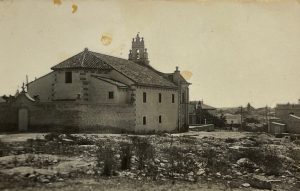
Hornillos de Cerrato today, via unknown
Hornillos de Cerrato, Palencia, Old Castile
On 15 October 1936, a squadron composed primarily of local Falangists and right-wing elements rounded up twelve male residents from the small village of Hornillos de Cerrato. The men were targeted due to their left-wing political affiliations, support for the Popular Front, or union ties. Before their deaths, the victims were subjected to severe torture. They were then loaded into trucks, transported across the provincial border into Valladolid, and driven to an isolated stretch of land alongside the L-111 highway. The executioners forced the men into the roadside ditch between the towns of Canillas de Esgueva and Hérmedes de Cerrato, where they were shot in the head via a firing squad and buried in a long, shallow trench spanning over 20 metres. For decades, the site was absorbed by the surrounding landscape, with local farmers growing wheat year after year directly over the hidden grave.
The location of the fosa was kept alive through decades of whispers and local memory, preserved by the deathbed testimony of an elderly local shepherd who had witnessed the immediate aftermath of the massacre in 1936 (and his name has been kept anonymous as per request). In August 2005, a scientific excavation of the site successfully uncovered the remains of all 12 individuals. Forensic and osteological analysis definitively proved the nature of their deaths: almost all the recovered skulls exhibited clean, classic entry and exit wounds from firearm impacts (the tiro de gracia or coup de grâce). Following DNA cross-referencing, all twelve victims were successfully and officially identified by name.
On 21 August 2006, exactly one year after the dig, the remains were returned to their surviving families. The town of Hornillos de Cerrato hosted a massive, emotional public funeral and tribute. The caskets were draped in Republican flags and paraded through the streets before being given a permanent, dignified resting place inside the formal municipal cemetery, marking a rare and triumphant historical closure for a community where a single night in October 1936 had devastated generations of local families.
The quiet countryside outside Canillas de Esgueva, via Pueblos y Lugares
Ten of the men were farmers and day labourers – Bernabé Ibáñez Macho, age 16, Dionisio González Sebastián, age 17, Marcelino Blanco Frías, age 38, José Antolín Expósito, age 40, Gregorio Mazariegos Sebastián, age 39, Julián Mazariegos Ruifernández, age 41, Aniano Patus Esteban, age 43 (who also worked as a barber), and Aquilino Ibáñez Torres, age 44. the other locals men were Eleuterio Manchón Domingo, a 23-year-old plasterer and gypsum factory worker, and Vicente López Asensio, age 38, a bricklayer. Men like these had strayed alive over the last three months of war because they were useful over the summer harvest season. Now autumn had arrived, being a union member meant certain death, and starvation and poverty for their families.
The area had a similar theme everywhere; at El Vodocal (Villamuriel de Cerrato) sits one of the largest and most tragic mass grave sites in the entire Palencia province. Located in an uncultivated field near the Carrión riverbank, the site contained approximately 80 victims. It holds immense historical significance because it represents a two-phased exhumation: it was initially dug up partially by desperate families in March 1979 during the democratic Transition without forensic tools, and later fully cleared with scientific criteria. The victims were mostly working-class trade unionists and political dissidents processed out of the provincial capital’s holding locks. Nearby is Fuentincho, the La Fosa de las Mujeres at Villamediana, holding 11 women and 2 men from the nearby town of Dueñas, which was subjected to brutal ideological purges (over 100 executed, including 25 women). Like Vodocal, it was partially opened in the 1980s, and the final remaining female skeletal remains were forensically recovered by the ARMHA in March 2009. In Portillo de los Hornillos town itsel are the victims of nearby Baltanás, with a mass trench containing 21 bodies. Discovered in 2004 in a rural mountain pass known as El Portillo, these victims were executed by Francoist death squads in September 1936. For nearly two decades, the victims remained completely anonymous in a shared pantheon inside the Baltanás Cemetery. However, following structural testimony shifts, modern DNA campaigns cross-referenced family samples to systematically pull these names out of historical anonymity. At Fuente El Guijo is Mojón Alto I and II from Villaconancio. Mojón Alto refers to a high geographic landmark and boundary stone dividing local agricultural parcels. The Falangist squads routinely targeted these border markers (mojones) because they sat outside urban jurisdictions, meaning local town police wouldn’t register the bodies. The site was excavated to repatriate local farmers executed during the chaotic 1936 autumn sweeps.5. Lagar de Sém at Cubillas de Santa Marta is a massive rural burial site containing 26 victims. Located just over the provincial border in Valladolid, this site represents the heavy toll paid by local vineyard and agricultural workers. The ARMHA has targeted this immediate perimeter, including an adjacent trench just outside the Cubillas de Santa Marta Cemetery containing 6 additional victims, to resolve the localized disappearances of the rural Popular Front base.San Millán and Revilla at Villamediana has highly organized graves containing 13 victims (at San Millán) and 8 victims (at Revilla). Villamediana acted as a central epicentre for these roadside purges.
La Barranca, Logroño (La Rioja)
The site of La Barranca (located in the barranco de Barrigüelo near Lardero, just outside Logroño in La Rioja) was one of the most systematic and notorious killing grounds of the White Terror. Over 400 Republican civilians were executed and buried there in mass trenches. The official records from the Asociación La Barranca and local judicial ledgers show that the daily pace of mass killings shifted away from the city centre in mid-October 1936.
.
Prior to September, Nationalist death squads conducted their sacas closer to the city, dumping bodies near the walls of the official Logroño Cemetery. According to Red Cross and local civil registries, 210 people were executed in August and 118 in September. By mid-September, the Logroño Cemetery had physically run out of space to accommodate the victims. This logistical bottleneck is exactly why the military command established the isolated trench at La Barranca, so they could continue their purges in a more ‘discreet, agile, and spacious’ manner far away from the public eye.
.
For the month of October 1936, the official registries record a sudden, dramatic drop to 13 verified executions at the main Logroño sites, though the true number would be closer to 100. As the Nationalist army mounted its massive, high-stakes offensive to break into Madrid province, the military authorities in La Rioja temporarily halted their massive nightly massacres. They purposefully kept hundreds of remaining leftist prisoners alive inside the makeshift local prisons (like the Frontón Beti Jai and the Industrial facility) to serve as a preventative hostage block to keep the quiet rearguard pacified while the main army was tied down at the gates of the capital.
.
Between its opening on 10 September and its abrupt closure on 15 December 1936, more than 400 people were systematically executed and buried specifically inside the hidden trenches of La Barranca. This means that once the harvest truce (keeping labourers and workers alive so their work can be exploited) and the temporary hostage pauses ended, the death squads were murdering an average of 5 to 15 people nearly every single night. The victims were processed with bureaucratic efficiency. Truckloads of prisoners were rounded up from local temporary holding prisons, specifically the Escuela Industrial and the Frontón Beti-Jai cinema in Logroño. Under the cover of total darkness, they were driven 5km south to the barranco de Barrigüelo. The military authorities forced political prisoners to dig massive, long trenches. The victims were lined up along the edges of these pits, shot by firing squads, and tumbled directly into the earth.
.
To project an image of a legitimate state to international observers like Britain and France, the Nationalist high command ordered an absolute halt to unrecorded roadside massacres. From mid-December onward, the regime shifted entirely to formal Summary War Councils (Sumarísimos).The killing did not stop, but it was moved inside prison walls, leaving La Barranca frozen as a massive, silent monument to the raw, unchecked violence of the autumn of 1936.
Related
Got a comment, question or suggestion? Know who took a photo? Have questions about a particular date or event? Cancel reply