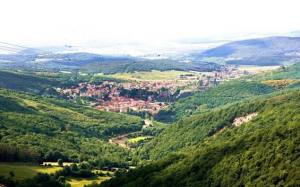
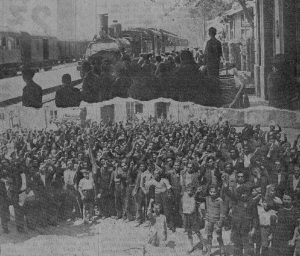
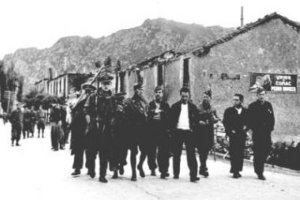
The Fosa de los 13 de Priaranza (The Mass Grave of the 13 of Priaranza) is widely considered the foundational milestone of the modern Historical Memory movement in Spain. Located in Priaranza del Bierzo, León (Castilla y León), its excavation in October 2000 was the first scientific exhumation of Civil War victims involving professional archaeologists, forensic anthropologists, and DNA identification testing.
On 16 October 1936, exactly three months after the military uprising in Morocco that sparked the Spanish Civil War, a mobile squad of Falangists rounded up a group of 15 civilian men from various towns across the El Bierzo region and they were held at the Villafranca del Bierzo City Council before being were driven to the 8-kilometre marker of the local Ponferrada-Ourense highway. They were shot at the roadside at the entrance to Priaranza del Bierzo and their bodies were thrown into a single, shallow ditch. Among the victims was Emilio Silva Faba, a local merchant and active member of the left-wing political party Izquierda Republicana.
The grave remained untouched for 64 years until Emilio Silva Faba’s grandson, journalist Emilio Silva Barrera, set out to locate his grandfather’s resting place in March 2000. Guided by local oral histories, especially the testimony of Arsenio Marcos, the vicinity under a roadside tree was identified. On 21 October 2000, a specialised team including forensic physician Francisco Etxeberria, anthropologist Maria Encina Prada, and archaeologist Julio Vidal commenced the excavation and after only a few days of searching near mutated highway lines, they uncovered a leather boot containing foot bones, and eventually revealed all 13 skeletons.
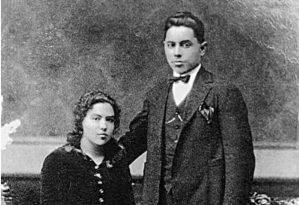
Six of the victims came from Villafranca del Bierzo and its population of 4,500, including Emilio Silva Faba, shopkeeper of La Preferida. He was an official member and a formal auditor for Izquierda Republicana (Republican Left), the progressive political party founded by Manuel Azaña, with an official leadership role in managing the party’s electoral processes in the province. Because of his outspoken secular and Republican public views, local Falangists systematically extorted his business immediately after the July 1936 coup before arresting him. On 15 October, Silva was summoned him to the Town Hall (he assumed for extortion again) and took his eight-year-old son Ramón with him but would not let him leave, and the boy was sent home alone. Silva’s wife, Modesta, took Manuel, another of their sons, and her brother-in-law Manolo to the Town Hall to see what was happening. Manolo was allowed to see his brother, who gave him his wedding ring to give to his wife to say goodbye. On 16 October, one of Silva’s sons arrived at the Town Hall to deliver his father’s breakfast and the Falangists laughed at the boy, saying his father had run away. That boy’s own son would be the one to find the bodies in 2000.
Arrested alongside Silva that day was Enrique González Miguel aka El Madrileño, age 25, a progressive shoemaker who actively collaborated with local left-wing political coalitions in the municipality, his involvement with local progressive youth networks, and his failure to align his business with Nationalist civic expectations. César Fernández Méndez was another local merchant who actively backed democratic municipal policies, which made him a target for local fascists looking to pacify the town’s commerce sector. Manuel Lago González, age 23, Enrique González Alba were day labourers and members of the UGT, and Juan Francisco Falagán Álvarez was a unionised railway worker.
The nearby town Corullón, a town of around 3,000 had three men grabbed that night from among its rugged agrarian community highly active in rural labour syndicates. Arrested were Blas Fernández Mauriz age 23, a day labourer and member of the UGT, Victoriano García Castaño and his father-in-law Gaspar Uría Mauriz, also targeted specifically because of their union membership in local peasant and agricultural labour syndicates associated with the UGT.
From neighbouring Trabadelo, a small mountain valley transit municipality of just over 1,000 people came Antonio López García, Sergio Prada Cobo, and Leopoldo Moreira, who were unionised industrial workers who had participated in localised labour strikes and wage disputes prior to the outbreak of the war. From Vega de Valcarce, a sprawling border municipality connecting León with Galicia which around 2,500 people came Gregorio Villalibre Pérez, and one man was collected from Paradaseca, a highly isolated mountain hamlet of roughly 400 inhabitants, who has been never been identified, though he had only one hand, which had been amputated long before his death. Oral history gathered across the valley suggested a working-class man with a known hand injury was swept up by the Falangists from that specific area, but the lineage of his immediate family has disappeared over time.
The story of the execution was preserved thanks to Leopoldo Moreira. The 14 men arrested in Villafranca had been held in the local jail before before an Olarte soft drink truck came to collect in the small hours of 16 October. They stopped on the way at a house to drag another man out of bed, whose name was not recorded on the journey. As the truck travelled towards Priaranza del Bierzo, Emilio Silva Faba asked his companions to let him die first because he could not bear to see them hurt.
When the Falangist truck arrived at 8-kilometre of the highway, Leopoldo Moreira made a dash for freedom and yelled for the others to follow. The man who had just been pulled from bed followed him and took advantage of the darkness to leap from the vehicle and run. The first man was quickly cornered and gunned down, but Moreira successfully slipped away into the mountains. Disoriented and fleeing in total darkness, he spent the night wandering the hills.
The 14 bodies were found by three young boys, one named Francisco Cubero, from Priaranza and Villalibre the next day, and they buried the bodies in the ditch under 75cm of soil. Once heading back into Priaranza, they met with the family of the man who had been pulled from his bed, who gave the boys 50 pesetas (about €220 today) to go back out there and retrieve their missing loved one (the average wage of a worker was 3-5 pesetas per day). The boys brought him back, still only wearing his underwear he had been sleeping in the night before. He was quietly buried in the local cemetery and has never been identified, as he had never been listed as arrested or killed, and naturally the family said nothing. No one could speak a word, as the region was already dotted with graves from the preceding months of horror.
At dawn on 17 October, Moreira neared the roadside again and witnessed the immediate aftermath of the execution site before retreating safely back into hiding. Moreira successfully navigated his way to the nearby village of Pereje, where his girlfriend, Modesta Santín, and his closest friend resided. Living clandestinely, he recounted the details of the transport, the names of the men taken, and the roadside location near Priaranza del Bierzo where the victims were shot and buried. Modesta hid this information for decades, passing the account down to her children.
Following his breakthrough to Pereje, Moreira was forced to live as a topo (mole) or fugitive, hiding out in the rugged mountains of Sotogayoso to evade the sweeping Nationalist patrols. His evasion lasted until 16 August 1937, when after ten months on the run, his hiding position was compromised. A Nationalist faction consisting of the Guardia Civil and local paramilitaries cornered him in the hills and shot him during a confrontation. But his friend in Pereje who had helped him hide, had shared the information with his own brother, Arsenio Marcos, who kept the secret hidden until 2000 when Emilio Silva Barrera came to town. Also there was Francisco Cubero, one of the boys who had found and buried the bodies in 1936, and helped with the exhumation. Each body had been laid out respectfully, not left in a pile, the fate of of so many roadside killings.
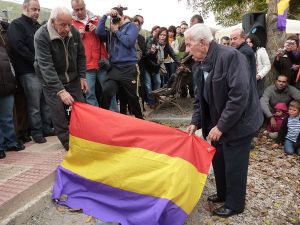
Emilio Silva Faba’s son, Emilio and Ramon, unveil the plaque for the Priaranza del Bierzo 13, via Emilio Silva Barrera. Five of the six Silva children were able to be present for the exhumation of their father.
For the first time in Spanish history, forensic specialists used comparative DNA testing to positively identify a disappeared person from the Civil War (Emilio Silva Faba). His remains were subsequently returned to his family and buried in a proper cemetery. The impact of the Priaranza del Bierzo exhumation completely changed how Spain processed its wartime past. The immense media and public response to the excavation led Emilio Silva and his colleagues to establish the Asociación para la Recuperación de la Memoria Histórica (ARMH). This became the leading institutional engine for mapping, locating, and exhuming thousands of mass graves across Spain. Priaranza shifted exhumations from private, uncoordinated family digs using their hands and tools into a standardised, scientific methodology recognised by human rights organisations globally. Today, the original roadside ditch features a public memorial plaque dedicated to the 13 men. The site is recognised as a permanent monument to the thousands of victims of enforced disappearance during the Franco regime.
Emilio Silva Barrera planned to return to normal life, but right away, other relatives started contacting him, wanting got know how digs could be organised. By December 2000, the Asociación para la Recuperación de la Memoria Histórica was born with archaeologist Santiago Macías, Over the course of the next quarter-century, the volunteer-led NGO completely transformed Spain’s approach to its wartime past, conducting over 200 forensic digs and successfully recovering the remains of more than 1,600 disappeared persons from unmarked graves nationwide. This decades-long grassroots pressure fundamentally altered the country’s legislative landscape, shifting Spain from its post-dictatorship Pact of Forgetting to formal state recognition. Today, memory work is governed by the 2022 Democratic Memory Law, which builds upon an initial 2007 statute. This current legislation codifies the search for the missing as an official responsibility of the central government, establishes a state-funded DNA bank, bans Francoist symbols, and declares all summary convictions handed down by the dictatorship’s political tribunals to be completely illegal.
The gravesite database has over 6,00 currently registered sites and approximately 114,00 people still missing. On 7 October 2026, Benigno Alvarez and José María Fernández will be exhumed in Trabadelo, the same town where Leopoldo Moreira lived before having to flee into the night on 16 October 1936. Less than a month ago, a documentary on Federico García Lorca was shown in Spain, attempting to revise history on the realities of the war, claiming the Republicans started the war and the fascists were just innocent bystanders. The work never stops.
By early October 1936, the 90-day siege of the Asturian capital reached its most claustrophobic and violent phase. The Republican coalition, spearheaded by roughly 10,000 highly motivated leftist militias and Asturian coal miners, launched a desperate final assault on October 4. They knew a Nationalist relief column was rapidly marching from Galicia to break the encirclement. Inside the city, the 3,000 Nationalist defenders under Colonel Antonio Aranda were in a catastrophic state. Having lost over half their men to brutal combat, the garrison was plagued by intense food shortages, severed water and electricity lines, and a raging outbreak of typhoid.
.
The final days saw the nature of the combat shift into terrifying subterranean urban warfare. The Asturian miners used their professional expertise with industrial dynamite to systematically blast holes directly through the stone walls of residential blocks, clearing rooms hand-to-hand with pistols and bayonets. By October 12, the Republicans had captured the city reservoir, overran the San Salvador cemetery, and pushed deep into the La Argañosa suburb, compressing Aranda’s remaining forces into a tiny redoubt in the absolute center of the city around the Oviedo Cathedral.
.
By 12 October, the style of combat inside the Asturian capital had devolved into brutal, close-quarters subterranean urban warfare. The Republican miners, facing heavy machine-gun nests sweeps down open streets, systematically used industrial dynamite to blast through the masonry walls of connected residential blocks. In a fierce, room-by-room struggle, the miners dislodged Nationalist forces from the strategic San Salvador cemetery. Concurrently, they successfully pushed through the La Argañosa suburb and seized the city reservoir. Capturing the reservoir was a devastating blow to Colonel Antonio Aranda’s defenders. The city had already been suffering from severe water shortages, and this development stripped the remaining defenders of their final supply of fresh water.
.
Republcians take the abandonded water station, via Ahora, Biblioteca Nacional de España
With the outer suburbs in Republican hands, the remaining Nationalist garrison (1,500 effective men left out of the initial 3,000) was compressed into less than twenty percent of the city layout, heavily fortified in the houses immediately surrounding the Oviedo Cathedral. Heavy Republican artillery and aerial bombardment constantly pounded this central pocket. The interior of Oviedo became a graveyard. Unburied bodies rotted in the rubble, and because there was no fresh water for sanitation, a typhoid epidemic exploded exponentially through the overcrowded basements and church vaults where families were hiding. Civilians and wounded soldiers resorted to drinking highly contaminated water from stagnant puddles, broken fire hydrants, or shallow city wells.
.
Believing victory was hours away and acutely aware that a Nationalist relief column from Galicia was drawing dangerously near, the Republican leadership ordered an all-out, fanatical push into the absolute core of the city. Armed with pistols, bayonets, and endless crates of dynamite, the miners advanced on Aranda’s final command posts. Nationalist soldiers used Republican prisoners as human shields in windows to deter the miners’ advance.By the end of 15 October, the Republican attackers had almost completely exhausted their artillery shells and ammunition reserves. The men were physically spent after weeks of non-stop urban assault.
.
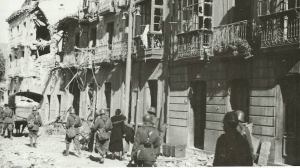
Republicans walk street to street in Oviedo, via Ahora, Biblioteca Nacional de España
On the afternoon of 16 October, just as the Nationalist inner perimeter was on the verge of collapsing, the Columnas de Galicia, composed of regular army troops, Falangist volunteers, and Moroccan Regulares, a massive force of roughly 19,000 Galician troops, punched through the outer Republican lines at the village of Soto. Pushing rapidly through the western entrance of the city, the column established a narrow, physical corridor into Oviedo. The sudden appearance of fresh, heavily armed Nationalist reinforcements instantly broke the morale of the exhausted, out-of-ammunition Republican forces. The 87-day siege was lifted.
.
The entry of the relief column shifted the tactical balance of power instantaneously. The Asturian miners, completely exhausted by weeks of non-stop urban assault and running critically low on ammunition, realised their encirclement was compromised. The majority of the Republican militias executed a organised withdrawal out of the city streets. They pulled back toward the immediate outskirts, the surrounding rugged hills, and the mining valleys further south from which they had originally launched their campaign. Those Republican units positioned directly in the path of the incoming Galician columns were brutally overrun. The Nationalist relief units used overwhelming firepower to sweep the access roads, trapping and annihilating the rear-guard elements left behind to cover the miners’ retreat. Though pushed out of the urban centre, the Republicans did not flee the province; they re-entrenched in the foothills just outside Oviedo, locking the city into a localised frontline that would persist for another full year.
.
The lifting of the siege revealed a devastated cityscape. Out of Oviedo’s pre-war population, only about 20,000 citizens remained inside the city borders, the rest having fled into the countryside or deeper into Republican territory before the encirclement tightened. For those who stayed, life had been lived underground in dark cellars to escape constant artillery bombardment and air raids. Aranda had systematically rounded up hundreds of family members of prominent trade unionists, socialists, and Republicans to hold as hostages over the course of the siege. These civilian prisoners were forced into the upper floors of strategic buildings and used as human shields in windows to deter Republican artillery and dynamite squads and now the siege was over, most of these original hostages had simply ‘disappeared.’
.
The immediate days following October 17 brought immense relief from fighting, but they also introduced institutionalised terror. Under the newly promoted General Aranda, the Nationalists exacted severe, immediate retribution on anyone suspected of leftist sympathies. In the initial days following the relief, at least 370 Republican prisoners were immediately rounded up and executed. Falangist death squads conducted sweeps of the city districts and civilians who had aided the miners or expressed union sympathies during the siege were systematically imprisoned, used as forced labour to clean the rubble, or disappeared. Nationalist Spain immediately branded Oviedo as the Alcázar of the North, elevating the defence into a massive symbolic victory that heavily boosted the domestic and international prestige of Generalissimo Francisco Franco.
.
Nationalist soldiers in Oviedo as the siege ends, via unknown
Because Oviedo remained an isolated Nationalist stronghold surrounded by the wider, Republican-held Asturian countryside for another full year, the city’s internal security was kept under a state of permanent, violent paranoia. Military tribunals replaced the initial street executions, turning the repression into an industrial process. Anyone tied to the Frente Popular or the local mining syndicates faced execution or long-term imprisonment in makeshift concentration camps. Modern forensic investigations and historical databases compiled in Asturias confirm that the municipal cemetery of Oviedo houses some of the largest mass graves of Francoist reprisals in northern Spain. Over the course of the war and its immediate aftermath in Asturias, Franco’s forces executed nearly 6,000 Republicans, with a major concentration of those deaths originating from the purges inside Oviedo.
.
In central Oviedo is a former mass grave site, Cementerio de San Pedro de los Arcos, which has 1,142 bodies removed in 1964 to line the walls of Franco’s crypt at Valle de los Caídos. Another right beside it, San Pedro de los Arcos, contained another 150 people, but none were properly checked or identified before being stolen, so how many were repression victims, how many were fighting casualties, and how many were civilians caught in between, will forever remain unknown. There are other enormous mass grave sites just southwest of the city, though those equated to battles in 1937. While many locations were overrun by Nationalist soldiers and then remained that way for the rest of the war, places like Oviedo and the wider Asturias province was still set to suffer frontline battles for years to come. Less than 35km north of Oviedo, the city of Gijon was days away from mounting a comeback against the Nationalists.
.
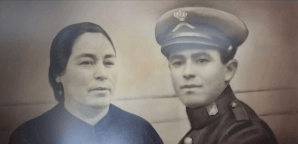
Sinforosa Ovejero and her husband, Agustín Felipe Labrado Family archive of Rosa Labrado
Mesegar de Tajo, Toledo, New Castile
The remains of Agustín-Felipe Labrado Bolonio and Timoteo Higueras Ocaña have recently been recovered and identified 90 years after their execution during the Spanish Civil War. Following a historical investigation and forensic identification process initiated in 2022, their remains were officially returned to their families on 17 February 2024. The two individuals had been buried in an unmarked mass grave located in the municipality of Mesegar de Tajo, Toledo, since 16 October 1936.
Documentation compiled by the Manuel Azaña Association indicates that Labrado and Higueras were killed on 16 October 1936 by mobile paramilitary squad known as the Falangist Centuria of Las Palmas who arrived in Mesegar de Tajo as part of the wider Nationalist plan to eliminate anyone connected to left-wing sympathies. Higueras was a teenager at the time of his death. Documents preserved in the Historical Archive of Defence showed that his father, Cristino Higueras, had been a member of the Spanish Socialist Workers’ Party (PSOE). Unable to capture his father, the squad dragged the 17-year-old day labourer out of his house instead.
Agustín-Felipe Labrado Bolonio, age 30, was a bricklayer originally from Domingo Pérez, Toledo. His father, Vicente Labrado, was a member of the General Union of Workers (UGT) and had served as the deputy mayor of Carriches. Prior to the investigation, Labrado’s descendants assumed that he had died in active combat on the front lines. But unable to get to his father, Labrado had been taken from his home to be murdered. Together, the two men who hanged on the edge of town for everyone to see, and left there as a warning.
The recovery of the bodies was directed by local historian and researcher Francisco González, who began a study on Francoist repression in Mesegar de Tajo in 2022. González combined archival research with oral history, interviewing elderly local residents to establish potential burial sites, and one local had information on the location of a Mesegar mass grave. The breakthrough came when a 90-year-old resident of the town had an idea of the general area of the grave, and then a bricklayer from nearby Cebolla mentioned doing a building extension over that same space back in the 1980s and had found bones during the work.
Both men were hanged at the site of the pit and then taken down by a local resident who, after getting permission from the local military, buried them after their bodies had been left in public view for several days as a warning. Damaged remains belonging to the two victims were located on August 11, 2025, and in November that year, the remains of Agustín Felipe Labrado Bolonio matched with DNA. On 17 February 2026, the remains were returned to their families at the Mesegar de Tajo Cultural Centre and then buried in a the local cemetery.
Mesegar de Tajo had only 500 residents in 1936, and three weeks earlier, a group of local Falangists had rounded up five men to be trucked out of town and murdered. The took brothers Petronilo and Jesús Rodríguez Vargas and two unnamed neighbours and drove them from Mesegar de Tajo along with Justo Rodríguez Arrogante, who manged to jump out of the truck and run away, dodging every bullet.
El Carpio del Tajo, just a few kilometres south, has five mass graves that are spread evenly through the town like bizarre marking points north to south through the population of 4,400 in 1936. Three are from 22 or 23 October 1936, each with three victim each, Nicolás Bautista Hormigos, Nicolás Rojas Hormigos, and Mariano Palomo Torralba, then Felix Martín Arroyo,
Eugenio Baltasar Robles, and Saturnino Esteban Rodriguez, both in the northern end of town, and then Antonio Ortiz Pérez, Justo Villalba Ludeña, and Avelino Escalonilla Carrasquilla on the southern outskirts of town.
Placed in the middle of town are two more sites dated in February and March 1937, with Daniel Torres, Sebastián Esteban Ludueña, Maximino Rojas (the local Frente Popular nightwatchman), Hilario Blazquez Rivera, Juan Vidal Juarez, Dámaso Hormigos Corral, Evaristo Hormigos Vidal, and Gregorio Martín Ozagón.
The fifth grave in middle of the town line is the women’s grave, with Jorja Herradón,
Petra Ayala Herradón, Eulogia Santos Galdán, Petra García Segovia, and two unnamed victims. The province of Toledo, much was which never saw a frontline, currently has 60 mass graves sites, some reaching into the hundreds or thousands in numbers.
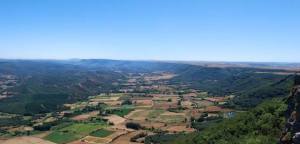
La Lora plateau and the Valderredible valley, via Wikimedia Commons
Valderredible, Palencia, Old Castile
By mid-October 1936, the focus of the international press was transfixed by the race toward Madrid. Yet, along the jagged peaks dividing the provinces of Burgos and Palencia, a critical, grinding war of attrition was unfolding. This northern mountainous sector, primarily defined by the rugged La Lora plateau and the Valderredible valley, became a vital chess match that would dictate the cohesion of the Nationalist front and the survival of Republican resistance in the north.
.
The surrounding mountain peaks and the industrial mining basin of northern Palencia were held by Republican forces, predominantly trade-unionist miners and local militias who had retreated into highly fortified alpine networks after losing the lowlands. By October, the frontline had completely stalled into a brutal mountain gridlock. Moving through this high-altitude terrain required secure provincial connections, turning the Burgos–Palencia sector into an active battleground. The Republican forces of 3,500 to 5,000 combatants Asturian and Cantabrian miners, local popular front militias, and scattered loyalist regulars were fiercely motivated, they suffered from decentralised command structures and chronic ammunition shortages. But they needed to protect the mining basins and maintain control of the critical industrial infrastructure in northern Palencia to fuel the war effort, and disrupt communication and logistics between the Nationalist command centre in Burgos and their units operating in western Palencia.
.
The Nationalist forces were comprised of regular army units executing commands out of Burgos, bolstered by heavily armed local Falangist and Carlist Requeté militias, numbering as high as 4,500-6,000 men. They held an advantage in artillery and cohesive operational coordination and planned to eradicate pockets of Republican resistance along the mountain ridges to eliminate the threat of sudden counter-attacks, bridge the geographic and organisational gap between the forces stationed in Burgos and those operating deeper in the Palencia sector, and control the vital mountain passes and roads to prepare for a sweeping future offensive toward Santander and the northern coast.
Barruelo de Santullán today, via Turismo Palencia. Many of the small town in the region are now abandoned
Combat erupted violently along the Burgos–Palencia frontier, concentrating heavily around the mining hub of the Barruelo front. Republican miners fiercely defended their entrenched positions against probing Nationalist assaults. Though geographically localised, these operations were directly tied to the wider struggle for control of the Burgos-Palencia sector.
.
Shifting their focus to the challenging terrain of La Lora / Valderredible, Nationalist troops launched a coordinated assault that successfully overran and occupied Villamoñico on 18 October. This was a pivotal tactical victory aimed squarely at strengthening the physical connection with friendly units operating across the provincial line in Palencia. The capture closed a dangerous gap in the Nationalist line, improving local communication.
.
Refusing to give the Republican forces time to regroup, Nationalist forces maintained their momentum through the La Lora / Valderredible region the following day. Pushing forward from their newly secured base, they captured the town of Respende. This operation served as a direct continuation of the previous day’s advance, effectively securing the vital border transit corridors and cementing Nationalist control over the high ground.
.
The prize of this northern sector was a singular, flat-topped plateau that had dictated military strategy for two millennia: Monte Bernorio. On 17 October 1936, a violent Nationalist counter-offensive shattered the status quo in the sector, executing a rapid tactical reversal that would permanently alter the defensive geometry of the northern front. Rising sharply to an altitude of 1,170 metres in northern Palencia, Monte Bernorio is a natural watchtower. The plateau offers complete visual and ballistic command over the vital transit corridors and railway lines connecting the flat Castilian plains (La Meseta) to the northern coast.
The mountain’s military value was nothing new; its natural stone ramparts had served as a heavily fortified Iron Age stronghold destroyed by Emperor Augustus during the Roman conquest of Spain. In October 1936, modern armies stepped into those exact same ancient trenches. Whoever held the heights of Bernorio held the key to the entire Palencia–Burgos sector.
.
Capitalizing on a coordinated autumn offensive designed to destabilize the Nationalist rearguard, Republican worker and miner militias launched a daring uphill assault. Braving heavily exposed slopes, they successfully overran the Nationalist outposts and seized Monte Bernorio, forcing the rebel defenders to retreat into the valleys below. For a brief week, the Republic held the ultimate high-ground vantage point in the province. Recognizing that leaving the plateau in Republican hands left their communication corridors entirely exposed, the Nationalist command rapidly organized a combined-arms response. Utilizing the nearby hamlet of Cabria as a staging ground, Nationalist infantry and artillery columns launched a fierce, multi-pronged counter-assault.
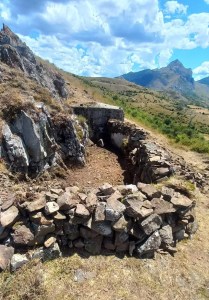
Advancing aggressively from the east of Cabria, the Nationalist spearhead battered the Republican defensive perimeter. Lacking heavy weapons to suppress the incoming fire, the militia lines buckled. By the end of the day, Nationalist forces swept across the summit and occupied Monte Bernorio, entirely reversing the Republican gain of 10 October. The engagement was characterized by the brutal realities of alpine warfare. Because digging traditional trenches into the solid rock of the mountain plateau was nearly impossible, both sides fought from behind ancient stone ruins and natural limestone fissures. Nationalist mountain batteries positioned in the lowlands provided devastating preparatory bombardment, allowing their infantry to close the distance across the exposed mountain approach and drive the Republican forces back toward the northern valleys.
.
he successful counter-attack on 17 October locked Monte Bernorio down as an impenetrable Nationalist bastion. Following the battle, rebel engineers immediately fortified the mountain’s north face, excavating a dense network of subterranean trenches and concrete machine-gun pillboxes known locally as the parapet of death. By reclaiming the heights, the Nationalists permanently anchored their defensive line in the Palencia sector. This single day of fighting effectively neutralized the Republican offensive capabilities in the region, freezing the territorial boundaries of the north-eastern mountain front until the entire northern zone collapsed in the summer of 1937.
.
The front page of El Cantábrico as refugees from Barruelo de Santullán arrive in Santander, via Biblioteca Nacional de España
Because Barruelo de Santullán was a left-wing industrial mining hub, it bore the brunt of intense violence, and marked as a prime target for Nationalist ‘cleansing’. It had already been a focal point of the 1934 worker uprisings, which made the Nationalist forces view its population with deep hostility. The fighting on 16 October resulted in heavy combat casualties on both sides, but the deadliest phase for civilians occurred as the town fell firmly under Nationalist control. Prominent left-wing figures, union leaders, and local officials were rounded up. The Republican mayor, Adrián Fernández Gutiérrez, and numerous local citizens were executed or tortured by Falangist militias. To escape the immediate threat of execution, hundreds of miners and their families fled into the surrounding mountains, becoming early guerrillas known as Los del Monte, or crossed the rugged terrain into the temporarily safe Republican territory of Santander. Many of those who stayed behind or were later captured following the collapse of the Northern Front in 1937 were executed.
.
Nationalists entering Villamoñico, via Diario de Leon
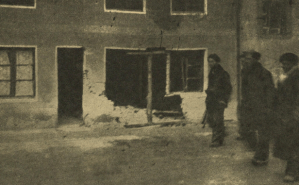
For the small agricultural villages of Villamoñico and Respende in the Valderredible valley, the experience was less about mass industrial executions and more about swift military occupation and institutional purge. Combat casualties during the 18–19 October advance were primarily restricted to the militias defending the access roads and passes. Because these villages were small and isolated, they lacked the dense barricades found in the mining basins.
.
Rather than mass graves, the repression here focused heavily on ideological and institutional purges. The Francoist authorities methodically went through rural communities to remove anyone suspected of Republican or progressive sympathies. Local records track the structural repression of public servants, such as Basilio Molinero Alcalde, a local schoolteacher who had taught in Villamoñico. Following the outbreak of the war and the Nationalist takeover, he, like thousands of other educators, was subjected to a strict depuración process, suspended of his pay, and permanently stripped of his teaching credentials for not aligning with the new regime’s ideology. No mass grave sites have been uncovered in relation to any of the events.
In 2025, Villamanín lcoals started digging out the old trenches around the region, via iLeon
Córdoba, Andalucia
Saca de presos (the systematic extraction of prisoners from jails for execution) matching the influx of unidentified bodies in local registries is one of the most thoroughly documented aspects of the war in Córdoba. By mid-October 1936, the nature of the executions in Córdoba city shifted from chaotic paramilitary street violence into a cold, industrialised administrative routine. Because the Francoist authorities now sought to maintain a veneer of bureaucratic order, cemetery workers at the San Rafael and La Salud cemeteries were forced to log incoming bodies. Historians cross-referencing these logs found that on nights when a massive saca took place at the prison, the cemetery logs for the very same or subsequent day would show an identical spike in entries.
.
To mask the identities of the executed, many were logged simply as desconocido (unknown) or marked with codes like MV (Muerte Violenta – Violent Death) or J (Judicial). This direct correlation between the number of empty beds in the prison and the number of nameless bodies arriving at the cemetery gates forms the foundation of modern forensic mapping in the region. The acceleration of prison executions in the capital after mid-October was directly triggered by the brutal military campaigns happening simultaneously across the broader Córdoba province.
During the first half of October 1936, Nationalist forces under Colonel Ciriaco Cascajo and Major Bruno Ibáñez launched a massive offensive to conquer the north-western territory of the province, specifically the Guadiato Valley and towns like Peñarroya-Pueblonuevo, Belmez, and Espiel. As Nationalist forces captured these left-wing mining towns in mid-October, they carried out immediate, sweeping reprisal campaigns. In Peñarroya-Pueblonuevo alone, between 300 and 400 people were executed immediately following the town’s fall. Thousands of suspected Republicans, union leaders, and sympathisers who weren’t shot on the spot were arrested and funnelled back to the central prisons in Córdoba city. Faced with a massively overcrowded prison system and a desire to completely purge the province of Popular Front leadership, Major Bruno Ibáñez (who had taken over as chief of public order in late September) drastically escalated the rate of executions. At the height of this mid-autumn cleansing campaign, executions in the province frequently reached up to 100 people per day.
This horrific logistical synchronisation is why Córdoba remains one of the largest focal points for modern mass grave exhumations in Spain. Historians calculate that roughly 4,000 victims were buried in the mass graves of the city’s San Rafael and La Salud cemeteries alone, with the provincial death toll exceeding 11,000 lives lost during the Francoist purging campaigns.
Ciudad Rodrigo, Salamanca, Old Castile
While the major fronts of the Spanish Civil War raged in Aragon and the Central Plains, a silent, localised campaign of political executions was orchestrated by Nationalist forces in the rearguard. One of the most stark examples of this systemic violence occurred on 16 October 1936 in the rural district of Pedrotoro, a small dependency of Ciudad Rodrigo in the province of Salamanca. For decades, the exact fate of those taken remained buried under fields of grain. However, extensive historical research and eventual forensic excavation verified both the site and the identities of the victims.
.
The executions took place at a location historically referred to as the Valle del Lagar, situated within a private estate known as Finca La Rad. Positioned near the transit paths toward Tenebrón, this isolated agricultural terrain was selected by Falangist and Nationalist paramilitary forces to serve as a discreet execution and burial ground. The terrain itself offered a grim clue to the families searching for the site decades later; as is common across many Spanish Civil War burial locations, variations in soil composition caused vegetation and crops to grow noticeably differently directly over the disrupted earth.
.
Through investigations supported by regional memory associations like Asociación Salamanca Memoria y Justicia, eight victims were tied directly to the execution site of 16 October 1936. Remigio Baz Martín, Ángel Sierra Mangas, and two women, Gertrudis Sánchez Montero and Clara Machado Vieira, all of Ciudad Rodrgo had been arrested. Alongside them was Antonio Hernández Rastrero from nearby Casillas de Flores, and Graciliano Hernández Tomás was a native of Puebla de Azaba. Included was Escalera Iglesias from Villamiel in Cáceres, and Pablo Santos Sánchez came from Palma de Mallorca.
Archaeological teams and volunteers conducted exploratory trenching at the Valle del Lagar site in 21012 and evidence confirmed the presence of human remains, because the mass grave sat on private farmland, further forensic progress stalled when an amicable agreement could not be reached with the estate owners, showing how bitter some still feel about the war. In March 2018, the City Council of Ciudad Rodrigo authorised a rare forced temporary occupation of the land specifically to allow historical and forensic teams to fully uncover the grave. The subsequent professional exhumations ultimately confirmed the exact physical layout of the fosa (mass grave). The forensic paper trail, cross-referenced with municipal files and testimony, solidified 16 October 1936 as the definitive date of death for the eight individuals, granting closure to their surviving descendants.
Related
Got a comment, question or suggestion? Know who took a photo? Have questions about a particular date or event? Cancel reply