Between 9 and 14 October 1936, the Spanish Republic’s campaign to globalise its defence landed on the docks of Alicante. While loose bands of foreign volunteers had already been fighting in sporadic militia columns, this five-day window marked the official, organised arrival of the first substantial contingent of the International Brigades. Tasked with transforming an uncoordinated influx of global anti-fascists into a disciplined military machine, the Republican government engineered a rapid transfer from the Mediterranean coast to a centralized training depot in the province of Albacete.
.
By September 1936, the Soviet Union and the Communist International (Comintern) realised that the disparate, untrained Republican militias could not halt General Francisco Franco’s professional African army marching on Madrid. A centralized plan was drawn up in Moscow and Paris to recruit, transport, and train foreign volunteers under strict military discipline.
The plan required a secure maritime entry point far from the active northern and western fronts, paired with an inland rail junction that could act as a secure, isolated training base.
Alicante was chosen as the primary maritime receiving port due to its deep-water harbour and relative safety from Nationalist naval blockades in the early autumn of 1936. Albacete was selected as the operational headquarters because of its strategic position on the central plateau, linking Madrid, Valencia, and Andalucia by rail.
.
The entire enterprise was cloaked in bureaucratic secrecy, managed by seasoned Comintern operatives. André Marty as a French Communist Party leader and Comintern veteran appointed as the Chief Commander of the Albacete Base. Known for his rigid discipline and paranoia, Marty oversaw the administrative and political structure of the brigades. Luigi Longo (Gallo) was a prominent Italian Communist who served as the Inspector General of the International Brigades, managing the tactical integration of the foreign units. Vital Gayman was a French operative who served as the primary administrative chief of staff under Marty at the Albacete headquarters. Giuseppe Di Vittorio (alias Mario Nicoletti) was an Italian trade unionist who acted as a key political commissar, focusing on the morale and political alignment of the arriving volunteers, and who led the first maritime contingent. He would instantly become the central political commissar of the Albacete apparatus.
.
The historical record features minor discrepancies regarding the exact hour the first keel touched the docks, but archives reconstruct the troop movements as starting on 9–11 October when small, vanguard groups totalling roughly 50 to 100 volunteers arrived via small commercial steamers slipping into Alicante and Valencia. These men were primarily French and Italian communists tasked with setting up the initial port reception committees. The definitive foundational contingent arrived at the port of Alicante on 12 October 1936, when approximately 500 volunteers stepped off the transport ships. The vast majority were French (nearly 60%), followed by substantial groups of Germans, Italians, Poles, and British anti-fascists. Many were political exiles fleeing Nazi Germany or Fascist Italy who had been organised by the Comintern bureau in Paris, where the volunteers had been living in exile.
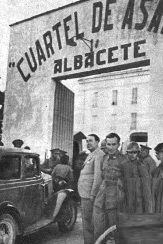
Assault Guards barracks in Albacete
The 12 October 1936 arrival of the first 500 volunteers was a highly calculated clandestine operation but declassified Comintern records and French maritime logs showed the details of how this group was assembled, transported, and thrust into the chaotic Spanish theatre.
The primary vessel that carried the first official cohort was the Ciudad de Barcelona, a Spanish steamship operating under the complete, secretive direction of the French Communist Party (PCF) and the Comintern. The volunteers boarded from the major French port of Marseille on 11 October 1936, slipping out into the Mediterranean under the cover of night. To mask the operation from French authorities and international non-intervention committees, the ship’s manifest was heavily forged. The organizing committee checked the volunteers in using false papers, listing them as repatriated Spanish citizens or returning Catalans fleeing the European mainland. The volunteers stepped off the ship in Alicante dressed in civilian clothes, carrying little more than small suitcases. Spain was suffering from a catastrophic shortage of rifles, and no weapons were wasted on the rearguard. Roughly half were completely untrained working-class volunteers with no military experience. The other half, were older, highly disciplined political exiles who had fought in World War I or served in European standing armies. This mix of veterans was what allowed the brigades to stabilise so quickly.
.
The Ciudad de Barcelona carried the very men hand-selected to build the command infrastructure of the International Brigades, including Giuseppe Di Vittorio, leader of the operation, plus Hans Kahle, a German veteran of World War I. Upon arriving, he was immediately chosen to organise and command what became the Thälmann Battalion and, later, the XI International Brigade. Also on board was Dr Pierre Rouquès from France and Dr John Simon from Britain, both medical doctors who immediately went to work organising the Sanitary Services (the medical corps) for the entire international force, and Ljubomir Ilić, a highly trained Yugoslav military strategist who went on to lead partisan-style operations.
.
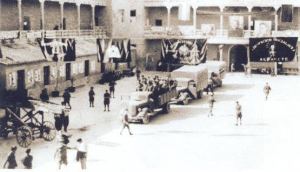
In the early hours of 13 October, the 500 volunteers were marched from the Alicante docks to the local railway station. Under tight security, they were loaded onto a dedicated troop train bound for the interior. The contingent rolled into Albacete station on the morning of 13 October 1936, and they were marched through the city to the Guardia Civil barracks (Cuartel de la Guardia Civil), which had been cleared out and repurposed as the main base of operations. A secondary, smaller maritime arrival and an overland rail contingent via the Catalan border arrived in Albacete over the next 24 hours. By 14 October, the official International Brigade establishment roster at Albacete stood at roughly 650 combat-ready volunteers.
.
Upon arrival, the 650 volunteers were rapidly decentralised across specific facilities in and around Albacete to prevent overcrowding and maintain operational secrecy. The Central Headquarters was stablished in the Pasaje de Lodares, a secure, glass-roofed commercial arcade in the centre of Albacete, when the Cuartel de San Francisco, a former convent and military barracks, became the primary billeting and supply distribution centre for the incoming troops. As the numbers swelled past the initial 650 in the days that followed, Marty moved the volunteers out into villages 30-40km north based on language and nationality. Tarazona de la Mancha became home to the French and Belgian volunteers, Madrigueras took the Italian units (the Garibaldi Battalion in its infancy) and eventually the British Battalion, and Mahora handled the German-speaking volunteers from Germany, Austria and Scandinavian volunteers (which would become the Thälmann Battalion). Villanueva de la Jara later became a hub for Slavic, Polish, and eventually the American Lincoln Battalion volunteers. Because the Republic suffered from a desperate shortage of trucks and gasoline, troop movements relied almost entirely on trains. Recruits could arrive at the main Albacete terminal from the coast, get shuffled onto local branch lines directly to their village barracks, and then be rapidly re-mobilised back to the main station when the Madrid front faced a crisis.
.
The plan was to give the untrained men a crash course in military tactics, but the rapidly collapsing frontline completely ruined the training schedule. The instructors were a mix of the experienced international exiles arriving with them (like Hans Kahle) and highly specialized Soviet military advisors who began arriving in Spain the exact same week. Colonel S.M. Krivoshein arrived in Cartagena on the Soviet supply ship Komsomol on 12 October with the first 50 tanks, acting as a direct training link. They were supposed to train for months but because Franco’s troops were rapidly encircling Madrid, their training in Albacete would last less than three weeks.
.
.
This initial contingent of 650 men formed the raw material for what would become the XI and XII International Brigades. Within less than a month, these exact volunteers would be thrown directly into the frontline trenches of University City during the desperate, successful defence of Madrid, yet the volunteers were largely blind to the actual situation. Most volunteers arrived fuelled by romantic Comintern propaganda published in Paris, believing they were joining a highly organised, heroic, and well-equipped People’s Army fighting a clean war for democracy. The reality they hit in Albacete was a shock, a Republican zone fractured by bitter infighting between communists, socialists, and armed anarchists who deeply distrusted the Comintern, a severe lack of basic supplies.
.
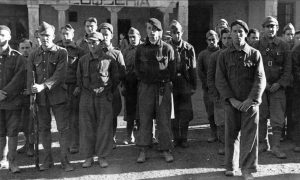
British writers, journalists, and volunteers who arrived in those first weeks, such as John Sommerfield and John Cornford, left detailed memoirs describing an experience defined by administrative confusion, systemic shortages, and immense cultural friction. When the train pulled into Albacete on the morning of 13 October, the town was already a frantic, overcrowded wartime hub draped in political banners and blasted by loudspeakers. Initially, the locals welcomed the foreigners enthusiastically. However, the mood changed the moment the volunteers marched into their assigned quarters: the Guardia Civil barracks (Cuartel de la Guardia Civil) and the Cuartel de San Francisco. The barracks had been stripped bare, no beds, no mattresses, and no furniture. The first 500 men had to sleep in rows directly on the freezing concrete floors, wrapping themselves in whatever civilian coats they owned. The cookhouses and general mess halls were unequipped, and an initial diet consisted almost entirely of basic Spanish rearguard food of dry bread, rancid olive oil, heavily garlicky bean stews, and cheap local wine. For northern Europeans, the sudden change in diet caused widespread gastrointestinal illness during their very first days of training.
The Comintern organisers had promised a professional military structure, but the logistical reality was a disaster. The uniform and supply delivery did not arrive until days into their stay, and when it did, it caused widespread frustration. John Sommerfield famously recalled the logistical mess in his memoir: ‘Everyone got something and no one got everything. We marched off looking like a lot of scarecrows, and in filthy tempers.’ The volunteers were issued an absurd, non-standardised mix of gear, some wore heavy French velvet corduroy trousers, while others got lightweight Spanish overalls. Many were given alpargatas (traditional canvas espadrilles with hemp soles). These shoes were useless for European military drilling and the freezing October mud of the central plateau, and there were not enough belts, packs, or blankets to go around.
.
Because actual rifles were desperately needed at the crumbling Madrid front, André Marty refused to waste real firearms on the base. During that first week, the volunteers were marched out to the dusty fields surrounding Albacete and the outlying villages (like Madrigueras and Tarazona) to do basic drills. Lacking real gear, they spent their first week practicing marching formations and taking cover while holding wooden sticks and broomhandles. Many units never fired a single live round of ammunition before being deployed. The actual weapons, a chaotic mix of outdated Mexican rifles and newly arrived Soviet firearms, were kept locked in crates. They were only distributed on the railway platform the exact night the men boarded trains to go into combat.
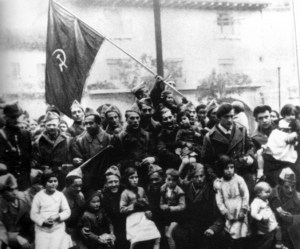
Locals and the volunteers of the Tschapaiew battalion in the Plaza Mayor in Tarazona de la Mancha in October 1936
The first week exposed deep political and social divides within Albacete itself. Coming from traditional European backgrounds or strict communist parties, many volunteers clashed over military hierarchy. Some factions demanded a militia style democracy where orders and officers had to be voted on by the ranks, while André Marty and the Soviet advisors demanded rigid, uncompromising military subordination. Albacete and its surrounding province featured strong anarchist (CNT) and Trotskyist (POUM) presences. These groups viewed the arriving Comintern/Soviet-backed hierarchy with intense suspicion. The foreign volunteers, under strict orders from Marty, were isolated from the local population to prevent them from absorbing counter-revolutionary anarchist ideals.
.
The relationship between the local Spanish villagers in the countryside and the newly arrived foreign volunteers was deeply complicated. It evolved rapidly from initial awe and radical solidarity into a tense, heavily policed co-existence shaped by severe wartime scarcity, cultural friction, and Comintern paranoia. Historical records and diaries from the training towns (like Madrigueras and Tarazona) show that the local population experienced the arrival through three phases. In October 1936, the isolated, agrarian villagers of Albacete province had rarely, if ever, encountered foreigners. The arrival of hundreds of young men speaking French, German, and Italian was a profound shock. For the deeply pro-Republican or anarchist peasants, the foreigners were viewed as heroic saviours, as the beleaguered Spanish people were no longer fighting fascism alone. Locals were fascinated by the foreign political exiles. Children would swarm the volunteers, and despite having no shared language, villagers would use basic hand gestures to communicate solidarity. Local families frequently invited volunteers into their modest homes to share whatever meager food they had.
.
As the volume of volunteers rapidly escalated from 650 to over 3,000 in a matter of weeks, the romanticism began to curdle under the weight of extreme resource scarcity. Spain’s rearguard was already suffering from supply chain collapses. The sudden introduction of thousands of hungry foreign soldiers completely drained the local village economies. While the foreign volunteers complained bitterly about sleeping on bare concrete floors and eating repetitive, garlicky bean stews, the local Spanish peasants were often eating even less. Watching large contingents of foreigners consume the region’s limited flour, olive oil, and livestock inevitably triggered quiet resentment among families struggling to feed their own children.
.
The deep cultural differences between secular, highly politicised urban northern Europeans and traditional, rural Spanish villagers caused immediate friction. Many volunteers, particularly from France and Germany (and Britain in later arrivals), brought heavy northern European drinking habits with them. In the small towns, intoxicated volunteers occasionally caused public disturbances. This behaviour deeply offended the more abstemious, conservative social norms of the rural Spanish peasants. While many locals supported the Republic, they were often still culturally tied to traditional town customs. Some of the more radical foreign volunteers engaged in heavy-handed anti-religious behaviour, such as mocking local church structures or utilizing empty chapels disrespectfully, which alienated the more traditional, non-political segments of the village populations.
.
The defining factor in how locals felt was that they were ultimately forbidden from truly knowing the volunteers. Base Commander André Marty was deeply paranoid about espionage, Trotskyism, and the region’s powerful anarchist (CNT) factions corrupting his troops. To prevent ‘ideological contamination,’ Marty implemented a totalitarian regime across the training villages. Volunteers were placed under strict curfews and barred from socialising freely in local taverns. The Comintern’s internal secret police heavily patrolled the town squares, viewing any deep fraternisation between a foreign soldier and a local Spanish civilian with immediate suspicion. As a result, local villagers quickly came to view the International Brigades as a rigid, unapproachable, and heavily armed parallel state operating inside their own towns.
.
By the end of that first week, the atmosphere turned grim. News filtered into the barracks that Franco’s Army of Africa was rapidly closing in on the outskirts of Madrid. The romantic idea of spending months building a revolutionary army evaporated. The volunteers realised they were being rapidly organised into shock troops destined for immediate, high-casualty deployment. True to those fears, within three weeks of their chaotic first days in Albacete, this exact group would be thrown directly into the meat-grinder of the University City trenches. Within three months, the majority of that initial cohort would be dead or severely wounded.
Cartagena, Murcia
Between 12 and 13 October 1936, the Mediterranean port of Cartagena became the gateway for the Soviet Union’s first massive, direct military intervention on behalf of the Spanish Republic. With General Francisco Franco’s Nationalist armies rapidly closing in on Madrid, the arrival of the Soviet cargo ship Komsomol and the first shipments of Polikarpov I-15 fighter aircraft marked the end of the Republic’s reliance on obsolete weaponry. For the first time, state-of-the-art armour and aviation entered the Spanish theatre, accompanied by elite Soviet personnel tasked with altering the course of the war.
.
On 12 October 1936, the Soviet freighter Komsomol slipped into the heavily fortified naval base at Cartagena. While historical sources occasionally feature discrepancies, with some contemporary accounts pointing to 15 October, specialist naval history and the definitive research of military historian Michael Alpert firmly place the arrival in this mid-October window.
The Komsomol carried a meticulously packed, high-priority cargo designed to give the Republic immediate tactical support with 50 T-26 light tanks, the most advanced light tank in the world at the time. Armed with a formidable 45mm 20-K gun and two 7.62mm DT machine guns, it completely outclassed the German Panzer I and Italian L3/35 tankettes being used by Franco’s forces, which carried only light machine guns. They arrived with thousands of rounds of high-explosive and armour-piercing 45mm shells, alongside complete mechanical replacement kits to sustain the armour in the field.
Stepping off the Komsomol under an assumed Spanish alias was Colonel Semyon Krivoshein, a brilliant and experienced Red Army armour commander. Krivoshein was personally charged by Moscow to establish the secret Soviet tank training center at Archena (a resort town in nearby Murcia) and rapidly assemble a fighting force capable of defending the capital. Along with him came a cohort of Soviet tank personnel, including expert drivers, gunners, and mechanics who would initially man the tanks themselves due to the lack of trained Spanish crews.
The next day, the air war over Spain was revolutionised with the arrival of the first batch of Polikarpov I-15 biplane fighters at Cartagena. Nicknamed the Chato (Snub-nosed) by Republican pilots due to its distinctively short cowl, the I-15 was highly agile, possessed an excellent rate of climb, and was armed with four 7.62mm PV-1 machine guns. Until its arrival, the Nationalist air force and the German Condor Legion had enjoyed near-total air supremacy over the central front. This arrival signalled the official launch of the massive Soviet aviation pipeline. The aircraft arrived disassembled inside large wooden crates to evade international non-intervention scouts. They were quickly offloaded and rushed inland to secret hangar facilities, primarily at the Los Alcázares airbase, where Soviet technicians worked around the clock to assemble, test, and prepare the fighters for combat.
The simultaneous arrival of Soviet tanks and fighters at Cartagena in mid-October completely transformed the geography of the war. Cartagena proved its worth as the ultimate strategic deep-water port for the Republic. Protected by powerful coastal artillery batteries, it allowed Soviet shipping lines to bypass the Nationalist-controlled Straits of Gibraltar. From Cartagena, Krivoshein’s tanks and the Polikarpov crates were loaded onto trains and expedited to the central zone. Within less than three weeks, these exact T-26 tanks would fight their first action at the Battle of Seseña on 29 October, while the I-15 fighters would challenge fascist bombers in the skies directly over Madrid by early November.
Related
Got a comment, question or suggestion? Know who took a photo? Have questions about a particular date or event? Cancel reply