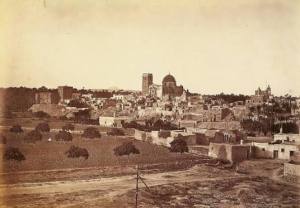
- Alicante, Valencia
In the rural periphery of Alicante, near the hamlet of Vallongas, local anti-fascist militias executed several right-wing suspects. This operation targeted individuals identified by local syndicates as sympathisers of the military rebellion. The identified fatalities from this action included Carlos Antón Pastor, Antonio Soria Gabaldón, Manuel Domínguez Margarit, and Juan Iñesta Rico. The following day, the repression spread across separate, decentralised locations in the Alicante district and the coastal municipality of El Campello. Rather than a single mass execution, militias took four prisoners to isolated roadside or coastal sites to avoid public disruption. The victims of these coordinated actions were Carmelo Serrano García, Jeremías Pastor Pérez, Víctor Manuel Niñoles Martínez, and Julio Sánchez Gómez.
.
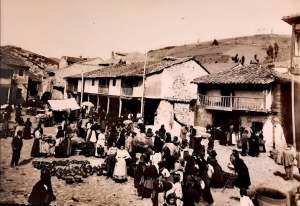
- Pola de Gordón, León, Old Castile
On 25 September 1936, a Nationalist aircraft attacked the Republican-held area around Llombera de Gordón, in the mountains north of León. The village lay within the Republican zone centred on Pola de Gordón, close enough to the front for military positions and civilian communities to be exposed to Nationalist air attack. The aircraft first attacked a Republican military position near Llombera before turning towards the village itself. It then dropped two bombs on Llombera, where the casualties were civilians. Five people were killed and another three wounded.
.
The bombing demonstrated how little separation existed between the front and civilian life in northern León. Llombera was only a small mountain community, but its proximity to Republican positions placed its inhabitants directly within the reach of Nationalist aviation. two bombs were enough to leave five civilians dead and three wounded.
.
In late September 1936, Nationalist forces were using aerial dominance to chip away at the Republican mountain fortifications in León to clear the passes toward Asturias. Because these rural hamlets directly housed militia billets and artillery covers, civilian populations in small agrarian communities like Llombera were frequently exposed to immediate aerial bombardment.
.
- Aibar, Navarra
On 25 September, Nationalist supporters from Olite, accompanied by men from Aibar, began arresting residents of Aibar. The prisoners were taken from their homes and loaded onto a lorry. They were told that they were being taken to Pamplona to make statements. Three prisoners from Sangüesa were also placed aboard, and during the night the lorry travelled towards Aldunate, about 30km south-east of Pamplona.
.
At approximately 4am on 26 September, the prisoners were taken out beside the N-240 road, around kilometre 25, shot and buried in a common roadside grave. The local priest, Fulgencio Martínez Crespo, was present to provide religious assistance to those who wanted it before they were killed. The victims recorded from the Aibar and Sangüesa group include Dominica Azparren Gil, a 52-year-old housekeeper affiliated with the socialist UGT union who ran the Casa del Pueblo (socialist headquarters) in Aibar. In a brutal display of postwar Francoist bureaucracy, she was heavily fined 40,000 pesetas after she had already been shot.
.
Alaso taken was Antón Alzueta Erdozáin, Benito Alzueta Goñi, a farmer associated with the UGT, Gerardo Bueno Expósito, Cándido Domeño Belío, Javier Iciz Ribera, who served as the left-wing mayor of Aibar representing Izquierda Republicana, José Pérez Ibero, José Alzate Egozcue, Honorio Ibáñez Leoz and Melitón Mulet Arrieta. The group included agricultural workers and other local residents associated with organisations or municipal politics of the Republic. Damián Ardanaz Subiza, also from Aibar, was taken with the group but escaped alive from the immediate shooting and permenately disappeared.
.
Individual historical accounts identify ten victims from Aibar and Sangüesa, while the official grave inventory describes the 26 September burial as containing eight people. The Aldunate area had already been used for killings on 16 August and 3 September, so records for the different groups and graves have not always been consistent. The official inventory estimates sixteen victims in total from the separate killings at Aldunate during August and September. Some remains were recovered in 1978 and reburied in Aldunate cemetery, in September 2022, the local municipalities alongside the Asociación de Familiares de Fusilados de Navarra (Affna36) finally inaugurated an official memorial site at the Aldunate cemetery to grant these victims a proper resting place, rectifying the challenges faced during a 2019 archaeological surveys caused by old road expansions.
.
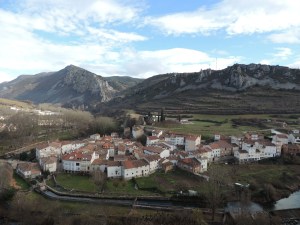
- Torrecilla en Cameros, Logroño (La Rioja)
By late September 1936, the Nationalist rearguard was shifting from chaotic street-level roundups to structured clearing operations. Local right-wing militias and the Civil Guard used list-based arrests to systematically empty the Torrecilla prison. They executed these men along the isolated mountain pass toward Soria to terrify the remaining local population into absolute political submission.
.
A mass grave was exhumed in in 2012 the cemetery of Montenegro de Cameros, containing the remains of nine men, aged between 21 and 51, who were executed on September 25, 1936, on the road between Villoslada and Montenegro de Cameros. The victims, four from Torrecilla en Cameros, (Toribio Ruiz, Pedro Soldevilla, Agustín Velilla, and Vicente Velilla) four from Nieva de Cameros Eleuterio Barrios, Pascual López, Francisco Marín, and Manuel Sáenz), and one from Pradillo (Santos Velilla), were taken from the Torrecilla prison and loaded onto a truck that headed towards the province of Soria.
.
The group consisted of ten men, including Juan Barrios (the brother of victim Eleuterio Barrios), but when the truck carrying the prisoners slowed down or stopped at the isolated mountain area of Las Rozas along the border between La Rioja and Soria, Juan Barrios leaped from the vehicle and vanished into the dense woods of the rugged Cameros mountains. Despite immediate manhunts by local right-wing militias and the Guardia Civil, the mountainous terrain worked to his advantage. Juan successfully evaded his pursuers, managed to cross over into Republican-held territory, and survived the rest of the Spanish Civil War. While his brother, Eleuterio Barrios, was executed that day alongside the other eight men, Juan’s survival allowed the details of that fateful paseo on 25 September 1936 to be passed down through the generations, directly aiding modern historians and family members when they began uncovering the mass grave at Montenegro de Cameros decades later.
.
The nine bodies were found on 26 September in a roadside ditch on the border between La Rioja and Soria, compassionate local residents from Montenegro de Cameros moved the bodies to the protection of the municipal cemetery wall to give them a proper, albeit clandestine, burial. The remains of at least six men have been found, mixed up and fragmented, by the regional memory association La Barranca in April 2012, victims of cemetery usage and space re-allocations mixing the bones, making forensic recovery highly complex.
.
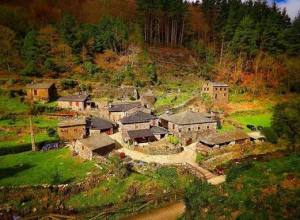
- Taramundi, Asturias
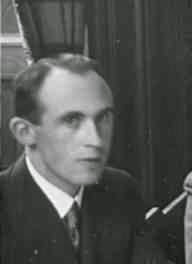
The Francoist state continued to prosecute Díaz-Villamil long after his physical elimination. The Tribunal of Political Responsibilities assessed his estate’s liability at one million pesetas, and authorities confiscated 1,150 pesetas in cash found on his corpse, along with his personal effects and bank accounts, targeting his surviving family to collect the arbitrary state debt. later.
.
- Bilbao, Bizkaia, Basque Country
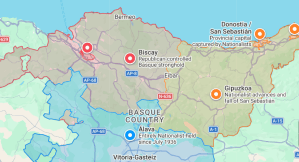
Approximately 190,000 people lived in Bilbao when Nationalist aircraft attacked the city and its industrial surroundings on 25 and 26 September. The targets lay within one of Spain’s largest industrial areas – Bilbao and the lower Nervión estuary contained docks, railway facilities, factories and the Altos Hornos de Vizcaya steelworks, alongside densely populated working-class municipalities such as Barakaldo.
.
Nationalist aircraft bombed the Bilbao area on 25 September, after General Emilio Mola had threatened further attacks if the city did not surrender. Raids continued on the 26th, with bombs falling on Bilbao and Basauri and Burtzeña in Barakaldo. Modern Basque documentation gives a combined toll for the attacks of 96 people killed and about 650 wounded, though contemporary and later accounts differ over the precise distribution of casualties between individual raids and locations.
.
The 25 September raid was followed by killings in the Bilbao estuary at Barakaldo, where merchant vessels had been requisitioned as floating prisons for people detained as opponents or suspected opponents of the Republic. The Cabo Quilates lay at the Dársena de Portu, close to the industrial waterfront, and held hundreds of prisoners; one local reconstruction estimates approximately 700 prisoners aboard the ship. The Altuna Mendi was another of the vessels being used for detention.
.
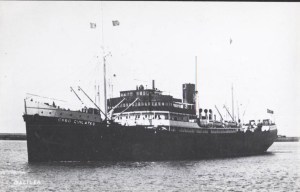
After the bombing, a crowd gathered on the waterfront demanding reprisals against the prisoners. People crossed the estuary in gabarras and reached the ships. The guard associated with the Cabo Quilates consisted of approximately 20 militiamen and 15 Carabineros under Pedro Garmendia; surviving accounts indicate that they failed to prevent the attackers from boarding. On the Cabo Quilates, 41 prisoners were shot on deck and inside the holds. Among the dead was Fernando María de Ybarra, Marquess of Arriluce, whose family was associated with the shipping company that owned the vessel before its requisition. The Altuna Mendi was attacked during the same violence and 29 prisoners were killed aboard it, bringing the total for the two ships that night to 70 dead.
.
The air attacks also accelerated practical preparations for protecting Bilbao’s civilian population. Air-raid shelters and other passive-defence measures became increasingly urgent as it became clear that the city, its industrial suburbs and the Nervión estuary could expect further Nationalist bombing. The consequences of the 25–26 September raids had already extended far beyond bomb damage: dozens of civilians had been killed or wounded, and 70 prisoners had been murdered in reprisals after the first attack.

