By October 1936, the major frontline of the Spanish Civil War was the army pushing from Extremadura toward Madrid. But Huelva in western Andalucía was trapped firmly under Nationalist military control, having been overrun during the brutal summer offensives.
.
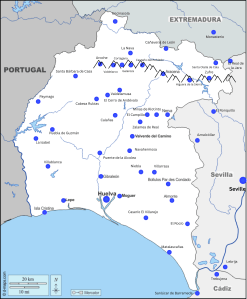
This continued the highly structured, geography-based repression campaigns orchestrated by local Falangist squads, military administrators, and right-wing information committees. Archival data preserved by the Diputación de Huelva and regional memory registries shows that between 9 and 13 October 1936, a wave of highly coordinated executions swept across the province targeting specific socio-economic zones – the northern mountain villages, the highly unionised mining basins, and the central agricultural valleys.
.
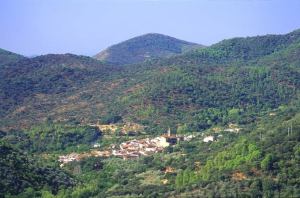
The rugged, high-altitude Sierra de Huelva, stretching along the borders of Extremadura, had been a difficult region for the Nationalists to pacify due to its isolated geography. By October, local Falangist squads used newly compiled political blacklists to systematically purge these mountain villages of Republican sympathisers and municipal leaders. Cañaveral de León, a small mountain village suffered a massive, single-day collective saca on 9 October. A concentrated group of local neighbours was marched to the municipal cemetery walls and executed en masse. The victims included Benito López Mateos, José Olivo Olivo, Lorenzo Olivo Olivo, Manuel Olivo Sánchez, Francisco Parrillo Olivo, José Plaza Infantes, and Francisco Rodríguez Plaza. Alongside them was Diego Cerezal Márquez, a resident from nearby Zalamea la Real who had been caught or moved into the sector.
.
On 13 October, the regional ‘clean-up’ focused on a network of neighbouring mountain towns of the Sierra de Aracena, including Cortegana, Valdelarco, La Nava, and Castaño del Robledo, resulting in eleven recorded killings. To streamline the logistics of the firing squads and terrorise the valley, multiple victims, including Antonio Aguirre Moreno and José Blanco Domínguez, were driven out of their home villages and executed together at a common trench in La Nava. The group included Ángel Vázquez Martín, the Republican mayor of Castaño del Robledo, executed alongside José Pedro García Domínguez, Hermenegildo Díaz Barbosa, Ángel Expósito Iglesias, Bernardo Gandullo Benítez, Emilio García López, Santiago González Gil, Diego Montaño Gómez, and Francisco Romero Navarro.
The copper and pyrites mining basin of Huelva (centred around Riotinto and Nerva) was historically the most militant anti-fascist zone in southwest Spain, dominated by powerful socialist (UGT) and anarchist (CNT) mining unions. Having fiercely resisted the July coup, the workforce was subjected to a relentless professional and physical liquidation that continued through autumn. On 9 October, six prominent industrial workers and union organizers were extracted from the mining town of Nerva and transferred to the regional hub of Minas de Riotinto for execution, their bodies dumped into the massive communal trenches near the mine pits. The victims were Francisco Figueras Santos, Pedro Gómez Quintana, Joaquín Macías Centeno, Luis Martínez Vázquez, Francisco Vázquez Granado, and José María Vila Hidalgo.
.
The mining purges expanded into neighbouring extraction hubs over the following days. On 11 October, Lorenzo Muñoz Silgado was executed in the mining area of Calañas (Torrerera), while Francisco Monteagudo Rodríguez was shot the same day in El Campillo. On 12 October, the elimination of El Campillo’s Republican leadership concluded with the execution of its socialist mayor, José Jesús Limón Castilla, alongside José Lenisio Castilla, José Valle Díaz, and María Muñoz Álvarez, a 60-year-old local woman targeted by local informants. The total number of victims killed in El Campillo remains unknown, thought the site of the mass grave has been marked in their memory since 1981. A second pit, containing 11 victims of the initial coup has been exhumed and dignified.
.
Across the central agricultural plains and the wine-producing Condado region of Huelva, the focus of the October 1936 purge was the systematic execution of day-labourers who had participated in the Second Republic’s agrarian land reforms. On Saturday 10 October 1936, a multi-town sweep resulted in the simultaneous execution of localised political figures and agricultural workers across the central Huelva plains. In Higuera de la Sierra, José Luis Díaz Cubero, the democratically elected Republican mayor of the town, was executed to decapitate the local municipal administration. In Aroche, two local agrarian workers, Domingo Anarte Peña and José Antonio Lobo Cañado, were shot and buried in the local cemetery fosa. In La Palma del Condado, José Gaitán Martínez was executed by local Falangists. In Valverde del Camino, Casiano Heredia Vázquez was eliminated in this strategic transit hub and in El Cerro de Andévalo, Miguel Pavón Banda was executed as part of the rearguard pacification. The agricultural purge continued the following day, killing José Pichardo Barrera in the countryside town of Villarrasa.
.
The region measured executions through geographical targets: executing mayors to dismantle municipal government, shooting miners to break the unions, and killing mountain peasants to secure the remote highlands. This localised, targeted methodology turned the entire province into a network of hidden mass graves, ensuring complete social and political submission through the systematic destruction of the Republic’s regional base.
The copper mining region of Riotinto and Nerva houses some of the most extensively excavated mass graves in Spain. In Nerva, the main cemetery fosa is documented as the largest rural mass grave in the entire country. Between 2019 and 2023, a massive, systematic exhumation program at the site successfully recovered the skeletal remains of 266 victims of the Nationalist repression. At nearby Santa Bárbara Municipal Cemetery in Minas de Riotinto had been ongoing between 2021-present on the 211 believed victims, of which, 138 have been recovered.The records from Nerva and Riotinto confirm that men like Francisco Figueras Santos and Pedro Gómez Quintana were skilled industrial tradesmen, pit miners, and railway workers. Local accounts describe how Falangist troops entered the towns carrying large crucifixes, and within half an hour, municipal flatbed trucks were actively transporting these unionised workers to the cemetery walls.
José Luis Díaz Cubero (known by his village nickname, Zacarías) was a wealthy businessman and owner of a prominent local cork factory in Higuera de la Sierra. When he accepted the role of Republican mayor, he dedicated himself to the needs of the working-class day-labourers, and was described as an incredibly moderate, conciliatory, and peaceful politician. Despite his wealth and moderate stance, he was still targeted because he represented the legitimate democratic framework of the Second Republic.Following his execution on 10 October 1936, his body was dumped into a pit, which was marked by regional memory groups to prevent his name from being erased from the town’s municipal history. The town has several small pits, which someone grew hedges over, with 27 believed victims over 14 months. In 2019, an exhumation found 20 people, over half being women killed in 1937.
Cañaveral de León today, via Vive Mas Andalucía
The Cañaveral de León mass grave holding the large group from 9 October (including the Olivo family, José Plaza Infantes, and Francisco Rodríguez Plaza) remains located in a quiet, preserved sector of the Cañaveral de León Municipal Cemetery. It is completely free of later modern niches to protect the integrity of the soil. Historians estimate that roughly 40 victims from Cañaveral and surrounding hamlets are crowded into this single trench. In 1990, surviving families and local authorities successfully erected a permanent stone monolith monument directly over the fosa site to publicly memorialise the names of the neighbours lost that morning. In 2025, a new survey discovered six victims, and exhumation is pending.
.
At La Nava, the eleven victims from the October 13 sweep, including Ángel Vázquez Martín, the Republican mayor of Castaño del Robledo, were initially driven to an empty plot inside the La Nava Cemetery to be shot and buried. This site represents one of the earliest micro-exhumations in the region. Spurred by the persistent demands of a victim’s family member who had secretly documented the location, the fosa was carefully opened. The remains of seven of the believed nine victims were respectfully gathered and re-interred together in a unified, dignified plot inside the cemetery. The town only had around 650 resident in 1936, and has dropped to less than 300 today.
.
Today, visitors to the La Nava cemetery can walk down the main path and see a distinct rectangle outlined with white stones embedded in the dark soil. This visual anchor marks the exact footprint of the original 1936 trench, accompanied by a marble plaque dedicated specifically to the Valdelarco and Castaño neighbours who died there. Nearby Valdelcaro has its own pit, with at least eight of the ‘missing’ 45 residents, unexhumed but memorialised since 1995, and Galaroza currently believes they have a pit containing at at least 13 people but the site has been either accidentally or neglectfully damaged over time. The whole area has towns of 2,000-3,000 residents during the war, and all lost large groups of individuals, men and women.
.
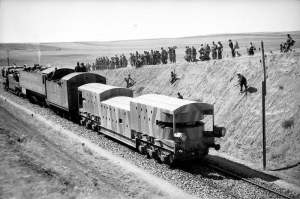
Republican train outside Bargas, via El Ferrocarril en las guerras de España
Bargas, Toledo, New Castile
The period immediately following the fall of Toledo saw all eyes point towards Madrid, but on 10–13 October 1936 a substantial, coordinated Republican counter-offensive designed to seize back the strategic initiative. The Republican command orchestrated a multi-pronged assault that relied on a unique triumvirate of leaders, blending professional military discipline with highly motivated volunteer militias.
.
Lieutenant Colonel Ricardo Burillo, a professional officer and former commander of the Assault Guards, provided the formal tactical structure for the central thrust. Assisting him was Captain Manuel Uribarri, who brought the aggressive, highly ideological manpower of the Levantine Uribarri Column up from the east coast. Completing the axis was Joaquín Mena, a local militia commander whose intimate knowledge of the Tagus frontline allowed him to coordinate vital flanking manoeuvres closer to Toledo’s city gates. The combined force under Burillo, Uribarri, and Mena totalled between 8,000 and 10,000 men in the Toledo sector. This was a massive concentration of manpower for the Republic at the time, consisting of regular Assault Guards, and localised Tagus militias.
.
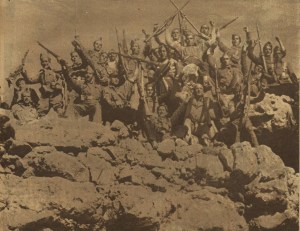
The epicentre of this combined clash was the strategic town of Bargas, situated 15km north of Toledo. The Nationalist forces occupying the Bargas-Toledo hinge had 2,500 to 3,000 men under local commanders like Colonels Barrón and Asensio Cabanillas, who had to be rapidly reinforced when the line threatened to break. Between 11 and 13 October, the area bore witness to intense, heavy fighting. The Republican forces advanced with enough momentum to breach the outer perimeters of Bargas, briefly penetrating the town itself. The ferocity of the assault caught the Nationalist command off guard. To secure his rear lines, General Varela was forced to abruptly halt his broader offensive operations toward Madrid, pivoting the Moroccan Regulares and Foreign Legion units back south to shore up Toledo’s vulnerable northern defences.
.
This sudden bottleneck was notice by the international press. Prior to 11 October, foreign correspondents stationed in Spain had been writing obituaries for the Republic, treating the fall of Madrid as a certainty after the dramatic relief of the Toledo Alcázar. The sudden eruption at Bargas forced a dramatic shift in tone. Initial, sensationalised press cables out of Republican Madrid even claimed that Toledo was on the verge of a total counter-encirclement. Journalists embedded with the Nationalists documented the frantic movements of Varela’s vanguard turning around in dust clouds to defend the city’s perimeter, providing the global public with the first visual evidence of a stalled advance. Over a few days, the republican militias suffered 1,000 – 1,500 killed, wounded, and missing. Because the militias charged open ground and briefly forced their way into the streets of Bargas against fortified Nationalist machine-gun positions, their infantry took the brunt of the losses. The Nationalists soldiers lost several hundred deaths or injuries, due to their superior defensive positioning and tactical experience, but still enough to deal a structural blow to Varela’s momentum towards Madrid.
Republicans at the front in Toledo province, October 1936, via Ahora, Biblioteca de España
Though the Republican troops ultimately failed to hold Bargas and were forced to withdraw by 13 October, the operation achieved its most vital strategic objective. The temporary relief experienced by the capital in mid-October was earned through blood, proving that even in a period of retreat, the Republic was still capable of launching coordinated operations that could alter the Nationalist timetable and buy precious time for the defences of Madrid to organise.
.
While the heavy fighting at Bargas temporarily halted the Nationalist advance toward Madrid in mid-October 1936, a grim, administrative routine of violence was playing out behind the lines inside the city of Toledo. Captured by General José Enrique Varela’s forces on 27 September to relieve the legendary siege of the Alcázar, the city quickly became the site of a systematic purge. By mid-October, this wave of summary executions left a permanent, tragic mark in the municipal cemetery logs, culminating in a stark entry on 13 October 1936 – the burial of María Sánchez Piedrahita and 26 unidentified individuals in a single mass grave.
Fosa (or Patio) 42, a section of the Toledo Municipal Cemetery historically designated as the fosa de la caridad (the charity plot). Between 28 September and 15 October 1936, this single patch of land became a mass burial ground for 727 individuals. The overwhelming majority of those brought to the cemetery gates by Nationalist squads were stripped of their identity. In the cemetery’s official Libro-Registro (Inhumation Registry Book), page after page lists the dead simply as desconocidos (unknowns). They were Republican soldiers, militiamen, and local working-class civilians.
.
On 13 October, the cemetery registrar logged Fosa (Grave) 38 within Patio 42. This specific entry stands out to modern historians because it contains a rare exception to the rule of anonymity with the name of María Sánchez Piedrahita, though the other 26 beside her did not get that luxury. The Toledo cemetery holds the remains of approximately 1,787 victims distributed across five fosas. Fosa 42, traditionally designated for the burial of the indigent, became the burial site for the bodies of Republican detainees brought in by the truckload; between September 28 and October 13, 1936, following the entry of General Varela’s troops into the city. Fosa 42 escaped destruction in 2002, when the Toledo City Council planned a cemetery expansion that was halted by a local movement dedicated to historical memory. A project to dignify the site was carried out in 2007, and a commemorative monument was erected.
.
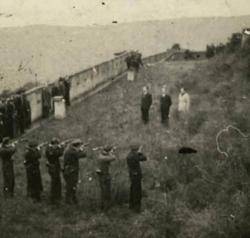
Firing squad of Colonel Feliciano Montero y Dalmases, Joaquín Ruiz de Porras, and José Borbón y Rich
La Garrotxa, Girona, Catalonia
In Catalonia, the collapse of the initial July military uprising gave rise to a powerful wave of revolutionary committees. By autumn, the initial explosive violence had begun transitioning into institutionalised, selective purges. In the province of Girona, October 1936 exposed the grim reality of this consolidation through high-profile executions of military rebels and a sustained undercurrent of political and religious repression. On 13 October 1936, the Republic asserted its judicial authority over those who had backed the July coup. Following a trial by a newly established Popular Tribunal, three prominent military rebels were taken to the Castle of Sant Julià de Ramis, located just north of Girona city, and executed by a firing squad.
The condemned men represented the key echelons of the regional military mutiny; Lieutenant Colonel Feliciano Montero y Dalmases, Captain Joaquín Ruiz de Porras (sometimes cited as Ruiz de Torras), and Lieutenant José Borbón y Rich, an infantry lieutenant with direct ties to the Bourbon aristocratic lineage. His father, José Borbón y de la Torre, was a cousin of King Alfonso XIII and murdered his wife María Luisa Rich y Carbajo in 1936, which the monarchy and Primo de Rivera dictatorship punished with permanent leave from the military in Morocco, while their two children had to live with what they had seen. Beatriz de Borbón y Rich, sister to José Borbón y Rich killed in 1936, could not publicly speak about what happened to her family until 1983.
.
Further inland, away from formal military installations, the violence took on a distinctly ideological and anticlerical tone. Local historical research within the Garrotxa comarca reveals that the uncontrolled, chaotic violence of July and August had evolved. Through September and into October, the killings continued at a lower, more deliberate level. Within this region, historians have tracked a total of 91 victims of rearguard repression. The demographics of those targeted highlight the deeply political and religious nature of the local execution. Approximately 83% of the victims were explicitly identified with traditionalist, conservative, or right-wing political affiliations. A significant portion of the casualties also comprised local Catholic priests, monastics, and religious figures, reflecting the fierce anticlerical cleansing sweeping across revolutionary Catalonia at the time.
.
The military leaders executed on 13 October at the Castle of Sant Julià de Ramis (Montero y Dalmases, Ruiz de Porras, and Borbón y Rich), their status as high-ranking rebel officers meant their bodies were swiftly recovered by family and sympathetic local groups shortly after their execution. They were securely buried in proper graves, escaping the fate of missing persons that befell so many others during the war. Under the Causa General after the war, authorities systematically interviewed local populations in the Garrotxa to locate these hidden mass graves. The bodies of the 91 victims were progressively exhumed and positively identified wherever possible. They were moved directly into consecrated ground in local municipal cemeteries (such as in Olot) or interred in family pantheons with full honours.
.
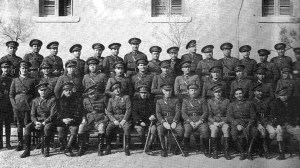
Officers of the Tarifa 11 Regiment before the start of the Civil War, which was overseen by General José García-Aldave Mancebo
Alicante, Valencia
On 13 October 1936 at the local cemetery of San Blas, following formal proceedings overseen by the newly formed Tribunal Popular of Alicante, eight professional military officers were sentenced to death. The primary figure executed was General José García-Aldave Mancebo, who had served as the Military Governor of Alicante and commander of the 6th Infantry Brigade. When the July coup erupted, García-Aldave famously wavered with his support. While he assured Republican leadership over the phone that his garrison was loyal and even sent a detachment to quell rebels in Almansa (between Alicante and Albacete centres), his choice to keep his core forces confined to the Benalúa/San Francisco barracks was interpreted by local leftist militias as a stalling tactic. Stripped of command on 23 July, his indecision ultimately sealed his fate before the revolutionary tribunal.
.
García-Aldave was lined up against the firing squad alongside seven of his subordinates and sympathisers who had held the barracks – Joaquín Luciáñez Riesco, José Meca Romero, Félix Ojeda Vallésm Manuel Pascual Martínez, Santiago Pascual Martínez, Enrique Robles Galdó, and Antonio Sintes Pellicer. José García-Aldave Mancebo and his seven subordinates were buried together in a ditch at the San Blas Cemetery in Alicante. Immediately after the war ended in April 1939, the men were ruled martyrs for the Crusade, and all eight were exhumed and re-interred with full military honours in dedicated, permanent niches and family pantheons within the newly built Cemetery of Nuestra Señora del Remedio.
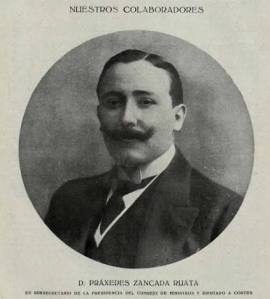
Práxedes Zancada Ruata
On the same day was the death of Práxedes Zancada Ruata, an exceptionally prominent civilian intellectual and politician. A highly educated legal scholar and writer, Zancada had spent his life exploring labour laws and advocating for protective legislation for the working class. However, his political pedigree made him an immediate target for the wartime militias, as he had served as the private secretary to the murdered liberal Prime Minister José Canalejas, acted as a deputy in the Restauración Cortes, and prominently collaborated with the state apparatus during the Primo de Rivera dictatorship. His past ties to elite conservative institutional power overrode his lifelong advocacy for labour reforms, resulting in his execution.
.
After being killed on 13 October, Zancada’s body was initially treated as an anonymous casualty of war, but due to his immense social stature and elite family connections, his relatives were able to locate and secure his body. Following the Nationalist victory, he was safely moved into a private, permanent family plot, completely avoiding the fate of the anonymous mass graves.
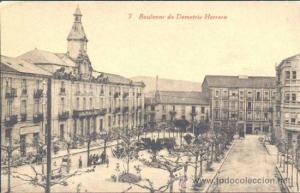
Torrelavega
Torrelavega, Santander (Cantabria)
As the frontlines of the Spanish Civil War hardened in mid-October 1936, the northern province of Santander remained inside the Republican zone. Within this territory, the town of Torrelavega and its surrounding hills became the backdrop for anticlerical purges. On 13 October 1936, months of evasion came to a tragic end at Alto de la Montaña with the capture and summary execution of three members of the Claretian religious order – Father Isaac Carrascal Mozo, Father Joaquín Gelada Hugas, and Brother Félix Barrio Barrio.
.
The journey began on 18 July 1936, in the coastal town of Castro Urdiales where the three men belonged to a local Claretian missionary community that operated a Catholic school. When news of the military coup broke, the local mayor initially urged leftist militias to show restraint, allowing the Claretians to continue working in their classrooms. But by 18 August 1936, mounting threats of violence forced a total dispersion of the community. While many of their peers fled into hiding across the province, Fathers Gelada and Carrascal, alongside Brother Barrio, sought a closer sanctuary. They were granted secret asylum at the House of the Sacred Heart, a local convent run by the Sisters Servants of Jesus, where the Claretians had previously served as chaplains.
.
For nearly two months, the three religious men lived in total isolation within a modest gardener’s cottage on the convent’s estate. There, hidden away from the militia patrols scouring the towns, they quietly maintained their religious commitments. By October, as the Republican authorities intensified their searches for hidden clergy and fifth columnists, the sanctuary was compromised. Militia forces operating out of the Torrelavega sector located their hideout, dragged the three men from the estate, and transported them to the scenic vantage point known as Alto de la Montaña (or La Montaña), just outside the Torrelavega city limits where they were executed by a firing squad. The bodies of the three Claretians were put in a pit near the execution site, but their remains were exhumed and brought to formal consecrated ground in 1937. Recognised by the Vatican as victims killed strictly in odium fidei (out of hatred for the faith), their historical trajectory culminated in their beatification.
Related
Got a comment, question or suggestion? Know who took a photo? Have questions about a particular date or event? Cancel reply