- Huelva, Andalucía
By mid-September 1936, the Spanish Civil War in the southwestern province of Huelva was entering its final, decisive phase of territorial conquest. Following the fall of the major mining centres in August, Republican resistance was pushed into the rugged northern mountains. Between September 19 and September 30, Nationalist forces launched a series of operations that completely eliminated organized Republican territorial control in the province, transforming Huelva into a consolidated Nationalist rear area defined by military governance, economic confiscation, and systemic repression.
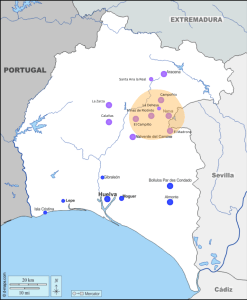
On 19 September 1936, Nationalist forces completed the occupation of the northern Sierra by capturing the final remaining Republican-held municipalities: Hinojales, Cumbres de Enmedio, Cumbres Mayores, and Cumbres de San Bartolomé. The fall of these towns marked the absolute end of organized Republican administration in Huelva province. From September 19 onward, Nationalist territorial occupation was complete.
While formal military resistance collapsed, the arrival of Nationalist troops triggered an immediate humanitarian crisis. Between September 19 and 25, thousands of Republican supporters, including former militiamen, political activists, and terrified civilians, fled into the countryside or desperate routes toward the Portuguese border. This mass flight marked the beginning of the huidos (the hidden ones) phenomenon in the northern Sierra, as hundreds of people went into hiding in the mountains to escape impending violence.
For those escaping the advance of Nationalist troops into the northern Sierra, the immediate priority was survival. The huidos in Huelva initially consisted of isolated individuals, families, and shattered remnants of Republican militiamen who fled with nothing into the rugged, mountainous terrain or toward a tightly patrolled Portuguese border. The mountains offered cover but immense hardship. Starvation, exposure, and a lack of medical care were rampant. At this stage in September 1936, the huidos were passive fugitives trying to avoid execution, not an organized resistance. Over time, out of sheer desperation and the impossibility of returning home without being shot, these desperate groups began organizing for survival. By 1937, this very zone became so volatile that the Nationalist command officially declared parts of Huelva as Spain’s first anti-partisan war zone, treating these hidden populations as active military combatants.
With territorial conquest finalized, the final third of September saw Nationalist authorities pivot from active military campaigns to strict administrative and economic control. The province rapidly consolidated into a secure Nationalist rear area. Organized military operations largely ceased, allowing military authorities, the Guardia Civil, and the Falange to concentrate their efforts on policing, searches, and arrests.
Key infrastructure and economic hubs were systematically secured while isolated border zones were brought to heel. On September 23, a Guardia Civil column led by Captain Gumersindo Varela Paz arrived in Encinasola. The arrival of Varela’s column ended the town’s isolation near the Portuguese frontier and established effective Nationalist military control over the sensitive border district.
As Nationalist control solidified, a brutal apparatus of political repression was unleashed across the province. In the newly captured municipality of Cumbres Mayores, repression began immediately after September 19, eventually resulting in the deaths of at least 50 local residents, including those transported and killed elsewhere.
The Falange detention centre at the Palacio de Mora Claros remained heavily active, alongside the overcrowded provincial prison and various makeshift facilities. Huelva city served as the central hub to which prisoners from surrounding municipalities were transported. Regular executions continued at known provincial killing sites, including the walls of the San Sebastián and La Soledad cemeteries, as well as the Conquero/Parque Moret area.
The intellectual, political, and social elite of the Republican era were primary targets. On September 30, the prominent lawyer, Republican politician, and Freemason Alfonso Morón de la Corte was executed against the cemetery walls in Huelva city. His death capped a devastating month that saw Huelva transition entirely from a contested front to a tightly policed stronghold of the Nationalist faction.
The White Terror under General Gonzalo Queipo de Llano was exceptionally brutal in southwestern Spain. Throughout the course of the war and its immediate aftermath, historians estimate that over 6,000 people were murdered in Huelva province, with at least 1,200 to 2,000 executed in Huelva city alone. During September 1936, the machinery of death peaked as the territory was completely enclosed. On August 29, just prior to September, 67 captured members of the famous Riotinto Mining Column (who had tried to transport dynamite to defend Seville) were summarily executed after a sham trial. This set a terrifying precedent for September. Throughout September, executions were continuous and meted out daily at the walls of the San Sebastián and La Soledad cemeteries. Bodies were swept into massive common graves. Scholars note that the final weeks of September demonstrated no subsidence in the killing; rather, it functioned as a cleansing mechanism to pacify the newly conquered rear area By late September, life in the Riotinto-Nerva mining basin, which had surrendered in late August after heavy artillery and aerial bombardment, had transformed into a dystopian climate of fear. The British-owned Rio Tinto Company (RTC) quickly cooperated with the new military authorities to restore production for the Nationalist war effort. The mining district, which had been a proud cradle of the Spanish labour movement, was completely broken. The combination of corporate compliance and fascist policing ensured that the miners were reduced to a captive, heavily policed workforce under the constant threat of the firing squad.
Women were also being killed in large numbers during the consolidation, and they were subjected to a distinctly weaponised, gender-specific form of torture and humiliation. Historians and modern forensic archaeologists excavating mass graves in southwestern Spain, including Huelva and Extremadura, have unearthed extensive evidence of this targeted violence. Women were frequently targeted under a concept historians call double punishment, punished once for their ideological stances (or those of their male relatives) and a second time for violating traditional, conservative gender roles by being politically active. In Huelva’s towns, when Republican men (like unionised miners or local officials) fled into the mountains, Nationalist forces routinely arrested their wives, mothers, daughters, and sisters in their stead. Many were taken straight to the cemetery walls and shot. Recent archaeological excavations in southwestern Spain led by forensic anthropologist Laura Muñoz-Encinar have uncovered the physical remains of pregnant women in mass graves, buried alongside small personal female items like hairpins, thimbles, and sewing kits. While thousands of women were killed, a massive portion of the female population was intentionally kept alive to serve as living examples of psychological terror. The Nationalist faction, heavily influenced by extreme machismo and fascist theories, viewed left-wing women as mentally inferior or morally deviant. In his nightly radio broadcasts from Seville, General Gonzalo Queipo de Llano actively encouraged the sexual abuse of Republican women. The torture methods used specifically against women were designed to strip away their dignity and bodily autonomy before the entire community. Their hair was forcibly shaved off to mark them publicly as ‘reds.’ A ribbon or single tuft of hair was sometimes left to mock them, then forced to drink large quantities of castor oil, a powerful laxative, causing uncontrollable, severe diarrhoea. Shaved and soiled, they were paraded through village streets by Falangists, forcing them to defecate publicly to break their spirit. Rape and sexual mutilation by Falangists and Guardia Civil were widespread, systemic, and unpunished during town pacifications. This distinct machinery of torture left deep psychological scars. Because these humiliations happened in the open square of small Huelva villages, it forced entire communities to witness the complete subjugation of their neighbours. For decades after the war ended, the fear of this specific degradation kept the surviving women of Huelva completely silent, living alongside the men who committed the crimes. Absolutely no evidence exists beyond what other were forced to watch, and the word of the brave women who could eventually break their silence.
- Coyanza, León, Old Castile
In September 1936, six men from Valencia de Don Juan, then often known as Coyanza, were arrested by supporters of the Nationalist uprising and eventually taken to the killing grounds at Villadangos del Páramo. Four were Socialist councillors in the town’s Frente Popular municipal administration and two were members of the UGT. All six can now be identified: Urbano González Soto, Víctor Pérez Barrientos, Marcelino Quintano Fernández, Jesús Luengo Martínez, Moisés Rodríguez Martínez, and Frideberto Pérez Manovel. Marcelino Quintano Fernández was arrested on 17 September, when armed Falangists arrived while his family was preparing to celebrate his nephew’s birthday. His mother, Antonia, reportedly clung to the side of the truck and pleaded with the Falangists not to take him. Urbano González Soto had already spent several days detained in Valencia de Don Juan, where his ten-year-old sister Melchora had been taking him breakfast.
Quintano and González were both thirty years old and Socialist councillors. González had previously worked in France and, after returning to Valencia de Don Juan, established an albardería, making equipment for pack animals. Quintano worked at the local Casa Alcón bazaar and warehouse. The other two councillors were Víctor Pérez Barrientos and Jesús Luengo Martínez. The remaining prisoners, Moisés Rodríguez Martínez and Frideberto Pérez Manovel, belonged to the UGT. Rodríguez, born in 1905, was a farm worker who had also worked as a miner at Matarrosa del Sil; he was married and had three children. He had participated in the October 1934 uprising, been imprisoned, and been released under the February 1936 amnesty.
On 19 September, the six were taken from Valencia de Don Juan in a requisitioned four-cylinder Ford truck belonging to the Fábrica de Harinas Industrial Valenciana. Relatives of Moisés Rodríguez followed at a distance after being told that the prisoners were being taken to León. At Villamañán, another prisoner was added to the group under Guardia Civil guard. Research suggests that this seventh man was probably Eduardo Prieto, from Celadilla, though his identity is not completely certain. The truck continued to San Marcos in León, a former convent and military establishment which the Nationalists had converted into a major detention centre. Accounts collected from the families state that the prisoners were placed in cells that had previously been horse stalls and were severely beaten during their short confinement. They were not brought before a military court and received no death sentences.
On 20 September, the prisoners were taken from León to the monte de Villadangos, about twenty kilometres west of the city. The six men from Valencia de Don Juan, together with the seventh prisoner, were killed at Pozo Melgar and their bodies disappeared into the Villadangos burial system. The civil register recorded the deaths of the six Valencia de Don Juan men on 20 September, initially treating the bodies as unidentified but their families began discovering what had happened almost immediately. A relative of Urbano González who possessed a travel permit reached Villadangos a few days later. Among belongings collected from the dead and kept by the local priest, he recognised Urbano’s partly scorched mottled coat. A photograph of Urbano remained in one of its pockets. The discovery gave the family evidence that the official disappearance had ended at Villadangos.
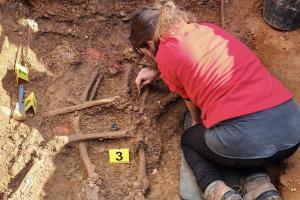
More than eighty years later, the Villadangos grave provided physical confirmation. After the 2022 exhumation, genetic testing by the University of the Basque Country identified the remains of Urbano González Soto and Marcelino Quintano Fernández with DNA matches exceeding 99 per cent. The two Socialist councillors were among the first victims from the Villadangos killings to be individually identified from the recovered remains.
- Tejería de Monreal, Navarra
The Tejería de Monreal, south-east of Pamplona, was used as a killing and burial site during the repression in Navarre. Between 17 and 21 September, several groups of Republicans were targeted, taken to the surrounding Monreal area and shot. On 17 September, four residents of Aós, a small village in the Lónguida valley, were killed near Monreal by Requetés and Falangists. Their bodies were buried in the wider Tejería-Monreal grave area. The following day, 18 September, a Requeté group arrested eleven men in Aoiz. Most were Socialist workers employed on the Irati railway or at the local electrical works. Their families attempted to intervene after the arrests, but the prisoners remained in Requeté custody.
On 19 September, the men arrested at Aoiz were taken to the Tejería de Monreal and shot. Sources differ slightly over whether ten or eleven men were killed, but at least ten deaths are documented. Antonio Arlegui Arraiza was among the identified victims. The killing ground was used again on approximately 21 September, when Santos Itarte, a Basque nationalist and head of the Irati hydroelectric installation, was taken to Monreal and killed. His death came only two days after the execution of the Aoiz prisoners, several of whom had also worked within the railway and electrical network connected with the Irati company. The site later became one of the principal known mass-grave locations in this part of Navarra, containing 100 or more people brought from several surrounding communities.
- Valladolid, Old Castile
The Cementerio del Carmen in Valladolid became one of the principal burial sites for victims of Nationalist and later Francoist repression. More than 1,000 people are estimated to have been buried in the cemetery between 1936 and 1941, including people murdered extrajudicially and prisoners executed following summary military proceedings.
The first five mass graves, now known as Fosas I to V, were used between 4 August and 19 September 1936, during the most intense early period of repression following the Nationalist takeover of Valladolid. Approximately 380 people were buried in these graves. The burials included people taken from prisons and detention centres, along with victims of both extrajudicial killings and executions ordered through the Nationalist military justice system. There was almost no break in the use of the cemetery. Fosas VI and VII contain burials dating from 21 September 1936 to 6 June 1937, beginning only two days after the recorded period for Fosas I–V ended. These two graves contained at least 136 victims.
The graves remained largely undisturbed for decades. In 2016 and 2017, the Asociación para la Recuperación de la Memoria Histórica (ARMH) excavated Fosas I–V. The excavation was partial, recovering 247 people from the approximately 380 recorded burials. In 2020, the recovered remains were reburied with dignity and a memorial bearing the names of those killed in the repression was inaugurated at the cemetery. The ARMH returned in 2022 and 2023 to excavate Fosas VI and VII. Another 136 people were exhumed. Across the work undertaken at the cemetery so far, approximately 380 victims have been recovered, leaving hundreds of the more than 1,000 people believed to have been buried there still unrecovered.
The excavations have also produced personal possessions carried by the victims when they died. Among them were fragments of clothing, watches, spoons, a tailor’s measuring tape, part of a Guardia Civil uniform, and a faded photograph. Despite its deterioration underground, the photograph still showed the silhouettes of two children holding hands. The objects give some indication of the people behind the numbers, workers carrying the tools of their trades, people wearing watches or ordinary clothing, a member of the Guardia Civil, and someone who had kept a photograph of two children with them until their death. A memorial ceremony for the victims recovered from Fosas VI and VII was held at the Cementerio del Carmen on 14 April 2024. Nearly ninety years after the first burials were made there, the work of locating and recovering Valladolid’s victims remains incomplete.
- Valencia