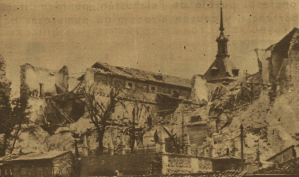
As General Varela’s Army of Africa made its rapid, brutal push northward through the Tagus Valley, thousands of rural refugees flooded into Toledo and Madrid. These displaced populations carried accounts of Nationalist massacres, adding to a climate of panic and anxiety in the city. Yet, because Toledo was easily accessible by train and car from Madrid, it became a focal point for global media. Foreign journalists, politicians, and writers travelled from the capital for day trips to view the spectacle of the siege. Local cafés and taverns outside the combat zones did brisk business serving wine and meals to reporters waiting for updates. This intersection of civilian life and military theatre peaked on the night of 17 September. When the Asturian miners finalised their explosives tunnels, Republican authorities went through the streets with loudspeakers ordering a sudden evacuation of the eastern quarters. Hundreds of residents gathered on the outer ridges of the Tagus gorge to watch the massive explosion at dawn.
.
Specialised coal miners from Asturias were brought in by the Republican high command to excavate two horizontal mine shafts through solid granite toward the southwest tower of the Alcázar. The excavation required 33 days of continuous labour and exposed the miners to constant dangers, including the threat of counter-mining by defenders, structural collapse, asphyxiation, and the extreme peril of handling thousands of kilograms of explosives.. The psychological strain on the Nationalist garrison had been immense; trapped in the subterranean galleries, the defenders spent days listening to the rhythmic, echoing thud of picks beneath their feet, fully aware of what the noise portended. By the night of 17 September, the preparation phase concluded. The miners packed the main subterranean chamber with a massive payload of 5,000kg of high explosives, wired directly to electrical detonators.
.
At approximately 6:30am on 18 September, the plunger was depressed. The detonation sent a shockwave that rattled the ancient structures of Toledo, shattering glass windows for miles around and generating a boom heard as far away as Madrid. An immense pillar of black smoke and pulverised stone rose into the sky. When the air cleared, the entire great southwest tower had toppled into complete ruin, and the western façade of the quadrangular fortress lay completely sheared away, reduced to a monumental mountain of brick and stone debris.
.
The military operation that immediately followed the dust cloud was a distinct, high-intensity offensive. Republican Prime Minister Francisco Largo Caballero travelled directly from Madrid to witness the destruction first-hand and oversee what was intended to be the final, decisive breakthrough. To ensure a safe deployment route for the infantry, Republican artillery batteries immediately poured a ferocious, 15-minute barrage into the flaming ruins.
.
As the artillery fire ceased, a major assault force composed of over 1,500 organised union militiamen and reinforcements surged forward up the hill, led by four armoured cars and tanks. Believing that the 10,000kg explosion had completely eradicated the garrison, the infantry swarmed the smoking breaches. However, the assault quickly ran into a tactical paradox that would later characterise the Battle of Stalingrad, that reducing a stone fortress to heavy rubble often favours the defenders. While the upper towers had collapsed, the vast majority of Moscardó’s garrison had survived the blast by sheltering deep within the thick vaulted cellars and underground tunnels of the academy.
.
As the Republican militias attempted to scramble over the steep mounds of loose masonry and shattered stone beams, they found their advance completely broken up by the terrain. From the jagged lips of the craters and surviving basement slits, the Nationalist defenders emerged with machine guns and rifles, unleashing a devastating crossfire. The chaotic, close-quarters infantry charge stalled on the slopes of the debris. Despite the absolute destruction of their landmark fortress, the defenders successfully repelled the onslaught.
.
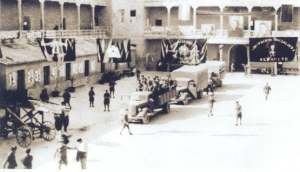
Cuartel de la Guardia Civil (Guardia Civil Barracks) in Albacete, which was repurposed in time to receive international volunteers from October 1936, on Paseo de Alfonso XII (which was ( later renamed Paseo de la Libertad). The building no longer exists. Photo via unknown, possibly Luis Escobar López, Dezső Rebai (Turai) , or Harry Randall
Albacete, Murcia (now Castilla La Mancha)
On 18 September 1936, a pivotal diplomatic and military shift occurred far from the front lines of the Spanish Civil War that fundamentally changed the trajectory of the conflict and transformed a quiet La Mancha crossroads into a hub of global anti-fascist resistance. Meeting in Moscow, the Executive Committee of the Communist International (Comintern) officially approved the organisation of the International Brigades, authorising the recruitment and deployment of foreign volunteers into structured military formations to defend the Second Spanish Republic. This high-level decision set off a chain reaction that directly shaped the destiny of Albacete, which was selected by Republican authorities as the principal base, depot, and training centre for this new international army.
.
By mid-September 1936, the Republican government was reeling from the relentless advance of General Francisco Franco’s forces, which were heavily backed by regular military aid from Nazi Germany and Fascist Italy. Recognizing that the Western liberal democracies were committed to a policy of non-intervention, Joseph Stalin and the Comintern leadership stepped into the vacuum. The resolution passed on 18 September transformed what had been a spontaneous, chaotic influx of individual foreign sympathisers into a highly organised, state-backed paramilitary pipeline. The Comintern tasked its network of global communist parties, most notably the French Communist Party (PCF) in Paris, with managing a massive clandestine recruitment system. Volunteers from all over the world were to be screened, processed, and funnelled across the Pyrenees.
.
Once the international apparatus was set in motion, the Republican government needed a secure, strategically positioned operational hub to receive these thousands of raw recruits. They selected Albacete, located roughly halfway between Madrid and the vital Mediterranean ports like Valencia and Alicante, Albacete sat safely in the Republican rear guard, well insulated from immediate frontline breakthroughs. The city featured a major railway junction, making it the perfect logistical sorting mechanism to receive trainloads of volunteers coming from the French border and later deploy them rapidly to critical fronts like Madrid. The surrounding plains provided ample open space for improvised training fields, firing ranges, and barrack installations, The first substantial contingents of the International Brigades would arrive at the Albacete base on 13 October 1936.Without this single international directive, Albacete would have remained a modest provincial capital; instead, it was set on an irreversible path to becoming the global epicentre of anti-fascist solidarity.
.
Linares, Jaén, Andalucía
On 18 September 1936, a dark and calculated episode of wartime violence unfolded in the town of Linares, leaving a paper trail that reveals the grim reality of extrajudicial executions during the opening months of the Spanish Civil War. On this date, a group of political prisoners was removed from the local Linares jail under the official guise of an administrative transfer, a move that local prison records prove was a fatal ruse. Surviving prison documentation from 18 September explicitly states that 16 prisoners were formally discharged and listed as transferred to Jaén, the provincial capital. When historians cross-referenced these logs with the intake archives of the Jaén provincial prison, they discovered a chilling anomaly: the arrival of these sixteen individuals was never recorded. This administrative gap provides undeniable supporting evidence of a common wartime practice. The prisoners never reached their destination because they were intercepted and killed along the road by militiamen or radical committees during the transfer. Once the prisoners were loaded onto trucks and moved into the isolated rural stretches between Linares and Jaén, the transport vehicles would be intercepted by pre-arranged execution squads. The victims were shot by the roadside and buried in unmarked mass graves, allowing the perpetrators to claim the prisoners had simply vanished en route. All mass graves in the area related to Republicans murdered after the war.
.
Calanda, Teruel
Republican repression in the Aragonese municipality of Calanda during the opening months of the Spanish Civil War culminated in a targeted wave of extrajudicial executions between 14 and 17 September 1936. Local radical militias, operating in the vacuum left by the collapse of central authority, methodically purged right-wing sympathisers, landowners, and individuals perceived as a potential Fifth Columnist supporting Franco’s uprising.
.
On 14 September 1936, the initial and largest wave of the purge took place. Armed militia squads rounded up local dissidents from makeshift prisons or their homes, resulting in the extrajudicial execution of at least eight identified men on a single day, all rich landowners and right-wing sympathisers. The eight men listed above were chosen because their names sat at the top of the committee’s blacklists, representing the core religious, financial, and political old guard of the town. Brothers Carmelo Gracia Gayán and José Gracia Gayán, brothers Francisco Grao Marco and José Grao Marco, Isidro Herrero Albert, Adolfo Gresa Ayora, Manuel Jarque Lasmarías, and local businessman Pedro Labarías Magrazo. Two days later, the anti-fascist patrols carried out a secondary wave of executions, killing Manuel Molins Espada, a rich local landowner, and Luis Llop Grao, a bourgeoise merchant. The following day, Enrique Marqués Villanueva, a devout Catholic and public servant was killed. All were privately marked and buried, and are not in a mass grave.
.
Tarragona, Catalonia
Among the countless dark episodes that fractured the region of Catalonia during the opening months of the Spanish Civil War, the events of 18 September 1936 in Tarragona stand out as a chilling example of arbitrary summary executions carried out in the shadows of the conflict’s frontlines. On this fateful night, the fragile safety offered by private sanctuaries was violently dismantled along the Mediterranean coast.
.
The focal point of the tragedy was the Hotel Nacional in Tarragona, an establishment that had quietly become a makeshift refuge. In the chaotic weeks following the military uprising in July 1936, anti-clerical and political purges swept through Republican-controlled areas. Seeking shelter within the hotel’s walls were individuals marked by the shifting political tides: the owner of the establishment, Andrés Alfonso Vallespín; a group of five religious men who had hoped to elude the sweeping persecution of the clergy; and two right-wing civilian guests, a father and his son, who found themselves trapped by their perceived political sympathies.
.
Late in the evening on 18 September, armed patrols belonging to the Anarchist-syndicalist militias of the FAI (Federación Anarquista Ibérica) breached the premises of the Hotel Nacional. Singled out for their religious identity, right-wing backgrounds, or association with the property, the eight men were led away from the relative quiet of the hotel into the waiting custody of the armed patrol. They were transported toward the outskirts of the city, directed onto the highway leading toward Barcelona. In the dark hours before dawn, the stretch of the Tarragona-Barcelona road became the site of a brutal mass execution. The eight prisoners—Andrés Alfonso Vallespín, the five unnamed religious men, and the father and son—were shot alongside the roadside, their bodies left behind as stark testimony to the ruthless urban and regional terror that accompanied the early republican rear-guard actions in Catalonia.
.
For generations leading up to 1936, Catalan society was deeply fractured by sharp economic divisions. The wealth of the urban bourgeoisie, hoteliers, and property owners was built upon the labour of a heavily exploited working class who endured poor conditions and minimal rights. When the military coup of July 1936 fractured state authority, it unleashed a massive social revolution. For many workers and anarcho-syndicalist militiamen, the conflict was an opportunity to dismantle an oppressive capitalist system and fight back against the classes they held responsible for their historic subjugation. While the extrajudicial killing of these eight individuals on the Barcelona road remains a tragic loss of life, the actions of the militias came from a place of systemic grievance rather than random malice. The working class viewed themselves as fighting a defensive war against both a fascist military uprising and a socio-economic structure that had oppressed them for decades. Consequently, the events of 18 September reflect a fierce, structural class war where those associated with economic privilege were targeted by a desperate, mobilised workforce seeking to overturn the old social order.
.
Between July and December 1936, before the Republican government managed to re-impose central judicial authority, various revolutionary militias carried out widespread extrajudicial executions. Out of 8,352 total recorded victims killed behind Republican lines in Catalonia, historians have identified clear patterns targeting the region’s economic and religious infrastructure. The Church bore the heaviest institutional toll, with 2,441 religious personnel executed in Catalonia, including 1,215 diocesan priests, 1,016 monks, and 210 nuns, representing roughly 30% of the entire Catalan clergy. In Spain’s manufacturing heartland, approximately 1,150 large factory owners, directors, and major shareholders were killed to make way for anarcho-syndicalist union collectivisation. Driven by generations of agrarian disputes and tenant evictions, landowners and rural elites were targeted, with roughly 900 substantial property owners were targeted and executed in rural districts. Meanwhile, the lower bourgeoisie and small business owners, belonging to the merchant and middle classes, such as hoteliers, shopkeepers, and contractors who employed labour, saw around 1,400 deaths killed due to their perceived right-wing or conservative alignments in July-December 1936.
.
Nules, Castellón, Valencia
The mid-September weeks of 1936 marked a devastating escalation of rear-guard violence in the Plana Baixa comarca of Castellón. As republican state control collapsed across the Valencian region, local revolutionary committees took absolute control of public order. In the towns of Nules and Borriana, this shift manifested in a wave of targeted roundups and summary executions, where local right-wingers, conservatives, and clergy were systematically purged. Over forty-eight hours between 18 and 19 September, the fates of eleven individuals came to symbolise the terrifying localized intimacy of the Spanish Civil War’s ‘Red Terror.’
.
The violence peaked on 18 September when a group of four men from Borriana were seized and transported to the nearby municipality of Nules. The victims, Vicente Gabalda Monfort, Francisco Tena Bernat, Bautista Rosell Gozalbo, and José Tena Tráver, were killed together in a coordinated execution. In a small agricultural community, these men were not anonymous targets; they were known local figures, likely tied to Borriana’s prosperous orange-exporting bourgeoisie or traditionalist conservative circles. Their execution in Nules, away from their hometown, followed a common tactical pattern used by wartime militias: removing prisoners to neighbouring jurisdictions to carry out killings away from local sympathetic eyes and to blur administrative accountability.
.
The momentum of the purges carried directly into the following day, striking both towns simultaneously with devastating precision. In Nules, a second wave of executions claimed five more lives – Juan Bautista Moles Ferrandis, Virginia González Picó, Juan Bautista Villalonga Turró, Joaquín Bueso Arnau, and Francisco Bueso Sanz. The inclusion of Virginia González Picó underscores that the violence was not restricted to men; women from prominent conservative or deeply religious families were increasingly targeted if they were perceived as ideologically dangerous. The shared surnames among the victims (such as the Bueso family) strongly indicate that entire households were being decimated in single sweeps, wiping out local right-wing networks root and branch.
.
Concurrently, back in Borriana, the revolutionary committee turned its focus toward the total eradication of the Catholic Church. On 19 September, two brothers and priests, Nicolás and Pedro Barber Aymérich, were murdered. As blood relatives and members of the clergy, their joint execution highlighted the intense anti-clerical vitriol gripping the region. For the radical militias, eliminating local priests was a foundational step toward dismantling the traditional social order of the Valencian countryside.
.
While these names rarely appear in broad national histories of the Spanish Civil War, their deaths represent the true microscopic reality of the conflict. In regions like Castellón, the war was fought block by block, turning neighbours against one another based on class, faith, and political affiliation. Documenting the synchronized deaths of the Tena, Bueso, and Barber Aymérich families ensures that the heavy human toll exacted on right-wing civilians in the Valencian rear-guard is preserved.
Related
Got a comment, question or suggestion? Know who took a photo? Have questions about a particular date or event? Cancel reply