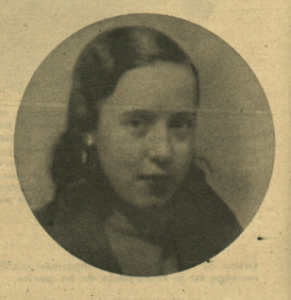
Antonia Mínguez was a courageous Spanish anti-fascist miliciana and political organiser who became an early symbol of martyrdom and youth sacrifice during the opening months of the Spanish Civil War (1936–1939).
.
Mínguez was a dedicated militant of the Juventudes Socialistas Unificadas (JSU) (Unified Socialist Youth), a massive left-wing youth organisation formed in the spring of 1936 by merging Spain’s communist and socialist youth wings. Within Madrid’s wartime JSU structure, local administrative and paramilitary sectors were broken into geographic divisions called Radios. Antonia belonged to Radio 6, operating out of the heart of the capital.
When Francisco Franco’s military coup plunged Spain into conflict in July 1936, Mínguez was among the first wave of young working-class women to volunteer for the frontlines. Militants belonging to this specific municipal sector were mobilised into volunteer battalions (such as the JSU Largo Caballero or Octubre columns) and rushed straight down the highway to fortify the Tagus Valley corridor.
.
The heavy, multi-pronged onslaught by General Yagüe’s Army of Africa against the hastily assembled Madrid youth militias at Talavera reached its climax between 3 September and 6 September 1936. Given the time required to transport casualty records back to Madrid, notify her JSU district, and arrange a print layout, Mínguez was almost certainly killed during that specific frontline collapse, with the newspaper tribute running two weeks later 20 September. Because she died in the field during a rapid military retreat, she likely was buried in an unmarked front-line grave or an aggregate cemetery, and has been forgotten by history.
.
Zaragoza, Aragon
The Zaragoza municipal cemetery (Torrero) and its surrounding rural districts stood at the epicentre of a brutal and deeply institutionalised wave of Nationalist rearguard repression during the Spanish Civil War. While the initial summer months of 1936 were defined by erratic, street-level vigilante actions, by September 1936 the violence evolved into a clinical, state-sanctioned extermination machine designed to purge left-wing municipal officials, prominent trade unionists, and agricultural workers. The visual scars of this history remain explicitly preserved in the bullet-pocked execution walls of the Torrero Cemetery, which witnessed the systematic implementation of terror en caliente (hot terror) and administrative execution sweeps.
.
The window between 20 September and 30 September 1936 represented one of the most lethal spikes of localised execution in the Aragonese campaign. Historical tracking reveals a stark division between explicitly recorded mass shootings and civil registry reconstructions: Each day had at least a dozen killings, and on 25 September, a massive surge in prison clearances leads to at least 32 mass-shooting victims, with 27 September with another 30 lives taken, and 29 and 30 September seeing two dozen killed each day.
.
The scale of the atrocities committed in the Zaragoza province reflected its status as a critical Nationalist base of operations on the northern front line. The massive leap in September perfectly illustrates the mechanics of the limpieza de la retaguardia (cleansing of the rearguard). When Republican forces pushed locally or launched counter-offensives on the Aragon front, the Nationalist military authorities in Zaragoza reacted by rapidly clearing out regional prisons to eliminate potential ‘fifth column’ threats. The vast majority of these victims were interred anonymously in the massive communal graves (fosas comunes) of Torrero, leaving behind a profound legacy of structural terror that remained officially silenced for decades. Zaragoza province has 335 registered mass grave sites, the largest being Torrero in Zaragoza city. The province lost approximately 3,500 people during the war, 2,500 being in 1936 alone, out of the population of around 180,000.
.
The Aragón Front
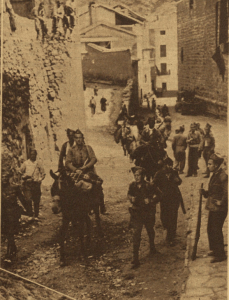
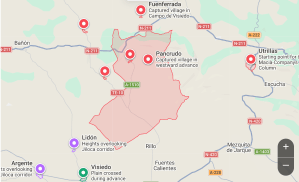
Between 20 and 25 September 1936, the Republican offensive expanded substantially across the Utrillas, Campo de Visiedo, Torre los Negros, and Alfambra sectors. On 20 September, Republican troops belonging to the Macià-Companys Column, a volunteer milicia formed in Catalonia by Esquerra Republicana and Estat Català, advanced westward from their stronghold in Utrillas. The objective was to push toward the strategic municipalities of Torre los Negros, Fuenferrada, and Villanueva del Rebollar.
.
The sudden, aggressive push westward by the Macià-Companys Column on 20 September 1936 was deeply tied to the political landscape in Barcelona. The column was explicitly formed on 3 September 1936 by the Generalitat de Catalunya (the Catalan autonomous government). The regional government was alarmed by the massive power wielded by anarchist (CNT-FAI) columns on the Aragon front. By deploying their own loyal infantry—composed of Esquerra Republicana (ERC) and Estat Català nationalists—they hoped to establish a political counter-balance and lay the groundwork for a future, regulated Catalan Army. To ensure professional military execution, they placed the column under Lieutenant Colonel Jesús Pérez Salas, a highly capable, regular army officer who attempted to instill strict discipline into the volunteer forces.
.
During this swift operational advance, the column successfully occupied the villages of Portalrubio, Pancrudo, and Alpeñés. They subsequently extended their defensive lines across the plains of the Campo de Visiedo, driving toward the vital high-altitude terrain that overlooked the Jiloca communication corridor near Argente and Lidón. The movement across the rugged Campo de Visiedo plain toward Argente and Lidón was brilliant in theory. The Republicans were aiming straight for the Jiloca River corridor. If Pérez Salas’s men could seize the heights overlooking this corridor, they could position artillery to shell Nationalist supply trains, effectively starving the Nationalist garrison inside Teruel and severing the rebel front line in two.
.
Recognising the impending threat to their supply lines, Nationalist military authorities reacted rapidly. Rebel troops stationed in Calamocha, heavily reinforced by columns mobilised from Calatayud and the Molina de Aragón sector, counterattacked to halt the Republican breakthrough The resistance encountered between 21 and 24 September at Torre los Negros and Vivel del Río Martín demonstrated the rapid consolidation of the Nationalist military machine. Rather than panicking, the rebel command utilised their superior logistical organisation. They rapidly ferried elite reinforcements from Calatayud and Molina de Aragón via the very Jiloca corridor the Republicans were trying to reach. The fighting at Venta del Diablo (literally The Devil’s Inn) became legendary for its brutality, as battle-hardened regular troops and right-wing militias engaged in close-quarters skirmishes to halt the Catalan advance.
.
By 25 September, the campaign evolved from a localised Catalan operation into a massive, multi-regional offensive. Recognising the breakthrough potential, other prominent formations joined the fray. The Torres-Benedito Column, a heavily unionised, left-wing volunteer militia that had marched north from Valencia, and the Del Rosal Column, led by professional Republican officer Colonel Francisco del Rosal, brought battle-hardened anarchists and militant sectors from the centre of the country.
.
This massive convergence stabilised the Alfambra–Corbalán line. It successfully built a crescent-shaped wall of fortified positions to the north and east of Teruel. While it failed to cut the Jiloca corridor entirely, it checked the Nationalist capability to launch counter-offensives outward from Teruel. The offensive launched by the Republican columns between 20 and 25 September 1936 was costly, chaotic, and ultimately resulted in minor territorial shifts that quickly stalled.
.
The outcome of the late-September campaign, the casualties, and the aftermath of the fighting highlight the progression of the war on the Aragon Front. Because the armies in September 1936 were still largely composed of untrained volunteer militias rather than structured divisions, exact casualty lists were rarely kept. Records from regional hospitals and column journals showed that close-quarters fighting around Torre los Negros and the crossroads at Venta del Diablo resulted in hundreds of dead and wounded on both sides. The volunteer militias of the Macià-Companys and Torres-Benedito columns suffered heavily from Nationalist artillery and rapid strafing runs by rebel aircraft. Lacking conventional military training, the militias frequently failed to dig proper defensive trenches, making them easy targets in the open plains of the Campo de Visiedo. Meanwhile, the Nationalists forces rushed from Calatayud and Molina de Aragón also took significant casualties as they threw themselves directly into the path of the Republican advance to protect their supply lines.
.
The Macià-Companys Column successfully advanced the Republican line several kilometres westward. They successfully captured and held a string of small villages, including Portalrubio, Pancrudo, and Alpeñés, and pushed the front line across the Campo de Visiedo. However, they failed to cut the Jiloca corridor. The Nationalist counter-offensive successfully checked the Republican advance just short of the vital heights overlooking the highway and railway. The front line froze in the rugged terrain between Torre los Negros and Calamocha. Teruel remained firmly in Nationalist hands, and its connection to Zaragoza remained unbroken.
.
After 25 September, the multi-column convergence stabilised the Alfambra–Corbalán line. Realising that neither side had the manpower or firepower to completely destroy the other, both the Republican militias and the Nationalist troops began to dig in. The fluid, mobile warfare of the summer was replaced by a static, gruelling war of positions. This network of trenches, concrete bunkers, and fortified outposts would remain virtually unchanged for over a year. The near-miss of the September offensive proved to the Republican government that loose, politically divided volunteer columns could not win the war.
.
For the civilian population of the Campo de Visiedo, the freezing of the front lines was a tragedy. Villages that changed hands during the chaotic September week faced immediate, brutal purges. When Nationalist forces re-secured villages or retained control of border towns, the Guardia Civil and Falange execution squads systematically executed anyone suspected of welcoming or aiding the Catalan columns. Ultimately, the positions established during those intense September days laid the exact geographical boundaries for the catastrophic Battle of Teruel.
.
Granada, Andalucía
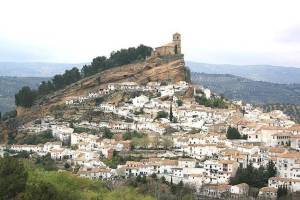
By mid-September 1936, Nationalist operational movements in western Granada transitioned from loose, fluid columns into aggressive territorial consolidation. The primary objective was to expand the buffer zone around Granada city and violently dismantle the eastern flank of the Republican pocket. On 20 September 1936, this strategic advance culminated in the Nationalist capture of Montefrío, a strategic mountainous enclave positioned right on the regional frontier. The loss of Montefrío represented a major territorial blow to the Republican rearguard in western Granada, shifting the operational line significantly farther away from the provincial capital. Outmanoeuvred by rebel forces, the surviving Republican militias withdrew in a disorganised retreat toward their remaining defensive holdouts deeper to the west.
.
As the front line moved westward, the internal ‘pacification’ and systemic political purging inside the provincial capital intensified under strict administrative control. The local prison system, overflowing with suspected left-wing sympathisers, trade unionists, and Popular Front supporters, was cleared systematically via coordinated execution groups (sacas).
On 22 September 1936, this dark judicial framework reached a massive single-day peak when 38 people were summarily executed against the walls of the Granada municipal cemetery. This group of victims stands as the final exceptionally large, securely dated September group in the localized execution chronology currently available. It marked the formal transition in Granada from chaotic extrajudicial paseos into a clinical, bureaucratised execution process.
.
Following the capture of Montefrío, the Nationalist columns under the broader operational umbrella of the southern army pressed their mechanical advantage along the Genil river basin. The intention was to sever communication channels feeding into the Republican strongholds of Málaga province. On 24 September 1936, Nationalist forces successfully captured the town of Moraleda de Zafayona. This advance effectively consolidated absolute Nationalist control over the principal western approaches protecting Granada city. By tightening this tactical knot, the Nationalist faction pushed the active front line significantly farther toward the heavily fortified, Republican-held Loja–Alhama–Málaga zone, leaving the local communities fractured and exposed to immediate rearguard political cleansing.
During September 1936, the war in Málaga province was defined by a brutal, asymmetric dynamic. Outnumbered on the ground, General Francisco Franco’s Nationalist forces weaponised raw airpower, carrying out devastating bombing raids on Málaga city to induce civilian panic. In response, local Republican militias and radicalised crowds inside the city reacted with immediate, lethal vengeance, executing right-wing and military prisoners held in the provincial jail through coordinated sacas. As the front line in the surrounding mountains rapidly collapsed, the cycle of aerial terror and prison massacres reached a catastrophic peak.
.
Throughout September, every Nationalist airstrike on the urban centre of Málaga was followed by a retaliatory raid on the Provincial Prison. As civilian casualties rose from the bombs, armed groups cleared out cells to execute suspected Nationalist sympathisers, military officers, and religious figures. On 20 September 1936, a devastating Nationalist bombing raid struck the city, triggering an immediate and violent reaction. Militias entered the Provincial Prison, removing 47 prisoners who were subsequently executed in the rearguard. A day later, another, Nationalist air raid inflicted further damage on the civilian population. In the immediate aftermath, an additional 17 prisoners were dragged from their cells and summarily shot. On 24 September, the cycle culminated in the single most lethal day of rearguard violence in the city. Following a massive and highly destructive air raid, an angry crowd and militia units executed 107 prisoners at or near the San Rafael cemetery. This stands as the largest single-day prison saca documented in Málaga city during September 1936.
.
Amidst the urban chaos and constant threat of naval encirclement, the Republican navy received a critical operational boost. On 21 September 1936, the Republican cruiser Méndez Núñez successfully docked at the Málaga port. The warship arrived after completing a high-stakes voyage back from Spanish Guinea (where the crew had successfully subverted a Nationalist mutiny attempt). By anchoring in Málaga, the Méndez Núñez joined the local Republican naval forces operating along the vital Mediterranean coastline, providing anti-aircraft defence and protecting the maritime supply lines keeping the isolated city alive.
.
While the provincial capital bled from the air, Nationalist columns continued to relentlessly tighten their territorial grip on the rugged Serranía de Ronda mountain range.
On 24 September 1936, Nationalist troops advanced outward from their newly secured base in Ronda to occupy the strategic towns of Benaoján and Montejaque. This double conquest was a major logistical victory for the rebel forces. By seizing these specific mountain municipalities, the Nationalists secured vital sections of the regional railway and road networks snaking through the Serranía, completely severing the communication corridors between the mountain villages and the broader Republican territory, further isolating Málaga from the interior.
.
Gipuzkoa, Basque Country
The Nationalist advance resumed on 17 September 1936 with several columns operating through central Gipuzkoa. Colonel José Los Arcos Fernández commanded the main central force, which was divided into operational groups. These included Lieutenant-Colonel Ángel Tejero’s six companies of the América infantry regiment and Pérez Salas’s four companies of the Carlist Tercio de Montejurra, heavily supported by mortars. They formed part of several thousand Nationalist troops then operating actively across the Gipuzkoa province.
.
Tejero’s men advanced through Beasain towards Ormaiztegi and Gabiria on 17 September. To obstruct enemy communications, Republican militias had already systematically destroyed the large, iconic railway viaduct at Ormaiztegi. Armed Republican groups—including elements associated with the militant Rusia battalion—occupied defensive positions in the surrounding hills. Rather than attempting to hold every vulnerable settlement along the road, Republican units chose to withdraw towards the higher ground protecting Zumarraga.
The fighting around Zumarraga heavily involved small Republican positions dug into the Beloki and Irimo heights, covering a town of roughly 5,000 inhabitants. Recognizing the impending threat, a substantial portion of the civilian population had already evacuated the municipality by 18 September. Tejero’s troops worked to outflank the defensive heights, while other Nationalist detachments attacked through the mountains further north, successfully forcing the Republican defenders to divide their limited manpower between several competing approaches.
.
On 19 September, Los Arcos ordered coordinated attacks pressing directly towards the Urola valley. Díez de Rivera’s group advanced through the Bidania pass towards Errezil, while Pérez Salas pushed directly through the Mandubia pass. These were tight mountain routes where a relatively small number of entrenched Republican and Basque defenders occupying the heights and road bottlenecks could significantly delay a larger column. Facing encirclement, the Republican and Basque units withdrew towards Azpeitia, Bergara, and Antzuola as their positions became increasingly untenable.
.
Tejero’s Nationalist forces officially entered Zumarraga on 20 September, meeting little resistance inside the urban center because the Republican defenders had already executed a full tactical withdrawal. On the exact same day, parallel Nationalist columns reached Azpeitia and Azkoitia, extending the front line directly into the Urola valley.
.
Azpeitia had approximately 8,000 inhabitants in 1936, and hundreds began leaving the town after the Republican authorities announced around midday on 19 September that Nationalist troops were rapidly approaching. Families who considered themselves politically vulnerable joined the retreating leftist militias and Basque nationalists (gudaris) moving westward towards remaining Republican-held territory, while others chose to remain in their homes to await the impending change of control.
.
Republican and Basque military units had spent the preceding days defending the mountainous approaches through Errezil. By the 19th, however, they were executing a full tactical pullback. Illustrating the sheer confusion of the withdrawal taking place through the valley, a commander from the anarchist CNT arrived at the iconic Loiola Sanctuary, desperately seeking two gudaris and two local doctors who possessed an intimate knowledge of the rugged Errezil terrain.
.
At approximately 10:30 a.m. on 20 September 1936, the first Nationalist armoured vehicle entered Azpeitia, accompanied by roughly twelve Carlist Requetés. Operating as an advance scouting party rather than the main body, they cleared the way for the core column of the Tercio de Lácar—a Navarrese Carlist battalion leading the push into the Urola valley. The column followed through the Enparan neighborhood, where local right-wing Carlist sympathisers emerged into the streets to welcome them.
.
The entering Requetés immediately targeted institutional symbols. They broke into the Basque Nationalist Party (PNV) local headquarters (batzoki) and other leftist political premises, systematically wrecking their contents, burning an ikurriña (the Basque flag), and destroying the emblem of the Emakume Abertzale Batza (the Basque nationalist women’s organisation). Simultaneously, soldiers removed the flag of the Second Spanish Republic from the Ayuntamiento (Town Hall), raising the Navarrese flag in its place as an immediate act of conquest rather than waiting for a subsequent administrative reorganisation.
Civilian bloodshed occurred within the first hour of the occupation. At around 11:00 a.m., eleven-year-old José Sarasua Uranga (known locally by the nickname Kukubiltxo) was playing near the Enparan-gain farmhouse with a companion, Nicolás Aguirre, when advancing Requetés suddenly opened fire. Apparently misidentifying the two young boys as fleeing Republican combatants, the soldiers shot Sarasua dead and wounded Aguirre. Local archival research also records at least three civilian fatalities resulting from aerial bombardments around the occupation period, though surviving documentation does not securely establish the exact dates or confirm whether Republican or Nationalist aircraft dropped the ordnance.
.
The town’s carceral infrastructure changed hands instantly with the occupation. Prior to 20 September, the Azpeitia local prison and the subterranean cellars of the Loiola Sanctuary had been used by Republican authorities to detain right-wing suspects. Upon taking the town, Nationalist personnel inverted the system, initiating immediate sweeps to arrest individuals associated with the Republican parties, left-wing trade unions, and Basque nationalist organisations that had governed the area since the July coup. While dozens of residents from Azpeitia and neighbouring municipalities were subsequently funnelled into the prison system, surviving records do not provide a reliable, isolated figure for those confined strictly within the first days following 20 September.
.
Around 6,000 people lived in Azkoitia when the active front line reached the Urola valley in September 1936. A significant number of local families began to evacuate alongside the retreating Republican units, particularly households whose members had been actively involved in Republican trade unions or Basque nationalist organisations and feared immediate arrest upon the arrival of Nationalist troops.
.
The volatile local situation was deeply complicated by the presence of right-wing prisoners already being held by the Republican authorities. On 19 September 1936, a highly unique local agreement was signed by representatives of the Frente Popular (Popular Front), local Catholic clergy, and the right-wing detainees. This pact was explicitly intended to safeguard the lives of the right-wing prisoners during the chaotic military evacuation; in return, the local right-wing faction promised to protect the families of Frente Popular supporters who chose to remain behind under the impending Nationalist occupation.
.
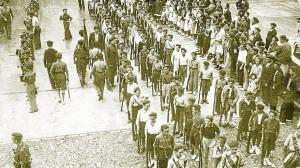
Children and teenagers from Azkoitia stand armed in lines in the town square, via Azkoitia iruditan by Juan Luis Olalde
Despite the negotiation, the arrangement failed to protect everyone. Six Carlist Requetés from Azkoitia, who had been held in custody by the Republicans, managed to escape during the confusion. However, they were subsequently recaptured by retreating left-wing militiamen and executed at Iraeta on 20 September. These deaths occurred precisely during the chaotic hours when Republican forces were abandoning the Urola valley and Nationalist troops were entering directly behind them.
.
The Nationalist column commanded by Pérez Salas, which included four companies of the Carlist Tercio de Montejurra, officially occupied Azkoitia on 20 September 1936. By the time they established full operational control, an unknown number of civilians had already fled the town. The documentation of a single local household illustrates the heartbreaking decisions families faced during the evacuation: Claudio Zubizarreta Zabalo fled the town with four of his sons, travelling by bus and lorry towards the coastal enclave of Saturraran and later Gernika, while his wife and daughter remained behind in Azkoitia. Three of the fleeing sons were actively serving as gudaris (soldiers) for the Basque Nationalist Party (PNV).
.
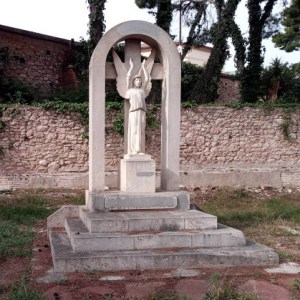
Picadero de Paterna, to commemorate the site where many were executed in Valencia, via Wikimedia Commons
Paterna, Valencia
Between 20 and 25 September 1936, this internal cleansing reached a distinct peak across the region, resulting in coordinated mass executions of religious sisters and educators at notorious execution zones like the Picadero de Paterna. The execution wall at the Picadero de Paterna, a firing range turned into a dominant execution site for leftist militias, witnessed a major single-day tragedy. A group of 17 religious women were systematically rounded up from their civilian hiding places and executed at the Picadero de Paterna, a military firing range on the outskirts of Valencia.
.
On 22 September 1936, the rearguard terror claimed three members of the Hermanos de las Escuelas Cristianas (Brothers of the Christian Schools). The three De La Salle Brothers had fled their schools to find refuge among sympathetic local families, but they were hunted down, arrested, and executed together in the village of Benimaclet.
.
Two days later, Paterna became the site of another major religious massacre. A group of eleven Carmelite religious women was extracted from their temporary urban shelters by armed patrols. They were driven to the outskirts of the town and summarily shot against the execution walls. This execution stands as one of the most securely dated and devastating single-day campaigns against a specific female religious order during the entire autumn phase in Valencia.
.
The violence against institutional caretakers culminated in the capital city of Valencia. The Casa de la Misericordia (House of Mercy) was a prominent charitable facility dedicated to housing orphans and the destitute. On 25 September 1936, militias carried out an administrative saca of the compound, seizing 11 religious women associated with the institution. The 11 Carmelite Sisters of charity captured from the Casa de la Misericordia (House of Mercy), who were executed at the Paterna firing range across 24 and 25 September, were exhumed from the communal trenches shortly after the war ended.
.
The three De La Salle Christian Brothers initially dumped into the general Valencia Municipal Cemetery mass grave were removed and reburied in the 1940s and relocated to a dedicated pantheon and crypt built for the martyred educators at the La Salle regional house and novitiate in the Valencia province.
.
For the estimated 17 anonymous religious women killed on 20 September, the process was more fragmented. Because their individual identities had not yet been fully recorded in the municipal registry at the time of death, they were initially moved during the post-war excavations to the Common Crypt of the Fallen (Cripta de los Caídos) inside the Valencia Cemetery. Over the decades, local diocesan historical groups have successfully identified several of these individuals by name, leading to their reburials inside the home convents of their respective religious orders.
Related
Got a comment, question or suggestion? Know who took a photo? Have questions about a particular date or event? Cancel reply