The period between 8 and 15 September 1936 represents the peak of the Terror Blanco in western Andalucia and Extremadura. Between 8-15 September immediate localised coups and systematic, military-led territorial sweeps as Nationalist forces under General Queipo de Llano secured the southwestern mining basins and pushed north toward Madrid. By early September 1936, Nationalist columns were aggressively expanding out of Seville and Huelva capital to crush the heavily unionized, left-leaning rural and mining communities. Towns like La Granada de Riotinto, Campofrío, Nerva, and Minas de Riotinto were major targets because their populations consisted heavily of organized miners and agrarian workers who had fiercely resisted the July coup, and by mid-September, the Nationalist approach and encirclement of these communities was almost complete. When towns fell on or around September 15, the limpieza social, social cleansing began immediately.
.
Nationalist execution squads operated under the Bando de Guerra, which criminalised anyone associated with the Second Spanish Republic, leftist parties, or trade unions. To avoid localized uprisings or out of administrative convenience, Nationalist forces frequently used proxy transports. Victims rounded up in one town (such as Campofrío) during the week were driven to a neighbouring municipal cemetery (like La Granada de Riotinto) to be shot against the cemetery walls and buried in anonymity, Executioners intentionally avoided filing legal death certificates during this window to obscure the scale of the slaughter. Families were left completely in the dark, and victims were dumped into roadside ditches or mass graves. The extreme violence in the Huelva-Badajoz border region triggered the historic panic that culminated on 17 September 1936, with the tragic exodus of the Columna de los 8,000, thousands of terrified rural citizens fleeing the exact rearguard terror that was consuming the Riotinto basin.
.
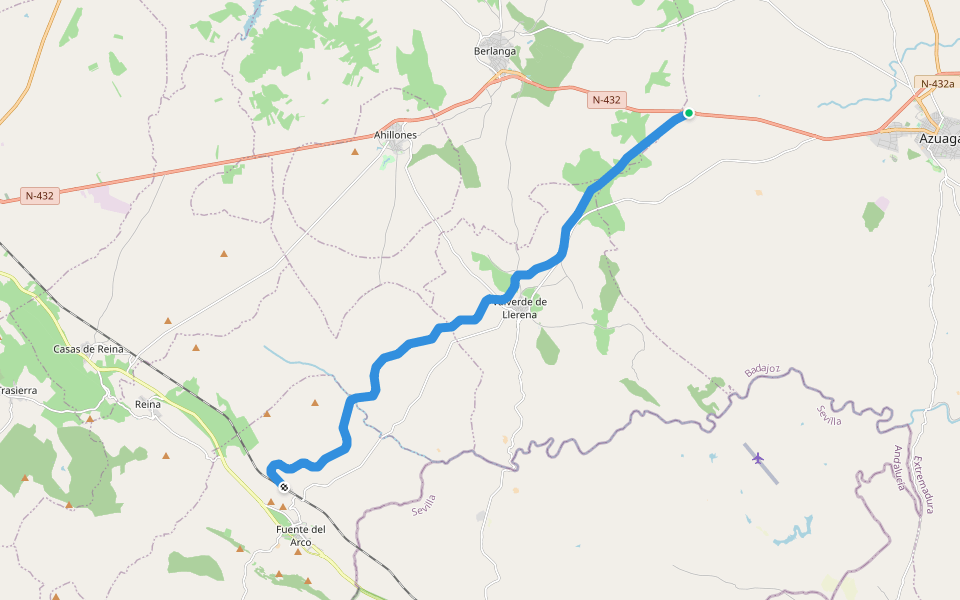
Puerto del Pencón, Reina, Fuente del Arco, and Llerena in Badajoz, Extremadura
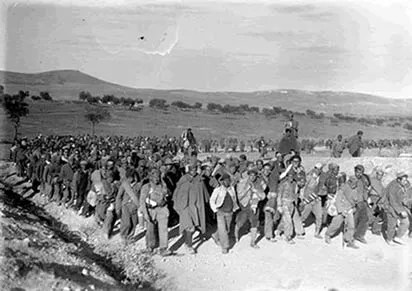
Rare photo of the column of refugees, via Digital Assembly Magazine
On the evening of 17 September 1936, the tragic ambush at Puerto del Pencón near Reina and Fuente del Arco shattered the fleeing Column of 8,000. As the massive civilian exodus neared the safety of Republican-held territory, Nationalist military forces under General Gonzalo Queipo de Llano intercepted the human wave. What began as a desperate journey for survival transformed into a bloody slaughter and mass imprisonment. By the time darkness fell on 17 September, the exhausted column had left open paths behind to navigate the local cattle tracks known as the Cañada Real del Pencón. Unbeknownst to the civilian leadership, Nationalist troops had reinforced the Llerena sector and positioned heavy machine-gun nests on the high ground overlooking the ravine.
.
Flanked by Nationalist cavalry and motorised patrols, the column found its advance blocked just as the terrain narrowed near the municipal boundaries of Reina and Fuente del Arco. As the first light broke or under the cover of the evening approach, the Nationalists opened fire with devastating, indiscriminate machine-gun volleys directly into the crowd of families. Caught in open terrain with no heavy defensive cover, the thin line of protecting militiamen was quickly overwhelmed. Panic tore through thousands of children, women, and elderly people.While the main guard collapsed, small groups of agile individuals and resilient fighters managed to break through the tightening lines, scrambling across the open countryside toward the safety of loyalist positions in Azuaga and La Serena.
.
For those unable to outrun the machine guns, the aftermath was catastrophic. Historical findings compiled by researchers at Todos los Nombres detail the fate of the captured. Roughly 2,000 refugees, predominantly men suspected of union or leftist political ties, alongside stranded families, were rounded up at gunpoint, and were marched under heavy armed guard to the nearby town of Llerena. Over 80 to 100 people were killed directly during the initial machine-gun ambushes on 17–18 September. Most were buried where they fell in clandestine trenches and mass graves along the Cañada Real del Pencón cattle track and nearby fields. In the days and weeks following the capture, military tribunals and firing squads executed hundreds of prisoners inside Llerena’s municipal limits. Others were packed onto trucks and sent back to their original towns in Badajoz and Huelva to face local purges.
.
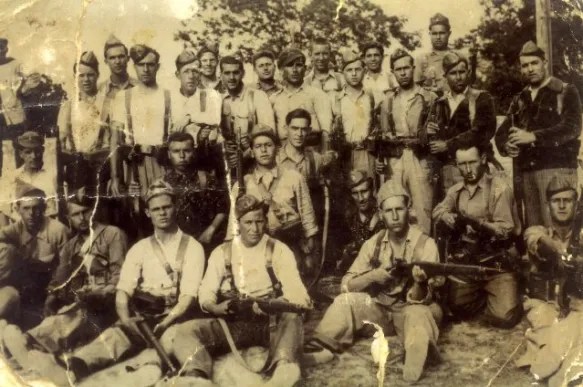
Militiamen that travelled with the column of refugees, via Digital Assembly Magazine
Many fleeing civilians panicked during the ambush and tried to walk all the way back to their home villages in south-western Badajoz and northern Huelva. Upon arrival, they were rounded up by local Falangist execution squads, shot, and buried in the local village graveyards to serve as a public warning. Historians estimate that out of the roughly 8,000 people who started the trek, approximately 5,000 to 6,000 people successfully escaped into Republican-held territory. Despite the heavy machine-gun fire and cavalry, the sheer volume of the human wave fractured the Nationalist lines. Most of the successful escapees crossed safely into the Republican enclave of Azuaga and the broader La Serena region. From there, many fled further east toward Ciudad Real, Toledo, and Madrid to escape the advancing Nationalist armies. However, their safety in Azuaga was short-lived, as Nationalist troops captured the town just a week later on 24 September 1936.
.
For decades, the victims of the Column of 8,000 lay forgotten in anonymous pits. Modern exhumation efforts led by historical memory associations and forensic archaeologists have recently uncovered the remains of dozens of victims along the route of the tragedy. Driven by funding from the Spanish Ministry of Democratic Memory, these scientific excavations are slowly providing answers to grieving families. The most significant archaeological breakthroughs regarding this tragic exodus have occurred at the Cemetery of Valverde de Llerena. In May 2025, a team of archaeologists directed by Sheila Romero from the heritage firm Almena began excavating one of the largest Francoist mass graves in the region. Located at the municipal cemetery of Valverde de Llerena, teams discovered stacked skeletons and personal items.Initial phases uncovered at least nine bodies, but experts estimate the site contains between 26 and 30 victims from the September 1936 repression, and relied heavily on the oral memory of local elderly residents to pinpoint the exact location.
.
Cañada Real del Pencón, via Pacing Walking App
As the primary destination where the 2,000 captured refugees were marched, Llerena became a focal point for systematic executions. Forensic excavations along the Arroyo Romanzal stream bed exposed multiple mass graves. Academic papers archived by the digital memory platform Todos los Nombres note that these graves provide stark evidence of the rapid execution patterns used by Nationalist troops to manage the massive influx of prisoners. The gateway town where refugees first gathered before marching has also seen multi-phase excavations. A major exhumation initiative in 2012 successfully recovered the skeletons of 43 victims. Subsequent fieldwork led by forensic anthropologist Laura Muñoz-Encinar uncovered five extra mass graves. The skeletal remains showed high levels of perimortem trauma and severe violence directed at female victims. Archaeologists noted an unusually high percentage of women in these specific Badajoz graves. The historical and physical data showed that these were not combatants, but rather the wives, daughters, and sisters of Republican men who had already fled. When Nationalist forces occupied the towns and found the men gone, they rounded up the female relatives as a proxy punishment.
.
Many female skeletons were uncovered still wearing high-heeled shoes, dress sleeves, and fine domestic items, proving they were snatched directly from their homes during routine daily life or during sudden village round-ups, leaving them no time to change into practical clothes for travel or flight. Other items found directly with their remains included everyday hairpins, hair combs, tie garters, and small domestic items like thimbles, pins, and small sewing kits that women carried in their pockets.
.
While male bodies were often thrown in sequentially, female bodies frequently showed unnatural, erratic skeletal positioning, left exposed on top of the pile.. Anthropologists noted that women were often grouped in specific areas of the pit and were frequently the last to be thrown into the mass grave. The chaotic orientation of the limbs and pelvic bones strongly correlated with historical oral testimonies regarding the systematic rape, head-shaving, and physical defilement of ‘Red’ women before they were shot by Nationalist troops and Falangist paramilitaries. One of the most horrific findings confirmed by Dr Muñoz-Encinar’s physical anthropological studies was the presence of multiple pregnant women among the executed in the Llerena and Fregenal de la Sierra sectors. The discovery of fetal skeletal structures within the pelvic cavities of the victims provided undeniable physical proof of a total war doctrine where even unborn children of suspected leftists were systematically eliminated.
.
Many mass graves along the Cañada Real del Pencón cattle track, where the actual ambush occurred, remain difficult to locate or exhume. Decades of agricultural clearing, changing property lines, and infrastructural growth have buried the trenches under deep layers of earth. However, local activism remains incredibly strong. Annual commemorative marches organized by groups like the Asociación de la Columna de los Ocho Mil continue to lobby for institutional support to search the open fields between Reina and Fuente del Arco.
.
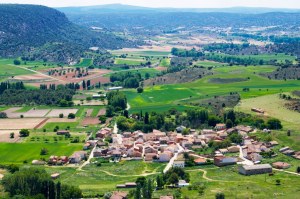
Huérmeces del Cerro today, via Wikimedia Commons
Cuidad Real, New Castile
Between 17 and 21 September 1936, the fractured remnants of the Column of 8,000, having survived a devastating military assault by nationalist forces near Fuente del Arco and Reina in southwest Badajoz—pushed eastward into Ciudad Real province, where local republican authorities organized a critical railway evacuation to transport traumatized refugees deeper into central Spain.
.
While thousands had been capturedand later subjected to summary executions in Llerena or forced back to their towns of origin, a battered contingent managed to slip through the net, pressing eastward on foot and across rudimentary tracks toward the provincial border of Ciudad Real. Entering Ciudad Real province over the subsequent days, these bedraggled survivors encountered a landscape that, while still firmly under Republican control, was rapidly mobilizing to absorb the human shockwave of the war’s early months. Local committees, railway workers, and civil defence groups recognized that leaving thousands of exposed refugees lingering near the frontlines would invite further catastrophe. The immediate imperative shifted from a disorganised retreat on foot to a coordinated logistical rescue centred around the regional railway network.
.
Between 18 and 21 September, improvised and scheduled trains were marshalled at key junction points within reach of the fleeing crowds. Stations in and around the eastern approaches became frantic hubs of activity where exhausted families, many carrying only livestock or small bundles of possessions, were loaded onto packed freight and passenger carriages. The railway evacuation moved thousands of these displaced people eastward toward safe havens in non-combat zones, functioning as a vital lifeline that prevented total encirclement and annihilation by the fast-moving insurgent columns. The narrow window of rescue between 17 and 21 September highlights both the absolute chaos of the early Spanish Civil War and the quiet heroism of infrastructural resistance. While the massacre at Fuente del Arco permanently scarred the memory of Extremadura’s rural communities, the subsequent transit through Ciudad Real demonstrated how the republic’s rail arteries could be weaponised for humanitarian survival, turning a military rout into an organised evacuation that saved thousands from the advancing terror.
.
But for the traumatised survivors of the Column of 8,000, entering Ciudad Real province was a profoundly jarring experience. They transitioned from the immediate horror of military slaughter into a starkly different, yet deeply strained, sanctuary. Ciudad Real was firmly in Republican territory, which meant the refugees were no longer actively hunted by Nationalist cavalry or artillery, but it was not a peaceful haven. The province was under intense wartime strain. In September 1936, the region was adjusting to its own internal turmoil, having faced an explosion of political tension, local executions, and structural breakdown over the summer. The atmosphere was chaotic, hyper-vigilant, and resource-thin. The cities and towns were operating under the control of local revolutionary committees and militiamen who were trying to coordinate a war effort while suddenly being flooded by thousands of destitute, terrified peasants from Extremadura.
.
The initial points of relief for those who slipped through the Nationalist lines near Fuente del Arco were the mining towns and railway hubs closest to the Badajoz-Ciudad Real border, like
Almadén, this heavily leftist, union-dominated town served as the first major geographical bastion of safety. Survivors who trekked across the rural tracks found immediate refuge here. Nearby Puertollano was a crucial industrial and railway town further east. It became the primary assembly point where fleeing families were gathered, triaged, and organised for deeper transit into the interior. The provincial capital of Cuidad real city station served as a critical sorting mechanism. The survivors rarely stayed long in the city itself; the goal was to keep the human flow moving toward Madrid, Valencia, or La Mancha via the rail lines.
.
The reception from the local populace was generally deeply empathetic, but severely limited by poverty and wartime shortages. The towns they entered were populated heavily by workers, miners, and agrarian labourers who shared strong political and class solidarity with the refugees. The local population viewed the survivors not just as victims, but as companions in the struggle against the Nationalist advance. Improvised relief was set up by local committees, the Socorro Rojo Internacional (Red Relief International), and trade unions. Locals provided water, basic medical aid for those wounded at Fuente del Arco, and simple rations like bread, oil, and stews. Despite the goodwill, the aid was rudimentary. The province was already experiencing supply chain issues. Refugees were often housed in crowded public buildings, warehouses, or left waiting on open-air railway platforms. While the locals shared what they had, there simply was not enough infrastructure to comfortably sustain thousands of unexpected, traumatised people.
.
The transformation of Ciudad Real from an ordinary province into a massive logistical transit net was orchestrated by local committees, predominantly driven by the Unión General de Trabajadores (UGT) and the anarcho-syndicalist Confederación Nacional del Trabajo (CNT). These traditional ideological rivals enacted an emergency pact of functional solidarity to handle the human catastrophe. The Sindicato Nacional de Ferroviarios (National Railway Union) took direct control of the tracks, rolling stock, and signalling systems. Unionized rail workers manually rerouted empty freight wagons (vagones de mercancías) from central depots down to the border branch lines, overriding standard timetables to prioritise humanitarian extraction. They oversaw communal kitchens on or directly adjacent to the station platforms, where they established giant cauldrons to produce basic, high-yield caloric sustenance like pucheros (chickpea and potato stews), bread rations, and coffee.
.
Because the Column had been shelled and fired upon heavily at Fuente del Arco, hundreds of survivors arrived with infected shrapnel wounds, lacerations from fleeing through thick brush, and severe dehydration. Trade union militias commandeered local schools and public buildings around the stations, turning them into temporary clinics staffed by volunteer doctors and nurses who rationed scarce medical gauze and antiseptics. Primary accounts and historical analyses paints a devastating picture of the refugees as they poured into the Ciudad Real stations. The column was not an army; it was an entire community in flight, consisting of landless day-labourers (yunteros), elderly peasants, pregnant women, and terrified children. Witness accounts from local railway staff described the arrivals as ghostly crowds. Having marched for days under a scorching late-summer sun, pursued by Nationalist cavalry and aircraft, many arrived shoeless, their feet bound in bloody rags. The psychological trauma was immense, as families had been separated during the panic at Fuente del Arco, and many mothers arrived holding children while completely unaware if their husbands had been captured or executed in Llerena. Refugees clutched meager remnants of their old lives. Witnesses noted that many refused to abandon their draft animals, attempting to load goats, pigs, or mules directly into the passenger and freight cars. Those without animals carried small, knotted bundles (hatillos) containing basic clothing, family photos, or a single iron cooking pot. Upon reaching the safety of the packed platforms, a mix of overwhelming relief and chaotic despair took over. The noise was described as deafening, filled with the cries of lost children, the bleating of livestock, and the shouting of union volunteers trying to force as many bodies as possible into the wooden freight wagons before the next train needed to depart.
.
The first major escape route began at the Almadenejos-Almadén station using the Ciudad Real–Badajoz Line managed by the MZA railway network. Evacuation trains picked up fleeing civilians here and moved them through Almodóvar del Campo and Puertollano. From these intermediate stops, the refugees arrived at Ciudad Real Capital, where authorities sorted them and sent them northward toward Madrid’s Delicias Station or eastward to Albacete. The second route started at the Puertollano Junction and utilized the Puertollano–Valdepeñas Narrow Gauge line. These trains traveled through Calzada de Calatrava and Granátula de Calatrava before reaching Valdepeñas. At Valdepeñas, passengers connected to the main railway artery that led south toward Andalusia or east toward the Levante and Valencia regions. The third route operated from Puertollano Suroeste along the Peñarroya–Puertollano Mining Line owned by the SMMP network. This line transported refugees through small industrial and mining stops like Conquista and San Quintín. It integrated displaced workers and their families directly into the wider regional network across (New Castile/La Mancha.
.
Guadalajara, New Castile
Between 17-19 September 1936, the rugged northern highlands of Guadalajara province became the stage for a fierce, fast-paced battle as Republican militias launched a localised counter-attack to halt the Nationalist advance toward Madrid. Centred around the strategic hamlets of Huérmeces del Cerro and Jodra del Pinar, this mini-operation illustrated the volatile, fluid nature of front lines during the opening months of the Spanish Civil War, even though the fighting usually only had between a few dozen to 100 men in action at a time.
.
The mini-offensive began in earnest on 17 September 1936, when Republican forces encountered advancing Nationalist troops near Huérmeces del Cerro. Facing a well-armed rebel column pushing south from the Sigüenza axis, local Republican militias and regular units put up stubborn resistance, temporarily halting the Nationalist momentum in the rocky terrain. Capitalising on this defensive stand, the Republican command quickly organized an offensive manoeuvre. On 18 September, Republican forces launched a spirited counter-attack directly against the Nationalist lines at Huérmeces. This tactical push forced the Nationalist troops onto the defensive, throwing their immediate operational plans into temporary disarray.
.
The Republican momentum immediately rippled eastward across the valley. On the same day, 18 September, Republican columns drove forward and successfully recaptured the nearby town of Jodra del Pinar. By capturing Jodra, the Republican forces briefly severed a crucial tactical axis used by the Nationalists to link their frontline units, threatening to unhinge the entire right flank of the rebel advance. Recognizing the danger of a wider breakthrough, the Nationalist command immediately diverted reinforcements to the sector. Between 18 and 22 September, the entire Huérmeces–Jodra sector became engulfed in sustained, bitter combat. Both sides threw localized reinforcements into the line, refusing to yield the high ground. This heavy four-day window of continuous fighting exhausted both forces’ offensive capabilities. It effectively froze the pocket, locking the northeastern gateway to Madrid into a permanent trench line.
.
The towns of Huérmeces and Jodra sat directly on the southern flank of Sigüenza, a major railway hub and the ultimate Republican stronghold in northern Guadalajara. By counter-attacking here, the Republican militias successfully disrupted the Nationalist schedule This localized operation bought the defenders inside Sigüenza nearly three additional weeks to fortify the city. If the Nationalist columns had broken through Huérmeces and Jodra unimpeded, they would have gained a clear path into the Henares River valley. This valley contained the main railway line and highway linking Madrid to Guadalajara and Zaragoza. Keeping the Nationalists bogged down in the northern highlands kept this vital supply artery open for the Republic during a critical month of the war.
.
This mini-operation marked the exact moment the war in Guadalajara changed structural forms. It proved to both high commands that the era of rapid, unchecked motorized column advances (guerra de columnas) was over in this sector. Because the territory changed hands twice in 48 hours, both forces realized they could not hold the open ground, forcing them to build the permanent, heavily fortified trench systems that froze the Guadalajara front line for the next two and a half years.
.
In September 1936, the Republic was suffering catastrophic defeats across the south and west of Spain (losing Badajoz, Talavera, and Ronda in rapid succession). The ability of poorly trained, improvised militias to launch a coherent, multi-town counter-attack and actively recapture territory, even briefly, was a massive boost to Republican morale in the central zone, proving that Franco’s forces were not entirely unstoppable.
.
Cervera, Lleida, Catalonia
On the night of 17 September 1936, the rearguard of Lleida province experienced one of its most tragic anti-clerical massacres when Republican militiamen executed 15 elderly, sick, and incapacitated Claretian monks at the Cervera municipal cemetery. During the chaotic opening months of the Spanish Civil War, Catalonia was gripped by a deep public-order crisis. While the central Republican government struggled to maintain control, revolutionary committees and local militias operated with near-total autonomy, unleashing a fierce wave of political and religious purges across the region. In the municipality of Cervera, this ideological violence targeted the local Claretian missionary community.
.
When the conflict erupted in July, the main Claretian university and house in Cervera were seized and dissolved. While many younger monks scattered or went into hiding, 15 members of the community remained behind at the local hospital due to their advanced age, severe illness, or physical incapacitation. Because they were completely bedridden or otherwise physically vulnerable, these men posed no conceivable military or political threat to the revolutionary authorities. Despite their condition, a band of local militiamen targeted the hospital on the night of 17 September. The 15 elderly and sick Claretians were forced from their beds, loaded into vehicles, and driven under the cover of darkness to the outskirts of the town. Upon arriving at the Cervera municipal cemetery, the militiamen lined the monks up against the wall and summarily executed them by firing squad.
.
Girona, Catalonia
On 17 September 1936, five Catholic priests were tortured and executed by Republican militia at the Llar del Soldat in Figueres, marking one of the most brutal localised incident in a month that saw six clergy members systemically murdered across the Girona province. The collapse of central law and order following the July 1936 military coup left much of Catalonia under the decentralised control of autonomous revolutionary committees and militia factions . In the Girona province, this unchecked authority fuelled an intense, widespread anti-clerical purge targeting the Catholic Church.
.
The violence peaked in the municipality of Figueres on 17 September 1936. A group of five local priests, Joan Ciurana Oliver, Lluís Perramón, Ramon Vilar, Alexandre Cristià, and Francesc Calvet, were rounded up by militiamen. The captive clergy were taken to the Llar del Soldat (the Soldier’s Home), a facility directly associated with the sweeping historic fortress of Figueres Castle/Sant Ferran Castle. The five men were subjected to severe torture inside the complex before being summarily shot. This targeted execution of non-combatant clergy underscored the deep ideological and religious animosity driving local armed groups operating behind the front lines. The exhumation reports note extensive fractures, blunt force trauma, and bruising inflicted antemortem, indicating that they were severely beaten and abused while detained at the Llar del Soldat complex before being shot. Individuals living near the castle and the Llar del Soldat area provided sworn testimonies regarding the screams heard from the facility on the night of 16–17 September.
.
The massacre at Figueres was part of a relentless, broader campaign of violence that swept through the region during late summer. According to extensive research compiled within the archives of the Girona diocese, 62 clergy and religious members were killed during September. The social and ecclesiastical profiles of the 62 victims highlight a deliberate, systematic effort to dismantle both the local parish structure and the educational or monastic networks of the Church. The vast majority were everyday parish priests embedded in rural and municipal communities throughout the province, targeted for their religious office. The remaining victims belonged to various monastic, missionary, or teaching congregations operating within the diocese.
.
While historical records indicate that August 1936 had been even deadlier in the province, accounting for 79 religious deaths, the 62 murders recorded in September proved that the region remained an exceptionally violent sector of the Republican rearguard. The lack of state control allowed autonomous militia units to carry out unchecked violence against religious figures well into autumn, leaving an indelible scar on the region’s history.
.
Vitoria and Villarreal, Álava, Basque Country
In September 1936, Vitoria was firmly under Nationalist control, as was most of Álava, but it was not far behind the front. The city had a population of roughly 40,000, and served as the province’s principal Nationalist administrative, military and supply centre. Republican-held territory began only about 15km to the north, around Villarreal/Legutio and Monte Albertia, while the roads through Álava provided Nationalist troops with routes towards the remaining Republican-held areas of Gipuzkoa and Bizkaia. Vitoria consequently functioned both as a secure Nationalist headquarters and as a city close enough to active fighting to face Republican air attack, including the 17 September bombing, while troops, aircraft and supplies passed through the city and its Salburua aerodrome.
Around 40,000 people lived in Vitoria in 1936. The city had been under Nationalist control since July, but the Republican front remained remarkably close: positions north of the city around Villarreal/Legutio and Monte Albertia were only about fifteen kilometres away. On 17 September 1936, Republican aircraft operating from the northern Republican zone had bombed Vitoria. The surviving material establishes the raid and its effect on the Nationalist authorities, but I cannot establish a reliable figure for civilian deaths or wounded from this particular attack. It would be misleading to supply one. The raid demonstrated that Vitoria, despite being securely controlled on the ground by the Nationalists, remained within reach of Republican aviation.
.
Local Nationalist authorities responded by asking for additional aircraft to protect the city. On 26 September, six German Heinkel He 51 fighters arrived at the José Martínez de Aragón aerodrome at Salburua, east of Vitoria, accompanied by six German pilots and mechanics. The men and aircraft belonged to the German military assistance already being supplied to the Nationalists; the Condor Legion itself would not be formally organised until November.
.
The German personnel were lodged at the Hotel Frontón in Calle San Prudencio, without being entered normally in its register because their presence was intended to remain discreet. That secrecy lasted poorly after Mayor Pedro Rafael Santaolalla Aparicio, Civil Governor Cándido Fernández Ichaso and military representative Ángel García Benítez gave the Germans an official reception at the Ayuntamiento. Each received a silver medal bearing the Virgen Blanca, followed by a reception and dinner at the Círculo Vitoriano. The visit produced an unexpected civilian tragedy two days later. On the morning of 28 September, twenty-five-year-old German pilot Ekkehard Hefter flew over the centre of Vitoria as part of a gesture of thanks to the city authorities. His Heinkel struck an obstacle and crashed at the Plaza de España, killing Hefter and two local men on their way to work: Antonio Peral Maza, a twenty-nine-year-old milkman, and Vicente López de Lacalle, a twenty-year-old blacksmith.
.
Within eleven days, Vitoria had experienced a Republican bombing raid, received six German fighters and their crews, and suffered three deaths when one of those aircraft crashed into the centre of the city. While Republican aircraft were attacking Vitoria on 17 September, Republican troops were also fighting immediately north of the city around Villarreal de Álava, now Legutio, and Monte Albertia. The front here lay only about fifteen kilometres from Vitoria, with Republican-held territory extending south from Bizkaia towards the Álava plain.
.
Villarreal was a small municipality of roughly 1,500 inhabitants, surrounded by high ground controlling roads between Vitoria and northern Álava. Monte Albertia, rising immediately to its east, gave whoever occupied it observation over the approaches towards Villarreal and the routes leading south towards the Nationalist-held provincial capital. Between 17 and 20 September, Republican troops attacked Nationalist positions in this sector. These operations involved Republican and Basque militia attempting to push southwards from their positions around Villarreal and Albertia while Nationalist troops based in Álava held the approaches to Vitoria. The surviving provincial chronology confirms four days of fighting, but I cannot establish reliable strengths or casualty totals for these September attacks. They should not be confused with the much larger Battle of Villarreal beginning on 30 November, for which considerably better figures survive.
.
The September fighting did establish something important about the geography of the war in Álava, that though the Nationalists controlled Vitoria and most of the province, armed Republican positions remained within roughly fifteen kilometres of a provincial capital of about 40,000 people. The front north of Vitoria remained active after 20 September and would become one of the principal battlefields of the northern war later in the year.
Related
Got a comment, question or suggestion? Know who took a photo? Have questions about a particular date or event? Cancel reply