The fall of Ronda on 16 September 1936 was a decisive Nationalist military victory in southern Andalucía led by General José Enrique Varela that shattered the Republican mountain barrier and established a permanent rebel base in the Serranía de Ronda. This pivotal event marked the collapse of Republican defensive lines in the high mountain plateau and signalled the aggressive expansion of General Francisco Franco’s forces into the rugged borderlands between Málaga and Cádiz.
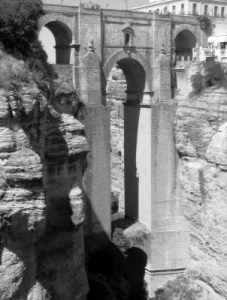
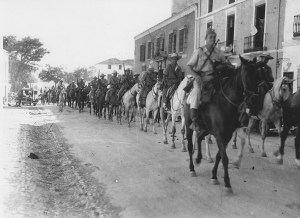
On the morning of 16 September 1936, troops under the command of General José Enrique Varela converged on Ronda. The approach involved a severe artillery bombardment that softened the town’s perimeter. This was followed by fierce, chaotic street fighting as disorganized local Republican militias attempted to hold the historic clifftops. General Varela commanded an estimated 2,500 to 4,000 troops during the push through the Serranía. The core of this force relied on the Army of Africa, featuring battle-hardened Moroccan Regulares and the Spanish Foreign Legion, supported by local Guardia Civil and right-wing Falangist paramilitaries. A crucial moment occurred when the fast-moving Regulares successfully charged and secured Ronda’s historic Puente Nuevo (New Bridge). This tactical push prevented the retreating Republican militias from detonating explosives to destroy the bridge, keeping the city’s primary transit route intact.
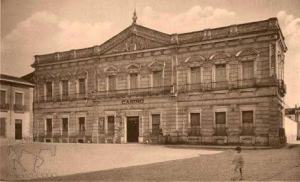
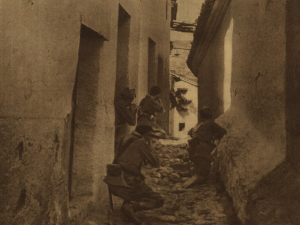
Soldiers arrive in Ronda
Ronda was defended by an estimated 1,500 to 3,000 armed individuals, a force consisted of improvised worker militias organized by the Anarchist CNT-FAI and socialist unions . They possessed very little heavy artillery, suffered from severe ammunition shortages, and lacked a unified military command structure. Outgunned and completely encircled, the Republican defenders withdrew through the ravines, leaving Varela in undisputed operational control. Ronda was instantly transformed into the dominant Nationalist command centre for subsequent operations across the Serranía.
The impending violence and fear of reprisals triggered an immediate humanitarian crisis. A substantial portion of Ronda’s population fled before or during the military occupation. Thousands of desperate civilians and Republican loyalists headed east on foot through the rugged mountain terrain toward Republican-held Málaga, severely straining the coastal city’s housing and food supplies just months before the infamous Desbandá tragedy. For those who remained, the Nationalist victory initiated an immediate and systematic purge of the local rearguard. Historical and forensic investigations of Ronda’s cemetery have identified four distinct mass graves containing an estimated 425 victims, with 203 documented deaths linked directly to the brutal initial pacification phase. The new military authorities systematically rounded up and executed municipal officials, trade unionists, and anyone suspected of supporting the Popular Front government.
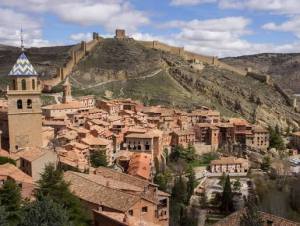
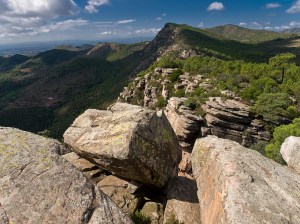
Albarracín today, via Wikimedia Commons
Albarracín, Teruel, Aragon
By the end of the summer of 1936, the rugged and historic Albarracín comarca in the Teruel province of Aragon had become a fractured, terrifying landscape. As General Francisco Franco’s rebel Nationalist forces consolidated their control over western Teruel following the July military coup, a systematic campaign of rearguard political cleansing was unleashed across the region. Rather than experiencing front-line combat during this initial phase, the towns and villages nestled in the Sierra de Albarracín were subjected to a targeted, calculated purge aimed at permanently erasing anyone loyal to the Second Spanish Republic.
Albarracín, Teruel, Aragon
Following the swift collapse of Republican resistance in the capital city of Teruel and its surrounding areas, Nationalist columns and local right-wing paramilitaries secured the remote mountain territory. In villages like Gea de Albarracín and the regional capital of Albarracín itself, the arrival of the rebel forces signalled an immediate breakdown of civil liberties. Local authorities, trade unionists, and agrarian labourers who had championed the Popular Front were systematically hunted down. Under the cover of darkness, paramilitary squads carried out paseos, victims were removed from their homes, driven to isolated stretches of highway or cemetery walls, and summarily executed.
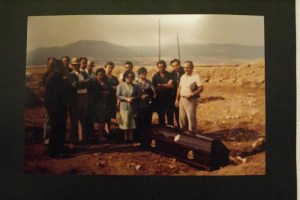
Gea de Albarracín, in Teruel, in 1979 when the families privately moved the bodies, via Asociación Pozos de Caudé
On the night of 16 September 1936, a group of 12 residents from the neighbouring town of Cella, all of them men targeted for their political leanings or labour activism, were transported by their captors into the valley. They were taken to a secluded point along the main secondary road that cuts through the rugged terrain to connect the local municipality with Albarracín. Forced out into the brush, approximately 20 meters from the asphalt, the twelve men were shot and buried in a shallow, unmarked trench. For decades under the Francoist dictatorship, this site remained an unmentionable scar on the local landscape, an open secret protected by a forced institutional silence.
.
The mass grave is located precisely on the right side of the road connecting the town with Albarracín, about 2kms from Gea. In the decades following Spain’s transition to democracy, grassroots historical memory organizations stepped forward to document the site and restore dignity to those lost in the brush. A commemorative plaque was erected at the site, officially documenting the circumstances of the late-night killings and clearly bearing the names of the 12 murdered men from Cella. In 2022, a dedicated commemorative sculpture was formally installed next to the original plaque. The artwork serves as a permanent visual anchor along the highway, transforming what was once a hidden symbol of wartime terror into a public space of mourning, historical recognition, and democratic reflection.
Jaca, Huesca, Aragon
Jaca became a central hub of Nationalist terror and extrajudicial executions in northern Huesca during September 1936, with the Campo de Tiro de Batiellas serving as the primary killing site for the region. Following the military coup in July 1936, Jaca remained firmly under Nationalist control. Cut off from the Republican zones and isolated in the high Pyrenean foothills, the town’s new authorities quickly established a rigid apparatus of control. Local Republican officials, trade unionists, left-wing political figures, and suspected loyalists of the Second Spanish Republic were targeted in a systematic wave of arrests.
The local military authorities utilized the Campo de Tiro de Batiellas, a military firing range located just outside the town limits, as an isolated execution ground. Detainees were brought to the range under the cover of darkness or during sequestered military operations, shot by firing squads, and subsequently buried in anonymous graves in and around Jaca.
.
Surviving documentation from the historical memory and disappeared-persons records of Aragon exposes the relentless pace of these murders during September 1936. The records highlight two distinct waves of concentrated violence during the month. The first wave occurred mid-month, recording six people executed at Batiellas on 16 September, followed immediately by another eight executions on 17 September. After a brief lull in front-line movements and local pacification sweeps, a second, intense wave of killings struck at the end of the month. Archival data records three deaths on 28 September, seven deaths on 29 September, and four additional deaths on 30 September. In total, these specific dates account for at least twenty-eight documented murders at the Batiellas firing range, illustrating how the Nationalist rearguard systematically eliminated perceived internal enemies far behind the active front lines of Aragon.
.
Alcázar de San Juan, Cuidad Real, via Memoria Democratica
Cuidad Real, Old Castile
The Alcázar de San Juan witnessed one of the largest concentrated episodes of Republican rearguard violence in Cuidad Real between 16-19 September 1936, resulting in at least 35 executions carried out by the Batallón Mancha Roja after a fatal Nationalist air raid. On 16 September 1936, the strategic railway installations and CAMPSA fuel depot in Alcázar de San Juan were struck by the first documented Nationalist air attack in the Ciudad Real province. The aerial bombardment caused the death of a young local girl, which immediately triggered profound grief and fury among the civilian population.
.
In the wake of the attack, a volatile public demonstration emerged in the town. Socialist Mayor Domingo Llorca and communist leader Emilio Tajuelo addressed the gathered crowds and publicly demanded immediate retaliation against suspected right-wing dissidents and detainees held locally. Spurred by these fiery speeches, members of the local militia unit, the Batallón Mancha Roja, launched a massive saca. Detailed historical research establishes that 35 people were murdered on 16 September alone, and continuing systematically through 19 September and cementing the event as one of the darkest chapters of internal rearguard violence in La Mancha.
.
Because Alcázar de San Juan was a prominent economic hub in the La Mancha region, it had a well-defined upper-middle class. The Batallón Mancha Roja, composed primarily of radicalized left-wing railway workers, socialites, and unionists, viewed local landowners (propietarios), wealthy agrarian elites, and conservative business owners as natural economic oppressors who intrinsically supported the military coup. Several prominent local businessmen and property owners were dragged from their homes or the municipal detention centres to the cemetery gates on 16 September.
A primary target group consisted of members and local organizers of right-wing parties. This included individuals affiliated with the conservative CEDA (Spanish Confederation of Autonomous Right-Wing Groups) and the radical, fascist Falange Española. Anyone who had actively campaigned against the Popular Front coalition in the February 1936 elections was viewed as a potential internal saboteur fifth columnist waiting for Franco’s troops to arrive.
.
In line with the fierce anti-clericalism that erupted across the Republican rearguard in the summer of 1936, the Catholic Church was heavily targeted. The victims of the September saca included local priests, friars, and at least one documented nun from the local parishes and convents. The militia viewed the institutional Church as a direct ideological ally of the Nationalist rebellion.
.
The lists of the detained and executed included members of the Guardia Civil or local law enforcement who were suspected of harbouring sympathies for the rebel generals. Even if they had not actively participated in a local uprising, as Alcázar de San Juan had remained strictly loyal to the Republic from the opening days of the war, their institutional background made them immediate targets for pre-emptive elimination.
.
The specific identities and backgrounds of these victims were heavily documented after the war by the Francoist regime’s massive judicial investigation, the Causa General. Post-war military tribunals prosecuted surviving members of the Batallón Mancha Roja and local prison guards, such as Pascasio Piedad Villaseñor and UGT-PSOE militia sargeant José Molina Sánchez, explicitly for their roles in processing registries, rounding up these specific civilian profiles, and delivering them to the firing squads at the municipal cemetery.
.
The Sierra Calderona, where the Valencia towns are located, via Wikimedia Commons
Paterna, Vinalesa, Gilet, Turís, in Valencia
On 16 September 1936, the rearguard of Valencia experienced a coordinated surge of Republican extrajudicial and tribunal-backed executions, resulting in at least 37 deaths across Paterna, Vinalesa, Gilet, and Turís. During the chaotic early months of the Spanish Civil War, the province of Valencia remained under the control of the Second Spanish Republic. While spared from active frontline fighting at this stage, the region became a focal point for internal political and religious purges carried out by revolutionary committees, militias, and newly established judicial bodies.
.
The largest single formal proceeding occurred at Valencia and the execution grounds of Paterna. On 16 September 1936, approximately 21 prisoners, comprising military personnel, Assault Guards, students, and other defendants originating largely from Madrid, were shot following proceedings by a Popular Tribunal. Archival research has successfully reconstructed at least 21 secure names from these tribunal lists, representing the institutionalized phase of Republican justice meeting out capital punishment against suspected military and political subversives.
.
Parallel to the tribunal executions in Paterna, localized extrajudicial violence struck several rural communities across the Valencian province on the exact same day. In Vinalesa, a group of eight identified Falangists and right-wing activists were killed together in a single targeted action. A similar collective execution took place in the town of Gilet, where at least five identified residents from neighboring Puçol were taken and killed. This group included the Capuchin friar Julio Esteve Flors, the local lawyers Eduardo Martínez Climent and Gonzalo Esteve Flors, alongside Miguel Aguilar Bonet and Enrique Sebastiá Puchol, reflecting the deep-seated anti-clerical and anti-bourgeois animosity of local revolutionary elements.
At the same time, the anti-clerical purges swept through Turís, where three Catholic priests, Salvador Ferrer Cardet, José Manuel Ferrer Jordá, and Pablo Martínez Robles, were arrested and killed together. These concurrent waves of violence on 16 September demonstrated how quickly the Valencian rearguard fractured under the pressure of the war, as both state-sanctioned popular tribunals and informal local purges systematically targeted military dissidents, political opponents, and members of the clergy.
.
These smaller scale killings would be reversed when the war ended, with thousands of Republicans murdered in the region.
Republicans on watch in Granada, early September 1936, via Ahora, Biblioteca de España
Granada, Andalucía
Between 15 and 20 September 1936, the failed Republican push to capture Granada gave way to defensive consolidation, while Nationalist authorities accelerated a brutal campaign of mass executions that claimed at least 77 documented lives across the province. As summer turned to autumn in 1936, the strategic landscape around the provincial capital shifted dramatically. Following weeks of fluid conflict and failed republican offensives designed to dislodge the rebel garrison inside the city, the military initiative broke down.
Between 15 and 20 September, Republican forces officially abandoned their offensive postures around Granada, transitioning instead into a permanent defensive posture. Troops and militias dug in to hold critical rear guard approaches and supply corridors, consolidating static positions across Iznalloz, Guadix, the Alpujarras, Loja, Alhama, and Vélez de Benaudalla. This frozen arc marked the solidification of the rugged Granada Front.
.
While the front lines hardened in the surrounding hills, the Nationalist rearguard inside Granada operated an intensive system of political cleansing and murder. On 16 September, marking one of the largest single-day execution tallies of the month in the provincial capital, Nationalist firing squads murdered 41 individuals. The victims included not only local prisoners but captives systematically transferred from various outlying municipalities, including Íllora, Huélago, Víznar, and Quéntar. Terror continued unabated the following day with another mass execution of 25 people, which prominently included nine residents from Huélago who had been transported to the city for execution.
.
The mountain slopes and ravines between Víznar and Alfacar, already infamous as the killing fields where poet Federico García Lorca was murdered a month prior, continued to function as the primary clandestine disposal sites for the region. On 18 September, a specific group of identified prisoners originating from Fuente Vaqueros and nearby towns were executed in this sector. The five men executed on 18 September 1936 at the ravines of Víznar and Alfacar were targeted because they were left-wing municipal organisers and union members from the town of Fuente Vaqueros. The local Guardia Civil detained and handed them over to the military command at Víznar, where they were shot that same day. A significant development occurred when a multidisciplinary team from the University of Granada successfully identified the remains of these exact men – Antonio Calero Gracia, a left-wing political organiser and agrarian worker from Fuente Vaqueros, Andrés Cano Martín, an activist and agrarian labourer targeted during the town sweeps, Guillermo Gracia Roldán, a local resident whose family fought for decades to locate his final resting place, and Francisco Soriano López & José Valverde Carujo, both local unionists aligned with the agricultural labour movements of the Vega de Granada. They were executed by platoons comprised of Assault Guards and right-wing volunteers from the Escuadras Negras (Black Squads). They were buried in the Barranco de Víznar, a 10,000-square-metre ravine along a sharp curve on the road between Alfacar and Víznar.
.
The reach of the Nationalist death squads extended deep into the peripheries of the province. On 19 September, a group of 11 residents from Puebla de Don Fadrique were executed in Granada. These individuals had been rounded up from the staunchly Republican-held northeastern pocket of the province, detained, and transported across hostile territory directly into Nationalist hands to face extrajudicial death. By the close of 20 September 1936, the dual reality of the Granada sector was firmly established: a static, defensive mountain war on the outer rims, paired with a relentless, bureaucratic and extrajudicial terror purging the rearguard within.
.
The Nationalists secured the urban core, the military headquarters, and the vital Armilla Airbase. The Extermination Axis of Víznar–Alfacar, which is located just 10 kilometres northeast of the capital, these two villages sat right on the edge of the Nationalist frontline military sector. They served a dual purpose, a strategic mountain outpost facing Republican territory, and the primary clandestine execution sector where thousands of prisoners were brought from the city and shot.
The Republic still held an expansive semi-circle around the city, successfully blocking the Nationalists from expanding eastward, holding Iznalloz, anchored the front directly to the north, blocking the main highway routes, Guadix, positioned further east, it served as the secondary administrative and military command centre for the Republican forces in the province, the Alpujarras, a rugged mountain territory directly to the south that remained a staunch Republican stronghold, and Puebla de Don Fadrique, tucked into the far north-eastern corner of the province, this isolated town was entirely surrounded by Republican territory. The 11 residents executed on 19 September had to be captured by Nationalist raiding parties or local operatives, detained, and transported westward into the city across active front lines.
Related
Got a comment, question or suggestion? Know who took a photo? Have questions about a particular date or event? Cancel reply