- Extremadura
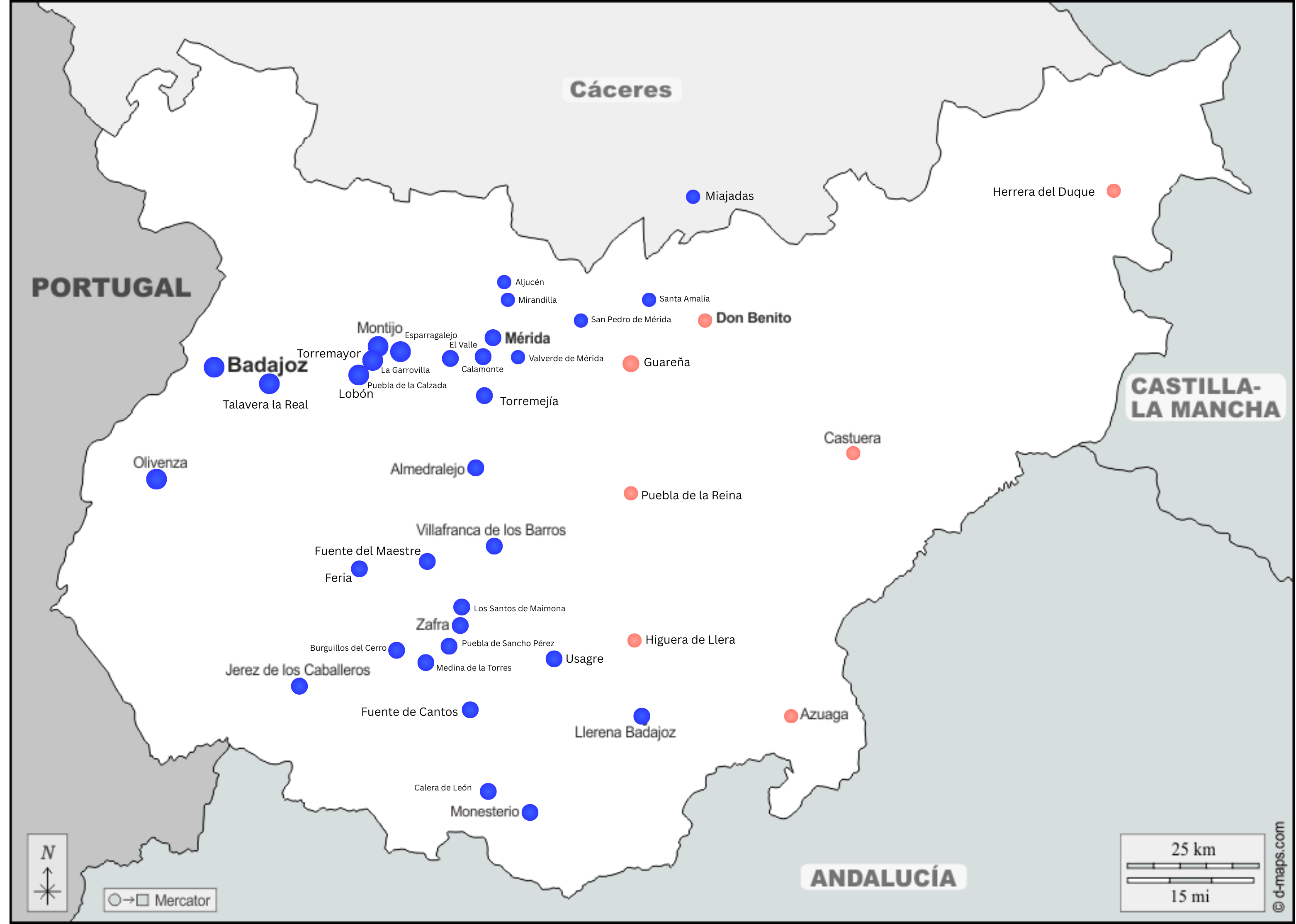
Aljucén was a small agricultural village of approximately 1,100 inhabitants, situated on the main road north from Mérida towards Cáceres. The village remained under Republican control following the military uprising in July, although it was largely isolated after Nationalist forces captured Mérida on 11 August. On 16 August 1936, Nationalist troops of the Army of Africa advanced on the town from Mérida occupied Aljucén with little organised resistance. Its capture secured the main highway towards Cáceres and Trujillo, allowing troops, vehicles and supplies to move safely towards the Sierra de Guadalupe and the Madrid front. The casualties were never properly disclosed, though the town seemingly had no Republican militia to fight, and the only identified mass graves in the town is of approximately twelve residents of Mirandilla who were arrested, forced into a van, and murdered near the town. The site where they were killed and buried is known as El Cancho de la Cigüeña (The Stork’s Rock). On April 26, 2009, the area was searched for bodies on behalf of Pedro Ribero, a family member, not they have not been located.
Just 7km away, Mirandilla had a population of approximately 1,900 inhabitants in 1936. Located northeast of Mérida, the village remained under Republican authority until the Nationalist advance following the capture of Badajoz. On 16 August 1936, troops under Commander Antonio Castejón occupied the village while extending Nationalist control across the eastern approaches to Mérida. The occupation formed part of a wider effort to secure the Nationalists’ rear before the main Army of Africa advanced towards Madrid. In July 2009, Pilar Moyano, granddaughter of Zacarías Moyano began the process of uncovering a grave site. In 1936, Moyano was arrested along with others in the village church, and taking advantage of a moment of inattention from the Guardia Civil captors, Moyano managed to escape to the church tower, jumping from it and breaking his legs. Unable to get up, he was executed there buried in a shallow grave at the cemetery. Relatives cared foer the burial sites until 2009, when the excavation was completed and Zacarías Moyano Ruiz was found with a broken spine. The town also has another mass grave on a private property known locally as Meregilda, where Marcelo Tirado Molina and Prudencio Arenas were thrown in a well. Relatives knew of the location and tended the site, but no excavation has been successful.
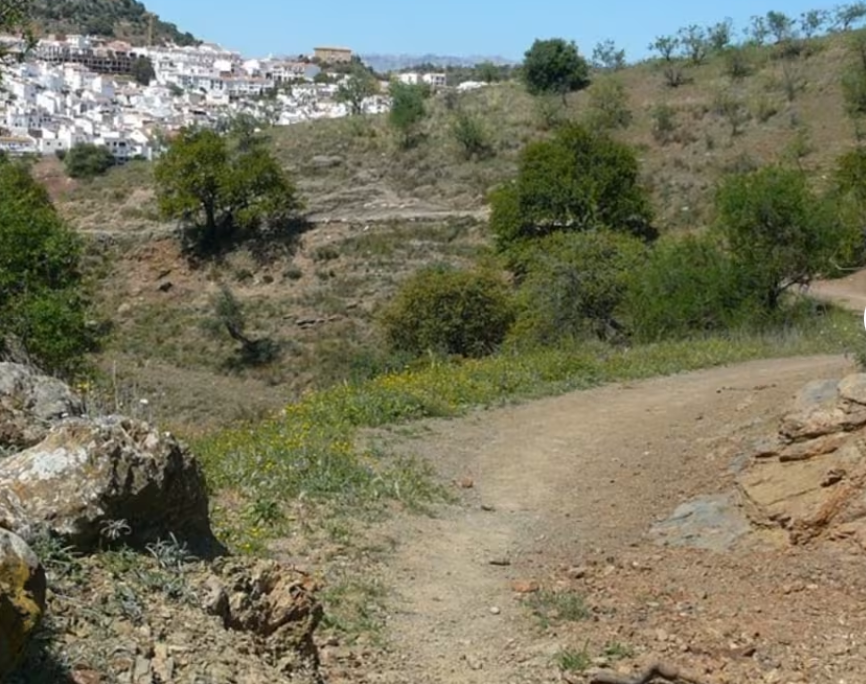
The same day, the 1,300 inhabitants of San Pedro de Mérida, 11km from Mirandilla were also occupied by Castejón’s Africa column on 16 August 1936. Its capture marked the beginning of the Nationalist advance into the Vegas Altas, opening the route towards Santa Amalia while protecting the eastern flank of the Army of Africa’s main advance through the Sierra de Guadalupe. The actions at San Pedro de Mérida rely only on oral testimony and bear little or no evidence of what the army of local Nationalists did, though in 2008, roadworks accidentally uncovered a mass grave as a road was being widened near the local cemetery, holding approximately 13 people including at least three women. the bodies have been left in place. Just outside the town is the historic rural livestock track and ancient path in Extremadura that forms part of the Camino Mozárabe pilgrim route connecting Córdoba and Mérida. A mass grave of an unknown lies beside the path, including the bodies of Luisa Muñoz Gallego and José Cerrato Muñoz, a mother and son killed on 7 September 1936. Because of lack of witnesses at the burial, the exact spot of the graves cannot be found (budget cuts), but as of 2026, the pilgrim track is being widened, which may turn up the lost souls.
- Balaeric Islands
Click here to catch up on part one of the Balearics Islands
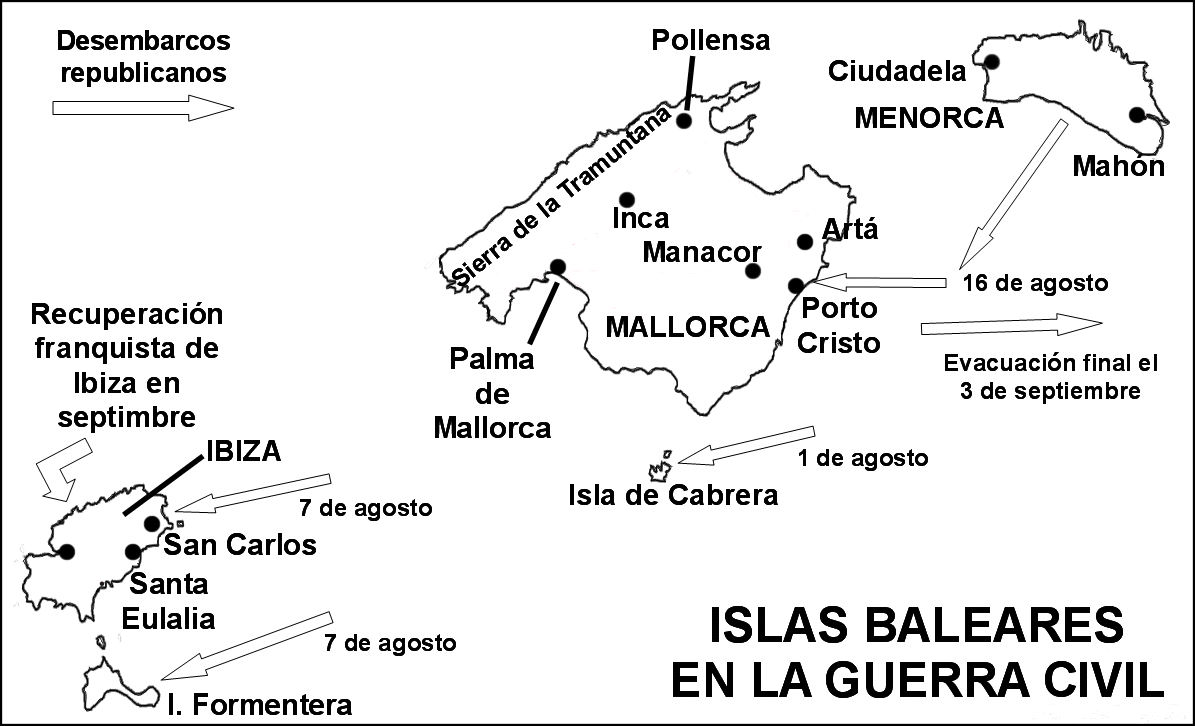
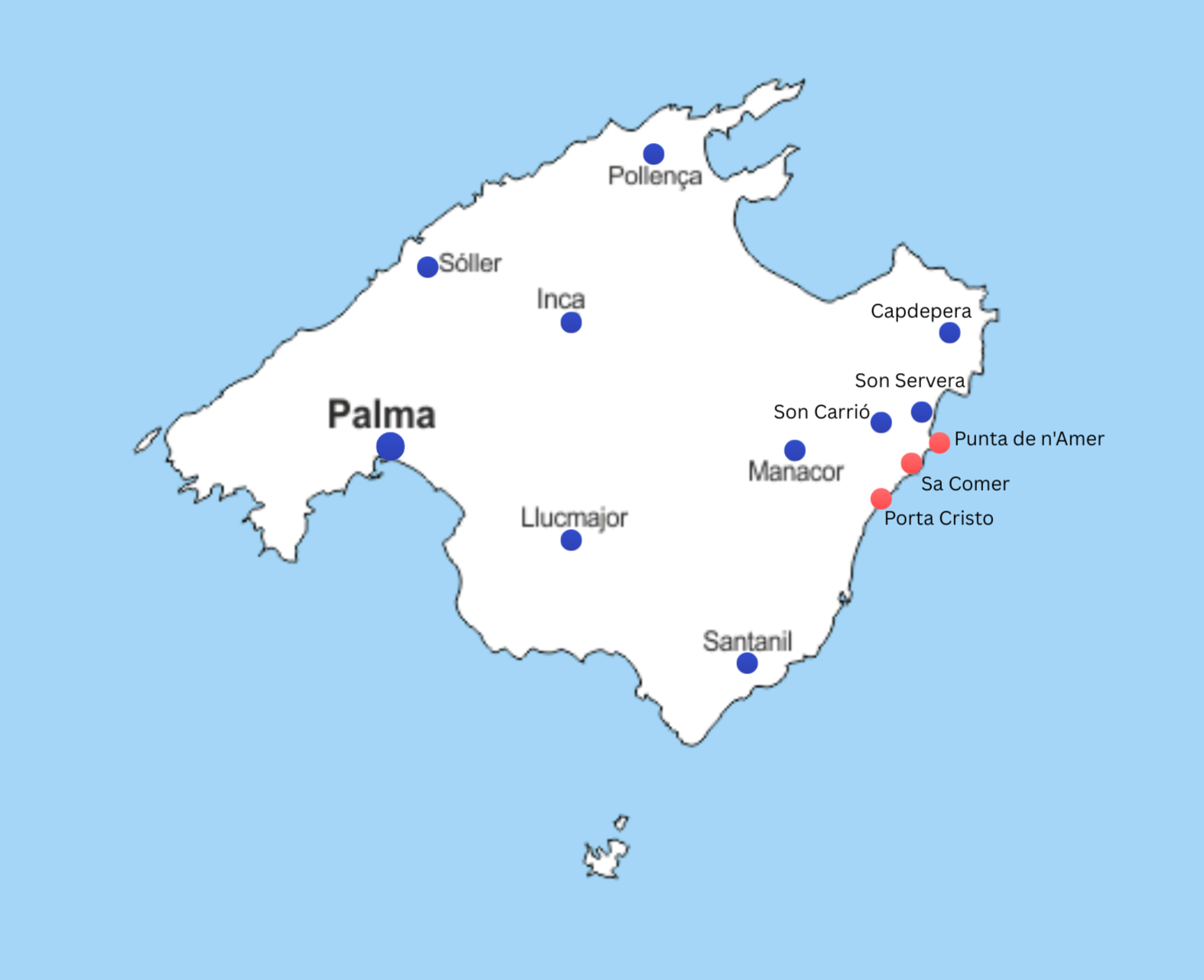
In the early hours of 16 August 1936, the Republican expedition appeared off the eastern coast of Mallorca. Bayo had chosen a stretch of coast running roughly from Porto Cristo northwards to Sa Coma and Punta de n’Amer, about 55 kms east of Palma. The landing would take place on the opposite side of the island from the capital and immediately threaten Son Servera, Son Carrió, Sant Llorenç des Cardassar and Manacor, the principal towns and road junctions behind the coast.
Landings took place at Cala Anguila, Cala Petita, Porto Cristo, Cala Morlanda, Cala Moreia and Sa Coma–Punta de n’Amer, spreading the expedition along several kilometres of coastline. The Republican naval force supporting the operation included the destroyers Almirante Miranda and Almirante Antequera, the coastguard vessel Xauen, torpedo boat T-17, the water carrier A-3, and transports including Ciudad de Barcelona, Ciudad de Cádiz, Ciudad de Mahón, Ciudad de Tarragona, Isla de Tenerife, Mar Negro, Mar Cantábrico and Umbe Mendi. The hospital ship Marqués de Comillas accompanied the expedition, together with tugs and smaller auxiliary craft. At Punta de n’Amer, landing barges K-12 and K-26 helped carry men and equipment from the larger vessels to shore.
The first landing began before dawn and immediately demonstrated one of Bayo’s problems. At about 4:15am, approximately 400 anarchist militiamen who had come from Cabrera landed at Cala Anguila, around 2kms south of Porto Cristo, apparently without Bayo’s authorisation. They encountered virtually no resistance and moved towards Porto Cristo. At around 6:00am, another force, estimated at approximately 500 men, landed at Cala Petita, immediately beside Porto Cristo.
At approximately 06:30, around 1,200 men were put ashore at Porto Cristo, carried from ships lying outside the harbour by three landing barges. At almost the same time, Bayo landed with approximately 1,100 men at Sa Coma and Punta de n’Amer, about 6kms north of Porto Cristo. A further group of around 150 landed at Cala Morlanda, south of Sa Coma, at about 7:30am. The contemporary figures are estimates rather than exact personnel counts, but they indicate the scale of the first morning: several thousand Republican personnel were ashore along the eastern coast within hours.
The landing caught the local defenders badly outnumbered. Mallorca’s Nationalist authorities controlled the island, but their forces were dispersed and there was no large garrison waiting on the beaches. Guardia Civil, Carabineros, soldiers, Falangists and other armed volunteers began moving towards the coast as reports reached Manacor, Sant Llorenç and Son Servera. The immediate objective was not to throw Bayo’s entire expedition back into the sea, something the available forces could scarcely accomplish, but to block the roads leading inland until reinforcements could arrive.
For the inhabitants of the coast, the invasion arrived suddenly. Porto Cristo, then a small harbour and summer settlement belonging to the municipality of Manacor, was largely abandoned as the Republican force entered. Families fled inland as ships appeared offshore and firing began. The landing transformed farms, holiday houses, roads and villages into a battlefield within hours. In the wider Manacor district, fear that local Republican sympathisers might join Bayo produced an immediate reaction from the rebel authorities. Mass arrests began on 16 August, and the invasion became a justification for an intensification of repression against people who had taken no part in the landing.
On August 16, 1936, the lifeless body of a man was found at km 14.2 of the Palma-Valldemossa road. According to the description, he appeared to be about 45 years old. The cause of death, as recorded at the time, was an accident, though the town judge acknowledged that, along with the burial papers, he sent to the Military Court three empty rifle casings that had been found next to the body and an unfired pistol cartridge. In March 1986 that his daughter, Maria Sastre Vicens, obtained a court order to rectify the official death certificate, recognising that her father’s death was the result of an execution by firing squad. Three years after his death, the body was identified as Andreu Sastre Ferragut. In 2020, efforts were still being made to find his body; he is just one of the countless Mallorcans who ‘disappeared,’ in the area, like the nearby cliffs that were chosen to throw victims into the abyss, next to the current Hotel Encinar, formerly known as Can Madò Pilla, on the MA-10 road, which runs from Valldemossa to Deià. It remains unknown how many innocents were thrown from the cliffs.
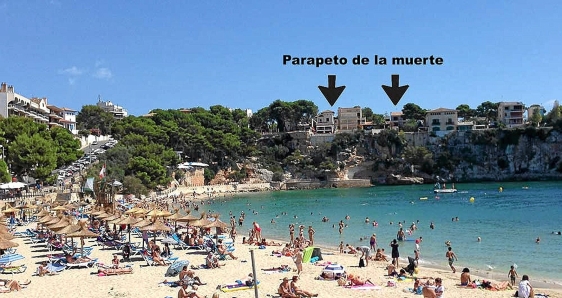
Also on 16 August, in the early morning, when the first landing took place within the municipality of Manacor, 422 people died at the Riuet and hastily buried in a marshy area. The Nationalist authorities prohibited access to the area and cordoned it off so no one enter. A year later, when the fascist monument was to be inaugurated on September 4, 1937, crossing the Riuet was mandatory to reach it, so a company of workers from Palma was sent to work on cleaning the area, removing a large number of truckloads of mud mixed with human remains, with the strictest discretion, and dumped in a still-unknown location. All around the area has scattered human remains that remain undignified.
The Finca Son Bauló estate was owned in 1936 by Pere Santandreu Planes, known as ‘El médico Perico,’ the municipal doctor of Santa Margalida at the time. He was dismissed from his position as municipal doctor of Santa Margalida due to his membership in the Balearic Republican Left (ERC) party. Though there are oral accounts that mention the Son Bauló well as a common site for the murder and disposal of the bodies of Republican victims of repression, we only have evidence of the deaths and abandonment of the bodies of Cristóbal Sales, from Santa Margalida, and Francisco Mas Munar, from Maria de la Salut, within this well.
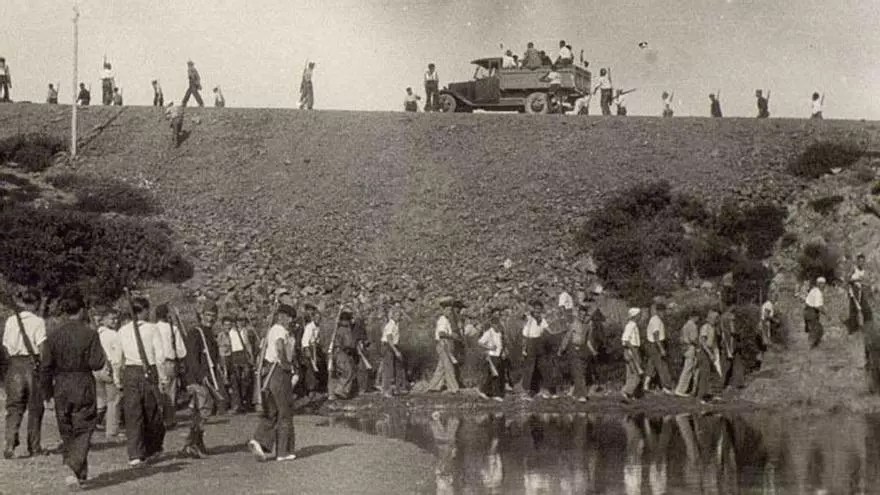
At Porto Cristo, the lack of immediate opposition allowed Republican militiamen to enter the settlement, but it also exposed the weaknesses of the expedition. Instead of immediately concentrating inland, men became dispersed through the port and surrounding buildings. Nationalist accounts subsequently accused the militiamen of widespread looting; though such accounts were heavily incorporated into rebel propaganda, the breakdown of discipline at Porto Cristo was real enough to concern Bayo and contributed to the loss of valuable hours.
From Manacor, approximately 12kms inland, Nationalist forces were being assembled and sent towards the coast. The road from Manacor to Porto Cristo gave the defenders a direct route for reinforcements, while other forces moved towards Son Servera and Sant Llorenç to prevent Bayo’s northern landing from reaching the interior. What had initially been scattered resistance became progressively stronger during the day.
Bayo established his headquarters around Punta de n’Amer, the rocky peninsula separating Sa Coma from Cala Millor, and the surrounding coastal strip became the centre of the Republican bridgehead. Men, ammunition, artillery, vehicles and supplies continued to come ashore behind the first waves. Republican warships remained offshore and aircraft operated above the battlefield, giving the expedition firepower that the Mallorcan defenders initially struggled to match.
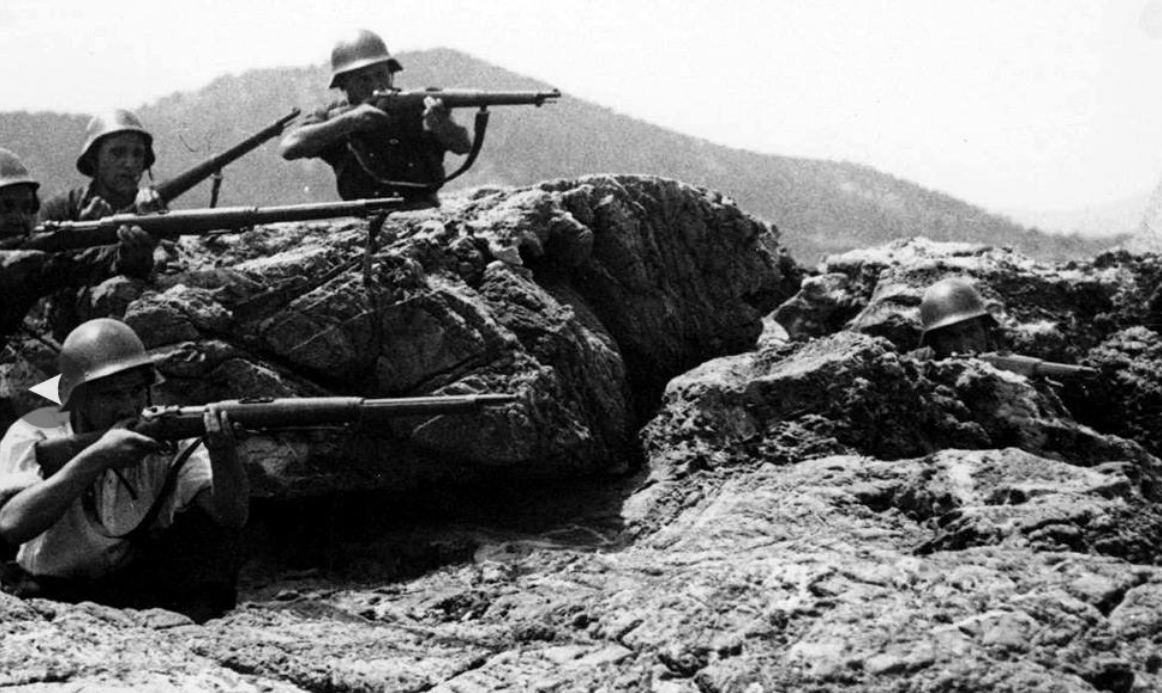
But the situation around Porto Cristo deteriorated during the afternoon. Nationalist reinforcements arriving from Manacor counterattacked the Republicans occupying the settlement and its approaches. Fighting developed around buildings, roads and the harbour itself. The Republicans were forced out of much of Porto Cristo, though they retained positions in the surrounding coastal area. Further north, Bayo’s force around Sa Coma and Punta de n’Amer had considerably more room where Republican groups began pushing inland and north-westwards towards the approaches to Son Servera and westwards towards Son Carrió. By the end of the first day the expedition had established a coastal bridgehead approximately seven kms long. It was a substantial achievement: thousands of men had been transported across open sea, landed with weapons and supplies, and maintained themselves on hostile territory. The question became whether Bayo could break through before Mallorca could bring its greater resources to bear.
By the morning of 17 August, roughly 3,000–3,500 Republican personnel had been put ashore on Mallorca, though they were scattered between several landing areas rather than concentrated as a single force. The largest concentration was around Sa Coma and Punta de n’Amer, where Bayo had landed with approximately 1,100 men and established his headquarters. To the south, other contingents occupied positions around Cala Moreia, Cala Morlanda, Cala Anguila and Cala Mendia, while the fighting of the previous day had left control of Porto Cristo, approximately 12kms east of Manacor, uncertain.
The Nationalists faced the opposite problem. They controlled almost the entire island but initially had relatively few men concentrated on its eastern coast. Mallorca possessed approximately 1,200 regular infantrymen and around 300 Guardia Civil and Carabineros at the beginning of the crisis, supplemented by Falangists, requetés and other armed volunteers. These forces were dispersed across the island. Mobilisation began bringing additional men into service after the invasion, while troops and volunteers travelled east from Palma and other towns. Modern reconstruction indicates that the Nationalists would eventually concentrate approximately 2,900 men on the eastern front, meaning that neither side ever possessed an overwhelming numerical advantage. On 17 August the immediate Nationalist priority remained Porto Cristo. The settlement was small, but its harbour and road made it disproportionately important. A secure Republican harbour would allow ships to unload ammunition, artillery, vehicles, food and reinforcements directly onto quays rather than transferring everything into landing craft and bringing it across the beaches. The road running west from Porto Cristo also led directly to Manacor, the largest town in eastern Mallorca and only about 12kms away.
Several hundred Republican militiamen remained in and around Porto Cristo after the confused fighting of 16 August. They included elements of the approximately 400 anarchists who had landed independently at Cala Anguila and the roughly 500 men landed near Cala Petita, together with men from the larger force of approximately 1,200 put ashore around Porto Cristo during the main landing. These numbers should not be added together as if every man remained concentrated inside the town: casualties, movement between positions and withdrawals had already dispersed the original landing groups.
Against them, the Nationalists fed reinforcements down the Manacor–Porto Cristo road. Regular soldiers were joined by Guardia Civil, Carabineros, Falangists and armed civilian volunteers. Rather than confronting several thousand Republicans simultaneously, the defenders could concentrate against the comparatively isolated southern part of Bayo’s bridgehead while the largest Republican force remained around Sa Coma and Punta de n’Amer, approximately 6kms further north.
Fighting continued through Porto Cristo and the surrounding countryside. Houses, walls and fields provided cover, and the close proximity of the opposing forces limited the usefulness of Republican naval gunfire. Bayo possessed considerable firepower offshore, but a destroyer’s guns could not easily distinguish Republican militiamen from Nationalist troops fighting among buildings. The Nationalists eventually secured Porto Cristo when Republican groups withdrew towards Cala Anguila, Cala Mendia, Cala Morlanda and Cala Moreia, leaving the harbour and the direct road to Manacor in Nationalist hands. Men who had become separated during the fighting were left vulnerable to capture as Nationalist forces searched buildings and surrounding properties.
The weakness of the Nationalist line became particularly obvious at Son Servera. When a Republican emissary entered the town demanding its surrender during the opening phase of the campaign, its immediate defence consisted of only two Guardia Civil and five Falangists. Colonel Emilio Ramos Unamuno, responsible for the defence of Mallorca, considered the danger serious enough that at 5:00pm he ordered Son Servera evacuated towards Sant Llorenç des Cardassar and Artà. For a short period, , a town of several thousand inhabitants stood immediately ahead of a Republican expedition numbering several thousand men while only a handful of armed Nationalist supporters remained to protect it.
Republican ships and aircraft bombarded Son Servera, but the delay in sending a strong force into the town gave the Nationalists time to reverse the situation. Reinforcements began arriving. Approximately 200 soldiers, requetés and Falangists reached the area as the defence was reconstructed, and further troops followed. What had briefly been an almost undefended town was becoming one of the strongest positions facing the Republican beachhead.
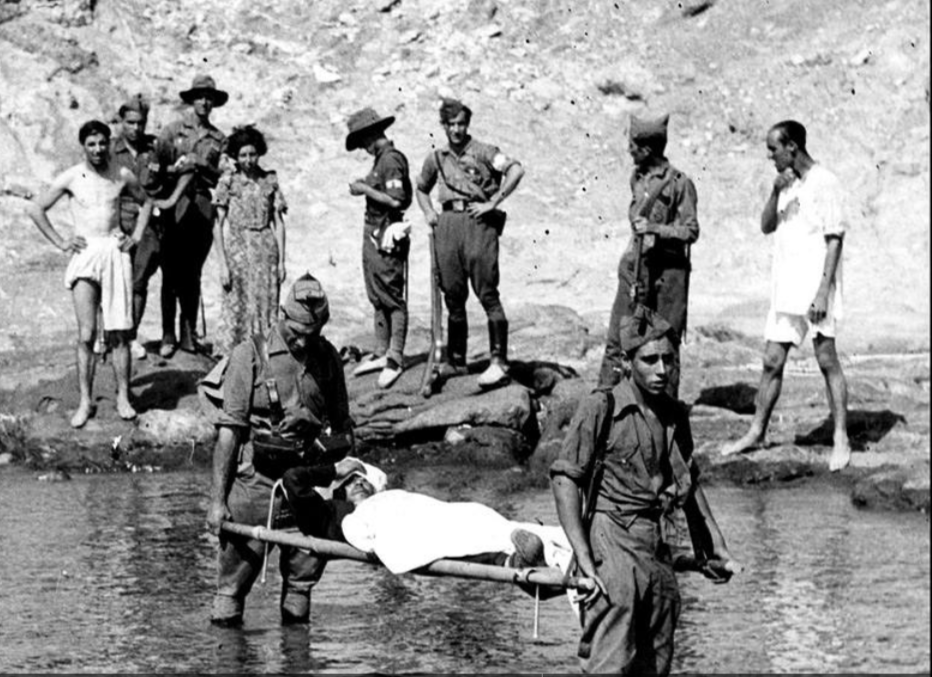
The fighting was also beginning to affect thousands of civilians living in the eastern municipalities. Manacor had around 13,000 inhabitants, while Son Servera and Sant Llorenç contained several thousand more, in addition to families scattered across the fincas between the towns and the coast. People abandoned exposed houses, moved inland, hid during bombardments or found themselves sharing roads with columns of soldiers and armed volunteers. Farms, vehicles, animals and food were requisitioned as both sides attempted to support growing forces in the area.
Behind the front, the invasion intensified Nationalist repression. Manacor became both the principal military centre behind the southern sector and a centre for arrests. Rumours circulated that thousands of local leftists were preparing to rise and join Bayo. Claims appeared of supposed Republican columns of 2,000 men being organised around Manacor, Felanitx and Artà, though the alleged conspiracy bore little relationship to the actual situation. Men and women who had belonged to left-wing parties and unions before the uprising could nevertheless be treated as potential collaborators with an invading force they had never seen.
On 18 August, the northern end of Bayo’s beachhead became the centre of the fighting. Son Servera, approximately 6kms inland from the Republican positions around Sa Coma and Punta de n’Amer, was the first substantial town blocking an advance into north-eastern Mallorca. Roads from Son Servera ran west towards Sant Llorenç des Cardassar, north towards Artà and south-west towards the Manacor district. Its capture would do considerably more than enlarge the beachhead: it would disrupt the Nationalist defensive network and give Bayo access to roads leading deeper into the island. Approximately 3,000–3,500 Republican personnel were now distributed across the wider beachhead, though only part of that force could be directed against Son Servera because positions around Porto Cristo, Son Carrió and the beaches also had to be held.
Republican aircraft and the warships lying off the eastern coast added another dimension to the attack. Son Servera could be bombarded from the air and sea while Republican infantry pressed towards it from the coast. For the inhabitants, there was little distinction between front and rear. Shells and bombs could reach houses beyond the infantry positions, and families moved away from the exposed edges of the town or sought shelter when aircraft appeared overhead.
Among the fascist volunteers entering this battlefield was Antoni Perelló Serra, a twenty-year-old Falangist from Llubí. He had arrived on the eastern front on 16 August as part of a group of 42 Falangists from his town. His later recollections describe a battlefield of scattered positions, small groups occupied farm buildings, walls and heights, moved along unfamiliar tracks and attempted to determine where Republican forces were concealed. His testimony is particularly useful because it shows how quickly civilians who had joined the Falange found themselves fighting alongside professional soldiers only days after Bayo appeared off the coast.
The Republicans also encountered Mallorcans prepared to help them. During the campaign inhabitants of the Son Servera area crossed into Bayo’s lines, approximately up to 190 people from the municipality. Some were political sympathisers escaping Nationalist territory, while others provided local knowledge to forces whose Catalan and Menorcan volunteers knew little about the roads, paths and properties through which they were advancing. For Nationalist authorities, such defections reinforced fears that the invasion might provoke the internal rising Bayo had hoped for.
After the failure to take Son Servera on 18 August, the invasion entered a different phase. Bayo still had roughly 3,000–3,500 people ashore, with further personnel and supplies arriving by sea, but there was no immediate advance across Mallorca. Instead, the expedition settled into the territory it already occupied. The principal Republican concentration remained around Sa Coma and Punta de n’Amer, with positions extending inland towards Son Servera and Son Carrió and southwards through the coastal area towards Porto Cristo. Across from them, the Nationalists continued bringing men east until approximately 2,900 soldiers, Guardia Civil, Carabineros, Falangists, requetés and other personnel were serving along the front.
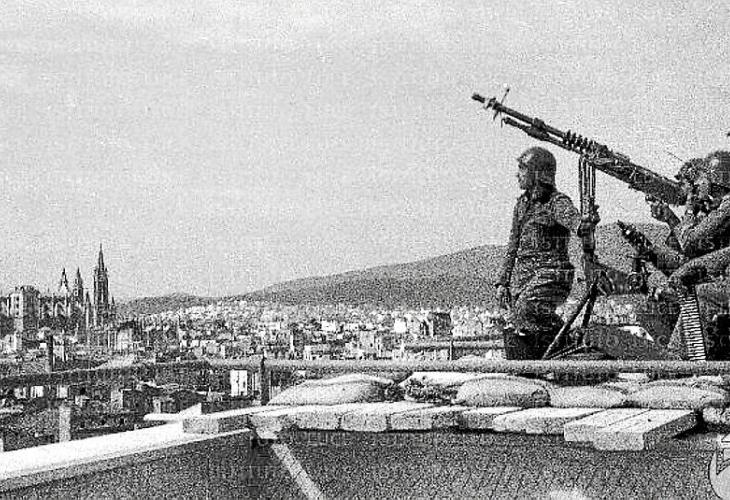
For the militiamen who had expected a rapid campaign, the experience now became one of waiting interrupted by firing, patrols and local attacks. The August heat was intense. Thousands of people required drinking water and food every day, while ammunition, medical supplies and equipment had to cross the Mediterranean and then be carried from the beaches to scattered positions. Punta de n’Amer became the centre of Bayo’s improvised enclave. Ships stood offshore, smaller craft moved between them and the beaches, and vehicles and men carried supplies inland. Margalida Llinàs Vives, thirteen years old and living near Son Carrió, later remembered that families had been told that if the church bells rang they were to leave and hide in caves. She recalled aircraft passing sufficiently low for people below to see the men inside them and remembered watching militiamen who had come inland from Punta de n’Amer. Such memories place the battle in a landscape still occupied by families who had been living ordinary rural lives only days earlier.
Rumour magnified the danger. Stories circulated that enormous clandestine columns were waiting to join Bayo, with one version claiming forces of 2,000 men each around Manacor, Felanitx and Artà, but these formations did not exist. But the possibility that local Republicans might help the invaders was believable enough to the Nationalist authorities to influence arrests and surveillance. Every person disappearing from a village towards the Republican lines could make those remaining behind more suspect. Meanwhile, Mallorca was beginning to receive something far more important than additional local volunteers. The island’s authorities had appealed to Fascist Italy for assistance, and the first Italian involvement was developing while Bayo’s expedition remained fixed on the eastern coast in the third week of August. Aircraft, weapons and personnel promised to change a situation in which Republican ships and aircraft had so far operated with little serious opposition.
- Granada
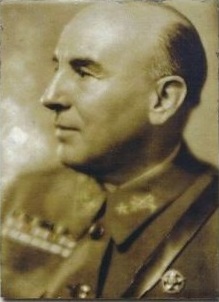
On 16 August 1936, General Manuel Campins Aurelio, commander of the military district in Granada at the outbreak of the uprising, was executed after being convicted by a Nationalist court-martial. Campins had attempted to avoid bloodshed during the July rebellion and refused to give his full support to the military conspiracy. He was no revolutionary and did not support the Republican Popular Front, but his hesitation was interpreted by the Nationalist leadership as disloyalty when his reluctance cost the Nationalist an easy takeover of Granada.
The murderous Queipo de Llano in Seville he ordered Campins’ dismissal and arrest by radio without hearing his side of the story, and ordered his subordinate, Colonel Basilio León Maestre, to take command. Campins was transported to Seville by plane on August 4, where he faced a summary court-martial, which sentenced him to death on August 14. Queipo de Llano, who was running Andalucía as his own personal kingdom of horrors, refused clemency from General Franco himself, which would eventually come back to haunt him.
Campins’ fate sent a powerful message throughout the armed forces. that political allegiance outweighed professional service, and that ideology outranked any kind of morality. Campins’ sentence was carried out on August 16 at 6:30 am against the walls of the Macarena district of Seville. Those present at the execution, all workers on their way to work on trams were forced to stop to witness the event, had no idea who was being killed, dressed in civilian clothes and it was remarked that he died with courage and dignity.