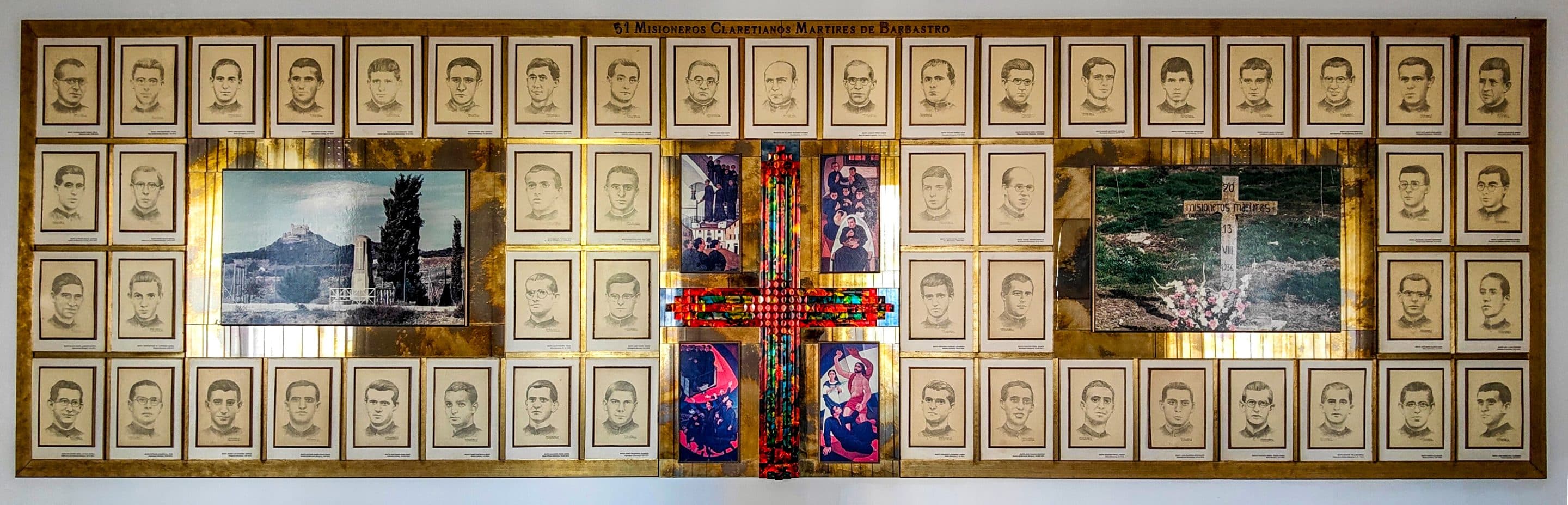
Before the outbreak of the Spanish Civil War, Barbastro was a small cathedral city in the province of Huesca, in Aragón, about 60 kilometres east of Huesca and 140 kilometres north-east of Zaragoza. It served as the seat of the Diocese of Barbastro whose clergy ministered to towns and villages across the Somontano region. Among the largest religious communities in the city were the Claretians, officially the Congregation of the Missionary Sons of the Immaculate Heart of Mary. Their Barbastro house was one of the congregation’s principal seminaries in Spain, where young men studied philosophy and theology before ordination. In July 1936, the community numbered 51 religious priests, brothers, and seminarians, most of them in their late teens or twenties.
Anticlericalism had been a recurring feature of Spanish political life since the early nineteenth century, although its strength varied considerably over time. Liberal reformers often criticised the Catholic Church’s political influence, economic privileges, and dominant role in education, arguing that these institutions hindered Spain’s political and social modernisation. Conservatives, meanwhile, regarded Catholicism as a central element of Spanish identity and social order. These competing views became intertwined with wider conflicts over monarchy, constitutional government, regional autonomy, and the distribution of political power. During the nineteenth century, successive Liberal governments confiscated much of the Church’s property through the desamortizaciones. Although intended to reduce ecclesiastical wealth and strengthen the state, much of the land passed into the hands of wealthy private owners rather than small farmers. These reforms weakened the Church economically but also reinforced its alliance with conservative political and social interests. At the same time, disputes over education, labour rights, and the relationship between Church and state deepened political polarisation.
By the time the Second Republic was proclaimed in 1931, anticlerical sentiment had become particularly strong among many anarchists, socialists, communists, and some republican groups. They viewed the Church as closely associated with the monarchy, conservative landowners, and the military establishment. Other Republicans supported secular reforms without advocating violence, while most Spaniards continued to identify as Catholic even if their level of religious observance varied considerably. Following the military uprising of July 1936, revolutionary violence spread rapidly across many Republican-held areas where state authority collapsed. Churches, convents, and monasteries were attacked, religious buildings were burned or looted, and thousands of members of the clergy and religious orders were killed by revolutionary militias and local revolutionary committees. Historians estimate that approximately 6,800 Catholic clergy and religious died in Republican-held Spain during the war. The scale of the violence varied greatly between regions. In the Diocese of Madrid, more than 1,000 clergy were killed, while the Diocese of Barbastro suffered one of the highest proportional losses, with around 123 of its approximately 140 priests and religious murdered during the summer of 1936.
When the military uprising 1936, Barbastro remained under Republican control. Local authority quickly passed to revolutionary committees made up largely of members of the CNT, UGT, and left-wing political organisations, while the Republican mayor, Pascual Sanz, remained the city’s civilian head. The central Republican government never ordered the murder of clergy, the revolutionary authorities in Barbastro regarded the Catholic Church as one of the principal institutions that had upheld Spain’s traditional social and political order. For many revolutionaries, priests represented not only religion but also the monarchy, conservative politics, large landowners, and decades of inequality. The Church therefore became a symbolic target as much as a physical one.
There is no evidence that the Claretian seminarians had taken part in the military uprising or that weapons were stored in their seminary. When militiamen searched the building on 20 July, they found none. Nor is there evidence that the young seminarians were personally hated by the people who arrested them. Instead, they were targeted because they belonged to a religious order and wore the cassock. The revolutionary authorities believed that eliminating the clergy would help destroy the influence of the Catholic Church in the new revolutionary society they hoped to create. Contemporary accounts also record repeated attempts to persuade the imprisoned Claretians to renounce their vocation, suggesting that the authorities viewed their religious commitment as the reason for their imprisonment.
The events that followed unfolded over less than a month. Between 20 July and 18 August 1936, the revolutionary authorities arrested almost every major religious community in Barbastro. The victims included Bishop Florentino Asensio Barroso, 51 Claretian religious, 18 Benedictine monks from the nearby monastery of El Pueyo, 9 Piarists, numerous diocesan priests, and several lay Catholics. Few Spanish dioceses suffered losses on the same scale. Of the 140 priests incardinated into the Diocese of Barbastro before the war, 123 were killed, making it one of the most devastating episodes of anti-clerical violence during the Spanish Civil War.
For almost two weeks after their arrest, the Claretian prisoners remained alive. The revolutionary authorities had searched the seminary, found no weapons, arrested the community, and divided its members between the municipal prison, the Piarist school, and local hospitals. During that time, no Claretian was executed, although anti-clerical violence continued elsewhere in Barbastro and more clergy were brought into custody. The situation changed after the arrival of the Ascaso Column in Barbastro on 25 July. Spanish accounts state that some of the newly arrived anarchist militiamen wanted to kill the imprisoned clergy immediately, but the local revolutionary committee refused to allow an uncontrolled massacre, insisting that it would decide the prisoners’ fate itself.
During the night of 1–2 August, the Comité de Enlace Antifascista authorised the first organised removal of prisoners from the municipal jail. According to contemporary accounts, a detachment of militiamen led by Ginesta arrived carrying a written order requesting twenty prisoners. This was the first saca carried out after the arrests. Among those selected were the three senior members of the Claretian community: Felipe de Jesús Munárriz Azcona, the superior; Juan Díaz Nosti, prefect of the seminarians; and Leoncio Pérez Ramos, the administrator. Unlike the younger Claretians, they had been held in the municipal prison since 20 July. No surviving committee record explains why they were chosen first, but they had been separated from the rest of the community from the day of their arrest because they were its recognised leaders. Before dawn on 2 August, the prisoners were taken from the jail with other detainees, transported to the cemetery on the outskirts of Barbastro, and shot without trial. The group also included diocesan clergy and lay prisoners arrested during the first days of the revolution. The remaining Claretians in the Piarist school learned that the three priests had been executed when they failed to return. The revolutionary authorities had begun carrying out the programme of executions that would continue throughout August.
During their imprisonment, surviving accounts describe the Claretian community maintaining a disciplined religious routine despite increasingly harsh conditions. According to the two Argentine seminarians who were eventually released because of their nationality, the prisoners secretly received Holy Communion during the early days of their captivity whenever opportunities arose. Prayer, the Rosary, and the recitation of the Divine Office became central to their daily lives as they prepared themselves for what many believed would be their deaths. The physical conditions in the improvised prison steadily deteriorated. Water was scarce during the intense August heat, and the prisoners later recalled suffering from thirst and overcrowding. The Argentine seminarian Faustino Parussini also described repeated mock executions intended to terrorise the prisoners. Parussini and other Claretian accounts also describe attempts by some militiamen to break the prisoners’ resolve through humiliation and psychological pressure. According to these testimonies, prostitutes were brought into the building in an effort to provoke the imprisoned seminarians, who were reportedly threatened with immediate execution if they refused to abandon their vows. These accounts further state that several prisoners were offered the possibility of release but chose to remain with their companions.
By early August, the revolutionary authorities in Barbastro had already begun carrying out organised executions of imprisoned clergy. On the evening of 8 August, militiamen entered the San Lorenzo School, where Bishop Florentino Asensio Barroso had been imprisoned since 22 July, and removed him from the other prisoners. They transferred him to a solitary cell in the municipal jail in Barbastro’s town hall. During the night he was interrogated and brutally tortured. Contemporary witnesses and later medical examinations recorded that he suffered repeated beatings and the mutilation of his genitals while in custody. At about 2 a.m. on 9 August militiamen removed the bishop from the jail and loaded him onto a truck with twelve other prisoners, including members of the clergy and several lay detainees. The convoy drove to Barbastro Cemetery, where the prisoners were taken from the vehicle and shot without trial. Their bodies were buried in a mass grave.
The bishop’s death was the second organised execution of imprisoned clergy in Barbastro within a week. It demonstrated that the revolutionary committee was eliminating prisoners in successive groups rather than in a single massacre. Clergy of different religious orders, diocesan priests, and lay Catholics were all among the victims, while dozens of prisoners remained alive in the San Lorenzo School awaiting an uncertain fate.
Shortly after 3.30 a.m. on 12 August, around fifteen armed Republican revolutionary militiamen entered the assembly hall of the San Lorenzo School, where the remaining Claretian prisoners were being held. They carried coils of rope and ordered the lights to be switched on. One of the militia leaders shouted for ‘the six oldest’ to come forward. The six men selected were Fr Sebastián Calvo Martínez, Fr Pedro Cunill Padrós, Fr José Pavón Bueno, Fr Nicasio Sierra Ucar, Brother Gregorio Chirivás Lacambra, and Subdeacon Wenceslao María Clarís Vilaregut. No explanation was given for their selection beyond the order to produce the oldest prisoners. Unlike the executions on 2 August, these men had been imprisoned together in the San Lorenzo School rather than the municipal jail.
The militiamen tied each prisoner’s hands behind his back before binding them together in pairs, elbow to elbow. As they were led from the hall, Fr Secundino Ortega, who remained with the other prisoners, gave them absolution. Before leaving, the execution squad again offered the six men the chance to save their lives by abandoning their priesthood and religious vocation. According to the surviving Claretian testimonies, all six refused.
The prisoners left in the assembly hall did not witness the executions but at 3.53am, they heard gunfire from outside the prison. The six men had been taken to nearby Barbastro Cemetery, where Republican militiamen shot them without trial. Like the earlier victims, they were buried in a mass grave in the cemetery. Less than three hours later, members of the revolutionary committee returned to the prison accompanied by armed militiamen. They took the names of every remaining Claretian prisoner. Survivors later described this as the creation of a list that determined the order in which the remaining prisoners would be removed and executed over the following days.
The executions on 13 August were no longer carried out by selecting prisoners inside the jail. By this stage, the Republican revolutionary committee controlling Barbastro had prepared a list of names before the militia entered the San Lorenzo School. The armed Republican militiamen who arrived shortly after midnight, in the early hours of 13 August, simply read the names aloud. The decision over who would die had already been made. The list contained the names of twenty Claretian prisoners, one priest, seventeen theology students, and two brothers. Most were in their late teens or early twenties. No explanation was given for why these particular men had been chosen, and no surviving committee record explains the criteria used to compile the list. The prisoners were ordered to gather their belongings before being led from the assembly hall. Contemporary Claretian accounts state that they wore their religious cassocks, having remained in clerical dress throughout their imprisonment. There are no reliable reports that they were beaten before leaving the prison that night. Instead, witnesses among the remaining prisoners recalled the men embracing one another, saying farewell, and leaving the building together under armed guard.
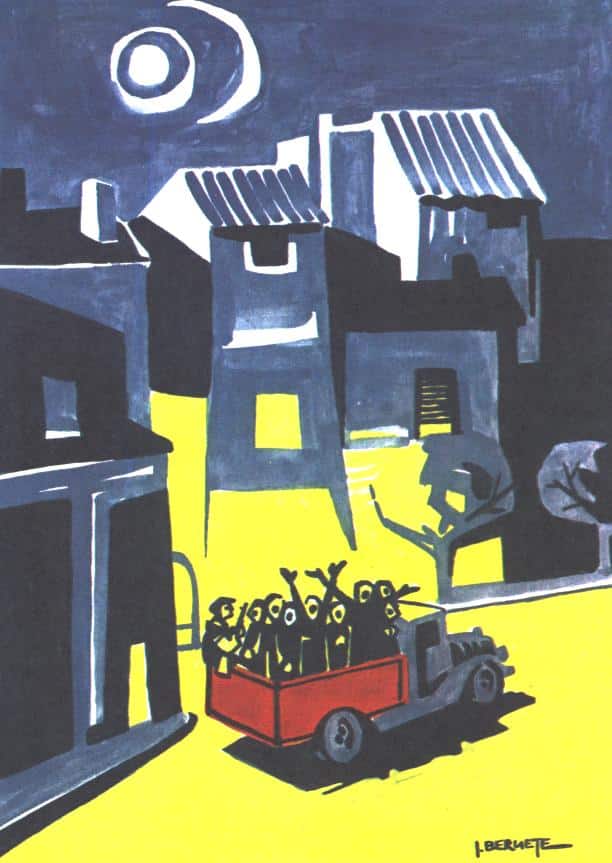
The other prisoners watched as the twenty were loaded onto a truck outside the school. As the vehicle drove away through the streets of Barbastro, the condemned men sang hymns and shouted religious acclamations, including ¡Viva Cristo Rey! Those left behind remained awake. At approximately 12.40am, they heard a volley of rifle fire from the direction of Barbastro Cemetery, followed by individual shots that survivors believed were the coup de grâce. The prisoners had been taken to the cemetery on the outskirts of the town, where Republican militiamen executed them by firing squad without trial. They were buried in a mass grave** in the cemetery later that same night. None of the prisoners remaining in the San Lorenzo School witnessed the executions themselves, but many later described hearing the gunfire and realising that another group of their companions had been killed.
Shortly after midnight on 15 August 1936, Republican revolutionary militiamen entered the San Lorenzo School carrying another prepared list of names. As on 13 August, the names had already been selected by the revolutionary authorities controlling Barbastro before the militia arrived. The list contained the names of the twenty remaining healthy Claretian prisoners. One by one they were called forward, ordered from the assembly hall, and placed under armed guard. The remaining prisoners watched as the group was loaded onto a truck and driven through the streets of Barbastro towards the cemetery. The executions took place at Barbastro Cemetery during the early hours of the morning. Republican militiamen shot the twenty prisoners without trial before burying their bodies in the cemetery’s mass grave, alongside those executed on 2, 9, 12, and 13 August.
The killings left only two Claretian seminarians alive in Barbastro. They had not escaped execution but had been admitted to Barbastro Hospital before 15 August because they were ill. The surviving Claretian records identify them as José María Ruiz Cano and Mariano Avellana Porró, although they do not record the nature of their illnesses. Their stay in hospital delayed their deaths by only three days. On 18 August, Republican militiamen removed both men from the hospital, executed them at Barbastro Cemetery, and buried them in the same mass grave as their companions.
Two Argentine seminarians had been released because of their nationality and later described both the harsh treatment endured by the prisoners and occasional acts of compassion shown by individual guards. Before his execution, the Claretian Faustino Pérez García wrote a farewell message on the wrapper of a chocolate bar, expressing forgiveness towards those responsible. The document survives as one of the best-known contemporary testimonies from the Barbastro executions.
In total, 51 Claretian priests, brothers, and seminarians, together with Bishop Florentino Asensio Barroso and other clergy imprisoned in Barbastro, were executed by Republican revolutionary forces during August 1936. The killings destroyed the Claretian seminary that had operated in the town for decades and eliminated almost an entire generation of the congregation’s young clergy.
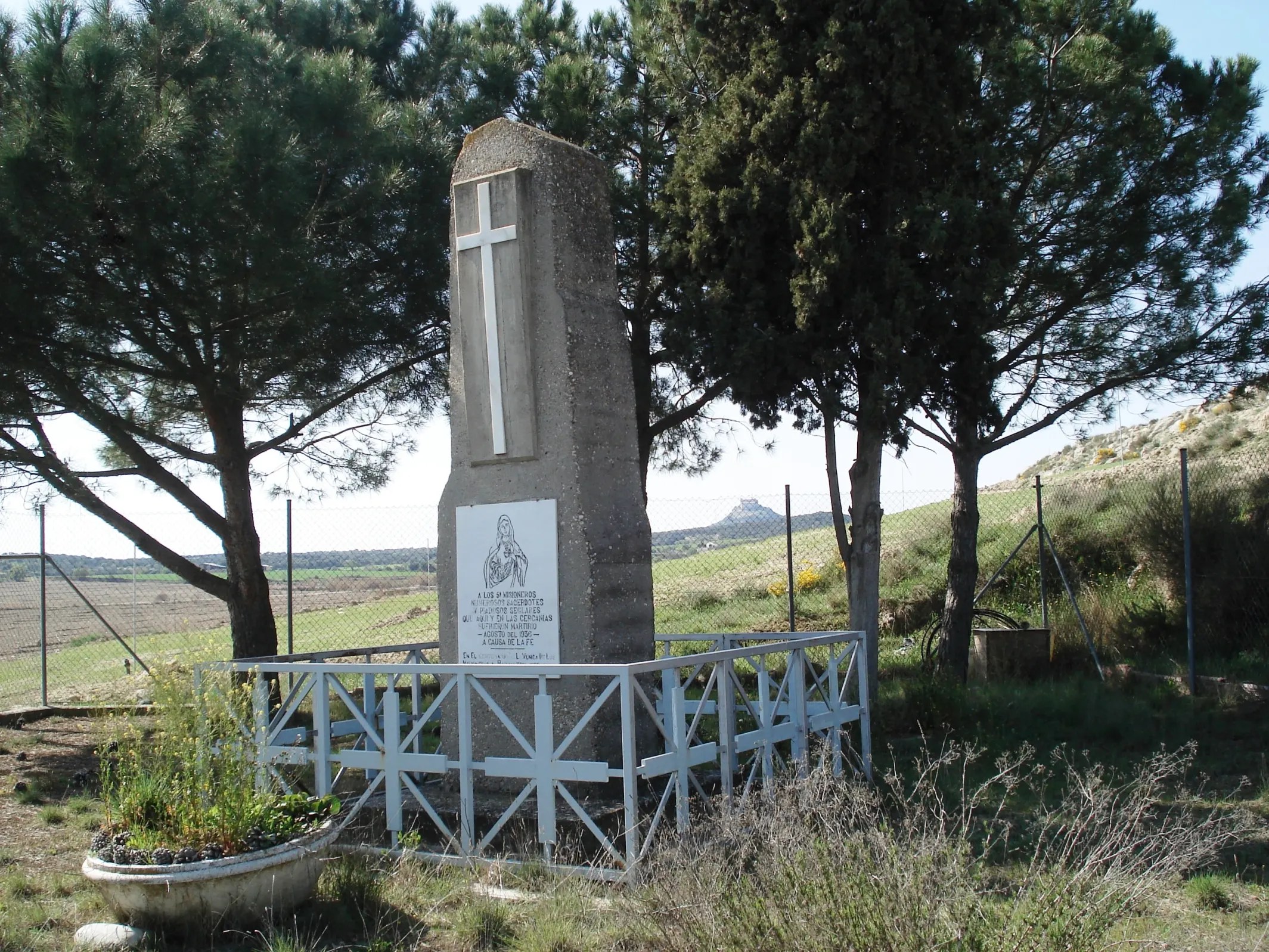
Following the Nationalist capture of Barbastro in March 1938, the cemetery graves were opened and many of the victims were identified and reburied. Witness testimony from surviving prisoners and local residents helped reconstruct the sequence of the executions and identify where many of the bodies had been buried. These accounts remain the principal source for reconstructing the events inside the San Lorenzo School and the executions carried out at Barbastro Cemetery. The Catholic Church later recognised the victims as martyrs. In 1992, 51 Claretian martyrs of Barbastro were beatified by Pope John Paul II. Bishop Florentino Asensio Barroso was beatified in 1997, and the memory of those executed is preserved at the former Claretian seminary and at Barbastro Cemetery.