

Villafranca le dos Barros had a rich, ruling family who owned Baroque mansions, oil and chemical factories, and much more, providing labour to the locals, but but getting paid fairly would eat into profits. Both photos taken 1909, via unknown
With Zafra under Nationalist control, the Army of Africa turned its attention to the remaining towns that could threaten its communications before the advance on Almendralejo and Mérida. Villafranca de los Barros, a town of 10,800, stood on the railway and road linking Zafra with Almendralejo. Leaving it in Republican hands would have exposed the Nationalists’ eastern flank and threatened the supply route supporting the columns advancing north.

On 8 August 1936, Captain Meléndez entered Villafranca de los Barros at the head of a detachment of Legionarios from Major Antonio Castejón’s column and occupied the town. Republican resistance proved brief, but the following day a Republican force from Badajoz, led by the deputy Pedro Martínez Cartón, launched a counter-attack in an attempt to recover it. Nationalist troops repelled the attack, ending the last serious effort to regain control of the town before the fighting moved towards Almendralejo. But the occupation immediately transformed Villafranca from a captured town into one of the Army of Africa’s principal bases in Extremadura. The Nationalists established a military command, quartered troops there between operations, and converted the Colegio de San José into a field hospital for wounded soldiers. Moroccan Regulares stationed in the area were even provided with a small mosque within the college grounds and a separate burial area in the municipal cemetery, illustrating how long the town remained an important logistical centre after the front moved north.
Military control quickly gave way to political repression as arrests began almost immediately after the failed Republican counter-attack, and executions continued for months and became one of the municipalities most severely affected by Francoist repression in Extremadura with the town losing 500-700 people. Municipal records created during the occupation acknowledged that more than 300 people had been ‘eliminated’ between 9 August and early November 1936, illustrating the scale of the violence in the first three months alone, as seen in the history of the town, where Villafranca’s memory is preserved through extensive local research. Historians including Francisco Espinosa Maestre, María del Espino Núñez-Barranco, Sebastián Merino Muriana, and José Antonio Soler Díaz-Cacho have reconstructed the names and fates of hundreds of victims using the Civil Registry, municipal archives, and oral testimony. During the 1980s, remains recovered from the original cemetery fosa were reinterred beneath a memorial, and the town has continued to expand the documented list of victims as new evidence emerged.
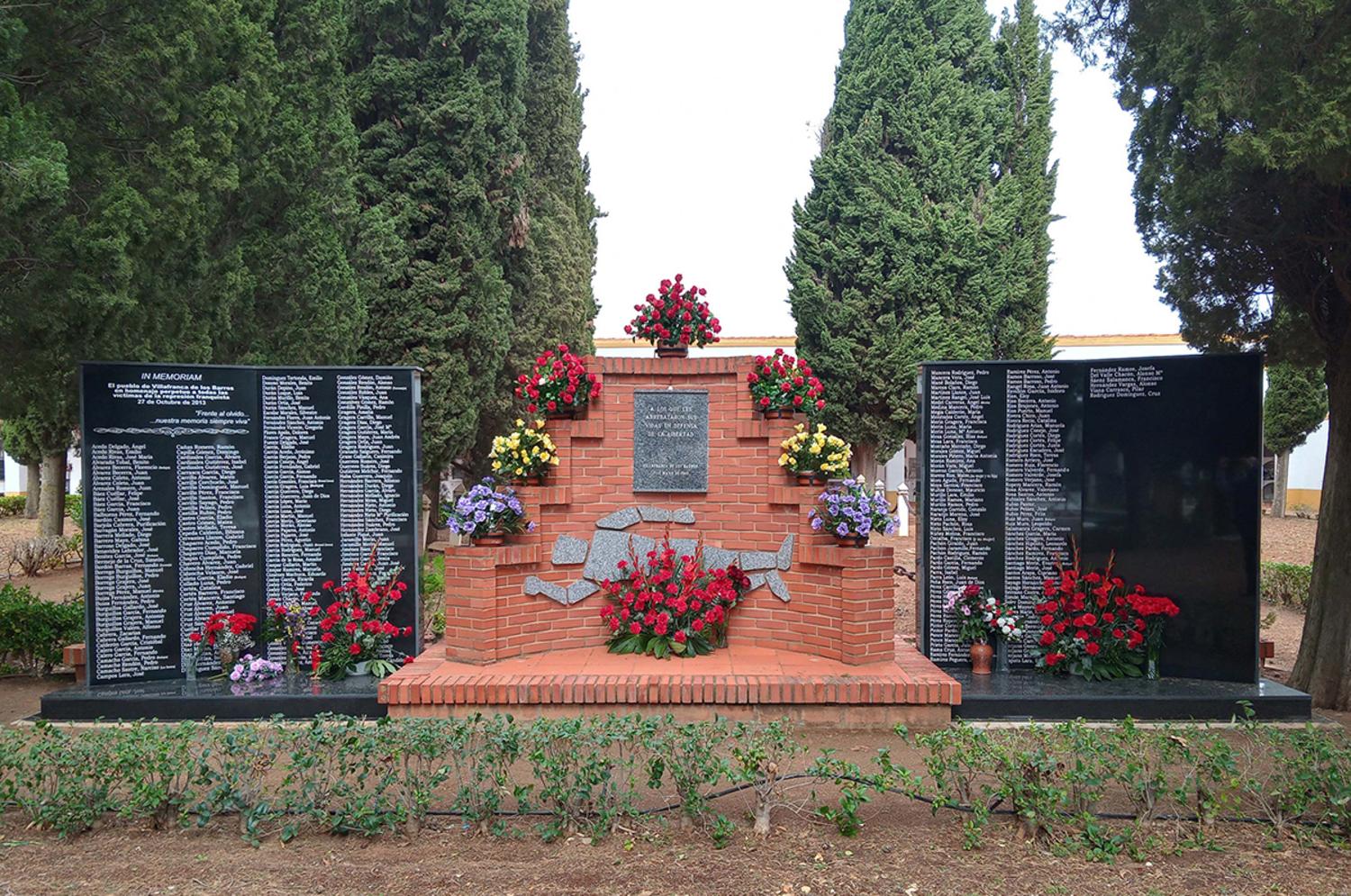
The list tells the story of a couple who were murdered and their four children left to leave on the streets on their own. One of taken in by a newly widowed women, who raised him with her four children, and he later married one of the daughters of his adopted mother. The list also talks of men who were hidden from their families, only to have their relatives threatened with death if they did not hand over the wanted, who were executed. See here in Spanish for all the tales of the town

Another story of Catalina Rivera Born in Zorita (Cáceres) in 1901, Catalina Rivera was a Republican schoolteacher and a member of the Federation of Education Workers (FETE), affiliated with the UGT (General Union of Workers). Rivera was art of the local Casa del Pueblo (People’s House), participated in the women’s liberation movement in the area, and taught local farm workers how to read and write in her home in the evenings, free of charge. She also welcomed farm labourers into her home after they finished their work and taught them to read and write free of charge, as 50% of men and 60% of women were illiterate, as were around 67% of children, despite the Republic literacy reforms. Many boys were expected to be labourers, girls cleaners and wives, and did not get an education. The number are consistent throughout Extremadura, who was well above the illiteracy average rate of 44% for the country.
When the rebel troops approached Villafranca de los Barros, many people took the chance to run, but Rivera stayed to care for her father while her brother and fiancé fled. Several days after the army occupation, Rovera and her father changed her minds, and planned to leave for Zorita in Cáceres province, but news of their plan reached the rebels. Both were captured and Rivera’s father was executed at once. As a Republican women, Rivera was taken back into town in Villafranca, where she was paraded through the streets, likely naked and shaved and shot on August 9, 1936, likely after sexual violation, aged only 35 years old. A document stated that she had been executed for rebellion against the Army, and the local parish priest said she had been shot for being a Marxist.
Historian Francisco Espinosa Maestre uncovered Rivera’s memory discovering non-payment of a sewing machine in local paperwork. ‘Most of the teachers at that time were Catholic, conservative, a model completely opposite to the one she represented. She was an easy target,’ Espinosa explained on the TVE program Crónicas. ‘She would tell us: ‘Girls who want to go to Mass, go; those who don’t want to, don’t go. Let there be freedom for each of us to do as we please.’
- Toledo, New Castile
As the siege settled into a stalemate on the ground, the Republicans increasingly turned to the air in an effort to break the defenders’ resistance. Aircraft had appeared over Toledo since the opening days of the siege, but during August their visits became a familiar part of daily life. The sound of aero engines overhead often prompted civilians to look towards the Alcázar, wondering whether another bombing raid was about to begin. On 8 August, Republican aircraft had dropped sixteen bombs onto the Alcázar while also releasing tear-gas grenades, hoping to make the defenders’ already difficult conditions even more unbearable. The following day, aircraft again attacked the fortress while Republican artillery joined the bombardment from positions around Toledo. Click here for the August Toledo siege


Dear Caroline, eagerly following your daily chronicles from so far away but emotionally close. My two maternal grand parents were republican teachers, affiliated to the UGT, in La Herradura ( Granada), fleeing in “La Espantá” (“The Crime of the Malaga-Almería Road”, by Norman Bethune , I’ m pretty sure You know) with my mother ( then one year old) and two uncles to Adra (Almería) .
Many, many thanks for your heartfelt and breathtaking account.
All the best
José Manuel Quesada Molina Córdoba-Granada-Sevilla, just now reading you in Conil (Cádiz)
I am sorry I have not commented here before now. Your grandparents have been through an incredibly heart-breaking event, and they managed to survive to get to Almería That is truly incredible.