

Puebla de Sancho Pérez lies approximately 6 kilometres south of Zafra on the road leading north from Los Santos de Maimona. In 1936, the town had a population of about 3,350, making it one of the smaller municipalities in the Zafra–Río Bodión district, but its position placed it directly in the path of the Army of Africa as it advanced towards Mérida and Badajoz.
Like neighbouring towns, Puebla de Sancho Pérez depended almost entirely on agriculture. Most residents worked as agricultural labourers on large estates surrounding the town, while a much smaller number earned a living as artisans, railway workers and small traders. The social divisions that characterised southern Extremadura were equally visible here. A relatively small group of landowners controlled much of the surrounding farmland, while hundreds of labourers relied on seasonal employment and welcomed the labour reforms introduced during the Second Republic. Socialist organisations and the UGT developed a strong presence among agricultural workers, while conservative landowners, practising Catholics and right-wing supporters remained influential within the town.
The military uprising of July 1936 failed in Puebla de Sancho Pérez. Local Republican authorities retained control, disarmed suspected supporters of the rebellion and organised civilian defence, but they possessed few military resources. As the Army of Africa captured Monesterio, Los Santos de Maimona and Zafra during the first week of August, it became clear that the town could not be defended against professional troops supported by artillery and machine guns. Republican militia and local supporters withdrew as the Nationalist columns approached, allowing the Army of Africa to continue north without delaying its advance towards Villafranca de los Barros and Mérida.
The occupation marked the beginning of a sustained campaign of repression. Javier Martín Bastos documented approximately 70 victims of Francoist repression from Puebla de Sancho Pérez, while the town also suffered Republican killings before the Nationalist occupation. The documented victims represent a minimum figure. Oral testimony collected during later investigations indicates that violence extended beyond what survives in the Civil Register, where many executions were concealed through inaccurate or deliberately vague causes of death.
The executions continued for months after the military occupation. Victims included agricultural labourers, railway workers, craftsmen and local political activists. Some Civil Register entries originally recorded deaths as the result of Justicia Militar before officials later altered the wording to phrases such as deaths caused by gunfire during a clash with security forces, illustrating attempts to disguise executions after the event. Individual cases demonstrate the continuing nature of the repression. Industrial worker José Montaño Toribio was killed on 7 August 1936, the day Nationalist forces occupied the town. Agricultural labourer Remigio Rodríguez Matos died on 15 September 1936, his death recorded as the result of Military Justice. Manuel Fuentes Guerrero, a widowed labourer with four children, was executed on 14 September 1936. Railway worker Pedro Fuente Pachón was executed on 4 December 1936, showing that the killings continued long after organised military resistance in Extremadura had ended.
The cemetery became the principal burial place for many of those executed. During the late 1980s, relatives campaigned for the recovery of the victims buried in the cemetery’s mass grave. The initiative began after repeated requests from José Muñoz Roblas, a former president of the Socialist Youth who had spent years in prison after the war and lost several members of his own family during the repression. Supported by the town council, the grave was exhumed, the remains were reburied, and a memorial stone was erected commemorating those ‘who were deprived of their lives for defending liberty and democracy’. The monument remains one of the earliest local memorials established in Extremadura through cooperation between relatives and the municipal authorities.

Usagre stands approximately 15 kilometres south-east of Zafra and had a population of around 4,500 in 1936. Like most towns in southern Badajoz Province, its economy depended almost entirely on agriculture. Large estates surrounded the town, employing hundreds of seasonal labourers whose livelihoods depended upon the harvest. During the Second Republic, socialist organisations and the UGT gained considerable support among agricultural workers, while conservative landowners, practising Catholics and right-wing political organisations remained influential. The result was a deeply divided community long before the outbreak of the Civil War.
Republican authorities had retained control of the town, organised local defence and confiscated weapons from suspected supporters of the rebellion, but once the Army of Africa broke through southern Extremadura during the first week of August, the town became isolated from the main Republican defensive positions, so Nationalist forces entered Usagre on 7 August encountered little organised resistance. Republican militia and many political activists withdrew before the arrival of the Nationalist columns, allowing the Army of Africa to continue its advance towards Villafranca de los Barros and Mérida without becoming involved in prolonged fighting inside the town.
Military occupation marked only the beginning of the violence. Local Falangists, supported by the new authorities, began identifying Republican supporters, trade union members, municipal councillors and labour organisers. Arrests followed quickly. Prisoners were held inside the town before being removed for execution, usually without any formal judicial process. Research by Javier Martín Bastos has identified approximately 112 victims of Francoist repression in Usagre, making it one of the hardest-hit towns in the district relative to its population. The documented figure represents a minimum because Civil Register entries frequently concealed executions behind deliberately misleading causes of death, while some victims never appeared in the official records at all. Most of those killed were agricultural labourers, reflecting both the occupational structure of the town and the strength of its organised labour movement before the war. The executions continued throughout the late summer and autumn of 1936 and victims ranged from young labourers to older householders and included municipal officials, union members and ordinary residents accused of supporting the Republic.
The cemetery became the principal burial place for those murdered during the repression. Later investigations identified a mass grave within the cemetery containing Republican victims executed after the Nationalist occupation. Archaeological work confirmed the presence of multiple bodies buried without coffins in hurried graves, consistent with witness testimony describing executions carried out during the autumn of 1936. The investigations formed part of wider efforts across Extremadura to document the victims of Francoist repression and return identified remains to their families where possible. Research into the victims has restored many individual names that disappeared from official history for decades. Their occupations, family circumstances and ages demonstrate that the repression extended far beyond people who had taken up arms. Agricultural workers, craftsmen, municipal employees and local political activists all appear among the documented dead, reflecting the broad social impact of the violence that followed the Nationalist occupation of the town.
After defeating Republican militia at nearby Los Santos de Maimona, the Army of Africa advanced on Zafra. The town had become the principal communications centre in southern Badajoz. Commander Antonio Castejón Espinosa’s column entered Zafra on 7 August 1936 after Republican resistance in the surrounding area had collapsed. Many militia had already withdrawn following the defeats further south, and the town fell without urban fighting that had characterised some earlier engagements. The speed of the advance reflected the Army of Africa’s operational doctrine: bypass or overwhelm organised resistance, leave occupation forces behind, and continue north before Republican commanders could establish a new defensive line. At 3:00am, the townspeople could not sleep, and had placed white sheets out their windows, a sign of surrender to the coming army. By 5:00am, the artillery fire started at the train station as the first train of the day set to leave, and then began the bombardment into the town. Only one man sat perched in a cinnamon tree with a gun to repel the Legionarios, who laughed as he drunken fired at them at 7:00am, before he was murdered and the town fell to the Nationalists. The locals left all their doors open, fearing that Moroccan soldiers would tear them off it they were closed, so the houses could be looted.

The military victory immediately gave way to organised repression. There had been no killings of right-wing residents in Zafra during the Republic’s brief control of the town, due in large part to the efforts of Socialist mayor Eloy José González Barrero to prevent reprisals. That restraint offered no protection after the Nationalist occupation. Castejón reportedly ordered that a list be prepared containing approximately seventy names, around one percent of the town’s population, to be executed. The final list was reduced to 48 prisoners, although witnesses later recalled that Castejón insisted that every name removed should be replaced with another so that the target number of one percent of the town needing to be killed was maintained.
In the heat of the day, a procession of army and prisoners went along Sevilla Street, with people cheering, scared, or hiding. Prisoners, tied in groups of seven or eight, their faces contorted with grief, of the 50 who died on the first day, where Antonio Amaya, Ángel Caño, Bárbara Bizarro, Luis Mata, Diego Luna, Paca Infante, Luis Madroñero, ‘Reverte,’ Antonio Guerrero, Teodomiro Trujillo, Julián Vitorique, Juan Antonio Zambrano, the Coronels, the Montaños and Don Rafael, the pattern maker, and Doña Juana, the teacher, president of the Zafra Women’s Society of Various Trades. Prisoners in these groups were marched north with the advancing troops. At intervals along the road the prisoners were taken aside and shot, forcing those who remained alive to witness each successive execution while awaiting their own deaths. At least 180 people executed in Zafra following the occupation plus the deaths in prison, military executions, and ‘disappearances,’ alongside the public sexual humiliation of the female population, and subsequent starvation of orphans left behind the army’s wake. Many victims came from Zafra itself, while others were arrested in neighbouring villages and brought to the town.
From Conversación sobre la historia – ‘The trucks, the horses, the troops, the abandoned corpses, the dogs barking and sniffing at the blood, the cicadas, the heat, the fear… I can still hear the atrocious sound of the firing squads that, every five minutes, barely slow the march of the “conquerors,” and I see the enormous cloud of dust from that day’s tragic history drifting away along the Los Santos road.’

The scale of the repression transformed one of Extremadura’s most important market towns into a major centre of Nationalist violence. The capture of Zafra also completed the Army of Africa’s consolidation of southern Badajoz, and its railway station and road network now allowed men, ammunition, fuel, and supplies to move north from Seville with increasing efficiency while securing the rear of Yagüe’s offensive. With Monesterio, Fuente de Cantos, Los Santos de Maimona, and Zafra under Nationalist control, the final obstacle before the Guadiana was Mérida, where the Republican Army would make its next determined attempt to halt the advance of a corridor of incredible cruelty.
In the late 1980s, José Muñoz Roblas, who had been president of the Socialist Youth in 1936, whose close associates were killed, along with other survivors, demanded an exhumation in the cemetery of Puebla de Sancho Pérez, 4km south of Zafra. José, a carpenter who had been sentenced to 30 years in prison for being a Republican sympathiser. The exhumation was accompanied by a religious ceremony in the cemetery and the installation of a headstone that reads, ‘In memory of comrades whose lives were taken for defending freedom and democracy. Years 1936-1939. Their family and friends.’ The exhumation and reburials was strictly private and does not publicly show numbers of names of the victims. In 2011, the list of those who suffered reprisals was added to the monument, the same year the right-wing government was put back in power in the area, though survived and is still in place.

By the time the Army of Africa reached Almendralejo on the night of 7 August 1936, thousands of refugees had already carried news of the Nationalist advance into the town. Republican militia prepared for a determined defence, while hundreds of civilians sought safety wherever they could. The Army subjected Almendralejo to sustained artillery fire and aerial bombardment before advancing into the outskirts. The town’s defenders held a number of right-wing prisoners, and militia leaders warned that they would kill them if the Nationalists entered. When Asensio’s troops reached the edge of Almendralejo, 28 prisoners were killed before the Army could reach them.
The fighting proved more difficult than previous engagements along the road from Seville. Reinforced by Antonio Castejón’s column, the Nationalists gradually forced their way into the centre of the town and around 40 Republican militiamen made a final stand inside the parish church. Asensio ordered the building set alight, adding wet straw and sulphur in an attempt to drive the defenders out with smoke. When this failed, artillery continued to batter the church until resistance finally collapsed. By 10 August, organised Republican resistance in Almendralejo had ended, and the Nationalists had taken several hundred prisoners.
The occupation marked the beginning of one of the bloodiest episodes of repression in Extremadura. Contemporary Portuguese newspapers reported that more than 1,000 people, including around 100 women, were shot in what they described as the punishment of an ‘accursed town.’ Local historians have identified by name more than 400 men and 16 women executed during the occupation and the following three months, while concluding that the true number of victims was certainly higher. The violence extended beyond the executions. Women were raped, many had their heads shaved and were forced to drink castor oil, while local right-wing groups organised mounted patrols to hunt down leftists who had escaped into the surrounding countryside. Franco ordered Asensio’s and Castejón’s army columns to leave Almendralejo and unite for the advance on Mérida and Badajoz only after the local right believed the Republican movement in the town had been effectively destroyed, leaving the requested Guardia Civil, Falangists, and Carlists to complete the cleansing.
Almendralejo cemetery used to have a mausoleum that held three or four bodies, which had been privately dug up inside the cemetery at an unknown date (presumably by family members), who knew where to find mass grave pits within the cemetery. A memorial unveiled in 2023 is now on the site, which lists 462 victims from Almendralejo, and 252 victims from nearby areas, who were killed between 1936 – 1939. Another pit site in what was known as the Old Cemetery area, owned by Manuel Parejo, whose father had been murdered, held another 36 bodies that were also moved to the memorial site in 2024.

On 7 August 1936, Madrid experienced one of its first significant Nationalist air raids of the Civil War. Aircraft flying in support of the rebellion dropped bombs over parts of the capital, marking the beginning of a campaign that would eventually make Madrid one of the most heavily bombed cities in Europe. The raid caused relatively limited military damage, but its psychological impact was considerable. Air-raid sirens sounded, civilians sought shelter, and anti-aircraft guns opened fire as bombs fell on a city that had remained physically untouched during the fighting of July.
The attack lacked the scale of the bombardments that would begin later in the autumn, it reinforced growing fears that Madrid would soon become the Nationalists’ principal objective. Newspapers reported the raid alongside news of the Army of Africa’s advance through Extremadura, while rumours of spies and a so-called ‘fifth column’ operating inside the capital spread rapidly through the city. The bombing also marked an early demonstration of the increasing importance of air power during the Civil War.
During the fighting of July 1936, Madrid had already experienced isolated overflights and small-scale bombing attacks as Nationalist aircraft targeted military positions, barracks and transport facilities. These early raids caused comparatively little damage and were often viewed as extensions of the fighting that had followed the failed uprising rather than as sustained attacks on the capital itself, but they introduced Madrid’s inhabitants to the reality of aerial warfare and demonstrated that the city was vulnerable to attack from the air.
The next day, France closed its border with Spain to most official arms shipments, marking one of the most consequential diplomatic decisions of the war’s opening weeks. Publicly justified as a policy of non-intervention, the decision severely weakened the Spanish Republic’s ability to obtain weapons and military supplies just as Fascist Italy and Nazi Germany were expanding their military assistance to the Nationalists.
For many Republicans, the decision confirmed a growing fear that Europe’s democratic governments were unwilling to defend the Spanish Republic even as fascist powers intervened openly on behalf of the military rebellion. In London and Paris, however, many politicians believed that avoiding a wider European war had become the overriding priority, even if that meant abandoning Spain to its own fate.
When the military uprising began in July 1936, the French government under Prime Minister Léon Blum initially appeared willing to assist the Spanish Republic. Blum headed France’s Popular Front government, a coalition of socialists, radicals and republicans whose political outlook broadly aligned with Spain’s own Popular Front administration. French trade unions, socialist organisations, communists and anti-fascist groups demanded that weapons and aircraft be sent to Spain before the rebellion could consolidate its gains. During the final days of July, a limited number of French aircraft and military supplies reached Republican territory, raising hopes in Madrid that more substantial assistance would follow. But within France, mounting opposition from across the political spectrum. Conservative parties, influential Catholic organisations, industrial leaders and sections of the French military warned that direct intervention could deepen political divisions at home and risk drawing France into a wider European conflict. President Albert Lebrun urged caution, while senior military officers questioned whether France was prepared for the consequences of becoming involved in Spain’s war. By 8 August, France closed the Franco-Spanish border to most official arms shipments. The frontier was never completely sealed and arms continued to cross through unofficial channels, the political message was unmistakable. The Republic’s closest democratic neighbour had chosen restraint over intervention at the very moment its need for foreign assistance was becoming most acute.
While France wrestled with its own political divisions, Britain pressed firmly for a policy of non-intervention. The British government, led by Prime Minister Stanley Baldwin, regarded the Spanish Civil War with increasing alarm. There were growing fears that direct French support for the Republic would encourage Germany and Italy to intervene even more openly on behalf of the Nationalists, raising the possibility of a wider European war at a time when Britain was neither politically nor militarily prepared for another continental conflict.
Many figures within the British political establishment viewed developments inside Republican Spain with deep unease. Reports reaching London described armed militias replacing sections of the regular army, factories and farms being collectivised, churches attacked or burned, clergy killed, and revolutionary committees exercising authority in place of local government. To many conservative politicians, diplomats and newspaper editors, Spain appeared to be descending into social revolution as well as civil war or a revolutionary movement beyond the control of the Republican government on the other, neither option they wanted spreading around Europe or their own doorstep.
While Britain and France debated neutrality, Germany and Italy were already intervening directly in Spain. Although the large formations later known as the German Condor Legion and the Italian Corpo Truppe Volontarie had not yet arrived, aircraft, fuel, spare parts, military equipment, specialist personnel and experienced aircrews were all reaching Nationalist Spain. What had begun as a military uprising was increasingly being sustained by international support. Foreign correspondents reported growing bitterness towards the western democracies, as many Republicans concluded that Britain and France feared social revolution more than they feared the expansion of fascism.
The closure of the French border carried immediate consequences for the Spanish Republic. Since the outbreak of the military uprising, the Republican government had struggled to transform the spontaneous resistance of workers, militia organisations and loyal military units into a coordinated war effort. Although much of Spain’s industrial capacity remained in Republican hands, particularly in Catalonia and the Basque Country, the disruption caused by the fighting, shortages of raw materials and the collapse of normal supply networks made it impossible to replace military equipment at the rate it was being consumed. The Republic urgently required rifles, machine guns, artillery, aircraft, ammunition, fuel and trained military personnel. Every week that passed without reliable foreign supplies made it more difficult to equip the growing number of volunteers arriving at the front. Many militia columns continued to rely on a mixture of captured weapons, obsolete rifles and whatever ammunition could be obtained locally.
Organisation remained equally challenging. Socialist, communist, anarchist and republican militias fought with determination but often retained separate command structures, political leadership and logistical systems. Coordination between different fronts remained inconsistent, while experienced officers were in short supply after many senior commanders had either joined the rebellion or been removed from their posts. Eyewitnesses from the Guadarrama, Aragón and Córdoba fronts later described volunteers arriving with little military training, shortages of ammunition, confused chains of command and inadequate medical supplies. Despite these difficulties, morale in many Republican cities remained remarkably resilient. Recruitment continued in Madrid, Barcelona and Valencia, while political parties, trade unions and neighbourhood organisations organised new militia columns, collected supplies and raised funds for the war effort.

Lora del Rio celebrating the local fair, via Ayuntamiento de Lora del RíoIn July 1936, Lora del Río was one of the largest agricultural towns in eastern Seville Province, with a population of approximately 12,000 to 13,000. Situated on the north bank of the Guadalquivir River, 57 km northeast of Seville, it occupied a strategically important position on the railway, the main road east, and the river crossings. After the military uprising began on 18 July, Nationalist forces quickly secured Seville and spread north and east through the province, capturing town after town along the road to Lora del Rio, with Alcalá de Guadaíra (which saw 137 arrested and execution when first captured, and another 350 tortured, executed and deumped), Mairena del Alcor and El Viso del Alcor all quickly falling unto Nationalists hands suffering mass killings near their local cemeteries (all three towns have mass graves). One the town closest to Lora del Rio along this road was Carmona, which was captured on 22 July, losing their 12 Republican militia who tried to defend the town. Around 200 people had managed to flee, but another 200 men, women, and children were executed. Local accounts said Republican women were dragged form the homes, shaved, poisoned and paraded, before being subjected to rape, some taken back to farmhouse by wealthy landowners for their own use.
Lora del Río, however, remained under Republican control for almost three weeks, making it one of the last significant Republican-held municipalities east of the provincial capital. The Republican authorities organised a local defence committee drawn from the town’s left-wing parties and trade unions. Armed civilians and militia occupied public buildings, controlled access to the town and prepared for an attack from Seville. As Nationalist columns advanced through neighbouring municipalities, refugees arrived with reports of executions, arrests and the destruction of Republican organisations. Their accounts convinced many residents that surrender offered little chance of survival. Others chose to remain, hoping the Republican government would organise a counter-offensive before Nationalist troops reached the town.
The nearby town of Alcolea del Río, 15km west, was not so lucky, quickly overthrown by the Nationalists and 81 locals were soon executed. Falangists then blackmailed families into signing death certificates stating their loved ones died of natural causes in exchange for revealing the location of the bodies so they could identify them. After these exhumations resulting from blackmail, the site of the mass grave in the back of the local cemetery remained undisturbed until 1979, when it was given a pyramid bearing the names of those who suffered repression. It is still unknown how many were placed in this specific mass grave, as Seville province alone has 151 sites, and a number of small towns surround Alcolea del Rio, and prisoners may have been moved between the areas, or placed in the river.
In nearby Lora del Rio, several right-wing prisoners had been executed during the first week of August, particularly on the nights of 1–3 August, after armed men arrived from neighbouring Constantina. Later Francoist investigations attempted to attribute all of these deaths to the Constantina group, examination of witness statements and contemporary evidence demonstrates that the killings occurred over several nights and involved more than one group. Many of the testimonies collected during the dictatorship were obtained under interrogation, and several defendants later stated that Guardia Civil officers beat them until they signed prepared statements. The precise responsibility for individual killings therefore remains difficult to establish.
By the first week of August, the defenders expected an assault at any moment. They prepared to destroy the railway bridge over the Azanaque stream with approximately 150kg of dynamite and also planned to demolish the bridge on the road to La Campana to slow the Nationalist advance. On the morning of 7 August, they damaged one of the railway tracks, believing the attackers would arrive by train. Instead, Lieutenant Colonel Heliodoro Rolando Tella Cantos left Seville before dawn with a column of approximately 600 Legionnaires, cavalrymen, Guardia Civil and engineers, supported by artillery. As the column approached Lora del Río from the west, the carefully prepared demolitions failed to stop the advance. Within hours, one of the last Republican strongholds in eastern Seville Province stood on the verge of collapse.
Lieutenant Colonel Heliodoro Rolando Tella Cantos assembled his column in Seville during the early hours of 7 August 1936. The force left the city at approximately 4:00am and numbered around 600 men. It consisted of the First Bandera of the Spanish Foreign Legion, a dismounted squadron from the Taxdir Cavalry Regiment, detachments of the Guardia Civil, military engineers, two 105 mm artillery pieces, and an ambulance. Among the officers accompanying the expedition were Captain Juan Ramón Benítez Tatay, Captain Rafael Coronel Torres, and Captain Carlos Mencos López. Benítez Tatay and Coronel Torres were both natives of Lora del Río and knew the town well.
The column followed the main road through La Algaba, Alcalá del Río, Villaverde del Río and Cantillana before turning towards Lora del Río. Republican defenders had expected an attack by rail and had concentrated much of their effort on preparing the railway bridges for demolition. Although they damaged part of the railway line on the morning of 7 August, Tella’s force advanced by road, rendering much of the preparation ineffective, and Tella established his artillery on the Cerro de León, a hillside approximately two kilometres from the town. The guns opened fire on Lora del Río for several hours. Shells struck residential buildings and the Santa Catalina Hospital, while explosions echoed across the town. The bombardment served not only to weaken resistance but also to spread panic among the civilian population before the troops entered.
Families needed to abandon their homes as the bombardment intensified. Some parents gathered children and whatever possessions they could carry before fleeing towards the surrounding countryside and the hills north of the town, while others sheltered inside their homes, uncertain whether to flee or remain. By the time the Nationalist column approached the outskirts of Lora del Río, much of the civilian population had already begun to disperse.
Republican defenders possessed rifles, a small quantity of explosives and determination, but they lacked artillery, professional soldiers and the ammunition needed to oppose a well-equipped military column. As the Legion advanced into Lora del Río, the remaining defenders withdrew or attempted to escape before they could be surrounded. The Nationalists entered the town later that day, occupied the Ayuntamiento and other strategic buildings, and released the right-wing prisoners who had remained in custody during the weeks of Republican control. The capture of Lora del Río ended almost three weeks of Republican administration and the beginning of a systematic campaign of arrests and reprisals. Right-wing prisoners released by Tella’s column, together with local conservatives and Falangists who had remained in hiding during the Republican period, immediately began identifying people who had supported the Republic. Some accompanied patrols through the streets, pointing out homes where councillors, trade union leaders or militia members had lived. Others supplied lists of names or denounced neighbours they believed had participated in arrests, searches or political activity during the previous three weeks.
One of the most revealing episodes shows a collection of photographs taken during a May Day demonstration before the Civil War. Falangist Rafael Dana Aranda later recalled that Judge Eugenio Fernando Picón Martín asked him for the photographs shortly after the Nationalist occupation. Dana believed they would be used simply to establish what had happened during the Republican period and handed them over willingly. Instead, the photographs were enlarged, identified men and women marching beneath Republican banners or raising clenched fists, and used them to locate and arrest many of the people who appeared in them. Participation in a legal demonstration held before the war could now become evidence leading to imprisonment or execution.
By 9:00am on 8 August, fewer than 24 hours after the occupation, the authorities already held more than 60 prisoners. Temporary detention centres filled with councillors, labourers, railway workers, farm workers, teachers, members of socialist and anarchist organisations, and anyone denounced as having collaborated with the Republic. Families often received no explanation for the arrests. Relatives watched soldiers remove fathers, brothers or sons from their homes, never to see them again.
Lieutenant Colonel Heliodoro Rolando Tella Cantos returned to Seville on 8 August, leaving part of his force behind to secure the town. Command passed to Captain Carlos Mencos López, who supervised the occupation during its most violent phase. Two days later, on 10 August, Mencos ordered the creation of a new municipal commission to replace the elected Republican council. Isaías Benítez Tatay became its president, while Judge Eugenio Fernando Picón Martín served as vice-president. The remaining members came largely from conservative professions and landowning families, signalling that political power had passed completely into the hands of those who had supported the military uprising.
Alongside the new municipal commission, an informal purge committee emerged to decide the fate of prisoners. Montero identifies Captain Juan Ramón Benítez Tatay, Isaías Benítez Tatay, Judge Picón, military commander Manuel Calderón Horrillo, Falange leader José María Leyva Montoto and Falange militia commander Miguel Campos Cabrera among those who participated in questioning detainees and determining the punishments imposed upon them. Their decisions shaped the repression that followed. Some prisoners entered military prisons or concentration camps, but many others disappeared from custody and were executed without judicial process. The new authorities also moved quickly against Republican property, as houses belonging to people who had fled were searched, businesses were seized, and farms stood vulnerable to confiscation.
As prisoners accumulated in temporary detention centres, military authorities and local collaborators separated those considered most closely associated with the Republic from those who would remain in custody. Armed parties removed prisoners in small groups, drove or marched them to isolated locations outside Lora del Río for execution, or against the walls of the local cemetery. Families learned of their relatives’ deaths only through rumour or by recognising clothing on bodies recovered from the roadside or local cemeteries. Arrests continued as neighbours denounced neighbours, fugitives were captured, and military investigators examined records left behind by the Republican authorities. Anyone who had served on the town council, belonged to a trade union, held office in a left-wing political party, or assisted the Republican administration risked execution or long imprisonment. The Nationalists also relied heavily on information supplied by local supporters. Men and women who had remained loyal to the military uprising identified houses, workplaces and family members of Republican activists. The May Day photographs examined by Judge Eugenio Fernando Picón Martín accompanied lists of trade union members, municipal records, electoral rolls and personal denunciations all contributed to the expanding campaign of arrests. The repression therefore became increasingly systematic as military occupation gave way to organised political persecution. At the same time, soldiers and local collaborators searched homes belonging to prisoners and fugitives, removing livestock, furniture, clothing, agricultural tools and household possessions.
Municipal records demonstrate that homes and items seized during Nationalist looting formed part of an organised process rather than isolated acts of theft. In 1937, the authorities auctioned property accumulated by the military command since the occupation. The inventory included horses, mules, donkeys, beds, wardrobes, sewing machines, bicycles, tables, chairs, radios, farming equipment and children’s furniture taken from Republican families. The commission also transferred crops from land abandoned by fugitives to politically reliable landowners and confiscated livestock and poultry from families identified with the Republic. On 13 August, the new authorities further proposed employing prisoners on municipal works in return for food rather than wages, revealing how quickly repression extended beyond executions into the economic exploitation of surviving prisoners. Military victory also became a transfer of wealth, employment and influence to those who had supported the uprising.
The artillery bombardment on 7 August had seen entire families abandon their homes before the Nationalists entered the town, taking only what they could carry. Some fled into the hills north of Lora del Rio, hoping to hide until the fighting ended, while others attempted the much longer journey into Republican-held territory. The exodus included farm workers, railway employees, craftsmen, councillors, trade union members, women, children and elderly relatives. For many, leaving meant abandoning everything they owned. Whole households disappeared from Lora within hours of the occupation. Antonio Caballero Dávila fled with his wife Dolores Fernández Fernández and their three daughters. The family of Agustín Cabello Solís also escaped on 7 August, while José García de la Cruz, the father of eight children, left with most of his household before the Nationalists secured the town. Hundreds of similar cases appear throughout research, demonstrating that the occupation displaced complete families rather than only armed Republican supporters.
Many refugees spent days hiding in the countryside before attempting to reach Republican territory, and some were captured while travelling and returned to military custody, but many were killed in the countryside by Nationalists and Falangist supporters who shot and bombed refugees groups, on foot, on horseback, and in one case, by hiring a plan to identify and hunt refugee families. Those who successfully crossed the front often enlisted in Republican military units because they could not safely return home. Juan Gandía Ramírez, an agricultural labourer from Lora, escaped on the day of the occupation, reached Madrid and enlisted in the Ángel Pestaña Battalion. Thousands of Andalucian refugees followed similar paths, because Nationalist occupation had made return impossible.
The Nationalist authorities treated flight itself as evidence of guilt and referred to these people as fugitives instead of refugees. Families who escaped had their homes searched, their property inventoried and their land placed under official control. Crops standing in the fields no longer belonged to those who had planted them. Livestock, tools, carts and household furniture passed into military hands before being redistributed or sold. Those who remained faced equally difficult choices. Wives whose husbands had fled came under suspicion and frequently endured repeated searches, torture, and rape. Parents often concealed the whereabouts of sons serving with the Republican Army despite the risk of imprisonment. Children learned not to discuss missing relatives in public, while neighbours became reluctant to offer assistance for fear of attracting attention themselves. The disappearance of hundreds of men from the workforce transformed daily life as women, elderly parents and older children attempted to cultivate farms, harvest crops and support households that had suddenly lost their principal wage earners.
For many refugees, exile lasted years, including those who survived the Civil War only to return to imprisonment, concentration camps, or forced labour after 1939. Many never returned to Lora del Río at all. For decades, the full extent of the repression in Lora del Río remained largely hidden. Families knew where relatives had disappeared and remembered the arrests that followed the occupation, but fear prevented many from speaking publicly. Under the Franco dictatorship, those whose fathers, husbands or brothers had been executed often avoided discussing what had happened, while official records frequently concealed the true circumstances of death behind military formulas or incomplete documentation. Families never received a body, a death certificate or even confirmation of where their relatives had been buried.
The transition to democracy allowed survivors to begin recording their experiences, but it was not until much later that systematic historical research reconstructed the scale of the repression. Equally important, he interviewed surviving witnesses and relatives before their memories disappeared. Studies now can identify those executed immediately after the occupation, those imprisoned following military trials, prisoners who died in jails and concentration camps, Republican soldiers who never returned from the front, fugitives who disappeared after fleeing the town, and civilians whose property was confiscated because they had escaped Nationalist rule. The surviving municipal documentation also revealed how completely the new authorities reorganised the town after the occupation. Records preserved the appointment of the new municipal commission, the confiscation and redistribution of property, auctions of goods seized from Republican families, the transfer of agricultural land and crops, and the use of prisoners as a source of labour.
Today, Lora del Río stands as one of the best documented examples of Nationalist repression in Andalucía. The combination of archival research, municipal records and hundreds of family testimonies has produced a detailed reconstruction of the occupation and its aftermath. Although some victims can never be identified and many questions remain unanswered, the work of local historians and families has ensured that the events of 7 August 1936 and the months that followed are preserved as part of the town’s historical record rather than surviving only as fragments of memory.
The families of those long recorded as dead or missing began the process of digging in the Lora del Rio cemetery in 1977, taking on themselves to clean the area and erect a memorial, those any number of found people in their efforts is uncertain. As of 2025, a new mas graves of 45 people was found and identified and added to the town’s memorial. There are 615 recorded deaths, though the true number is approximately 1,000 killed in Lora del Rio, with whole families wiped out.
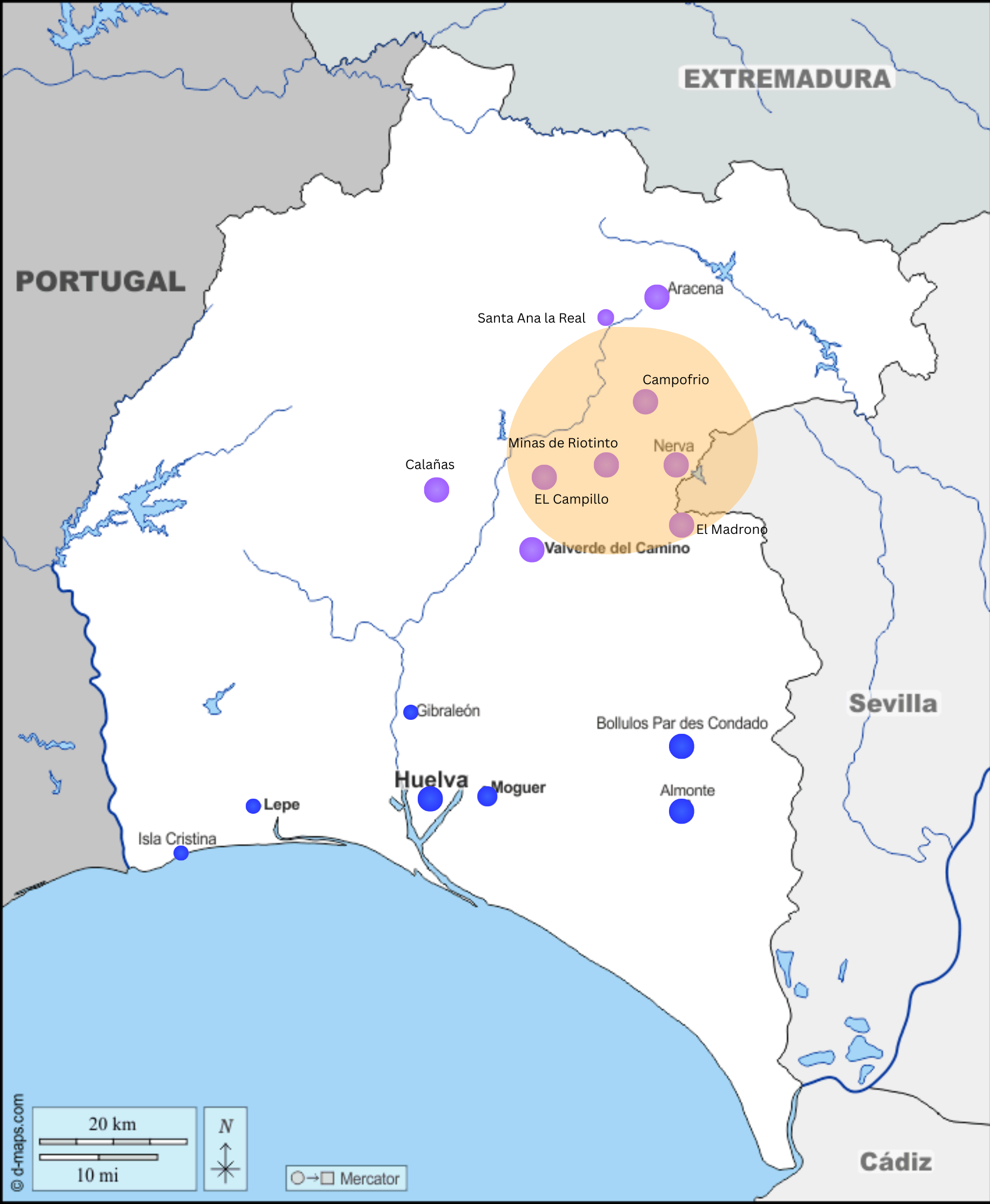
- Huelva
By 1 August 1936, the war had already divided Huelva province geographically. Huelva city, with a population of approximately 45,000, had fallen to the Nationalists on 29 July, and much of the southern and southeastern province was under their control. The mining basin around Nerva, Minas de Riotinto, Zalamea la Real, and Salvochea (renamed El Campillo) remained Republican, as did areas of the Sierra and western interior. Nerva had approximately 16,700 inhabitants, Zalamea la Real around 11,400, Minas de Riotinto around 10,300, and Calañas nearly 12,000 according to the 1930 census. Tens of thousands of people remained beyond Nationalist control in the northern half of the province.
Inside occupied Huelva, military authority rested with Guardia Civil commander Gregorio Haro Lumbreras. By a proclamation published on 1 August, Haro was acting both as military commander of Huelva and civil governor of the province. Above him stood General Gonzalo Queipo de Llano’s command in Seville, but Haro was the principal authority encountered by civilians within occupied Huelva: the provincial administration, policing, arrests, prisons, and repression operated under the new military regime he headed.
The front between the two areas spread across the interior of the province, with Valverde del Camino, a town of roughly 9,800 inhabitants about 20km south of Zalamea la Real, providing the Nationalists with their most important position facing the mining district. To the north and northeast, Republican-controlled communities and groups of armed miners still blocked the roads through the Sierra and towards Riotinto. Neither side possessed anything resembling a army in this part of Huelva. Nationalist forces operating through the province numbered in the hundreds and combined soldiers, Guardia Civil, Carabineros, Falangists, Requetés, and other armed supporters. On the Republican side, resistance depended heavily on miners and local militia equipped principally with rifles, shotguns, dynamite, and a very small number of machine guns.
For civilians in the territory already occupied, arrests continued in towns that had fallen during July, and prisoners began moving between municipal lock-ups, improvised detention centres, Huelva, and execution sites outside their hometowns. Political office, trade-union membership, participation in strikes, militia activity, denunciations by neighbours, and association with people who had fled could all bring arrest. Some people who had hidden in the countryside returned after receiving assurances that they would be safe, only to be detained later. Prisoners arrested elsewhere could be transferred to Huelva, while executions took place around the city and bodies were buried in the Cementerio de la Soledad. El Conquero also became associated with executions, with the eventual scale of the repression in Huelva province has identified more than 6,000 people killed by the Nationalists and subsequent Nationalist authorities over the course of the post-coup repression.
At the same time, the part of Huelva province still controlled by the Republic was becoming a refuge for people escaping the occupied south. Valverde stood near the boundary between the two zones, while further north the mining communities contained a large, politically organised industrial population with strong socialist, communist, and anarchist organisations. The mines themselves provided tunnels and industrial installations that could shelter civilians, while the surrounding hills offered routes towards the Sierra. During the coming weeks, these characteristics would make the Cuenca Minera both the principal remaining centre of Republican control in Huelva and the destination towards which the renewed Nationalist advance would eventually converge.
The first substantial fighting in Huelva during August came on 7 August at Finca El Empalme, the old railway junction between Valverde del Camino and Zalamea la Real. Valverde, with approximately 9,800 inhabitants, was already in Nationalist hands; Zalamea la Real, about 20km to the north and with a municipal population of roughly 11,400, remained Republican. Beyond Zalamea le Real lay El Campillo, Minas de Riotinto, and Nerva. Control of this road therefore determined whether Nationalist forces could advance directly into the heart of the mining basin.
Several hundred armed Republican miners moved south from the mining district towards the Nationalist positions around El Empalme railway alongside local militia drawn from communities where the CNT, UGT, socialist, communist, and other Republican organisations had mobilised supporters after the uprising. Their familiarity with dynamite gave them an unusual weapon, along with a few rifles and shotguns and only one machine gun, captured earlier from a Guardia Civil post.
Their immediate objective was to push the Nationalists away from the approaches to Zalamea la Real and, if possible, threaten Valverde itself. Retaking Valverde would have removed the most dangerous Nationalist position immediately south of the Cuenca Minera and reopened communications through a town that had served as an important commercial and transport centre for the surrounding district.
The miners encountered a much better equipped force at El Empalme railway. The Nationalists had infantry and Guardia Civil available, together with machine guns and artillery, while aircraft could be called in from Nationalist-controlled airfields. Exact numbers on the Nationalist side are uncertain, but the position was strong enough to withstand an attack by several hundred men without being abandoned, leading to five hours of fighting. The miners repeatedly attempted to dislodge the men holding the junction, but their numerical strength could not compensate for the difference in weapons. Artillery and aircraft made it particularly difficult to remain concentrated in the open country around the road. By the end of the engagement, the Republican force had failed to break the position and withdrew towards the mining district.


One thought on “On This Day in the Spanish Civil War: 7 August 1936 – including Lora del Rio and the First Bombing of Madrid”