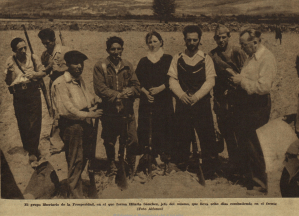
Few women who defended the Spanish Republic in the summer of 1936 have left behind so little documentary evidence as Hilaria Sánchez. No confirmed birth or death dates are currently known, nor has her life before or after the opening weeks of the Civil War yet been reconstructed. A single photograph, published in one of Madrid’s leading daily newspapers, preserves both her name and her role at one of the most critical moments in the Republic’s defence.
On 27 July 1936, the illustrated newspaper Ahora published a photograph taken by the celebrated photojournalist Alfonso Sánchez García. The image was taken in the Sierra de Guadarrama, where volunteer militia columns from Madrid had been rushed to prevent Nationalist forces advancing through the mountain passes towards the capital. The reference to eight days places the group at the front almost immediately after the military uprising, making them among the earliest neighbourhood militias organised to defend the Republic.
Although the surviving record tells us little else about Sánchez herself, the photograph establishes several important facts. She was recognised publicly by name, identified as the leader of her neighbourhood’s libertarian militia, and photographed not in Madrid but on an active front line. At a time when newspapers frequently referred to anonymous milicianas, Hilaria Sánchez was presented as the recognised leader of a fighting group.
The Grupo Libertario de la Prosperidad was rooted in the Ateneo Libertario Guindalera-Prosperidad, the principal anarchist cultural centre serving the neighbouring districts of Guindalera and Prosperidad before the Civil War. For many years, historians regarded these ateneos libertarios as little more than political meeting halls and recent scholarship by Dr. Francisco Javier Antón Burgos at Universidad Complutense de Madrid has radically revised that interpretation. Research published since 2023 has demonstrated that Madrid’s Libertarian Athenaeums formed the organisational backbone of the city’s anarchist movement. Closely associated with the CNT and FAI, they combined political education with an extraordinary range of community activities. Their libraries, lecture halls and classrooms promoted workers’ education and literacy, while their Escuelas Racionalistas, inspired by the educational philosophy of Francisco Ferrer Guardia, sought to provide secular, scientific and emancipatory education outside the influence of Church and State.
The ateneos were also centres of mutual aid. They organised cultural events, maintained consumer cooperatives, offered practical assistance to working-class families and created dense neighbourhood networks built upon voluntary association and collective responsibility. Long before the Civil War, they had become places where local residents debated politics, shared knowledge and organised around common social and economic concerns. When the military uprising began in July 1936, these same institutions adapted with remarkable speed to the demands of war. Their members organised neighbourhood defence, distributed weapons, recruited volunteers, established first-aid posts and field hospitals, assisted in constructing air-raid shelters and organised food distribution and other essential services. What appeared to outside observers as the spontaneous mobilisation of armed workers was, in many districts, the mobilisation of communities that had already spent years organising themselves through unions, cooperatives and libertarian ateneos.
Within that context, Hilaria Sánchez’s emergence as leader of the Prosperidad libertarian group becomes far easier to understand. Sánchez almost certainly belonged to an established network of local activists whose organisational experience predated the Civil War itself and is identified by the newspaper as their leader. Around her are volunteers dressed largely in civilian clothes, carrying an assortment of rifles and equipment that reflects the improvised nature of Madrid’s first militia columns during July 1936. Few wear uniforms. Their appearance captures the chaotic yet determined character of the Republic’s earliest military response to the coup.
The newspaper’s use of the masculine title jefe rather than the feminine jefa reflects contemporary Spanish usage, in which military and leadership positions were frequently described using masculine grammatical forms regardless of the holder’s gender. The image also challenges long-held assumptions about women’s roles during the opening weeks of the war. While many women served as nurses, medical workers or organisers, others exercised positions of authority within local militia groups before the later militarisation of the Republican Army reduced opportunities for women to remain in front-line service. Sánchez’s photograph captures one of those fleeting moments when neighbourhood defence was organised through revolutionary institutions rather than conventional military structures.
After the publication of the photograph, Hilaria Sánchez disappears from the surviving historical record. Whether she remained on the Guadarrama front, returned to Madrid, joined a later Republican military formation, entered another wartime role, went into exile or died during the conflict is presently unknown. No confirmed archival record has yet been connected to her name. As the Republican militias were gradually absorbed into the Popular Army during late 1936 and 1937, many neighbourhood organisations vanished into larger military formations. At the same time, women increasingly disappeared from newspaper coverage as journalists turned their attention towards commanders, major offensives and conventional military units. Under the Franco dictatorship, the histories of Republican neighbourhood organisations and the women who helped lead them were further suppressed or ignored. Sánchez is representative of a much larger, and until recently overlooked, chapter of Madrid’s revolutionary history.
When the military uprising divided Spain in July 1936, Segorbe quickly assumed a role far greater than its size suggested. Situated on the main road and railway linking Valencia with Teruel, the town controlled the southern entrance to the Alto Palancia valley. Any Republican force attempting to reach the Nationalist-held city of Teruel by the direct route had to pass through Segorbe before continuing north through Jérica, Barracas, Sarrión, and the mountain passes beyond.
The uprising failed to seize Segorbe. On 20 July, a local Popular Front Committee assumed authority in the town, replacing much of the existing municipal administration and ensuring that the road and railway remained in Republican hands. Throughout the following weeks, Segorbe became a secure concentration point where troops arriving from different parts of eastern Spain could assemble before advancing into Teruel province.
The first major formation reached Segorbe on 27 July. Commanded militarily by Colonel Hilario Fernández Bujanda and politically represented by Republican deputy Francisco Casas Sala, the mixed expedition assembled at Sagunto before travelling north to Segorbe. The column brought together Guardia Civil companies from Castellón province, militia from Castellón and Sagunto, Carabineros, medical personnel, and a convoy of buses, lorries, ambulances, and private vehicles. Contemporary estimates of its strength vary considerably, ranging from around 900 to more than 1,100 personnel, reflecting the difficulty of counting volunteers who continued to join the expedition during its journey.
Further reinforcements arrived later the same day when a company of approximately 90 Guardia Civil travelled from Cuenca under Captain Recuerda, accompanied by Lieutenant Benítez and Lieutenant Carrillo de Albornoz. Their unexpected appearance caused alarm among local militia, who could not immediately determine whether the guards remained loyal to the Republic. The confrontation ended peacefully, and the Cuenca company joined the expedition rather than fighting for control of the town. The incident nevertheless exposed the uncertainty that surrounded the loyalty of many Guardia Civil units during the opening days of the war.
The enlarged force remained in Segorbe overnight while its commanders attempted to organise the advance towards Teruel. The halt also revealed one of the expedition’s principal weaknesses. Although volunteers continued to arrive, there were insufficient rifles to arm everyone, forcing some militia to continue with limited or no weapons. The column therefore entered the campaign as a large but unevenly equipped force rather than a fully organised military formation.
Before dawn on 28 July, the column departed Segorbe, leaving part of the local Guardia Civil company behind to secure the town and protect the communications route. The main body advanced through Barracas towards Sarrión, before continuing towards La Puebla de Valverde and Mora de Rubielos, where it hoped to challenge Nationalist control of the approaches to Teruel. Historians disagree over the exact point at which the column later divided, but the surviving evidence places that decision after the force had left Segorbe. Likewise, the later rebellion by elements of the Guardia Civil occurred farther north near La Puebla de Valverde, not in Segorbe itself.
Segorbe continued to receive military formations after the Fernández Bujanda–Casas Sala Column departed. Contemporary reports recorded another mixed column of Carabineros, Assault Guards, and militia travelling to the town on 1 August, while later formations moving towards the Teruel front also passed through the same route. The available evidence does not allow every movement to be reconstructed in detail, but it demonstrates that Segorbe remained the Republic’s principal assembly point for operations directed towards southern Aragón during the opening weeks of the war.

