Perdiguera
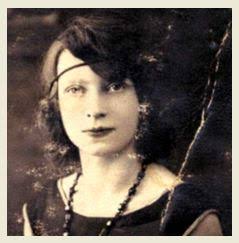
- Georgette Léontine Roberte Kokoczynski, aka Georgette Brivady, aka Mimosa
Born in France in 1907, Georgette Kokoczinski was a multi-talented French anarchist militant, nurse, and performer. Initially a prominent figure in the Montmartre cabaret scene under her stage name Mimosa, she integrated art and activism by using theatre groups to energise libertarian meetings and anti-fascist rallies throughout France. At 18, she met her partner, Fernand Fortin. and became a member of the group Éducation Sociale in Loches, and by 1928, she returned to Paris, using the stage name Mimosa. There, she became part of a theatre group that animated libertarian meetings and festivals. She also sold issues of La Revue anarchiste, run by Fortin. There she formalised her dedication to medical and social work by qualifying as a professional nurse.
After marrying Miecsejslaw Kokoczynski in 1931, she became part XIV Parisian Sector of the French Section of the Workers’ International and after a rally in 1936, driven by deep anti-fascist convictions, Kokoczynski volunteered for the Spanish Civil War in September 1936, joining the International Group of the Durruti Column on the Aragón front. Tasked with managing both the column’s field infirmary and its canteen near Zaragoza with Augusta Marx and Madeleine Gierth, where they cared for wounded volunteers. But when Nationalist forces launched a devastating counter-offensive at Perdiguera, Kokoczinski took up arms alongside the men as their positions were completely encircled.
One of the earliest reports from the War Health Committee suggested that Kokoczynski, alongside three other captured volunteers, was executed by a Nationalist firing squad directly behind the lines. To cover up the bodies or the scale of the localized massacre, Franco’s troops reportedly tossed the corpses into a local barn or farmhouse and set it ablaze. Another front-line report claimed that a small squad of French and Italian volunteers, including Kokoczynski, barricaded themselves inside an isolated rural building. They allegedly fought until their ammunition ran out, refusing a call to surrender, and were burned alive when Nationalist units torched the structure.
The specific idea that Kokoczynski suffered torture before her death comes from the published wartime memoirs of fellow International Group volunteer Antoine Gimenez. He recorded a highly graphic, controversial account alleging that Georgette Kokoczynski and Augusta Marx were captured alive by Nationalist troops, stripped naked, violently disembowelled while still alive, and then tossed back out onto the no-man’s-land or the front line to be completely finished off by gunfire. While this gruesome detail was widely shared in anarchist oral histories to highlight the extreme brutality of the Nationalist forces toward milicianas, modern academic historians treat it with extreme caution, noting it is incredibly difficult to verify due to the fog of war and the lack of forensic remains (though Nationalists openly portrayed female soldiers as unnatural, unchaste outcasts who deserved brutal ends, so her actual fate is incredibly difficult to establish).
Whether Kokoczynski died resisting a fiery siege, was shot immediately upon capture, or suffered a brutal, irregular battlefield execution, her death was carried out rapidly on the fields of Perdiguera. She passed straight from the chaos of the frontline into the anonymous landscape of the Aragon hills. Her death remaining one of the most poignant symbols of the sacrifices made by foreign milicianas. Fernand Fortin kept her diary, which stopped just before her death, though it was found among the International Institute of Social History in Amsterdam in Fortin’s handwriting in 2006.
In May 1937, Iberian Anarchist Federation (FAI) group in the Gràcia neighbourhood of Barcelona was started, all French-speaking and included Fortin, was named Mimosa in Kokoczynski’s honour. In July 1937, her friend Lola Iturbe was interviewed in Mujeres Libres and paid tribute to Kokoczynski’s sacrifice.
- Augusta Marx
Augusta Marx was a German Jewish Marxist and socialist militant born in Nuremberg in 1916. Forced to flee her homeland to escape Nazi persecution, she sought temporary refuge in the Netherlands and France before answering the urgent call to defend the Spanish Republic. A qualified nurse, Marx officially enlisted in the International Group of the Durruti Column in September 1936. Though initially deployed to run the field infirmary on the Aragón front alongside Georgette Kokoczynski, she actively rejected traditional, gendered rearguard roles, choosing instead to carry a rifle and operate as a full combatant on the front line.
During the heavy fighting at Perdiguera on 16 October 1936, Marx’s defensive unit was overrun and caught in the same brutal collapse that claimed her medical and combat peers. Because she was killed instantly on the battlefield during the intense fighting at the Battle of Perdiguera on 16 October 1936, she hopefully never fell into enemy hands alive, despite the horror stories that suggested otherwise.
- Pepita Inglés
Pepita Inglés, born in Cartagena, Spain in 1910, was a fierce Spanish miliciana who served as the prominent domestic counterpart to the foreign women of the Durruti Column. Born into the radical working-class movements of Spain and self-educated, she moved to Barcelona with her partner, where the couple had two children. Following the military coup Nationalist uprisings of July 1936, Inglés took part in street battles from the very beginning of the Spanish Civil War in Barcelona.
On 24 July, Inglés and her partner Mariano Sanchez both joined the anarchist Durruti Column to fight on the Aragon Front, leaving their children in the safety of Barcelona. Led by Buenaventura Durruti, she became part of the most recognised military organisation in the early part of the war, the ultimate symbol of the Spanish anarchist movement rooted in individualism and collectivism.
Inglés took on the codename Rosario, and friends described her as small, plump and lively, with and wore big glasses. When the Durruti Column reached the road leading to Pina de Ebro on 28 July 1936, the fascists bombed them from the air and Mariano Sanchez was killed, but Inglés chose to stay at the front as they marched for Zaragoza, and joined the Column’s tank corps, driving armoured vehicles.
Inglés took part in the battle of Perdiguera in October 1936, operating closely alongside Georgette Kokoczinski and the International Group during the gruelling pushes through the area and eventual retreat that claimed hundreds of lives. Showing immense aptitude for mechanised warfare, Inglés moved 300km west to the mountains of Villafría outside Burgos, before returning to fighting in the battle for Quinto in Zaragoza in November 1936.
By April 1937, Inglés was assigned to fight in the Sierra de Alcubierre mountain range at Santa Quiteria hermitage, to aid the Republicans in taking communications stations that linked to Tardienta in Huesca. The column was ambushed by a group of Nationalist soldiers. The Nationalists claimed they wished to desert the army and join the militias, but Inglés was suspicious. As she was the front of column, she was captured by the soldiers and taken back behind enemy lines, with no opportunity for escape or rescue. Ingles’ fate was rape and torture before execution, which faced all women near or far from the frontlines, and her end is subject to scrutiny. Her friend Lola Iturbe famously recorded that an unnamed comrade in their column knew her fate, and decided to sacrifice himself to stop her pain. He ran at the fascist group that held Ingles with a bomb, killing himself, Inglés and all the present fascists.
Edi Gmur, a Swiss militia who was in the same column as Inglés, wrote a memoir detailing her, the only woman alongside the group, who was taken prisoner on 18 April 1937 when Nationalists soldier lured her with fake calls of desertion and then shot her and took her prisoner. The following day, one of the soldiers did desert, and arrived at the column with Ingles’ glasses and reported she had been executed. She had stood at gunpoint and they forced her to shout ‘¡Arriba España!’, but she cried ‘¡Sois unos hijos de puta! (you sons of bitches) instead, and was executed. Her location of burial can not be traced.
- Juliette Baudard
Juliette Baudard was a committed French anarchist militant who stepped forward alongside her husband, Roger Baudard, to fight international fascism. The couple travelled to Spain during the initial waves of international mobilisation in the summer of 1936, embedding themselves in the defensive and auxiliary structures of the Durruti Column’s International Group.
While many foreign women were initially restricted to support logistics, Baudard and her contemporaries consistently defied these boundaries when tactical emergencies arose. Baudard joined the frontline trenches with a rifle in her hand. Records confirm that she arrived on the Aragon front alongside her husband, Roger Baudard. Following the intense, disastrous retreat during the Battle of Perdiguera on 16–17 October 1936, Nationalist troops searching the field explicitly documented finding her body fully armed and in combat uniform. This detail officially categorized her as a frontline casualty of war rather than a captured civilian or non-combatant nurse.
Her presence on the casualty lists remains a stark reminder that while history books often prefer to remember the sensationalized or heavily embroidered stories of female suffering, there were many women like Baudard who simply stood on equal tactical terms with the men, fought, and disappeared silently into the landscape. When writers or political factions reduce a woman’s real, lived agony into a mere rhetorical tool for shock value, they commit a secondary form of violence. They strip away her individual identity, her agency, and her humanity all over again, turning a complex human being into a flat, sensationalised symbol designed to provoke an emotional reaction from an audience. This exploitative approach is exactly why modern, ethical historical writing has shifted toward a framework of restorative dignity.
- Suzanne Girbe
Suzanne Girbe, born in Paris in 1913, was an anti-fascist volunteer from France who arrived in Spain during the chaotic, highly idealistic early weeks of the civil war. Enlisting directly into the Durruti Column’s International Group, she became an integral part of the small, tightly-knit collective of international women deployed across the rugged terrain of the Zaragoza front. Girbe was part of the strategic advance that briefly seized positions within Perdiguera before a heavily reinforced Nationalist counter-attack turned the town into a death-trap. Cut off from the main body of the Republican forces and lacking sufficient reinforcement, Girbe was killed during the frantic, close-quarters combat or the subsequent chaotic retreat that devastated the group between 16–17 October 1936.
• Archival listings and serious military historians log her simply as Killed in Action, dying directly in the trenches from shrapnel or standard gunfire while trying to hold off the Nationalist infantry breakthrough. Just like the stories of Georgette Kokoczynski, alternative contemporary rumours claimed that Girbe was part of the small group captured alive after their ammunition ran out. These accounts asserted that Girbe was executed on the spot by Franco’s troops and her body was thrown into a local barn to be burned.
In multiple early memoirs and secondary books, male writers frequently misspelled her name, confused her with another volunteer named Suzanne Hans, or aggregated her completely into a nameless list of French nurses. By erasing her specific, individual choice to leave France and stand in an alpine combat zone, early narratives stripped her of her human agency, treating her more like background scenery for a broader story of male tragedy. Just like the rest of the International Group who fell at Perdiguera, Suzanne Girbe’s remains have never been found or identified. She was buried by Nationalist forces in an anonymous, communal trench somewhere in the Aragon valley. Her legacy survives purely because modern archival historians have painstakingly cross-referenced old French passport logs and anarchist registries to ensure her actual name, and her real, unembellished sacrifice, is remembered.
- Eugénie Casteu
Eugénie Casteu was a fiercely independent French libertarian thinker, schoolteacher, and writer born in 1893 in Hécourt. Long before the outbreak of the Spanish Civil War, Casteu was highly vocal in European radical circles; writing for La Revue Anarchiste as early as 1923, she authored sharp critiques rejecting the patriarchal notion that a woman’s revolutionary role should be limited to submissive sacrifice or merely supporting male activists.
While several historical registries summaries list her among the survivors of the 1936 front-line fighting, crossing the Pyrenees primarily to provide direct aid and comfort to her brother, an international volunteer who had been seriously wounded on the front lines, only to then die in June 1937 in Catalonia. But more detailed scrutiny by French historians found Casteu died with a rifle in her hand during active combat, and her death bypassed the graphic, second-hand ‘torture porn’ narratives that memoirists later manufactured for. Casteu was not a prop used for shock-value wartime propaganda; she was a soldier who fell on equal tactical terms with her peers.
- Suzanne Hans
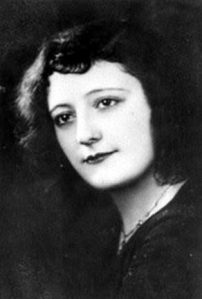
Suzanne Hans was born in 1914 in Épinal, France, to deeply committed anarchist parents and rose to become a prominent French anarchist militant who stood out as one of the most resolute combatants within the International Group. She initially signed up under the surname ‘Girbe’ the name of her mother’s husband, which has led to her story been mistaken for Suzanne Girbe who was fighting in the same battles.
Before leaving Paris, Suzanne lived a life marked by immense personal grief. She and her life partner, fellow libertarian activist Louis Recoule (Recoulis), had two daughters born consecutively in 1935 and 1936. Tragically, both infants died in quick succession from meningitis and whooping cough respectively. Heartbroken and with nothing left tying them to Paris, the young couple threw themselves entirely into the anti-fascist struggle as soon as news of the Spanish revolution reached France, arriving on the Aragon front lines at the end of September 1936.
Firing and manoeuvring alongside her partner, fellow international fighter Louis Recoulis, Hans proved to be a highly resilient guerrilla asset. Suzanne Hans and her partner Louis Recoule were both killed side-by-side during the catastrophic encirclement at the Battle of Perdiguera on 16 October 1936. She died at just 22 years old, sharing the identical anonymous battlefield burial as Augusta Marx and Juliette Baudard. Some tales speak of her survival, only to die a month later in the Battle of Farlete. More recent work shows Hans and Recoule were surrounded by Nationalist forces on the same front that claimed her closest friends, both killed in battle, completely wiping out the remaining core of the International Group’s pioneer milicianas.
- Gertrudis
Known in early column records only by her chosen pseudonym or first name, Gertrudis German Trotskyist youth who travelled to Spain to join the anti-fascist struggle. Because she integrated into the highly independent anarchist militias rather than the strictly bureaucratic International Brigades, her full name was never properly registered. Affiliated with either the DAS (Anarcho-Syndicalist Defence) or the dissident Marxist POUM, she integrated into the International Group of the Durruti Column as both a combatant and support worker on the volatile Aragón front.
During the chaotic Nationalist counter-offensive at Perdiguera, a small force of about forty international fighters entered the town and was quickly cut off and surrounded, and Gertrudis refused to abandon her position, staying behind to cover the retreat of her wounded comrades. Gertrudis died fighting in that encirclement alongside the unit’s commander, Louis Berthomieu, and fellow militants like Georgette Kokoczynski. Out of the entire group trapped in the town, only two men and one woman managed to slip through the lines to warn Durruti; the rest, including Gertrudis, were killed in action or executed upon capture. Her story is often cited by historians as a prime example of the forgotten, young international women who volunteered for front-line combat but vanished into historical anonymity because of the informal nature of the early militia columns.
- The First Unnamed Volunteer of Perdiguera
The first unnamed volunteer was a young foreign woman who travelled to Spain during the idealistic first wave of international mobilization in the summer of 1936. Immersed in the egalitarian spirit of the early worker militias, she took up arms with the International Group of the Durruti Column, bypassing the traditional, gendered rearguard roles typically assigned to women. In mid-October 1936, she was caught in the desperate, close-quarters defensive action when Nationalist artillery and cavalry overwhelmed the Republican lines at Perdiguera. According to the memoirs of surviving militia members and local post-war reconstructions, she was executed on the battlefield. Because the early militias rejected bureaucratic paperwork and formal identity cards as bourgeois conventions, her name was never recorded in the column’s chaotic casualty logs, leaving her to be remembered as a symbol of the anonymous international sacrifice for the Republic.
- The Second Unnamed Volunteer of Perdiguera
The Second Unnamed Volunteer represents another lost identity from the catastrophic destruction of the International Group’s female contingent at Perdiguera. Believed by historians to be of French or central European origin, she fought alongside Juliette Baudard and Suzanne Girbe during the ill-fated autumn offensive at Perdiguera. When the Republican front lines collapsed between 15 and 17 October 1936, she was reported missing in action and later confirmed executed by Nationalist forces. Her identity was lost to history due to a combination of factors – the intentional destruction of international passports by volunteers seeking to avoid diplomatic repercussions at home, the burning of local registries by Francoist forces, and the sudden, violent eradication of almost every close comrade who knew her real name.
Sigüenza
- Mika Etchebéhère
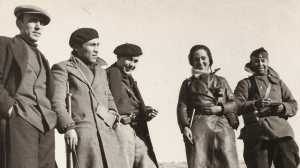
The history of the Spanish Civil War features a rich archive of foreign volunteers, but few individuals shattered the structural and social boundaries of the era as profoundly as Mika Etchebéhère. While foreign internationalists like Augusta Marx or Suzanne Hans fought bravely within segregated international centuries, Etchebéhère achieved an unprecedented military milestone; she became the only foreign woman to be officially promoted to the rank of Captain within the regular Republican forces. Operating on the absolute front lines of the central conflict, Etchebéhère’s leadership during the autumn of 1936 offers a masterclass in tactical grit, institutional navigation, and the preservation of human dignity amidst the absolute chaos of war.
Born Michaela Feldman in Moises Ville, Argentina, in 1902, Etchebéhère was the daughter of Jewish-Marxist refugees who had fled the pogroms of the Russian Empire. Deeply radicalized during her university years in Buenos Aires, she met her partner, Hipólito Etchebéhère. Together, they embarked on a decade-long odyssey through the European socialist underground, witnessing the rise of Nazism in Berlin before eventually settling in Paris.
When the military coup erupted in Spain in July 1936, the couple immediately travelled to Madrid. They joined a militia organized by the POUM (Workers’ Party of Marxist Unification)—a fiercely anti-Stalinist communist faction. The war turned intensely personal almost immediately. On 16 August 1936, during a violent clash on the Atienza front, Hipólito was killed in action. Rather than retreating to Paris to grieve, Etchebéhère made a definitive choice – she took her husband’s rifle, stayed on the front lines, and was overwhelmingly elected by the male militia fighters to take over command of the column.
By October 1936, Mika’s POUM column was deployed to hold the strategic town of Sigüenza (Guadalajara province), a crucial railway outpost blocking the Nationalist advance toward Madrid. The operation rapidly devolved into a waking nightmare. Surrounded by elite Nationalist units and Moorish Regulares, the Republican defenders were pushed back into the town’s massive medieval cathedral. For over a week, Etchebéhère managed a suffocating siege inside the stone walls of the Sigüenza Cathedral. Housing hundreds of combatants alongside terrified civilian families, the cathedral lacked water, food, and basic medical supplies.
While other commanders succumbed to panic or suggested a suicidal mass surrender, Etchebéhère maintained iron-clad military discipline. She rationed ammunition down to the single bullet, organized defensive barricades using ancient church altars, and personally tended to the wounded under continuous heavy artillery bombardment. When the cathedral’s roof finally collapsed under shellfire, Etchebéhère orchestrated a daring, nocturnal breakout. Squeezing through a microscopic gap in the Nationalist encirclement under the cover of a dense mountain fog, she successfully guided a large portion of her surviving troops through the pine forests back to safety in Republican territory.
Following her survival at Sigüenza, Etchebéhère’s reputation as a tactical commander caught the attention of the central Republican Ministry of Defence. As the disparate party militias were forcefully restructured into the Ejército Popular during late autumn, the transition usually resulted in milicianas being systematically stripped of their weapons and sent to the rearguard to work as cooks or nurses. Etchebéhère was the spectacular exception, as recognizing her strategic competence, the regular army command formally ratified her status, officially commissioning Etchebéhère as a Captain in the 38th Brigade of the Republican Army. Etchebéhère was deployed to the Moncloa sector on the immediate Madrid front line, commanding trenches directly inside the University City battle zone. Her men, completely devoted to her leadership, affectionately referred to her simply as La Capitana.
What distinguishes Mika Etchebéhère from the standard, blood-and-iron militarists of the era was her refusal to strip her soldiers of their humanity. In her celebrated postwar memoir, Ma guerre d’Espagne à moi (My Spanish Civil War), she explicitly detailed that her primary objective as a Captain was not the body count of the enemy, but keeping her young, working-class conscripts alive. While stationed in the static winter mud of the Madrid trenches, Etchebéhère discovered that the vast majority of her soldiers were illiterate teenagers from rural villages. She turned the front-line bunkers into makeshift classrooms, teaching her infantrymen how to read and write between sniper duels.
In 1937, as the Communist Party (PCE) launched a bloody, Stalinist purge against the POUM, Etchebéhère was arrested under false charges of being a Trotskyist spy. Her stature among the regular troops was so immense that prominent anarchists and international writers intervened directly, forcing her release and allowing her to serve out the remainder of the war in educational and medical administration until the fall of Madrid in 1939.
Mika Etchebéhère survived the war, escaping to France and later Argentina before passing away in Paris in 1992 at the age of 90. While history books often prefer to treat female participants of the Spanish Civil War as tragic victims (like Georgette Kokoczynski) or idealized propaganda icons (like La Pasionaria), Etchebéhère remains a towering monument of real-world military agency. Her life serves as absolute proof that a woman could hold the highest stakes of tactical command on equal terms with men, executing her duties with a profound balance of strategic discipline and deep human empathy.
- Clara Thalmann
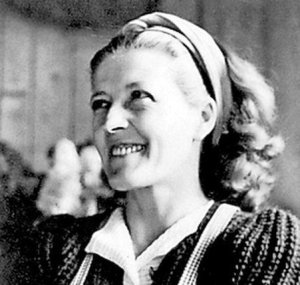
Born Clara Ensner in Basel, Switzerland, in 1908, she grew up in a radical, working-class family. Disillusioned by mainstream Soviet communism, she and her partner, Paul Thalmann, were expelled from the Swiss Communist Party in 1929 for openly sympathizing with Trotsky’s Left Opposition. Thalmann became a prominent Swiss anarchist, journalist, and elite swimmer who spent her life fighting institutional oppression.
Thalmann originally travelled to Barcelona to participate in the People’s Olympiad, an alternative protest to the Nazi-hosted 1936 Berlin Olympics. She never got the chance to dive into the pool when on 19 July, the day the games were scheduled to open, a right-wing military coup erupted across Spain. Swept up by the raw energy of the Catalan workers’ resistance, Thalmann went straight from the stadium to the streets, picking up a rifle to fight on the anti-fascist barricades during the Battle of Barcelona.
Fascinated by the profound social revolution taking place in Catalonia, Thalmann officially enlisted with the anarcho-syndicalists of the Durruti Column. Alongside a handful of other European anti-fascists, she helped form the column’s celebrated International Group.
Marching out to the arid Aragon front line, Thalmann stood on equal tactical terms with her male peers, estimating that women made up roughly 2% of the total front-line combatants in the confederal militias. Thalmann and her husband, Paul, deployed with anti-fascist forces to the Guadarrama and Sigüenza sectors northeast of Madrid to halt the fascist advance.
The Siege of Sigüenza ended in disaster for the Republicans. In October 1936, the Nationalists surrounded the town, forcing the remaining militia fighters and civilians into a brutal, claustrophobic last stand inside the town’s fortress-like cathedral. As the siege collapsed, the situation became a bloodbath. While many fighters were trapped inside and eventually surrendered (only to be systematically executed by the Nationalists), Thalmann was among a small, daring group of militia fighters who successfully broke through the enemy lines under the cover of night. Evading Nationalist patrols in the rugged terrain outside the city, she and a few survivors managed to safely retreat back to Republican-controlled territory.
Thalmann returned to Barcelona and aligned closely with the anti-Stalinist POUM (Workers’ Party of Marxist Unification). In May 1937, violent infighting broke out in Barcelona between anarchists/POUM and Soviet-backed Communist forces. During these May Days, Thalmann fought on the barricades and rooftops alongside English author George Orwell. Following the Soviet-backed crackdown on dissenters, Thalmann and her husband attempted to flee Spain by boat from Barcelona. They were captured and thrown into a secret prison run by the Communist security forces (SIM). To outsmart their captors during interrogations, they famously sang Swiss folk songs to one another through the walls, subtly altering the lyrics to pass information. Following intense pressure and appeals from international socialist groups, they were released and fled to France in late 1937.
Living in Paris during the Nazi occupation, the couple ran a covert revolutionary resistance group. They turned their apartment into a safe house, successfully hiding and saving numerous Jewish refugees and political dissidents. In 1953, weary of city life, they moved to Nice in the south of France and founded La Séréna, an egalitarian agricultural commune. It survived for decades as a legendary haven and meeting spot for global activists and revolutionaries until her death in 1987.
- Leopoldine Kokes
Leopoldine Kokes, born in Vienna in 1910, was a dedicated Austrian socialist and anti-fascist activist who fled Vienna following the rise of Austro-fascism. Drawn by the revolutionary atmosphere in Spain, she volunteered for the Durruti Column in the summer of 1936, integrating into the auxiliary and defensive infrastructure of the International Group on the Zaragoza front. Kokes holds a unique position in the unit’s history, the only woman in the International Group to survive the brutal front-line combat long enough to be formally pulled back to the rearguard.
She served on the Zaragoza/Aragon front with the International Group of the Durruti Column. In October 1936, her unit engaged in a disastrous, heavy battle at Perdiguera, where a significant portion of the international militiawomen serving alongside her, including Augusta Marx and Georgette Kokoczinski, were killed in action after being cornered, captured, and brutally executed on the spot. Kokes managed to retreat with the surviving remnants of her militia group as their lines collapsed. Because the Aragon front was a vast, open landscape rather than a walled town, the survivors were able to fall back into Republican-held territory, though the unit itself was nearly wiped out.
After the rout at Perdiguera, the decimated International Group retreated and consolidated their positions. Because the Republican push to capture Zaragoza stalled, the region transitioned into a gruelling, static war of positions and trenches. During the following months, Kokes and her remaining comrades faced a harsh winter holding the frontline sectors around Farlete, Osera de Ebro, and the Pina de Ebro mountains. She actively remained a combatant, enduring severe cold and local skirmishes, such as the intense November 1936 Nationalist assault on Farlete.
While she survived the bullets at Perdiguera, Kokes’ time on the front line was ended by a bureaucratic decree. In early 1937, the Republican government ordered all women off the front lines to standardise the regular army. Kokes did not want to leave, but she was officially disarmed and expelled from the column around March or April 1937. Historians note that this forced removal from combat paradoxically became her true escape from the war; because she was legally forced to the rear, she was spared from the subsequent near-total destruction of the International Group on the Madrid and Aragon fronts.
Like many of the women expelled from the front lines in early 1937, Kokes did not immediately leave Spain or abandon the anti-fascist cause. Instead, she was moved to support positions further behind the lines. Demobilised milicianas were typically absorbed into urban women’s civil columns, factories, logistical transport networks, or medical facilities in Republican strongholds like Barcelona and Madrid. Once she was forced off the battlefield, Kokes was subject to a massive shift in Republican public relations. The government under Juan Negrín aimed to project an image of traditional military order to the rest of Europe to secure foreign aid. As a result, women completely stopped featuring in Republican wartime propaganda. Kokes, who had spent months enduring a brutal winter in the trenches of Aragon, was legally relegated back to a domestic or non-combat support role.
Leopoldine Kokes’ specific post-war steps faded into the historical background. Following the final collapse of the Spanish Republic in 1939, foreign volunteers who survived faced incredibly perilous paths. Most foreign anti-fascist women were forced to flee across the border into French internment camps, while those who could not escape faced imprisonment, execution, or forced labour under the new Francoist dictatorship. Kokes’ ultimate legacy remains her status as the lone named female combatant of the Durruti Column’s International Group to survive the front-line massacres of 1936 long enough to be handed a demobilisation slip.
- Émilienne Morin aka Mimi-FAI
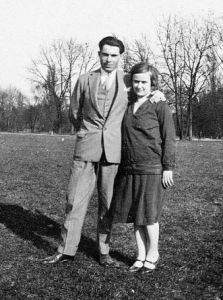
Born in Angers, France, Émilienne Morin was a prominent French anarchist, writer, and stenographer. Raised in a radical working-class family, she became highly active in the French anarcho-syndicalist movement during the 1920s. In 1927, she met the legendary Spanish anarchist revolutionary Buenaventura Durruti while he was in exile in Paris, eventually becoming his partner. The couple relocated to Spain in 1931 following the proclamation of the Second Spanish Republic, where Morin wrote heavily for the Confederación Nacional del Trabajo (CNT) press.
When the civil war erupted in July 1936, Morin made the painful sacrifice of leaving her young daughter, Colette, in the care of a trusted comrade to join the war effort. She climbed aboard a supply lorry bound for the Aragón front, arriving at the column’s encampment in Bujaraloz. Recognized for her administrative sharp-mindedness, she was immediately placed in charge of the Durruti Column’s military administration and commanded its official press department, earning the affectionate nom de guerre Mimi-FAI. Following Durruti’s death during the Siege of Madrid in November 1936, Morin returned to France. She spent the rest of her life speaking at massive solidarity rallies, writing for Le Libertaire, and fiercely defending Durruti’s memory from political appropriation, steadfastly maintaining that he fought for a social revolution, not a bourgeois army.
After the Spanish Civil War and World War II, Émilienne Morin’s daughter, Colette Durruti Morin grew up with her mother in France. Later in life, she moved to northern Catalonia and remained active in campaigns to preserve the historical memory of her father, serving as a vital contact for historians by providing primary source documents, letters, and personal recollections about her parents’ lives. Colette Durruti passed away recently in April 2025 at the age of 93.
Pilar Balduque Franco (unfortunate co-incidental surname)
Pilar Balduque was a Spanish libertarian militant who became a cornerstone of the administrative operations of the Durruti Column. Enlisting in Barcelona during the mass revolutionary mobilization of late July 1936, she was deployed to the column’s general headquarters on the volatile Zaragoza front. Balduque served as the head typist and archival secretary for the Column HQ, responsible for processing highly sensitive military directives, coordinates, supply registries, and frontline press dispatches.
While stationed at the headquarters, Balduque developed a profound, lifelong friendship with the Spanish miliciana Pepita Inglés, providing a crucial emotional anchor for Inglés when her partner was killed in an early Nationalist bombing raid at Pina de Ebro. Her political acumen and commitment earned her a seat on the column’s War Committee, a significant position for a woman in the early revolutionary militias.
In early 1937, when the Republican central government issued decrees to systematically militarize the popular worker militias, banning women from serving on the front lines, Balduque flatly refused to retreat to the peaceful rearguard. Defying the gendered demobilization orders, she remained embedded with the combat units, transitioning into the regular army as an administrative asset for the 119th Brigade under Commander Domingo Belmonte until 1939.
When the war was officially lost to Franco’s forces in early 1939, Balduque’s high-profile status as a Red anarchist meant certain execution if captured. She joined the massive, desperate exodus over the Pyrenees and fled to France. She managed to reach Bordeaux, where she lived in hiding for a few months. Recognizing that Europe was on the brink of World War II and that France was unsafe, the 28-year-old Balduque sought passage to Latin America. Propelled by financial aid networks set up for Spanish refugees (the SERE and JARE), she successfully boarded a ship and exiled herself to Mexico, joining thousands of other defeated Spanish republicans who spent the rest of their lives rebuilding their community across the Atlantic.
Palmira Jul Gonzalez
Palmira Jul was a fiercely dedicated Spanish anarchist and anarcho-syndicalist militant who participated in the intense street fighting that crushed the military uprising in Barcelona on 19 July 1936. Believing that the defeat of the fascist generals required a permanent revolutionary army, she officially enlisted in the newly formed Durruti Column on 24 July 1936. To deploy to the rugged and dangerous Aragón front, Jul had to make the agonizing decision to leave her children behind in Barcelona to be raised by collective libertarian day-care networks established by the workers.
Upon arriving at the front, Jul was integrated into the structural nucleus of the column’s administrative and logistics branch alongside Émilienne Morin. Operating in a non-hierarchical chaos that works, Jul managed the constant, complex flow of food distribution, medical supplies, and ammunition requisitions required to keep thousands of volunteer fighters sustained in the field. Her meticulous logistical management ensured that the fighting centurias remained operational during the campaigns of 1936 and 1937.
Azucena Haro
Azucena Haro was a revolutionary Spanish libertarian and working-class activist who stood on the front lines of the anti-fascist resistance in Catalonia from the very inception of the war. Following the successful defence of Barcelona in July 1936, Haro volunteered alongside her close comrades Pepita Inglés and Palmira Jul to take the revolution directly to the Nationalist strongholds in Aragón. Like Jul, Haro made the difficult revolutionary choice to leave her young children behind in the rearguard, placing her total faith in the solidarity of the collective social institutions in Barcelona.
Marching out with the historic first contingent of the Durruti Column on 24 July, she became an indispensable pillar of the column’s internal command and communications network. Haro worked tirelessly within the headquarters’ administrative apparatus to coordinate communication between the fluid, rapidly moving frontline skirmishers and the centralized supply depots. Her work helped sustain the logistical integrity of the anarchist columns before they were absorbed into the regular Republican armed forces.
Her unit pushed toward the strategic town of Pina de Ebro. Along the road to Pina, the column was subjected to heavy, terrifying strafing runs by fascist warplanes. While the brutal reality of this aerial bombardment shocked several of the volunteer militiawomen into retreating back to Barcelona, Haro was part of the dedicated anarchist circle that pressed forward into the heavy frontline combat of the Aragon region.
Unlike the international shock troops who faced rapid annihilation in localized pockets like Perdiguera, Haro and Jul remained deeply integrated with the core Spanish contingents of the Durruti Column on the Aragon front. Following the Ebro offensive, they largely operated around the column’s staging grounds and regional headquarters. They remained close to the column’s administrative backbone, working alongside figures like Pilar Balduque. Both women stubbornly resisted initial, soft suggestions to leave the trenches late in 1936. However, their frontline status officially ended when the column underwent militarisation.
When the spontaneous militias were forcefully reorganized into the regular Republican army (specifically transformed into the 26th Division), the central government enforced a strict ban on women in combat. By July 1937, exactly one year after they had first marched out of Barcelona, both Haro and Jul were stripped of their combat roles and forced to return to the civilian rear or take up non-combat support roles in factories or logistics.
When the Republican front collapsed in early 1939, surviving milicianas from the Durruti Column faced severe repression. While their close friend Pepita Inglés was killed before the war’s end, both Palmira Jul and Azucena Haro survived the immediate combat but were forced into the bitter options left to defeated anarchists – fleeing across the Pyrenees into brutal French internment camps (like the Argelès-sur-Mer camp) or remaining in Spain under assumed identities to survive the white terror of Franco’s dictatorship. Their primary legacy survives in the post-war memoirs of Lola Iturbe (specifically her seminal book La mujer en la lucha social y en la Guerra Civil de España), who named them specifically to ensure that the Spanish women who held the line after the terrifying aerial bombardments of the Ebro were not completely erased by history
Womens’s associations were becoming as much of a battleground as the government’s role to remove female soldiers in late 1936. The Communist AMA (Asociación de Mujeres Antifascistas) operated under the strict orthodoxy of the Spanish Communist Party (PCE) and Soviet advisers. The AMA argued that all social and revolutionary goals must be completely paused until absolute military victory over Franco was achieved. They viewed the chaotic, mixed-gender worker militias as an undisciplined liability. In line with the mid-October regularization decrees, the AMA actively discouraged women from staying on the firing lines. Instead, they recruited thousands of working-class women to serve the military machine in traditional roles: running barracks kitchens, washing uniforms, and manufacturing clothing. For the AMA, a woman’s highest revolutionary duty on the Toledo front was to free up a man so he could carry a rifle.
Founded in May 1936 by radical figures like Lucía Sánchez Saornil, Mujeres Libres grew to over 20,000 members. They fiercely rejected the Communist idea of putting off women’s liberation. They argued that women faced a triple enslavement, to capital, to ignorance, and to the deep, hypocritical sexism of their own male left-wing comrades. They believed that if the social revolution was paused for the war, the revolution would die. Mujeres Libres was highly vocal in resisting the forced removal of women from the active firing lines. However, recognizing that the male military leadership was aggressively defunding female combat units, they adapted. They organized specialized mobile columns to go to the Toledo and Madrid fronts to set up field clinics, transport networks, and literacy schools right behind the trenches. They focused on training women in advanced technical skills, radio communication, and battlefield nursing to ensure that even if they were stripped of rifles, women remained an irreplaceable, independent force on the landscape of the war.

