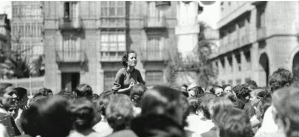
- Zaragoza, Aragon
By October 1936, the Zaragoza frontline had stabilized just miles to the east along the Aragon River, turning the province into a heavily militarised rear guard. Within this strategic crucible, the Nationalist faction executed a calculated, systematic campaign to permanently purge Republican elements from Aragonese society.
The infrastructure of death in Zaragoza evolved rapidly from chaotic extrajudicial killings to a highly organized, industrialized system. In the initial weeks, executions took place in dark, isolated rural pockets and natural landmarks surrounding the city. Bodies were routinely discovered along the Canal Imperial de Aragón, in the open expanses of Valdespartera, and scattered throughout rural districts. Victims were often taken in paseos when they were abducted from their homes at night by Falangist or Carlist squads and shot on roadsides.
By October, as formal military courts-martial began to parallel extrajudicial violence, the Torrero Cemetery on the southern edge of Zaragoza became the primary centralized execution site. Firing squads operated systematically against the exterior walls of the cemetery, watched over by witnesses like the Capuchin priest Father Gumersindo de Estella, who recorded the horrors in a private diary.
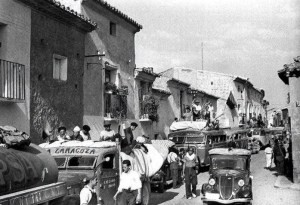
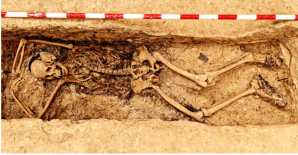
When the Nationalist forces seized the province in July 1936 and enacted the “Torrero system,” they intentionally pushed this baseline poverty into a state of structural destitution and literal starvation.
There was the loss of local institutions and social leadership. Teachers, doctors, councillors, union organisers, municipal employees, shopkeepers, tradespeople, and political activists were among those targeted. Killing people in those positions did not simply remove individuals; it removed people who performed particular functions within small communities.
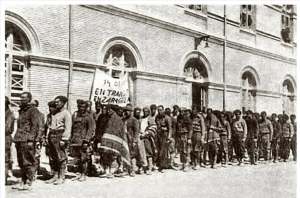
Then there is the psychological and social consequence: people learned what could happen to them. A family did not need to lose someone itself to be affected by the executions. If a neighbour disappeared, everyone knew. If a group was taken away at night, people knew where they had gone. If bodies began appearing outside the city or at cemetery gates, the information travelled through communities. The result was not merely fewer people. It was a population living under a radically altered set of expectations about what could safely be said, whom one could associate with, and what might happen to one’s family.
They did not run out of people because the pool of potential victims was continually being redefined. Once the initial political opponents had been eliminated, repression could extend into wider categories: relatives, suspected sympathisers, people accused of collaboration, people denounced by neighbours, people associated with organisations, prisoners, former officials, and people whose political identity was sufficient to make them suspect. The imprisonment of women at Torrero illustrates that expansion particularly clearly.
There was also another grim mechanism: the repression did not have to kill everyone to transform society. If one man in a household was murdered and another imprisoned, the surviving family might already be economically and socially crippled. If several men from the same village disappeared, those who remained did not need to be killed for the village to have been profoundly altered.
The poverty seeded in 1936 bloomed into a catastrophic, man-made famine during the late 1930s and 1940s, known across Spain as Los años del hambre. Rather than allowing the free market to recover, Franco’s regime enforced strict autarky (total economic self-sufficiency). The state fixed food prices artificially low, which inadvertently caused farmers to produce less food, hoarding what they did grow for the black market. The consequences for Zaragoza’s working class were brutal. Between 1936 and 1939, the purchasing power of the population dropped by an estimated 30%, while inflation and living costs skyrocketed. Official rationing cards introduced at the end of the war were hopelessly insufficient. While the rich survived using the black market, the poor were reduced to eating domestic animals, foraging for grass, and baking false tortillas made without eggs or potatoes. Severe malnutrition lowered immunity, triggering rampant outbreaks of tuberculosis, typhoid, and exanthematic typhus across the province’s overcrowded shantytowns. The extreme poverty in Zaragoza was an extension of the war itself. By controlling food, property, and resources, the regime effectively used deprivation as a tool of social subjugation, leaving an entire generation physically and economically broken.
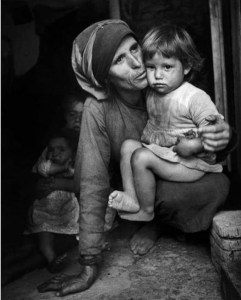
The most successful psychological tool of the repression was the destruction of public, and even private, speech. To survive under the Francoist dictatorship, families of executed Republicans had to completely erase their own history. Widows burned letters, hidden photographs, and political union cards. Children were strictly forbidden from ever mentioning their fathers’ names or how they died, even within the safety of their own homes. A toxic societal maxim took root across Zaragoza province: No te metas en política (Don’t get involved in politics) and Oye, ve y calla (Hear, see, and keep quiet). This enforced apathy shattered the rich pre-war social fabric of mutual-aid societies, agrarian syndicates, and cultural clubs, replacing them with an atomised society where isolation was the safest strategy for survival.
Poverty and repression combined to create an internal caste system within Zaragoza’s towns and villages, where the survivors were systematically dehumanized. The families of those shot at Torrero or the Canal Imperial were publicly marked. Widows had their heads forcibly shaved and were forced to clean public buildings or churches while being mocked. They were viewed as socially contagious; associating with a Red family could bring the suspicion of the Falange onto your own household. Children of the repressed grew up carrying an intense, manufactured sense of shame and operational guilt. They were legally and socially treated as second-class citizens, forced to navigate a world where their economic misery was viewed by the state as just punishment for their family’s treason.
What these families suffered left a massive psychological crater, yet has no physical weight, no formal monument in the family living room, and often, not even a name, an invisible inheritance. The trauma of the Torrero system and the starvation that followed did not move through the bloodline like an illness; it moved like an atmosphere. In these families, trauma is inherited through what is not there. It is the sudden, heavy silence that drops over the dinner table when a grandchild asks an innocent question about a great-grandfather (like my own). The trauma is transmitted through a negative space, the child learns very early on to map the boundaries of what is safe to talk about by sensing where the air in the room suddenly thins out.
Sometimes the inheritance is not mental; it’s physical. Long before a child is old enough to understand the words firing squad, communism, or autarky, they are reading their mother’s nervous system. If a mother lives in a state of chronic, hyper-vigilant fear—flinching when the door knocks unexpectedly, hoarding bread because of a deep-seated fear of scarcity, or lowering her voice to a whisper whenever discussing the past, the child’s own developing brain interprets the world as fundamentally dangerous. The mother’s coping mechanisms become the child’s baseline reality. The trauma is passed down as a physical predisposition toward anxiety and hyper-vigilance, stitched directly into the family’s daily habits.
The psychoanalyst Maria Torok described a concept called the crypt. When a trauma is too horrific to be spoken about, especially when revealing it could get the family killed or ruined by the Francoist regime, the family builds a secret, psychological vault. They bury the grief alive. The children grow up sensing that there is a hidden room in the family history. They inherit the grief of the event without ever being given the facts of the event. This creates a strange, ghostly inheritance: a grandchild might suffer from unexplained bouts of deep depression, a profound sense of worthlessness, or an intense fear of authority, carrying the emotional weight of a grandfather who was shot at the Torrero wall, even if they do not know his name.
In Zaragoza, this inheritance was formalized by a collective social ruled of do not get involved. It was a survival strategy masquerading as a family tradition. When a parent tells a child to keep their head down and never speak up, they are passing down a protective shield forged in 1936. But generations later, that same shield behaves like a cage, leaving descendants with an inherited, unexplainable reluctance to participate in civic life, stand up for themselves, or trust their neighbours.
Nationalist, conservative, religious, and Francoist supporters during the war and the dictatorship had a highly insulated, deeply ideological worldview. For these individuals, their compliance with living in a fascist state was not viewed as malicious opportunism, but as a righteous, defensive struggle for survival. They did not see themselves as callous bystanders to starvation; they believed they were saving Spain from total annihilation.
For the deeply religious and conservative sectors, the Civil War was never viewed merely as a political conflict. It was explicitly framed and experienced as a holy war to save Catholic civilization. They looked at the Second Republic and saw the burning of churches, the assassination of priests and nuns, and the rise of secularism as an apocalyptic threat to their way of life. In their minds, the brutal repression enacted through systems like Torrero was not murder; it was the necessary, surgical removal of a social cancer (communism, anarchism, and freemasonry). They believed that the moral contamination of Spain had to be completely purged for the nation to be reborn.
When looking at the widespread starvation of Los años del hambre, Francoist supporters did not experience guilt. Their interpretation of the misery was filtered through a heavy lens of victor’s justice. The regime’s propaganda machine consistently blamed the starvation on the legacy of Republican mismanagement, the theft of Spain’s gold reserves by the Republic to buy Soviet weapons, and international isolation. For many supporters, the poverty of the defeated was viewed as a natural, spiritually deserved consequence of their red sins. The families of the victors felt entitled to their relative comfort, viewing their access to jobs, pensions, and confiscated properties as a legitimate reward for their loyalty to God and the Fatherland.
While the working-class families of the repressed were literally eating grass and facing epidemics of typhus, a distinct upper-middle class of Francoist loyalists, military officers, and Falangists thrived. The regime’s policy of autarky (economic self-sufficiency) created a massively lucrative black market (el estraperlo). Those with connections to the local Francoist authorities or the military controlled the distribution of food rations, fuel, and supplies. For this group, the post-war years were a period of winning at life. They acquired the confiscated lands and businesses of executed or exiled Republicans for pennies. They lived in an insulated reality where luxury was accessible precisely because the state artificially depressed the wages and rights of the defeated working class.
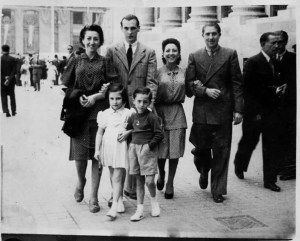
As the decades rolled into the 1950s and 1960s, the psychological justification for Francoism shifted from religious fanaticism to modern economic pragmatism. When the United States and Western powers embraced Franco in the 1950s as a vital ally against the Soviet Union during the Cold War, the conservative base felt completely vindicated. Their past violence was repackaged as a visionary, early stand against global communism. By the 1960s, the economic opening of Spain (the Milagro económico) brought consumer goods, cars, and tourism. For the conservative middle class, this material wealth was proof that the dictatorship worked. They wilfully compartmentalized the hidden mass graves of 1936, viewing the peace and economic growth of the 1960s as justification for the blood spilled to achieve it.
For the grandchildren and great-grandchildren of the repressed, the long-enforced pacto del silencio has largely shattered. There is a powerful, urgent emotional drive among descendants to uncover family histories, digitise old archives, and find out where their ancestors’ bodies are buried. Because the regional coalition government of Aragón recently repealed its Law of Democratic Memory, which funded the exhumation of mass graves, many families feel a deep sense of betrayal and abandonment by local institutions. For them, the wound remains wide open because they are running out of time to give their elderly relatives peace before they pass away.
In places like the Torrero neighborhood itself, memory has become a living, community-driven space. For many locals, the Torrero Cemetery is no longer viewed with just silent terror, but with a sense of collective stewardship. Civic groups regularly organise cultural events, educational routes for secondary school students, and music and theatrical performances centred around memory, particularly now during the Todos los Santos period. The fact that the Torrero firing squad wall was officially designated as a Lugar de Memoria Democrática (Site of Democratic Memory) gave many people a sense of institutional victory and dignity. It proved that the horrors their grandmothers whispered about were finally recognized as historical fact.
Outside the core of activist and descendant circles, there is a stark ideological and generational disconnect across the wider province. Half a century after Franco’s death, modern economic stresses, like housing crises and job scarcity, have led to a rise in far-right political alignments among some young people. For a segment of the younger population who did not live through the dictatorship, the heavy history of 1936 feels distant, irrelevant, or overly weaponised by modern political parties. A significant portion of the population still holds onto the deeply internalised belief that digging up mass graves or talking about the Civil War only reopens old wounds and divides the country. This view isn’t necessarily driven by malice, but by a lingering, inherited desire for social stability, the idea that the safest way forward is to leave the past alone.
But for many young people, the old advice to leave things alone doesn’t sound like wisdom or a recipe for stability, it sounds like a lie. They look at a 2026 reality defined by an acute housing crisis, economic precariousness, climate anxiety, and shifting political landscapes, and they see a direct line between the unresolved crimes of 1936 and the systemic problems of today. For decades, Spain prided itself on the peaceful Transition to Democracy in the late 1970s, which was built entirely on el pacto del olvido. The deal was simple – do not prosecute Francoist crimes, do not dig up the graves, and in exchange, you get stability.
Today’s youth view are not interested in any compromise, thanks to historical betrayal. They believe that by burying the truth, the architects of the transition simply allowed the economic and institutional power structures of the dictatorship to survive under a democratic veneer. The instability of 2026 is proof that a society built on a foundation of death can never truly be stable if the fascists and the morally corrupt were never truly flushed out.
- Madrid
Listen to me, comrades!
Tomorrow, October 29th , our artillery and armoured trains will open fire on them. Immediately afterward, our aircraft will appear, dropping bombs on the enemy and unleashing machine-gun fire. At the moment of the air attack , our tanks will attack the enemy from their most vulnerable side, sowing panic in their ranks…
Now we have tanks and planes, forward comrades of the front,
heroic sons of the working people!
Victory is ours!
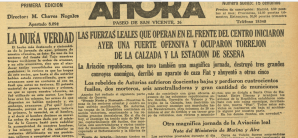
Radio speech by Largo Caballero on October 28, 1936
This radio speech by Spanish Prime Minister Francisco Largo Caballero marked a critical, dramatic turning point in the Battle of Madrid during the Spanish Civil War. The context surrounding 28 and 29 October 1936 blends desperate psychological warfare with the arrival of heavy Soviet military aid. The Republican forces, hastily assembled, fragmented militias of socialists, communists, and anarchists, were poorly armed and losing ground daily. Panic was spreading, and the fall of the capital felt imminent to international observers.
Unknown to the public, the Soviet Union had finally decided to break the Non-Intervention Agreement and secretly shipped heavy military hardware to the Republic. Just days prior to this speech, Soviet T-26 tanks and Polikarpov fighter aircraft arrived in Spain. Soviet military advisors and newly trained crews were being rapidly deployed to the front lines. Largo Caballero’s speech on 28 October was the first time the Republican leadership openly boasted about having these advanced weapon systems, aimed at shattering the defeatist mindset of the population.
Largo Caballero referenced the Seseña counter-attack on 29 October 1936, a plan to launch a major counter-offensive near the town of Seseña (just south of Madrid) to halt the Nationalist advance. Led by Soviet commander Semyon Krivoshein, a column of 15 T-26 tanks would charge the Nationalist lines. While the tanks technically achieved surprise and routed the cavalry they encountered, the infantry militias had to follow through effectively.
Largo Caballero’s speech was designed as a massive morale booster. Up to this point, Nationalist aircraft (supplied by Nazi Germany and Fascist Italy) had complete dominance over the skies of Madrid, terrifying the civilian population. By broadcasting that the Republic now possessed its own modern tanks and planes, Caballero aimed to inspire the heroic sons of the working people to stand their ground. The 29 October counter-attack could provide a massive psychological lift that ultimately helped Madrid survive the brutal onslaught and siege that followed in November.
Behind the scenes, the military balance was drastically shifting. On 28 October, Soviet-supplied Tupolev SB Katiuska bombers flew their very first high-speed missions over the Madrid front. Concurrently, the steamship Carl Lepin docked in Cartagena carrying 25 dismantled Polikarpov I-15 fighter planes and Soviet pilots who were immediately rushed toward the central front to challenge the fascist air dominance. Soviet T-26 tanks under the command of Red Army captain Pavel Arman were already being secretly staged in the towns south of Madrid, preparing for the upcoming surprise assault.
Desperate to stop the military retreat and halt a growing defeatist attitude among civilians, he completely sacrificed operational surprise. By loudly broadcasting over the radio that artillery, tanks, and aircraft would attack tomorrow at dawn, Prime Minister Caballero tipped off the Nationalist forces. He prioritized civilian and militia morale over the tactical advantage of a surprise attack.
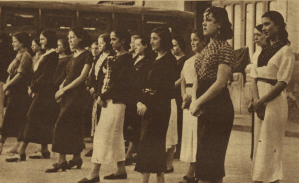
Inside Madrid, the atmosphere was chaotic yet defiant. Air raid sirens were a constant reality as German and Italian planes bombed the city centre. On 28 October, long lines of civilians, including large numbers of marginalized groups like Madrid’s Romani community, crowded the Ministry of War to secure travel passes to evacuate the city. Political parties like the PCE frantically organized trenches, built barricades, and demanded a single unified military command to prepare for a street-by-street siege.
- Barcelona, Catalonia
Between 28 and 31 October 1936, the Republican government launched a frantic administrative revolution to replace voluntary, revolutionary chaos with strict state discipline. The transition began on 28 October in Catalonia, where regional military authorities published sweeping measures for the militarisation of the Catalan militias. Until this point, militias operated under their own trade union banners (such as the anarchist CNT-FAI or the Marxist POUM), choosing their own officers and frequently ignoring centralized military strategy. This decree was part of a larger, controversial push to dissolve these independent political armies and absorb them into the regular Republican Popular Army structure.
The transformation became total across the remaining Republican territory over the next forty-eight hours. On 29 October, a sweeping decree was issued ordering the immediate militarisation of all male citizens aged 20 to 45 who were medically fit, dramatically expanding the draft. This was formally published in the Gaceta de Madrid on 30 October, cementing the legal shift from voluntary ideological mobilisation to mandatory national service.
This administrative centralisation was notonly about winning the war at the front; it was an aggressive attempt by the central government to regain a monopoly on violence in the rear guard. In the chaotic opening months of the war, independent revolutionary committees and party militias had established parallel policing systems, launching unauthorized sacas and extrajudicial killings under the guise of revolutionary security. By absorbing these militia units into a unified, professional army structure, the government directly targetted the primary mechanisms through which revolutionary organisations conducted arbitrary arrests. On 31 October, the Ministry of the Interior formally defined specific offences under a newly unified public order system. This critical legal step extended state control over order-policing offences, taking investigative powers out of the hands of unchecked party committees and placing them under a standard, legally accountable state police structure.
This sweeping institutional overhaul was executed by the central Republican government under Prime Minister Francisco Largo Caballero (a left-wing socialist serving as both Premier and Minister of War). However, the real political engine behind this specific push was a coalition of moderate Socialists (led by Indalecio Prieto), Republicans, and the Communist Party of Spain (PCE). The Soviet Union, which had just begun supplying heavy weapons to the Republic, explicitly demanded a disciplined, traditional army structure. Soviet military advisors refused to hand over tanks and planes to independent anarchist militias who did not answer to a central command.
While the official reason was winning the war against Franco, the decrees had a secondary, deeply political objective: crushing the internal social revolution. In July 1936, the state had essentially collapsed. Power had shifted to the streets, where trade unions like the anarchist CNT-FAI ran factories, organized food distribution, and conducted their own parallel police work. Largo Caballero’s government needed to destroy this dual-power system to reassert the authority of the bourgeois democratic state.
The independent revolutionary committees had created patrullas de control (control patrols) and chekas (private party prisons). They were conducting arbitrary arrests and extrajudicial executions (paseos) that were destroying the Republic’s international reputation. By passing the public order decrees of 31 October, the government aimed to strip these political parties of their policing powers, put investigations under a common police structure, and stop the unchecked killings.
The public response was deeply fractured along ideological lines, splitting the Republican zone into factions that would later violently clash in the streets. For middle-class Republicans, moderate socialists, and members of the Communist Party, the news was received with a sense of relief and grim determination. They were terrified by Franco’s rapid advance and exhausted by the chaotic, arbitrary violence of the local rearguard committees. Newspapers like El Sol and the communist Mundo Obrero praised the measures, running front-page headlines demanding ‘Discipline, Command, and Organization!’ For them, conscription and formal policing were the only ways to avoid total military annihilation.
For the revolutionary working class, particularly the anarchists of the CNT-FAI and the anti-Stalinist Marxists of the POUM in Catalonia, the decrees were received with immense suspicion, anger, and a sense of profound betrayal, and came only days after other sweeping changes. Anarchist workers did not want to become regular soldiers; they believed in voluntary, egalitarian militias where officers were elected and titles did not exist. Being forced into a traditional army with salutes, uniforms, and military courts felt like a return to the old oppressive system they had just overthrown.
Interestingly, because the anarchist leadership was facing a dilemma, they knew Madrid was about to fall and that unity was desperately needed, their official newspapers (Solidaridad Obrera) played down the anger. They presented the militarisation as a bitter, temporary wartime medicine rather than a defeat of the revolution, telling their members: We must accept discipline to defeat fascism. Despite the public calls for unity, on the ground in Barcelona and the Aragon front, ordinary militia members felt the government was actively stealing the revolution from them. This deep emotional resentment simmered for months, directly laying the psychological groundwork for the bloody May Days of 1937, when these factions eventually turned their guns on each other in open civil war within the Republican zone.
- Santander (Cantabria) / Palencia / Burgos Front
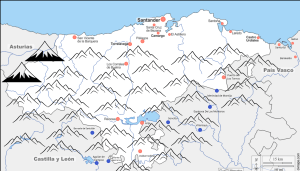
Along a 100-kilometre line separating Republican-held Santander (Cantabria) from the Nationalist-held provinces of Palencia and Burgos, thousands of men clashed in a desperate game of strategic chess. Though local records describe these actions as a chaotic succession of skirmishes rather than a single named battle, they were bound together by a critical, overarching Republican mission: force General Francisco Franco to pull his troops away from the gates of Madrid. The Ejército del Norte (Republican Northern Army) launched a multi-pronged offensive across the Cantabrian mountains. The plan was to punch through the mountain passes, threaten the Nationalist command hub in the city of Burgos, and force Franco to divert precious artillery, troops, and German/Italian aircraft away from the capital.
What followed was a series of overlapping mountain campaigns split into three strategic sectors.
While the active fighting in the mountains involved several thousand men on each side, the broader territorial pools backing up these forces across the wider northern theatre were much larger. The Republican base, behind the mountain line, the wider province of Santander and its neighbouring coastal regions held a massive but heavily disorganized pool of roughly 30,000 to 40,000 men under various union or party banners. However, because the Republic lacked a unified command structure at this time, the vast majority of these men remained stationed in coastal cities like Santander for civil defence and policing, rather than being deployed to the cold mountain trenches.
The Nationalist command in northern Spain had around 100,000 total men stationed across their broad northern zone (including the deep rear guards in Burgos, Galicia, and León). Crucially, because General Franco considered the Burgos-Palencia border a secondary defensive theatre, only a fraction of this force was positioned along the border, while their primary, elite units were deployed south toward Madrid.
On the western edge of the front, fighting centred around the strategic heights of Monte Bernorio, shielding the towns of Aguilar de Campoo and the mining centre of Barruelo de Santullán. Between 20 and 31 October, the initial fury of the Republican operations began to wane. The front settled into a gruelling, static phase. Rather than grand infantry charges, the conflict here became a war of position, defined by cold mountain patrols, sniper fire, and localized trench warfare. The Nationalist command successfully dug into the high ground, preventing any significant Republican breakthrough and turning the Palencia border into an immovable wall.
In the central sector, the Republicans used the natural basin of Valderredible as an armoured staging ground. Throughout late October, they launched a relentless succession of attacks pushing uphill toward the high limestone plateau of La Lora, Soncillo, and the communication hub of Villarcayo. Because these assaults were launched in waves by independent, political militias, the highly disciplined Nationalist defenders were able to anticipate and contain them one by one. The Republicans bled heavily on the slopes of La Lora, failing to achieve the clean territorial rupture they desperately needed.
Further east, the fighting raged along the steep mountain approaches from Santander, focusing heavily on Espinosa de los Monteros, the plains of Merindad de Montija, and the vital Puerto de Los Tornos mountain pass. For the actual offenses and counter-attacks launched along the mountain passes (such as the attacks out of Valderredible and the pressure on Espinosa de los Monteros, the Republicans had 3,500 and 5,000 active combatants were mobilised for these late October operations. These men were primarily pulled from the Popular Militias of Santander, reinforced by scattered Basque volunteer detachments and ideological left-wing battalions (such as the socialist UGT, communist groups, and anarchists).
The Nationalists matched these numbers locally with a tactical vanguard of roughly 4,000 to 5,000 frontline troops deployed to hold the fortified border towns and ridges. These units consisted of highly disciplined Navarrese Carlist Requetés, small regional Castilian infantry companies, and dedicated mobile cavalry columns used to probe the mountain passes.
Republican forces maintained constant, aggressive pressure along the northern Burgos line to exploit any weak points. Despite days of mountain skirmishes under deteriorating autumn weather, the Nationalist lines fractured but never broke. The rugged terrain heavily favoured the defending Nationalists, and by the end of October, the eastern front remained firmly locked in a stalemate.
The failure of the northern offensive to break the Nationalist lines and decisively alter the course of the war came down to two fatal structural realities. The brutal terrain of the Cantabrian range naturally compartmentalized the war. Deep valleys and high ridges isolated units from one another, turning what should have been a massive, unified offensive into a collection of lonely, disconnected valley battles. Plus, in late October 1936, the Republican forces in the north had not yet undergone the structural militarisation occurring elsewhere in Spain. Units operated under local anarchist, socialist, or regional banners, choosing their own objectives. Lacking unified communications, synchronized timing, and heavy artillery support, their bravery was consistently neutralized by the centralized command of the Nationalist forces under General Fidel Dávila.
By 31 October 1936, the smoke cleared to reveal a frozen front line. The Nationalist command accurately assessed that while the Republicans had high morale, they lacked the logistical coordination to pose an existential threat to Burgos. Consequently, the Nationalist staff officially categorized the wide Burgos-Palencia front as a secondary, largely defensive theatre. Franco kept his best resources concentrated on the siege of Madrid, and the Northern Front dissolved into a quiet, frozen winter of mountain blockades, setting the stage for the catastrophic local fall of the northern provinces the following year.
During the first three months of the Spanish Civil War , repression in Santander province was very reactionary. Because the authorities initially lost full control to worker militias, the repression during this early period was marked by arbitrary violence, anticlerical attacks, and vengeful crowd reactions. In the immediate aftermath of the July 1936 uprising, power on the streets shifted heavily toward left-wing trade unions (the socialist UGT and anarchist CNT) and Popular Front militias. The first weeks were characterized by paseos. Militias or armed groups arrested right-wing suspects, landowners, Falangists, and conservative sympathizers from their homes at night, took them to isolated areas, and executed them. Historians note that much of this early violence was perpetrated by uncoordinated, terrified, or vengeful mobs rather than being an organized state policy.
Unlike the neighbouring Basque province of Biscay, where the Basque government actively protected the Catholic Church, Santander experienced the intense anticlerical violence seen in the rest of the Republic. Catholic priests, monks, and religious figures were primary targets for radicals who viewed the Church as an institutional ally of the military rebels. Churches and religious monuments were vandalized and damaged, and infamous executions took place; for instance, right-wing prisoners and priests were taken to the Isla de Mouro (an islet off the coast of Santander) and executed.
As the number of right-wing detainees grew, local authorities converted commercial ships in the Bay of Santander into floating prisons, most notably the Cabo Quilates and the Alfonso Pérez, centres of intense vulnerability. Whenever Nationalist forces bombed Santander, retaliatory violence erupted on the ships. The most notorious event of this early period occurred after a German/Nationalist bombing raid on Santander. In a wave of fury, a vengeful crowd and militiamen boarded the Cabo Quilates and massacred 156 right-wing prisoners, army officers, and priests held on board.
By late September and October 1936, the chaotic, anarchic violence of the street militias began to subside. The Republican authorities established Tribunales Populares)to bring a semblance of legal order. While executions and imprisonments continued, they shifted from random midnight killings by autonomous mobs to formal wartime trials and sentences, though these courts still lacked traditional judicial safeguards.
For the Santander province specifically, comprehensive studies by modern historians, most notably the exhaustive demographic research of Jesús Gutiérrez Flores and Enrique Menéndez, fix the total death toll from Republican rearguard repression during the entire war at approximately 1,144 to 1,307 victims. Of this total, more than half of the casualties occurred during the chaotic first three months (July–October 1936), before the Republican authorities successfully institutionalised the rearguard tribunals. The core of the verified local death toll stands at 1,156 residents from Cantabria’s various municipalities. When factoring in individuals from bordering areas (like northern Burgos or Palencia) or non-residents caught in the province at the time, the total expands to 1,307 victims.

