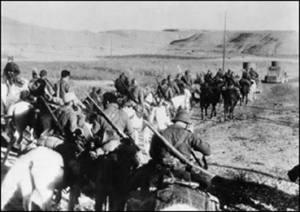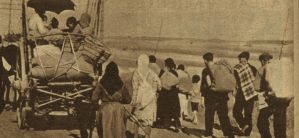
In the chaos of the shifting fronts, children were frequently being left abandoned on the streets or in empty houses after their parents were taken away to be shot. This devastating abandonment happened on both sides of the conflict, but it took on different structural realities depending on which faction controlled the area. When a saca or military purge occurred, execution squads typically arrived in the dead of night or early morning. They targeted adults while the children were often left behind in the confusion. In small towns like those in the La Sagra sector or the Guadarrama mountains, neighbours were frequently too terrified to take in the children of reds. Doing so could instantly brand that neighbour as a sympathiser of the executed parents, putting their own life at risk. As a result, traumatised children were left wandering the village squares or sitting on the doorsteps of looted homes. They became living ghosts, ignored by a population paralysed by fear.
In Republican-held territories and cities like Madrid or Barcelona, the state actively tried to manage the crisis of orphaned and displaced children, though the system was quickly overwhelmed. The Republican government, along with anarchist and socialist women’s organisations, set up improvised children’s homes in requisitioned mansions or convents to get orphans off the streets. As the food shortages worsened and bomb raids intensified, the Republic organised massive evacuations. Thousands of orphans and displaced children were sent to the safer coastal regions of Catalonia and Valencia, or shipped abroad to countries like France, the UK, and the Soviet Union (the famous Children of Russia).
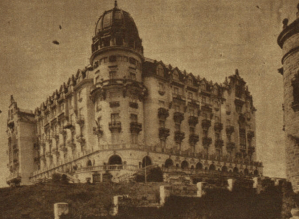
In areas captured by the Nationalists, the fate of left-wing orphans was dictated by an institutionalised policy driven by the regime’s psychiatric and political ideology. Antonio Vallejo-Nájera, the chief psychiatrist of Franco’s army, conducted pseudo-scientific studies claiming that Marxism was a mental bio-psychic illness transmitted genetically. To ‘save’ the children of executed or imprisoned Republicans, he argued they had to be permanently separated from their families. Orphans left on the street or in prisons were swept up by the state and placed into strict institutions run by the Catholic Church or the Auxilio Social (the Falangist social aid organisation). Their legal names were frequently changed, their pasts were systematically erased, and they were raised to fiercely support the fascist state. Many were illegally adopted out to wealthy, conservative, regime-supporting families who were told the child was a foundling from the streets.
In the deeply impoverished, rural parts of Andalucía, a region defined by massive latifundios and crippling peasant poverty, there were no formal state infrastructures, orphanages, or institutional resources to catch these children. When the terror swept through Andalusian villages during the summer and autumn of 1936, the fate of orphans was dictated by basic human desperation, the rigid class dynamics of the countryside, and a crushing culture of fear.
In Andalusian peasant culture, extended family networks were traditionally tight. However, the sheer extremity of the Nationalist ‘clean-up’ (such as the brutal campaigns led by General Queipo de Llano) weaponised fear to break these bonds. If a child’s parents were shot as reds, taking that child in was a massive physical risk. A grandparent, aunt, or uncle who opened their door to an orphan could instantly be denounced by local fascists for harbouring subversives. Even when families wanted to help, Andalusian day-labourers lived on the absolute brink of starvation. Adding another mouth to a household that subsisted on scraps of bread meant literally taking food out of the mouths of surviving biological children. Many orphans were passed around secretly from house to house at night, hidden in barns or back rooms, never staying in one place long enough to draw the attention of the local Falange or Guardia Civil.
In a region completely lacking institutional systems, the wealthy landowners (señoritos or caciques) created their own informal, exploitative solution for these children. Wealthy, right-wing families frequently took left-wing orphans off the streets to use them as unpaid, disposable labour. Boys as young as six or seven were sent into the olive groves or fields to do agricultural labor for no wages, sleeping in stables. Girls were taken into the big estate houses as chachas (domestic servants), working endless hours in exchange for floor space to sleep and kitchen scraps, prime targets for sexual exploitation. These children were stripped of their dignity. They were constantly reminded that their parents were traitors and that they owed their lives to the generosity of the people exploiting them. It was a feudal system of survival wrapped in ideological humiliation.
In many Andalusian villages and towns, children who had no remaining family and were not taken in by landowners had no choice but to form roaming bands of street survivors, known colloquially as golfos or pícaros. These children survived entirely by their wits in the Andalusian countryside. They slept in caves, abandoned railway brick-kilns, or underneath olive trees. They formed a desperate underclass, stealing fruit from orchards, begging outside churches, and scavenging through the waste of military barracks. Local right-wing authorities and religious figures often viewed these roaming orphans not as victims of war, but as moral degenerates and criminals. They were routinely beaten, chased out of villages by the Guardia Civil, or locked up in local lockups alongside adult criminals until the formal Auxilio Social system slowly expanded into the south years later.
- Barcelona, Catalonia
On 24 and 25 October 1936, a critical turning point occurred in the Spanish Civil War, exposing the complex intersection of local social revolution, fragile political coalitions, and the aggressive internationalisation of the conflict. Over these forty-eight hours, Catalonia sought to legalise a radical worker-led economy and unify its fractious anti-fascist factions. Concurrently, the broader geopolitical landscape shifted permanently as the European fascist powers formalised their alliance and the Spanish Republic began shipping its financial lifeline to the Soviet Union.
Following the military uprising of July 1936, workers in Catalonia spontaneously seized control of factories, transport networks, and commercial enterprises abandoned by owners who had fled or supported the fascist rebellion. For months, this hyper-radical, bottom-up economy functioned de facto. On 24 October 1936, the Generalitat issued the historic Decree of Collectivisation and Workers’ Control. This decree sought to bring institutional order and state supervision to the spontaneous revolution. It institutionalised a mixed economy. All enterprises employing more than 100 workers (or those owned by fascists) were legally collectivised and managed by elected Enterprise Committees. Companies with 50 to 99 employees could collectivise if two-thirds of the workforce voted in favour. Smaller businesses remained private but under strict worker control committees.
While the decree legalised worker-led initiatives, it also introduced state oversight and structural planning through an Economic Council. Anarchists viewed this as a victory for syndicalism, but it laid the groundwork for the government to slowly reassert centralised control over industry later in the war.
Recognising that internal divisions were crippling both the economy and the front lines, Catalonia’s primary revolutionary and political bodies publicly established a new framework for unity on 25 October. This fragile pact brought together bitter ideological rivals: the anarchist CNT (National Confederation of Labour) and FAI (Iberian Anarchist Federation) alongside the socialist UGT (General Union of Workers) and the Moscow-aligned PSUC (Unified Socialist Party of Catalonia). The agreement attempted to strike a balance between making a revolution and winning a war. It established unified guidelines for economic planning, codified the collaborative roles of the trade unions, and tried to streamline relations between independent revolutionary committees and the formal Generalitat government. However, fundamental tensions regarding whether to prioritise the immediate socialist revolution or the military defeat of Franco would ultimately fracture this unity by May 1937.
The 25 October unity agreement in Catalonia was highly serious in intent, but ultimately failed as a lasting political alliance. While it represented the high-water mark of wartime cooperation between Catalonia’s revolutionary trade unions and political parties, the deep ideological fractures between its signatories proved impossible to bridge. The agreement was driven by absolute desperation, yet it carried the seeds of its own destruction.
The pact forced real, immediate compromises from both sides of the anti-fascist spectrum. The Anarchists (CNT-FAI) accepted state authority and for a movement rooted in the total destruction of the state, the anarchists made a massive concession. They agreed to formalise relations with the Generalitat government and accepted structured municipal councils, effectively integrating themselves into the state machinery to win the war. • The Marxists (PSUC) and Socialists (UGT) accepted the revolution and in return, the state and the Moscow-backed communists officially recognised the extensive collectivisation of industry that had already taken place, promising not to roll back the worker takeovers. Both sides agreed to phase out independent, politically aligned party militias in favour of a single, unified, and disciplined army under central command.
Despite the public display of unity, the agreement lasted less than seven months because it attempted to paper over a fundamental, irreconcilable question – should the revolution happen now, or after the war is won? The PSUC/UGT ‘war first’ position, backed by Soviet advisors, the communists and socialists, argued that winning the military war against Franco was the absolute priority. They believed radical collectivisation was ruining the economy, terrifying foreign democracies, and alienating the middle class. They wanted to dismantle the revolutionary committees and nationalise everything under strict state control. • The CNT-FAI ‘revolution first’ position argued that the war and the revolution were inseparable. They believed working-class soldiers would only fight and die on the front lines if they knew they were actively defending a newly liberated, worker-controlled society, rather than just returning to a capitalist republic. The daily implementation of the 25 October agreement quickly degenerated into street-level power struggles over the control of food distribution, weapons, and enterprise committees.
Elsewhere, Aragon had already became the most radical, purist example of rural anarcho-communism during the war. When Catalan anarchist militias marched into eastern Aragon in July 1936, they immediately began helping local peasants seize land. Collectivisation in Aragon was predominantly agrarian, aiming to abolish the wages system and eliminate private commerce. Villages merged their lands into sweeping communal holdings. The guiding principle was from each according to their ability, to each according to their need. Many collectives completely abolished paper currency, replacing it with local voucher systems.
It was never formally recognised or legalised by the central Spanish Republic. Instead, the anarchists established their own regional government, the Regional Defence Council of Aragon. This body officially formed in October 1936 and held its historic assembly at Caspe. Because the central Republic was weak, it reluctantly gave the Council a veneer of legality in December 1936, but never fully legitimised its sweeping anti-property rules. The entire Aragon model was violently liquidated by the regular Republican Army (led by Communist commander Enrique Líster) in August 1937.
In Valencia, collectivisation was far less sweeping in the countryside but highly prominent in the coastal region’s manufacturing towns. Unlike Aragon’s radical abolition of money, Valencia opted for industrial self-management and state-regulated distribution. Only about 13% of its rural lands were collectivised, but its vital export economy, specifically the citrus sector, required rapid organisation. The trade unions created the CLUEA (Unified Levantine Council for Agricultural Export) to directly manage, market, and package the regional orange crop for international export to generate foreign currency for the war effort.
Local authority rested with the Popular Executive Committee of Valencia, established on 22 July 1936. This committee passed local guidelines regulating workplace takeovers, but it never issued a singular, uniform piece of legislation like Catalonia’s October Decree. The central Republican government relocated its capital to Valencia in November 1936 and dissolved the independent Popular Executive Committee in January 1937, subsequently absorbing the factories and agricultural systems directly into state-directed nationalisation by late 1937.
- Cartagena, Murcia
While Catalonia attempted to formalise its revolution, the international landscape transformed in a way that sealed the Republic’s fate. On 25 October, Nazi Germany and Fascist Italy concluded a secret diplomatic accord that formalised the Rome–Berlin Axis.
The ongoing Spanish Civil War was a primary catalyst for this historic alliance. Both Adolf Hitler and Benito Mussolini were already actively sending troops, aircraft, and armour to aid General Francisco Franco’s Nationalist rebels. Their shared intervention in Spain allowed the two dictatorial regimes to test military hardware, contest Soviet influence, and realise they shared a common expansionist destiny in Europe.
Faced with a tightening fascist noose around Madrid and a strict non-intervention policy from Western democracies like France and Britain, the Republican government turned to the Soviet Union for survival. On 25 October, four Soviet cargo ships slipped out of the naval port of Cartagena, carrying roughly 510 tonnes of gold, the bulk of the Bank of Spain’s historic gold reserve. Bound for the Soviet port of Odessa, this shipment was the beginning of the controversial Moscow Gold. The physical relocation of the reserves effectively handed the Republic’s financial sovereignty to Joseph Stalin. It ensured a steady pipeline of Soviet military hardware and advisors, but it also drained the nation’s wealth and deepened the Communist party’s leverage over the fractured Republican government.
- Esquivias, Borox, and Seseña, Toledo
The transition between 23 and 26 October 1936 was the exact architectural pivot point when the Nationalist assault on Madrid transformed into a focused, lethal southern spearhead. Over these four days, General Emilio Mola fundamentally rewrote the strategic blueprint of the war, abandoning a complex three-sided encirclement in favour of an aggressive southern drive led by General José Enrique Varela. Simultaneously, far behind the front lines, the systemic apparatus of Nationalist political executions continued, highlighting the brutal cross-provincial nature of the rearguard terror.
Prior to 23 October, the Nationalist advance toward Madrid from the south was a sweeping, broad-front manoeuvre. However, as the columns drew closer to the capital’s outer suburbs, General Varela recognised the need to consolidate a tight, impenetrable jumping-off line to protect his flanks before the final urban assault. Varela ordered General José Monasterio’s cavalry and motorised columns to establish the Illescas–Esquivias–Seseña–Vértice de la Reina line. The goal was to sever the critical communication and rail lines linking Madrid to Aranjuez and Toledo, and create a solid defensive wall to block any Republican counter-attacks originating from the east.
Moving with rapid coordination, Monasterio’s forces pushed east across the fertile plains of La Sagra. On 25 October, Nationalist troops successfully stormed and captured Esquivias and Borox, while simultaneously thrusting into the vital railway hub of Seseña. This advance was spearheaded by the Moroccan Regulares acting as shock troops alongside the Foreign Legionnaires, numbering roughly 10,000 elite combatants in the immediate sector, heavily supported by Italian-supplied tankettes and German artillery. They easily brushed aside the poorly organised, under-equipped Republican worker militias defending the towns.
The entry into Esquivias, Borox, and Seseña on 25 October 1936 was a highly asymmetrical encounter. The initial Nationalist takeover was swift, but it immediately set the stage for one of the most famous, violent, and technologically significant encounters of the entire war just days later. There were not many organised Republican troops stationed inside these towns on the exact day they fell. The defending forces consisted of sparse, detached sections of poorly trained worker militias, small local defence committees, and a handful of loyalist naval infantry. They completely lacked heavy anti-tank weaponry or structured artillery support. Because the Republican infantry was thin on the ground and deeply disorganised, the Nationalists took Esquivias, Borox, and Seseña with comparatively low casualties. Colonel Monasterio’s Moroccan Regulares)and cavalry rapidly swept the flat plains of La Sagra, brushing aside the initial rearguard skirmishes and forcing the scattered militias to flee back toward Madrid or Aranjuez.
While 25 October was easy for the Nationalists, the Republican command realised that letting Monasterio hold these towns would permanently sever the southern rail supply lines to Madrid. The Republic rapidly massed a major counter-offensive force right behind the sector. By 29 October, the Republic threw a massive force of 3,800 infantrymen (including the famous brigade led by Enrique Líster) directly at Seseña. Crucially, this infantry was supported by a brand-new secret weapon that had just arrived from the USSR, a company of 15 heavily armed Soviet T-26 tanks crewed by Russian and Spanish tankers under the command of Soviet specialist Pols Armāns.
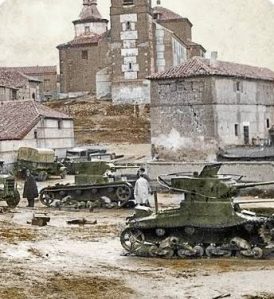
When the Soviet T-26 tanks rolled into Seseña and Esquivias, the Nationalist defenders, who only possessed light Italian L3/33 tankettes, panicked. A single Soviet tank reportedly crushed or destroyed 11 Italian tankettes. However, the Nationalist Moroccan and Falangist infantry quickly adapted. In the narrow, twisting streets of Esquivias and Seseña, they climbed onto roofs and utilised the first recorded massive use of Molotov cocktails (improvised gasoline firebombs) to torch the air intakes of the Soviet tanks from above.
The fighting ultimately failed to recapture the sector for the Republic due to a catastrophic lack of coordination. The Soviet tanks charged far ahead into the streets of Seseña, but the unseasoned Republican infantrymen, pinned down by Nationalist machine-gun fire on the outskirts, became exhausted and sat down, failing to follow the armour. The tanks were temporarily encircled, forced into desperate street-level rammings, and eventually had to retreat back through Borox.
The repression in the La Sagra region (the corridor containing Esquivias, Borox, and Seseña) during the autumn of 1936 was exceptionally severe, fluid, and violent. Because the frontline shifted dramatically across these towns in October 1936, the local population was subjected to a traumatic double-wave of political cleansing, first under the Republican militias, followed immediately by an institutionalised, systematic purge by the advancing Nationalists.
Armed Republican militia groups had targeted the large landowners (terratenientes), Catholic priests, Falangist sympathisers, and members of right-wing parties. Across Toledo, hundreds of people were subjected to sacas or paseos. In nearby Seseña, churches were vandalised, religious icons were publicly burned, and local right-wing figures were executed by radical committees before the front line arrived. When General Varela’s columns captured Esquivias, Borox, and Seseña on 25 October, the nature of the violence transformed from chaotic, revolutionary score-settling into an institutionalised, military-driven policy of extermination. Since the Nationalist advance on Madrid relied heavily on Moroccan Regulares and the Spanish Foreign Legion commanded by officers like Varela and Yagüe, these forces used terror as a deliberate psychological tool to break Republican morale and secure the rearguard. Upon entering Esquivias and Seseña, Nationalist troops carried out immediate executions of anyone suspected of leftist or union affiliations, including poor agrarian day-labourers who had participated in wartime collectivisation. Republican women in these villages were targeted for gender-based humiliation; many were raped, subjected to forced ingestions of castor oil, or paraded through the streets with their heads shaved.
The sheer reputation of Nationalist violence in Toledo caused absolute panic among the local citizenry. As Monasterio’s cavalry advanced toward the Illescas–Seseña line, a massive exodus of civilian refugees clogged the roads leading north toward Madrid. Fearing summary execution or forced conscription, thousands of local peasants, families, and union workers abandoned their homes and harvests. This massive influx of displaced, traumatised civilians into Madrid heavily strained the capital’s food and medical infrastructure just as the brutal siege was about to begin.
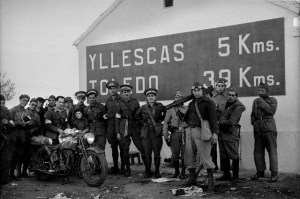
and ambulance drivers, via unknown
- Las Navas del Marqués, Ávila
The collapse of the Republican defensive pocket in the Las Navas del Marqués sector on 25 October 1936 was a minor tactical engagement that carried major consequences. It marked the final, unceremonious breakdown of a strategic mountainous buffer zone. By clearing these residual positions, the Nationalist forces permanently secured their own rear supply lines and cleared one of the final natural obstacles blocking their relentless advance toward the ultimate prize of Madrid.
Located on the rugged borderlands between the provinces of Ávila and Madrid, Las Navas del Marqués sits along a vital geographic ridgeline that links up with the strategic Alto del León pass. For weeks, Republican volunteer militias operating out of the nearby Peguerinos area used these mountain pockets to harass Nationalist transport. Had the Republic successfully broken through this sector, they could have severed the primary supply arteries feeding the entire Nationalist front line facing Madrid.
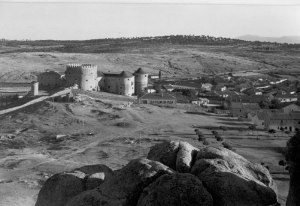
By launching a methodical eastern offensive through mid-October, the Nationalists sought to systematically clean up these mountains. Capturing the final heights on 25 October meant their logistics were completely secure, leaving them free to point their full weight directly at the capital. The actual urban centre of Las Navas del Marqués fell on 22 October after a brief but exceptionally bloody house-to-house battle. The subsequent actions leading up to 25 October were mop-up operations targeting the residua” positions, the trenches, crags, and hillsides surrounding the town where holdout Republican forces tried to maintain a foothold. The final hours of the town’s collapse resulted in at least 51 documented Republican deaths. When Nationalist artillery and professional units swept the remaining mountain pockets on 25 October, those under-equipped milicianos who chose to stay and fight were heavily shelled and and killed rather than simply bypassed.
The historical record notes that the Nationalists swept through the remaining positions with comparatively little difficulty. This stark phrase highlights the tragic, widening gap in military capability that characterised the autumn of 1936. The Republican defenders in these remote sectors were largely disjointed, poorly equipped worker militias. They lacked a unified command structure, heavy artillery, and adequate ammunition. In contrast, the attacking Nationalist columns were highly coordinated, utilising concentrated mortar fire, professional tactical manoeuvring, and air or artillery superiority. The ease with which the remaining pockets fell underscored the grim reality that enthusiasm alone could not hold ground against a professionalised, structured war machine.
Once the Republican pocket was eradicated on 25 October, the sector underwent an immediate transformation. Recognising that a desperate Republican counter-attack was always a possibility, the Nationalist 71st Division rapidly shifted from an offensive footing to a defensive one. They heavily fortified the high ground south of Las Navas del Marqués. Drawing directly on the defensive models and concrete blockhouse layouts (blocaos) that Spanish officers had perfected during the Rif War in North Africa, they constructed a sprawling, highly sophisticated network of concrete trenches, pillboxes, and machine-gun nests. This defensive line successfully locked down the sector, freezing the front lines in this specific mountainous zone for the remainder of the three-year war while the main theatre of slaughter shifted to the gates of Madrid.
The defeated forces in this sector belonged primarily to the remnants of the Columna Mangada (a famous, early-war Republican militia column led by Julio Mangada). When their lines collapsed at Las Navas del Marqués, the surviving milicianos retreated higher into the freezing, rugged Sierra de Guadarrama mountains, moving eastward toward the Madrid provincial border. They fell back in two primary directions, first to Santa María de la Alameda, a nearby mountain municipality with a vital railway station. Surviving forces scrambled here to establish a secondary defensive fall-back line and protect the rail links into Madrid. Then also Peguerinos, where the vast majority of the retreating fighters consolidated in the nearby mountain village. This area became a chaotic, heavily congested sanctuary for the fleeing troops. The Nationalists pursued them relentlessly; Moroccan Regulares and Falangist militias stormed Peguerinos, capturing it after a ferocious counter-offensive just a few days later, on 29 October 1936.
Following the July coup, Las Navas del Marqués had been quickly occupied by the famous Columna Mangada, a massive Republican militia force led by the eccentric Lieutenant Colonel Julio Mangada. Mangada established his military headquarters directly inside the town’s Ermita del Santísimo Cristo de Gracia. Local records and historical accounts indicate that at least 25 local residents (known as naveros) were executed during the Republican occupation. The victims included conservative civilians, local right-wing figures, and Guardia Civil officers who had been caught or ambushed in the nearby area. These individuals were subjected to summary trials by wartime revolutionary committees. They were taken to the outskirts of the town and shot, primarily against the walls of the local cemetery or down by the Saluda bridge over the Cofio River. Religious structures were also targeted; the local convent of Santo Domingo and San Pablo was ransacked, and its religious art and historical objects were confiscated or destroyed by the militia forces.
When the Nationalist forces under General Pedro de la Cerda finally stormed and permanently captured Las Navas del Marqués on 22 October, a symmetric but more institutionalised wave of counter-repression immediately followed. In keeping with General Mola’s explicit directives to use extreme violence to pacify newly captured territories, the incoming Nationalist troops, including Falangist militias, immediately initiated a purge.
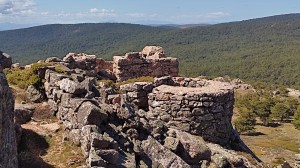
Any local townspeople, railway workers, or day-labourers who had chosen not to retreat to Peguerinos, or who were suspected of cooperating with the Columna Mangada or holding leftist union cards (UGT/CNT), were rounded up. Rather than being taken as prisoners of war, many were summarily executed to permanently guarantee that no pro-Republican sabotage would threaten the Nationalist supply lines leading to the Madrid front. Following the civil war, the town’s repressive framework was institutionalised. The local Castillo-Palacio de Magalia was eventually turned over to the Sección Femenina (the women’s branch of the fascist Falange party) to indoctrinate and control the social structure of the local population of 3,500 for decades.
- Madrid
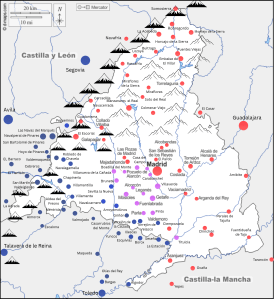
Running through Lozoya, Buitrago, and down to Torrelaguna is the spine of the Canal de Isabel II infrastructure. This network of dams, reservoirs (such as Puentes Viejas and El Villar), and open aqueducts was the sole life support system for Madrid’s citizens and its newly arrived military forces. Madrid sits on a dry plateau and does not have a massive natural river running through its centre (the Manzanares is historically shallow and narrow). Whoever controlled the northern mountain valleys controlled the survival of the city. Franco’s high command recognised this immediately; if the Nationalist columns could breach the Somosierra pass and push south through Torrelaguna, they wouldn’t need to fight a bloody house-to-house battle in Madrid’s streets. They could simply close the valves, drain the aqueducts, and starve the capital into submission via dehydration within days.
Throughout October 1936, while the southern front was collapsing into chaos, a specialised and fiercely determined collection of Republican forces, including local construction workers, engineers from the water company, and communist-led militias, built an impenetrable defensive shield around the water hubs. Republican engineers turned the infrastructure itself into a weapon. They prepared plans to blow up key dams if the Nationalists breached the mountains, which would have flooded the valleys and drowned any advancing columns. Torrelaguna acted as the ultimate defensive plug. Because the Republican forces stubbornly held the town and the rocky ridges surrounding it, the Nationalist columns under General Mola were completely blocked from reaching the primary water filtration and distribution stations.
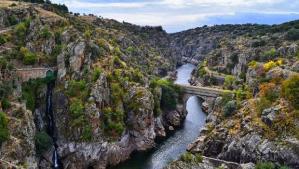
In La Sagra (Seseña, Illescas, Valdemoro), the terrain was flat, open cornfields. It allowed for high-speed motorised movements, tank battles, and rapid territorial changes. In the north (El Escorial to Torrelaguna), the terrain was brutal, rocky granite. The Republic fought with absolute desperation here because they knew that losing a single town like Torrelaguna meant the immediate end of the war. Mola’s realisation that he could not crack this water shield without taking catastrophic losses is the exact reason he ordered his northern army to halt and drop into a defensive posture on 25 October 1936.
While Varela’s forces were successfully executing their eastward shift on 25 October, General Emilio Mola, the supreme director of the northern and central Nationalist armies, made a monumental command decision that completely changed the trajectory of the Madrid campaign. Originally, Mola had envisioned a simultaneous, three-sided encirclement of Madrid. The northern columns operating in the rugged Sierra de Guadarrama were supposed to breach the mountain passes and descend on the capital in lockstep with Varela’s southern forces. However, fierce Republican resistance, brutal mountain terrain, and events like the holdout pockets near Las Navas del Marqués convinced Mola that the northern advance was stalling and consuming too many resources.
Mola officially abandoned the idea of a synchronised northern and southern advance. He ordered the northern forces to immediately halt offensive operations, drop into a strict defensive posture, and simply engage in pinning actions (fixing Republican forces around El Escorial and the Guadarrama pass) to ensure the Republic could not redeploy those troops southward. Mola reinforced this strategic shift by issuing explicit orders that local engagements on the western flank, specifically around the Robledo–Chapinería axis, must not be allowed to delay or distract the primary columns advancing from the south.
By 26 October, the campaign for Madrid officially ceased to be an encirclement. It was now a massive, concentrated southern offensive powered by Varela’s elite colonial troops, while the western and northern fronts were reduced to secondary, supporting pressure points. While the military high commands remapped the front lines, the systemic elimination of political dissidents continued unabated in Nationalist-held territory, acting as a deliberate tool to secure the rearguard.